
AI-Powered Drug Formulation Market Size and Share
Market Overview
| Study Period | 2020 - 2031 |
|---|---|
| Market Size (2026) | USD 0.93 Billion |
| Market Size (2031) | USD 2.77 Billion |
| Growth Rate (2026 - 2031) | 24.37 % |
| Fastest Growing Market | Asia-Pacific |
| Largest Market | North America |
| Market Concentration | Medium |
Major Players *Disclaimer: Major Players sorted in no particular order Image © Mordor Intelligence. Reuse requires attribution under CC BY 4.0. | |
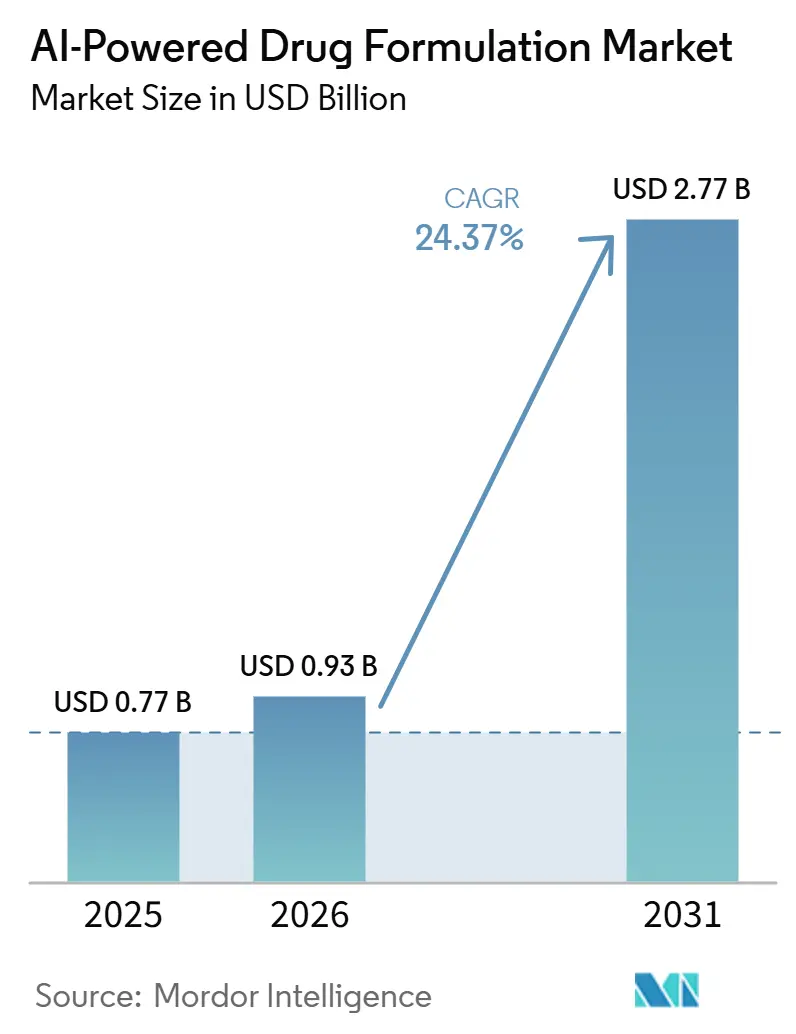
AI-Powered Drug Formulation Market Analysis by Mordor Intelligence
The AI-powered drug formulation market is projected to expand from USD 0.77 billion in 2025 and USD 0.93 billion in 2026 to USD 2.77 billion by 2031, registering a CAGR of 24.37% between 2026 and 2031. The AI-powered drug formulation market is moving away from trial-and-error formulation work because drug developers now need faster design cycles, lower material waste, and more predictable development outcomes. The AI-powered drug formulation market is also gaining momentum from the rise of biologics, nucleic acid therapies, and cell and gene therapies, since these modalities need tighter control over stability, viscosity, delivery, and excipient selection than older workflows can consistently provide. Demand is also being reinforced by precision medicine programs, where dose design and formulation design need to adjust faster to patient, indication, and molecule-specific requirements. Even with clear momentum, adoption still depends on how quickly regulated users can validate AI outputs, integrate them into legacy lab systems, and build enough structured formulation data to improve model transferability across programs.
Key Report Takeaways
- By component, software platforms held 51.4% share in 2025 and are also expected to be the fastest-growing segment with a 24.62% CAGR.
- By deployment mode, cloud-based solutions held 52.72% share in 2025 and are forecasted to expand at a 25.18% CAGR through 2031.
- By technology, machine learning and deep learning led with 40.26% share in 2025, while predictive modeling and simulation are projected to grow at a 25.74% CAGR through 2031.
- By application, formulation design and optimization accounted for 41.16% share in 2025, while excipient compatibility analysis is forecasted to grow at a 26.03% CAGR through 2031.
- By drug type, small molecules held 40.14% share in 2025, while biologics are projected to expand at a 27.26% CAGR through 2031.
- By end-user, pharmaceutical and biopharmaceutical companies accounted for 46.2% share in 2025, while contract research organizations are projected to grow at a 26.6% CAGR through 2031.
- By geography, North America held 44.24% share in 2025, while the Asia-Pacific is projected to grow at a 28.31% CAGR through 2031.
Note: Market size and forecast figures in this report are generated using Mordor Intelligence’s proprietary estimation framework, updated with the latest available data and insights as of January 2026.
Global AI-Powered Drug Formulation Market Trends and Insights
Drivers Impact Analysis*
| Driver | (~) % Impact on CAGR Forecast | Geographic Relevance | Impact Timeline |
|---|---|---|---|
| Rising Need to Reduce Trial-and-Error in Formulation Development | +5.2% | Global | Short term (≤ 2 years) |
| Growth in Biologics, Nucleic Acids, and Advanced Therapy Formulations | +4.8% | North America, Europe, Asia-Pacific | Medium term (2-4 years) |
| Increasing Demand for Personalized and Precision Medicine Dose Design | +4.5% | North America & EU | Medium term (2-4 years) |
| Expansion of Multi-Modal Pharma Data and Compute Infrastructure | +3.8% | APAC core, spill-over to MEA | Medium term (2-4 years) |
| Pharma-CDMO Workflow Digitization and Self-Service Formulation Platforms | +3.2% | North America & EU | Short term (≤ 2 years) |
| Rising Need for Faster Excipient Screening and Stability Prediction | +2.8% | Global | Short term (≤ 2 years) |
| Source: Mordor Intelligence | |||
Rising Need to Reduce Trial-and-Error in Formulation Development
Escalating development costs and shorter commercial timelines are pushing the AI-powered drug formulation market toward tools that can reduce repeated lab iterations. This pressure is strongest when late-stage formulation failures delay filing plans, waste scarce API, or force manufacturing changes after clinical progress has already been made. The FDA’s ongoing focus on quality issues, drug shortages, and manufacturing reliability supports earlier use of quality-by-design thinking, which strengthens the case for predictive formulation work at the front end of development.[1]U.S. Food and Drug Administration, “Considerations for the Use of Artificial Intelligence to Support Regulatory Decision-Making for Drug and Biological Products,” U.S. Food and Drug Administration, fda.gov A 2026 Nature Communications study reinforced that point by showing 60% lower development time and 65% lower API use in an AI-powered tableting workflow tested across 1,199 data points from 170 formulations.[2]Nature Communications, “Accelerated Drug Development Using a Digital Formulator and a Self-Driving Tableting Data Factory,” Nature Communications, nature.com For buyers in the AI-powered drug formulation market, the appeal is practical because lower material consumption and faster decision cycles directly affect development cost and speed. This is why adoption is shifting from pilot activity toward routine workflow inclusion in both sponsor and outsourced formulation settings.
Growth in Biologics, Nucleic Acids, and Advanced Therapy Formulations
The AI-powered drug formulation market is also being lifted by the fast expansion of complex drug classes that require tighter formulation control than small-molecule programs. Cell and gene therapy pipelines remained active at a large scale in late 2025, and each program depends on highly specific decisions around vector stability, delivery systems, and process conditions. A 2026 Nature Reviews Materials article described the shift from combinatorial lipid nanoparticle screening toward generative design, and the LiGen model reported average predicted performance gains of 30.7% against retrieval-based baselines.[3]“From Screening to Generative Design in Nucleic Acid Delivery,” Nature Reviews Materials, nature.comChime Biologics responded to this demand in November 2025 by launching an AI platform that spans cell line development, bioprocessing, and CMC support, which shows that end-to-end biologics workflow tools are becoming a commercial need rather than a narrow experiment. As these therapy classes grow, the AI-powered drug formulation market is being pulled toward platforms that can handle higher variability, higher value batches, and more demanding stability targets.
Increasing Demand for Personalized and Precision Medicine Dose Design
Precision medicine is making dose design and formulation design more variable, which is strengthening demand across the AI-powered drug formulation market. Patient-specific dosing, adaptive release behavior, and combination therapy use cases do not fit well with slow empirical workflows built for standardized high-volume formats. AI models can draw on genomic data, biomarker patterns, and prior formulation performance to narrow promising design paths faster than conventional screening methods. A 2025 study archived by PMC found that AI tools used within quality-by-design frameworks improved both speed and precision in dosage design, which aligns with regulatory expectations for structured pharmaceutical development. In areas such as oncology and rare diseases, the AI-powered drug formulation market benefits because off-the-shelf dosing platforms often do not match the complexity of the treatment profile.
Pharma-CDMO Workflow Digitization and Self-Service Formulation Platforms
The AI-powered drug formulation market is also advancing because CDMOs and related service providers are digitizing how they develop and transfer formulation programs. These organizations sit between innovator demand and manufacturing execution, so speed, reproducibility, and client visibility matter as much as scientific capability. AI tools help them move from labor-heavy formulation work toward more repeatable and data-supported development services, which changes how they compete for new programs. The market effect is important because outsourced partners can spread software use across multiple clients and molecule classes, which raises utilization and shortens time to value. In practice, this means the AI-powered drug formulation market is not only driven by large pharma buyers, but also by service partners that want to strengthen their delivery timelines and technical positioning. This shift supports self-service and collaborative platform models where sponsors, CROs, and CDMOs can work from the same evidence base across development stages.
Restraints Impact Analysis*
| Restraint | (~) % Impact on CAGR Forecast | Geographic Relevance | Impact Timeline |
|---|---|---|---|
| Sparse, Proprietary, and Non-Standardized Formulation Data | -2.8% | Global | Long term (≥ 4 years) |
| Limited Validation and Explainability for Regulated Use Cases | -2.5% | North America & EU | Medium term (2-4 years) |
| Integration Friction with Legacy Lab, ELN, and QbD Workflows | -1.8% | Global | Short term (≤ 2 years) |
| High Switching Costs for Enterprise and CDMO Deployment | -1.4% | Global | Long term (≥ 4 years) |
| Source: Mordor Intelligence | |||
Sparse, Proprietary, and Non-Standardized Formulation Data
A major limit on the AI-powered drug formulation market is the small and fragmented nature of real formulation datasets. Unlike genomics or imaging, formulation records often include only tens or hundreds of experiments, and many negative results remain unpublished or locked within single organizations. A 2026 International Journal of Pharmaceutics study reached a similar conclusion and introduced a structured machine-readable oral formulation database to help address that gap. The practical result is that many models in the AI-powered drug formulation market still work best within narrow drug classes, process windows, or formulation types. Until broader data standards and shared datasets improve, model generalizability will remain one of the clearest limits on adoption at scale.
Limited Validation and Explainability for Regulated Use Cases
The AI-powered drug formulation market also faces a validation problem because regulated use cases need stronger evidence than exploratory research tools. FDA draft guidance issued in January 2025 laid out a seven-step, risk-based credibility framework tied to the context of use, which means higher-impact applications need more rigorous supporting evidence. That burden grows when AI outputs influence control strategies, dose specifications, or other decisions that affect quality and patient risk. This creates a gap between what the technology can generate and what regulated organizations feel comfortable using in formal submissions or locked production workflows. As a result, the AI-powered drug formulation market can advance quickly in screening and design support, while adoption remains slower in uses that sit closer to formal CMC evidence.
*Our forecasts treat driver/restraint impacts as directional, not additive. The impact forecasts reflect baseline growth, mix effects, and variable interactions.
Segment Analysis
By Component: Software Platforms Anchor the Formulation AI Stack
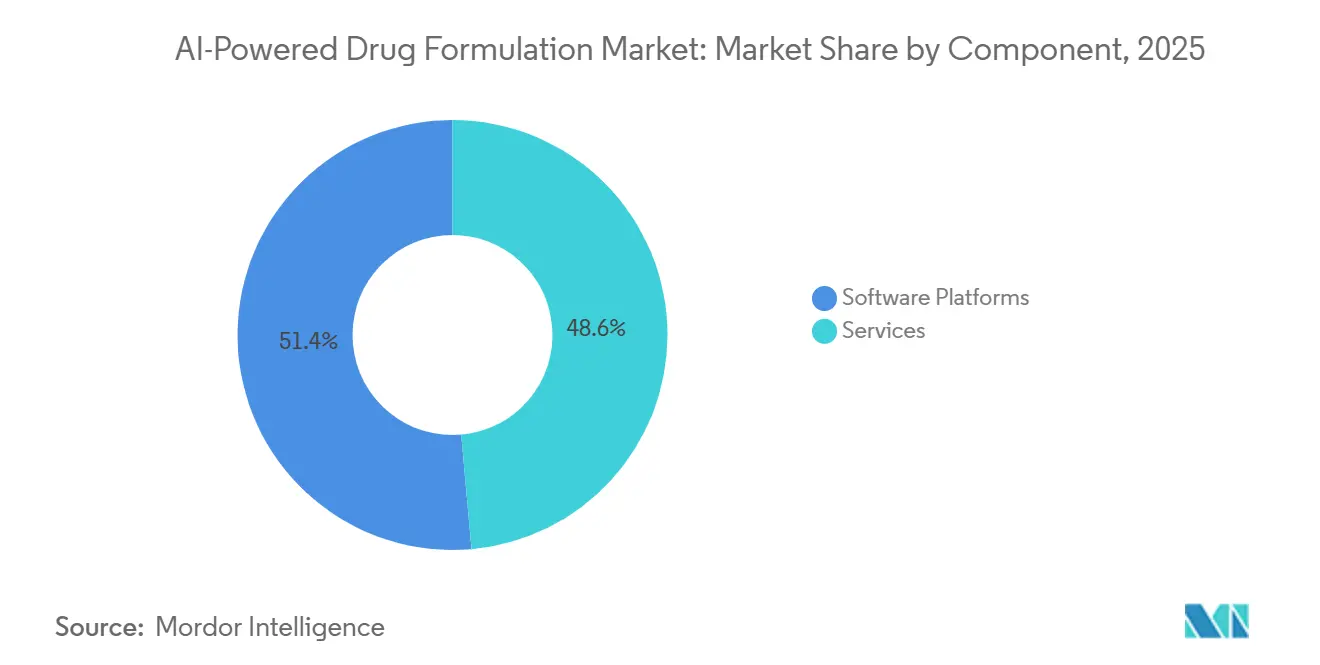
Software platforms held 51.38% of the AI-powered drug formulation market share in 2025 and are also expected to be the fastest-growing segment with 24.61% CAGR through 2031, which shows that buyers currently place more value on repeatable computational capability than on project-based support. In the AI-powered drug formulation market, this favors vendors that can combine model execution, data handling, workflow traceability, and user collaboration in one environment. It also points to a purchasing preference for tools that fit into wider R&D and CMC operating models rather than narrowly scoped technical tasks.
As sponsors and outsourced partners gain comfort with software-led workflows, service revenue is likely to follow through model setup, integration, validation, and program-specific support. This keeps the AI-powered drug formulation industry tied closely to software licensing economics even when hands-on scientific services continue to grow. It also means vendors with strong platform footprints can extend into adjacent support work without changing the core structure of the segment.


By Deployment Mode: Cloud Infrastructure Enables Multi-Site Formulation Workflows
Cloud-based deployment accounted for 52.72% of the AI-powered drug formulation market size in 2025 and is also anticipated to be the fastest-growing deployment segment with a 25.18% CAGR through 2031. For many users, cloud deployment reduces the need for frequent hardware upgrades and allows capacity to scale with program demands. In the AI-powered drug formulation market, this matters because program intensity can change quickly across discovery, preclinical work, and CMC preparation.
Mid-sized pharma and biotech firms benefit because they can access advanced tools without maintaining the same level of internal infrastructure as larger enterprises. On-premises deployments still have a role where IP sensitivity, data sovereignty, or internal control policies remain high. Even so, the direction of the AI-powered drug formulation market still favors cloud architecture because collaborative formulation work increasingly crosses sites, organizations, and development functions.
By Technology: Machine Learning Leads; Predictive Modeling Accelerates Fastest
Machine learning and deep learning commanded 40.26% of the technology segment in 2025, which reflects their current maturity in screening, compatibility prediction, dissolution work, and stability forecasting. A 2026 AAPS Open study reported that the FormulationDE system used a LightGBM classifier on 1,105 drug-excipient pairs and achieved an AUC of 0.82 on prospective 2023 to 2024 test data. It also explains why buyers still view machine learning as the most practical entry point for immediate use.
Predictive modeling and simulation are expected to be the fastest-growing technology area, with a 25.74% CAGR through 2031, because users want better links between in vitro behavior, process conditions, and expected in vivo outcomes. The segment is especially relevant when teams need faster scenario testing without running every option through physical experiments first. Across the AI-powered drug formulation market, that approach lets vendors expand automation and evidence generation while keeping continuity with tools that regulated users already recognize.
By Application: Formulation Design Dominates; Excipient Compatibility Drives Next Wave
Formulation design and optimization held 41.16% of application revenue in 2025, which makes it the most mature and established use case within the AI-powered drug formulation market. That position reflects direct buyer demand for tools that can shorten the path from molecule characteristics to workable formulation options. The segment’s strength also shows that companies are most willing to adopt AI where it improves early decision quality and reduces repeated bench work.
Excipient compatibility analysis is anticipated to be the fastest-growing application at a 26.03% CAGR through 2031, which points to rising demand for faster early-stage risk screening. Stability and shelf-life prediction, high-throughput screening, and personalized formulation work remain important adjacent uses, and advanced therapy formulation is becoming the highest-growth, higher-value part of the application mix. This gives the AI-powered drug formulation market a layered application structure where the core use case is established, but the next growth wave is forming around faster compatibility and complex modality support.
By Drug Type: Small Molecules Hold Share; Biologics Set the Growth Agenda
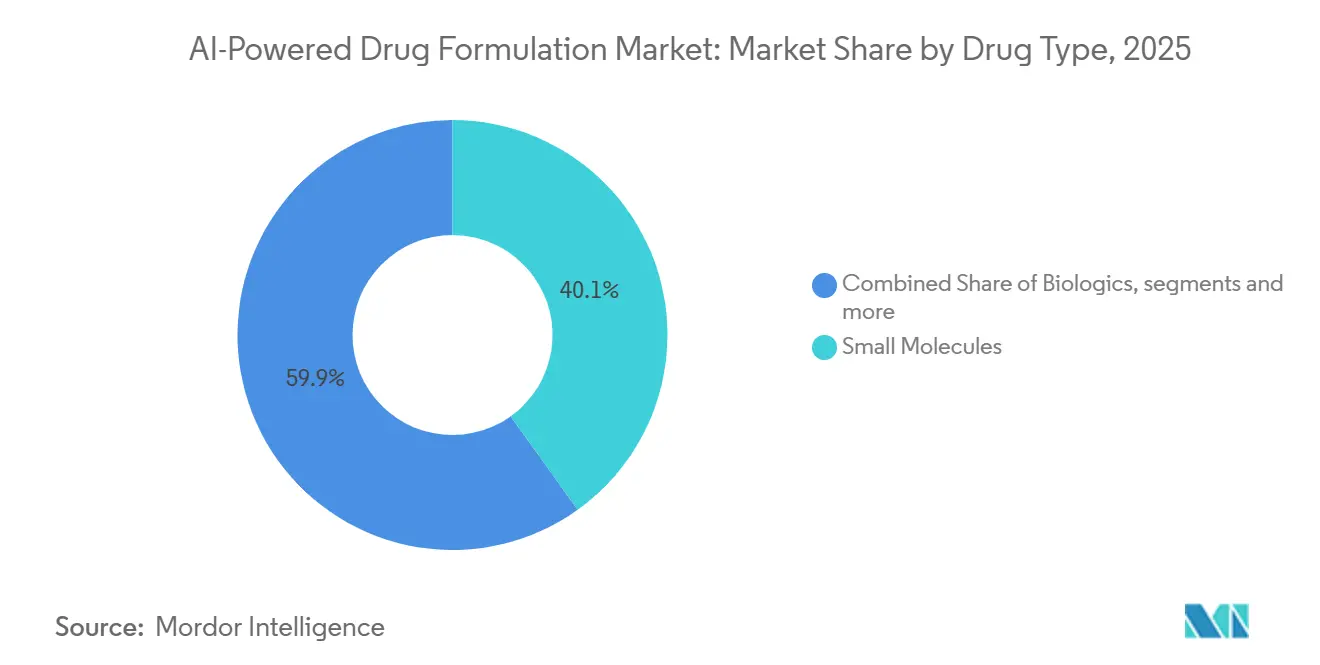
Small molecules accounted for 40.14% of the AI-powered drug formulation market in 2025, reflecting the continued volume of oral solid dosage programs and the maturity of tools built around API-excipient behavior in these systems. A 2026 Pharmaceutics article showed that machine learning could predict tablet pre-formulation properties from raw material information, composition, and process conditions without post-compression measurements. That makes small molecules the current foundation of commercial deployment because they offer enough scale and data structure for repeated model use.
Biologics are projected to be the fastest-growing drug type with a 27.26% CAGR through 2031, and this is where much of the future expansion in the AI-powered drug formulation market is likely to concentrate. Monoclonal antibodies, bispecifics, and therapeutic proteins bring formulation demands around viscosity, aggregation, solubility, and high-concentration stability that are harder to solve with manual iteration alone. Within the AI-powered drug formulation industry, growth is therefore shifting toward segments where each failed experiment costs more time, more material, and more development risk.

By End-User: Pharma Companies Lead; CROs Signal the Structural Shift
Pharmaceutical and biopharmaceutical companies held 46.24% of end-user revenue in 2025, which shows that large sponsor organizations still anchor demand in the AI-powered drug formulation market. These companies have the budget, data, and program scale needed to invest early in software-led formulation workflows. Their position also reflects the direct financial impact of formulation cycle time on filing plans, clinical supply readiness, and portfolio productivity.
Contract research organizations are expected to be the fastest-growing end-user group at 26.57% CAGR through 2031, which signals a broader shift in where formulation innovation work is being executed. Sponsors are increasingly willing to use external specialists for AI-assisted formulation studies when those providers can move quickly and operate within established quality frameworks. This is expanding the role of outsourced partners from execution support toward knowledge-intensive development work inside the AI-powered drug formulation market.
Geography Analysis
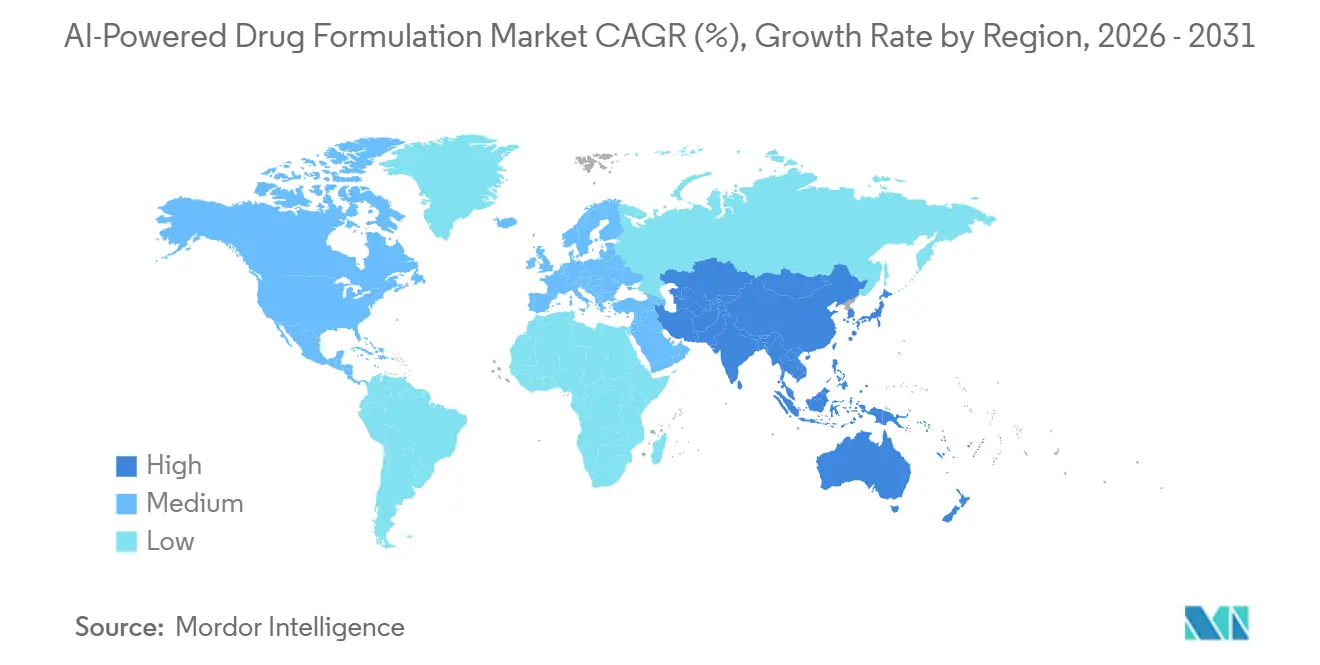
North America held 44.19% of the AI-powered drug formulation market share in 2025, which made it the leading regional contributor. The region benefits from a dense concentration of large pharmaceutical companies, a mature startup and venture environment, and a strong base of software and biosimulation vendors. The United States remains the center of regional activity because it combines sponsor demand, platform development, and regulatory engagement in the same market. This keeps North America at the front of the AI-powered drug formulation market, where regulated deployment pathways are being tested in parallel with new technical capabilities.
Europe held a significant share in 2025, supported by Germany, Switzerland, the United Kingdom, and France. The region combines a strong pharma manufacturing base with demanding regulatory and quality expectations, which makes it an important proving ground for validated AI workflows. European buyers appear focused on platforms that can support explainability, documentation, and lifecycle control rather than pure experimental speed alone. This gives the AI-powered drug formulation market in Europe a more measured but structurally important role.
Asia-Pacific is projected to be the fastest-growing region with a 28.31% CAGR through 2031, driven by China, India, South Korea, and Japan. The region is adding momentum through pharmaceutical digitalization, expanding outsourcing capacity, and stronger use of AI tools in development and manufacturing settings. South Korea stands out for active partnership flow, while India’s large CRO base supports adoption where service differentiation depends increasingly on speed and analytical capability. China adds scale because digital infrastructure and pharmaceutical modernization are being pushed together in the same operating environment. As a result, the AI-powered drug formulation market is likely to see much of its incremental regional expansion come from Asia-Pacific over the forecast period.

Competitive Landscape
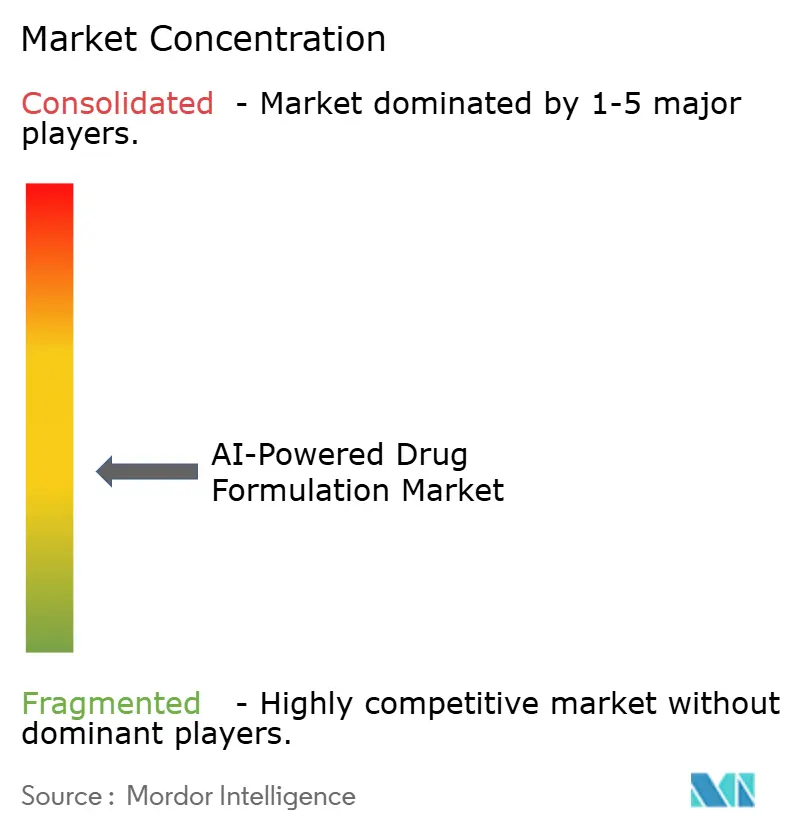
The AI-powered drug formulation market is moderately fragmented, and no single company controls the full value chain across design, simulation, data infrastructure, and workflow execution. Competitive positions depend on how well vendors can combine usable models, structured data, compliant workflow support, and integration with sponsor or partner systems. Established simulation players retain an advantage because they already sit inside regulated research and development environments and have long histories with evidence-backed modeling tools. Newer AI-led entrants are still relevant because they can move quickly in generative design, data orchestration, and more specialized formulation tasks. This leaves the AI-powered drug formulation market open to both consolidation and targeted partnerships.
Chime Biologics followed another path when it launched an integrated AI platform in November 2025 that linked cell line development, upstream and downstream work, and CMC support for biologics programs. These moves show that competition is no longer limited to isolated prediction tools, because buyers increasingly want connected systems that fit larger development workflows. The AI-powered drug formulation market therefore, rewards vendors that can pair technical performance with operational fit.
White space remains meaningful in areas such as cell and gene therapy process control, lipid nanoparticle formulation design, and tools that turn formulation outputs into submission-ready documentation. Data infrastructure and interoperability are also important because the value of a model falls quickly when it cannot connect to real lab records and development evidence. Smaller providers can still defend positions if they build better datasets, stronger specialization, or easier integration around specific formulation problems. At the same time, larger vendors remain well placed because their installed base lowers switching friction for regulated customers. This balance keeps the AI-powered drug formulation market active, but still far from concentration around a small number of dominant firms.
AI-Powered Drug Formulation Industry Leaders
Schrödinger, Inc.
Dassault Systèmes SE
Microsoft Corporation
NVIDIA Corporation
Benchling, Inc.
- *Disclaimer: Major Players sorted in no particular order

Recent Industry Developments
- July 2026: Certara and NVIDIA announced integration of the NVIDIA BioNeMo Agent Toolkit into Certara's open AI platform, combining Certara's biosimulation models, regulatory expertise, and proprietary datasets with agentic AI frameworks. The collaboration enables autonomous agents to optimize dosing strategies, simulate patient and trial scenarios, evaluate ADMET properties, and assemble regulatory-ready evidence packages across the full drug development continuum.
- July 2026: Insilico Medicine announced a strategic collaboration with Takeda valued at approximately USD 600 million in total potential deal value, with USD 60 million in near-term fees. Under the agreement, Insilico's Pharma.AI generative platform leads AI-driven molecule identification across Takeda's therapeutic areas, with Takeda applying global development capabilities to advance selected candidates through clinical validation.
- June 2026: Quotient Sciences, a UK-based CRDMO, initiated the first Phase I clinical trial of an oral drug formulated entirely using AI following MHRA approval. The study evaluates safety and pharmacokinetics in healthy volunteers, marking the first AI-generated pharmaceutical formulation to progress to clinical evaluation globally.


Global AI-Powered Drug Formulation Market Report Scope
According to the report’s scope, the AI-powered drug formulation market refers to the industry focused on the use of artificial intelligence technologies to optimize the design, development, and optimization of pharmaceutical formulations. AI-driven platforms accelerate formulation selection, predict drug stability and performance, improve manufacturing efficiency, and reduce development time and costs across pharmaceutical and biotechnology applications.
The AI-powered drug formulation market is segmented into component, deployment mode, technology, application, drug type, end-user, and geography. By component, the market is segmented into software platforms and services. By deployment mode, the market is segmented into cloud-based and on-premises. By technology, the market is segmented into machine learning and deep learning, predictive modeling and simulation, generative AI and neural networks, hybrid AI approaches, and natural language processing. By application, the market is segmented into formulation design and optimization, excipient compatibility prediction, stability and shelf-life prediction, high-throughput screening optimization, personalized and precision medicine formulations, and advanced therapy formulations. By drug type, the market is segmented into small molecules, biologics, nucleic acid-based drugs, cell and gene therapy payloads, and vaccines. By end-user, the market is segmented into pharmaceutical and biotechnology companies, contract research organizations, contract development and manufacturing organizations, and academic and research institutes. By geography, the market is segmented into North America, Europe, Asia-Pacific, the Middle East and Africa, and South America. The report also covers the estimated market sizes and trends for 17 countries across major regions globally. The report offers values (USD) for all the above segments.
| Software Platforms |
| Services |
| Cloud-Based |
| On-Premises |
| Machine Learning and Deep Learning |
| Predictive Modeling and Simulation |
| Generative AI and Neural Networks |
| Hybrid AI Approaches |
| Natural Language Processing |
| Formulation Design and Optimization |
| Excipient Compatibility Prediction |
| Stability and Shelf-Life Prediction |
| High-Throughput Screening Optimization |
| Personalized and Precision Medicine Formulations |
| Advanced Therapy Formulations |
| Small Molecules |
| Biologics |
| Nucleic Acid-Based Drugs |
| Cell and Gene Therapy Payloads |
| Vaccines |
| Pharmaceutical and Biotechnology Companies |
| Contract Research Organizations |
| Contract Development and Manufacturing Organizations |
| Academic and Research Institutes |
| North America | United States |
| Canada | |
| Mexico | |
| Europe | Germany |
| United Kingdom | |
| France | |
| Italy | |
| Spain | |
| Rest of Europe | |
| Asia-Pacific | China |
| Japan | |
| India | |
| Australia | |
| South Korea | |
| Rest of Asia-Pacific | |
| Middle East and Africa | GCC |
| South Africa | |
| Rest of Middle East and Africa | |
| South America | Brazil |
| Argentina | |
| Rest of South America |
| By Component | Software Platforms | |
| Services | ||
| By Deployment Mode | Cloud-Based | |
| On-Premises | ||
| By Technology | Machine Learning and Deep Learning | |
| Predictive Modeling and Simulation | ||
| Generative AI and Neural Networks | ||
| Hybrid AI Approaches | ||
| Natural Language Processing | ||
| By Application | Formulation Design and Optimization | |
| Excipient Compatibility Prediction | ||
| Stability and Shelf-Life Prediction | ||
| High-Throughput Screening Optimization | ||
| Personalized and Precision Medicine Formulations | ||
| Advanced Therapy Formulations | ||
| By Drug Type | Small Molecules | |
| Biologics | ||
| Nucleic Acid-Based Drugs | ||
| Cell and Gene Therapy Payloads | ||
| Vaccines | ||
| By End-User | Pharmaceutical and Biotechnology Companies | |
| Contract Research Organizations | ||
| Contract Development and Manufacturing Organizations | ||
| Academic and Research Institutes | ||
| By Geography | North America | United States |
| Canada | ||
| Mexico | ||
| Europe | Germany | |
| United Kingdom | ||
| France | ||
| Italy | ||
| Spain | ||
| Rest of Europe | ||
| Asia-Pacific | China | |
| Japan | ||
| India | ||
| Australia | ||
| South Korea | ||
| Rest of Asia-Pacific | ||
| Middle East and Africa | GCC | |
| South Africa | ||
| Rest of Middle East and Africa | ||
| South America | Brazil | |
| Argentina | ||
| Rest of South America | ||


Key Questions Answered in the Report
What is driving growth in the AI-powered drug formulation market?
Growth is being driven by the need to reduce trial-and-error work, support complex biologics and nucleic acid therapies, and accelerate precision dose design. The market is projected to rise from USD 0.77 billion to USD 0.93 billion in 2026 to USD 2.77 billion by 2031 at a 24.37% CAGR.
Which deployment model is leading adoption?
Cloud-based deployment led with 52.72% share in 2025 and is also expected to be the fastest-growing deployment mode, with a 25.18% CAGR through 2031.
Why are biologics important for this market?
Biologics are the fastest-growing drug type at a 27.26% CAGR through 2031 because these products need tighter control over viscosity, aggregation, solubility, and stability than many small molecule programs.
Which region is expected to expand the fastest?
Asia-Pacific is projected to grow at a 28.31% CAGR through 2031, supported by pharmaceutical digitalization, CRO expansion, and stronger AI adoption in China, India, South Korea, and Japan.
Page last updated on:





