
AI Operating System Market Size and Share
Market Overview
| Study Period | 2020 - 2031 |
|---|---|
| Market Size (2026) | USD 11.02 Billion |
| Market Size (2031) | USD 33.13 Billion |
| Growth Rate (2026 - 2031) | 24.63 % |
| Fastest Growing Market | Asia-Pacific |
| Largest Market | North America |
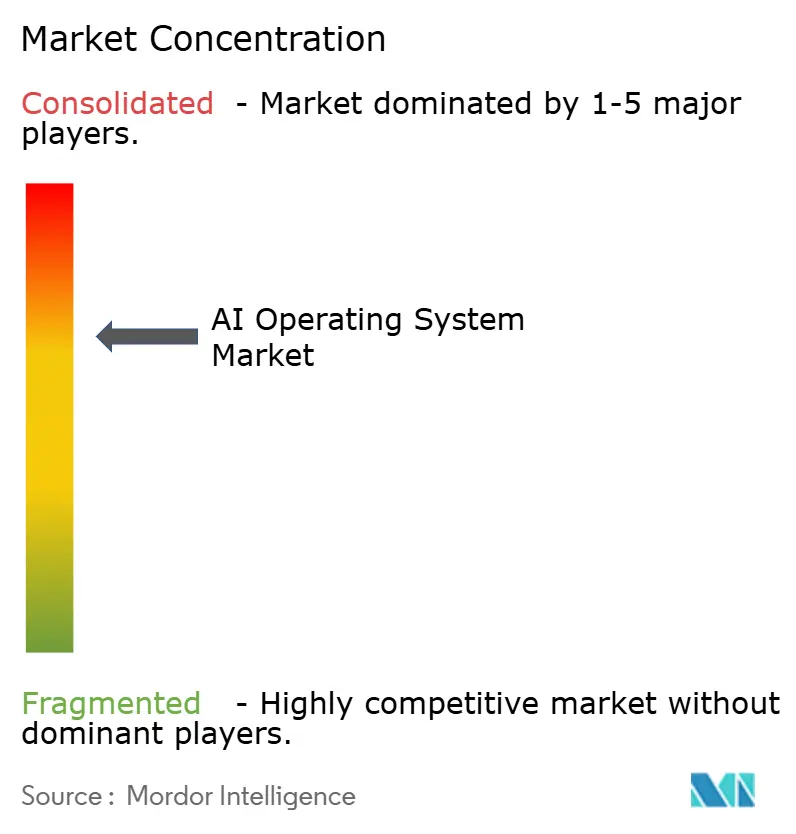
| Market Concentration | Medium |
Major Players *Disclaimer: Major Players sorted in no particular order Image © Mordor Intelligence. Reuse requires attribution under CC BY 4.0. | |
AI Operating System Market Analysis by Mordor Intelligence
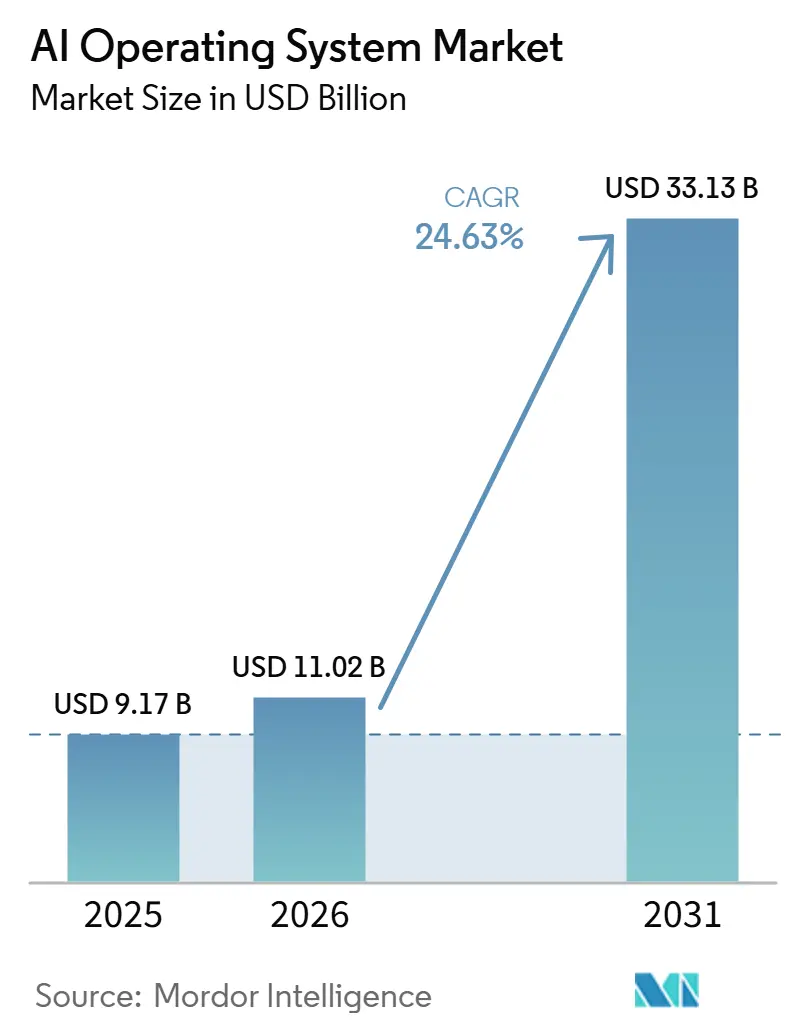
The AI Operating System Market size is projected to expand from USD 9.17 billion in 2025 and USD 11.02 billion in 2026 to USD 33.13 billion by 2031, registering a CAGR of 24.63% between 2026 and 2031. The AI Operating System Market is expanding as organizations move AI from limited trials into production systems that need reliable oversight. Buyers increasingly need a common layer that coordinates model requests, applies policies, and records decisions across business processes. The phased requirements of the EU AI Act make governance, documentation, and transparency more important for deployments in regulated settings. Cloud providers, model developers, and workflow software vendors are responding by bringing orchestration, identity controls, and monitoring closer together. This creates openings for platforms that can support both cloud models and local processing without weakening security or operational control.
Key Report Takeaways
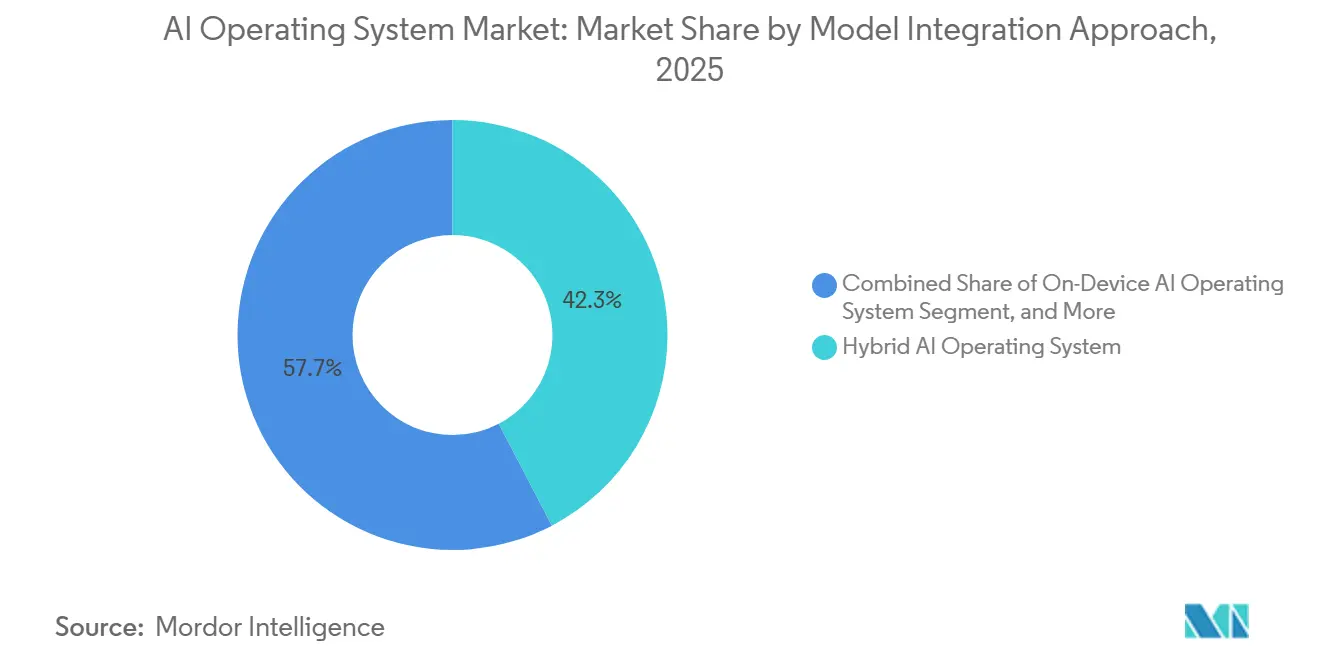
- By model integration approach, hybrid platforms accounted for 42.31% share of total revenue in the AI Operating System Market 2025, while on-device platforms are projected to expand at a CAGR of 27.84% through 2031.
- By platform, mobile platforms held 38.62% of the total revenue in 2025, while embedded and edge platforms are projected to expand at a CAGR of 28.41% through 2031.
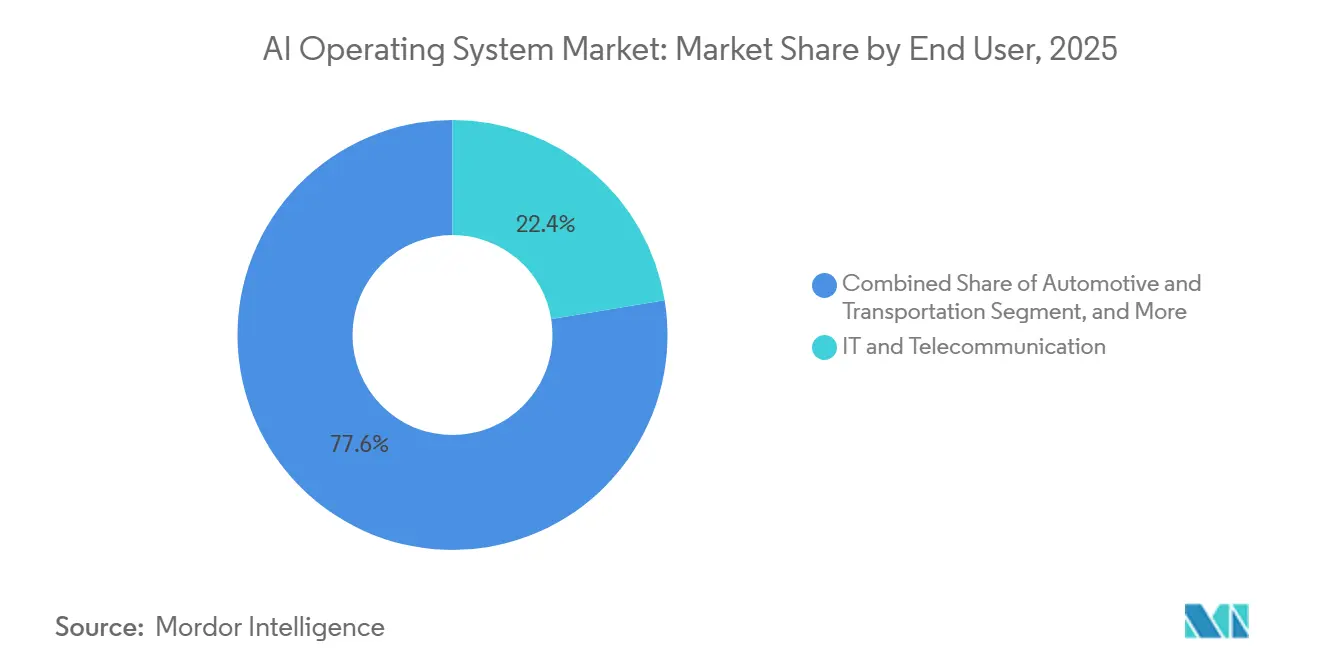
- By end user, IT and telecommunications accounted for 22.47% share of the total revenue in the AI Operating System Market 2025, while automotive and transportation is projected to expand at a CAGR of 29.18% through 2031.
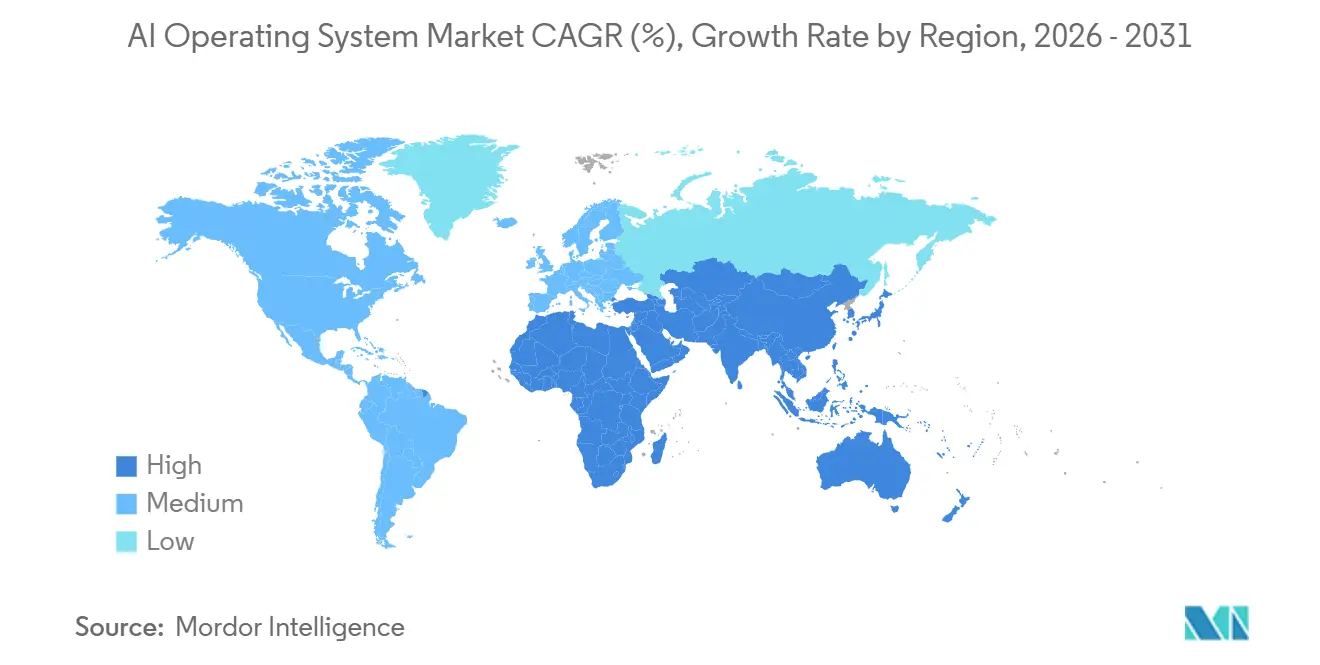
- By geography, North America held 36.42% of the total revenue in 2025, while Asia-Pacific is projected to expand at a CAGR of 28.73% through 2031.
Note: Market size and forecast figures in this report are generated using Mordor Intelligence’s proprietary estimation framework, updated with the latest available data and insights as of January 2026.
Market Trends and Insights
Drivers Impact Analysis of AI Operating System Market*
| Driver | (~) % Impact on CAGR Forecast | Geographic Relevance | Impact Timeline |
|---|---|---|---|
| Enterprise Demand for Governed AI Orchestration | +6.5% | Global, concentrated in North America and Europe | Short term (≤ 2 years) |
| Proliferation of AI Accelerators and NPU-Enabled Devices | +5.2% | Global, with Asia-Pacific at the core and spillover to North America | Medium term (2-4 years) |
| Expansion of On-Device and Edge AI Processing | +4.1% | Asia-Pacific at the core, with spillover to North America and Europe | Medium term (2-4 years) |
| Growth of Autonomous Agents and Goal-Oriented Interfaces | +3.4% | North America and Europe, with early gains in Asia-Pacific | Short term (≤ 2 years) |
| Increasing Requirements for Model Lifecycle Management and Auditability | +2.1% | Global, driven by regulation in Europe and North America | Medium term (2-4 years) |
| Agent-Ready Operating Layers for Legacy System Modernization | +1.5% | North America and Europe, with emerging demand in South America and the Middle East and Africa | Long term (≥ 4 years) |
| Source: Mordor Intelligence | |||
Enterprise Demand for Governed AI Orchestration
The AI Operating System Market is benefiting from demand for systems that authorize, record, and review each model action. Organizations need these capabilities when AI tools interact with customer data, business records, or regulated workflows. Microsoft made Azure AI Foundry Agent Service generally available in June 2026 with sandboxed compute, identity features, governance tools, and observability across 20 Azure regions.[1]Microsoft Foundry, “What’s New in Microsoft Foundry, June 2026,” Microsoft Foundry Blog, devblogs.microsoft.com This release shows that enterprise buyers now expect controls to be available at the production stage rather than added later. The EU AI Act also introduces transparency, risk management, and documentation requirements that encourage organizations to select platforms with built-in governance. Large organizations in finance, healthcare, and public administration are therefore more likely to standardize their AI tools, while smaller firms may continue to use lighter automation products.
Proliferation of AI Accelerators and NPU-Enabled Devices
The growing supply of specialized processors is widening the technical base for the AI Operating System Market. Faster accelerators make it more practical to run reasoning, memory, and agent workloads at scale. NVIDIA reported fiscal 2026 data center revenue of USD 193.7 billion, up 68% year over year, and stated that Blackwell Ultra can lower the cost of agentic workloads by up to 35 times compared with Hopper.[2]NVIDIA Corporation, “NVIDIA Announces Financial Results for Fourth Quarter and Fiscal 2026,” NVIDIA Newsroom, nvidianews.nvidia.com The company also presented Vera Rubin as a platform designed for agentic workloads, with a cost per inference token up to 10 times lower than Blackwell's. These gains can support larger deployments, although the strongest benefits are likely to reach major cloud providers and well-funded enterprises first. The installed base of AI-capable hardware in mobile devices, PCs, vehicles, and industrial equipment also provides software providers with more deployment options for local intelligence.
Expansion of On-Device and Edge AI Processing
The AI Operating System Market is increasingly shaped by workloads that cannot depend on a cloud connection. Automotive, healthcare, and industrial users need short response times and tighter control over sensitive data. ThunderSoft introduced AquaDrive AIOS 2.1 in April 2026, featuring local model inference for vehicle functions and response times below 500 milliseconds in latency-sensitive scenarios. Google announced Gemini Intelligence for Android in May 2026, including on-device Gemini Nano v3 inference and multi-step app automation.[3]Google, “Gemini Intelligence Brings Proactive AI to Android,” Google Blog, blog.google These releases show that local processing is becoming a planned product feature, rather than a backup for cloud services. Hybrid designs remain important because they can keep sensitive tasks on a device while directing more demanding requests to larger cloud models.
Growth of Autonomous Agents and Goal-Oriented Interfaces
Autonomous agents are driving demand for an operating layer that manages multiple model responses. These systems need to break goals into steps, coordinate tools, retain context, and request approval before acting on important tasks. Salesforce reported more than 8,000 customer deals for Agentforce by early 2026, indicating that enterprise agent programs are moving beyond isolated pilots.[4]Salesforce, “Salesforce Announces Prepackaged Agentforce Help Agent,” Salesforce Newsroom, salesforce.com The AI Operating System Market gains from this shift because conventional application stacks do not consistently provide shared controls for multi-step agent actions. Organizations need clearer records of what an agent did, which data it used, and who approved the action. Those requirements are especially important where automated activity affects customers, employees, financial decisions, or public services.
Restraints Impact Analysis of AI Operating System Market*
| Restraint | (~) % Impact on CAGR Forecast | Geographic Relevance | Impact Timeline |
|---|---|---|---|
| High Compute, Memory, and Energy Costs | -3.1% | Global, most acute in South America, the Middle East and Africa, and Southeast Asia | Short term (≤ 2 years) |
| Data Privacy, Security, and Regulatory Compliance Burden | -2.4% | Global, concentrated in Europe and North America | Medium term (2-4 years) |
| Hardware Fragmentation and Interoperability Gaps | -1.8% | Global, particularly Asia-Pacific and the Middle East and Africa | Medium term (2-4 years) |
| Integration Complexity Across Legacy Enterprise Systems | -1.4% | North America and Europe | Long term (≥ 4 years) |
| Source: Mordor Intelligence | |||
High Compute, Memory, and Energy Costs
Compute, memory, and power needs remain a major constraint on the AI Operating System Market. Production agent workloads require more resources than simple inference requests because they may involve persistent memory, multi-step reasoning, and multiple coordinated agents. This burden can be difficult for mid-sized organizations that lack the volume discounts available to large cloud customers. Higher energy demand also affects data center planning and can delay capacity additions in regions with constrained grids. NVIDIA's reported improvement in cost per inference token points to a path toward lower operating costs. However, these gains do not immediately remove the financial barrier for organizations that must buy capacity at market rates.
Data Privacy, Security, and Regulatory Compliance Burden
Privacy and compliance demands can extend implementation schedules for the AI Operating System Market, especially in regulated sectors. The EU AI Act applies its rules in stages, with prohibited practices taking effect in February 2025, general-purpose AI model obligations in August 2025, and broader requirements becoming applicable in August 2026. Organizations operating across jurisdictions must consider data protection, industry requirements, security controls, and AI management practices simultaneously. Anthropic expanded Claude Enterprise with 28 security and compliance integrations, including Cloudflare, CrowdStrike, Microsoft Purview, Okta, Palo Alto Networks, and Zscaler. The breadth of these integrations shows the operational work required before an enterprise deployment is approved. Smaller providers may struggle to offer comparable controls, thereby favoring larger platforms with established compliance capabilities.
*Our forecasts treat driver/restraint impacts as directional, not additive. The impact forecasts reflect baseline growth, mix effects, and variable interactions.
AI Operating System Market Segment Analysis
By Model Integration Approach:
Hybrid Platforms Lead as On-Device Use ExpandsHybrid platforms accounted for 42.31% share of the AI operating system market size in 2025. They allow organizations to process sensitive requests locally while maintaining access to cloud models for more demanding tasks. This balance matters to financial services, healthcare, government, and other buyers that need data residency controls. Microsoft Foundry provides hosted agents with sandboxed compute and connections to Azure model endpoints, demonstrating how a cloud provider supports this design. The approach can reduce the need to choose between stronger model capability and tighter handling of sensitive information. It also gives technology teams a practical way to assign workloads by risk, latency, data location, and the availability of local compute resources. This flexibility can simplify internal approval processes when different business units operate under distinct data-handling rules.
On-device platforms are projected to grow at a CAGR of 27.84% from 2026 to 2031. Apple previewed next-generation Apple Intelligence and Siri AI across iOS 27, macOS 27, iPadOS 27, watchOS 27, and visionOS 27 in June 2026. Local processing supports privacy and can improve response times where an internet connection is unreliable. Cloud-native platforms remain necessary for tasks that require very large context windows or rapid model changes. Across the three approaches, customers are placing more value on model version control, performance monitoring, rollback options, and audit records. These functions are moving into platform offerings rather than remaining as separate management tools. Buyers can use a common control structure to compare model versions, review changes, and respond when a model produces unsuitable results. This is important when teams use several models and must maintain consistent records across their applications.



By Platform:
Mobile Leads While Embedded and Edge Systems AdvanceMobile platforms accounted for 38.62% of the AI Operating System Market size in 2025. Their position reflects the global scale of smartphone use and the maturity of Android and iOS ecosystems. Google introduced Gemini Intelligence with Gemini Nano v3, multi-step app automation, and an initial rollout for Samsung Galaxy S26 and Google Pixel 10 devices. Apple also expanded its system-level AI capabilities across its device portfolio in 2026. Desktop and laptop use is also growing as AI PCs add neural processing capabilities, although enterprise refresh cycles can slow adoption. The device category remains useful for employees who need AI support inside productivity, engineering, analytics, and customer service software. Adoption is likely to depend on how easily local functions work with established security and device management policies.
Embedded and edge platforms are projected to grow at a CAGR of 28.41% through 2031. This portion of the AI Operating System Market supports automotive, industrial, and smart infrastructure applications that need local, predictable processing. ThunderSoft deepened its collaboration with Qualcomm and, in April 2026, signed a cooperation memorandum with Hyundai AutoEver for vehicle AI agent and zonal control solutions. TRATON GROUP and Applied Intuition announced TRATON ONE OS in April 2026, with ECU testing starting that month and vehicle rollout targeted for 2028. Automotive suppliers must also meet functional safety requirements such as ISO 26262 and SOTIF, which makes validation and lifecycle management central to these deployments. Vehicle programs also need software that can be maintained over long product cycles and updated without disrupting core functions. This makes coordination among automakers, chip suppliers, software providers, and Tier 1 suppliers especially important.
By End User:
IT and Telecommunication Leads as Automotive Adoption Speeds UpIT and telecommunications accounted for 22.47% share of the AI operating system market sizeue in 2025. Cloud providers and telecom operators are both users of these platforms and suppliers of the infrastructure needed to run them. Telecom companies use AI layers for network operations, fault prediction, and customer service. BFSI is another major user because financial firms need model governance, auditability, and clear controls over automated decisions. Healthcare, public administration, industrial manufacturing, education, and utilities also represent a broad demand base as AI moves into operational processes. Each group has different needs, but all require dependable access controls and a clear record of system activity. Energy and utility users are exploring AI support for grid optimization, asset management, and automated balancing.
Automotive and transportation are projected to grow at a CAGR of 29.18% from 2026 to 2031. Vehicle makers need a coordinated software layer for driver assistance, in-cabin systems, fleet services, and over-the-air updates. ThunderSoft's AquaDrive AIOS 2.1 combines cockpit and ADAS functions under an AI as OS architecture. Honda described ASIMO OS as central to the software-defined vehicle approach for its Honda 0 Series vehicles. These examples indicate that vehicle makers are designing common AI-capable software layers into new platforms rather than adding isolated features to older architectures. Retail and e-commerce are also using these capabilities for inventory coordination, customer support, and supply chain management. Their use cases depend on connecting agents with product, order, and fulfillment data while retaining approval points for high-impact actions. The same pattern is extending to service operations where employees need timely recommendations but remain responsible for final decisions.
Geography Analysis
North America AI Operating System Market
North America accounted for 36.42% of total revenue in 2025. The United States has a high concentration of cloud providers, model developers, and enterprise platform companies. The NIST AI Risk Management Framework provides buyers with a recognized framework for evaluating governance and risk controls. This can favor providers that include risk management and documentation from the start. Canada adds to its research and technology activities through its clusters in Toronto, Montreal, and Vancouver. Mexico is seeing increased use in manufacturing and logistics as embedded automation becomes more practical.
APAC AI Operating System Market
Asia-Pacific is projected to grow at a CAGR of 28.73% through 2031. China is expanding AI applications through public policy and domestic technology ecosystems, while Japan and South Korea bring automotive, robotics, consumer electronics, and semiconductor capabilities. India and Southeast Asia offer mobile-first demand, growing digital infrastructure, and expanding enterprise cloud use. The regional opportunity extends beyond consumer devices because industrial control, vehicle systems, and enterprise software are also adopting local AI capabilities. The AI Operating System Market has varied regional demand, with each country emphasizing different device types, domestic suppliers, and deployment models.
EMEA and South America AI Operating System Market
Europe is the third-largest region, with Germany, the United Kingdom, and France leading adoption in industrial, financial, and public-sector applications. The EU AI Act creates compliance work for high-risk uses and supports demand for platforms with audit, transparency, and risk management features. South America is at an earlier stage, with activity concentrated in financial services and digital government. Infrastructure constraints and a limited talent pool can slow broader adoption there. Saudi Arabia and the UAE are active investment centers within the Middle East and Africa. NVIDIA stated that DRIVE Hyperion supports level 4-ready robotaxi deployments and is being pursued with HUMAIN in the Middle East.

Competitive Landscape
The AI Operating System Market has a moderately consolidated cloud orchestration layer and a more fragmented set of model, governance, and vertical software providers. Microsoft, Google, and Amazon Web Services compete to provide broad orchestration environments for enterprise customers. Other suppliers compete through data management, infrastructure, workflow automation, model development, or sector-specific applications. NVIDIA supplies infrastructure that supports these platforms, while ServiceNow and Salesforce build AI capabilities into enterprise workflows. NVIDIA stated that Microsoft Azure, Google Cloud, AWS, and Oracle Cloud Infrastructure planned production deployments of Blackwell Ultra and Vera Rubin platforms. This alignment can make it easier for buyers to select common software and hardware stacks.
Competition also centers on the ability to manage data, model behavior, identity, and enterprise controls. Databricks and Palantir compete at the data and governance layer as they add agent capabilities to their platforms. Anthropic formed an enterprise AI services company with Blackstone, Hellman and Friedman, and Goldman Sachs to support deployments in mid-sized businesses. This approach uses dedicated applied engineering support rather than relying only on standard channel partnerships. Providers that reduce implementation effort may have an advantage when customers lack internal AI engineering resources. The AI Operating System Market has opportunities in governance tools for regulated sectors and in autonomous-agent risk management.
Apple's strategy relies on its control over A-series and M-series silicon and on-device AI functions, which supports differentiation in premium devices. SambaNova Systems and Cerebras Systems are pursuing specialized inference architectures that offer alternatives to a GPU-centered approach. Mistral AI and Cohere offer enterprise-grade model options that can reduce reliance on a single model supplier. ISO/IEC 42001:2023 is relevant in procurement because it establishes requirements for AI management systems. Platforms with lifecycle management, access controls, and evidence for review can be better positioned than disconnected tools. ServiceNow made Build Agent generally available in May 2026 across Cursor, Windsurf, Claude Code, and GitHub Copilot.
AI Operating System Industry Leaders
Microsoft Corporation
Alphabet Inc
Amazon Web Services, Inc.
Apple Inc.
International Business Machines Corporation
- *Disclaimer: Major Players sorted in no particular order
AI Operating System Market Companies Covered in this Report
- Microsoft Corporation
- Alphabet Inc.
- Amazon Web Services, Inc.
- International Business Machines Corporation
- NVIDIA Corporation
- Apple Inc.
- Oracle Corporation
- Salesforce, Inc.
- ServiceNow, Inc.
- SAP SE
- OpenAI, L.L.C.
- Anthropic PBC
- Databricks, Inc.
- Snowflake Inc.
- Palantir Technologies Inc.
- C3.ai, Inc.
- UiPath, Inc.
- DataRobot, Inc.
- Hugging Face, Inc.
- Mistral AI SAS
- Cohere Inc.
- SambaNova Systems, Inc.
- Cerebras Systems, Inc.
- H2O.ai, Inc.

Recent Industry Developments in AI Operating System Market
- July 2026: Anthropic restored global access to Claude Fable 5, its most capable generally available model, across the Claude Platform, Claude.ai, AWS Bedrock, Google Cloud, and Microsoft Foundry, following the US Department of Commerce's withdrawal of emergency export controls. The development removed a near-term availability constraint on enterprise AI operating system deployments built on Claude's frontier reasoning capabilities.
- June 2026: Microsoft's Foundry Agent Service reached general availability, publishing hosted agents to Microsoft 365 Copilot and Microsoft Teams across 20 Azure regions globally, with per-session sandboxed compute, persistent memory, and integrated Entra Agent ID identity for each deployed agent. The release marked the first major hyperscaler AI operating system reaching production-grade enterprise availability at organizational scale.
- June 2026: Apple previewed iOS 27, macOS 27, iPadOS 27, watchOS 27, and visionOS 27 at WWDC, introducing next-generation Apple Intelligence and Siri AI, a fully rebuilt on-device AI operating system interface with deep system access and cross-app contextual reasoning across all Apple platforms.
- June 2026: Anthropic launched Claude Fable 5, a Mythos-class model for long-horizon enterprise agents, available across the Claude API, Amazon Bedrock, Google Cloud, and Microsoft Foundry, alongside the limited-availability Claude Mythos 5 through the US government's Project Glasswing program.


Global AI Operating System Market Report Scope
The AI operating system market refers to the ecosystem of next-generation system software fundamentally designed to natively integrate, manage, and orchestrate artificial intelligence and machine learning workloads across various computing environments. Unlike traditional operating systems that run AI applications as separate software layers, AI operating systems provide built-in capabilities for AI model execution, neural processing unit (NPU) optimization, intelligent resource allocation, and seamless data processing. The market encompasses on-device, cloud-native, and hybrid integration approaches, supporting platforms ranging from smartphones and personal computers to embedded systems and edge devices. These operating systems cater to a wide range of end users across the IT, automotive, healthcare, manufacturing, and government sectors. By deeply embedding AI into the core system architecture, AI operating systems enable real-time, low-latency intelligence, enhance user experiences through proactive contextual understanding, improve data privacy via local processing, and enable the autonomous management of complex AI-driven workflows and agentic tasks.
The AI Operating System Market Report is Segmented by Model Integration Approach (On-Device AI Operating System, Cloud-Native AI Operating System, and Hybrid AI Operating System), Platform (Mobile, Desktop and Laptop, Embedded and Edge, and Others), End User (IT and Telecommunication, BFSI, Automotive and Transportation, Healthcare and Life Sciences, Retail and E-Commerce, Industrial Manufacturing, Education and Research Institutions, Government and Administration, Energy and Utilities, and Other End-User Industries), and Geography (North America, South America, Europe, Asia-Pacific, and Middle East and Africa). The Market Forecasts are Provided in Terms of Value (USD).
| On-Device AI Operating System |
| Cloud-Native AI Operating System |
| Hybrid AI Operating System |
| Mobile |
| Desktop and Laptop |
| Embedded and Edge |
| Other Platforms |
| IT and Telecommunication |
| BFSI |
| Automotive and Transportation |
| Healthcare and Life Sciences |
| Retail and E-Commerce |
| Industrial Manufacturing |
| Education and Research Institutions |
| Government and Administration |
| Energy and Utilities |
| Other End Users |
| North America | United States | |
| Canada | ||
| Mexico | ||
| South America | Brazil | |
| Argentina | ||
| Rest of South America | ||
| Europe | Germany | |
| United Kingdom | ||
| France | ||
| Russia | ||
| Spain | ||
| Rest of Europe | ||
| Asia-Pacific | China | |
| Japan | ||
| India | ||
| South Korea | ||
| Southeast Asia | ||
| Rest of Asia-Pacific | ||
| Middle East and Africa | Middle East | Saudi Arabia |
| United Arab Emirates | ||
| Rest of Middle East | ||
| Africa | South Africa | |
| Nigeria | ||
| Rest of Africa | ||
| By Model Integration Approach | On-Device AI Operating System | ||
| Cloud-Native AI Operating System | |||
| Hybrid AI Operating System | |||
| By Platform | Mobile | ||
| Desktop and Laptop | |||
| Embedded and Edge | |||
| Other Platforms | |||
| By End User | IT and Telecommunication | ||
| BFSI | |||
| Automotive and Transportation | |||
| Healthcare and Life Sciences | |||
| Retail and E-Commerce | |||
| Industrial Manufacturing | |||
| Education and Research Institutions | |||
| Government and Administration | |||
| Energy and Utilities | |||
| Other End Users | |||
| By Geography | North America | United States | |
| Canada | |||
| Mexico | |||
| South America | Brazil | ||
| Argentina | |||
| Rest of South America | |||
| Europe | Germany | ||
| United Kingdom | |||
| France | |||
| Russia | |||
| Spain | |||
| Rest of Europe | |||
| Asia-Pacific | China | ||
| Japan | |||
| India | |||
| South Korea | |||
| Southeast Asia | |||
| Rest of Asia-Pacific | |||
| Middle East and Africa | Middle East | Saudi Arabia | |
| United Arab Emirates | |||
| Rest of Middle East | |||
| Africa | South Africa | ||
| Nigeria | |||
| Rest of Africa | |||


Key Questions Answered in the Report
What is the AI Operating System Market size?
The AI Operating System Market is projected to grow from USD 11.02 billion in 2026 to USD 33.13 billion by 2031 at a CAGR of 24.63%.
Which model integration approach leads adoption?
Hybrid platforms led with 42.31% share in 2025 because they can combine local data handling with cloud model access.
Which platform type is growing fastest?
Embedded and edge platforms are projected to grow at a CAGR of 28.41% through 2031, supported by automotive and industrial uses.
Why are organizations adopting AI operating platforms?
Organizations need shared controls for model access, security, records, workflow coordination, and compliance.
Which end-user group is growing fastest?
Automotive and transportation is projected to grow at a CAGR of 29.18% through 2031 as vehicles adopt unified software layers for AI functions.
Which region is growing fastest?
Asia-Pacific is projected to grow at a CAGR of 28.73% through 2031, supported by activity in China, Japan, South Korea, India, and Southeast Asia.
Page last updated on:


 Your data is secure and never sold or shared.


