
AI In Telecommunication Market Size and Share
Market Overview
| Study Period | 2020 - 2031 |
|---|---|
| Market Size (2026) | USD 5.78 Billion |
| Market Size (2031) | USD 29.17 Billion |
| Growth Rate (2026 - 2031) | 38.23 % |
| Fastest Growing Market | Asia-Pacific |
| Largest Market | North America |
| Market Concentration | Medium |
Major Players *Disclaimer: Major Players sorted in no particular order Image © Mordor Intelligence. Reuse requires attribution under CC BY 4.0. | |
AI In Telecommunication Market Analysis by Mordor Intelligence
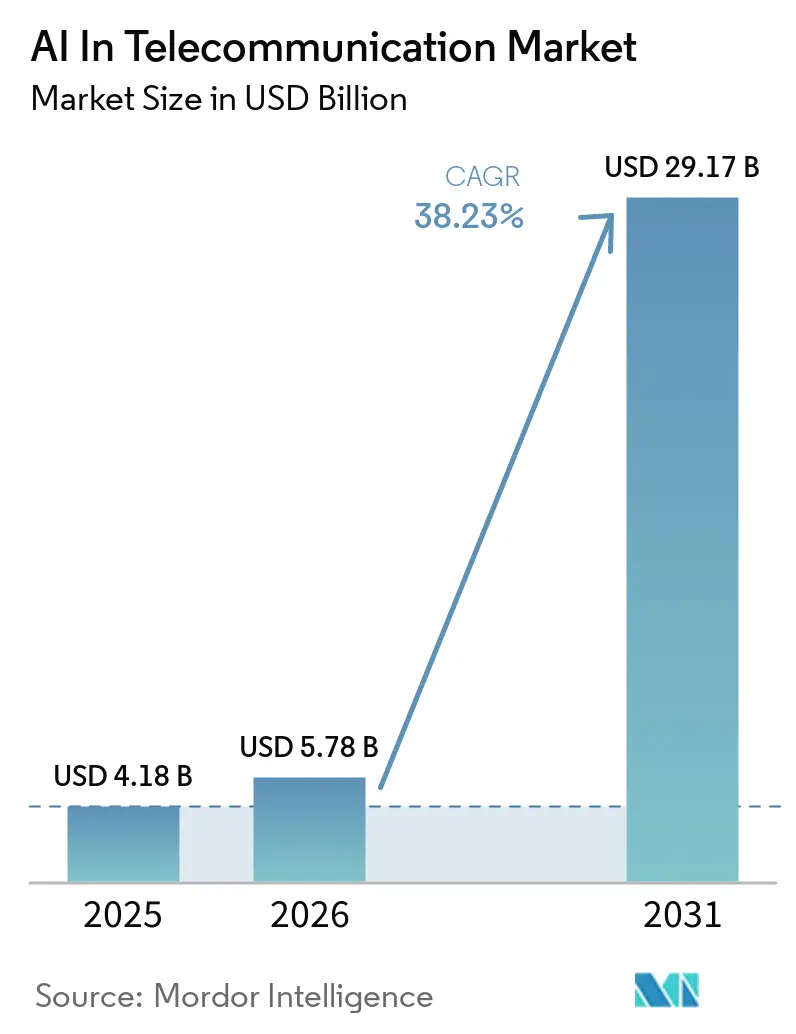
The AI in telecommunication market size is expected to increase from USD 4.18 billion in 2025 to USD 5.78 billion in 2026 and reach USD 29.17 billion by 2031, expanding at a CAGR of 38.23% over 2026-2031. 5G Standalone deployment and Open RAN adoption are increasing the number of network settings that operators must manage. This is moving AI from limited trials into network, operations, and customer-facing systems. Operators are also seeking new revenue from network intelligence while managing the cost of larger 5G workloads. Data residency rules are making local, on-premises, and hybrid deployments more important in regulated markets. Competition now spans network equipment vendors, cloud providers, and telecom software specialists, while energy and inference costs will remain important limits on deployment at scale.
Key Report Takeaways
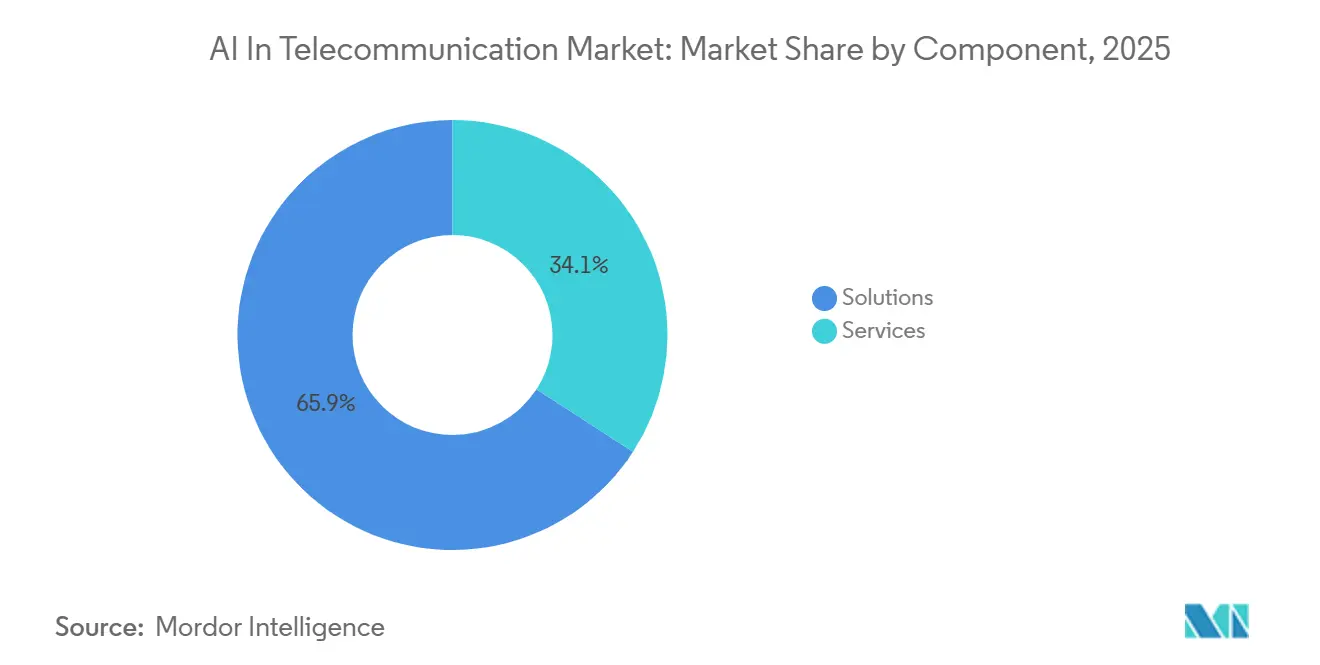
- By component, solutions held 65.87% of component revenue in 2025, while services are projected to expand at a 39.74% CAGR through 2031 in the AI in telecommunication market.
- By deployment mode, cloud accounted for 58.48% of deployment revenue in 2025 and is projected to advance at a 39.41% CAGR through 2031.
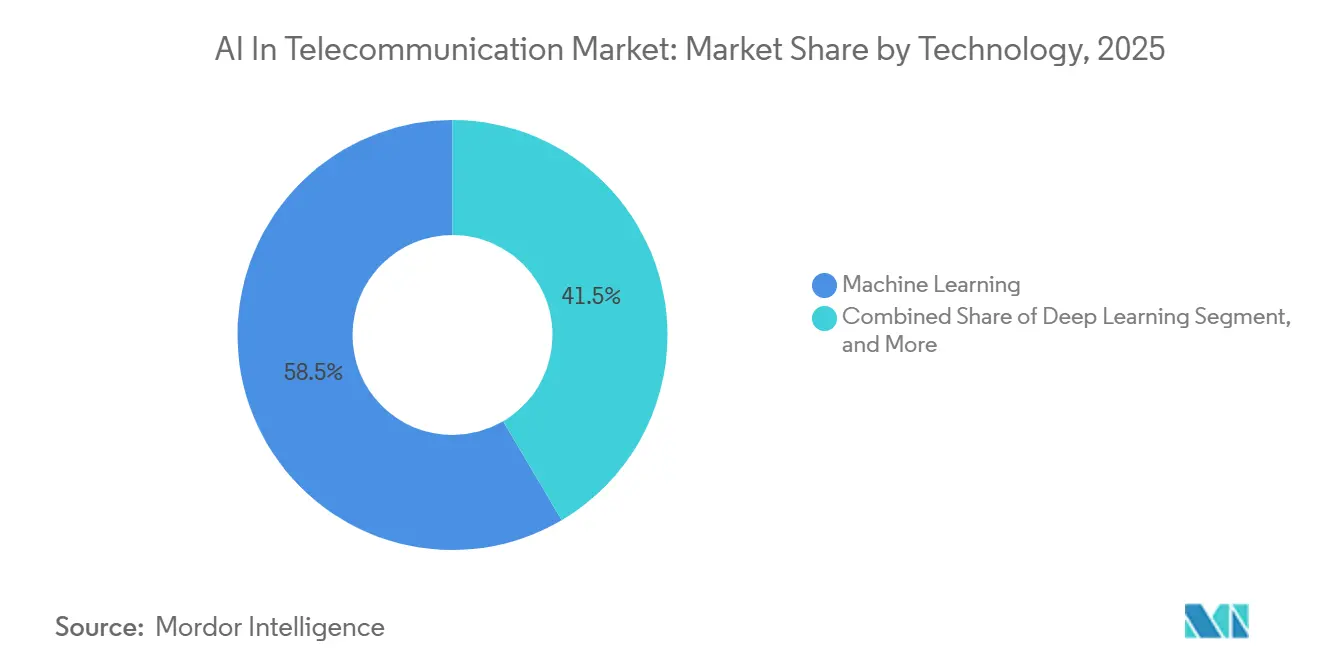
- By technology, machine learning held 42.98% of the AI in telecommunication market size in 2025, while computer vision is projected to expand at a 39.59% CAGR through 2031.
- By application, customer analytics accounted for 27.98% of the AI in telecommunication market size in 2025, while network security is projected to advance at a 39.28% CAGR through 2031.
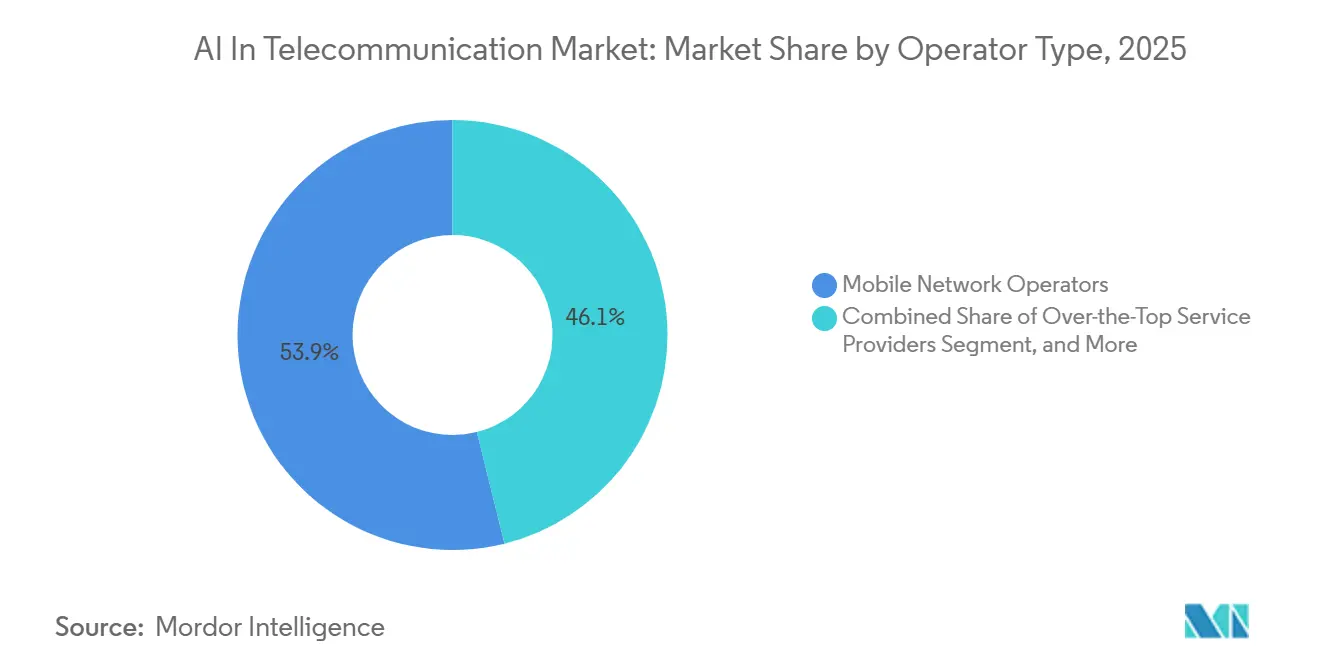
- By operator type, MNOs held 53.88% of operator-type revenue in 2025, while OTT service providers are projected to expand at a 39.86% CAGR through 2031.
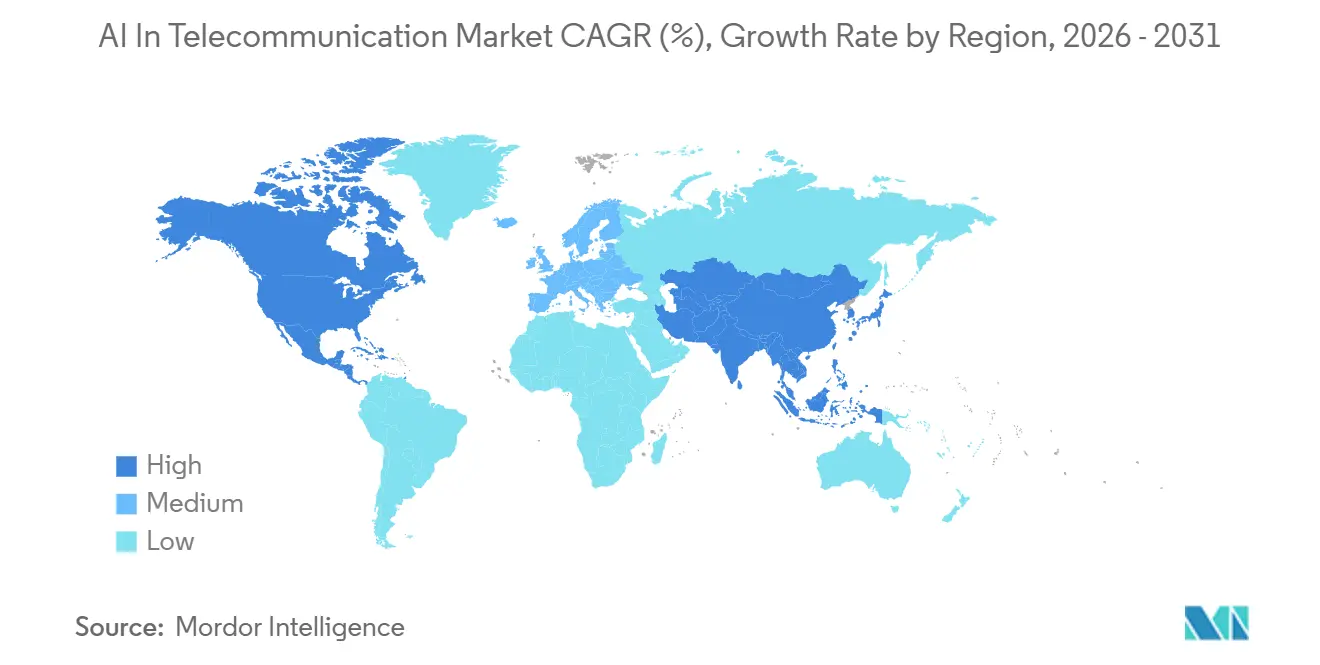
- By geography, North America held 42.37% of the AI in telecommunication market in 2025, while Asia-Pacific is projected to advance at a 39.21% CAGR through 2031.
Note: Market size and forecast figures in this report are generated using Mordor Intelligence’s proprietary estimation framework, updated with the latest available data and insights as of January 2026.
Market Trends and Insights
Drivers Impact Analysis of AI In Telecommunication Market*
| Driver | (~) % Impact on CAGR Forecast | Geographic Relevance | Impact Timeline |
|---|---|---|---|
| 5G Standalone and Open RAN Complexity Driving AI Network Automation | +8.2% | Global, with early gains in North America, Northeast Asia, and GCC | Short term (≤ 2 years) |
| Rising Demand for Zero-Touch Operations and Network Reliability | +6.5% | Global, accelerating in Europe, Japan, and South Korea | Medium term (2-4 years) |
| Growing Need for AI-Enabled Customer Experience and Churn Reduction | +5.8% | Global, highest in Asia-Pacific and North America | Short term (≤ 2 years) |
| AI-Driven Energy Optimization Under Rising Network Power Costs | +4.9% | Global, critical in Europe and Asia-Pacific core markets | Short term (≤ 2 years) |
| Telco-Specific Foundation Models and Agentic Network Operations | +4.2% | North America and Europe leading, Asia-Pacific following | Medium term (2-4 years) |
| Edge-Cloud Convergence Enabling Low-Latency Telecom AI Monetization | +3.8% | Asia-Pacific core, North America, with spillover to GCC and Europe | Long term (≥ 4 years) |
| Source: Mordor Intelligence | |||
5G Standalone and Open RAN Complexity Driving AI Network Automation
5G Standalone and Open RAN designs have increased the settings that operators need to control across the radio network. Rule-based tools cannot manage this level of change across large networks with the same speed as AI systems. Ericsson launched an AI in RAN software subscription in June 2026, with reported gains of up to 20% in downlink throughput and 10% in spectral efficiency across more than 15 live deployments. The software includes an AI-native scheduler for link adaptation and AI-managed beamforming, and it operates on existing hardware. Nokia introduced an AI-native RAN platform in July 2026 that reported more than 20% spectral efficiency gains today and targets more than 100% improvement by 2028. These offers show how the AI in telecommunication market is becoming part of the radio software stack rather than a separate analytics purchase.[1]
Rising Demand for Zero-Touch Operations and Network Reliability
Operators are putting AI into fault detection, root-cause analysis, and remediation to reduce the need for manual network intervention. NTT Docomo introduced a commercial AI agent system for mobile network maintenance in February 2026. The system analyzes traffic and alarm data from more than 1 million network devices in real time and is expected to reduce fault response time by 50%. NTT Docomo also deployed Nokia MantaRay AutoPilot on a public cloud in June 2026 for AI-driven network quality optimization. Google Cloud's autonomous network operations framework supported Deutsche Telekom's MINDR program and reduced mean time to repair by 25% in early deployments. Rakuten Mobile's Level 4 Autonomous Network certification on its commercial Open RAN network shows that cloud-native network design can support higher levels of operational autonomy.[2]
Growing Need for AI-Enabled Customer Experience and Churn Reduction
Customer-facing AI is receiving more attention because operators can connect it directly to retention and service costs. Circles. Life used an AI-native telecom stack in Singapore and reported a 22% increase in average revenue per user and a 9% reduction in churn. Its AI concierge resolved 65% of customer support cases without further assistance. Amdocs expanded its Store Genie system to PLDT Home in June 2026 after deployment at Smart Communications. The service reduced order inquiry handling from 10 hours to 2 minutes, reduced escalation tickets by 50%, and avoided more than 61,000 hours of customer wait time. These deployments give operators more customer-intent data, which can improve both retention actions and personalized offers within the AI in telecommunication market.
AI-Driven Energy Optimization Under Rising Network Power Costs
Energy use is a major operating cost for MNOs, which makes network optimization a practical AI use case. Deutsche Telekom reported up to 65% energy savings in its live 5G Core network through energy-aware automation developed with Mavenir. Nokia stated that its AI-driven energy efficiency solution can deliver 7-30% power savings in multivendor RAN environments without performance loss. A 2026 Scientific Reports study found that combined deep learning and multi-agent reinforcement learning reduced energy consumption by up to 15% in a 5G-oriented simulation. The same study reported a 60% improvement in cell-edge user data rates and a 70% reduction in outage probability. Differences in electricity tariffs mean that operators in high-cost markets may have a stronger financial reason to adopt these tools.[3]
Restraints Impact Analysis of AI In Telecommunication Market*
| Restraint | (~) % Impact on CAGR Forecast | Geographic Relevance | Impact Timeline |
|---|---|---|---|
| Data Privacy, Sovereignty, and AI Governance Requirements | -3.1% | Europe, India, GCC, and markets with strict data localization mandates | Short term (≤ 2 years) |
| Legacy Network Integration and Interoperability Complexity | -2.7% | Global, most acute in markets with multi-decade OSS/BSS infrastructure | Long term (≥ 4 years) |
| Shortage of Telco-Grade AI and MLOps Talent | -2.2% | Global, most severe in South America, Africa, and smaller European markets | Medium term (2-4 years) |
| Inference Economics and Uncertain 5G Return on Investment | -1.8% | Global, with asymmetric pressure on smaller operators and greenfield markets | Medium term (2-4 years) |
| Source: Mordor Intelligence | |||
Data Privacy, Sovereignty, and AI Governance Requirements
The European Union AI Act entered full application on August 2026, setting binding requirements for high-risk AI systems. Relevant telecom uses can include network security scoring, customer risk profiling, and AI-supported network management decisions. Operators must address data governance, model transparency, and human oversight before deploying these systems across European markets. India is phasing in its Digital Personal Data Protection Act from November 2025 to May 2027. These requirements can require AI pipelines to keep sensitive financial, biometric, and network data within national boundaries. The result is a more segmented AI in telecommunication market, where regional data-center capacity and hybrid deployment options carry greater weight.
Legacy Network Integration and Interoperability Complexity
Many operators face a basic implementation problem when connecting AI models with older OSS and BSS systems. These systems were not designed for real-time data exchange or automated action across network domains. TM Forum's Open Digital Architecture and Open API catalog provide common interfaces for functions such as service ordering, inventory, trouble tickets, and customer management. Operators still need to redesign internal processes and connect existing systems before they can use AI across the full operating environment. They also need governance for model drift, retraining, and inference latency where model performance can affect service obligations. This complexity favors providers that can support multivendor integration and managed model operations.
*Our forecasts treat driver/restraint impacts as directional, not additive. The impact forecasts reflect baseline growth, mix effects, and variable interactions.
AI In Telecommunication Market Segment Analysis
By Component:
Solutions Lead, While Services Support Operational DeliverySolutions accounted for 65.87% of component revenue in 2025, giving them the leading position in the AI in telecommunication market. Operators have favored established software tools and platforms over developing every AI system internally within the AI (artificial intelligence) in telecommunication market. These offerings connect AI models with OSS, BSS, and RAN workflows. Amdocs introduced its aOS agentic operating system in February 2026 to work above existing BSS and OSS stacks. The platform approach supports coordination across vendor environments without replacing the full network software estate.
Services are projected to expand at a 39.74% CAGR through 2031, making them the fastest-growing component. Operators without internal MLOps teams need support for deployment, tuning, monitoring, and retraining across live networks. IBM expanded its collaboration with NVIDIA in March 2026 for GPU-native analytics, document processing, and on-premises AI deployment. These functions become more important when AI moves beyond a pilot. Managed services can also replace one-time projects with contracts tied to model performance and defined service outcomes.
By Deployment Mode:
Cloud Leads, While Hybrid and Edge Meet Specific RequirementsCloud held 58.48% of deployment revenue in 2025 and is projected to expand at a 39.41% CAGR through 2031. This combination makes cloud both the largest and fastest-growing deployment mode. Public cloud platforms provide scalable computing capacity, integrated AI tools, and open interfaces for model development in the artificial intelligence in telecommunication market. NTT Docomo and NEC began Japan's first commercial 5G Core service on AWS in February 2026. Their AI and GitOps-based automated network construction reduced build time by 80%.
On-premises deployment remains relevant where data residency rules or latency needs limit public-cloud use. Hybrid and edge configurations serve AI-managed beamforming and real-time fraud detection that cannot tolerate a delayed link to a centralized cloud. This creates a division between cloud-based model training and edge-based inference. The approach uses centralized capacity for training while locating time-sensitive decisions close to the network. It may reduce cloud's current advantage as AI-capable edge hardware becomes more accessible.
By Technology:
Machine Learning Supports the Installed Base, While Computer Vision ExpandsMachine learning held 42.98% of technology revenue in 2025 and remained the core technology for telecom AI use cases. It supports predictive maintenance, churn models, spectrum allocation, and anomaly detection. Deep learning supports neural-network RAN schedulers and AI-based beamforming. Natural language processing enables generative AI chatbots and customer-service agents. These technologies depend on machine-learning infrastructure for training, inference, and model management across the artificial intelligence in telecommunication market.
Computer vision is projected to expand at a 39.59% CAGR through 2031, the fastest rate among the listed technologies. Türk Telekom used a 360-degree camera and a YOLO v8 computer-vision model for RAN inspection. The company reduced daily manual inspection time from 14 hours to 15 minutes, a 98% reduction. e& UAE also introduced AI-powered drone inspection for cell towers through its Drones Operations Centre. These uses support more automated infrastructure management across large tower estates.

By Application:
Customer Analytics Remains Largest, While Security Grows FasterCustomer analytics accounted for 27.98% of application revenue in 2025, making it the largest use case. Operators use it for churn reduction, average revenue per user optimization, and customer lifetime value analysis in the AI in telecommunication market. These uses have a direct connection to revenue and can draw funding from marketing and digital programs. Network optimization and virtual assistants also have meaningful roles in the artificial intelligence in telecommunication market. They help operators manage radio resources, steer traffic, optimize network slices, and reduce contact-center demand.
Network security is projected to advance at a 39.28% CAGR through 2031, making it the fastest-growing application. Telecom fraud is becoming more difficult to counter as attackers use AI to adapt scams and avoid static controls. Openmind Networks reported in 2026 that 80% of current telecom fraud threats were AI-assisted and cited projected subscriber losses of USD 71 billion during the forecast period. Operators are responding with AI fraud detection and continuously updated content inspection tools. This creates ongoing demand for upgrades rather than a single security software purchase.
By Operator Type:
MNOs Lead Adoption, While OTT Providers Grow FasterMNOs accounted for 53.88% of operator-type revenue in 2025 and had the largest AI in telecommunication market share. Their ownership of radio, core, and transport assets gives them the broadest scope for automation. MNOs are using AI for beamforming, network orchestration, customer service, and real-time fraud detection. They are the primary buyers of AI subscriptions from network vendors and telecom cloud platforms. Fixed and internet service providers are applying related tools to broadband optimization, fiber maintenance, and customer-premises troubleshooting within the artificial intelligence in telecommunication market.
OTT service providers are projected to expand at a 39.86% CAGR through 2031, the fastest rate for operator types. Streaming, digital content, and digital-native mobile services are making AI part of the product architecture. JioHotstar integrated conversational AI in February 2026 for more than 500 million monthly users, and more than 60% of users selected voice-first discovery when it was available. Canal+ began a multiyear arrangement with Google Cloud in June 2026 for AI-supported content discovery, personalization, and production. These examples show that OTT providers use AI in the consumer interface and in the content workflow.
Geography Analysis
North America AI in Telecommunication Market
North America held 42.37% of the AI in telecommunication market share in 2025, supported by large operator programs and mature cloud ecosystems. The artificial intelligence in telecommunication market benefits from the concentration of cloud ecosystems and tier-1 operator programs in the United States. AT&T introduced OTel 2.0 in July 2026, an open-source telecom AI model trained on more than 400 billion telecom tokens. AMD, Microsoft, Dell, and Red Hat contributed through the GSMA Open Telco AI program. This reflects a shift in which operators contribute models and benchmarks rather than only purchase AI products. Canada and Mexico are following the United States through network automation initiatives and 5G rollout.
APAC AI in Telecommunication Market
Asia-Pacific is projected to expand at a 39.21% CAGR through 2031, making it the fastest-growing region. China Mobile allocated CNY 9.8 billion (USD 1.4 billion), to 5G-Advanced upgrades across more than 400,000 base stations in 2025. Airtel is building an AI-ready data center campus in Visakhapatnam and targets 56 edge data centers through Nxtra. SK Telecom and NVIDIA announced a gigawatt-scale AI Cloud in July 2026. NTT Docomo is combining commercial cloud core deployment, AI-led maintenance, and AI-enabled multiband frequency-control research for 6G.
EMEA and South America AI in Telecommunication Market
Europe has a significant position through operator programs in Germany, the United Kingdom, Finland, and the Netherlands. The Middle East is led by the GCC, where 5G subscription penetration reached 53% at the end of 2025 and is forecast to approach 90% by 2031. South America remains at an earlier stage, with Brazil leading network modernization and 5G expansion. Africa is a longer-term opportunity centered on South Africa and Nigeria, where 5G is forecast to rise from 4% of mobile subscriptions in 2024 to 25% by 2030.
Competitive Landscape
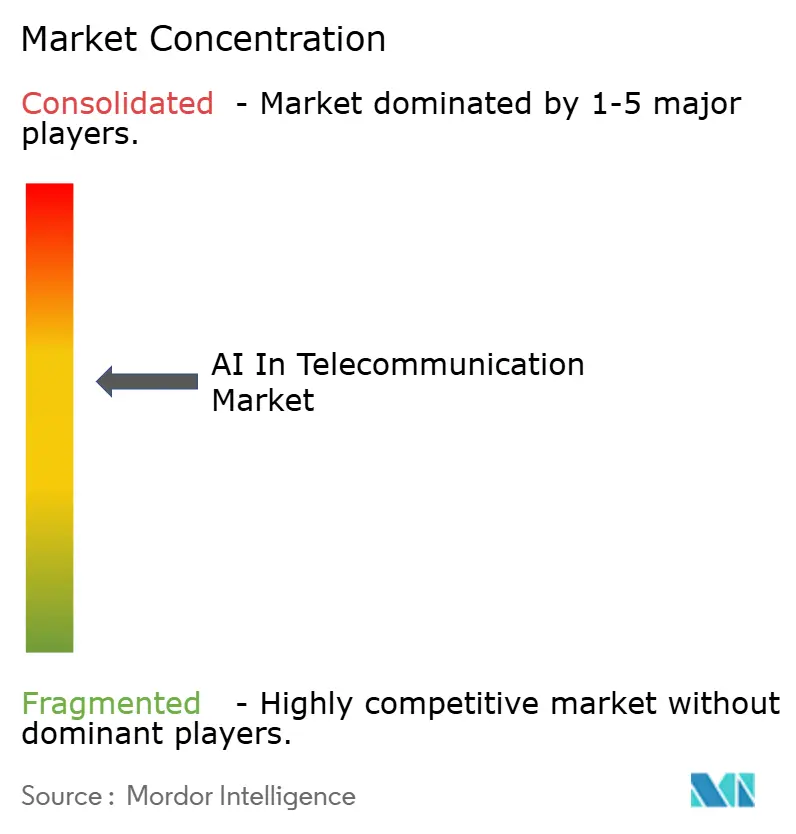
The AI in telecommunication market includes infrastructure vendors, cloud platforms, OSS and BSS specialists, Open RAN software firms, and AI-focused companies. Competition is concentrated among major suppliers at the infrastructure and platform level, while smaller providers compete across specialized workflows. Ericsson is embedding AI models into its baseband and software portfolio through subscriptions that can operate on existing equipment. Nokia is pursuing GPU-powered AI-native radio infrastructure and has set a target for more than 100% spectral efficiency improvement by 2028. These approaches reflect different views on how AI processing should be placed in future radio networks.
Amdocs is positioning its aOS platform as an orchestration layer across BSS, OSS, customer, network, and IT workflows. It advanced live multivendor AI-RAN validation with Fujitsu and Supermicro in June 2026. AWS, Google Cloud, and Microsoft are seeking roles as compute, data, and analytics providers for operator transformation programs. Nokia launched its Autonomous Network Fabric in 2025 using Google Cloud services for agentic workflows, monitoring, and remediation. The AI in telecommunication market rewards suppliers that can integrate with established operator systems without adding operational complexity.
Rakuten Mobile and Rakuten Symphony completed a nationwide RIC deployment in February 2026 with third-party rApp integrations and reported TM Forum Level 4 Autonomous Network certification. Open interfaces and standards are important because they can allow AI in telecommunication market application suppliers to participate in network optimization. Ericsson and Nokia also announced a cross-company collaboration in March 2026 to develop rApps for both service management and orchestration platforms.
AI In Telecommunication Industry Leaders
-
Microsoft Corporation
-
Telefonaktiebolaget LM Ericsson
-
Nokia Corporation
-
International Business Machines Corporation
-
Huawei Technologies Co., Ltd.
- *Disclaimer: Major Players sorted in no particular order
AI In Telecommunication Market Companies Covered in this Report
- International Business Machines Corporation
Recent Industry Developments in AI In Telecommunication Market
- July 2026: SK Group and NVIDIA announced a USD 500 billion-plus comprehensive partnership to build gigawatt-scale AI cloud infrastructure in South Korea, with SK Telecom planning a 2 GW-scale AI factory powered by NVIDIA's DSX platform and Vera Rubin accelerated computing; the first AI data center is expected to be operational in 2027. This partnership repositions SK Telecom from MNO to AI infrastructure provider and signals a template for how large telcos in Asia are positioning themselves as national AI compute champions.
- June 2026: Amdocs completed a live AI-RAN field-validated blueprint in collaboration with Fujitsu's 1Finity and Supermicro, deploying a next-generation Open vRAN architecture on ARM-based servers with NVIDIA GH200 Grace Hopper Superchips in a fully integrated multivendor 5G Standalone environment, demonstrating seamless cloud-native, AI-driven RAN orchestration.
- April 2026: Rakuten Symphony was selected for a JPY 8 billion grant from Japan's Ministry of Economy, Trade and Industry to conduct large-scale Open RAN and RIC trials across 7 countries, Indonesia, Malaysia, Vietnam, India, Kuwait, Bolivia, and Paraguay, comprising 100 base stations per country.
- March 2026: NTT Docomo and NEC began Japan's first commercial 5G Core service on AWS in February 2026, deploying the world's first AI and GitOps-based automated core network construction that reduced network build time by 80%, significantly improving disaster recovery and capacity scalability.
Global AI In Telecommunication Market Report Scope
The AI in Telecommunication Market refers to the industry focused on the deployment and integration of artificial intelligence technologies, including machine learning, natural language processing, predictive analytics, computer vision, and generative AI, across telecommunications networks, platforms, and services to enhance operational efficiency, customer experience, network performance, and revenue generation.
The AI in Telecommunication Market Report is Segmented by Component (Solutions [Software Tools and Platforms], and Services [Professional Services and Managed Services]), Deployment Mode (Cloud, On-Premises, and Hybrid and Edge), Technology (Machine Learning, Deep Learning, Natural Language Processing, and Computer Vision), Application (Customer Analytics, Network Security, Network Optimization, Virtual Assistance/Chatbots, and Other Applications), Operator Type (Mobile Network Operators, Fixed and Internet Service Providers, and Over-the-Top Service Providers), and Geography (North America, South America, Europe, Asia-Pacific, Middle East and Africa). The Market Forecasts are Provided in Terms of Value (USD).
Segmentation Overview
| Solutions | Software Tools |
| Platforms | |
| Services | Professional Services |
| Managed Services |
| Cloud |
| On-Premises |
| Hybrid and Edge |
| Machine Learning |
| Deep Learning |
| Natural Language Processing |
| Computer Vision |
| Customer Analytics |
| Network Security |
| Network Optimization |
| Virtual Assistance and Chatbots |
| Other Applications |
| Mobile Network Operators |
| Fixed and Internet Service Providers |
| Over-the-Top Service Providers |
| North America | United States |
| Canada | |
| Mexico | |
| South America | Brazil |
| Argentina | |
| Rest of South America | |
| Europe | United Kingdom |
| Germany | |
| France | |
| Spain | |
| Italy | |
| Russia | |
| Rest of Europe | |
| Asia-Pacific | China |
| Japan | |
| South Korea | |
| India | |
| Australia and New Zealand | |
| Rest of Asia-Pacific | |
| Middle East | Gulf Cooperation Council |
| Turkey | |
| Israel | |
| Rest of Middle East | |
| Africa | South Africa |
| Nigeria | |
| Rest of Africa |
| By Component | Solutions | Software Tools |
| Platforms | ||
| Services | Professional Services | |
| Managed Services | ||
| By Deployment Mode | Cloud | |
| On-Premises | ||
| Hybrid and Edge | ||
| By Technology | Machine Learning | |
| Deep Learning | ||
| Natural Language Processing | ||
| Computer Vision | ||
| By Application | Customer Analytics | |
| Network Security | ||
| Network Optimization | ||
| Virtual Assistance and Chatbots | ||
| Other Applications | ||
| By Operator Type | Mobile Network Operators | |
| Fixed and Internet Service Providers | ||
| Over-the-Top Service Providers | ||
| By Geography | North America | United States |
| Canada | ||
| Mexico | ||
| South America | Brazil | |
| Argentina | ||
| Rest of South America | ||
| Europe | United Kingdom | |
| Germany | ||
| France | ||
| Spain | ||
| Italy | ||
| Russia | ||
| Rest of Europe | ||
| Asia-Pacific | China | |
| Japan | ||
| South Korea | ||
| India | ||
| Australia and New Zealand | ||
| Rest of Asia-Pacific | ||
| Middle East | Gulf Cooperation Council | |
| Turkey | ||
| Israel | ||
| Rest of Middle East | ||
| Africa | South Africa | |
| Nigeria | ||
| Rest of Africa | ||
Key Questions Answered in the Report
What is the AI in telecommunication market size?
The sector is expected to increase from USD 4.18 billion in 2025 to USD 5.78 billion in 2026 and reach USD 29.17 billion by 2031, registering a CAGR of 38.23% during the forecast period.
What is driving adoption of AI in telecommunications?
Adoption is being driven by the deployment of 5G Standalone networks, Open RAN architectures, zero-touch operations, customer-service automation, and energy optimization initiatives across telecom networks.
Which component leads telecom AI spending?
Solutions accounted for the largest share of component revenue at 65.87% in 2025, while services are projected to witness the fastest growth with a CAGR of 39.74% through 2031.
Which technology is expanding fastest in telecommunications?
Computer vision is projected to be the fastest-growing technology segment, expanding at a CAGR of 39.59% through 2031, supported by automated network inspection and drone-based tower monitoring applications.
Which telecom application is advancing fastest?
Network security is expected to be the fastest-growing application segment, advancing at a CAGR of 39.28% through 2031 as telecom operators address rising AI-assisted fraud and cybersecurity threats.
Which region is expanding fastest for telecom AI?
Asia-Pacific is projected to be the fastest-growing regional market, advancing at a CAGR of 39.21% through 2031, supported by investments in 5G-Advanced networks, edge infrastructure, and AI computing capabilities.