
AI In OTT Market Size and Share
Market Overview
| Study Period | 2020 - 2031 |
|---|---|
| Market Size (2026) | USD 8.55 Billion |
| Market Size (2031) | USD 20.69 Billion |
| Growth Rate (2026 - 2031) | 19.33% CAGR |
| Fastest Growing Market | Asia-Pacific |
| Largest Market | North America |
| Market Concentration | Medium |
Major Players *Disclaimer: Major Players sorted in no particular order Image © Mordor Intelligence. Reuse requires attribution under CC BY 4.0. | |
AI In OTT Market Analysis by Mordor Intelligence
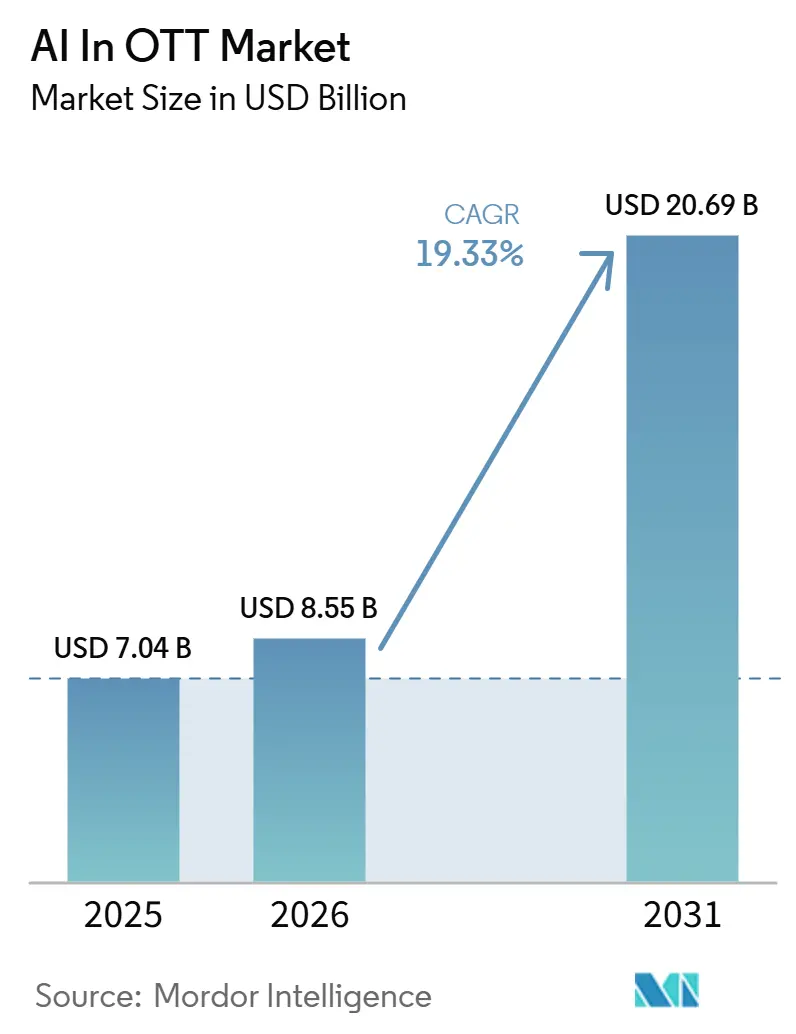
The AI in OTT market size is projected to expand from USD 7.04 billion in 2025 and USD 8.55 billion in 2026 to USD 20.69 billion by 2031, registering a CAGR of 19.33% between 2026 to 2031. The AI in OTT market is moving from isolated workflow tools toward systems that support content delivery, discovery, personalization, and monetization across a streaming service. Larger content libraries make manual curation harder and increase the value of automated discovery and viewer experience management. Cloud providers, streaming services, and specialized media technology suppliers are investing in this area, which makes AI capabilities part of broader platform decisions rather than optional features. Hybrid subscription and advertising models are also raising the value of better audience targeting, while production, localization, and metadata tools widen the range of deployment opportunities. The market's progress will depend on whether providers can connect audience data, content data, and operational workflows without weakening consent, data governance, or content quality.
Key Report Takeaways
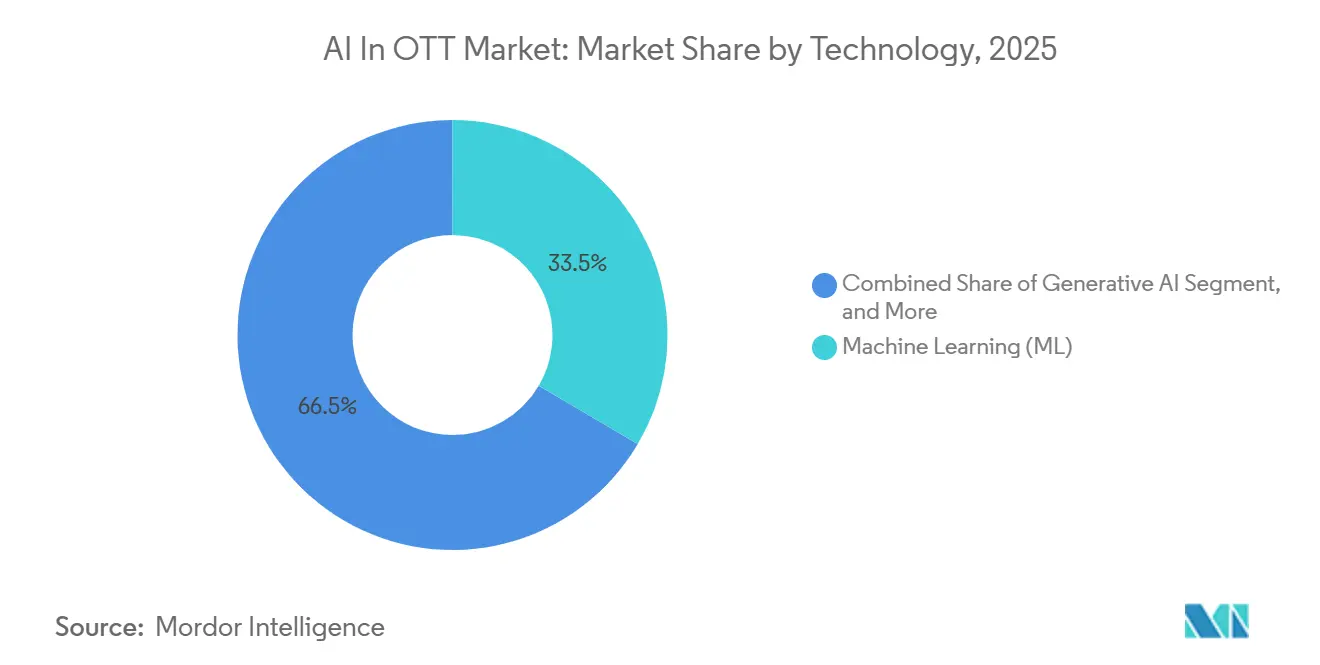
- By technology, machine learning held 33.46% of the AI in OTT market share in 2025, while generative AI is projected to expand at a 19.52% CAGR through 2031.
- By application, AI recommendation engines held 21.88% of the AI in OTT market share in 2025, while advertising targeting and monetization optimization is projected to expand at a 19.78% CAGR through 2031.
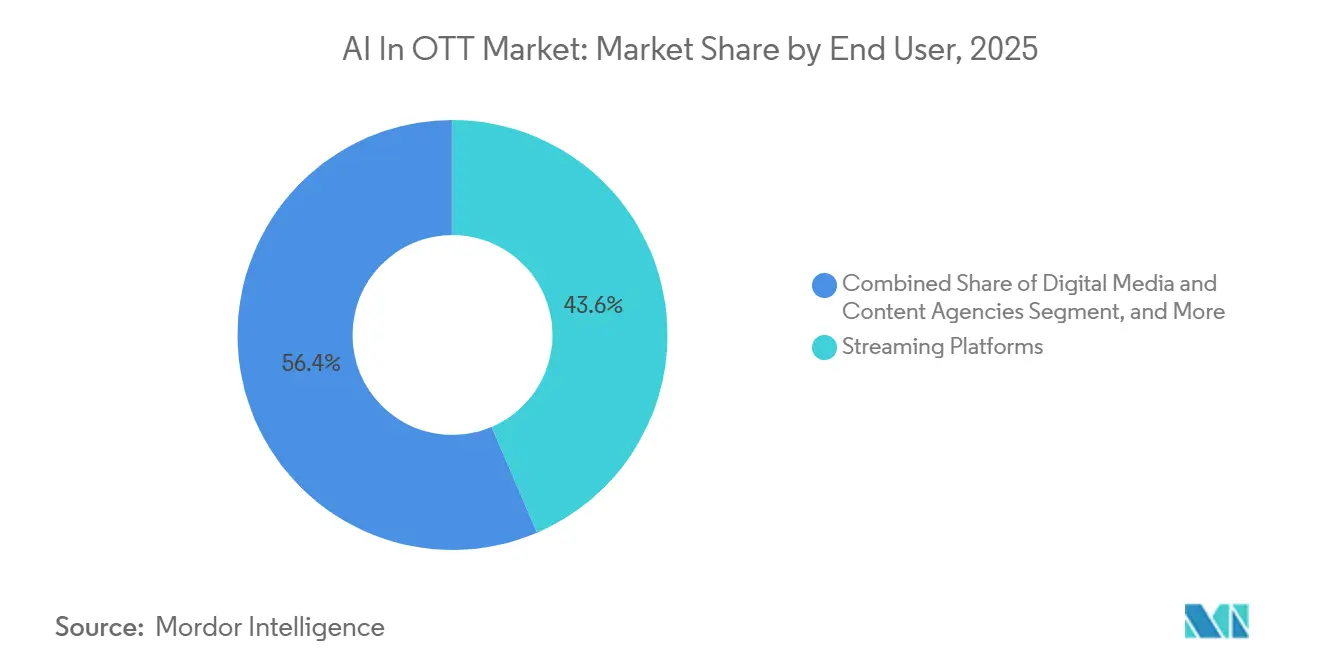
- By end user, streaming platforms held 43.56% of the AI in OTT market share in 2025, while digital media and content agencies are projected to expand at a 19.88% CAGR through 2031.
- By geography, North America held 40.76% share in 2025, while Asia-Pacific is projected to expand at a 20.18% CAGR through 2031.
Note: Market size and forecast figures in this report are generated using Mordor Intelligence’s proprietary estimation framework, updated with the latest available data and insights as of January 2026.
Global AI In OTT Market Trends and Insights
Drivers Impact Analysis*
| Driver | (~) % Impact on CAGR Forecast | Geographic Relevance | Impact Timeline |
|---|---|---|---|
| Demand for Hyper-Personalized Viewing Experiences | +4.5% | Global, highest intensity in North America and Asia-Pacific | Short term (≤ 2 years) |
| AI Use for Content Recommendations and Retention | +3.8% | Global, dominant in North America, UK, India, and Japan | Short term (≤ 2 years) |
| AI Adoption for Ad Targeting and Monetization | +3.2% | North America and Europe core, spillover to South America and Asia-Pacific | Medium term (2-4 years) |
| AI-Driven Metadata, Search, and Discovery Workflows | +2.5% | Global, critical in fragmented Asia-Pacific and European multilingual libraries | Medium term (2-4 years) |
| AI-Assisted Localization, Dubbing, and Subtitle Scale-Up | +1.8% | Asia-Pacific core, South America, Middle East, and Africa | Long term (≥ 4 years) |
| Culturally Aware Recommendation Models | +1.2% | South and Southeast Asia, Middle East and North Africa, and Sub-Saharan Africa | Long term (≥ 4 years) |
| Source: Mordor Intelligence | |||
Rising Demand for Hyper-Personalized Viewing Experiences
Hyper-personalization has become a basic expectation for OTT services that compete for recurring viewing time in 2026. Netflix documented GenPage as an end-to-end system for constructing its homepage, rather than a tool that optimizes individual recommendation rows. The company reported statistically significant engagement gains and a 20% reduction in end-to-end serving latency in production tests against a mature multi-stage system.[1]Netflix Technology Blog, “GenPage: Towards End-to-End Generative Homepage Construction at Netflix,” Netflix, Inc., netflixtechblog.com This approach lets a service consider content type, row position, and artwork choices together when it presents a viewer with a homepage. The resulting audience signals can also inform content acquisition and greenlight decisions, since viewing behavior provides a more immediate view of how titles perform with specific audiences. Services that only use a separate recommendation module may find it harder to connect those signals with programming and monetization decisions.
Increasing Use of AI for Content Recommendations and Retention
Recommendation and retention tools are shifting from reporting past behavior to identifying actions that may prevent a subscriber from leaving. Netflix described recommendations as a force multiplier for its content spending during its 2026 earnings discussion, showing the importance that a leading platform assigns to effective discovery. Churn models can combine changes in viewing completion, payment problems, and household activity to identify risk before a cancellation is completed. This gives customer teams more time to offer a relevant title, a plan change, or another tailored intervention. The value for the AI in OTT market is not limited to preventing cancellations, because the same data can guide merchandising and audience planning. The quality of these actions still depends on reliable subscriber records and clear rules for using personal data.
Growing Adoption of AI for Ad Targeting and Monetization Optimization
The move toward advertising-supported and hybrid streaming services is making ad technology a central part of the AI in OTT market. Wurl introduced BrandDiscovery as a generative AI contextual targeting product that classifies video content at the scene level using genre, brand-safety, and sentiment signals.[2]Wurl, “Introducing BrandDiscovery: GenAI-Powered Contextual Targeting,” Wurl, wurl.com Scene-level classification can give advertisers a more suitable setting than program-level labels, especially when a title moves between different moods or themes. Roku stated that it expected streaming advertisers to redirect up to 50% of near-term search and social budgets into connected-TV advertising. This gives platforms a reason to improve the relevance and measurability of each advertising impression. It also makes transparent controls for brand safety and audience data more important when AI determines where an advertisement appears.
Expansion of AI-Driven Metadata, Search, and Discovery Workflows
Metadata has become a practical limit on how well AI systems can search, recommend, and monetize streaming content. Amagi reported that applied AI was moving into media workflows and identified metadata enrichment, subtitling, and publishing as active operating areas. Traditional genre and cast labels often do not capture the mood, setting, or narrative qualities that a viewer may use to search for a title. Cineverse introduced Matchpoint Hex to classify content through dimensions such as emotional arc, character archetype, tone, and setting. These richer descriptors can support natural-language discovery and better contextual advertising when they are verified and consistently structured. The AI in OTT market, therefore, needs content owners and distributors to treat metadata as a managed operational asset instead of a simple delivery attachment.
Restraints Impact Analysis*
| Restraint | (~) % Impact on CAGR Forecast | Geographic Relevance | Impact Timeline |
|---|---|---|---|
| Cost of Building Unified AI-Native OTT Stacks | -3.5% | Global, most acute for mid-tier and regional platforms | Medium term (2-4 years) |
| Fragmented Metadata Limiting Model Accuracy and Search Relevance | -2.8% | Asia-Pacific and Middle East and Africa fragmented markets, and multilingual libraries globally | Long term (≥ 4 years) |
| Copyright, Deepfake, and Talent-Labor Concerns | -2.1% | North America and Europe core, with exposure in UK, Germany, and France | Medium term (2-4 years) |
| Model Drift Across Languages, Dialects, and Local Libraries | -1.4% | India, Southeast Asia, and Sub-Saharan Africa | Long term (≥ 4 years) |
| Source: Mordor Intelligence | |||
High Cost of Building Unified AI-Native OTT Stacks
A unified AI-native architecture requires investment that many mid-tier and regional services cannot undertake quickly. These operators often rely on separate media asset management, transcoding, digital rights management, and delivery systems that exchange information through file transfers or custom interfaces. When these systems remain disconnected, a recommendation engine may struggle to link viewing activity reliably with subscription and advertising outcomes. This constraint limits the value that even a well-designed model can deliver to the broader AI in OTT market. Amagi reported strong revenue growth and positive adjusted EBITDA after providing managed cloud services that can ease some of this operational burden. While managed services can help, migrations still require time, data preparation, and organization-wide changes, which remain challenging for smaller operators.
Fragmented Metadata Limiting Model Accuracy and Search Relevance
Incomplete and inconsistent metadata reduces the accuracy of search, discovery, advertising, and recommendation tools. Content owners may omit episode details, ratings, regional artwork, or descriptive labels when delivery systems were designed for linear television rather than on-demand discovery. The same title can then be represented differently across several distributors, which forces platforms to reconcile incompatible schemas. Amagi's report described a format delivery burden in which content owners repeatedly adapt the same information for separate distributor taxonomies. The problem is especially significant for the AI in OTT market, where models need structured relationships between titles, people, languages, and viewing context. Better tagging tools will not fully resolve the issue unless rights holders, platforms, and channel operators establish consistent delivery requirements.
*Our forecasts treat driver/restraint impacts as directional, not additive. The impact forecasts reflect baseline growth, mix effects, and variable interactions.
Segment Analysis
By Technology: Machine Learning Supports Current Deployments While Generative AI Broadens Media Workflows
Machine learning held 33.46% of the AI in OTT market share in 2025, making it the leading technology segment across established streaming workflows. It supports personalization, churn scoring, real-time advertising decisions, and content quality monitoring at a scale that platforms already understand, because these uses depend on repeated analysis of defined signals rather than open-ended media generation. Its position reflects predictable operating costs and mature deployment patterns for large subscriber bases, which allows operators to use the same core methods across discovery, marketing, advertising, and customer service processes. These systems commonly combine multiple models to assess viewing behavior, title features, and session context, and they can update recommendations as a viewer changes device, time of viewing, or type of content selected. The technology remains useful because it can make repeated decisions quickly while platforms manage sizable catalogs and traffic volumes, while also giving operating teams established measures for testing performance and correcting weak results.
Generative AI is projected to grow at a 19.52% CAGR from 2026 to 2031, the fastest rate among the technology segments. It is being used for content creation, post-production enhancement, synthetic voice dubbing, conversational search, and richer homepage presentation, which links creative work with discovery and customer-facing experience instead of limiting automation to one production stage. Netflix stated that generative AI had been used on 300 titles in 2026, mainly in post-production, and said a documentary segment was produced twice as fast and at half the cost of a conventional process. Natural language processing also supports semantic search and voice-led discovery, while computer vision supports moderation, thumbnails, and video understanding, giving platforms several ways to interpret the same catalog through written, spoken, visual, and behavioral signals. Netflix's MediaFM uses video, audio, and text to produce shot-level media representations that can help with understanding newly released material. Other tools, including reinforcement learning and privacy-preserving approaches, remain smaller but relevant as services seek efficient and governed personalization, especially where providers must improve relevance without expanding the amount of personal information available to an individual model.



By Application: Recommendation Engines Lead While Advertising Optimization Expands Quickly
AI recommendation engines accounted for 21.88% of the AI in OTT market size in 2025, which reflects the long-standing role of discovery as the central use case for streaming AI. Leading systems combine collaborative filtering, content analysis, and deep learning to evaluate device, time, session behavior, and title attributes. Thumbnail choices and content rows can be tested and tailored at the individual viewer level. This gives platforms a way to reduce the effort of finding a relevant title within large and changing libraries, which can be particularly important when a new release must be surfaced quickly without displacing established titles that still have audience value. Recommendation work also supplies signals that can support retention programs, programming choices, and tailored promotion, since the response to a title, its artwork, and its placement can reveal patterns that standard viewing totals may not show.
Advertising targeting and monetization optimization is projected to expand at a 19.78% CAGR from 2026 to 2031. The growth reflects the importance of advertising yield as services combine subscription and advertising revenue, making the quality of inventory, the suitability of placement, and the ability to show business results more relevant to platform strategy. Contextual tools can use content and viewing signals to place a message in a more relevant environment, while dynamic systems can change creative presentation based on permitted audience context. Wurl's BrandDiscovery shows how scene-level signals can be used to create advertising segments that ordinary program metadata cannot provide. Content moderation, fraud detection, churn prediction, and audience analytics remain important applications because they protect the service and make its operations more reliable, while allowing teams to identify content, account, payment, and customer-care issues before they affect a larger group of viewers. AI-driven metadata and semantic search are also expanding as platforms seek better discovery across libraries that contain more languages, formats, and regional titles, where simple genre labels and title names do not give viewers enough help to describe what they want to watch.
By End User: Streaming Platforms Lead Investment While Agencies Extend Access to AI Tools
Streaming platforms held 43.56% of the AI in OTT market share in 2025, placing them at the center of adoption across production, distribution, discovery, and retention. These services directly operate the audience relationship and can connect content data with viewing, subscription, and advertising outcomes, allowing them to assess whether a discovery, production, or promotional decision produced a useful result for both the viewer and the business. They use AI for metadata enrichment, recommendations, customer retention, post-production tasks, and real-time delivery decisions, so the technology can be applied before a title is released, during its presentation to viewers, and after its performance is measured. Their scale allows them to build internal data assets that other end users may not possess, including linked information on catalog performance, household behavior, device use, advertising response, and the regional reception of individual titles. The leading role of platforms also reflects their need to serve large audiences with consistent experiences across many devices and regions.
Digital media and content agencies are projected to expand at a 19.88% CAGR from 2026 to 2031. Agencies can help content owners, regional broadcasters, and advertisers use AI tools when they lack internal teams to build and maintain specialized systems, translating operating needs into practical selection, implementation, creative, and measurement work for clients. This role becomes more relevant as the AI in OTT market requires more coordination among production, rights, localization, marketing, and advertising teams. Broadcasters and television networks are also using AI for FAST channel scheduling, metadata enrichment, dynamic advertising, subtitling, and social content publishing. Amagi stated that applied AI was moving into these media operations as FAST viewing grew through late 2025. Studios, production houses, telecom-linked services, and educational providers add demand for accessibility features, recommendation tools, and fraud prevention, although their requirements differ according to whether they need a consumer service, a production workflow, or a managed distribution environment.
Geography Analysis
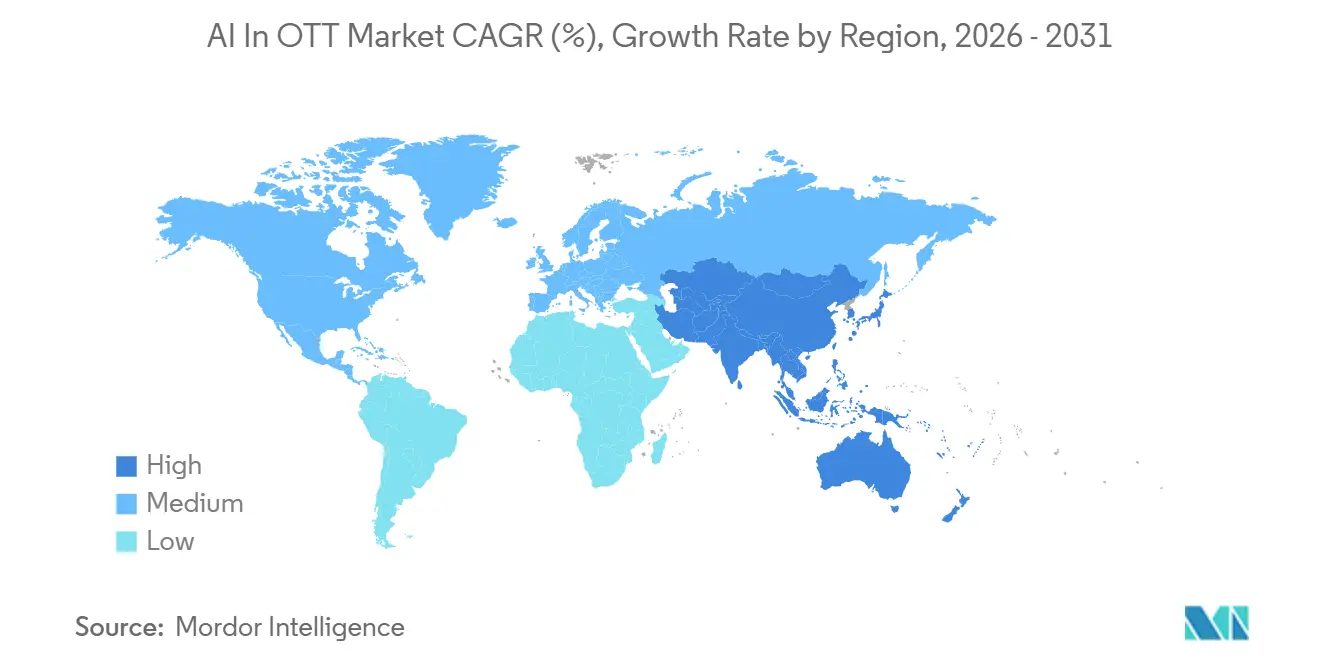
North America held 40.76% of the AI in OTT market share in 2025, supported by large streaming platforms, established programmatic advertising systems, and a substantial concentration of media technology capability. Platforms in the region are applying AI across production, distribution, discovery, audience retention, and advertising, which gives them several data points from which to assess performance and several operational areas where savings or service improvements may be captured. Netflix stated that 300 titles used generative AI in 2026, with most use in post-production. The region's scale gives major services access to first-party viewing data and resources for proprietary model development, although the usefulness of this data still depends on privacy practices, clear ownership rights, and the ability to link it to accurate title information. Canada and Mexico also provide opportunities as platforms expand advertising products and localized experiences.
Asia-Pacific is projected to grow at a 20.18% CAGR from 2026 to 2031, the fastest pace among the regions. Mobile-first audiences, diverse local languages, and active local platforms are increasing demand for subtitle generation, semantic search, audience segmentation, and flexible advertising formats, because a single catalog and interface must serve viewers with different language preferences, viewing habits, and device constraints. Reliance Industries reported that JioStar reached an average of 451 million monthly active users in FY26. Its JioStar GenAI Media Studio supports content ideation, audio, video, and final production workflows. The Asia Video Industry Association reported that local platforms held 84% of subscription video-on-demand subscriptions across Asia-Pacific, which makes locally relevant AI deployment important for the region.
Europe, South America, the Middle East, and Africa provide separate growth paths for the AI in OTT market, with high European requirements for transparency, documentation, and human oversight where automated decisions affect viewers or creators, which can increase implementation work but may also encourage providers to develop clearer controls and more accountable operating practices. South American platforms are using localization and advertising tools to serve Spanish-language audiences and other regional communities, and Prime Video introduced an AI dubbing pilot for content without existing localization to improve access for selected titles. The Middle East has growing broadband and smart television adoption, while Africa remains earlier in development and is centered on markets including South Africa and Nigeria. These regions need systems that handle local languages, varying network conditions, and local content preferences without assuming that North American audience models will transfer directly, since the value of search, recommendations, and dubbing depends on whether users can recognize their own viewing context in the service.

Competitive Landscape
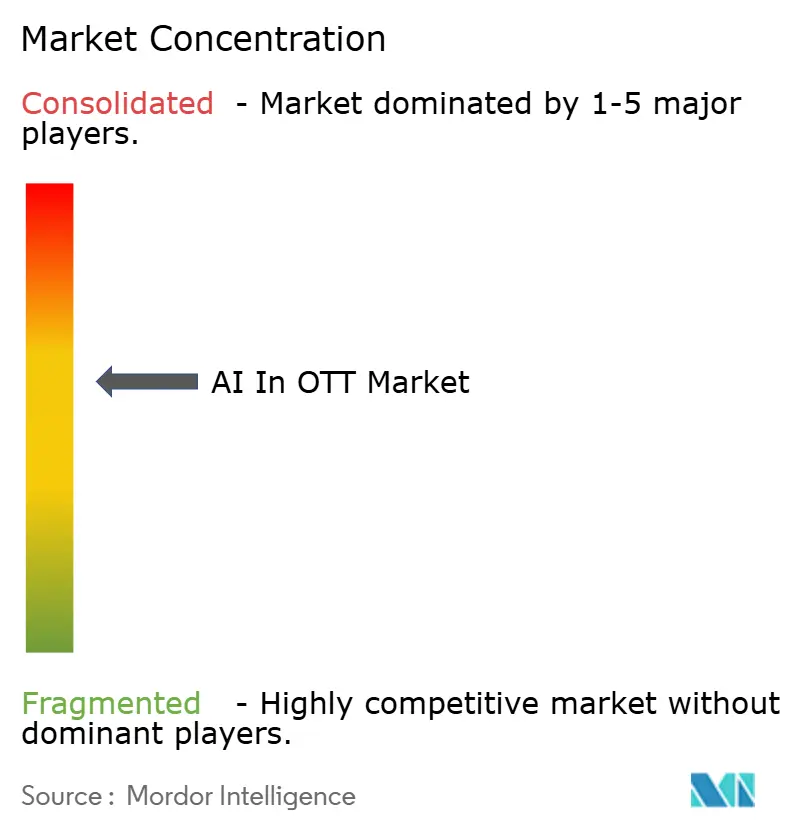
The AI in OTT market has a concentrated infrastructure layer and a more fragmented layer of media technology suppliers. AWS, Google, and Microsoft provide cloud infrastructure used by platforms and specialist vendors, while OTT-focused firms compete through workflow tools and content intelligence. The infrastructure providers benefit from broad computing, storage, model, and data services that can support deployment at scale. Specialist suppliers differentiate through metadata enrichment, FAST channel operations, advertising technology, analytics, moderation, and localization, offering platforms more targeted ways to improve a single workflow without replacing their full technology foundation. This structure means a streaming service can use common cloud foundations while selecting distinct products for individual media workflows, but it can also create integration work when data standards, security rules, and workflow ownership differ among the providers.
Competitive advantage increasingly depends on access to proprietary content and audience data, not only on the underlying model. Netflix's reported USD 587 million acquisition of InterPositive illustrates the value placed on production-related intellectual property and workflows that could enhance internal content processes. A model trained on a platform's own material may have operating context that a general-purpose system does not possess, including familiar production conventions, internal catalog relationships, and the patterns through which the platform has historically presented and promoted titles. The AI in OTT market also has open areas in mid-sized platforms, multilingual semantic search, and AI-supported FAST operations, where regional broadcasters may prefer managed services over extensive internal development. Amagi introduced agentic capabilities for media operations that automate tasks including metadata enrichment, captioning, subtitling, and localization.[3]Amagi Media Labs, “Amagi Unveils Agentic Capabilities Across Its Industry Cloud Platform, Enabling Autonomous Media Operations,” Amagi Newsroom, amagi.com
Wurl has focused on contextual advertising through scene-level content classification, while Cineverse has focused on experience-based content classification for discovery, programming, and advertising alignment. Kaltura has introduced tools that support personalized viewing experiences and publishing workflows for live, on-demand, and FAST services. Data governance, privacy, content rights, and human oversight remain practical differentiators, particularly where platform decisions affect content access or creator interests, because customers need to know how a provider manages training data, permissions, model outputs, and review processes, and a provider that can demonstrate reliable data handling and clear controls may be better positioned to win work from regulated or risk-conscious customers. The competitive picture remains mixed because the largest cloud firms are strong at the foundation layer, but workflow-specific expertise is distributed across many vendors, leaving room for focused suppliers that can prove better results in a defined use case or regional operating environment.
AI In OTT Industry Leaders
Amazon Web Services, Inc.
Google LLC
Microsoft Corporation
IBM Corporation
Netflix, Inc.
- *Disclaimer: Major Players sorted in no particular order

Recent Industry Developments
- July 2026: Netflix confirmed in its Q2 2026 SEC Form 10-Q that it completed the acquisition of InterPositive for approximately USD 587 million. Co-CEO Ted Sarandos stated that generative AI tools were used in approximately 300 Netflix titles, predominantly in post-production, and that one documentary segment was produced twice as fast and at half the cost of conventional workflows.
- June 2026: Fox Corporation announced a USD 22 billion agreement to acquire Roku, Inc., targeting USD 400 million in annual run-rate cost synergies and additional revenue upside from combining Fox's content assets with Roku's first-party CTV audience data and AI-driven advertising platform. Roku had reported net income of USD 88.4 million on revenue of USD 4.74 billion in its first full-year profitable year in 2025.
- May 2026: Roku unveiled a redesigned AI-powered home screen targeting over 100 million streaming households, featuring personalized content rails guided by behavioral insights, the platform's first significant home-screen update in over a decade.
- April 2026: Amagi announced the launch of Agentic Media Operations across its Amagi NOW industry cloud platform, integrating reasoning agents to automate metadata enrichment, captioning, subtitling, and localization across 29+ source languages translatable to 100+ target languages. Amagi simultaneously reported FY26 results showing 30% revenue growth and its first full-year profitability, with adjusted EBITDA rising 6x to INR 156 crore, approximately USD 18.7 million.


Global AI In OTT Market Report Scope
AI in OTT Market refers to the use of artificial intelligence and machine learning technologies within over-the-top streaming platforms to improve content discovery, personalization, and viewer engagement. It includes recommendation engines, smart search, content tagging, automated subtitles, and audience analytics that help platforms tailor the streaming experience.
The AI in OTT Market Report is Segmented by Technology (ML, NLP, Computer Vision, and Generative AI), Application (AI Content Personalization Market, AI Recommendation Engine Market, Advertising Targeting and Monetization Optimization, Content Moderation, Metadata, Search, and Discovery, Churn Prediction and Audience Analytics, and Fraud Detection and Account Security), End User (Streaming Platforms, Studios and Production Houses, Broadcasters and Television Networks, and Digital Media and Content Agencies), and Geography (North America, South America, Europe, Asia-Pacific, Middle East, and Africa). The Market Forecasts are Provided in Terms of Value (USD).
| Machine Learning (ML) |
| Natural Language Processing (NLP) |
| Computer Vision |
| Generative AI |
| Other Technologies |
| AI Content Personalization Market |
| AI Recommendation Engine Market |
| Advertising Targeting and Monetization Optimization |
| Content Moderation |
| Metadata, Search, and Discovery |
| Churn Prediction and Audience Analytics |
| Fraud Detection and Account Security |
| Other Applications |
| Streaming Platforms |
| Studios and Production Houses |
| Broadcasters and Television Networks |
| Digital Media and Content Agencies |
| Other End Users |
| North America | United States |
| Canada | |
| Mexico | |
| South America | Brazil |
| Argentina | |
| Chile | |
| Rest of South America | |
| Europe | Germany |
| United Kingdom | |
| France | |
| Italy | |
| Spain | |
| Rest of Europe | |
| Asia-Pacific | China |
| Japan | |
| India | |
| South Korea | |
| Australia | |
| Rest of Asia-Pacific | |
| Middle East | Saudi Arabia |
| United Arab Emirates | |
| Qatar | |
| Rest of Middle East | |
| Africa | South Africa |
| Egypt | |
| Nigeria | |
| Rest of Africa |
| By Technology | Machine Learning (ML) | |
| Natural Language Processing (NLP) | ||
| Computer Vision | ||
| Generative AI | ||
| Other Technologies | ||
| By Application | AI Content Personalization Market | |
| AI Recommendation Engine Market | ||
| Advertising Targeting and Monetization Optimization | ||
| Content Moderation | ||
| Metadata, Search, and Discovery | ||
| Churn Prediction and Audience Analytics | ||
| Fraud Detection and Account Security | ||
| Other Applications | ||
| By End User | Streaming Platforms | |
| Studios and Production Houses | ||
| Broadcasters and Television Networks | ||
| Digital Media and Content Agencies | ||
| Other End Users | ||
| By Geography | North America | United States |
| Canada | ||
| Mexico | ||
| South America | Brazil | |
| Argentina | ||
| Chile | ||
| Rest of South America | ||
| Europe | Germany | |
| United Kingdom | ||
| France | ||
| Italy | ||
| Spain | ||
| Rest of Europe | ||
| Asia-Pacific | China | |
| Japan | ||
| India | ||
| South Korea | ||
| Australia | ||
| Rest of Asia-Pacific | ||
| Middle East | Saudi Arabia | |
| United Arab Emirates | ||
| Qatar | ||
| Rest of Middle East | ||
| Africa | South Africa | |
| Egypt | ||
| Nigeria | ||
| Rest of Africa | ||


Key Questions Answered in the Report
What is the size of the AI in OTT market?
The AI in OTT market was USD 8.55 billion in 2026 and is projected to reach USD 20.69 billion by 2031 at a 19.33% CAGR.
Which technology leads AI adoption in streaming?
Machine learning led with a 33.46% share in 2025 because it supports established uses such as recommendations, churn scoring, and advertising decisions.
Which AI application is growing fastest in OTT services?
Advertising targeting and monetization optimization is projected to grow at a 19.78% CAGR from 2026 to 2031 as hybrid advertising models expand.
Which end users are adopting AI tools most actively?
Streaming platforms led with 43.56% share in 2025, while digital media and content agencies are projected to grow at a 19.88% CAGR through 2031.
Which region will grow fastest for AI-enabled streaming?
Asia-Pacific is projected to grow at a 20.18% CAGR from 2026 to 2031, supported by mobile audiences, local platforms, and multilingual content needs.
What limits the use of AI across OTT workflows?
Disconnected platform systems, inconsistent metadata, rights concerns, and weaker performance across languages and dialects can slow adoption.
Page last updated on:






