
AI Content Provenance Software Market Size and Share
Market Overview
| Study Period | 2020 - 2031 |
|---|---|
| Market Size (2026) | USD 1.31 Billion |
| Market Size (2031) | USD 4.67 Billion |
| Growth Rate (2026 - 2031) | 28.95 % |
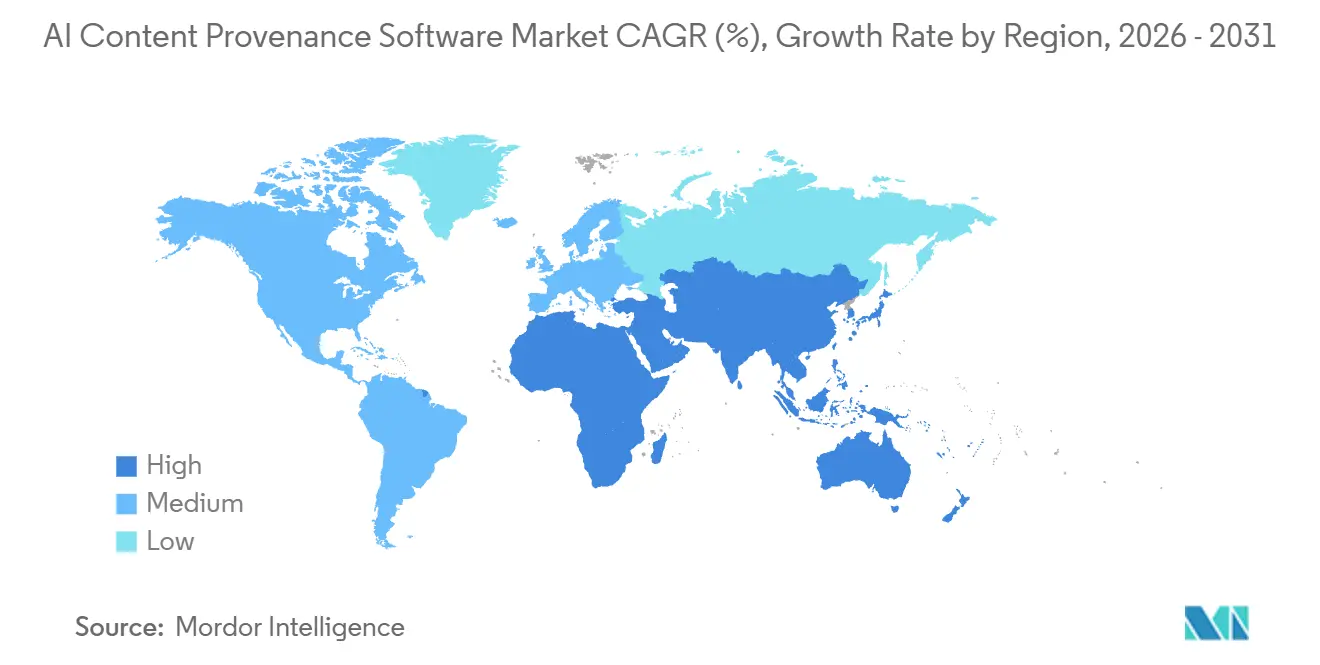
| Fastest Growing Market | Asia-Pacific |
| Largest Market | North America |
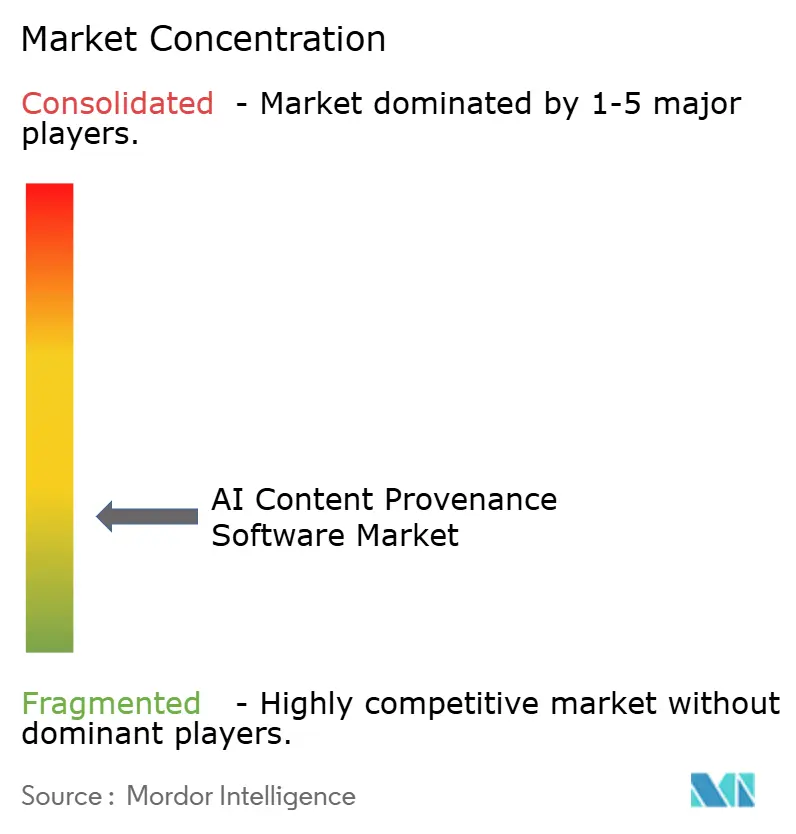
| Market Concentration | Low |
Major Players *Disclaimer: Major Players sorted in no particular order Image © Mordor Intelligence. Reuse requires attribution under CC BY 4.0. | |
AI Content Provenance Software Market Analysis by Mordor Intelligence
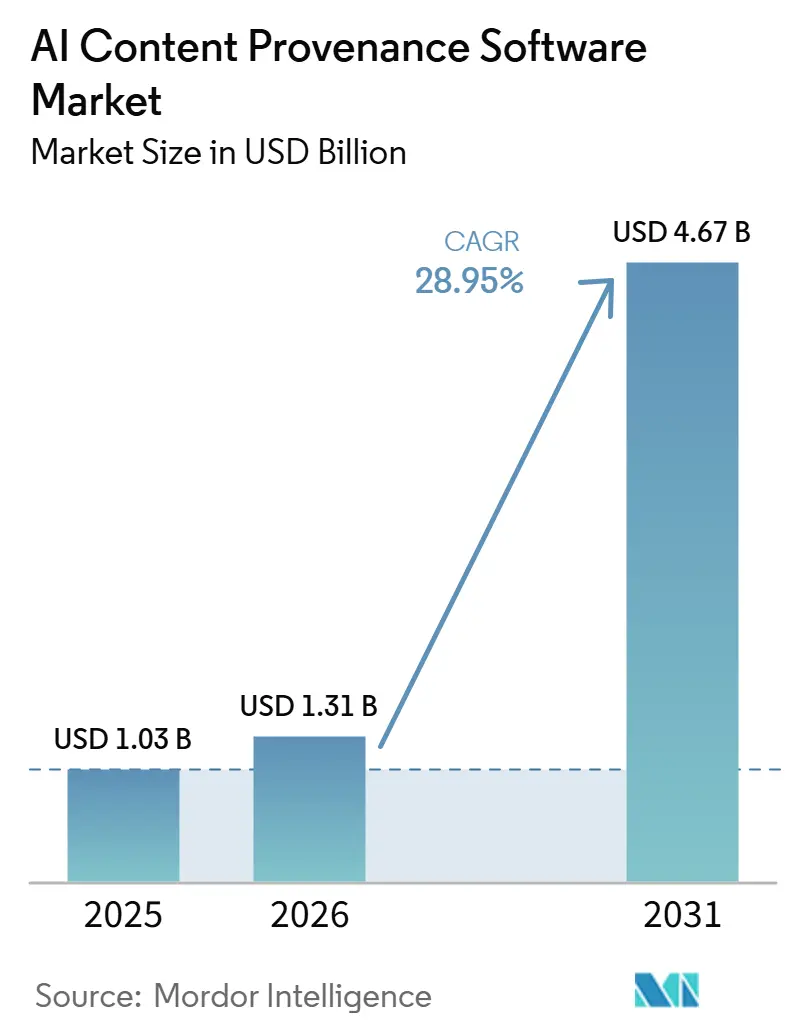
The AI Content Provenance Software Market size is expected to grow from USD 1.03 billion in 2025 to USD 1.31 billion in 2026 and is forecast to reach USD 4.67 billion by 2031 at 28.95% CAGR over 2026-2031. Demand is rising as synthetic media creates operational, fraud, and reputation risks for organizations that publish or rely on digital content. Regulatory obligations in major economies are also making machine-readable disclosure a more immediate requirement. Buyers increasingly need tools that establish where content originated, whether it was changed, and which system produced it. This is moving the AI Content Provenance Software Market from a trust-focused purchase toward a compliance and governance priority. Vendors are responding with combined capabilities for signing, watermarking, detection, verification, and auditable content histories.
Key Report Takeaways
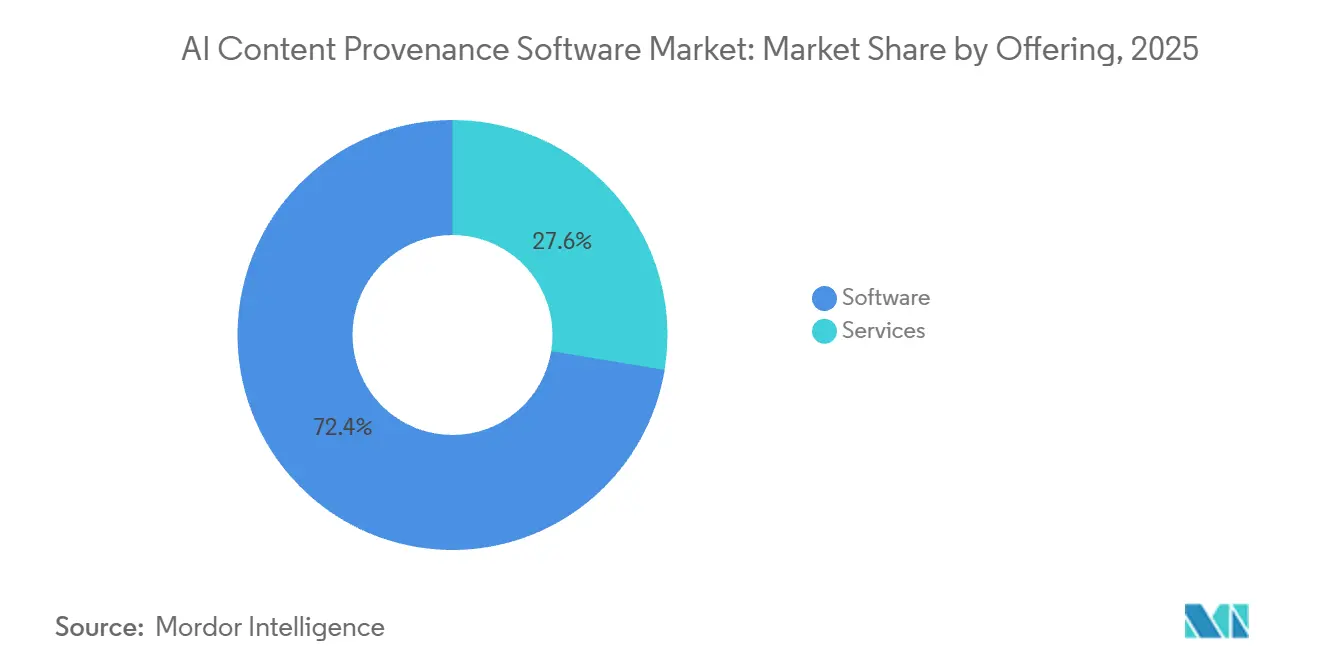
- By offering, software held 72.41% revenue share in the AI Content Provenance Software Market in 2025, while services are projected to expand at a 30.82% CAGR through 2031.
- By deployment model, cloud held 68.19% revenue share in 2025, while hybrid is projected to expand at a 29.74% CAGR through 2031.
- By content type, image held 34.62% revenue share in 2025, while video is projected to expand at a 31.18% CAGR through 2031.
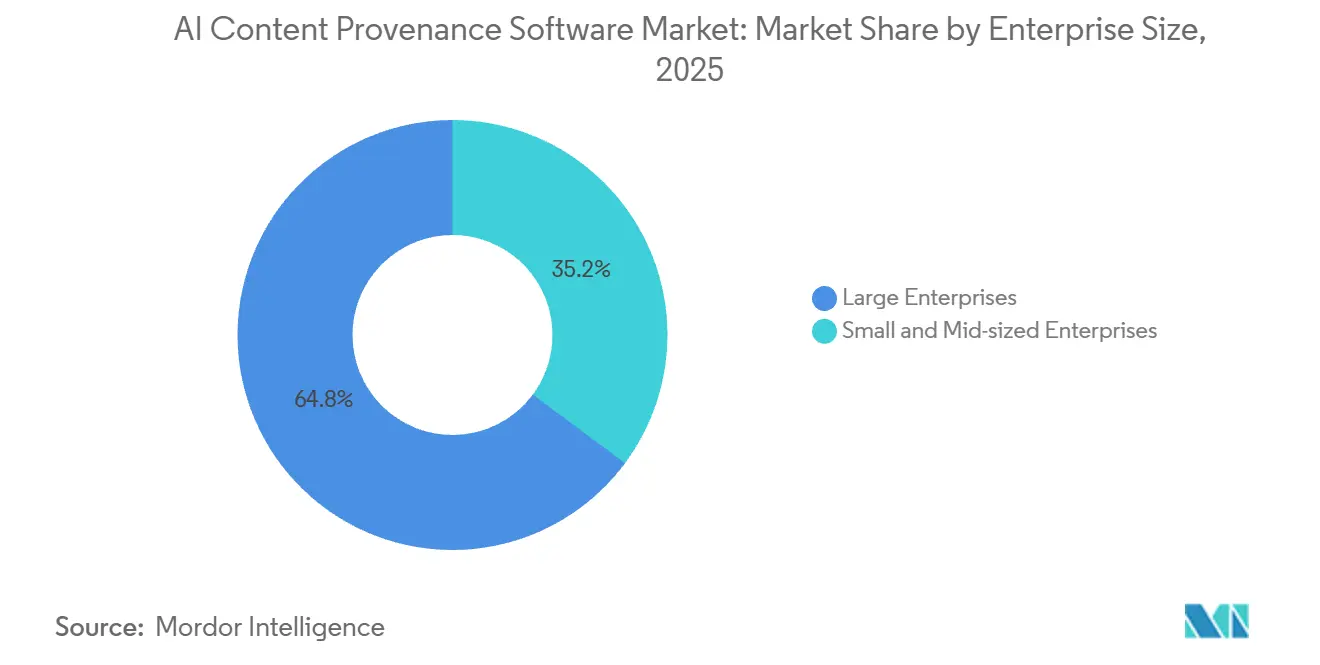
- By enterprise size, large enterprises accounted for 64.83% of revenue share in 2025, while small and mid-sized enterprises are projected to expand at a 30.41% CAGR through 2031.
- By end user, IT and telecommunications accounted for 24.36% of revenue in 2025, while healthcare and life sciences are projected to expand at a 29.63% CAGR through 2031.
- By geography, North America held 34.62% revenue share in 2025, while Asia-Pacific is projected to expand at a 31.24% CAGR through 2031.
Note: Market size and forecast figures in this report are generated using Mordor Intelligence’s proprietary estimation framework, updated with the latest available data and insights as of January 2026.
Market Trends and Insights
Drivers Impact Analysis of AI Content Provenance Software Market*
| Driver | (~) % Impact on CAGR Forecast | Geographic Relevance | Impact Timeline |
|---|---|---|---|
| Machine-Readable AI Disclosure Requirements | +7.2% | Global, immediate in Europe, China, and India, with spillover to Japan, South Korea, the United Kingdom, and Brazil | Short term (≤ 2 years) |
| Deepfake and Synthetic-Media Fraud | +6.8% | Global, concentrated in North America and Asia-Pacific, with spillover to Europe and the Middle East and Africa | Short term (≤ 2 years) |
| C2PA Standardization and Interoperability | +4.3% | Global, strongest in North America, Western Europe, Japan, and South Korea | Medium term (2-4 years) |
| Trusted Enterprise Content Workflows | +4.0% | North America and the European Union, with spillover to Japan, South Korea, and Australia | Medium term (2-4 years) |
| Upstream Provenance in Generative AI Pipelines | +3.2% | Global, concentrated in North America, the United Kingdom, Germany, and Japan | Medium term (2-4 years) |
| Hardware-Backed Capture and Attestation | +2.8% | Global, with early gains in North America, Japan, South Korea, and Germany | Long term (≥ 4 years) |
| Source: Mordor Intelligence | |||
Machine-Readable AI Disclosure Requirements
The European Union's AI Act, Article 50, transparency obligations take effect on August 2, 2026, and require providers to mark certain AI-generated or manipulated content in a machine-readable format. The European Commission published related guidance on July 20, 2026, which places significant emphasis on the implementation choices made by providers and deployers. The rules make content labeling a legal and operational consideration for organizations that use generative tools at scale. The AI Content Provenance Software Market benefits from the fact that signing, labeling, and verification functions can be built into publishing and review workflows. C2PA is being considered as ISO 22144 and provides an interoperable route for organizations that need to document content origin and changes.[1] This common technical foundation can reduce the burden of supporting different requirements across jurisdictions.
Deepfake and Synthetic-Media Fraud
The FBI recorded 22,364 complaints involving AI-enabled fraud and USD 893 million in adjusted losses in its 2025 annual report, which was published in 2026.[2] These cases show why financial institutions, insurers, and enterprises are treating content authenticity as an operational control. Research has also found that people have difficulty identifying sophisticated deepfake videos without technical support. The AI Content Provenance Software Market, therefore, addresses a gap that manual review cannot reliably close. Detection systems help identify suspicious content after creation, while provenance records can provide evidence of trusted creation and modification. This combination is becoming more relevant in workflows involving payments, customer service, executive communications, and patient-facing information.
C2PA Standardization and Interoperability
C2PA released Content Credentials 2.3 on February 9, 2026, adding support for live video through CMAF segment signing, plain-text files, OGG Vorbis audio, and cloud manifests. The association later published version 2.4, which continued the work on provenance capabilities and broader file coverage. These updates matter because the AI Content Provenance Software Market serves content environments that increasingly include images, video, audio, documents, and code. A shared specification gives buyers a clearer basis for evaluating compatibility across cameras, creative tools, content platforms, and verification services. The C2PA Conformance Program also provides a public means to identify products that have passed conformance testing. This distinction supports procurement teams that need evidence beyond product claims when choosing tools for regulated workflows.
Trusted Enterprise Content Workflows
Organizations are using AI systems to produce reports, contracts, customer communications, and diagnostic outputs. The resulting question is not only whether content is synthetic, but also whether it was authorized and can be traced to a known workflow. Digimarc extended its provenance and verification platform to LangChain, ServiceNow Action Fabric, Salesforce Agentforce, Google Gemini Enterprise Agent Platform, and Microsoft Copilot Studio in June 2026.[3] These integrations allow AI agents to stamp outputs at creation, submit incoming content for verification, and retrieve lineage records for audit work. The AI Content Provenance Software Market is therefore becoming integrated into broader AI governance programs rather than focusing solely on media authentication. Organizations that retain signed histories can support incident review, internal control testing, and documentation needs under AI management systems.
Restraints Impact Analysis of AI Content Provenance Software Market*
| Restraint | (~) % Impact on CAGR Forecast | Geographic Relevance | Impact Timeline |
|---|---|---|---|
| Metadata Stripping and Credential Loss on Platforms | -3.8% | Global, most acute in North America and Asia-Pacific where social platform distribution is dominant | Short term (≤ 2 years) |
| Adversarial Watermark Removal and Model Evasion | -3.2% | Global | Medium term (2-4 years) |
| Integration Cost and Provenance Governance Complexity | -2.5% | Global, most acute for small and mid-sized enterprises and in emerging markets | Medium term (2-4 years) |
| Privacy, Consent, and Cross-Border Data Constraints | -1.8% | Europe, China, and India, with spillover to Brazil and Southeast Asia | Long term (≥ 4 years) |
| Source: Mordor Intelligence | |||
Metadata Stripping and Credential Loss on Platforms
Content credentials can be lost when platforms recompress files or convert them to new formats during upload. This creates a break between the point where an asset is signed and the channels where audiences later view it. The issue limits the value of a provenance record when organizations distribute content through open social platforms. The AI Content Provenance Software Market is responding with layered approaches that pair cryptographic manifests with pixel-level or other durable signals. Those signals can help link altered or recompressed files back to a source record through verification services. Until preservation becomes more consistent across distribution channels, provenance controls remain strongest inside managed enterprise publishing environments.[4]
Adversarial Watermark Removal and Model Evasion
Research published at CVPR 2026 showed that some invisible watermarking approaches can be removed using zero-shot diffusion-based novel-view synthesis. These findings create uncertainty for buyers that expect a single invisible watermark to provide lasting proof of origin. The AI Content Provenance Software Market is responding by combining cryptographic records, visible labels, and imperceptible signals instead of depending on one control. This layered design is more aligned with the need for effective, interoperable, robust, and reliable technical solutions under Article 50. The continuing contest between evasion methods and defensive controls can still lengthen purchasing reviews in technically sophisticated organizations.
*Our forecasts treat driver/restraint impacts as directional, not additive. The impact forecasts reflect baseline growth, mix effects, and variable interactions.
AI Content Provenance Software Market Segment Analysis
By Offering:
Services Gain Importance as Governance Work ExpandsSoftware held 72.41% of the AI Content Provenance Software Market share in 2025, supported by early deployments of C2PA signing software development kits, watermarking application programming interfaces, and deepfake detection platforms. Large media organizations, financial services firms, and enterprise IT teams adopted these tools to add checks to established content workflows. In many cases, provenance began with a focused technical decision, such as integrating a signing library, deploying a verification interface, or subscribing to a cloud watermarking service. The C2PA Conformance Program reduced part of the vendor review burden by creating a public registry of tested implementations. Software remains the operating layer for creating, storing, inspecting, and verifying content records.
Services are projected to grow at a 30.82% CAGR from 2026 to 2031, as organizations recognize that end-to-end provenance requires more than a standalone product installation. They need to connect capture, signing, storage, editing, publication, and downstream verification without breaking records along the way. Managed signing, certificate lifecycle support, workflow design, and integration consulting address this requirement. The AI content provenance software industry is seeing recurring engagements that combine subscriptions with specialized implementation support across the AI Content Provenance Software Market. This service demand is strongest where internal teams lack experience with cryptographic records, governance processes, or cross-platform content operations.
By Deployment Model:
Hybrid Supports Regulated Content OperationsCloud deployment held 68.19% of the AI Content Provenance Software Market share in 2025, supported by lower initial setup requirements, flexible capacity for changing signing volumes, and vendor-managed certificate infrastructure. Cloud delivery helps teams deploy verification and detection capabilities without maintaining every part of the technical stack. It supports rapid onboarding, central control across distributed users, and updates to detection models without lengthy local deployment cycles. These advantages made cloud systems the primary route for initial software adoption. The model remains useful for organizations that can use external verification services within their data governance policies.
Hybrid deployment is projected to grow at a 29.74% CAGR from 2026 to 2031. Financial services, healthcare, and government users often face data residency, sovereignty, or chain-of-custody conditions that limit full reliance on external services. Hardware-backed capture also introduces a local component, as signing keys can be generated and protected on the device. Truepic stated that its secure media library was embedded in Qualcomm's Snapdragon 8 Elite Gen 5 platform, allowing device-level C2PA Content Credentials at capture. Records can then be checked against cloud certificate authorities, providing the AI Content Provenance Software Market with a hybrid approach for regulated users and a controlled option for defense, intelligence, and legal settings.
By Content Type:
Image Leads While Video Grows FastestImage accounted for 34.62% revenue share in 2025. Image tools benefited from early support for Content Credentials in cameras and creative workflows. This allowed the sector to establish signing and verification practices for high-volume, widely shared digital assets. Hardware-backed image signing also moved provenance beyond purely web-based processes. Organizations use these tools for content authenticity, rights management, claims evidence, and brand protection.
Video is projected to grow at a 31.18% CAGR from 2026 to 2031. C2PA 2.3 added CMAF segment signing for live video, addressing an important technical need for streamed material. Video deepfakes raise the consequences of false executive messages, impersonation, and manipulated evidence. Audio is gaining attention as voice cloning becomes a larger fraud concern, while text and code are emerging provenance needs within the AI Content Provenance Software Market. Research on secure medical image transmission indicates that specialized verticals may require more durable, sector-specific watermarking designs.
By Enterprise Size:
Smaller Organizations Adopt API-Based ToolsLarge enterprises held 64.83% revenue share in 2025 because their content volumes, compliance exposure, and fraud risk created a stronger immediate business case. They also had technical staff and budgets to manage certificate relationships, enterprise integrations, and provenance-preserving publication processes. Global media operations, financial institutions, and large content publishers were among the clearest use cases. Hardware-backed capture and complex approval flows can require resources more readily available in large organizations. This concentration reflects the initial cost and implementation demands of advanced provenance programs.
Small and mid-sized enterprises are projected to grow at a 30.41% CAGR from 2026 to 2031. Application programming interface-based delivery, tiered pricing, and managed services reduce the need for a dedicated provenance engineering team. Reality Defender introduced a developer application programming interface with a free tier of 50 detections per month in 2026, while GPTZero offered individual plans at USD 10 per month before its acquisition by Superhuman. These models show how vendors are adapting services for smaller teams with limited technical capacity in the AI Content Provenance Software Market. As packaged compliance modules mature, the gap in total ownership cost between large enterprises and smaller organizations may narrow.
By End Users:
IT and Telecommunication Leads as Healthcare ExpandsIT and telecommunications accounted for 24.36% of revenue in 2025. The sector faces synthetic media risks in contact centers, customer interactions, enterprise communications, and internal digital workflows. It also embeds verification functions into platforms used by other sectors. Pindrop reported that its Pulse platform was deployed in contact center environments and ranked first in the ACM MM Deepfake Detection Challenge 2025 for video detection. These uses show how provenance and detection tools can serve as controls within the broader communications infrastructure.
Healthcare and life sciences are projected to expand at a 29.63% CAGR from 2026 to 2031. Clinical documentation, diagnostic content, and patient communications create a need to determine whether material was generated, changed, or approved by a trusted party. HL7's January 2026 ballot treats AI Provenance as a distinct resource within its AI Transparency on FHIR work. Pindrop expanded its deepfake detection and identity verification offering into HIPAA-regulated healthcare environments in February 2026. BFSI, retail, automotive, transportation, and manufacturing are further opportunities for identity controls, product imagery, document authentication, and supply chain data integrity across the AI Content Provenance Software Market.
Geography Analysis
North America AI Content Provenance Software Market
North America accounted for 34.62% revenue share in 2025. The region has early commercial deployments in media, insurance, and financial services, where content fraud can have direct financial consequences. The FBI reported USD 893 million in adjusted losses connected to AI-enabled fraud in its 2025 annual report. This risk has supported procurement by firms that manage high-value digital assets and customer interactions. Truepic announced an integration with Cotality in June 2026 to enable verified virtual property inspections for home and construction lending.
Europe AI Content Provenance Software Market
Europe is a major demand center because the European Union AI Act creates a direct transparency requirement for certain AI-generated content. Article 50 obligations take effect on August 2, 2026, and the Commission published implementation guidance in July 2026. Germany's implementation process has established the Federal Network Agency as the central authority for the enforcement of the AI Act. In France, dpa Picture Alliance selected IMATAG as its preferred invisible watermarking technology in May 2026. The United Kingdom's AI Safety Institute and sector regulators are developing voluntary work that aligns with C2PA.
APAC, South America and MEA AI Content Provenance Software Market
Asia-Pacific is projected to grow at a 31.24% CAGR from 2026 to 2031. Japan's AI Promotion Act, enacted on May 28, 2025, established an AI Strategic Headquarters and a national AI strategy. Japan's Ministry of Economy, Trade, and Industry began a Digital Trustmark pilot for business-to-business platforms on July 15, 2026. India, South Korea, Southeast Asia, South America, and the Middle East and Africa are at different stages of interest in AI transparency and content disclosure.
Competitive Landscape
The AI Content Provenance Software Market is fragmented, with providers competing in capture-time attestation, watermarking, deepfake detection, and audit records. No provider has a dominant position across all content types and deployment settings. Digimarc extended its platform to LangChain, ServiceNow Action Fabric, Salesforce Agentforce, Google Gemini Enterprise Agent Platform, and Microsoft Copilot Studio in June 2026. This move brings stamping, verification, and lineage retrieval closer to the systems that create automated content. Truepic is positioned at the device layer through its work with Qualcomm on secure media capture.
IMATAG has a focused role in invisible watermarking for visual media, including uses where files may be compressed, cropped, or converted. Its selection by dpa Picture Alliance in May 2026 showed demand for rights and authenticity controls in a major image catalog. IMATAG also partnered with PIXRAY to connect invisible watermarking with rights enforcement for non-exclusive imagery. Pindrop is pursuing a specialized strategy in audio deepfake detection and contact center security. Its Zoom Contact Center integration embedded real-time deepfake detection, passive voice authentication, and fraud intelligence.
Platform-oriented companies are integrating provenance functions into the AI systems where content is created and decisions are made. Digimarc introduced a Model Context Protocol server in May 2026 for compatible systems to stamp, verify, log, and retrieve provenance data. The AI Content Provenance Software Market has room for cross-modal orchestration that links image, audio, video, text, and code into a single auditable chain. ISO/IEC 42001 and European Union documentation requirements are encouraging vendors to expand beyond standalone detection and watermarking products.
AI Content Provenance Software Industry Leaders
-
Adobe Inc.
-
Digimarc Corporation
-
Truepic, Inc.
-
Microsoft Corporation
-
Google LLC
- *Disclaimer: Major Players sorted in no particular order
AI Content Provenance Software Market Companies Covered in this Report
- Truepic, Inc.
- Attestiv, Inc.
- OriginStamp GmbH
- Serelay Ltd
- Digimarc Corporation
- Reality Defender, Inc.
- Sensity AI
- Hive Technology, Inc.
- Copyleaks, Inc.
- GPTZero, Inc.
- Originality.ai Inc.
- Turnitin, LLC
- Imatag SAS
- Verimatrix, Inc.
- Irdeto B.V.
- Synamedia Limited
- Nagra Kudelski SA
- Pindrop Security, Inc.
- Sightengine SAS
- DeepMedia AI, Inc.
- Polygraf AI, Inc.
- Veraquo GmbH
Recent Industry Developments in AI Content Provenance Software Market
- July 2026: IMATAG and ImageRights International announced a partnership joining the IMATAG Copyright Enforcement Partner Program, enabling organizations to pursue legal copyright enforcement against unauthorized use of watermarked visual content. The integration connects IMATAG's pixel-embedded watermark tracking directly to ImageRights' enforcement service for news agencies and stock libraries.
- July 2026: Digimarc extended its agent-native provenance and verification platform to LangChain, ServiceNow Action Fabric, Salesforce Agentforce, Google Gemini Enterprise Agent Platform, and Microsoft Copilot Studio. The integrations expose cryptographic stamping, multi-layered verification, and Lineage Vault retrieval as native capabilities within autonomous workflow architectures.
- June 2026: Copyleaks and Instructure announced a top-tier strategic sales partnership designating Copyleaks as the exclusive AI and text-matching partner for the Canvas learning management system. Instructure's global sales organization will offer Copyleaks solutions to K-12 and higher education institutions worldwide.
- June 2026: Truepic announced a strategic integration with Cotality for verified virtual property inspections in home equity evaluations, 1004D final inspection alternatives, and construction and renovation draws. The service became available within Cotality's Mercury Network and Collateral Management System platforms for mortgage lenders nationwide.
Global AI Content Provenance Software Market Report Scope
The AI content provenance software market refers to the ecosystem of software solutions and associated services designed to track, verify, and authenticate the origin, ownership, and modification history of digital content, particularly AI-generated or AI-altered media. This market encompasses tools that embed cryptographic metadata, digital watermarks, and standardized content credentials (such as C2PA) to establish an immutable chain of custody for various content types, including images, video, audio, and text. Deployed via cloud, hybrid, or on-premises models, these solutions cater to organizations of all sizes across industries such as media, BFSI, healthcare, and IT. By providing transparency into whether content is human-made, AI-generated, or manipulated, AI content-provenance software helps enterprises combat deepfakes, mitigate the spread of misinformation, protect intellectual property rights, ensure regulatory compliance, and maintain consumer trust in an increasingly AI-driven digital landscape.
The AI Content Provenance Software Market Report is Segmented by Offering (Software, and Services), Deployment Model (Cloud, Hybrid, and On-Premises), Content Type (Image, Video, Audio, Documents, and Text and Code), Enterprise Size (Large Enterprises, and Small and Mid-sized Enterprises), End Users (IT and Telecommunication, BFSI, Automotive and Transportation, Healthcare and Life Sciences, Retail and E-Commerce, Industrial Manufacturing, and Other End-Users), and Geography (North America, South America, Europe, Asia-Pacific, and Middle East and Africa). The Market Forecasts are Provided in Terms of Value (USD).
Segmentation Overview
| Software |
| Services |
| Cloud |
| Hybrid |
| On-Premises |
| Image |
| Video |
| Audio |
| Documents |
| Text and Code |
| Large Enterprises |
| Small and Mid-sized Enterprises |
| IT and Telecommunication |
| BFSI |
| Automotive and Transportation |
| Healthcare and Life Sciences |
| Retail and E-Commerce |
| Industrial Manufacturing |
| Other End-Users |
| North America | United States | |
| Canada | ||
| Mexico | ||
| South America | Brazil | |
| Argentina | ||
| Rest of South America | ||
| Europe | Germany | |
| United Kingdom | ||
| France | ||
| Russia | ||
| Spain | ||
| Rest of Europe | ||
| Asia-Pacific | China | |
| Japan | ||
| India | ||
| South Korea | ||
| Southeast Asia | ||
| Rest of Asia-Pacific | ||
| Middle East and Africa | Middle East | Saudi Arabia |
| United Arab Emirates | ||
| Rest of Middle East | ||
| Africa | South Africa | |
| Nigeria | ||
| Rest of Africa | ||
| By Offering | Software | ||
| Services | |||
| By Deployment Model | Cloud | ||
| Hybrid | |||
| On-Premises | |||
| By Content Type | Image | ||
| Video | |||
| Audio | |||
| Documents | |||
| Text and Code | |||
| By Enterprise Size | Large Enterprises | ||
| Small and Mid-sized Enterprises | |||
| By End Users | IT and Telecommunication | ||
| BFSI | |||
| Automotive and Transportation | |||
| Healthcare and Life Sciences | |||
| Retail and E-Commerce | |||
| Industrial Manufacturing | |||
| Other End-Users | |||
| By Geography | North America | United States | |
| Canada | |||
| Mexico | |||
| South America | Brazil | ||
| Argentina | |||
| Rest of South America | |||
| Europe | Germany | ||
| United Kingdom | |||
| France | |||
| Russia | |||
| Spain | |||
| Rest of Europe | |||
| Asia-Pacific | China | ||
| Japan | |||
| India | |||
| South Korea | |||
| Southeast Asia | |||
| Rest of Asia-Pacific | |||
| Middle East and Africa | Middle East | Saudi Arabia | |
| United Arab Emirates | |||
| Rest of Middle East | |||
| Africa | South Africa | ||
| Nigeria | |||
| Rest of Africa | |||
Key Questions Answered in the Report
What is the AI Content Provenance Software Market size?
It is expected to grow from USD 1.03 billion in 2025 to USD 4.67 billion by 2031, at a 28.95% CAGR.
What is driving demand for AI content provenance software?
Fraud risks and disclosure rules are increasing demand for signing, verification, and audit tools.
Which offering has the largest share in this sector?
Software led with a 72.41% share in 2025.
Which deployment approach is growing fastest?
Hybrid is projected to grow at a 29.74% CAGR through 2031.
Which region is expected to grow fastest?
Asia-Pacific is projected to grow at a 31.24% CAGR through 2031.
Why do healthcare organizations use provenance tools?
They support records for clinical content, patient communications, and AI-enabled workflows.