
Agricultural Technical Textile Market Size and Share
Market Overview
| Study Period | 2021 - 2032 |
|---|---|
| Market Size (2027) | USD 19.40 Billion |
| Market Size (2032) | USD 24.76 Billion |
| Growth Rate (2027 - 2032) | 5.00 % |
| Fastest Growing Market | Middle East and Africa |
| Largest Market | Asia-Pacific |
| Market Concentration | Low |
Major Players *Disclaimer: Major Players sorted in no particular order Image © Mordor Intelligence. Reuse requires attribution under CC BY 4.0. | |
Agricultural Technical Textile Market Analysis by Mordor Intelligence
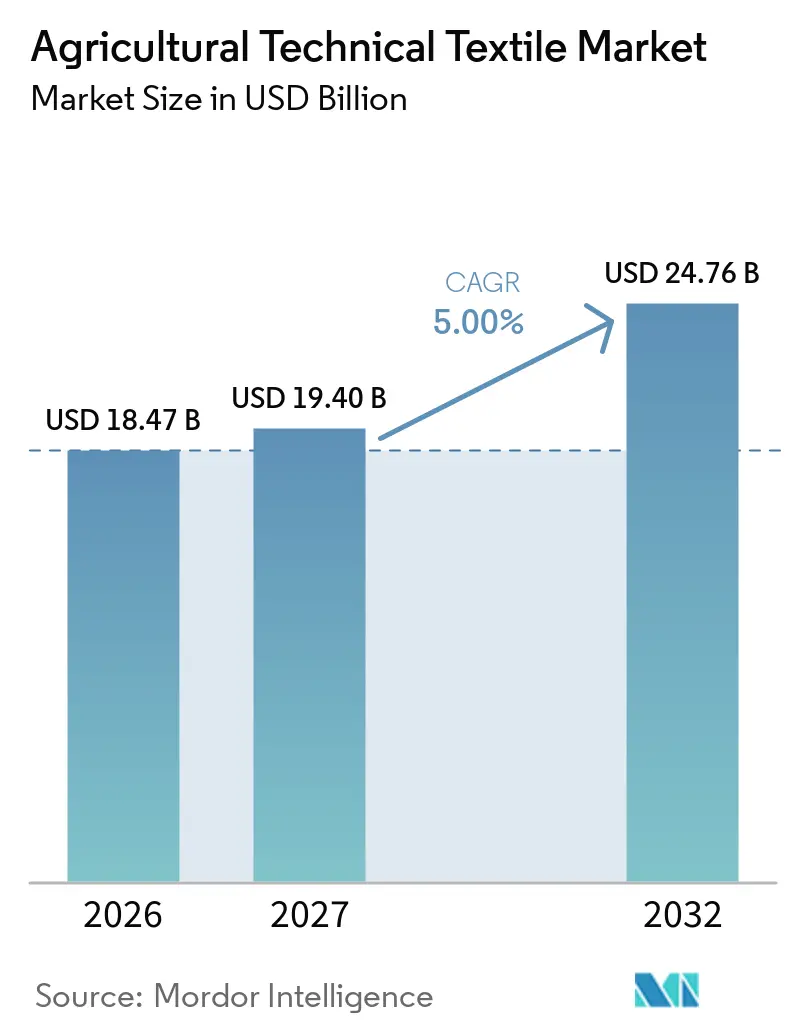
The Agricultural Technical Textile Market size is projected to expand from USD 18.47 billion in 2026 and USD 19.40 billion in 2027 to USD 24.76 billion by 2032, registering a CAGR of 5% between 2027 and 2032.
The agricultural technical textile market is gaining prominence due to the increasing adoption of protected cultivation, commercial horticulture, and physical crop protection practices. Growing exposure to unpredictable weather conditions, crop losses, and pest pressure is encouraging growers to use agricultural nets, crop covers, shade nets, and insect-proof screens, particularly for high-value crops. These textiles help regulate sunlight, temperature, moisture, and airflow while reducing direct exposure to pests and other external stressors. The market also benefits from growing interest in integrated pest management, as exclusion nets and other physical barriers can reduce reliance on certain chemical crop protection methods. Manufacturers are increasingly developing specialized textile solutions that combine light management, heat control, insect exclusion, and improved water-use efficiency to address diverse cultivation requirements. However, fluctuations in polymer raw material prices, limited access to financing for small-scale growers, plastic waste management obligations, and degradation caused by prolonged ultraviolet radiation exposure constrain market adoption. These factors affect product durability, replacement frequency, lifecycle costs, and the overall affordability of agricultural technical textiles.
Key Report Takeaways
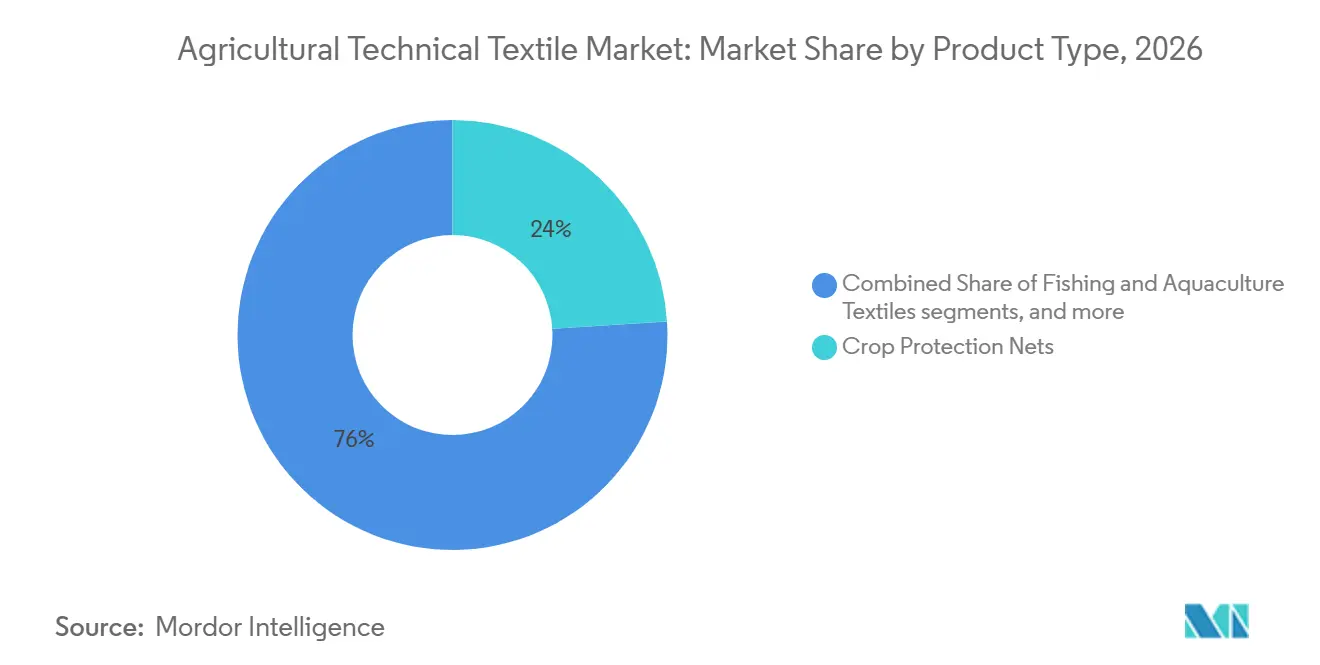
- By product type, crop protection nets accounted for 24% of the agricultural technical textile market share in 2026, while agricultural shade nets and greenhouse climate screens are projected to be the fastest-growing, registering a 7.2% CAGR through 2032.
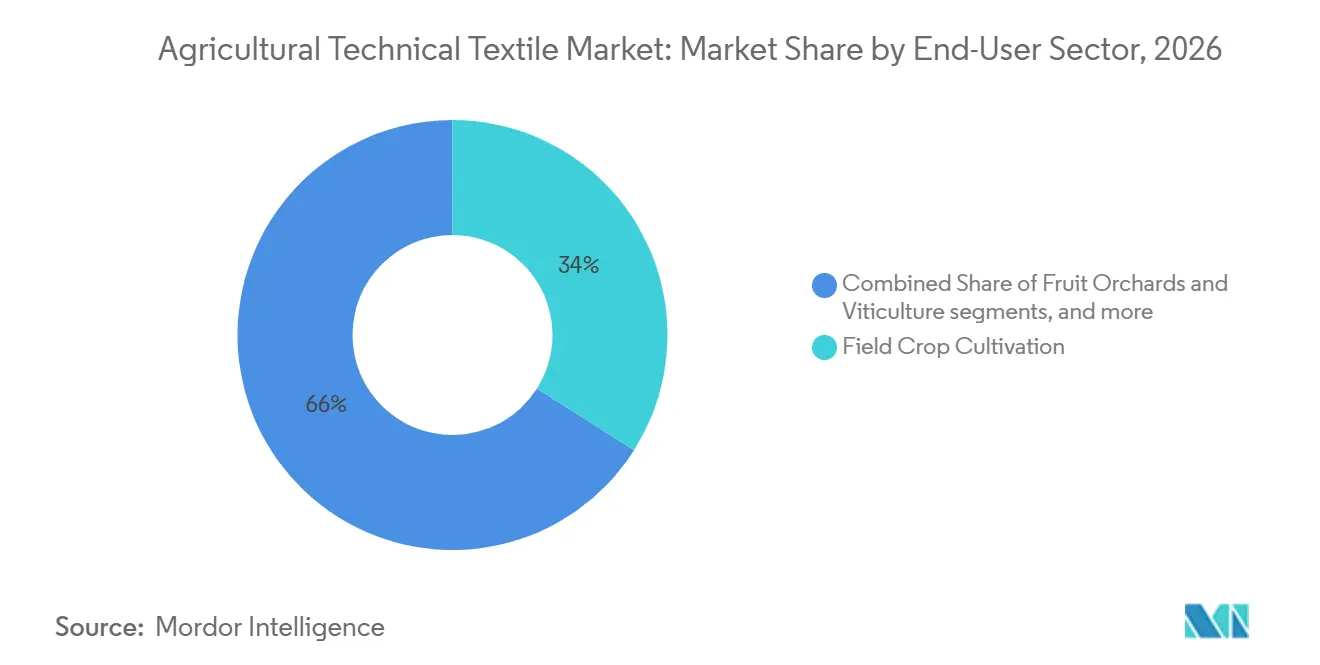
- By end-use sector, field crop cultivation accounted for 34% of the agricultural technical textile market size in 2026, while vegetable, floriculture, and nursery cultivation are projected to be the fastest-growing end-use sector, registering a 7.0% CAGR through 2032.
- By geography, Asia-Pacific accounted for 46% of the global revenue share in 2026, while the Middle East and Africa is projected to grow at a 6.5% CAGR through 2032.
Note: Market numbers in this report are based on Mordor Intelligence's proprietary estimation framework, which combines nine months of actuals with Q4 projections for base year 2026.
Global Agricultural Technical Textile Market Trends and Insights
Drivers Impact Analysis*
| Driver | (~) % Impact on CAGR Forecast | Geographic Relevance | Impact Timeline |
|---|---|---|---|
| Protected Cultivation and Commercial Horticulture | +1.2% | Global, concentrated in Asia-Pacific, EU, and MEA | Medium term (2-4 years) |
| Increasing Crop Losses from Extreme Weather and Pest Infestations | +0.9% | Global, with highest exposure in Asia and Sub-Saharan Africa | Short term (≤ 2 years) |
| Growing Adoption of Integrated Pest Management and Non-Chemical Crop Protection | +0.8% | EU, North America, and emerging South and Southeast Asian markets | Medium term (2-4 years) |
| Protected Cultivation and Agricultural Modernization Incentives | +0.7% | India, EU, Brazil, and MEA Gulf states | Medium term (2-4 years) |
| Crop Protection and Yield Improvement in High-Value Agriculture | +0.6% | North America, EU, Asia-Pacific, and MEA | Long term (≥ 4 years) |
| Mechanization of Forage Harvesting and Baling | +0.4% | North America, EU, Argentina, and Australia | Medium term (2-4 years) |
| Source: Mordor Intelligence | |||
Protected Cultivation and Commercial Horticulture
Protected cultivation is a central demand base for the agricultural technical textile market because net houses and greenhouses need screens, insect barriers, and covers. The agricultural technical textile market serves both basic structures and climate-controlled facilities, although product requirements differ by technology level. Plastic structures in Asia and Africa generally require large volumes of practical textile components, while advanced installations require better control of light and heat. Growers operating larger facilities also need screens that work with automated climate systems and drive equipment. This creates room for suppliers that can document performance and support installers in emerging protected-cultivation locations. Product selection also depends on crop value, local weather, and the operational capability of the farm.
Increasing Crop Losses from Extreme Weather and Pest Infestations
Crop losses from weather events and pests are strengthening the case for durable physical protection in the agricultural technical textile market. Food and Agriculture Organization reported in 2025 that disasters had caused USD 3.26 trillion in agricultural losses over three decades, with fruits and vegetables among the affected products.[1] A 2025 scientific review found that warming can increase insect pest damage in wheat, rice, and maize by changing pest ranges and reproductive cycles. Anti-hail, windbreak, and insect-exclusion nets can protect high-value crops through several seasons when they are correctly specified and installed. The agricultural technical textile market therefore gains relevance where growers need protection that addresses weather exposure and invasive pest risk at the same time. Reliable installation is important because poorly fitted nets may not deliver the expected protection.
Growing Adoption of Integrated Pest Management and Non-Chemical Crop Protection
Integrated pest management is increasing interest in exclusion nets, physical covers, and systems that can operate alongside biological controls. The European Commission continues to position lower pesticide use as an objective under its Farm to Fork Strategy. Food and Agriculture Organization reported in 2025 that biological control in Tanzania reduced fall armyworm infestation by more than 80% and increased maize yields by 45%. These approaches raise the importance of mesh size, durability, and ultraviolet stabilization for export-oriented farms. The agricultural technical textile market can benefit as physical protection becomes part of crop-management and compliance plans rather than a discretionary farm purchase. It can also reduce dependence on repeated chemical interventions in sensitive horticultural settings.
Protected Cultivation and Agricultural Modernization Incentives
Government programs are lowering investment barriers for protected cultivation and agricultural modernization in selected countries. India’s Ministry of Textiles reported in 2025 that 14 agrotextile research projects had been approved and that 576 farmers had received training at the Climate-Smart Agro-Textile Demonstration Centre in Gujarat.[2] The center uses monitoring tools for soil moisture, temperature, humidity, and crop yield. The agricultural technical textile market can benefit when such programs show growers how shade nets, mulch products, insect nets, and anti-hail systems work in local conditions. Public support also increases attention to performance standards, which can favor suppliers with documented product quality. Demonstration farms can shorten the learning curve for growers considering these products.
Restraints Impact Analysis*
| Restraint | (~) % Impact on CAGR Forecast | Geographic Relevance | Impact Timeline |
|---|---|---|---|
| Polyethylene and Polypropylene Price Fluctuations | -1% | Global, with high sensitivity in Asia-Pacific and EU-based converters | Short term (≤ 2 years) |
| High Initial Cost and Smallholder Affordability Limits | -0.8% | Sub-Saharan Africa, South and Southeast Asia, and South America | Long term (≥ 4 years) |
| Agricultural Plastic Waste and Recycling Challenges | -0.6% | EU, North America, and Asia-Pacific with growing regulatory exposure | Medium term (2-4 years) |
| Ultraviolet Degradation in Extreme Conditions | -0.4% | MEA, South Asia, and tropical Asia-Pacific | Medium term (2-4 years) |
| Source: Mordor Intelligence | |||
Polyethylene and Polypropylene Price Fluctuations
Polyethylene and polypropylene are important inputs for nets, mulch products, and covers, so changes in feedstock costs can quickly affect converter margins. The World Bank identified continued uncertainty in commodity markets in its 2025 outlook. The United States Energy Information Administration also reported ongoing uncertainty in energy and petrochemical market conditions during 2025.[3] The agricultural technical textile market faces pressure when processors must absorb higher resin costs or pass them to price-sensitive farmers. This can delay purchasing decisions and reduce funding available for new capacity or material development. Price changes are especially difficult for suppliers serving farms with limited ability to absorb cost increases.
High Initial Cost and Smallholder Affordability Limits
Initial installation costs can prevent smallholder farmers from adopting shade-net, anti-hail, and other supported protection systems. A 2025 World Bank paper identified high upfront costs, limited credit access, collateral limits, and repayment schedules that do not match farm income cycles as persistent barriers to technology adoption. FAO has also noted that farmers with more resources can capture a disproportionate share of finance-related benefits. The agricultural technical textile market needs financing structures that recognize the productivity value of protected cultivation and physical crop protection. Better links between growers, buyers, and lenders could make these purchases more accessible without relying only on lower product prices. Installation support and predictable crop sales can also improve the case for agricultural lending.
*Our forecasts treat driver/restraint impacts as directional, not additive. The impact forecasts reflect baseline growth, mix effects, and variable interactions.
Segment Analysis
By Product Type: Crop Protection Nets Hold the Largest Position
Crop protection nets held 24% of the agricultural technical textile market share in 2026. Their position reflects use across open-field vegetables, orchards, vineyards, and aquaculture ponds. Anti-insect, anti-hail, anti-bird, and windbreak variants protect crops against several forms of production risk. Demand is becoming more specification-led, where growers serve export markets or work under integrated pest-management programs. This keeps mesh precision and ultraviolet durability important in supplier selection.
Agricultural shade nets and greenhouse climate screens are the fastest-growing product category, registering a 7.2% CAGR through 2032. These products benefit from expansion in protected cultivation and interest in reflective and light-diffusing materials. Crop covers and plant protection fleece continue to support season extension and nonchemical production methods in temperate regions. Mulch mats, ground covers, nursery textiles, forestry textiles, and harvesting products serve field preparation and post-harvest tasks. Fishing and aquaculture textiles provide an additional product base in commercial aquaculture locations.

By End-Use Sector: Field Crop Cultivation Holds the Largest Position
Field crop cultivation held 34% of the agricultural technical textile market share in 2026. The segment includes cereal, oilseed, and row-crop production using mulch mats, ground covers, windbreak nets, and lightweight covers. Its large scale comes from extensive crop acreage rather than from high unit prices. Standard products can face intense price competition and volume-based purchasing. Suppliers therefore need efficient production, reliable distribution, and practical product performance.
Vegetable, floriculture, and nursery cultivation is the fastest-growing end-use sector, registering a 7.0% CAGR through 2032. The segment is supported by export-oriented greenhouse production in Morocco, Kenya, Vietnam, and Ecuador, where buyers require phytosanitary control. Flower production can support investment in shade and exclusion systems because light and temperature directly affect crop quality and bloom timing. Fruit orchards and viticulture also require protection against hail, frost, insects, and excessive light. The European Commission launched LIFE VINOSHIELD in June 2025 to deploy multifunctional textile nets across vineyards, showing the continued role of physical protection in specialized crops.
Geography Analysis
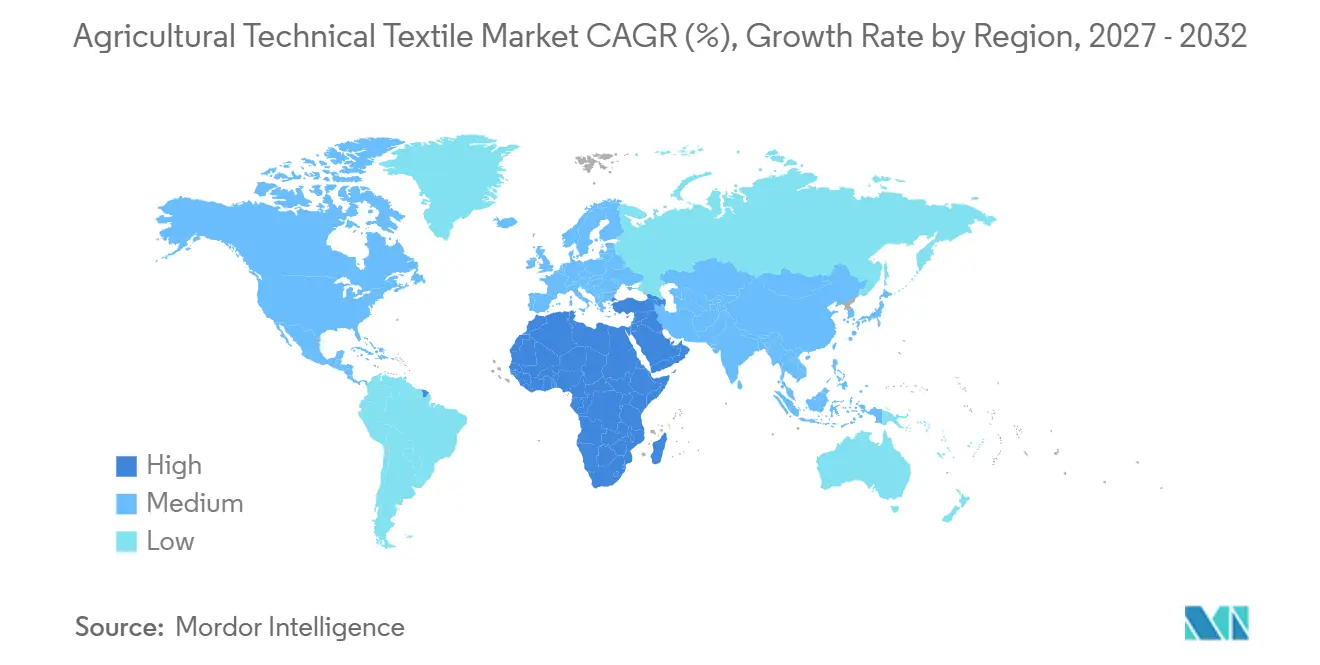
Asia-Pacific accounted for 46% of the global revenue share in 2026. China remains important because its plastic-covered greenhouse footprint is the largest globally. A 2025 satellite-based study estimated China’s covered greenhouse area at 8,224.9 square kilometers, equal to 57.7% of the mapped global total. India is supported by programs that encourage shade-net and polyhouse adoption. Vietnam and Indonesia are expanding protected cultivation for export-oriented vegetables and aquaculture.
Europe is the second-largest regional market and has a strong role in premium greenhouse screens and certified recyclable materials. Producers in the region respond to crop-protection and environmental requirements through higher-performance nets, climate screens, and simpler material structures. EN 18109:2025 is raising attention to recycling and material selection across agricultural plastics. North America grows through mechanized forage operations in the United States and Canada and through protected-cultivation investment in Canada and Mexico.
The Middle East and Africa is projected to be the fastest-growing geography, at a 6.5% CAGR from 2027 to 2032. Water scarcity, food-security priorities, and protected-cultivation investments support demand in Saudi Arabia, the UAE, Morocco, and South Africa. Morocco’s export-oriented greenhouse operations need insect-exclusion nets and ultraviolet-stabilized covers. Saudi Arabia and the UAE favor high-performance screens where heat and ultraviolet exposure are severe. South America also contributes through aquaculture textiles in Chile and forage-related net-wrap demand in Brazil, Chile, and Argentina.
Competitive Landscape
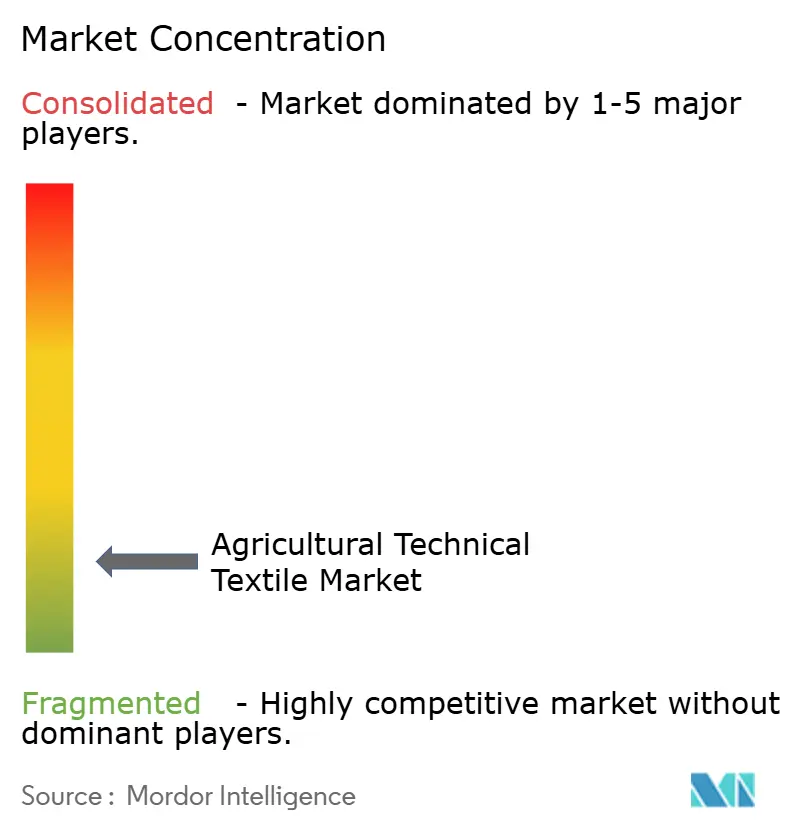
The agricultural technical textile market is fragmented. European specialists compete through certified greenhouse screens, insect nets, and anti-hail systems. Asian producers, particularly in China, compete more strongly in standard shade and mulch products where price is a greater purchasing factor. This division gives buyers a choice between lower-cost materials and higher-value products with documented performance. It also leaves room for specialized suppliers in photo-selective nets, biodegradable mulch textiles, and sensor-supported protection systems.
Competition in the agricultural technical textile market is increasingly tied to multifunctional design and compliance readiness. Producers are developing materials that can diffuse light, exclude insects, and reduce thermal load in a single installation. EN 18109:2025 increases the value of products designed for recycling and can disadvantage smaller converters that cannot update product structures. The European Commission’s LIFE VINOSHIELD project is also advancing the use of multifunctional nets in vineyard protection. John Deere’s round baling automation is a separate equipment move that can support demand for consistent, baler-specific net-wrap products.
The agricultural technical textile market also offers opportunities in aquaculture, protected horticulture, and smallholder-focused crop protection. Copper-treated and anti-biofouling net technologies can differentiate suppliers in aquaculture because they require specialized materials knowledge. Sensor-enabled anti-hail systems may give suppliers a path toward services related to crop conditions and light exposure. The largest unmet need remains affordable, technically validated protection for farms below two hectares in Sub-Saharan Africa and South and Southeast Asia.
Agricultural Technical Textile Industry Leaders
-
Arrigoni Group
-
KARATZIS S.A.
-
Ginegar Plastic Products Ltd.
-
Garware Technical Fibres Limited
-
Tama Group
- *Disclaimer: Major Players sorted in no particular order
Recent Industry Developments
- June 2026: Japanese researchers, in collaboration with Sumitomo Metal Mining, developed Solament AgriCool Shade, an agricultural fabric that blocks heat-generating near-infrared radiation while allowing visible light required for photosynthesis to pass through. The material is currently undergoing field trials across various crops and growing conditions to assess its effectiveness in reducing heat stress.
- August 2025: The European Standards Organisation published EN 18109:2025, the first pan-European standard specifically addressing lifecycle management and design-for-recycling requirements for agricultural plastics, including horticultural nets, twines, and nonwoven fabrics.
- June 2025: The European Commission launched LIFE VINOSHIELD, a project to deploy multifunctional textile nets across vineyards for integrated protection against hail, frost, insects, and excessive irradiation.
Global Agricultural Technical Textile Market Report Scope
The Agricultural Technical Textile Market Report is Segmented by Product Type (Crop Protection Nets, Fishing and Aquaculture Textiles, Crop Covers and Plant Protection Fleece, and More), by End-User Sector (Field Crop Cultivation, Fruit Orchards and Viticulture, and More), and by Geography (Asia-Pacific, Europe, Middle East and Africa, and More). The Report Offers Market Size and Forecasts in Value (USD) for all the Above Segments.
| Crop Protection Nets | Anti-Insect and Pest Protection Nets |
| Anti-Hail and Weather Protection Nets | |
| Anti-Bird and Wildlife Protection Nets | |
| Agricultural Windbreak Nets | |
| Agricultural Shade Nets and Greenhouse Climate Screens | Agricultural Shade Nets |
| Thermo-Reflective and Light-Diffusion Screens | |
| Thermal and Energy-Saving Greenhouse Screens | |
| Greenhouse Blackout and Light-Control Screens | |
| Crop Covers and Plant Protection Fleece | Nonwoven Floating Row Covers |
| Frost and Thermal Protection Textiles | |
| Other Woven and Knitted Crop Covers | |
| Fishing and Aquaculture Textiles | Commercial Fishing Nets |
| Aquaculture Cage and Containment Nets | |
| Specialized Aquaculture Protection Nets | |
| Mulch Mats and Agricultural Ground Covers | |
| Nursery, Plant Support, and Forestry Textiles | |
| Harvesting and Forage Management Textiles | |
| Other Agricultural Technical Textiles |
| Field Crop Cultivation |
| Vegetable, Floriculture and Nursery Cultivation |
| Fruit Orchards and Viticulture |
| Forestry and Landscape Cultivation |
| Livestock and Forage Operations |
| Fisheries and Aquaculture |
| North America | United States |
| Canada | |
| Mexico | |
| Europe | Germany |
| United Kingdom | |
| France | |
| Italy | |
| Spain | |
| Netherlands | |
| Rest of Europe | |
| Asia-Pacific | China |
| Japan | |
| India | |
| South Korea | |
| Taiwan | |
| Australia | |
| Indonesia | |
| Vietnam | |
| Rest of Asia-Pacific | |
| Middle East and Africa | Saudi Arabia |
| United Arab Emirates | |
| Turkey | |
| South Africa | |
| Rest of Middle East and Africa | |
| South America | Brazil |
| Argentina | |
| Chile | |
| Rest of South and Central America |
| By Product Type | Crop Protection Nets | Anti-Insect and Pest Protection Nets |
| Anti-Hail and Weather Protection Nets | ||
| Anti-Bird and Wildlife Protection Nets | ||
| Agricultural Windbreak Nets | ||
| Agricultural Shade Nets and Greenhouse Climate Screens | Agricultural Shade Nets | |
| Thermo-Reflective and Light-Diffusion Screens | ||
| Thermal and Energy-Saving Greenhouse Screens | ||
| Greenhouse Blackout and Light-Control Screens | ||
| Crop Covers and Plant Protection Fleece | Nonwoven Floating Row Covers | |
| Frost and Thermal Protection Textiles | ||
| Other Woven and Knitted Crop Covers | ||
| Fishing and Aquaculture Textiles | Commercial Fishing Nets | |
| Aquaculture Cage and Containment Nets | ||
| Specialized Aquaculture Protection Nets | ||
| Mulch Mats and Agricultural Ground Covers | ||
| Nursery, Plant Support, and Forestry Textiles | ||
| Harvesting and Forage Management Textiles | ||
| Other Agricultural Technical Textiles | ||
| By End-Use Sector | Field Crop Cultivation | |
| Vegetable, Floriculture and Nursery Cultivation | ||
| Fruit Orchards and Viticulture | ||
| Forestry and Landscape Cultivation | ||
| Livestock and Forage Operations | ||
| Fisheries and Aquaculture | ||
| By Geography | North America | United States |
| Canada | ||
| Mexico | ||
| Europe | Germany | |
| United Kingdom | ||
| France | ||
| Italy | ||
| Spain | ||
| Netherlands | ||
| Rest of Europe | ||
| Asia-Pacific | China | |
| Japan | ||
| India | ||
| South Korea | ||
| Taiwan | ||
| Australia | ||
| Indonesia | ||
| Vietnam | ||
| Rest of Asia-Pacific | ||
| Middle East and Africa | Saudi Arabia | |
| United Arab Emirates | ||
| Turkey | ||
| South Africa | ||
| Rest of Middle East and Africa | ||
| South America | Brazil | |
| Argentina | ||
| Chile | ||
| Rest of South and Central America | ||
Key Questions Answered in the Report
What is the projected value of the agricultural technical textile market by 2032?
The agricultural technical textile market is forecast to reach USD 24.76 billion by 2032. Its 5% CAGR reflects demand for protected cultivation, physical crop protection, and higher-value horticulture.
Which product category has the largest share in agricultural technical textiles?
Crop protection nets lead the product mix with a 24% share in 2026. Their wide use across vegetables, orchards, vineyards, and aquaculture supports this position.
Which end-use segment has the greatest demand for agricultural technical textiles?
Field crop cultivation accounts for the largest end-use share at 34% in 2026. It uses mulch mats, ground covers, windbreak nets, and lightweight covers across extensive crop acreage
Which region has the largest agricultural technical textile demand?
Asia-Pacific holds the largest regional share at 46% in 2026. China’s extensive covered greenhouse area and policy-supported adoption in India support regional demand.
Which region is expected to grow the fastest through 2032?
The Middle East and Africa is projected to expand at a 6.5% CAGR from 2027 to 2032. Food-security programs, water scarcity, and protected cultivation investment support this growth.
What limits adoption of agricultural technical textiles among smaller farms?
Upfront installation costs and limited credit access are major barriers. Polymer price changes, recycling requirements, and ultraviolet degradation can add to the cost and performance concerns farmers face.