
Agentic AI Workflow Orchestration Platform Market Size and Share
Market Overview
| Study Period | 2020 - 2031 |
|---|---|
| Market Size (2026) | USD 3.53 Billion |
| Market Size (2031) | USD 14.76 Billion |
| Growth Rate (2026 - 2031) | 33.11 % |
| Fastest Growing Market | Asia-Pacific |
| Largest Market | North America |
| Market Concentration | Medium |
Major Players *Disclaimer: Major Players sorted in no particular order Image © Mordor Intelligence. Reuse requires attribution under CC BY 4.0. | |
Agentic AI Workflow Orchestration Platform Market Analysis by Mordor Intelligence
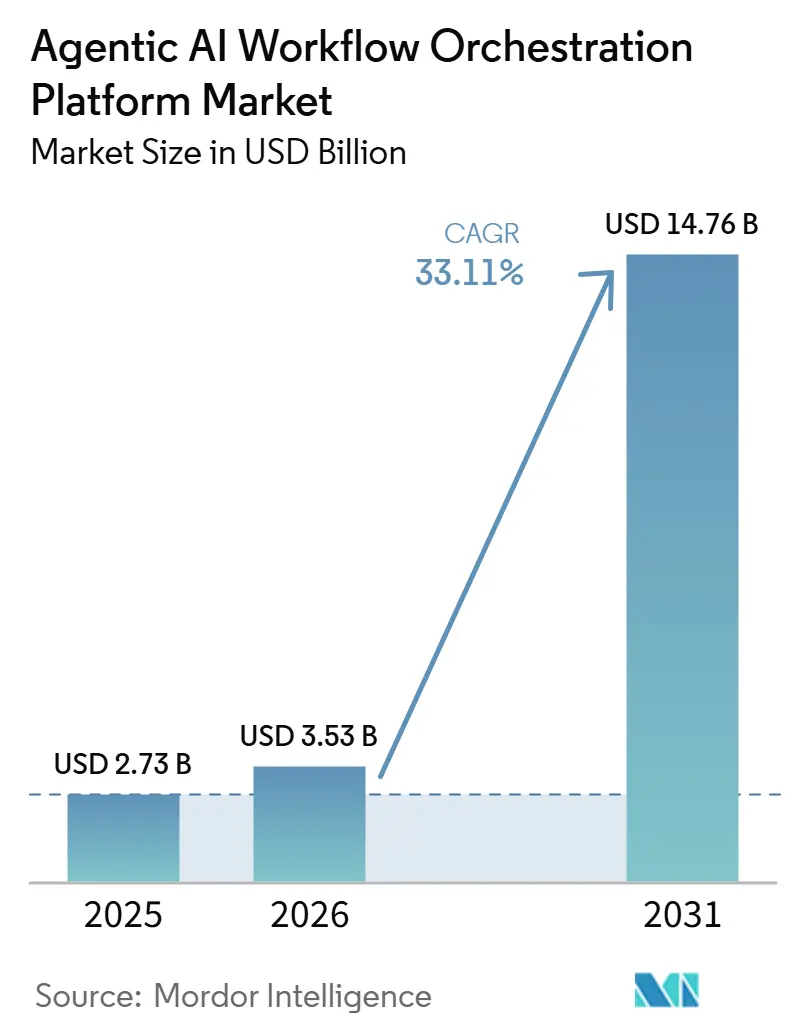
The agentic AI workflow orchestration platform market size is expected to grow from USD 2.73 billion in 2025 to USD 3.53 billion in 2026 and is forecast to reach USD 14.76 billion by 2031 at 33.11% CAGR over 2026-2031. The market is moving quickly as enterprises shift from narrow generative AI assistants toward coordinated systems that can manage full business tasks across multiple applications. Buying decisions are now shaped as much by governance, traceability, and approval controls as by model performance, which is changing how platforms are evaluated and deployed. Demand is also rising because large organizations want orchestration layers that can connect cloud models, internal data, enterprise software, and human review in a single operating flow. Competitive activity shows that major software vendors are embedding orchestration into broader suites, while open frameworks are lowering developer switching costs and widening experimentation. The strongest near-term opportunity lies in enabling enterprises to achieve reliable multi-agent coordination with auditability, while the largest risk remains the operational burden of integrating these systems into live business environments.
Key Report Takeaways
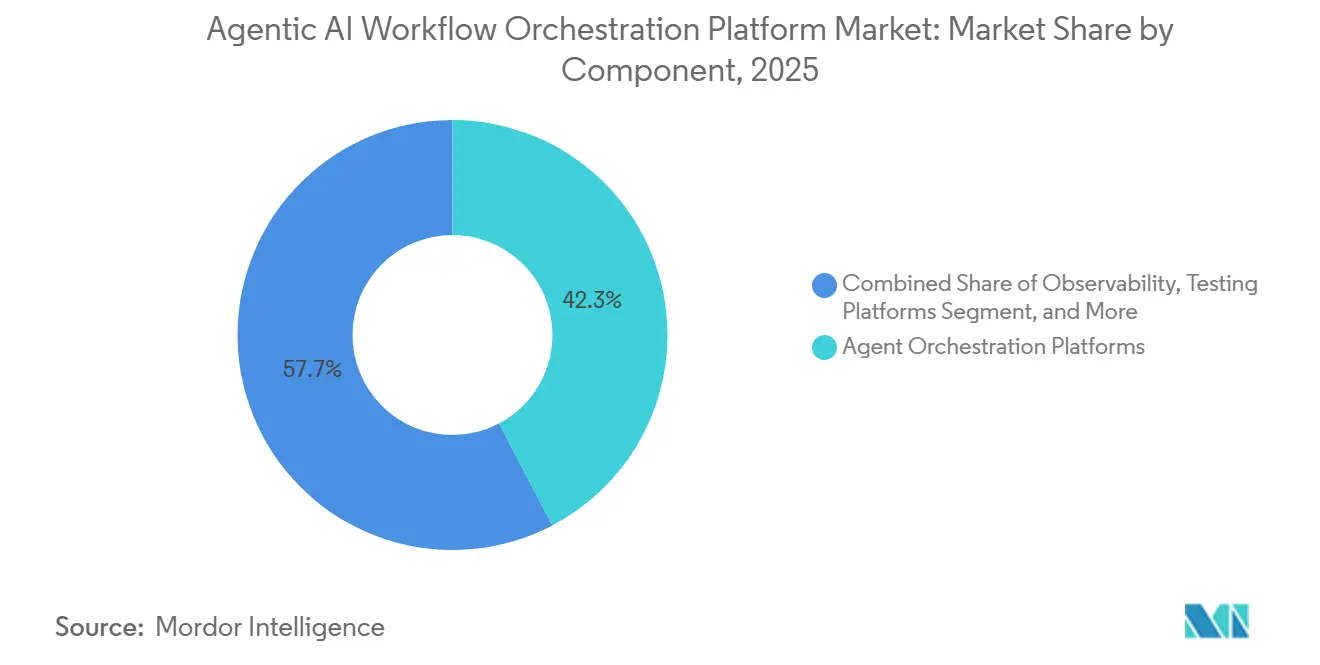
- By component, agent orchestration platforms held the largest share at 42.31% in the agentic AI workflow orchestration platform market 2025, while observability, testing, and governance platforms are projected to expand at a 36.84% CAGR through 2031.
- By deployment type, cloud-based deployments accounted for 74.18% in 2025, while hybrid deployments are expected to record the fastest CAGR of 35.49% through 2031.
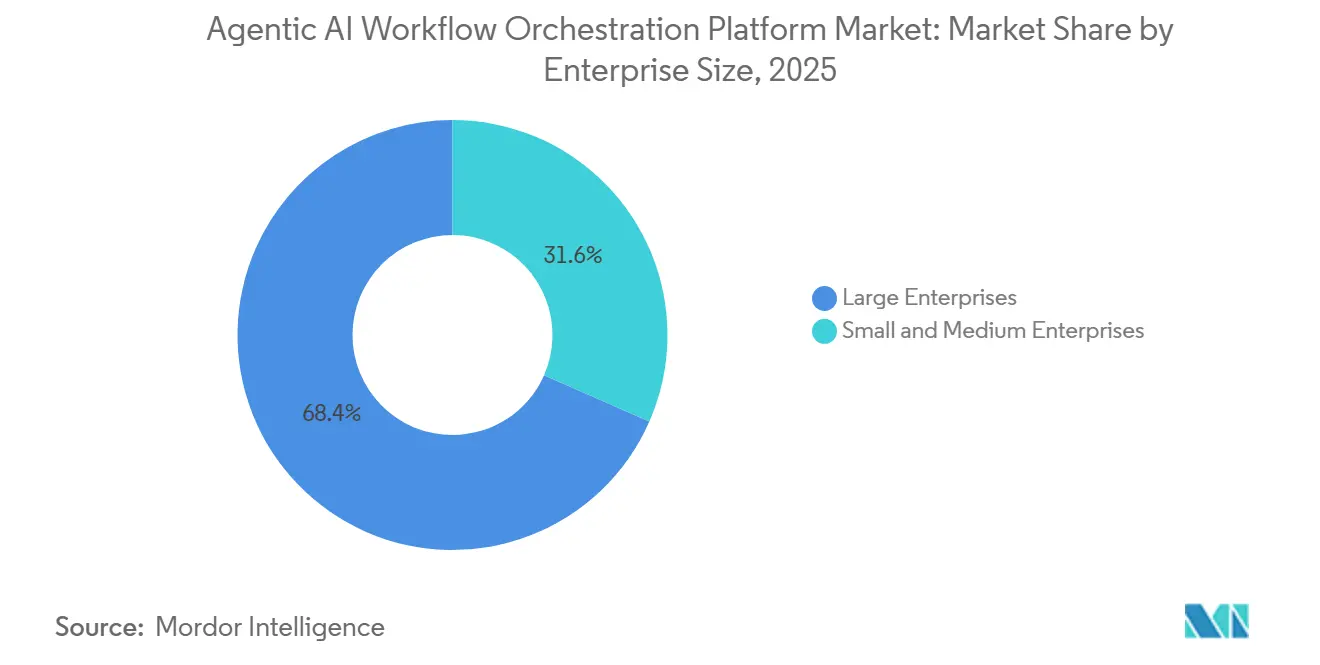
- By enterprise size, large enterprises held 68.42% of the agentic AI workflow orchestration platform market in 2025, while small and medium enterprises are projected to grow at a 37.12% CAGR through 2031.
- By end user, IT and telecommunication led with a 24.86% share in 2025, while healthcare and life sciences are expected to advance at a 36.27% CAGR through 2031.
- By geography, North America held the largest share at 36.73% in 2025, while Asia-Pacific is projected to expand at a 38.41% CAGR through 2031.
Note: Market size and forecast figures in this report are generated using Mordor Intelligence’s proprietary estimation framework, updated with the latest available data and insights as of January 2026.
Market Trends and Insights
Drivers Impact Analysis of Agentic AI Workflow Orchestration Platform Market*
| Driver | (~) % Impact on CAGR Forecast | Geographic Relevance | Impact Timeline |
|---|---|---|---|
| Enterprise Demand for Multi-Agent Task Automation | +7.8% | Global, with North America and Europe as early scaling markets | Short term (≤ 2 years) |
| Governance-Ready Orchestration With Audit Trails and Human Approval Gates | +5.2% | Global, with compliance intensity highest in Europe and North America | Short term (≤ 2 years) |
| Integration of Agentic Orchestration Into Existing SaaS and Cloud Ecosystems | +6.3% | Global, led by North America, with early gains in Asia-Pacific SaaS-heavy enterprises | Medium term (2-4 years) |
| Model Context Protocol and Tool-Calling Standards Improving Interoperability | +4.7% | Global, with strongest relevance in North America, Europe, and East Asia | Short term (≤ 2 years) |
| Proprietary Workflow Data Exhaust Improving Agent Planning Quality | +2.9% | North America and Europe, concentrated in large enterprises with mature data estates | Medium term (2-4 years) |
| Board-Level Pressure to Convert GenAI Proofs Into Measurable Operating Leverage | +3.6% | Global, with highest urgency in publicly listed large enterprises | Short term (≤ 2 years) |
| Source: Mordor Intelligence | |||
Enterprise Demand for Multi-Agent Task Automation Across Core Business Workflows
The main demand signal in the agentic AI workflow orchestration platform market is the shift from single-purpose assistants to coordinated systems capable of completing end-to-end business processes. Enterprises are no longer testing these tools solely for productivity gains in isolated teams; they are linking deployments to revenue, cost control, service speed, and process quality. This shift matters because orchestration becomes more valuable when several agents, tools, and approval steps must work in sequence across live business systems. It also changes buyer expectations, since vendors must support reliability, rollback logic, and clear control over how tasks move between automated and human stages. Organizations that wait for one preferred model provider to define the whole stack risk locking their operations into a narrow runtime that does not fit every workflow. The agentic AI workflow orchestration platform market is therefore gaining traction as enterprises look for a neutral coordination layer that can support multiple models and business functions over time.
Rising Need for Governance-Ready Orchestration With Audit Trails and Human Approval Gates
Governance has become a core buying factor in the agentic AI workflow orchestration platform market because enterprises need clear records of what agents did, why they acted, and where a person approved or stopped a task. Buyers in regulated sectors are placing greater weight on event logging, approval rules, and the separation of control logic from execution logic. A 2026 peer-reviewed study found that governance-driven architectures can create auditable, reproducible decision pipelines, giving enterprises a stronger compliance position than manual review alone.[1] This is reshaping procurement because platforms that treat governance as a built-in design layer are displacing tools that add controls later through custom work. It also widens demand beyond Europe, since many organizations now want a consistent internal control framework across all regions and business lines. As a result, the agentic AI workflow orchestration platform market is benefiting from the simple fact that governance needs to scale upward with every added workflow, model, and autonomous action.
Growing Integration of Agentic Orchestration Into Existing SaaS and Cloud Ecosystems
The agentic AI workflow orchestration platform market is also growing because orchestration is being absorbed into existing enterprise software estates rather than purchased only as a separate stack. Salesforce made its Agent Network capability generally available in the Summer 2026 release, which lets enterprises deploy coordinated agent workflows inside established CRM and ERP environments.[2] UiPath also introduced native support for coding agents in May 2026, demonstrating how orchestration is extending into new enterprise work patterns while remaining tied to broader automation platforms. This embedded model shifts competition toward connector depth, domain actions, ecosystem reach, and the smoothness of agent flows within existing software contracts. It also reduces adoption friction for buyers who prefer to expand with known enterprise vendors rather than launch greenfield deployments. The agentic AI workflow orchestration platform market is therefore strengthening within established SaaS and cloud ecosystems, as those environments already control identity, data access, workflow entry points, and budget approval.[3]
Expansion of Model Context Protocol and Tool-Calling Standards Accelerating Interoperability
Interoperability is becoming a stronger growth driver in the agentic AI workflow orchestration platform market as shared tool-calling standards reduce integration friction. Anthropic introduced the Model Context Protocol in November 2024 as an open standard for linking models and external tools through a common interface. IBM added support for remote MCP servers in watsonx Orchestrate during 2026, which shows that large enterprise vendors now view cross-system agent interaction as a practical requirement rather than a niche feature. Salesforce also integrated MCP into Agentforce, reinforcing the shift toward plug-and-play interoperability across agent environments. Once tool access is easier to standardize, buyers can focus more on governance, performance, and workflow design rather than on custom connector engineering. That change supports the market for agentic AI workflow orchestration platforms by reducing implementation drag and making multi-platform deployments more realistic for large enterprises.
Restraints Impact Analysis of Agentic AI Workflow Orchestration Platform Market*
| Restraint | (~) % Impact on CAGR Forecast | Geographic Relevance | Impact Timeline |
|---|---|---|---|
| Immature Observability, Testing, and Debugging for Multi-Agent Workflows | -4.2% | Global, most acute in markets with high production deployment density | Short term (≤ 2 years) |
| Unintended Write-Back Risk in Critical Business Systems | -3.1% | Global, with highest severity in BFSI and healthcare | Short term (≤ 2 years) |
| High Integration Complexity Across Legacy Applications and Data Silos | -5.3% | Global, concentrated in mature markets with large legacy ERP estates | Medium term (2-4 years) |
| Agent Sprawl Creating Security, Ownership, and Change-Management Friction | -3.8% | Global, with severity rising as deployment scale increases | Short term (≤ 2 years) |
| Source: Mordor Intelligence | |||
High Integration Complexity Across Legacy Applications and Data Silos
Legacy integration remains the largest structural brake on the agentic AI workflow orchestration platform market, as real business environments are full of legacy applications, scattered data, and undocumented operating logic. Orchestration becomes harder when agents must read and write across systems that were never designed for shared automation or real-time context exchange. The problem is not only technical access; many failures appear as business logic mistakes when an agent does not understand hidden rules, service triggers, or downstream dependencies. That raises deployment costs, stretches implementation timelines, and narrows adoption to organizations with mature integration teams and strong internal governance. It also makes middleware and translation layers more important, even though those additions create new project work and new maintenance points. The agentic AI workflow orchestration platform market will keep growing, but this integration burden will continue to delay broader rollout, where enterprises still depend heavily on legacy estates.[4]
Immature Observability, Testing, and Debugging for Multi-Agent Workflows
Observability remains another major restraint on the agentic AI workflow orchestration platform market, as multi-agent systems fail in ways that are harder to trace than in standard software. A broken process may begin several steps earlier than the visible error, making root-cause analysis difficult when tasks pass through several agents, tools, and human review points. Vendors are responding by adding stronger monitoring and control layers, and IBM expanded watsonx Orchestrate with AgentOps capabilities in 2026 to improve visibility and policy management. Even with those improvements, cross-vendor tracing and replay remain incomplete when one workflow spans commercial platforms, open frameworks, and custom enterprise nodes. That gap matters most in regulated settings, where teams must explain each decision path and document the exact execution chain. Until debugging and replay become more mature across frameworks, the agentic AI workflow orchestration platform market will face slower production commitments in complex enterprise environments.
*Our forecasts treat driver/restraint impacts as directional, not additive. The impact forecasts reflect baseline growth, mix effects, and variable interactions.
Agentic AI Workflow Orchestration Platform Market Segment Analysis
By Component:
Core Orchestration Holds The Revenue Base While Governance Tools Lead ExpansionAgent orchestration platforms accounted for 42.31% of the agentic AI workflow orchestration market in 2025, reflecting their role as the central layer that turns business intent into sequenced actions across agents, tools, and enterprise systems. This segment leads because every connected action, approval step, and workflow rule tends to deepen platform dependence over time. In practice, once enterprises route more critical work through the orchestration layer, switching becomes more difficult because connectors, policies, and workflow logic accumulate at that control point. Salesforce moved in this direction by making Agent Network generally available in 2026, signaling that large software vendors want orchestration to sit within broader enterprise environments rather than outside them. That pattern supports the agentic AI workflow orchestration platform industry because incumbent platforms already hold customer trust, identity controls, and direct access to day-to-day workflows.
Observability, testing, and governance platforms are projected to grow at a 36.84% CAGR through 2031, making them the fastest-rising component of the agentic AI workflow orchestration platform market. The reason is straightforward: fleets of agents create a greater need for replay, traceability, policy enforcement, and failure analysis as deployments scale across departments. This part of the agentic AI workflow orchestration platform industry is expanding faster than the core market because enterprises are moving from pilots into production and can no longer treat monitoring as optional. Agent development and runtime frameworks remain important because they lower the cost of experimentation and help teams prototype new agent flows quickly. Professional and managed services also remain relevant, especially for organizations that lack deep in-house AI engineering capacity and need help integrating orchestration into live systems.

By Deployment:
Cloud Leads Current Adoption While Hybrid Becomes The Preferred Future DesignCloud-based deployments held a 74.18% share of the agentic AI workflow orchestration platform market size in 2025, making cloud the clear default for early and current rollout. This model gained ground because enterprises could get started faster within existing cloud relationships and rely on managed runtimes to reduce internal setup work. It also suits organizations that want easier access to frontier models, faster software updates, and lower operational complexity during initial deployment. The cloud segment remains strong in the agentic AI workflow orchestration platform market because many buyers still prioritize implementation speed over deep infrastructure control. That advantage is especially evident when data residency is not the primary design constraint and when enterprise teams already run key workloads in hyperscaler environments.
Hybrid deployments are projected to expand at a 35.49% CAGR through 2031, which makes them the fastest-growing deployment path in the agentic AI workflow orchestration platform market. Regulated sectors are driving this shift because they want to keep orchestration runtimes and sensitive data closer to internal infrastructure while still using advanced cloud models where needed. UiPath addressed this demand in June 2026 through its on-premises-oriented Automation Suite approach for agentic AI deployments. Hybrid architecture is becoming increasingly important as enterprises seek a practical balance between governance, data control, and model access across multiple business environments. Fully on-premises deployments still matter in defense, national security, and other tightly controlled settings, but the strongest forward momentum is shifting toward designs that combine internal control with selective cloud connectivity.
By Enterprise Size:
Large Enterprises Supply Current Spending While SMEs Set The Faster PaceLarge enterprises captured 68.42% of the agentic AI workflow orchestration platform market share in 2025, showing that the revenue base still sits with organizations that can absorb integration complexity and long procurement cycles. These buyers are better positioned to manage security reviews, cross-functional workflow design, data governance requirements, and the change-management effort required by production-grade orchestration. They also have greater freedom to fund multi-phase deployments that integrate finance, IT, customer operations, and internal approval processes under a single platform logic. In the agentic AI workflow orchestration platform market, large enterprises remain the driving force because they run the broadest system estates and see the clearest value from coordinated automation across many teams. Their purchasing behavior is also shaping vendor road maps, especially around audit controls, reliability, workflow durability, and cross-application governance.
Small and medium enterprises are projected to grow at a 37.12% CAGR through 2031, which places them ahead of the overall market pace. This faster growth reflects changes in access conditions, as lighter platform tiers, consumption-based pricing, and no-code interfaces are reducing the need for specialized AI engineering teams. As setup times shift from long integration projects to simpler guided deployments, smaller organizations can begin with narrower workflows and still gain measurable value. The agentic AI workflow orchestration platform market is broadening here because SMEs do not need to copy the full architecture used by large enterprises to benefit from structured agent coordination. Even so, adoption will still depend on whether vendors can keep governance and integration simple enough for lean internal teams to manage without heavy outside support.
By End User:
IT And Telecommunication Retains Scale While Healthcare And Life Sciences Accelerates MostIT and telecommunications accounted for 24.86% of the agentic AI workflow orchestration platform market in 2025, reflecting the vertical's natural fit with multi-step, cross-system workflow automation. This segment leads because network operations, IT service management, customer support, and platform administration already rely on connected processes that benefit from centralized coordination. The value is strongest where many systems must exchange context quickly and where auditability, uptime, and escalation logic are already part of daily operations. In the agentic AI workflow orchestration platform market, this makes IT and telecom the clearest early adopters, as the operational pain points align closely with orchestration's strengths. BFSI also plays a meaningful role because regulated financial workflows require tighter controls, clearer approvals, and dependable coordination across multiple business applications.
Healthcare and life sciences are projected to grow at a 36.27% CAGR through 2031, making it the fastest-expanding end-user segment in the agentic AI workflow orchestration platform market. Growth is being supported by clinical workflow automation, ambient documentation, and care pathway coordination that move beyond narrow pilot use toward structured operating use cases. Viz.ai launched Viz Agent Studio in March 2026 to enable health systems to build and deploy AI care pathways in natural language across several specialties. A 2026 Nature study also described autonomous medical agents approaching the performance of experienced physicians across multiple EHR-based tasks in sandboxed settings, reinforcing the need for healthcare organizations to evaluate more production-oriented models. Oracle also extended its agentic AI platform to corporate banking in April 2026, demonstrating that domain-specific orchestration is advancing in highly regulated settings beyond healthcare.
Geography Analysis
North America Agentic AI Workflow Orchestration Platform Market
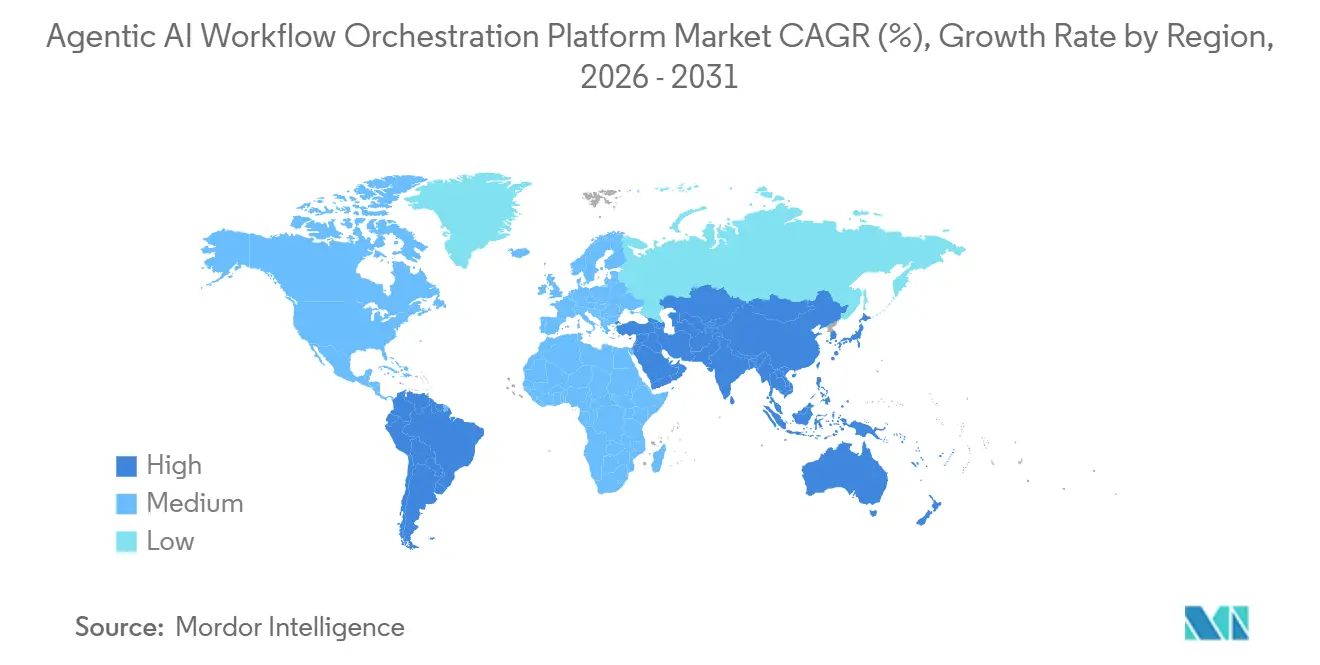
North America held 36.73% of the agentic AI workflow orchestration platform market share in 2025, maintaining its leading position. The region benefits from the concentration of major platform vendors, strong hyperscaler distribution, and a large base of enterprises that are moving generative AI pilots into broader production programs. The agentic AI workflow orchestration platform market is also maturing faster in North America because buyers there are more willing to connect orchestration directly to customer operations, internal service flows, and IT environments. As deployments deepen, demand is shifting toward stronger identity controls, more durable workflows, and built-in governance across large enterprise estates.
Europe Agentic AI Workflow Orchestration Platform Market
Europe remained a critical market for the agentic AI workflow orchestration platform, as compliance architecture is becoming central to buying decisions. Governance-focused procurement is strengthening as enterprises place greater emphasis on logging, human oversight, and workflow accountability before they scale agent-based operations. This environment favors vendors that can demonstrate clear policy controls and strong audit capabilities within the platform rather than through custom add-ons. IBM reinforced that positioning at Think 2026 by presenting watsonx Orchestrate as a control plane for the multi-agent era with policy enforcement across agents from different sources.
APAC, MEA and South America Agentic AI Workflow Orchestration Platform Market
Asia-Pacific is projected to record the fastest CAGR at 38.41% through 2031 in the agentic AI workflow orchestration platform market. Enterprise modernization programs are supporting growth, government-backed AI capacity-building, and a strong push to apply orchestration across the region's complex operational settings. Japan remains important because data control needs are strengthening demand for architectures that can support on-premises-compatible orchestration. Saison Technology reflected that regional direction in June 2026 when it announced Agent Orchestration within its HULFT Square iPaaS environment for secure enterprise-wide AI agent management. South America, the Middle East, and Africa are still earlier-stage regions in the agentic AI workflow orchestration platform market, but digital transformation programs and sovereign AI efforts are beginning to build a clearer long-term opportunity base.
Competitive Landscape
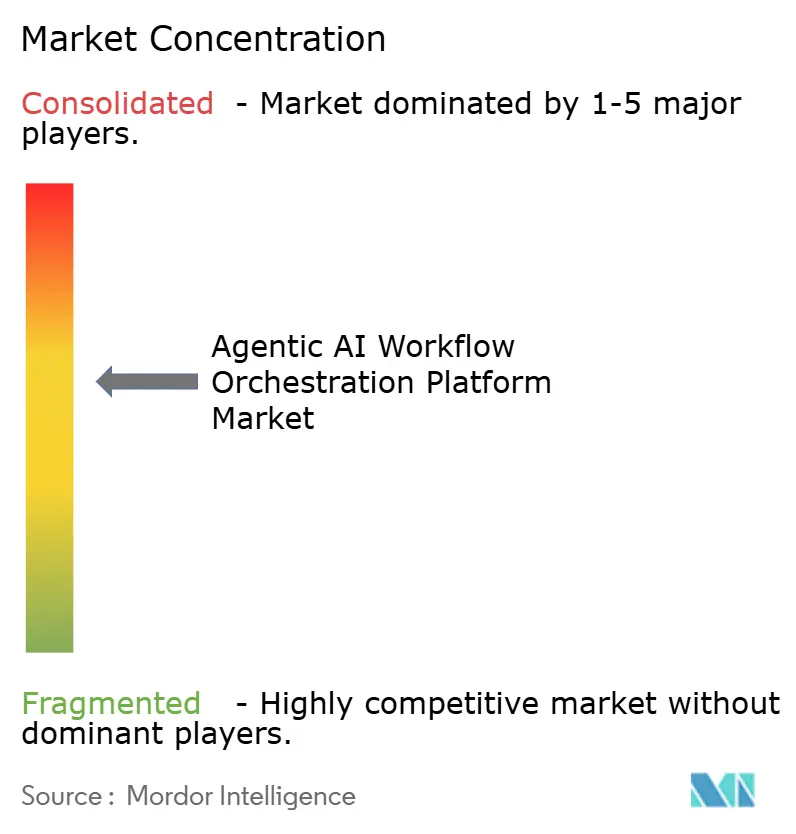
The agentic AI workflow orchestration platform market has a concentrated upper tier, but it still shows fragmentation underneath that leadership group. Microsoft, Salesforce, ServiceNow, IBM, and OpenAI hold strong visibility because they already serve large enterprise software buyers and can extend orchestration into familiar environments. Their advantage is not only model access; it also stems from distribution, identity integration, workflow entry points, and enterprise support structures. At the same time, the agentic AI workflow orchestration platform market remains open enough for newer providers and frameworks to influence developer behavior and reduce long-term lock-in.
A common strategy in the agentic AI workflow orchestration platform market is to embed orchestration into broader product suites while also opening developer paths through standards and SDKs. Microsoft introduced the Microsoft Agent Framework in public preview in May 2026, bringing AutoGen and Semantic Kernel into a single open-source SDK with observability, durability, and compliance support for Azure AI Foundry deployments. Salesforce expanded on this logic by making Agent Network generally available and integrating MCP into Agentforce to enable easier cross-tool interoperability. IBM followed with its next-generation watsonx Orchestrate positioning, which emphasized policy enforcement and cross-platform agent coordination inside a broader enterprise control plane.
The agentic AI workflow orchestration platform market is also shaped by the growing influence of open frameworks and protocol standards at the runtime layer. Anthropic's Model Context Protocol gave vendors and developers a more standardized way to connect tools, which reduced the value of purely proprietary connector logic. OpenAI added to that momentum by launching the Agents SDK in March 2025 as an open-source and provider-agnostic framework with tracing, guardrails, and human-in-the-loop support. This means commercial leaders must now compete not only on automation breadth, but also on governance quality, observability, workflow durability, and the speed with which enterprises can move from pilot to production. White-space opportunities remain strongest in regulated vertical solutions and in lighter offerings for smaller organizations that need governed coordination without the full integration burden seen in large enterprise deployments.
Agentic AI Workflow Orchestration Platform Industry Leaders
-
Microsoft Corporation
-
OpenAI, Inc.
-
Alphabet Inc
-
Amazon.com, Inc.
-
ServiceNow, Inc.
- *Disclaimer: Major Players sorted in no particular order
Agentic AI Workflow Orchestration Platform Market Companies Covered in this Report
- OpenAI, Inc.
- Microsoft Corporation
- Alphabet Inc.
- Amazon.com, Inc.
- Salesforce, Inc.
- ServiceNow, Inc.
- UiPath, Inc.
- Automation Anywhere, Inc.
- Workato, Inc.
- Pega Systems Inc.
- IBM Corporation
- Oracle Corporation
- SAP SE
- Boomi, L.P.
- LangChain, Inc.
- Anthropic PBC
- Cohere Inc.
- NVIDIA Corporation
- Celonis SE
- Palantir Technologies Inc.
Recent Industry Developments in Agentic AI Workflow Orchestration Platform Market
- July 2026: Salesforce made Agentforce Help Agent generally available, a prepackaged autonomous customer service agent with guided setup deployable in minutes across all channels, priced on a pay-per-resolution model. The launch accelerates Salesforce's push to monetize agentic AI on a consumption basis rather than per-seat licensing.
- June 2026: UiPath introduced Maestro Case, a new AI-native agentic case management capability within UiPath Maestro, extending governed orchestration to complex, exception-laden case management with full visibility and execution control. Maestro Case targets long-running business process exceptions that traditional RPA cannot handle deterministically.
- June 2026: Saison Technology (Japan) announced Agent Orchestration, a secure enterprise-wide AI agent management infrastructure embedded in its HULFT Square iPaaS platform, scheduled for commercial release on 1 July 2026. The announcement reflects the growing Japanese market for on-premises-compatible orchestration platforms with LLM cost governance.
- June 2026: Salesforce's Summer '26 Release made Agent Network, its multi-agent orchestration capability, generally available to all enterprise customers, along with new ITSM agent templates and a redesigned self-service agent setup flow.
Global Agentic AI Workflow Orchestration Platform Market Report Scope
The agentic AI workflow orchestration platform market refers to the ecosystem of software frameworks, platforms, and associated services designed to coordinate, manage, and govern multiple autonomous AI agents working collaboratively to execute complex, multi-step business processes. Unlike traditional linear automation, these platforms enable independent AI agents to plan, reason, delegate tasks, and utilize external tools to achieve overarching goals with minimal human intervention. The market encompasses orchestration layers that manage agent-to-agent communication, development frameworks for building custom agents, and specialized observability and governance tools that ensure agent reliability, safety, and regulatory compliance. Deployed across cloud-based, hybrid, and on-premises environments, these solutions cater to organizations of varying sizes across diverse industries, including IT, BFSI, healthcare, and manufacturing. By facilitating dynamic task allocation, contextual memory management, and real-time performance monitoring, agentic AI orchestration platforms empower enterprises to scale advanced cognitive automation, solve highly complex operational workflows, and drive digital transformation while maintaining strict control over AI-driven outcomes.
The Agentic AI Workflow Orchestration Platform Market Report is Segmented by Component (Agent Orchestration Platforms, Agent Development And Runtime Frameworks, Observability, Testing And Governance Platforms, and Professional And Managed Services), Deployment (Cloud-Based, Hybrid, and On-Premises), Enterprise Size (Large Enterprises, and Small And Medium Enterprises), End User (IT And Telecommunication, BFSI, Healthcare And Life Sciences, Retail And E-Commerce, Industrial Manufacturing, Education And Research Institutions, Media And Entertainment, Government And Administration, Energy And Utilities, and Other End-User Industries), and Geography (North America, South America, Europe, Asia-Pacific, and Middle East and Africa). The Market Forecasts are Provided in Terms of Value (USD).
Segmentation Overview
| Agent Orchestration Platforms |
| Agent Development and Runtime Frameworks |
| Observability, Testing and Governance Platforms |
| Professional and Managed Services |
| Cloud-Based |
| Hybrid |
| On-Premises |
| Large Enterprises |
| Small and Medium Enterprises |
| IT and Telecommunication |
| BFSI |
| Healthcare and Life Sciences |
| Retail and E-Commerce |
| Industrial Manufacturing |
| Education and Research Institutions |
| Media and Entertainment |
| Government and administration |
| Energy and Utilities |
| Other end-user industries |
| North America | United States | |
| Canada | ||
| Mexico | ||
| South America | Brazil | |
| Argentina | ||
| Rest of South America | ||
| Europe | Germany | |
| United Kingdom | ||
| France | ||
| Russia | ||
| Spain | ||
| Rest of Europe | ||
| Asia-Pacific | China | |
| Japan | ||
| India | ||
| South Korea | ||
| Southeast Asia | ||
| Rest of Asia-Pacific | ||
| Middle East and Africa | Middle East | Saudi Arabia |
| United Arab Emirates | ||
| Rest of Middle East | ||
| Africa | South Africa | |
| Nigeria | ||
| Rest of Africa | ||
| By Component | Agent Orchestration Platforms | ||
| Agent Development and Runtime Frameworks | |||
| Observability, Testing and Governance Platforms | |||
| Professional and Managed Services | |||
| By Deployment | Cloud-Based | ||
| Hybrid | |||
| On-Premises | |||
| By Enterprise Size | Large Enterprises | ||
| Small and Medium Enterprises | |||
| By End User | IT and Telecommunication | ||
| BFSI | |||
| Healthcare and Life Sciences | |||
| Retail and E-Commerce | |||
| Industrial Manufacturing | |||
| Education and Research Institutions | |||
| Media and Entertainment | |||
| Government and administration | |||
| Energy and Utilities | |||
| Other end-user industries | |||
| By Geography | North America | United States | |
| Canada | |||
| Mexico | |||
| South America | Brazil | ||
| Argentina | |||
| Rest of South America | |||
| Europe | Germany | ||
| United Kingdom | |||
| France | |||
| Russia | |||
| Spain | |||
| Rest of Europe | |||
| Asia-Pacific | China | ||
| Japan | |||
| India | |||
| South Korea | |||
| Southeast Asia | |||
| Rest of Asia-Pacific | |||
| Middle East and Africa | Middle East | Saudi Arabia | |
| United Arab Emirates | |||
| Rest of Middle East | |||
| Africa | South Africa | ||
| Nigeria | |||
| Rest of Africa | |||
Key Questions Answered in the Report
What is the current and forecast value of the agentic AI workflow orchestration platform market?
The agentic AI workflow orchestration platform market was valued at USD 2.73 billion in 2025, stood at USD 3.53 billion in 2026, and is forecast to reach USD 14.76 billion by 2031 at a 33.11% CAGR.
What is driving adoption of agentic AI workflow orchestration platforms?
The strongest demand is coming from enterprises that want multi-agent task automation, stronger governance, and easier integration with existing SaaS and cloud environments.
Which component category leads revenue today?
Agent orchestration platforms led the component mix with a 42.31% share in 2025 because they serve as the central control layer across agents, tools, and approvals.
Which deployment model is growing fastest?
Hybrid deployments are expected to grow the fastest at a 35.49% CAGR through 2031 as regulated organizations balance cloud model access with tighter control over data and runtimes.
Which end-user segment is expanding most quickly?
Healthcare and life sciences is projected to post the fastest end-user growth at a 36.27% CAGR through 2031 as clinical workflow automation and care pathway orchestration move into broader use.
Which region offers the strongest growth outlook?
Asia-Pacific is forecast to record the fastest regional CAGR at 38.41% through 2031, supported by enterprise modernization, policy support, and rising demand for secure orchestration environments.