
Africa Pet Treats Market Size and Share
Market Overview
| Study Period | 2021 - 2031 |
|---|---|
| Forecast Data Period | 2026 - 2031 |
| Base Year Market Size (2025) | USD 0.75 Billion |
| Market Size (2026) | USD 0.87 Billion |
| Market Size (2031) | USD 1.27 Billion |
| Growth Rate (2026 - 2031) | 7.86 % |
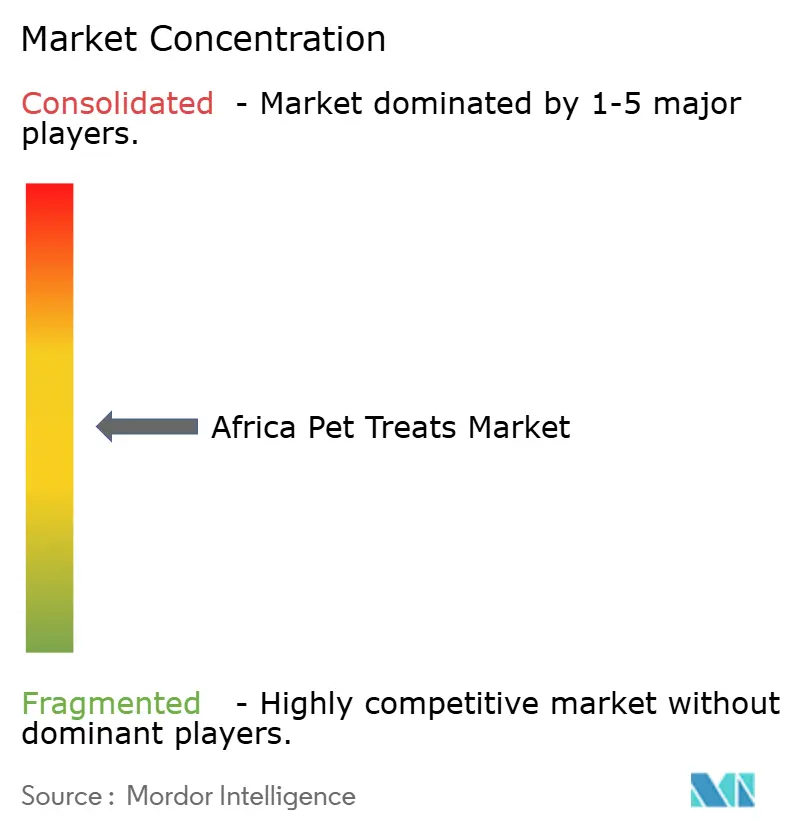
| Market Concentration | Medium |
Major Players *Disclaimer: Major Players sorted in no particular order Image © Mordor Intelligence. Reuse requires attribution under CC BY 4.0. | |
Africa Pet Treats Market Analysis by Mordor Intelligence
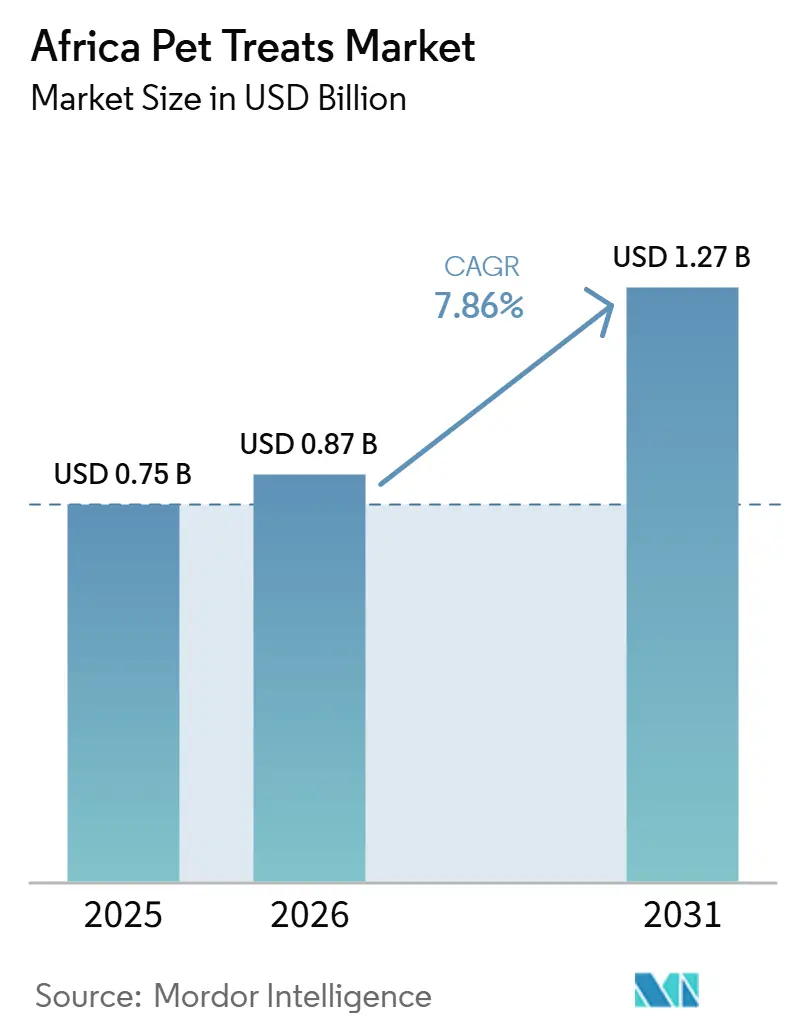
The Africa pet treats market size is projected to grow from USD 0.75 billion in 2025 to USD 0.87 billion in 2026 and is forecast to reach USD 1.27 billion by 2031 at 7.86% CAGR over 2026-2031. The Africa pet treats market is moving from informal feeding habits toward organized, packaged treat consumption, and that shift is becoming clearer in urban centers where pet ownership is more formal and repeat purchase behavior is easier to build. The Africa pet treats market is also benefiting from stronger demand for products that do more than offer taste, because owners increasingly look for treats linked to dental care, digestive support, and daily bonding routines. South Africa remains the center of the Africa pet treats market because it has the deepest retail base, the strongest local manufacturing footprint, and the most reliable route to premium distribution. Outside South Africa, the African pet treats market is expanding through a wider but still less organized set of country opportunities, especially where urbanization, middle-class growth, and local production are improving access. Growth in the Africa pet treats market will continue to depend on how well brands balance affordability, shelf stability, retail reach, and product credibility across very different African consumer and logistics conditions.
Key Report Takeaways
- By sub product, crunchy treats accounted for the largest Africa pet treats market share at 25.1% in 2025, while freeze-dried and jerky treats are projected to be the fastest-growing segment, registering a 12.6% CAGR through 2031.
- By pets, dogs dominated the market with the largest Africa pet treats market size, accounting for 86.9% of the market in 2025, and are also projected to record the fastest growth at a 9.7% CAGR through 2031.
- By distribution channel, specialty stores held the largest share at 42.4% in 2025, while the online channel is forecast to be the fastest-growing channel, expanding at a 11.5% CAGR through 2031.
- By geography, South Africa emerged as the largest regional market, capturing 58.3% of the market in 2025, and is projected to be the fastest-growing country, advancing at an 8.4% CAGR through 2031.
Note: Market size and forecast figures in this report are generated using Mordor Intelligence’s proprietary estimation framework, updated with the latest available data and insights as of January 2026.
Market Trends and Insights
Drivers Impact Analysis of Africa Pet Treats Market*
| Driver | (~) % Impact on CAGR Forecast | Geographic Relevance | Impact Timeline |
|---|---|---|---|
| Rising pet humanization and premium treat spend | +2.0% | Continental, strongest in South Africa, Kenya, and Nigeria | Short term (≤ 2 years) |
| Expansion of modern retail and specialty pet channels | +1.5% | South Africa, East Africa, and North Africa | Medium term (2-4 years) |
| E-commerce and direct-to-consumer growth in urban premium segments | +0.7% | South Africa urban core, Nairobi, and Lagos | Medium term (2-4 years) |
| Local manufacturing and import substitution in key hubs | +1.2% | South Africa, Kenya, and Nigeria | Medium term (2-4 years) |
| Functional treats for digestive, dental, and skin support | +1.0% | South Africa and major urban centers across the continent | Medium term (2-4 years) |
| Informal feeding conversion into packaged treats | +1.4% | Broadly across Sub-Saharan Africa | Long term (≥ 4 years) |
| Source: Mordor Intelligence | |||
Rising Pet Humanization and Premium Treat Spend
The African pet treats market is seeing a clear shift in buyer behavior, especially in larger cities, where pets are increasingly treated as part of the household rather than kept solely for practical reasons. That shift changes the role of treats, moving them from occasional rewards to products tied to care, routine, health, and everyday interaction. Premium and wellness-led products benefit the most from this change because buyers become more willing to pay for claims linked to dental care, skin support, better ingredients, and daily use. This pattern is especially important in South Africa because that country already has the retail depth and brand visibility needed to turn attitude changes into steady purchases. It also supports higher-value sub-categories in the Africa pet treats market, as treat spending becomes less dependent on impulse purchases and more tied to regular pet care habits. Over time, this gives established brands and credible local suppliers more room to grow without relying only on basic low-price formats.
Expansion of Modern Retail and Specialty Pet Channels
The Africa pet treats market still depends heavily on physical retail, and specialty stores remain central because they give shoppers product guidance, stronger category visibility, and better exposure to premium formats. That matters in a market where many consumers are still shifting from informal feeding toward branded products and often need reassurance before trading up. Specialty retail also helps functional and premium products by providing staff explanations, clinic links, and shelf grouping, making it easier for buyers to understand why one product costs more than another. In South Africa, this structure supports both international companies and domestic brands because organized pet retail provides them with a clearer path to repeat purchases and brand recognition. In other African markets, the same channel is important even when scale is smaller, because it acts as a bridge between informal trade and full modern retail. As a result, the Africa pet treats market is not just growing through more stores, but through better category education inside stores that already shape consumer trust.
Local Manufacturing and Import Substitution in Key Hubs
Local production is becoming one of the strongest structural supports for the Africa pet treats market because it reduces exposure to freight costs, currency fluctuations, and the lead times of imported products. It also improves the chance of reaching price-sensitive households, since locally made treats can be designed around accessible pack sizes and ingredients that fit local buying conditions. This matters most in South Africa, Kenya, and Nigeria, where domestic or regional manufacturing can shorten supply chains and improve shelf presence. A stronger local base also helps the African pet treats market by making it easier for brands to tailor products to climate, distribution realities, and typical pet owner spending patterns. Import substitution is therefore not only a cost story, but also widens the range of products that can be sold profitably outside the narrow, premium urban core. Over the forecast period, markets with credible domestic production will be better placed to compete in both value and premium tiers than markets that remain dependent on imported supply.
Functional Treats for Digestive, Dental, and Skin Support
Functional positioning is becoming more visible in the African pet treats market as brands aim to move treats beyond simple rewards and into everyday wellness routines. Dental products remain especially important because they are easy to explain, simple to use, and well-suited to veterinary and specialty channels where credibility matters. Virbac’s VeggieDent FR3SH dental chews are available through South African animal welfare and veterinary-linked channels, which support the role of clinically positioned formats in the category[1]Source: NSPCA, “Veggiedent FR3SH, Dental Chews for Dogs,” NSPCA, nspca.co.za. PetWell’s locally produced probiotic chews show that South African suppliers are also moving into digestive support, not only basic nutrition[2]Source: PetWell, “Probiotic Chew,” PetWell, petwell.co.za. These examples matter because the African pet treats market gains value faster when buyers believe a treat delivers a practical benefit, not just flavor or indulgence. As more brands compete on targeted health support, veterinary trust, and clear product claims, these factors are likely to matter more than broad brand awareness alone.
Restraints Impact Analysis of Africa Pet Treats Market*
| Restraint | (~) % Impact on CAGR Forecast | Geographic Relevance | Impact Timeline |
|---|---|---|---|
| High price sensitivity outside premium urban clusters | -1.2% | Broadly across Sub-Saharan Africa, most acute in Nigeria and Kenya mass-market segments | Short term (≤ 2 years) |
| Weak online penetration in most African markets | -0.9% | Continental, except South Africa’s urban core | Medium term (2-4 years) |
| Fragmented regulation and labeling compliance across countries | -0.6% | Economic Community of West African States (ECOWAS), Southern African Development Community (SADC), and East African Community (EAC) member states | Medium term (2-4 years) |
| Limited cold chain and logistics coverage for moist and fresh formats | -0.7% | Sub-Saharan Africa, excluding South Africa’s formal logistics corridor | Long term (≥ 4 years) |
| Source: Mordor Intelligence | |||
High Price Sensitivity Outside Premium Urban Clusters
Price remains the clearest limit on how quickly the Africa pet treats market can formalize outside wealthy urban pockets. Many households still compare packaged treats with table scraps or very low-cost feeding options, so premium positioning alone cannot unlock broad volume growth. This creates a sharp divide between buyers who want functional or premium products and buyers who will only enter the category through affordable formats. Chewy Pets Feeds, a Nigerian pet food brand, illustrates how local operators can address this barrier by pairing domestic production with official approvals and accessible positioning. In the Africa pet treats market, the brands most likely to scale widely are those that can offer small pack sizes, everyday use cases, and credible quality without pushing price too far above informal substitutes. Until incomes and category familiarity improve more broadly, affordability will remain a stronger purchase filter than brand aspiration in many countries.
Weak Online Penetration in Most African Markets
Digital sales still face structural limits in much of the Africa pet treats market because online shopping depends on payment confidence, delivery reliability, and consumer comfort with repeat e-commerce purchases. Those conditions are strongest in South Africa and much weaker across many other African markets. As a result, brands that rely too heavily on online-first models may struggle to build scale outside a small group of premium urban consumers. This matters because digital channels often offer a wider assortment of premium and niche products than physical stores, so a weak online presence slows category depth and overall access. The Africa pet treats market remains tied to traditional retail execution for most of the forecast period, even while online growth rates look attractive from a small base. In practice, digital expansion supports the market, but the channel’s current reach is too limited to act as a broad substitute for store-led distribution.
*Our forecasts treat driver/restraint impacts as directional, not additive. The impact forecasts reflect baseline growth, mix effects, and variable interactions.
Africa Pet Treats Market Segment Analysis
By Sub Product:
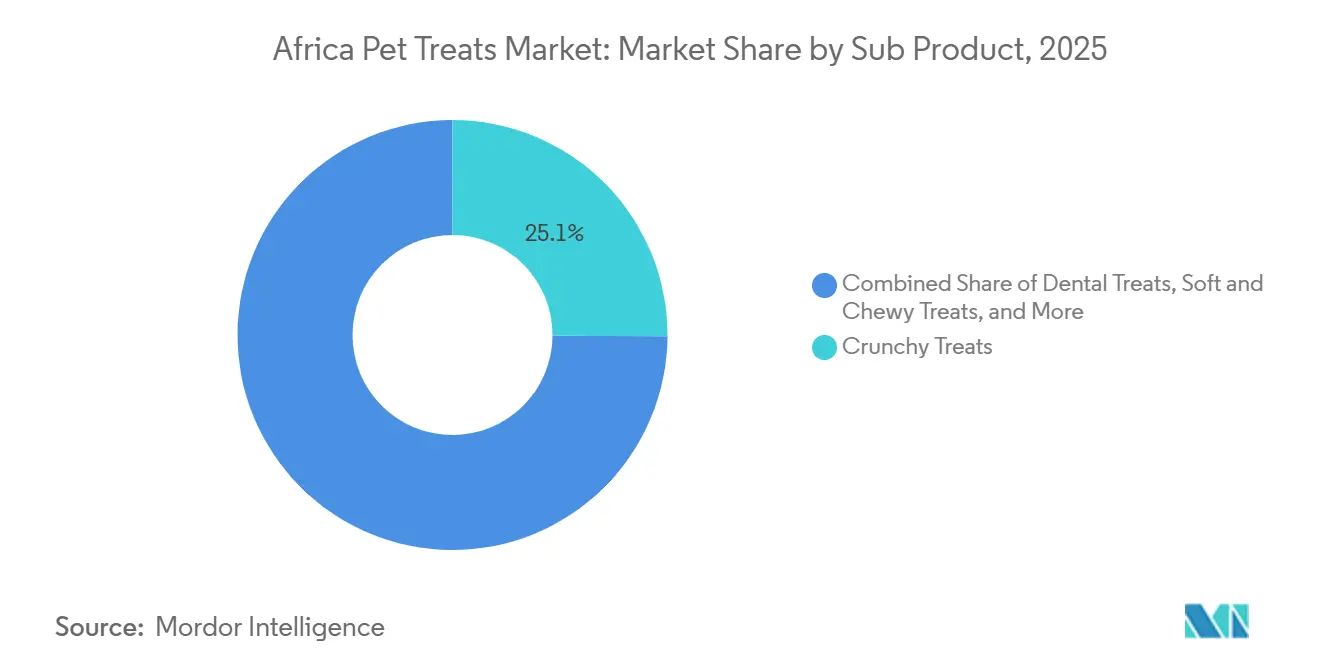
Functional and Premium Formats Drive Value DivergenceCrunchy treats held 25.1% of the Africa pet treats market in 2025, keeping it in the lead because the format is affordable, shelf-stable, and easy to distribute through both organized and informal channels. Dental treats are supported by clear oral health benefits and strong alignment with veterinary recommendations and specialty retail channels. Soft and chewy treats continue to gain popularity due to their suitability for training, bonding, and frequent feeding occasions. Freeze-dried and jerky treats are projected to expand at a 12.6% CAGR through 2031, making them the fastest-growing premium format in the Africa pet treats market, driven by increasing demand for minimally processed, high-protein treats. Other Treats remains commercially relevant, reflecting a diverse portfolio of niche, regional, and mixed-format products that cater to evolving consumer preferences.
The Africa pet treats market is therefore splitting between formats that drive volume and those that drive value growth. Crunchy products continue to win on reach because they travel well, sit easily on store shelves, and suit price-sensitive buyers entering the category. Freeze-dried and jerky products are moving faster because they align with clean-label preferences, premium nutrition claims, and functional positioning. Dental formats also remain important because they connect a treat purchase to a visible care benefit, which helps justify spend in markets where households want more than a reward-only product. The result is a sub-product mix in which accessibility protects volume, while premium and wellness-led formats shape future revenue expansion across the Africa pet treats market.



By Pets:
Dog Dominance With an Emerging Cat SegmentDogs accounted for 86.9% of the Africa pet treats market share in 2025 and are projected to record a 9.7% CAGR through 2031, indicating that canine products remain the center of the Africa pet treats market in both current scale and future momentum. Cats remain a strategically important segment despite being at an earlier stage of market development, supported by increasing urbanization and growing demand for specialized nutrition. Other Pets remain a niche category, reflecting limited commercial penetration and product availability. Dogs continue to dominate the African pet treats market because they combine companionship with practical roles in many households, enabling treat demand to span premium, value, and functional use cases more effectively than in other pet segments. This gives dog treats the broadest and most resilient demand base across the region.
The cat segment still matters strategically because its lower base leaves more room for formalization as owners shift from generic feeding toward specialized nutrition. Product development for cats can also help brands deepen their premium positioning, as feline buyers often seek more targeted textures, pearly-stage proteins, and portion sizes. The same logic supports local innovation, especially in markets where organized retail is becoming strong enough to support more specialized shelf space. Within the Africa pet treats industry, cats are not yet large enough to challenge dogs, but they are large enough to influence next-stage assortment strategy. That makes the segment important for brands that want to build early share before feline treat consumption becomes more mainstream in East and Southern Africa.
By Distribution Channel:
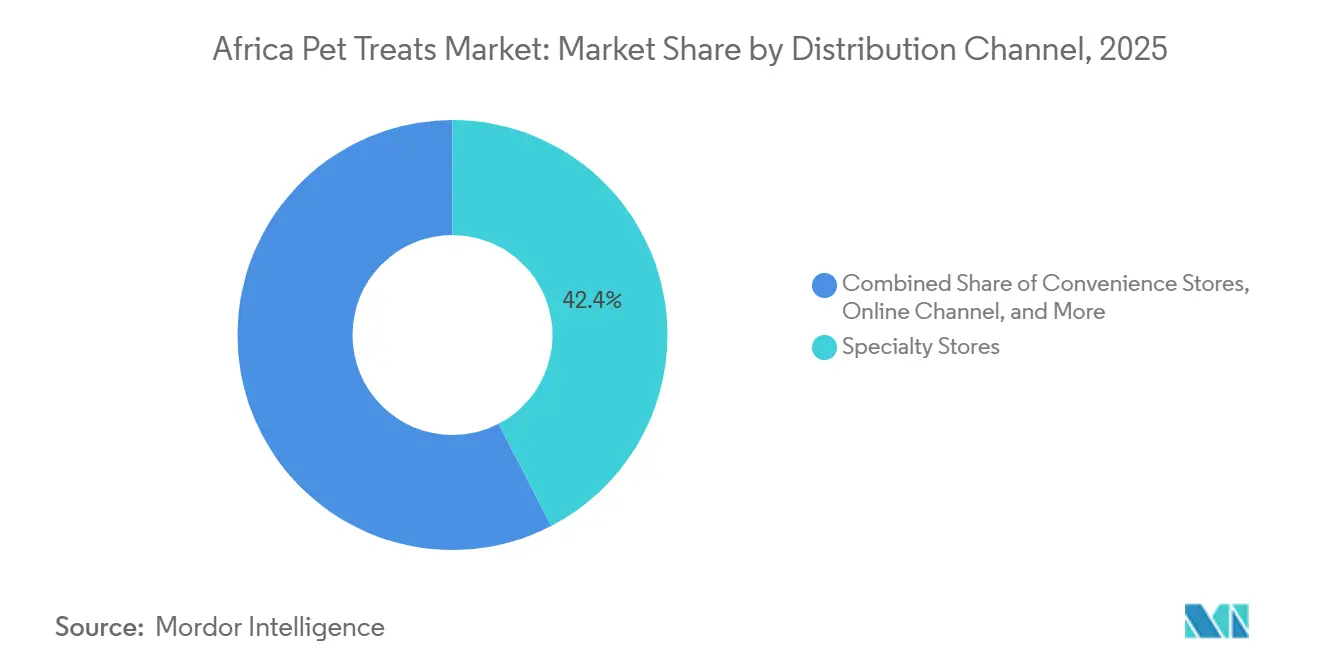
Specialty Retail Holds Scale, Online Builds TrajectorySpecialty stores led distribution with 42.4% share in 2025, while the online channel is projected to grow at 11.5% CAGR through 2031. Supermarkets and hypermarkets are close to specialty retail in practical reach, even if they are less focused on deep pet category education. Convenience stores and other channels continue to support the market through impulse purchases and localized retail access. This structure indicates that the African pet treats market still relies heavily on physical retail for product visibility, consumer education, and purchase decisions, particularly among buyers transitioning from unbranded or informal alternatives. It also highlights that although online sales are expanding, traditional retail channels remain the primary route to market across much of the region.
The Africa pet treats market works through different channel roles rather than one channel replacing another. Specialty retail supports discovery, trust, and premium conversion, especially for wellness-led or veterinary-adjacent products. Supermarkets and hypermarkets help normalize everyday treat purchases by making mainstream options part of broader household shopping routines. Online channels build value by extending assortment and supporting repeat purchase among already engaged premium households. Together, this creates a channel mix where physical retail carries current scale and digital retail shapes future convenience, retention, and premium basket growth.
Geography Analysis
South Africa Pet Treats Market
South Africa accounted for 58.3% of the Africa pet treats market share in 2025 and is projected to grow at an 8.4% CAGR through 2031, maintaining its position as the region's largest pet treats market. This is supported by stronger organized retail, higher consumer purchasing power, a well-established pet care culture, and a domestic manufacturing base that ensures better product availability and supply continuity. According to the Statistics South Africa General Household Survey 2026, more than 7.4 million dogs are owned by 4.2 million households, representing 21% of all households, providing a large and stable consumer base for pet treats[3]Source: Statistics South Africa (Stats SA), General Household Survey 2025; The Citizen, “Animal Shelter Pressure Rising,” citizen.co.za.. These factors make South Africa the preferred entry point for international brands and the primary hub for premium and functional pet treat innovation in Africa.
North, East and West Africa Pet Treats Market
Nigeria and Egypt are emerging as the next key growth markets within the Africa pet treats market. Nigeria benefits from a large urban population, rising disposable incomes, expanding supermarket networks, and increasing availability of packaged pet products. Egypt is witnessing steady market expansion, supported by growing companion animal ownership, improving retail infrastructure, and rising consumer awareness of premium pet nutrition. Kenya also continues to strengthen its position by improving local manufacturing capabilities and broader distribution of pet treats across organized retail channels. However, market development remains uneven, with regulatory frameworks, purchasing power, and retail penetration varying considerably across countries.
Africa Pet Treats Market
This highlights that the Africa pet treats market should not be viewed as a single, homogeneous market. Country-specific strategies remain essential, as North, East, West, and Southern Africa differ significantly in pet ownership trends, retail infrastructure, consumer preferences, and pricing dynamics. Companies that adapt their product portfolios, pack sizes, pricing, and distribution strategies to the requirements of individual markets will be better positioned to capture long-term growth opportunities across the region.
Competitive Landscape
The Africa pet treats market is moderately concentrated, with competition led by Mars, Incorporated, Purina PetCare (Nestlé S.A.), Hill's Pet Nutrition, Inc. (Colgate-Palmolive Company), General Mills Inc., and Montego Pet Nutrition (Pty) Ltd. These companies benefit from strong brand recognition, broad product portfolios, and established distribution networks. At the same time, the market continues to offer opportunities for regional suppliers that can differentiate through local sourcing, competitive pricing, and a deeper understanding of local retail dynamics. Success depends on addressing affordability, accessibility, and consumer preferences across diverse African markets.
Regional companies continue to play an important role due to their understanding of local purchasing behavior and ability to develop products aligned with market-specific price points. Bob Martin & Co. strengthens its presence through locally recognized pet care brands, while Virbac differentiates through veterinary-focused products such as VeggieDent FR3SH, reinforcing its position in the premium dental treats segment. Companies including RCL Foods, Farmina Pet Foods, Promeal (Oceana Group Ltd.), and Affinity Petcare S.A. are also expanding their presence through localized product offerings and distribution partnerships.
The competitive landscape is becoming increasingly layered as companies adopt different strategies to capture market share. Global brands maintain an advantage in organized retail, premium positioning, and product innovation, whereas regional manufacturers compete through localized supply chains, flexible pack sizes, and value-oriented offerings. Over the forecast period, competitive success will increasingly depend on aligning product benefits, pricing, and distribution strategies with the distinct requirements of individual African markets.
Africa Pet Treats Industry Leaders
Mars, Incorporated
Hill's Pet Nutrition, Inc. (Colgate-Palmolive)
General Mills Inc.
Purina PetCare (Nestlé S.A.)
Montego Pet Nutrition (Pty) Ltd
- *Disclaimer: Major Players sorted in no particular order
Africa Pet Treats Market Companies Covered in this Report
- Mars, Incorporated
- Hill's Pet Nutrition, Inc. (Colgate-Palmolive Company)
- General Mills Inc.
- Montego Pet Nutrition (Pty) Ltd
- Wellness Pet Company, Inc. (Clearlake Capital Group, L.P.)
- Purina PetCare (Nestlé S.A.)
- Virbac
- The J.M. Smucker Company
- Affinity Petcare S.A.
- RCL Foods
- Bob Martin & Co.
- Farmina Pet Foods
- Promeal (Oceana Group Ltd.)
- Vafo Praha, s.r.o.
- Alltech Inc.

Recent Industry Developments in Africa Pet Treats Market
- April 2026: Montego Pet Nutrition (Pty) Ltd introduced its new Karoo Wild Functional Dog Treats, a super-premium range made with novel African proteins and functional ingredients targeting joint health, skin and coat, digestion, and immunity. The launch reflects the growing trend of premiumization and functional pet treats in South Africa.
- March 2026: RCL Foods signed an agreement to acquire Martin & Martin for USD 38 million (ZAR 695 million), expanding its pet food portfolio by adding wet pet food, biscuits, treats, and pet care brands in South Africa.
- April 2025: Thokoman Foods launched six stock-keeping units (SKUs) of sugar-free pet treats, including biscuits and pet peanut butter made from repurposed peanut by-products, strengthening sustainable product innovation in the African pet treats market.


Africa Pet Treats Market Report Scope
Pet Treats are complementary pet food products offered as rewards, snacks, or training aids. They are formulated to enhance palatability while supporting specific nutritional, functional, or dental health benefits and are intended to supplement, not replace, a complete and balanced diet.
The Africa Pet Treats Market Report is Segmented by Sub Product (Crunchy Treats, Dental Treats, Soft and Chewy Treats, and More), by Pets (Cats, Dogs, and Other Pets), by Distribution Channel (Convenience Stores, Online Channel, Specialty Stores, Supermarkets and Hypermarkets, and More), and by Geography (South Africa and Rest of Africa). The Market Forecasts are Provided in Terms of Value (USD) and Volume (Metric Tons).
| Dental Treats |
| Crunchy Treats |
| Soft and Chewy Treats |
| Freeze-dried and Jerky Treats |
| Other Treats |
| Dogs |
| Cats |
| Other Pets |
| Convenience Stores |
| Online Channel |
| Specialty Stores |
| Supermarkets/Hypermarkets |
| Other Channels |
| South Africa |
| Nigeria |
| Egypt |
| Rest of Africa |
| Sub Product | Dental Treats |
| Crunchy Treats | |
| Soft and Chewy Treats | |
| Freeze-dried and Jerky Treats | |
| Other Treats | |
| Pets | Dogs |
| Cats | |
| Other Pets | |
| Distribution Channel | Convenience Stores |
| Online Channel | |
| Specialty Stores | |
| Supermarkets/Hypermarkets | |
| Other Channels | |
| Geography | South Africa |
| Nigeria | |
| Egypt | |
| Rest of Africa |


Key Questions Answered in the Report
What is the size outlook for Africa pet treats through 2031?
The Africa pet treats market is projected to rise from USD 0.87 billion in 2026 to USD 1.27 billion by 2031 at a 7.86% CAGR.
Which product type leads sales in Africa pet treats?
Crunchy Treats led in 2025 with 25.1% share because the format is affordable, shelf stable, and easier to distribute across mixed retail systems.
Which product type is growing fastest in this category?
Freeze-Dried and Jerky Treats is projected to grow at 12.6% CAGR through 2031, supported by premium, clean-label, and functional positioning.
What is the main barrier to faster category expansion?
Price sensitivity remains the biggest barrier because many households still compare packaged treats with informal feeding options and only enter the category through accessible formats.
Page last updated on:





