
Africa Dry and Wet Pet Food Market Size and Share
Market Overview
| Study Period | 2021 - 2031 |
|---|---|
| Forecast Data Period | 2026 - 2031 |
| Base Year Market Size (2025) | USD 2.20 Billion |
| Market Size (2026) | USD 2.30 Billion |
| Market Size (2031) | USD 3.10 Billion |
| Growth Rate (2026 - 2031) | 6.15 % |
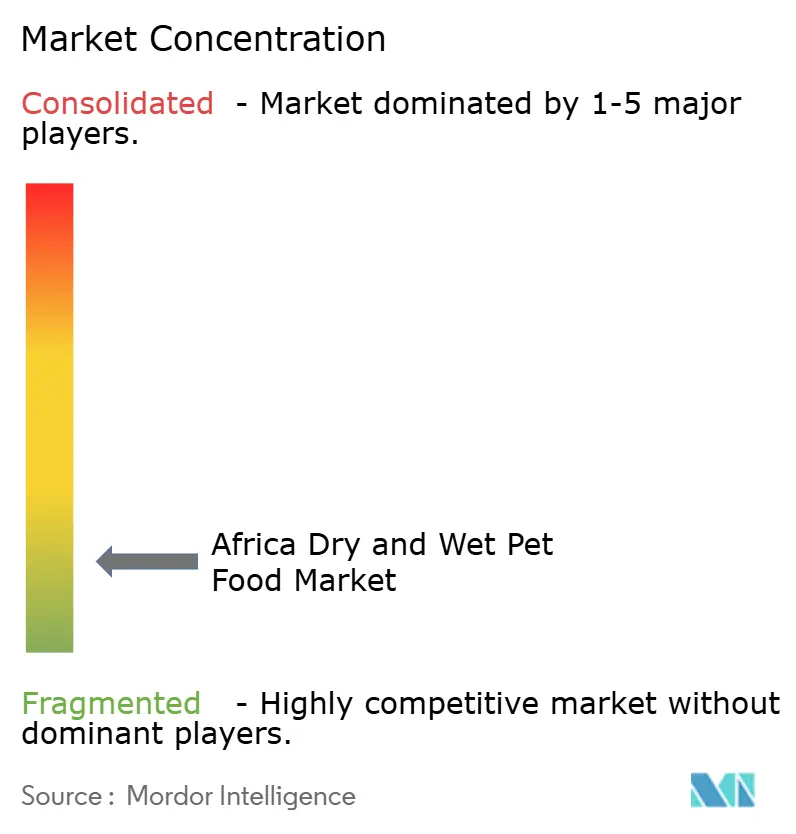
| Market Concentration | Low |
Major Players *Disclaimer: Major Players sorted in no particular order Image © Mordor Intelligence. Reuse requires attribution under CC BY 4.0. | |
Africa Dry and Wet Pet Food Market Analysis by Mordor Intelligence
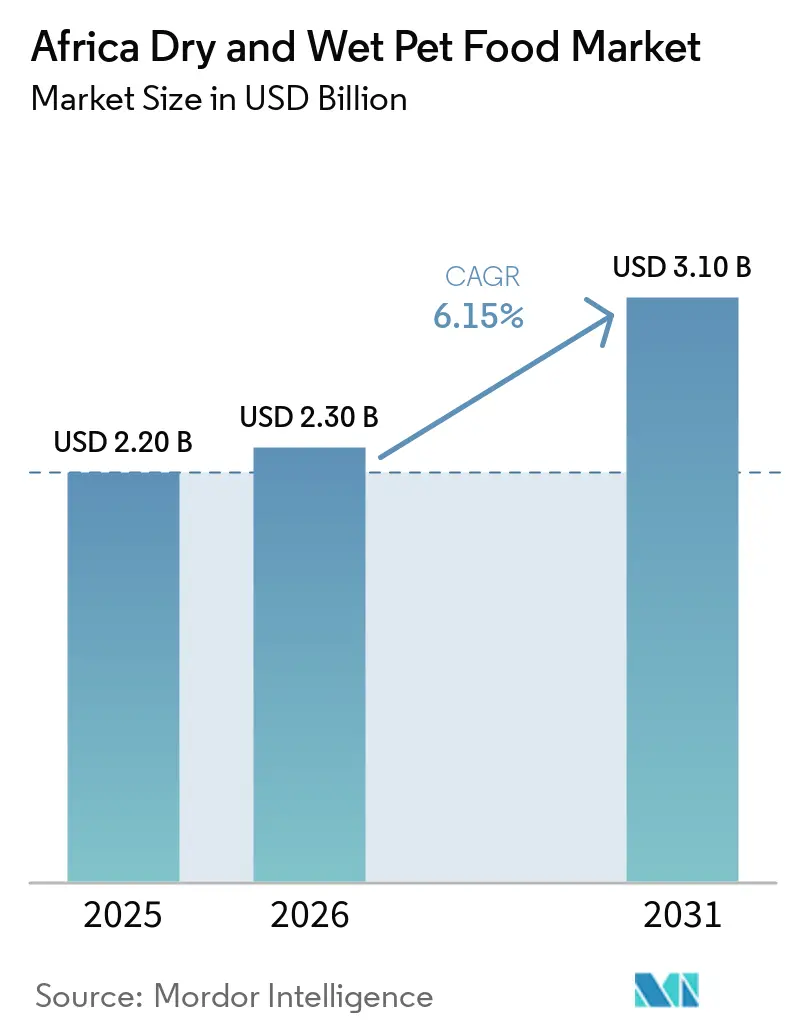
The Africa dry and wet pet food market size is projected to grow from USD 2.2 billion in 2025 to USD 2.3 billion in 2026 and is forecast to reach USD 3.1 billion by 2031 at 6.15% CAGR over 2026-2031. The Africa dry and wet pet food market is growing as more urban households move from occasional feeding to planned nutrition, and this shift is widening the addressable base for branded products. South Africa remains the commercial center of the Africa dry and wet pet food market, with Statistics South Africa reporting 7.4 million pet dogs across 4.2 million households and 2 million pet cats in its General Household Survey 2025[1], which was released in May 2026. The same release showed a clear income divide in pet ownership, with dog ownership reaching 41.8% among households in the living standards measure (LSM) 8 to 10 and 15.6% among households in LSM 1 to 4, which supports stronger premium demand in higher-income urban clusters. Competition across the Africa dry and wet pet food market remains fragmented, so companies are relying on broader retail access, tighter quality positioning, and selective acquisitions to build scale rather than depending on category dominance.
Key Report Takeaways
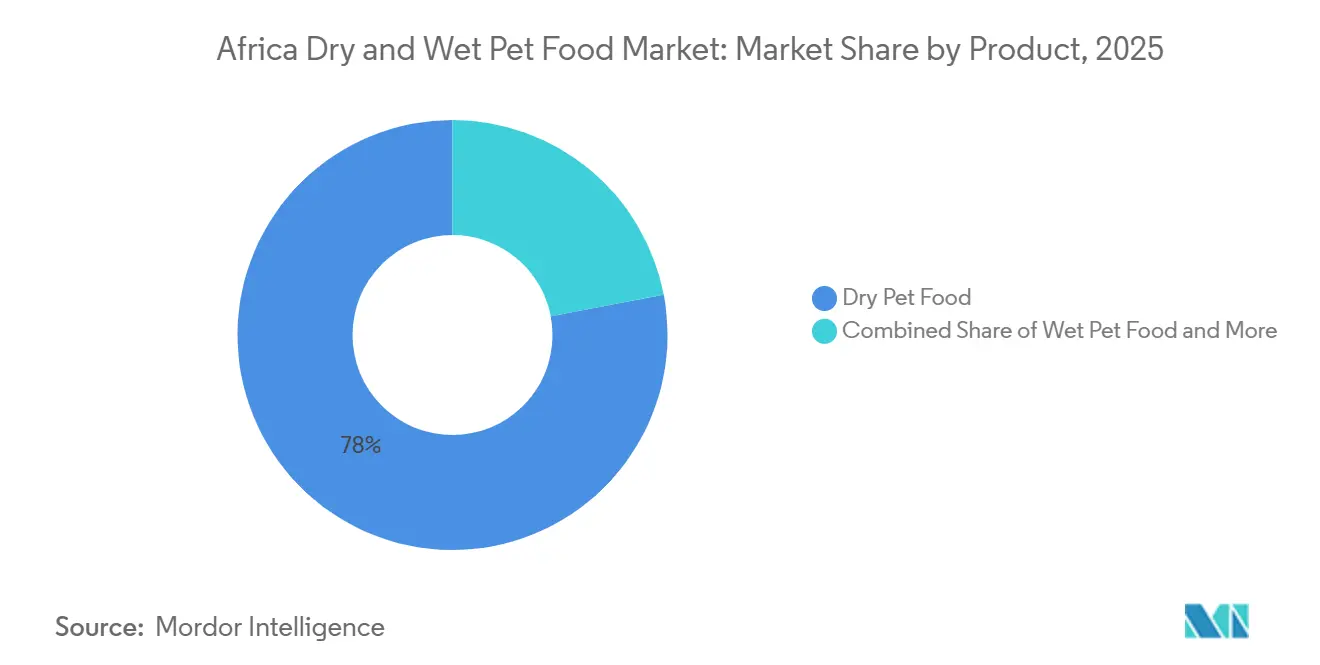
- By product, the Africa dry and wet pet food market was led by dry pet food with 78% share in 2025, while wet pet food is projected to grow at a 9.8% CAGR during 2026-2031.
- By pets, dogs held 79% in 2025, while cats are projected to grow at an 8.7% CAGR during 2026-2031.
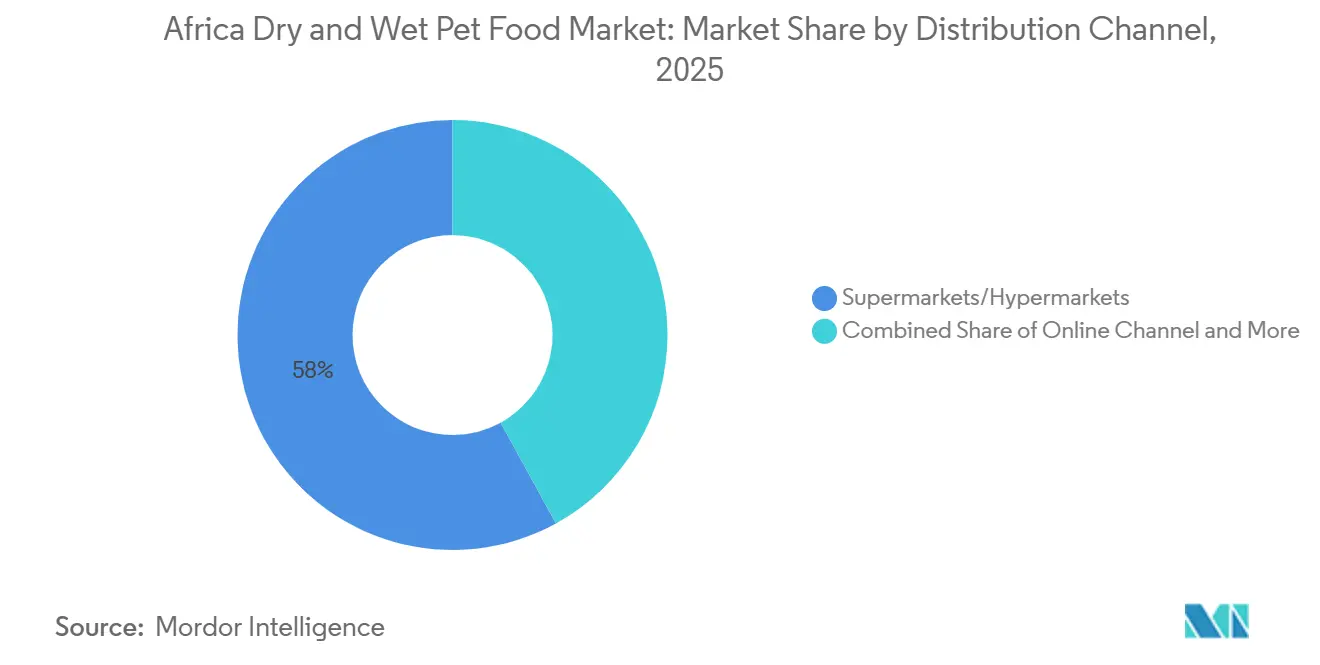
- By distribution channel, supermarkets and hypermarkets accounted for 58% of Afric Dry and Wet Pet Food Market Size in 2025, while online channels are projected to grow at a 13.2% CAGR during 2026-2031.
- By geography, South Africa held 42% in 2025, while Rest of Africa is projected to grow at a 7.1% CAGR during 2026-2031.
Note: Market size and forecast figures in this report are generated using Mordor Intelligence’s proprietary estimation framework, updated with the latest available data and insights as of January 2026.
Africa Dry and Wet Pet Food Market Trends and Insights
Drivers Impact Analysis*
| Driver | (~) % Impact on CAGR Forecast | Geographic Relevance | Impact Timeline |
|---|---|---|---|
| Premium Pet Nutrition in Urban Households | +1.4% | Africa, strongest in South Africa, Kenya, and urban Nigeria | Medium term (2-4 years) |
| Modern Retail and Online Availability Expansion | +1.2% | South Africa and Nigeria urban corridors, with spillover to Egypt and Kenya | Short term (≤ 2 years) |
| Vet-Led Functional and Life-Stage Diet Adoption | +0.9% | South Africa, with rising influence in Nigeria and Kenya | Medium term (2-4 years) |
| Imported Formulations and Private Label Penetration | +0.7% | South Africa, Egypt, and Nigeria | Short term (≤ 2 years) |
| Shelf-Stable Wet Food Logistics Improvement | +0.4% | Sub-Saharan Africa, especially West and East Africa | Long term (≥ 4 years) |
| Trade-Down Within Premium to Mass-Market Ranges | +0.3% | Africa, strongest in Nigeria and Egypt | Short term (≤ 2 years) |
| Source: Mordor Intelligence | |||
Premium Pet Nutrition in Urban Households
Premium demand is becoming more visible in the Africa dry and wet pet food market as urban pet owners pay closer attention to ingredient quality and life-stage fit. This change is greatest where household spending power is already higher and where formal pet ownership patterns are better established. In South Africa, the official pet population update and the large ownership gap between higher-income and lower-income households show why premium products are still concentrated in a narrower consumer band today. That pattern matters because the next layer of growth will depend less on already premium buyers and more on whether middle-income households move toward more consistent commercial feeding. The Africa dry and wet pet food market is therefore gaining value not only from more pets, but also from more deliberate spending per pet.
Modern Retail and Online Availability Expansion
Retail access is improving the visibility of branded products across the Africa dry and wet pet food market, especially in cities where grocery chains already shape shopping habits. Shelf space matters because it determines which brands are seen regularly and which products become part of repeat purchase behavior. Woolworths Holdings Limited completed its acquisition of Absolute Pets with effect from April 1, 2024, adding a large specialty network to its broader retail portfolio and strengthening organized access to pet food in South Africa. As modern retail expands, premium and therapeutic lines gain a better route to shoppers who might not often visit veterinary clinics or independent pet stores. The Africa dry and wet pet food market also benefits, as digital channels help reduce the access gap in areas where physical specialty stores remain limited.
Vet-Led Functional and Life-Stage Diet Adoption
Veterinary advice is becoming more important in product selection across the Africa dry and wet pet food market, especially for owners managing age, digestion, or weight concerns. This is raising demand for formulas that are positioned around specific needs rather than broad everyday feeding. The Pet Food Industry Association of Southern Africa (PFISA) stated in 2024 that it had stepped up shelf testing and quality oversight[2], which supports buyer confidence in labeled product claims and in more specialized nutritional positioning. As confidence in verified claims improves, veterinarians and trained retail staff have more influence over trading consumers up from general products to targeted diets. This supports a richer mix in the Africa dry and wet pet food market even when overall unit growth stays moderate.
Imported Formulations and Private Label Penetration
Imported products and retailer-controlled lines are widening consumer choice in the Africa dry and wet pet food market, but they are also changing how brands compete. Imported formulations usually enter through premium and specialty channels first, while private label tends to grow where large retailers already have purchasing leverage and trusted store traffic. Woolworths Holdings Limited’s integration of Absolute Pets shows how a retailer can combine store access, category expertise, and branded assortment in one platform. That raises pressure on imported labels from above and below, with premium domestic brands competing on quality and retailer labels competing on value. In the Africa dry and wet pet food market, this dynamic favors operators that can balance price, compliance, and distribution speed.
Restraints Impact Analysis*
| Restraint | (~) % Impact on CAGR Forecast | Geographic Relevance | Impact Timeline |
|---|---|---|---|
| Limited Awareness of Species-Specific Nutrition | -0.80% | Nigeria and rest of Africa most acutely, with partial effect in Egypt and Kenya | Medium term (2-4 years) |
| Fragmented Distribution Beyond Major Cities | -0.90% | Sub-Saharan Africa, especially Nigeria and rest of Africa | Long term (≥ 4 years) |
| Imported Raw Material and Packaging Cost Volatility | -0.60% | Africa, most acute in Egypt and Nigeria | Short term (≤ 2 years) |
| Informal Feed Substitutes and Home-Mixed Diets | -0.70% | Nigeria and rest of Africa, lower in South Africa | Medium term (2-4 years) |
| Source: Mordor Intelligence | |||
Limited Awareness of Species-Specific Nutrition
Consumer education remains a significant barrier in the African dry and wet pet food market, especially where informal feeding remains common. Many households still view leftovers or home-mixed food as acceptable substitutes for commercial pet nutrition. This slows category conversion because the value of species-specific products is not always clear at the point of purchase. It also weakens the premium case for life-stage, functional, and therapeutic products, which depend on owners seeing nutritional differences as necessary rather than optional. The African dry and wet pet food market will therefore need sustained support from veterinarians, retailers, and industry bodies before adoption can expand beyond the most informed urban consumers.
Fragmented Distribution Beyond Major Cities
Distribution remains uneven across the Africa dry and wet pet food market, and this is one of the clearest limits on deeper category penetration. Modern grocery, specialty pet retail, and dependable delivery options are still concentrated in a relatively small number of urban corridors. That makes it harder for national or regional brands to build regular household demand outside the largest cities. It also affects wet food more directly because store handling, display discipline, and stock rotation become more important as product complexity rises. Until secondary cities gain better retail reach and more stable fulfillment systems, the Africa dry and wet pet food market will continue to grow faster in a narrow set of urban nodes.
*Our forecasts treat driver/restraint impacts as directional, not additive. The impact forecasts reflect baseline growth, mix effects, and variable interactions.
Segment Analysis
By product: Dry Pet Food Anchors the Market While Wet Formats Lead Growth
Dry pet food held 78% of the Africa dry and wet pet food market in 2025, which made it the largest product segment in the category. This position reflects the format’s fit with Africa’s retail and logistics conditions, where shelf stability matters more than product variety in many markets. Dry pet food can be sold in supermarkets, neighborhood stores, and general trade channels without refrigeration, which supports a wider physical reach. South Africa’s organized retail structure has also given dry products the broadest routine shelf presence in the region. Woolworths Holdings Limited completed the integration of Absolute Pets following its April 2024 acquisition, thereby reinforcing organized access to pet food in South Africa.
Wet pet food is the fastest-growing product type, with a compound annual growth rate (CAGR) of 9.8% during 2026-2031. Growth is being supported by rising cat ownership and stronger attention to moisture-rich feeding among engaged urban pet owners. Shelf-stable canned and retort pouch products are also helping the segment expand beyond a narrow refrigerated base. RCL Foods signed a binding agreement on March 31, 2026, to acquire Martin and Martin (Pty) Ltd for South African rand (ZAR) 695 million (USD 41 million), which shows clear corporate confidence in wet pet food demand. This leaves dry pet food as the volume base, while wet pet food captures a larger share of value growth.

By pets: Dogs Anchor Commercial Scale as Cat Adoption Builds
Dogs held 79% of the Africa dry and wet pet food market in 2025, which made them the largest pet category in commercial food demand. This position reflects the scale of dog ownership across African households and the stronger commercialization of dog food relative to cat food. Statistics South Africa (Stats SA) reported 7.4 million pet dogs across 4.2 million households in General Household Survey 2025, which remains the clearest official measure of South Africa’s dog population.
Cats are the fastest-growing pet category, with an 8.7% CAGR during 2026-2031. Their smaller commercial base leaves more room for growth as species-specific feeding becomes more common in urban households. Commercial cat food is also benefiting from stronger awareness that feline diets need different nutritional profiles than dog food. Stats SA also reported 2 million pet cats in South Africa in General Household Survey 2025, confirming a meaningful ownership base for future category expansion. This leaves cats as the clearest growth pocket, while dogs remain the volume core of the category.
By Distribution Channel: Organized Retail Commands Share as The Online Channel Accelerates
Supermarkets and hypermarkets held 58% of the Africa dry and wet pet food market in 2025, which made them the largest distribution channel. Their lead comes from high shopper traffic, broad product assortment, and stronger price visibility for mass-market buyers. This channel is strongest in South Africa, where pet food has become a more visible part of mainstream grocery retail. Woolworths Holdings Limited added Absolute Pets to its retail portfolio from April 2024, which deepened formal store access to both premium and everyday pet food ranges. Even so, specialty pet shops, veterinary clinics, and general trade still matter because they serve different buyer needs and income groups.
The online channel is projected to record the fastest growth, with a 13.2% CAGR during 2026-2031. E-commerce suits dry pet food especially well because repeat purchases and larger pack sizes fit scheduled delivery behavior. Online platforms also improve access to specialized ranges in places where physical pet retail remains limited. This channel should gain weight faster in higher-income urban markets before spreading more widely across the region. Even with this momentum, supermarkets and hypermarkets are projected to remain the volume leader through 2031.
Geography Analysis
South Africa held 42% of Africa dry and wet pet food market share in 2025, which made it the largest country market in the region. The country remains the commercial center of the category because it combines the strongest pet retail structure, domestic manufacturing capacity, and formal industry participation. Woolworths Holdings Limited completed its acquisition of Absolute Pets in 2024, which added more scale to organized pet retail and reinforced shelf access for both premium and mainstream brands. Montego Pet Nutrition reported production of more than 300 metric tons per day by 2025 from its South African facilities. Africa reported 57 active members during its 2024 rebranding period, which reflects the breadth of organized participation in South Africa’s pet food value chain[3].
Egypt remains a more constrained part of the Africa dry and wet pet food market because imported products face affordability pressure and consumers remain sensitive to price changes. This makes the market more favorable for value-led products and for brands that can manage costs tightly across sourcing and distribution. Premium dry and wet pet food demand is present in urban centers, but its expansion is less consistent than in South Africa because purchasing power remains under pressure. The market therefore shows selective opportunities rather than broad-based category acceleration. Egypt stays relevant to the regional outlook, but near-term growth is likely to be steadier than the pace seen in the fastest-expanding parts of the continent.
Rest of Africa is projected to record the fastest growth, with 7.1% CAGR in the Africa dry and wet pet food market size during 2026-2031. This group includes Nigeria, Kenya, and other African markets where commercial pet food penetration remains lower, which leaves more room for long-term expansion. Nigeria offers a large urban consumer base, but informal feeding and uneven distribution still limit broader conversion into packaged pet food. Kenya remains an important East African market because urban demand is building and the country is gradually becoming more relevant for formal pet food supply and category development. Across the wider Rest of Africa region, future gains will depend on better retail reach, stronger consumer awareness, and more consistent access to affordable packaged nutrition.
Competitive Landscape
The Africa dry and wet pet food market remains highly fragmented, with multinational names, national manufacturers, and specialist retailers all competing without any single company controlling the category. Mars, Incorporated retains strong premium visibility through veterinary and life-stage positioning, while local manufacturers compete harder on price access, pack architecture, and everyday availability. This creates a structure where channel presence often matters as much as brand scale. The Africa dry and wet pet food market also rewards companies that can pair quality claims with dependable retail execution. That is why investment is clustering around retail access, manufacturing scale, and selective portfolio expansion.
Woolworths Holdings Limited strengthened its position in organized pet retail by completing the Absolute Pets transaction in April 2024, which added a large specialist footprint to its existing platform. RCL Foods moved to broaden its pet exposure in March 2026 through the planned acquisition of Martin and Martin (Pty) Ltd, which would extend it more deeply into wet food, treats, and care products if approved. Montego Pet Nutrition stated in June 2025 that output had exceeded 300 metric tons per day and that it had secured rights to produce and distribute PAW Patrol-branded treats across Africa, Europe, and the Gulf Cooperation Council (GCC), showing the export and branding reach now available to South African producers. These moves show that competition is shifting from simple shelf presence toward broader platform building. Companies are trying to control more of the value chain around food, treats, and pet care adjacencies.
The fragmented structure of the Africa dry and wet pet food market still leaves room for smaller brands, especially in premium, specialty, and ingredient-led niches. Local players can often react faster to retail gaps, price points, and sourcing changes than multinational firms with more standardized regional systems. At the same time, fragmented competition means no company can rely only on brand recognition without maintaining broad execution discipline. The next winners in the Africa dry and wet pet food market are likely to be the companies that combine everyday affordability with stronger trust signals around quality and availability.
Africa Dry and Wet Pet Food Industry Leaders
-
Mars, Incorporated
-
Montego Pet Nutrition
-
AVI Products South Africa
-
Nurture Brands
-
Afrique Pet Food (Pty) Ltd
- *Disclaimer: Major Players sorted in no particular order
Recent Industry Developments
- March 2026: RCL Foods signed a binding agreement with Simrose Overseas S.A. to acquire Martin and Martin (Pty) Ltd for ZAR 695 million (USD 41 million). Martin and Martin produces wet dog and cat food, biscuits, treats, and pet care products under the Husky, Pamper, Beeno, and Bob Martin brands. The deal, subject to competition authority approval, would expand RCL Foods beyond its dry food base into fast-growing wet food and treat categories.
- July 2025: Biofarm acquired the Nutribyte pet food range in South Africa and stated that it would use its distribution network to expand the brand’s presence. This reflects continuing consolidation among local players in the Africa dry and wet pet food market.
- April 2024: Woolworths Holdings Limited completed its acquisition of Absolute Pets (Pty) Ltd, a 93.45% stake, effective from April 1, 2024, following South African Competition Tribunal approval. Absolute Pets, with 150 stores across South Africa, was integrated into the newly created Woolworths Ventures unit alongside WPet, the existing Woolworths pet care business.
Africa Dry and Wet Pet Food Market Report Scope
Complete and balanced nutrition products, including wet and dry formats, formulated for companion animals. The Africa Dry and Wet Pet Food Market Report is segmented by product (dry pet food and wet pet food), by pets (cats, dogs, and other pets), by distribution channel (convenience stores, online channel and more), and by geography (South Africa, and more). The market forecasts are provided in terms of value (USD) and volume (metric tons).
| Dry Pet Food | Kibbles |
| Other Dry Pet Food | |
| Wet Pet Food |
| Cats |
| Dogs |
| Other Pets |
| Convenience Stores |
| Online Channel |
| Specialty Stores |
| Supermarkets/Hypermarkets |
| Other Channels |
| Egypt |
| South Africa |
| Rest of Africa |
| By Product | Dry Pet Food | Kibbles |
| Other Dry Pet Food | ||
| Wet Pet Food | ||
| By Pets | Cats | |
| Dogs | ||
| Other Pets | ||
| By Distribution Channel | Convenience Stores | |
| Online Channel | ||
| Specialty Stores | ||
| Supermarkets/Hypermarkets | ||
| Other Channels | ||
| By Geography | Egypt | |
| South Africa | ||
| Rest of Africa |
Key Questions Answered in the Report
What is the projected value of Africa dry and wet pet food by 2031?
The Africa dry and wet pet food market is forecast to reach USD 3.1 billion by 2031.
Which product category leads the Africa dry and wet pet food market?
Dry pet food leads with 78% share in 2025.
Which pet category accounts for the largest commercial demand in Africa?
Dogs lead with 79% share in 2025.
Which geography is growing fastest in the Africa dry and wet pet food market?
Rest of Africa is growing fastest at 7.1% CAGR during 2026-2031.