
Africa AI-powered Energy Management Software Market Size and Share
Market Overview
| Study Period | 2020 - 2031 |
|---|---|
| Forecast Data Period | 2026 - 2031 |
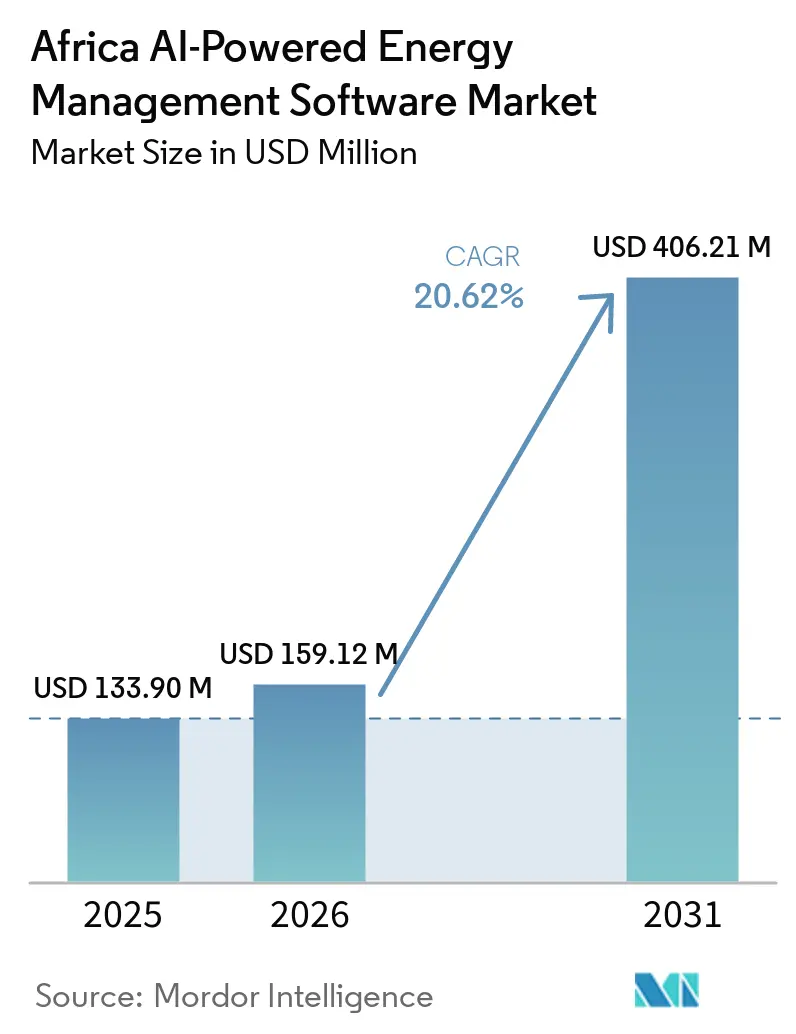
| Base Year Market Size (2025) | USD 133.90 Million |
| Market Size (2026) | USD 159.12 Million |
| Market Size (2031) | USD 406.21 Million |
| Growth Rate (2026 - 2031) | 20.62 % |
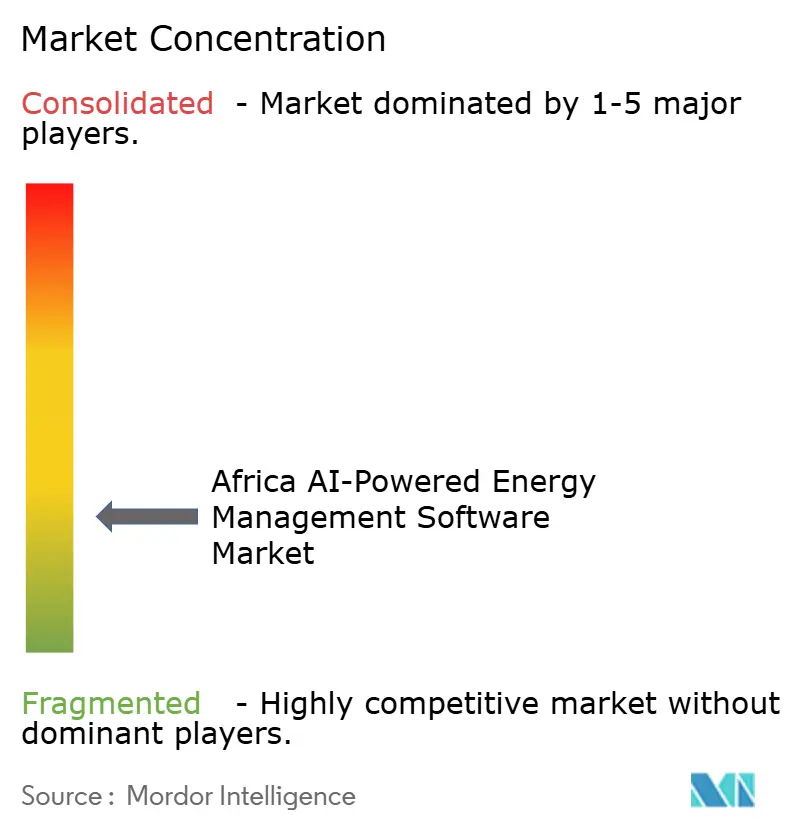
| Market Concentration | Low |
Major Players *Disclaimer: Major Players sorted in no particular order Image © Mordor Intelligence. Reuse requires attribution under CC BY 4.0. | |
Africa AI-powered Energy Management Software Market Analysis by Mordor Intelligence
The Africa AI-powered Energy Management Software Market size was USD 133.90 million in 2025 and is forecast to reach USD 406.21 million by 2031 at 20.62% CAGR from 2026 to 2031. The Africa AI-powered Energy Management Software Market is moving beyond basic monitoring, as utilities, commercial operators, and industrial users increasingly need real-time control over energy costs, load volatility, and asset performance. Buyers are adopting these platforms because distributed energy resources, unstable supply conditions, and tighter operating budgets now make manual energy management less workable across many African facilities. The early buying pattern still favors analytics and optimization tools, yet the commercial model is widening as vendors tie software to managed services, performance contracts, and subscription revenue. Competitive activity is also shifting, with global automation vendors using installed equipment, utility relationships, and digital service layers to protect their position, while Africa-focused software firms are building around local operating conditions. Integration complexity, fragmented data environments, and cybersecurity exposure continue to slow deployments, but those same constraints are strengthening demand for platforms that can combine AI, interoperability, and operational resilience in the Africa AI-powered Energy Management Software Market.
Key Report Takeaways
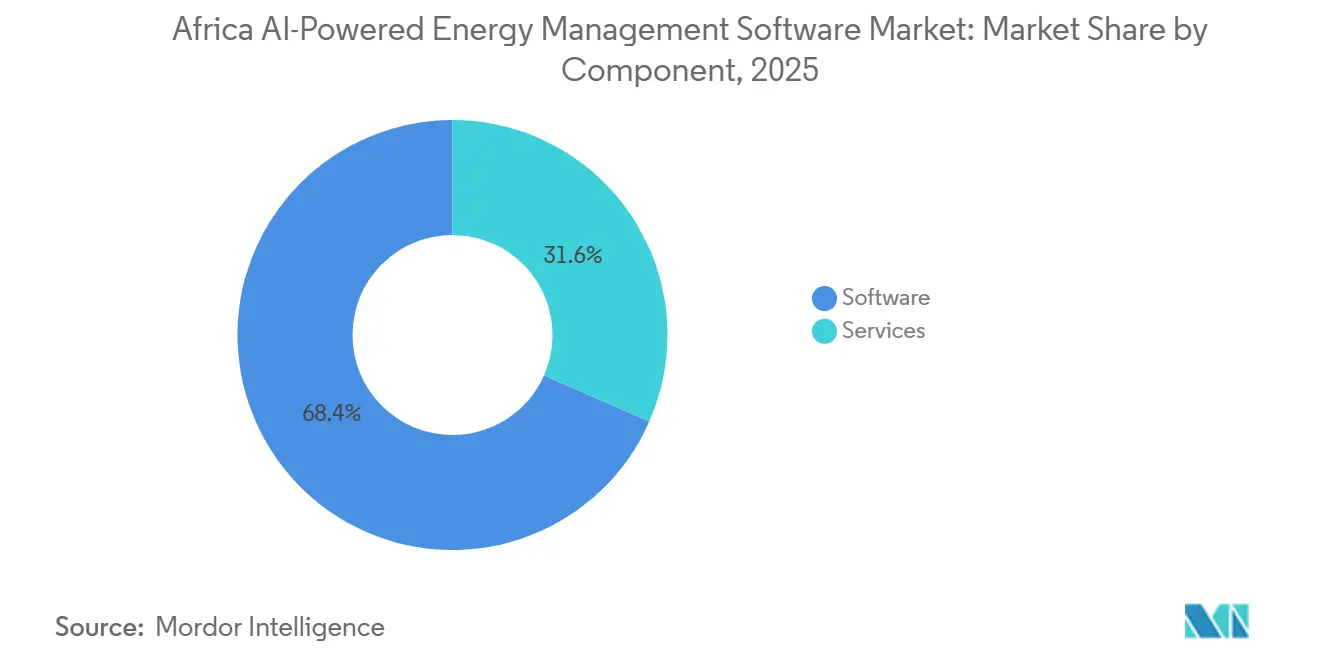
- By component, software held 68.41% of the Africa AI-powered Energy Management Software Market share in 2025, while services are projected to expand at a 23.34% CAGR through 2031.
- By deployment mode, cloud-based systems accounted for 66.29% of the Africa Artificial Intelligence Powered Energy Management Software Market size in 2025, while hybrid deployment is expected to grow at a 22.77% CAGR through 2031.
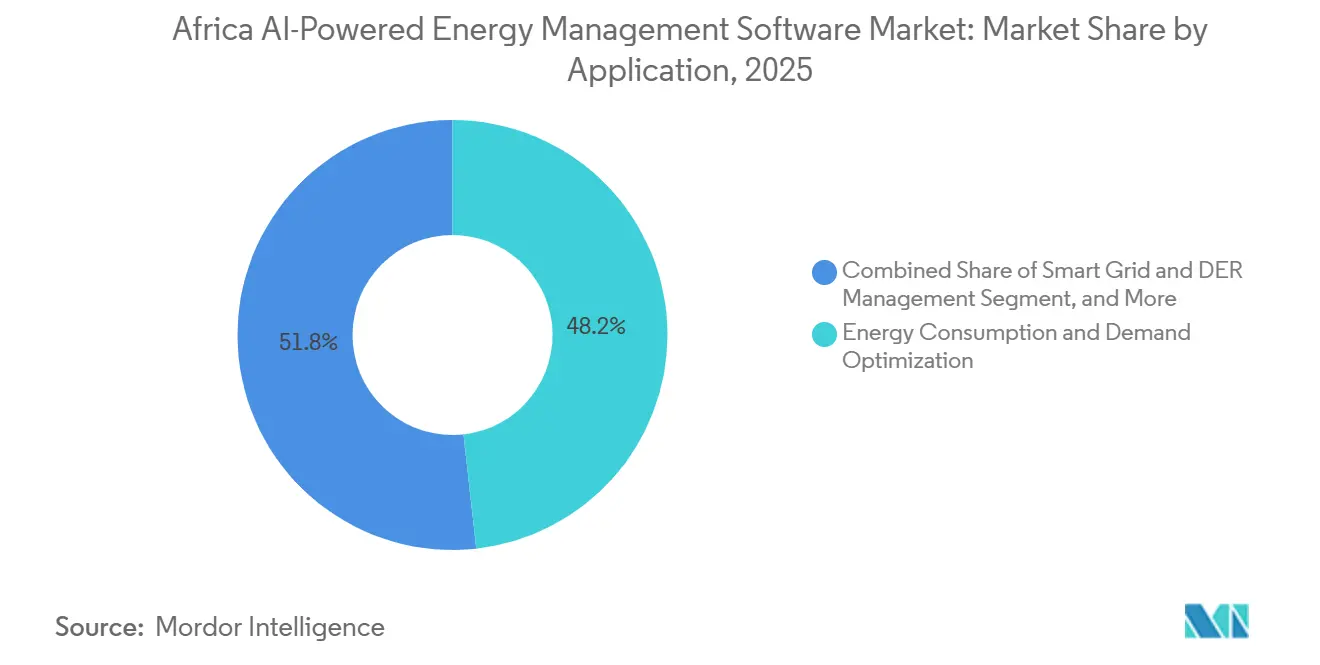
- By application, energy consumption and demand optimization captured 48.23% share of the Africa Artificial Intelligence Powered Energy Management Software Market size in 2025, while renewable energy forecasting and integration is projected to advance at a 21.89% CAGR through 2031.
- By end user, utilities held 54.12% share of the Africa Artificial Intelligence Powered Energy Management Software Market size in 2025, while commercial buildings are expected to post the highest CAGR at 22.25% through 2031.
- By geography, South Africa accounted for 65.18% of market revenue in 2025, while Egypt is projected to expand at a 23.05% CAGR through 2031.
Note: Market size and forecast figures in this report are generated using Mordor Intelligence’s proprietary estimation framework, updated with the latest available data and insights as of January 2026.
Market Trends and Insights
Drivers Impact Analysis of Africa AI-powered Energy Management Software Market*
| Driver | (~) % Impact on CAGR Forecast | Geographic Relevance | Impact Timeline |
|---|---|---|---|
| Real-Time Energy Optimization in Commercial and Industrial Facilities | +5.5% | Africa, with concentrated early adoption gains in South Africa, Nigeria, and Kenya | Short term (≤ 2 years) |
| AI Integration With Smart Grids and Distributed Energy Resources | +4.8% | South Africa, Egypt, Nigeria, and Kenya, with spillover to West Africa | Medium term (2-4 years) |
| ESG Reporting and Carbon Accounting Workflows | +3.2% | South Africa and Nigeria, with regulatory influence under IFRS S2 and South Africa's Climate Change Act 22 of 2024 | Medium term (2-4 years) |
| Edge AI for Site-Level Fault Detection and Control | +2.8% | Sub-Saharan mining belt, including Zambia, DRC, and South Africa, with early gains in East Africa | Medium term (2-4 years) |
| Retrofit Demand From Aging Building and Industrial Infrastructure | +2.2% | South Africa, Egypt, Morocco | Short term (≤ 2 years) |
| Electrification and Load Flexibility Across Mining and Heavy Industry | +1.8% | Southern Africa, including Zambia, South Africa, and DRC, with spillover to West Africa | Long term (≥ 4 years) |
| Source: Mordor Intelligence | |||
Rising Need for Real-Time Energy Optimization in Commercial and Industrial Facilities
Commercial and industrial users across the Africa AI-powered Energy Management Software Market are dealing with a sustained energy cost problem that manual monitoring cannot solve. In South Africa, rising tariffs and recurring supply instability have pushed many operators toward AI-enabled demand response and load-shifting tools to reduce peak consumption and lower exposure to volatile pricing. Honeywell deployed its Forge Performance+ platform at the Dangote Petroleum Refinery in Lagos in April 2026, demonstrating that real-time digital performance management is now in use at one of the continent's largest industrial sites. A June 2026 deployment in Nigeria also showed that AI-driven load management tied to solar and battery storage could reduce manufacturing power costs by 70%, which strengthened the commercial case for broader adoption. As tariff pressure and supply unreliability rise together, payback periods are shortening, and procurement is moving faster across the Africa AI-powered Energy Management Software Market.
AI Integration With Smart Grids and Distributed Energy Resources
The Africa AI-powered Energy Management Software Market is also gaining support from utility modernization programs that need better visibility across grids that were long operated with limited digital intelligence. Rocky Mountain Institute reported in October 2025 that many African utilities were still running largely analog systems with limited visibility into customer demand profiles and asset locations, leaving a clear opening for AI-based situational awareness and orchestration tools. GE Vernova, Larsen, and Toubro secured the KETRACO National System Control Center contract in Kenya, bringing GridOS Advanced Energy Management Systems and wide area monitoring capabilities into the national transmission environment.[1] In West Africa, GE Vernova software is also supporting dispatch, stability monitoring, and market operations for the West African Power Pool across 14 ECOWAS member countries. As distributed energy resources approach the 5% to 15% distribution peak threshold noted by RMI, AI software is becoming part of basic grid operations rather than a discretionary digital upgrade.
Expansion of ESG Reporting and Carbon Accounting Workflows
The Africa AI-powered Energy Management Software Market is also supported by the rising demand for tools that can automate emissions tracking, reporting, and audit-readiness at the facility level. South Africa's Climate Change Act 22 of 2024 introduced mandatory carbon budgets and mitigation planning, and the first commitment period began in January 2026, which raised the reporting burden for affected companies. In Nigeria, the Financial Reporting Council confirmed in March 2024 that climate risk disclosures aligned with ISSB IFRS S1 and S2 will become mandatory for public interest entities from January 2028. Azito Energie in Côte d'Ivoire deployed GE Vernova's CERius AI-powered carbon emissions management platform, making it the first known adoption of this technology in Africa for automated greenhouse gas inventory reporting. The Johannesburg Stock Exchange's alignment with ISSB standards and South Africa's phased move toward mandatory XBRL-based ESG reporting are pushing listed companies to replace manual disclosure workflows with software-based systems.
Edge AI Adoption for Site-Level Fault Detection and Control
Remote mining and industrial sites are becoming an important demand pool within the Africa AI-powered Energy Management Software Market because these facilities have high energy intensity, weak grid reliability, and limited tolerance for downtime. PotisEdge delivered a 39 MWh smart energy solution for the Zambia Ruida Mining photovoltaic-storage microgrid in February 2025, combining solar, battery, and diesel assets with AI-driven dispatch and load optimization. A 2025 peer-reviewed study in Frontiers in Energy Research also highlighted lightweight neural architectures and TinyML approaches for energy optimization in mining contexts where compressed model inference matters more than cloud dependence. Microsoft partners 4Sight and Armada used the Mining Indaba 2025 to demonstrate AI-powered edge computing for remote mines through ruggedized, modular data centers connected via satellite backhaul. The combination of local compute, intermittent connectivity support, and on-device inference removes barriers that had previously slowed AI deployment across remote extractive operations in the Africa AI-powered Energy Management Software Market.
Restraints Impact Analysis of Africa AI-powered Energy Management Software Market*
| Restraint | (~) % Impact on CAGR Forecast | Geographic Relevance | Impact Timeline |
|---|---|---|---|
| Integration Complexity With Legacy OT and IT Systems | -3.1% | South Africa, Nigeria, Egypt, with the strongest impact on large utilities and industrial operators using older infrastructure | Medium term (2-4 years) |
| Data Quality, Interoperability, and Sensor Fragmentation | -2.2% | Sub-Saharan Africa broadly, with acute challenges in West and East Africa | Long term (≥ 4 years) |
| Cybersecurity and Data Sovereignty Concerns for Critical Energy Assets | -1.6% | South Africa, Kenya, Nigeria, especially for grid-connected utilities managing critical infrastructure | Medium term (2-4 years) |
| Limited Payback Visibility in Small and Mid-Sized Sites | -1.1% | Across Sub-Saharan Africa, particularly francophone West Africa and East Africa | Short term (≤ 2 years) |
| Source: Mordor Intelligence | |||
High Integration Complexity With Legacy OT and IT Systems
A major brake on the Africa AI-powered Energy Management Software Market is the difficulty of connecting AI software to older operational technology and control environments that were never designed for data-rich automation. In March 2025, many industrial energy deployments in the region still used outdated SCADA and automation systems poorly aligned with cloud-native platforms, thereby extending procurement and implementation cycles. The governance gap between IT and OT compounds the problem because different teams with distinct operating assumptions often handle protection, uptime, and safety priorities. A 2025 review in the Journal of Big Data identified legacy infrastructure and a weak digital data architecture as leading barriers to AI deployment in energy systems, and this challenge is especially evident in African operating environments with long asset replacement cycles. These conditions keep near-term adoption concentrated among larger utilities and industrial groups that can fund integration work without disrupting day-to-day operations in the Africa AI-powered Energy Management Software Market.
Data Quality, Interoperability, and Sensor Fragmentation Issues
The Africa AI-powered Energy Management Software Market is also constrained by fragmented data environments across utilities, mini-grids, independent power producers, and commercial users that rely on different hardware and software stacks. Included VC described this in January 2026 as a major structural barrier to software-first scaling, because fragmented data and weak interoperability make model transfer and orchestration difficult across adjacent operators. Rocky Mountain Institute similarly reported that many African utilities still lack basic visibility into demand profiles and asset locations, which limits the accuracy of AI-based forecasting and demand optimization. Ethical Business Africa also noted in November 2025 that many parts of the continent still lack the connectivity and data infrastructure needed for AI systems, especially in rural and semi-urban areas where sensor coverage is inconsistent. Until common schemas, interoperable measurement layers, and standardized data pipelines improve, deployment ambition will continue to outpace operational data readiness across the Africa AI-powered Energy Management Software Market.
*Our forecasts treat driver/restraint impacts as directional, not additive. The impact forecasts reflect baseline growth, mix effects, and variable interactions.
Africa AI-powered Energy Management Software Market Segment Analysis
By Component:
Software Dominates While Services AccelerateSoftware accounted for 68.41% of component revenue in 2025, giving it the largest position in the Africa AI-powered Energy Management Software Market. Buyers initially favored software because analytics, visualization, and optimization tools could be layered onto existing systems before committing to broader transformation work. This pattern was strongest in South Africa, Egypt, and Nigeria, where early adopters sought fast gains in monitoring and control without taking on the full burden of integration. Software also matched the first stage of procurement in many utilities and industrial facilities, where visibility into energy use and operational anomalies mattered more than deep consulting support. That early weighting kept platform licenses and subscriptions at the center of spending in the Africa AI-powered Energy Management Software Market.
Services are projected to grow at a 23.34% CAGR through 2031, making them the fastest-expanding component of the Africa AI-powered Energy Management Software Market. The reason is practical, because many users need help with configuration, training, system tuning, and managed analytics long after the first software deployment goes live. Vendors that can link fees to measurable energy cost reduction are gaining traction with customers who want ongoing operational support rather than a one-time installation. Schneider Electric's regional push toward EcoStruxure Energy Intelligence also reflects this shift, as the company is moving from product-led contracts toward AI-linked recurring software and service models. Over time, those services may put pressure on pure software specialists, because broader incumbents can bundle analytics, implementation, and long-term optimization into a single commercial offer.
By Deployment Mode:
Hybrid Architectures Gain Traction Beyond CloudCloud-based deployment held a 66.29% share in 2025, making it the leading delivery model across the Africa AI-powered Energy Management Software Market. Cloud systems appealed to buyers because they lowered upfront infrastructure costs and made it easier to configure, monitor, and update distributed assets across wide geographic footprints. They also fit the needs of organizations that wanted faster deployment and centralized visibility across multiple buildings, substations, or operating sites. For many commercial users, cloud-based platforms provided an accessible entry point into AI-based energy management without requiring large on-site computing investments. This gave cloud deployment a strong early lead in the Africa AI-powered Energy Management Software Market.
Hybrid deployment is forecast to expand at a 22.77% CAGR through 2031, reflecting the need to combine cloud analytics with local control for critical operations. Utilities, mines, and large industrial sites increasingly need on-site response capacity because real-time decisions cannot always wait for stable connectivity or round-trip cloud processing. Mining deployments highlighted this need in 2025, as edge-based AI solutions were being deployed to remote sites with challenging power and communications conditions. PotisEdge's Zambia microgrid project also showed that local dispatch intelligence is becoming central, as solar, battery, and diesel systems must be continuously balanced.[2] Vendors that can manage both edge and cloud environments through one interface are therefore gaining a stronger position in the Africa AI-powered Energy Management Software Market.
By Application:
Demand Optimization Leads, Renewable Forecasting Gains MomentumEnergy consumption and demand optimization accounted for 48.23% of the application landscape in 2025, making it the largest application segment in the Africa AI-powered Energy Management Software Market. This leadership reflects the immediate need to manage peak demand, reduce exposure to expensive supply periods, and improve resilience in systems with limited reserve margins. Commercial and industrial users value this application because it delivers direct savings through load shifting, automated controls, and better use of backup power and storage. The same application also supports utilities that need flexible demand reduction rather than relying solely on additional generation capacity. That direct economic value kept demand optimization at the front of spending across the Africa AI-powered Energy Management Software Market.
Renewable energy forecasting and integration is projected to grow at a 21.89% CAGR through 2031, which makes it the fastest-rising application area. As solar, wind, and behind-the-meter energy resources expand, utilities need better forecasting and dispatch coordination than older grid tools can provide. GE Vernova's GridOS deployments in Kenya and the West African Power Pool illustrate how utilities are adding software layers that can support dispatch, stability, and market operations in more complex power systems. RMI also emphasized that improved grid intelligence becomes increasingly necessary as distributed energy resources approach higher shares of the system peak. As renewable penetration outpaces legacy forecasting capabilities, this application is becoming a larger growth engine for the Africa AI-powered Energy Management Software Market.

By End User:
Utilities Drive Scale, Commercial Buildings Chase EfficiencyUtilities held 54.12% of the Africa AI-powered Energy Management Software Market share in 2025, which made them the largest end-user group. Their lead came from the scale of the transmission, distribution, and control assets they must manage as they integrate more distributed and renewable resources into aging networks. Utilities also have a stronger need for enterprise-grade platforms because failures in forecasting, dispatch, or asset monitoring can affect entire service territories. National and state-owned power companies are therefore treating digitalization as a core operational requirement rather than a limited pilot exercise. This keeps utilities at the center of demand in the Africa AI-powered Energy Management Software Market.
Commercial buildings are projected to grow at a 22.25% CAGR through 2031, making them the fastest-growing end-user segment. Rising electricity tariffs, increased expectations for green building certification, and financing conditions tied to energy performance are pushing property owners and tenants to automate building energy decisions. Industrial facilities remain important, especially in mining, petrochemicals, and manufacturing, where energy can account for 20% to 40% of operating costs and where efficiency gains directly translate into operating margin. Schneider Electric's work with mining and industrial clients in Africa shows how integrated digital energy management is being tied to broader performance goals beyond simple utility bill reduction. Residential buildings still represent the smallest category, yet smart meter rollouts, rooftop solar adoption, and AI-based home-optimization tools are gradually building a wider user base for the Africa Artificial Intelligence Powered Energy Management Software Market.
Geography Analysis
South Africa AI-powered Energy Management Software Market
South Africa accounted for 65.18% of revenue in 2025, giving it the largest geographic position in the Africa AI-powered Energy Management Software Market. The country led because it combines the continent's deepest industrial base, a large commercial property sector, and a long period of electricity instability that pushed energy management into board-level planning. South Africa also benefited from stronger data, metering, and digital talent availability than most neighboring markets, which improved the operating conditions for software deployment. Research published in Energy Strategy Reviews in 2025 identified AI-driven grid monitoring, demand forecasting, and neural-network-based supply and demand management as important parts of South Africa's energy transition path. Mandatory climate disclosure and structured reporting requirements are adding another layer of demand, as listed and state-linked entities increasingly need software support for energy and emissions reporting workflows.
Egypt AI-powered Energy Management Software Market
Egypt is forecast to grow at a 23.05% CAGR through 2031, making it the fastest-expanding national market in the Africa AI-powered Energy Management Software Market. Large renewable energy assets, sovereign interest in AI capability, and rising demand for intelligent control across industrial and utility settings are supporting growth in Egypt. The country is also becoming more visible as a regional platform for enterprise AI adoption in the energy sector. IBM and Elsewedy Electric announced a strategic collaboration in April 2026 to apply watsonx.ai and watsonx Orchestrate across Elsewedy's energy operations, which signals growing acceptance of AI-led decision support in Egypt's power environment. As utility-scale generation and digital infrastructure expand together, Egypt is building a larger installed base of energy assets that can support future software growth in the Africa AI-powered Energy Management Software Market.
Broader African Markets
The Rest of Africa segment spans a wide range of maturity levels, with Nigeria and Kenya serving as key anchors for the next wave of adoption in the Africa AI-powered Energy Management Software Market. Nigeria is seeing growing demand from distributed renewable systems and behind-the-meter installations that require coordination across grid power, storage, and on-site generation. Kenya is moving forward with national transmission modernization through the KETRACO control center program, which brings advanced energy management software directly into transmission operations. Southern African mining markets are also important, as Zambia's Ruida Mining microgrid project created a visible example of AI-managed energy balancing in a remote, energy-intensive setting. These regional patterns show that adoption is not spreading evenly, yet they also show that the commercial logic of the Africa AI-powered Energy Management Software Market is becoming clearer across utilities, industrial sites, and distributed energy environments beyond the two largest national markets.
Competitive Landscape
The Africa AI-powered Energy Management Software Market remains fragmented, with global automation and enterprise software vendors competing alongside Africa-focused specialists and emerging AI energy startups. Large incumbents hold an advantage because they already have installed equipment, long-standing utility relationships, and the ability to bundle software into wider electrification and control contracts. That gives them a stronger starting point with large utility and industrial accounts, especially when buyers want a single vendor to handle monitoring, control, service, and cybersecurity across multiple asset classes. At the same time, local and regional firms are gaining attention by designing around intermittent connectivity, multi-source power environments, and site conditions that large global platforms did not originally target. This makes the Africa AI-powered Energy Management Software Market competitive on both scale and local fit.
Several strategic moves between 2025 and 2026 show how vendors are trying to widen their position in the Africa AI-powered Energy Management Software Market. Schneider Electric's April 2026 NExT program in Sub-Saharan Africa shifted EcoStruxure toward EcoStruxure Energy Intelligence, suggesting a stronger push toward recurring AI-led software revenue rather than hardware-adjacent contracts. Honeywell deepened its digital energy stack in March 2025 by integrating Innowatts' advanced metering and grid forecasting capabilities into Forge Performance+ for Utilities, and it expanded industrial deployment in April 2026 through the Dangote refinery project.[3] Bidgely also accelerated consolidation in March 2025 through its acquisition of Grid4C, adding patented AI capabilities in forecasting, diagnostics, and distributed energy optimization. These moves show that scale, software depth, and recurring value capture are becoming more important than stand-alone monitoring tools.
The main white space now sits with mid-sized commercial and industrial operators that are too complex for simple software packages and too small for highly customized global contracts in the Africa AI-powered Energy Management Software Market. Africa-native firms are using that opening to compete on integration speed, local operating knowledge, and the ability to manage mixed energy environments that combine grid supply, solar, storage, and backup generation. Differentiation is increasingly shifting toward edge inference, legacy sensor compatibility, and deployment models that work under weak data and connectivity conditions. Buyers are therefore evaluating vendors not only on technical capability but also on their ability to demonstrate local execution strength, service reach, and operational relevance across African energy settings.
Africa AI-powered Energy Management Software Industry Leaders
-
Siemens AG
-
Schneider Electric SE
-
IBM Corporation
-
Microsoft Corporation
-
SAP SE
- *Disclaimer: Major Players sorted in no particular order
Africa AI-powered Energy Management Software Market Companies Covered in this Report
- Siemens AG
- Schneider Electric SE
- ABB Ltd.
- Honeywell International Inc.
- IBM Corporation
- Johnson Controls International plc
- General Electric Company
- Eaton Corporation plc
- Emerson Electric Co.
- Oracle Corporation
- Microsoft Corporation
- Amazon Web Services, Inc.
- SAP SE
- C3.ai, Inc.
- Bidgely, Inc.
- Grid4C Ltd.
- Innowatts, Inc.
- Enel X S.r.l.
- GridPoint, Inc.
- Dexma Sensors, S.L.
Recent Industry Developments in Africa AI-powered Energy Management Software Market
- June 2026: GE Vernova Inc. showcased its comprehensive portfolio of integrated energy technologies at the Africa Energy Forum in Cape Town on June 17, 2026, including its GridOS orchestration software suite and the CERius AI-powered carbon emissions management platform, positioning digital decarbonization and grid stability tools as central to Africa's industrial energy transition strategy.
- April 2026: Honeywell deployed its Forge Performance+ connected services and digital performance monitoring platform at the Dangote Petroleum Refinery in Lekki, Nigeria, in April 2026, combining Honeywell UOP engineering expertise with real-time AI-driven operational insights to optimize production of high-octane fuels across core processing units at the world's largest single-train petroleum refinery.
- April 2026: IBM and Elsewedy Electric announced a strategic collaboration in April 2026 to advance enterprise-scale agentic AI adoption using the watsonx.ai and watsonx Orchestrate platforms across Elsewedy's energy operations in Egypt. Following a successful proof-of-concept in market intelligence research, the partnership aims to strengthen Egypt's positioning as a regional AI hub.
- February 2026: Honeywell and Kortech, a subsidiary of Hassan Allam Holding, signed a memorandum of understanding in February 2026 to collaborate on automating and digitizing critical infrastructure projects across Egypt, Saudi Arabia, and the UAE, combining Honeywell's Forge platform capabilities with Kortech's turnkey infrastructure solutions across data centers and smart-city developments.
Africa AI-powered Energy Management Software Market Report Scope
The Africa AI-powered Energy Management Software Market encompasses advanced software platforms that utilize artificial intelligence (AI), machine learning, and data analytics to monitor, optimize, and manage energy consumption across industrial, commercial, and public infrastructure in African countries. These solutions integrate with energy systems, smart meters, and IoT-enabled devices to enable real-time energy tracking, demand forecasting, and automated optimization of energy usage. Increasing energy demand, grid inefficiencies, renewable energy integration, and sustainability initiatives across the region drive the market. It supports organizations and governments in reducing operational costs, improving energy efficiency, and achieving decarbonization and electrification goals in both grid-connected and off-grid environments.
The Africa AI-powered Energy Management Software Market Report is Segmented by Component (Software, and Services), Deployment Mode (Cloud-Based, On-Premises, and Hybrid), Application (Energy Consumption and Demand Optimization, Asset Performance and Predictive Maintenance, Smart Grid and Distributed Energy Resource (DER) Management, Renewable Energy Forecasting and Integration, and Energy Trading, Pricing and Market Intelligence), End User (Utilities, Commercial Buildings, Industrial Facilities, and Residential Buildings), and Geography (South Africa, Egypt, and Rest of Africa). The Market Forecasts are Provided in Terms of Value (USD).
Segmentation Overview
| Software |
| Services |
| Cloud-Based |
| On-Premises |
| Hybrid |
| Energy Consumption and Demand Optimization |
| Asset Performance and Predictive Maintenance |
| Smart Grid and Distributed Energy Resource (DER) Management |
| Renewable Energy Forecasting and Integration |
| Energy Trading, Pricing and Market Intelligence |
| Utilities |
| Commercial Buildings |
| Industrial Facilities |
| Residential Buildings |
| South Africa |
| Egypt |
| Rest of Africa |
| By Component | Software |
| Services | |
| By Deployment Mode | Cloud-Based |
| On-Premises | |
| Hybrid | |
| By Application | Energy Consumption and Demand Optimization |
| Asset Performance and Predictive Maintenance | |
| Smart Grid and Distributed Energy Resource (DER) Management | |
| Renewable Energy Forecasting and Integration | |
| Energy Trading, Pricing and Market Intelligence | |
| By End User | Utilities |
| Commercial Buildings | |
| Industrial Facilities | |
| Residential Buildings | |
| By Geography | South Africa |
| Egypt | |
| Rest of Africa |
Key Questions Answered in the Report
What is the current and forecast value of the Africa AI-powered Energy Management Software Market?
The Africa AI-powered Energy Management Software Market was valued at USD 133.90 million in 2025 and is forecast to reach USD 406.21 million by 2031, growing at a 20.62% CAGR from 2026 to 2031.
Which component leads spending in this space?
Software led component revenue with a 68.41% share in 2025, as buyers prioritized analytics and optimization tools before broader service engagement.
Which deployment model is growing the fastest across Africa?
Hybrid deployment is projected to grow at a 22.77% CAGR through 2031, as utilities and industrial sites need both cloud analytics and local control.
Which application area has the largest revenue base?
Energy consumption and demand optimization held 48.23% share in 2025 because it directly addresses peak demand, cost control, and resilience needs.
Which end-user group is expanding the fastest?
Commercial buildings are expected to record the highest CAGR at 22.25% through 2031 as tariffs, financing conditions, and performance standards tighten.
Which countries are shaping near-term adoption trends?
South Africa led with 65.18% of revenue in 2025, while Egypt is projected to grow the fastest at a 23.05% CAGR, and Nigeria and Kenya remain important growth anchors.