
Affiliate Marketing Software Market Size and Share
Market Overview
| Study Period | 2020 - 2031 |
|---|---|
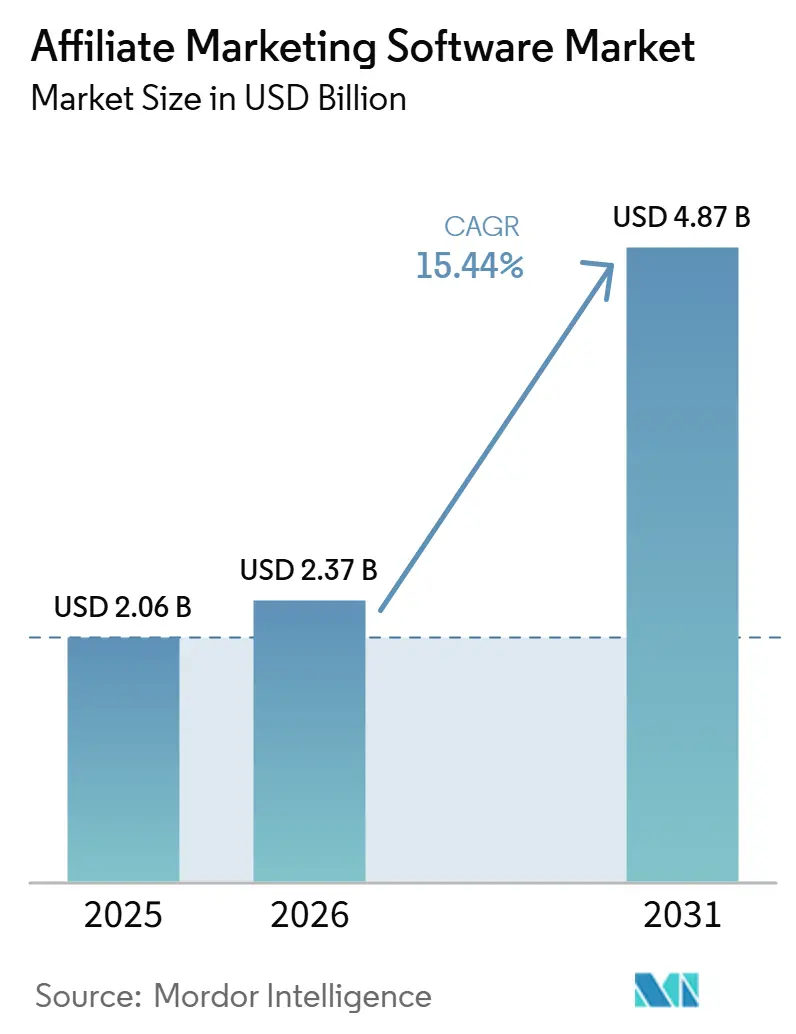
| Market Size (2026) | USD 2.37 Billion |
| Market Size (2031) | USD 4.87 Billion |
| Growth Rate (2026 - 2031) | 15.44 % |
| Fastest Growing Market | Asia-Pacific |
| Largest Market | North America |
| Market Concentration | Medium |
Major Players *Disclaimer: Major Players sorted in no particular order Image © Mordor Intelligence. Reuse requires attribution under CC BY 4.0. | |
Affiliate Marketing Software Market Analysis by Mordor Intelligence
The Affiliate marketing software market size is expected to grow from USD 2.06 billion in 2025 to USD 2.37 billion in 2026 and is forecast to reach USD 4.87 billion by 2031 at 15.44% CAGR over 2026-2031. Demand is shifting toward platforms that combine partner management, attribution, fraud controls, and reporting into a single workflow. Brands are also bringing creators, niche publishers, and conventional affiliates into the same commercial programs. This change favors providers that can manage varied partner terms without losing visibility over commissions or conversion quality. The Affiliate marketing software market is also moving toward first-party data and server-side measurement as browser restrictions limit older tracking methods. Competition is increasingly based on the ability to support large programs while reducing customer implementation and compliance work.
Key Report Takeaways
- By deployment mode, cloud held 70.14% of the Affiliate Marketing Software Market share in 2025 and is projected to expand at a 17.89% CAGR through 2031.
- By enterprise size, large enterprises held 72.89% of the Affiliate Marketing Software Market share in 2025, while SMEs are projected to record the highest CAGR of 18.22% through 2031.
- By application, affiliate program management accounted for 67.89% of the Affiliate Marketing Software Market share in 2025, while influencer and creator partnership management is projected to expand at a 17.43% CAGR through 2031.
- By end-user industry, retail and e-commerce held 38.13% of the Affiliate Marketing Software Market share in 2025, while media and entertainment is projected to grow at a 16.72% CAGR through 2031.
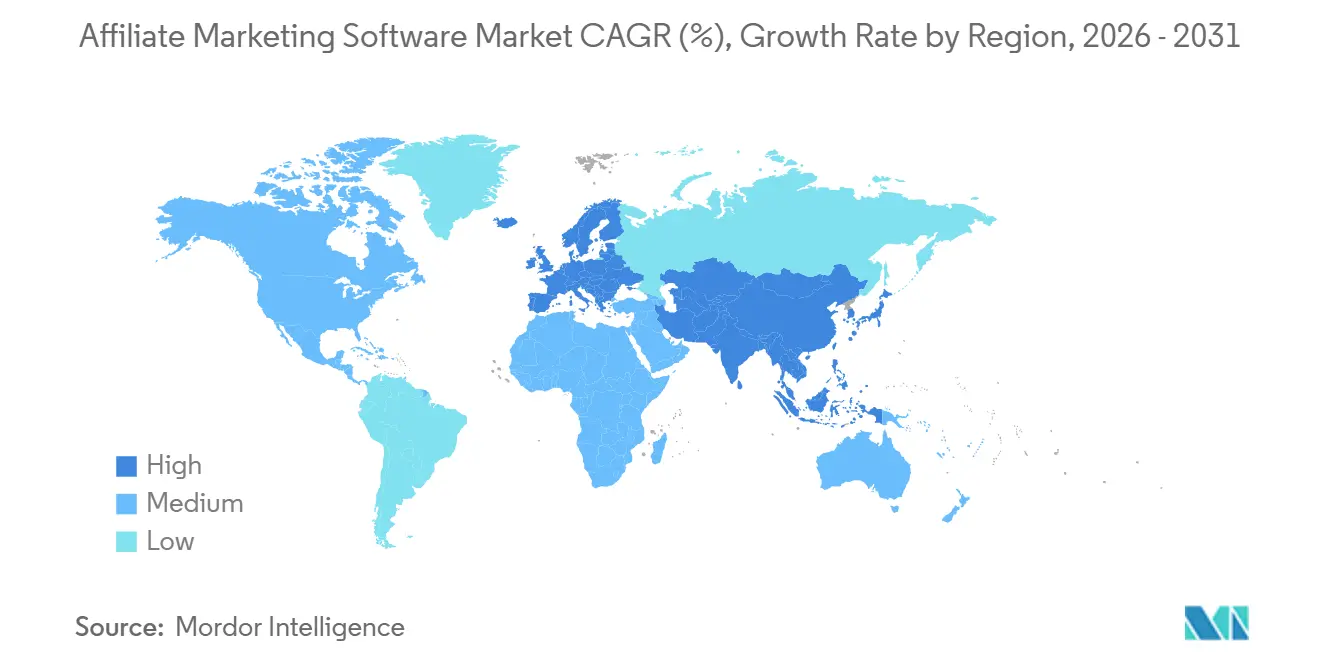
- By geography, North America held 36.21% share in 2025, while Asia-Pacific is projected to advance at a 17.04% CAGR through 2031.
Note: Market size and forecast figures in this report are generated using Mordor Intelligence’s proprietary estimation framework, updated with the latest available data and insights as of January 2026.
Market Trends and Insights
Drivers Impact Analysis of Affiliate Marketing Software Market*
| Driver | (~) % Impact on CAGR Forecast | Geographic Relevance | Impact Timeline |
|---|---|---|---|
| Rising Creator and Influencer Commerce Adoption | +3.2% | Global, with peak concentration in North America and Asia-Pacific | Short term (≤ 2 years) |
| AI-Enabled Fraud Detection and Attribution Accuracy Demand | +2.8% | Global, with early adoption in North America and Europe | Medium term (2-4 years) |
| Shift Toward Performance-Based Marketing Spend | +2.5% | Global, with North America and Europe as primary movers | Short term (≤ 2 years) |
| First-Party Data Activation After Cookie Deprecation | +2.1% | Global, with regulatory acceleration in Europe and Asia-Pacific | Medium term (2-4 years) |
| Micro-Partner and Niche Publisher Monetization Growth | +1.5% | Global, pronounced in Asia-Pacific, South America, and Europe | Medium term (2-4 years) |
| Cross-Border Partner Program Orchestration Needs | +0.8% | Asia-Pacific, Middle East, and South America, with spillover to Europe | Long term (≥ 4 years) |
| Source: Mordor Intelligence | |||
Rising Creator and Influencer Commerce Adoption
Creator-led commerce is moving from a small-campaign format to a regular customer-acquisition channel for many brands in the Affiliate marketing software market. Creator advertising spend reached USD 37 billion in 2025 and is expected to reach USD 44 billion in 2026, according to IAB data reported in April 2026. This activity expands the number and type of partners that an affiliate program must support. Companies often need to track creators, discount publishers, ambassadors, and referral partners under different payout structures. The Affiliate marketing software market, therefore, benefits when platforms can manage both fixed fees and outcome-based commissions within the same program. impact.com introduced creator storefront capabilities and an autonomous recruitment tool at its June 2026 iPX event, showing the effort to bring discovery, onboarding, and measurement into a connected platform.
AI-Enabled Fraud Detection and Attribution Accuracy Demand
Large affiliate programs in the Affiliate marketing software market need robust controls to prevent invalid traffic, click spamming, and attribution hijacking, which can distort commissions. This need has made fraud detection and transparency in attribution more important in enterprise platform selection. The Affiliate marketing software market is responding with tools that evaluate partner behavior and identify suspicious activity before commissions are approved. Everflow made its AI Shield product generally available on June 18, 2026, positioning behavioral analysis as an alternative to rules-based thresholds. Partnerize reported that its 2026 Zero-Click Commerce Index found that publishers generated 3.84 times more measurable purchase influence through AI-mediated discovery than through conventional last-click records.[1]Partnerize, “ICYMI Partnerize Brings VantagePoint to Publishers,” Partnerize, partnerize.com These developments place greater value on platforms that can test influence across a longer customer journey instead of simply assigning credit to the final click.
Shift Toward Performance-Based Marketing Spend
Marketing teams in the Affiliate marketing software market are continuing to prioritize channels with measurable results linked to commercial outcomes. The IAB's 2025 Outlook Study found that most brand marketers planned to increase performance advertising allocations relative to brand advertising during 2025. This preference supports software that records partner activity, commission rules, and completed actions in one place. It also changes how teams assess existing affiliate arrangements. Program managers are paying closer attention to whether attributed conversions were incremental and whether individual partners provide value beyond last-click reporting. The Affiliate marketing software market gains from this scrutiny because measurement systems become necessary operating tools rather than optional reporting add-ons.
First-Party Data Activation After Cookie Deprecation
Browser privacy changes are reducing the reliability of tracking methods used across the Affiliate marketing software market. Affiliate platforms are responding by using server-to-server event transfers, validated conversion records, and consent-aware identity matching. This approach can improve the clarity of commission decisions when browsers restrict conventional pixels. The Affiliate marketing software market is consequently seeing demand for systems that connect approved first-party data with partner activity. A platform also needs records that allow customers to review how a conversion was identified and why a partner received credit. These requirements raise the value of platforms that combine tracking architecture with consent and audit functions.
Restraints Impact Analysis of Affiliate Marketing Software Market*
| Restraint | (~) % Impact on CAGR Forecast | Geographic Relevance | Impact Timeline |
|---|---|---|---|
| Affiliate Fraud and Invalid Traffic Leakage | -1.8% | Global, with highest incidence in Forex, iGaming, and high-growth Asia-Pacific markets | Short term (≤ 2 years) |
| Privacy Compliance Complexity Across Jurisdictions | -1.5% | Europe, North America, and Australia, with spillover to Asia-Pacific and South America | Medium term (2-4 years) |
| Martech Stack Integration Friction | -0.9% | Global, most acute in large enterprises with legacy technology stacks | Medium term (2-4 years) |
| Long Sales Cycles for Enterprise Platform Replacement | -0.7% | North America and Europe, where incumbent platforms hold multiyear contracts | Long term (≥ 4 years) |
| Source: Mordor Intelligence | |||
Affiliate Fraud and Invalid Traffic Leakage
Fraud can erode confidence in the Affiliate marketing software market when managers cannot explain the quality of traffic or the basis for commissions. The issue is operational because inaccurate data can lead to disputed payouts and delayed decisions. It can also slow platform expansion when finance teams question whether program controls are adequate. The Affiliate marketing software market must therefore provide ongoing monitoring instead of a one-time fraud review. Fraud methods such as cookie stuffing, click spamming, and attribution hijacking continue to require updates to detection models. Everflow's 2026 product release reflects the wider push to identify suspicious behavior at both the program and network levels.
Privacy Compliance Complexity Across Jurisdictions
Programs operating across countries in the Affiliate marketing software market must apply different expectations for consent, data collection, and creator disclosures. This creates extra implementation work for brands and for vendors that configure platforms for them. The complexity may extend sales cycles because customers need assurance that their tracking setup fits internal policy requirements. The Affiliate marketing software market benefits from compliance automation, but building and maintaining these functions also adds cost. Platforms that record consent and explain how conversion data was processed can reduce operational burden for customers. Providers without jurisdiction-aware capabilities may be less suitable for buyers with programs across Europe, North America, and Asia-Pacific.
*Our forecasts treat driver/restraint impacts as directional, not additive. The impact forecasts reflect baseline growth, mix effects, and variable interactions.
Affiliate Marketing Software Market Segment Analysis
By Deployment Mode:
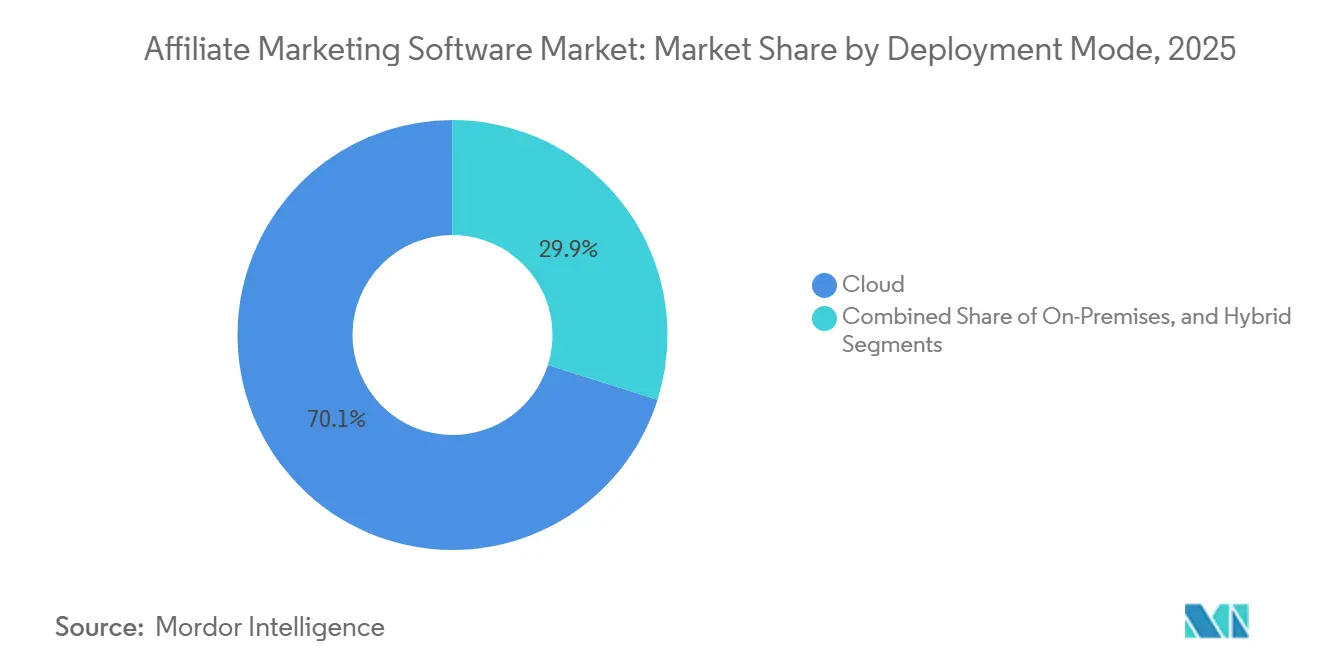
Cloud Adoption Supports Integrated Program OperationsCloud deployment accounted for 70.14% of the Affiliate marketing software market in 2025 and is projected to grow at a 17.89% CAGR through 2031. It supports the delivery of reporting, partner access, and program controls through a shared online environment. Modern affiliate programs often need updated conversion data during a campaign rather than at the end of a reporting cycle. Cloud systems can make those updates available to program teams and approved partners without separate local installations. They are also suited to features that depend on large data volumes, including real-time fraud scoring and dynamic attribution recalculation.
The deployment preference reflects operating needs rather than convenience alone. Cloud providers can add functionality across their customer base without requiring each customer to undergo a major software upgrade. This helps brands maintain consistent processes across multiple regions and partner groups. Hybrid models remain relevant where data residency rules or internal policies limit a full cloud move. On-premises systems also retain a role for companies with older technology environments that are being retired gradually. impact.com expanded its Integrations Hub at iPX in June 2026, illustrating how cloud platforms are extending access to connected tools and data services.



By Enterprise Size:
Large Programs Remain Important as SME Adoption BroadensLarge enterprises accounted for 72.89% of the Affiliate marketing software market in 2025. These organizations often have established partner networks, specialized teams, and formal requirements for reporting and payment administration. Their programs can involve multiple brands, markets, and commission structures simultaneously. This creates demand for full-platform systems that include fraud controls, compliance features, and multiple attribution methods. Large enterprise spending also reflects the higher pricing of platforms designed to support complex partner operations.
SMEs are projected to record the highest growth at an 18.22% CAGR through 2031. The opportunity comes from lower-barrier products that offer practical partner management without the need for an enterprise-scale implementation. Smaller companies can use these tools to formalize referral and affiliate activity that may previously have been managed through spreadsheets or separate applications. The Affiliate marketing software industry is therefore expanding beyond its early focus on large brands. In May 2026, PartnerStack's integration with AppDirect connected its partner capabilities to a subscription marketplace serving technology providers, advisors, and subscribers.[2]PartnerStack Inc., “PartnerStack Joins AppDirect,” PartnerStack, partnerstack.com This kind of connection can help smaller software businesses reach partner networks through existing commercial ecosystems.
By Application:
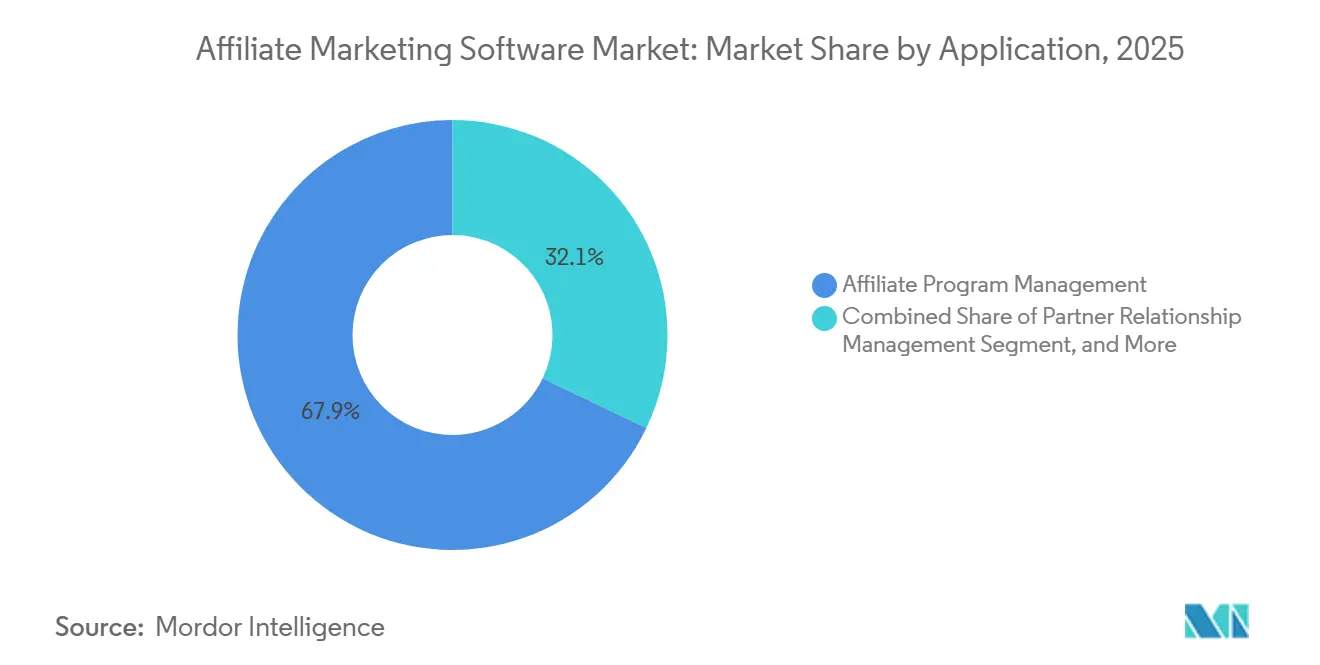
Program Management Leads While Creator Functions ExpandAffiliate program management accounted for 67.89% segment share in 2025. It remains the core use case because organizations need to create links, record conversions, calculate commissions, and make payouts. These basic activities form the control layer for most partner programs. They also create the data foundation needed for performance reporting and partner reviews. The leading position shows that dependable program administration remains the first requirement for buyers.
Influencer and creator partnership management is projected to grow at a 17.43% CAGR through 2031. Brands are combining social commerce, creator storefronts, and performance-based arrangements with more traditional affiliate activity. Levanta announced in March 2026 that its platform unified creator and affiliate programs across Shopify, Amazon, and Walmart, with cross-channel performance measurement. Partner relationship management and performance tracking remain important supporting applications. Partnerize's publisher-focused VantagePoint launch in January 2026 also showed how advanced attribution is being positioned as a distinct capability for organizations that need to assess influence beyond a click.
By End-User Industry:
Retail and E-Commerce Lead as Media and Entertainment ExpandsRetail and e-commerce accounted for 38.13% of the segment share in 2025. Online retailers have long used partners to acquire customers and measure sales against commission costs. The sector also has a dense base of publishers, comparison sites, coupon services, and creators. These conditions make affiliate systems a practical part of online retail operations. Retail buyers need accurate tracking because promotions, product availability, and commission rates can change quickly.
Media and entertainment are projected to grow at a 16.72% CAGR through 2031. Streaming services, digital publishers, and gaming businesses are using partner programs to support subscriptions, content discovery, and creator relationships. BFSI remains a valuable but more constrained end-user field because its programs face tighter compliance and anti-spam requirements. Travel and hospitality have continued rebuilding partner activity after the disruption experienced from 2020 through 2022. Information technology and telecommunications also use partner management for cloud software, cybersecurity, and developer tool referrals. PartnerStack has developed a position in these software-oriented referral programs through its focus on B2B partner ecosystems.
Geography Analysis
North America Affiliate Marketing Software Market
North America accounted for 36.21% of the Affiliate marketing software market in 2025. The region benefits from a mature enterprise affiliate ecosystem and a concentration of platform vendors. United States programs have moved from separate point solutions toward broader platforms that cover partner discovery, measurement, and operational controls. impact.com reported that Walmart and Lenovo were among clients with programs generating more than USD 110 billion in combined annual gross merchandise value.[3]impact.com, “impact.com Q1 Momentum and Rakuten Alliance,” impact.com, impact.com Canada and Mexico remain smaller regional markets that follow wider digital commerce development.
Europe Affiliate Marketing Software Market
Europe is the second-largest regional market. Its consent and privacy requirements can restrict tracking methods and raise demand for platforms with embedded compliance functions. Germany, the United Kingdom, and France are important markets due to their advanced digital commerce activity and robust data governance frameworks. The Affiliate marketing software market must support tracking solutions that meet program requirements without compromising privacy expectations.
APAC, MEA and South America Affiliate Marketing Software Market
Asia-Pacific is projected to record the highest regional CAGR of 17.04% through 2031. China has a social commerce and live-stream shopping environment that needs measurement across closed application ecosystems. India is expanding its digital advertising and affiliate activity, while Southeast Asia is seeing greater adoption of creator-led commerce. South America benefits from e-commerce and digital payment adoption, while Middle East programs are concentrated in Gulf Cooperation Council markets. Africa is still early in software adoption, though South Africa and Nigeria are seeing initial formalization in financial services and mobile commerce.

Competitive Landscape
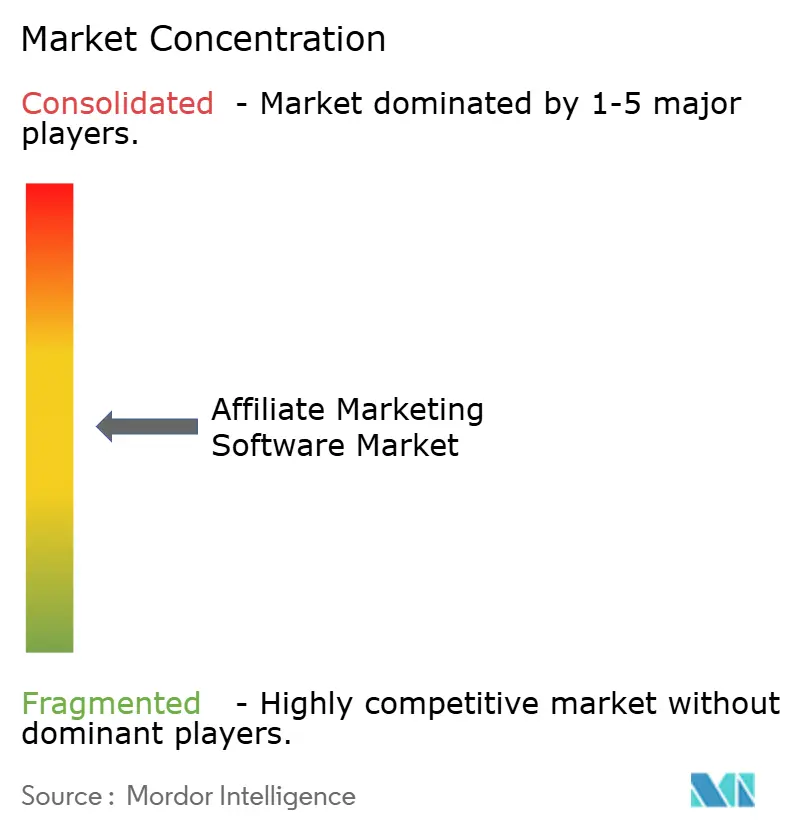
The Affiliate marketing software market is moderately concentrated among enterprise platform providers, while specialist suppliers dominate the mid-market. impact.com, Awin, and CJ Affiliate serve major brand programs, while Partnerize, PartnerStack, Everflow, Affise, and Tapfiliate serve a broader range of needs. Buyers compare partner recruitment, program controls, creator support, reporting depth, and implementation effort. This keeps the Affiliate marketing software market fragmented, with the largest providers accounting for only a small share. A small group of enterprise platforms remains important, but it does not eliminate choice for mid-market buyers.
Leading companies are building broader ecosystems to retain large customers. impact.com and Rakuten International announced an alliance on April 28, 2026, combining impact.com's platform with Rakuten Advertising's managed services and Rakuten Rewards' consumer intelligence. Impact.com also introduced creator commerce functions, an autonomous recruitment capability, and additional integration options at iPX in June 2026. Partnerize and Profound announced an integration in March 2026 that connected AI discovery intelligence with Partnerize's VantagePoint measurement infrastructure.
Open opportunities remain in AI-mediated commerce, vertical-specific commission structures, and self-service tools for SMEs. Everflow's AI releases show a focus on giving partner managers more direct access to tracking and attribution information.[4]Everflow Technologies, Inc., “Everflow Empowers Brands to Scale AI Agents Alongside Affiliates,” Everflow, everflow.io Partnerize stated that its VantagePoint Fractional Compensation Standard received certification from the Alliance for Audited Media with its January 2026 publisher launch. The Affiliate marketing software market will remain competitive as providers balance enterprise depth with accessible products for growing partner programs.
Affiliate Marketing Software Industry Leaders
Everflow Technologies, Inc.
Tune, Inc.
Refersion, Inc.
ClickBank, LLC
PartnerStack Inc.
- *Disclaimer: Major Players sorted in no particular order
Affiliate Marketing Software Market Companies Covered in this Report
- impact.com, Inc.
- Awin Global Limited
- CJ Affiliate, Inc.
- Rakuten Marketing LLC
- Partnerize Limited
- PartnerStack Inc.
- Everflow Technologies, Inc.
- Affise Group Limited
- Post Affiliate Pro, s.r.o.
- Tune, Inc.
- scaleo, s.r.o.
- Tapfiliate B.V.
- Refersion, Inc.
- LeadDyno, LLC
- ClickBank, LLC
- Admitad GmbH
- Cellxpert, Inc.
- HasOffers, Inc.
- Osiaffiliate, Inc.
- Tradedoubler AB

Recent Industry Developments in Affiliate Marketing Software Market
- June 2026: impact.com unveiled a suite of AI and creator commerce capabilities at its annual iPX event in Austin, Texas, on June 11, 2026. Announcements included the closed beta launch of an autonomous Recruitment Agent for partner discovery and onboarding, the general availability of creator Storefronts with full performance attribution, expanded Integrations Hub connectivity to large language models, including Anthropic's Claude, and a Model Context Protocol connector planned for a summer 2026 release.
- June 2026: Everflow Technologies, Inc. released its AI Shield fraud detection product into general availability on June 18, 2026. The system applies machine-learning behavioral models to detect bot traffic, click spamming, attribution hijacking, and other invalid traffic patterns at the network and program levels, representing a significant upgrade over rules-based threshold systems.
- April 2026: impact.com, Inc. and Rakuten International announced a strategic alliance on April 28, 2026, to modernize the affiliate and performance marketing ecosystem by combining impact.com's platform technology with Rakuten Advertising's global managed services and Rakuten Rewards' consumer intelligence. The alliance transitions thousands of merchants and publishers from Rakuten's software infrastructure to impact.com's platform.
- March 2026: Levanta announced on March 2, 2026, the unification of creator and affiliate programs across Shopify, Amazon, and Walmart into a single platform, enabling brands and agencies to run a single revenue-driving partnership program across DTC and marketplace channels, with cross-channel performance measurement through its AI-powered Creator Marketplace.


Global Affiliate Marketing Software Market Report Scope
The Affiliate Marketing Software Market comprises software platforms that help organizations create, manage, automate, monitor, and optimize affiliate marketing programs and partner ecosystems. These solutions offer capabilities such as affiliate program management, partner relationship management, influencer and creator partnership management, performance tracking, attribution analytics, commission management, partner onboarding, campaign monitoring, and revenue optimization. Affiliate marketing software helps businesses acquire customers, increase brand visibility, improve sales conversions, and manage performance-based marketing relationships across affiliates, publishers, creators, influencers, and strategic partners. The market is driven by the increasing adoption of performance marketing strategies, rising digital commerce activity, the growth of creator-led commerce, and demand for data-driven attribution and partner marketing optimization.
The Affiliate Marketing Software Market Report is Segmented by Deployment Mode (Cloud, On-Premises, and Hybrid), Enterprise Size (Large Enterprises, and Small and Medium Enterprises), Application (Affiliate Program Management, Partner Relationship Management, Influencer and Creator Partnership Management, and Performance Tracking and Attribution Analytics), End-User Industry (Retail and E-Commerce, Media and Entertainment, Travel and Hospitality, Banking, Financial Services, and Insurance [BFSI], Information Technology and Telecommunication, and Other End-User Industries), and Geography (North America, South America, Europe, Asia-Pacific, Middle East, and Africa). The Market Forecasts are Provided in Terms of Value (USD).
| Cloud |
| On-Premises |
| Hybrid |
| Large Enterprises |
| Small and Medium Enterprises |
| Affiliate Program Management |
| Partner Relationship Management |
| Influencer and Creator Partnership Management |
| Performance Tracking and Attribution Analytics |
| Retail and E-Commerce |
| Media and Entertainment |
| Travel and Hospitality |
| Banking, Financial Services, and Insurance (BFSI) |
| Information Technology and Telecommunication |
| Other End-User Industries |
| North America | United States |
| Canada | |
| Mexico | |
| South America | Brazil |
| Argentina | |
| Rest of South America | |
| Europe | Germany |
| United Kingdom | |
| France | |
| Italy | |
| Spain | |
| Russia | |
| Rest of Europe | |
| Asia-Pacific | China |
| Japan | |
| India | |
| South Korea | |
| Australia and New Zealand | |
| Rest of Asia-Pacific | |
| Middle East | Saudi Arabia |
| United Arab Emirates | |
| Turkey | |
| Rest of Middle East | |
| Africa | South Africa |
| Nigeria | |
| Rest of Africa |
| By Deployment Mode | Cloud | |
| On-Premises | ||
| Hybrid | ||
| By Enterprise Size | Large Enterprises | |
| Small and Medium Enterprises | ||
| By Application | Affiliate Program Management | |
| Partner Relationship Management | ||
| Influencer and Creator Partnership Management | ||
| Performance Tracking and Attribution Analytics | ||
| By End-User Industry | Retail and E-Commerce | |
| Media and Entertainment | ||
| Travel and Hospitality | ||
| Banking, Financial Services, and Insurance (BFSI) | ||
| Information Technology and Telecommunication | ||
| Other End-User Industries | ||
| By Geography | North America | United States |
| Canada | ||
| Mexico | ||
| South America | Brazil | |
| Argentina | ||
| Rest of South America | ||
| Europe | Germany | |
| United Kingdom | ||
| France | ||
| Italy | ||
| Spain | ||
| Russia | ||
| Rest of Europe | ||
| Asia-Pacific | China | |
| Japan | ||
| India | ||
| South Korea | ||
| Australia and New Zealand | ||
| Rest of Asia-Pacific | ||
| Middle East | Saudi Arabia | |
| United Arab Emirates | ||
| Turkey | ||
| Rest of Middle East | ||
| Africa | South Africa | |
| Nigeria | ||
| Rest of Africa | ||


Key Questions Answered in the Report
What is the size of the affiliate marketing software market?
The sector size is expected to increase from USD 2.06 billion in 2025 to USD 2.37 billion in 2026 and reach USD 4.87 billion by 2031. The outlook reflects wider use of connected partner, attribution, and program management capabilities.
What growth rate is forecast for affiliate marketing software?
The sector is forecast to grow at a 15.44% CAGR from 2026 through 2031. Growth is supported by the need to manage performance-based partner activity with clearer data and more reliable operational controls.
Which deployment mode leads affiliate marketing software adoption?
Cloud deployment held 70.14% share in 2025 and is projected to expand at a 17.89% CAGR through 2031. Cloud systems support shared access to reporting, partner operations, and platform updates without separate local installations.
Which end-user sector has the largest demand for affiliate marketing software?
Retail and e-commerce held 38.13% of demand in 2025 because online retailers use partners for measurable customer acquisition. The sector needs systems that can follow changing promotions, commission rules, and product availability.
Which region is expected to grow fastest for affiliate program platforms?
Asia-Pacific is projected to record a 17.04% CAGR through 2031, supported by social commerce, creator activity, and digital advertising growth. Its closed application environments and varied partner models increase the need for suitable measurement systems.
Why are companies adopting integrated partner platforms?
Companies need connected tools for affiliate, creator, and publisher programs, with consistent measurement, commission management, fraud controls, and reporting. An integrated approach can reduce the operational gaps created when partner data is held across separate systems.
Page last updated on:


 Your data is secure and never sold or shared.


