
Affiliate Marketing Services Market Size and Share
Market Overview
| Study Period | 2020 - 2031 |
|---|---|
| Market Size (2026) | USD 5.98 Billion |
| Market Size (2031) | USD 10.60 Billion |
| Growth Rate (2026 - 2031) | 12.13 % |
| Fastest Growing Market | Asia-Pacific |
| Largest Market | North America |
| Market Concentration | Medium |
Major Players *Disclaimer: Major Players sorted in no particular order Image © Mordor Intelligence. Reuse requires attribution under CC BY 4.0. | |
Affiliate Marketing Services Market Analysis by Mordor Intelligence
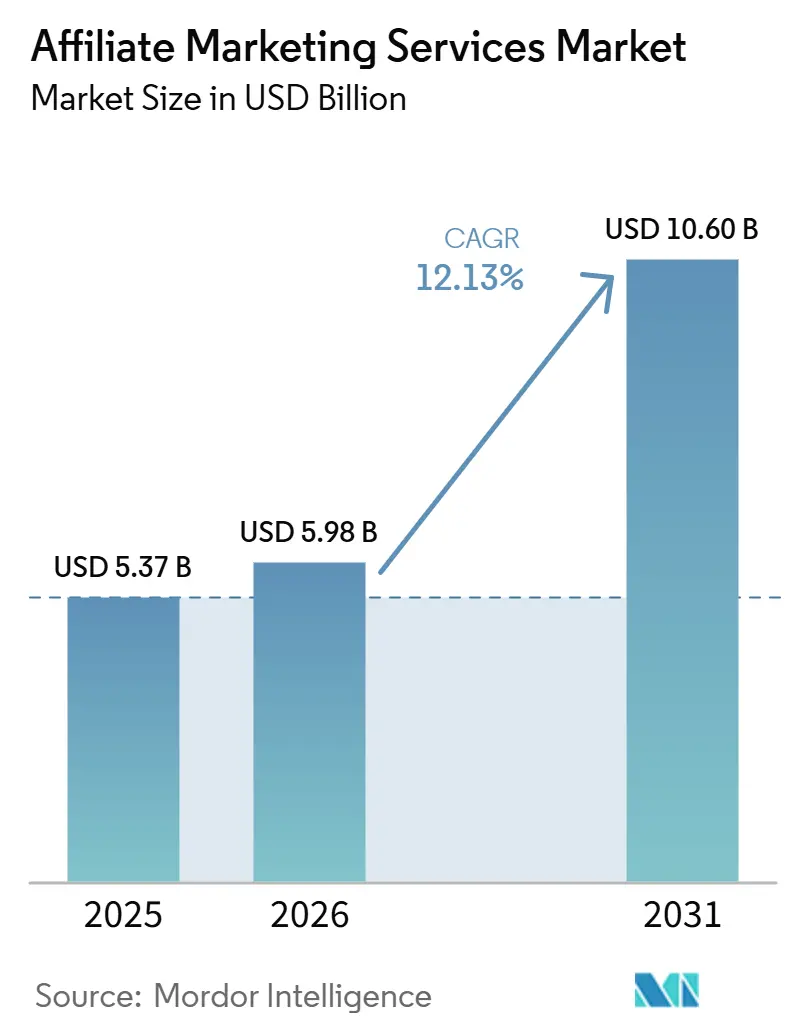
The Affiliate marketing services market size is expected to grow from USD 5.37 billion in 2025 to USD 5.98 billion in 2026 and is forecast to reach USD 10.60 billion by 2031 at 12.13% CAGR over 2026-2031. The growth reflects a reallocation of digital marketing budgets toward channels that connect spending to verified outcomes. Affiliate programs are moving beyond their earlier retail focus as advertisers use them for customer acquisition, partner management, and measurable revenue generation. Larger platforms are strengthening their position through integrated attribution, fraud screening, analytics, and managed services, while smaller operators face greater pressure to retain valuable publishers. Generative AI supports partner discovery, commission management, and fraud screening, but AI-generated search summaries can reduce referral clicks for content publishers. This combination increases the need for diversified performance channels and for service providers that can manage compliance, measurement, and publisher relationships.
Key Report Takeaways
- By service type, Managed Affiliate Program Services held 32.62% of the Affiliate marketing services market share in 2025, while Analytics and Optimization Services are projected to expand at a 13.03% CAGR through 2031.
- By organization size, Large Enterprises held 62.58% of the Affiliate marketing services market revenue in 2025, while SMEs are projected to record the highest CAGR of 13.31% through 2031.
- By end-user industry, Retail and E-commerce accounted for 39.21% of the Affiliate marketing services market size in 2025, while Healthcare and Life Sciences are projected to grow at a 13.14% CAGR through 2031.
- By geography, North America held 37.05% of revenue in 2025, while Asia-Pacific is projected to expand at a 14.10% CAGR through 2031.
Note: Market size and forecast figures in this report are generated using Mordor Intelligence’s proprietary estimation framework, updated with the latest available data and insights as of January 2026.
Global Affiliate Marketing Services Market Trends and Insights
Drivers Impact Analysis*
| Driver | (~) % Impact on CAGR Forecast | Geographic Relevance | Impact Timeline |
|---|---|---|---|
| Performance-Based Customer Acquisition Gains Budget Share | +3.2% | Global | Short term (≤ 2 years) |
| Expansion of E-commerce and Social Commerce Merchant Bases | +2.6% | Global, Asia-Pacific core | Medium term (2-4 years) |
| Rising Use of AI-Enabled Partner Discovery and Optimization | +2.1% | Global | Short term (≤ 2 years) |
| Growth of Affiliate Use in Financial Services, Travel, and Telecom | +1.6% | North America and Europe | Medium term (2-4 years) |
| Search and AI Referral Fragmentation Increases Need for Diversified Performance Channels | +1.3% | North America and Europe | Short term (≤ 2 years) |
| Cross-Border Creator and Publisher Monetization Expands Partner Supply | +1% | Asia-Pacific core, spillover to Middle East and Africa | Long term (≥ 4 years) |
| Source: Mordor Intelligence | |||
Performance-Based Customer Acquisition Gains Budget Share
Performance-based marketing directs spending toward verified outcomes, which shifts budgets away from display advertising and paid search toward affiliate channels. U.S. affiliate spending increased significantly in recent years, generating substantial e-commerce sales and delivering strong returns on investment. The same study reported that affiliate activity represented a meaningful share of U.S. e-commerce, demonstrating that the channel has become an established part of online sales activity. In Australia, many surveyed advertisers increased affiliate investment during the prior year, and most expected the channel to gain strategic importance for business results.[1]IAB Australia, “2026 Affiliate and Partnership Marketing State of the Nation Report,” IAB Australia, iabaustralia.com.au Enterprise programs increasingly use incrementality-tested commission structures that link payouts to verified new-customer contribution through holdout groups. This approach gives advertisers a clearer basis for comparing Affiliate marketing services market spending with impression-based channels, while reducing credit for transactions that would have occurred without a publisher’s contribution.
Expansion of E-commerce and Social Commerce Merchant Bases
The growth of merchant adoption is expanding demand for the Affiliate marketing services market across e-commerce and social commerce. Accessible software platforms let merchants introduce affiliate programs without the dedicated teams and bespoke tools that were once required. Creator-led affiliate commerce accounted for a substantial share of e-commerce revenue on major Southeast Asian platforms, which encouraged Lazada and Shopee to strengthen their programs as TikTok Shop gained gross merchandise value. Shopify Collabs lets merchants establish commission structures and manage creator relationships through an existing dashboard with minimal upfront cost.[2]Shopify, “Affiliate Manager Guide for Small Business Owners,” Shopify, shopify.com These lower entry barriers broaden participation by smaller merchants and extend the Affiliate marketing services market’s need for setup, recruitment, tracking, and program support, particularly where merchants need help selecting creators, setting commissions, and monitoring the quality of partner-led sales. The spread of these tools also connects creator relationships more directly with merchant operations, making affiliate programs easier to establish within ordinary e-commerce workflows.
Rising Use of AI-Enabled Partner Discovery and Optimization
AI is changing partner discovery, commission optimization, and fraud screening in the Affiliate marketing services market. A study covering marketers across multiple countries found that nearly all brands and creators were already integrating AI into partnership programs. The Pacesetters APAC Affiliate Advisory Board found that most participating brands regarded AI-mediated attribution as a high strategic priority. That finding supported Partnerize’s Australian launch of VantagePoint, which was certified by the Alliance for Audited Media and tracks publisher influence in AI summary citations. Dynamic commissioning tools can adjust payouts using publisher quality scores and incrementality signals with little delay. Their growing use supports recurring Affiliate marketing services market demand for analytics and optimization services as advertisers seek better control over partner quality, commission efficiency, fraud screening, and the performance of publishers that influence a sale before the final click.
Growth of Affiliate Use in Financial Services, Travel, and Telecom
Financial services, travel, and telecommunications support affiliate activity because customer values are high and purchase decisions often take longer. financeAds International operated more than 500 active programs for banks, insurers, and fintech brands in 2026.[3]financeAds International, “Company Overview and Network Description,” financeAds International, financeads.com U.S. affiliates that promote financial products must meet FTC disclosure requirements and often operate within CFPB-regulated standards, increasing demand for managed compliance services. B2B corporate travel has emerged as an affiliate category with high average order values per booking. Healthcare and life sciences companies also use more structured partner programs, with an impact.com data set indicating substantial partner activity and partner-driven spending. These operating requirements increase the importance of managed governance, approved content, verified publisher practices, and clear documentation across the affiliate marketing services market, particularly as brands work to protect consumers and meet regulatory obligations.
Restraints Impact Analysis*
| Restraint | (~) % Impact on CAGR Forecast | Geographic Relevance | Impact Timeline |
|---|---|---|---|
| Attribution Loss From Privacy Controls and Closed Platforms | -1.8% | Global | Short term (≤ 2 years) |
| Affiliate Fraud, Coupon Leakage, and Incentive Misalignment | -1.4% | Global | Medium term (2-4 years) |
| Search Algorithm Volatility Weakens Content Affiliate Economics | -1.1% | North America and Europe | Short term (≤ 2 years) |
| Cross-Border Tax, KYC, and Payout Complexity Slows Expansion | -0.8% | Asia-Pacific core, spillover to Middle East and Africa | Long term (≥ 4 years) |
| Source: Mordor Intelligence | |||
Attribution Loss From Privacy Controls and Closed Platforms
Third-party cookie deprecation and browser-level privacy controls reduce the accuracy of attribution across the Affiliate marketing services market. Safari Intelligent Tracking Prevention has shortened cookie lifespans, with certain JavaScript-set cookies limited to 24 hours, which does not fit multiday consideration cycles in insurance, financial products, and higher-consideration retail. Google’s Privacy Sandbox rollout distributes attribution signal loss over time rather than through a single cutoff, making budget decisions more difficult for program managers. GDPR enforcement requires server-to-server postback tracking when advertisers need to preserve conversion visibility within compliance obligations. This change requires engineering capacity, consent controls, and reliable data sharing processes that many mid-market advertisers do not have. The United Kingdom’s Competition and Markets Authority designated Google as a platform with strategic market status for its search and AI products in 2026.
Affiliate Fraud, Coupon Leakage, and Incentive Misalignment
Affiliate fraud now includes AI-generated synthetic user sessions that can pass behavioral validation checks. Coupon leakage remains a margin issue when aggregator affiliates receive credit for transactions that would have converted without their involvement. Commission structures can also favor short-term volume rather than customer quality, attracting publishers that prioritize conversion rates over retention. Everflow launched its Shield AI fraud detection platform on June 18, 2026, using machine learning to identify invalid traffic before payouts are processed. The Health Union and Solli 2026 Pharma Marketing Pulse Report found that 93% of pharma marketers require affiliate and influencer partners to have validated medical and regulatory review processes. These controls raise operating requirements across the Affiliate marketing services market for networks, advertisers, and publishers.
*Our forecasts treat driver/restraint impacts as directional, not additive. The impact forecasts reflect baseline growth, mix effects, and variable interactions.
Segment Analysis
By Service Type: Managed Programs Lead While Analytics Changes Program Value
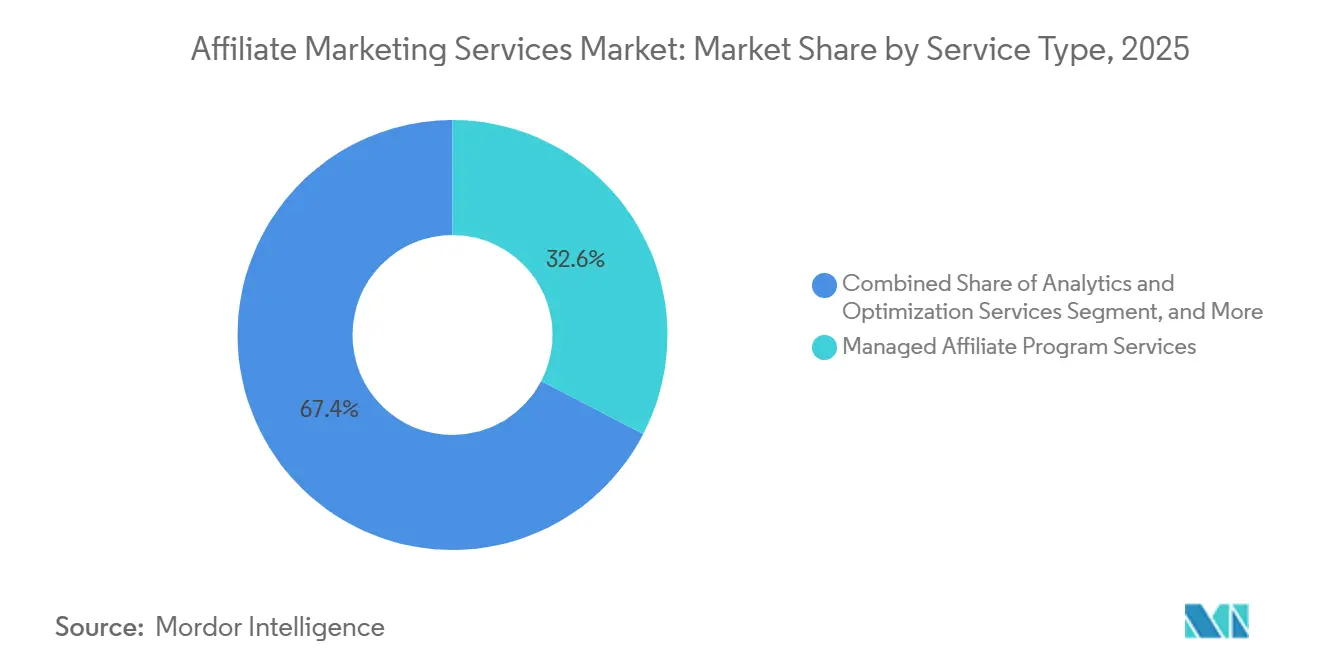
Managed Affiliate Program Services accounted for 32.62% of the Affiliate marketing services market revenue in 2025. Many advertisers outsource publisher recruitment, compliance reviews, commission negotiation, and performance reporting to specialized agencies. The model is especially relevant in financial services and healthcare, where GDPR alignment, FTC disclosure audits, and sector-specific KYC obligations make internal management resource-intensive. Analytics and Optimization Services is projected to be the fastest-growing service type, with a 13.03% CAGR from 2026 to 2031. The growth reflects the shift from last-click measurement to incrementality-based attribution, which requires platforms to interpret more complex publisher signals.
Partnerize reported that publishers generated 3.84 times more measurable purchase influence through AI-mediated discovery than through last-click records. Affiliate Platform and SaaS Licensing is also expanding as mid-market advertisers seek self-service tools without full outsourcing. Tracking and Attribution Services face pressure as server-side tracking replaces browser-based pixel integrations. Legacy providers must update their systems or risk losing ground to privacy-compliant tools. The global publisher base reached 3.2 million active affiliates in 2025, up 18.5% from 2.7 million in 2024, supporting Affiliate marketing services market demand for recruitment and onboarding services. The wider publisher pool also makes screening, relationship management, and structured onboarding more important for advertisers that want to maintain quality as their programs grow.



By Organization Size: Large Enterprises Lead While SMEs Expand Faster
Large Enterprises held 62.58% of the Affiliate marketing services market size in 2025. Global retailers, financial services firms, and travel brands run multi-network and multi-region programs that have layered publisher tiers and specialized service needs. These programs generally use higher commission floors, analytics tools, compliance solutions, and managed-service relationships. SMEs are projected to grow at a 13.31% CAGR from 2026 to 2031. This growth follows the reduced cost and lower technical requirements of modern affiliate platforms.
Historically, smaller firms needed dedicated partner managers, custom tracking tools, and negotiated minimum spending commitments to operate competitive programs. Software embedded in merchant dashboards now automates much of the setup and payout process at near-zero upfront cost. This change has widened access for smaller advertisers without eliminating their need for outside support. IAB Australia found that 64% of respondents expected affiliate marketing to become more important to their business results. The finding applies across program sizes and supports continued demand in the Affiliate marketing services market for platform and service providers that can simplify setup, reporting, payment administration, and compliance without requiring extensive internal resources.
By End-User Industry: Retail Leads While Healthcare Gains Ground
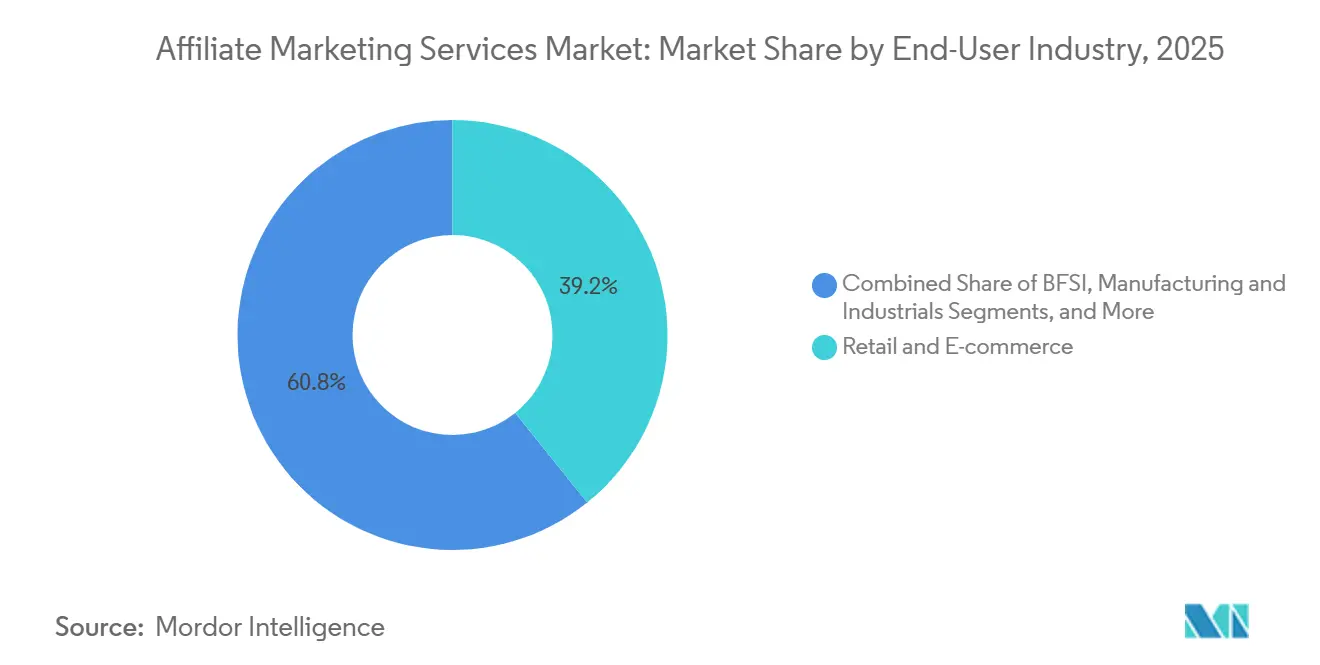
Retail and E-commerce accounted for 39.21% of the Affiliate marketing services market share in 2025. The sector benefits from high transaction volumes, short conversion cycles, and well-developed publisher groups that include product review, cashback, and loyalty providers. The UK APMA reported that cashback and loyalty publishers represented 29% of U.K. affiliate spending in 2026. Comparison shopping services and technology partners were the fastest-growing publisher categories in the segment, showing that programs are extending earlier in the purchase process.
Healthcare and Life Sciences are projected to expand at a 13.14% CAGR through 2031 as digital health brands move patient acquisition budgets to performance-verified channels. Partner-driven healthcare spending totaled USD 84 million in 2025 across telehealth consultations, over-the-counter supplement brands, and chronic care management programs. The Health Union and Solli report found that 45% of senior pharma marketing leaders were increasing spending on platforms with high medical authority and validated content review. BFSI programs also require strong publisher governance because verified leads can command high commissions. Manufacturing, industrial, automotive, and public-sector use cases remain less mature, leaving scope for Affiliate marketing services market adoption from a lower base and a need for service models that can adapt to longer sales processes.
Geography Analysis
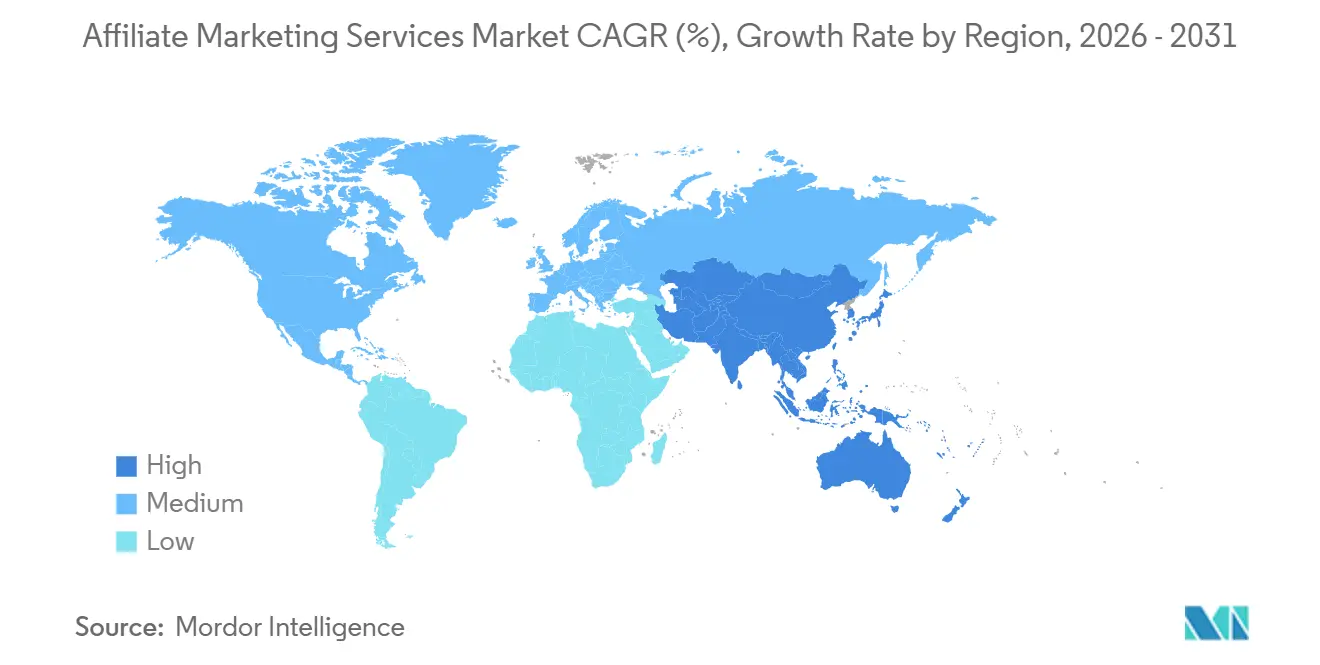
North America held 37.05% of the affiliate marketing services market revenue in 2025. The United States concentrated the largest share of global program activity, publisher volume, and enterprise spending. U.S. affiliate spending reached USD 13.63 billion in 2024 and generated USD 113 billion in e-commerce sales. Affiliate activity represented 9.4% of U.S. e-commerce, which shows the region’s deep adoption of performance-led partner programs. Enterprise brands are moving from last-click 30-day cookie models toward server-side tracking and commissions based on verified new-customer contribution.
Asia-Pacific is projected to record the highest regional CAGR at 14.10% from 2026 to 2031. India, Southeast Asia, and Australia are benefiting from faster digital commerce growth and creator-led affiliate models. IAB Australia found that 64% of respondents expected affiliate marketing to become more important to their business outcomes, while the Partnerize APAC board recorded CMO-level investment conviction of 4-5 out of 5 among participating brands. Creator-led affiliate commerce represented 50% to 70% of e-commerce revenue on major Southeast Asian platforms in mid-2026. Lazada and Shopee strengthened their affiliate programs as they competed with TikTok Shop.
Europe is the second-largest geographic segment, and GDPR creates distinct requirements for the Affiliate marketing services market architecture. U.K. affiliate spending totaled GBP 1.8 billion, or USD 2.28 billion, in 2025 and generated GBP 20.7 billion, or USD 26.1 billion, in attributed revenue. South America, the Middle East, and Africa are smaller but developing regions, with Brazil leading South America, the United Arab Emirates and Saudi Arabia leading Middle Eastern activity, and South Africa, Nigeria, and Egypt building fintech and mobile-first e-commerce infrastructure. Argentina and Chile are also growing, although international payout complexity can slow expansion.

Competitive Landscape
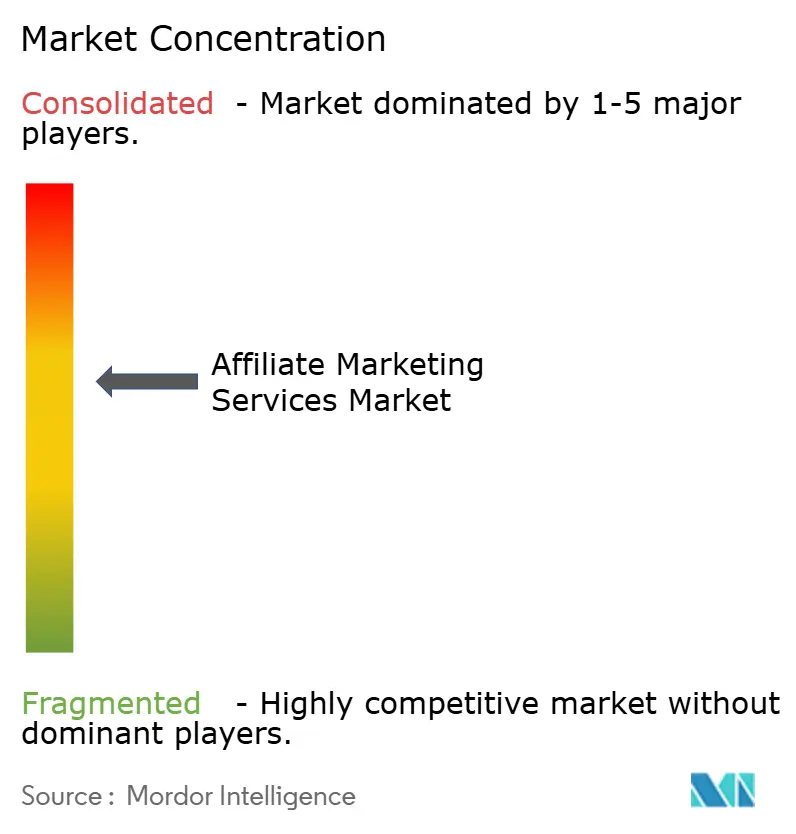
The Affiliate marketing services market has a fragmented middle tier, while concentration is stronger among global networks and platform companies that manage much of the enterprise program spending. Awin, impact.com, and Publicis Groupe’s CJ Affiliate are the leading group. The boundaries between network operators, software platforms, and managed-service providers are becoming less distinct. In April 2026, Rakuten International and impact.com announced an alliance that moved Rakuten’s network operations onto impact.com’s technology infrastructure while Rakuten retained agency services and its Rewards consumer network. This structure lets the companies compete in the Affiliate marketing services market through their established capabilities and combines publisher relationships with technology and managed services.
Awin reached a definitive agreement in July 2026 to acquire Rakuten Advertising’s affiliate and performance marketing division for USD 340 million. The combination would create the largest affiliate network globally by active publisher count if it closes. The transaction raises pressure on mid-tier networks, including Tradedoubler and Webgains, because larger networks can offer wider publisher access and broader operating capabilities. Healthcare compliance, B2B SaaS partnerships, and KYC-verified financial services publishers remain areas for specialized providers because they need subject-specific controls. The Affiliate marketing services industry continues to offer room for providers with compliance expertise and focused operating models.
AI-based dynamic commissions, fraud detection, and AI-mediated attribution mapping are becoming baseline capabilities rather than optional features. In March 2026, impact.com acquired the Berlin-based consent-management specialist Cassie to address GDPR and CCPA compliance requirements for European advertisers and publishers. Platforms with consent management and server-side tracking are better placed to meet enterprise onboarding requirements under the FTC and GDPR frameworks. Partnerize’s 2026 Zero-Click Commerce Index introduced an Alliance for Audited Media-certified method for measuring AI-mediated publisher influence, which could direct more commission credit to upper-funnel content publishers and change platform competition.
Affiliate Marketing Services Industry Leaders
Awin
impact Tech, Inc.
Publicis Groupe S.A.
Rakuten Group, Inc.
Partnerize
- *Disclaimer: Major Players sorted in no particular order

Recent Industry Developments
- July 2026: Awin reached a definitive agreement to acquire Rakuten Advertising's affiliate and performance marketing division for approximately USD 340 million. The combination would position the merged entity as the largest affiliate network globally by active publisher count, intensifying consolidation pressure on mid-tier networks.
- July 2026: impact.com introduced a three-tier Verified Publisher Classification System governing earnings-per-click floor guarantees, payout cadences, and priority queue access across health and finance vertical programs. The system covers more than 2,400 active advertiser programs and formalizes publisher quality tiers at scale.
- June 2026: Everflow launched Everflow Shield, an AI-powered fraud detection platform, in general availability. The system applies machine learning to identify AI-generated synthetic user sessions and other invalid traffic patterns before payouts are processed, addressing the evolution of affiliate fraud beyond legacy detection models.
- April 2026: Rakuten International and impact.com announced a strategic alliance to integrate Rakuten's global publisher relationships and managed services with impact.com's technology platform and marketplace. impact.com serves as the exclusive platform provider for Rakuten's affiliate partnership management while Rakuten retains its agency services and Rewards consumer network.


Global Affiliate Marketing Services Market Report Scope
Affiliate Marketing Services Market refers to the ecosystem of agencies, networks, platforms, and management services that help brands run performance-based partner marketing programs. It covers affiliate program setup, partner recruitment, tracking, attribution, commission management, compliance, and campaign optimization.
The Affiliate Marketing Services Market Report is Segmented by Service Type (Managed Affiliate Program Services, Affiliate Platform and SaaS Licensing, Tracking and Attribution Services, Partner Recruitment and Onboarding Services, Commission and Payout Management Services, Fraud Detection and Compliance Services, and Analytics and Optimization Services), Organization Size (SMEs, and Large Enterprises), End-User (Retail and E-commerce, IT and Telecommunications, BFSI, Healthcare and Life Sciences, Media and Entertainment, Travel and Hospitality, and Manufacturing and Industrials), and Geography (North America, South America, Europe, Asia-Pacific, Middle East, Africa). The Market Forecasts are Provided in Terms of Value (USD).
| Managed Affiliate Program Services |
| Affiliate Platform and SaaS Licensing |
| Tracking and Attribution Services |
| Partner Recruitment and Onboarding Services |
| Commission and Payout Management Services |
| Fraud Detection and Compliance Services |
| Analytics and Optimization Services |
| Small and Medium-sized Enterprises |
| Large Enterprises |
| Retail and E-commerce |
| IT and Telecommunications |
| BFSI |
| Healthcare and Life Sciences |
| Media and Entertainment |
| Travel and Hospitality |
| Manufacturing and Industrials |
| Others (Automotive, Public Sector, Others) |
| North America | United States |
| Canada | |
| Mexico | |
| South America | Brazil |
| Argentina | |
| Chile | |
| Rest of South America | |
| Europe | Germany |
| United Kingdom | |
| France | |
| Italy | |
| Spain | |
| Rest of Europe | |
| Asia-Pacific | China |
| Japan | |
| India | |
| South Korea | |
| Australia | |
| Rest of Asia-Pacific | |
| Middle East | United Arab Emirates |
| Saudi Arabia | |
| Qatar | |
| Rest of Middle East | |
| Africa | South Africa |
| Egypt | |
| Nigeria | |
| Rest of Africa |
| By Service Type | Managed Affiliate Program Services | |
| Affiliate Platform and SaaS Licensing | ||
| Tracking and Attribution Services | ||
| Partner Recruitment and Onboarding Services | ||
| Commission and Payout Management Services | ||
| Fraud Detection and Compliance Services | ||
| Analytics and Optimization Services | ||
| By Organization Size | Small and Medium-sized Enterprises | |
| Large Enterprises | ||
| By End-User Industry | Retail and E-commerce | |
| IT and Telecommunications | ||
| BFSI | ||
| Healthcare and Life Sciences | ||
| Media and Entertainment | ||
| Travel and Hospitality | ||
| Manufacturing and Industrials | ||
| Others (Automotive, Public Sector, Others) | ||
| By Geography | North America | United States |
| Canada | ||
| Mexico | ||
| South America | Brazil | |
| Argentina | ||
| Chile | ||
| Rest of South America | ||
| Europe | Germany | |
| United Kingdom | ||
| France | ||
| Italy | ||
| Spain | ||
| Rest of Europe | ||
| Asia-Pacific | China | |
| Japan | ||
| India | ||
| South Korea | ||
| Australia | ||
| Rest of Asia-Pacific | ||
| Middle East | United Arab Emirates | |
| Saudi Arabia | ||
| Qatar | ||
| Rest of Middle East | ||
| Africa | South Africa | |
| Egypt | ||
| Nigeria | ||
| Rest of Africa | ||


Key Questions Answered in the Report
What is the size of the Affiliate marketing services market?
The Affiliate marketing services market size is USD 5.98 billion in 2026 and is forecast to reach USD 10.60 billion by 2031 at a 12.13% CAGR.
What is the size of the Affiliate marketing services market?
The size is USD 5.98 billion in 2026 and is forecast to reach USD 10.60 billion by 2031 at a 12.13% CAGR. The forecast reflects greater use of measurable, performance-led customer acquisition and more demand for managed program, analytics, and compliance support.
Which service category leads affiliate marketing services?
Managed Affiliate Program Services led with 32.62% of revenue in 2025. Analytics and Optimization Services is projected to grow fastest at a 13.03% CAGR through 2031 as advertisers use more detailed attribution and partner performance data.
Why are businesses increasing affiliate spending?
Advertisers favor verified outcomes. U.S. affiliate spending generated USD 113 billion in e-commerce sales in 2024, with an average USD 11 return per dollar invested. PERFORMANCE MARKETING ASSOCIATION Incrementality testing also helps brands connect commissions with verified new-customer contribution.
Which organization size is expanding fastest?
SMEs are projected to expand at a 13.31% CAGR through 2031 as dashboard-based software reduces setup and payout barriers. These tools let smaller merchants launch programs without dedicated partner teams or bespoke tracking infrastructure, while automated workflows can reduce the operational burden of managing payments and routine partner administration.
Which end-user sector is growing fastest?
Healthcare and Life Sciences is projected to grow at a 13.14% CAGR through 2031 as digital health brands use performance-verified acquisition channels. The category also requires validated content, medical review, and regulatory review processes for participating partners.
Which region is projected to grow fastest?
Asia-Pacific is projected to expand at a 14.10% CAGR from 2026 to 2031, supported by digital commerce and creator-led affiliate models. This pace strengthens demand across the Affiliate marketing services market for publisher recruitment, tracking, and program management capabilities.
Which region is projected to grow fastest?
Asia-Pacific is projected to expand at a 14.10% CAGR from 2026 to 2031, supported by digital commerce and creator-led affiliate models. This pace strengthens demand across the Affiliate marketing services market for publisher recruitment, tracking, and program management capabilities, particularly as major regional platforms expand their creator partnerships and affiliate program activity at scale.
Page last updated on:





