
Advance Directives Market Size and Share
Market Overview
| Study Period | 2020 - 2031 |
|---|---|
| Market Size (2026) | USD 202.78 Billion |
| Market Size (2031) | USD 495.53 Billion |
| Growth Rate (2026 - 2031) | 19.47 % |
| Fastest Growing Market | Asia-Pacific |
| Largest Market | North America |
| Market Concentration | Medium |
Major Players *Disclaimer: Major Players sorted in no particular order Image © Mordor Intelligence. Reuse requires attribution under CC BY 4.0. | |
Advance Directives Market Analysis by Mordor Intelligence
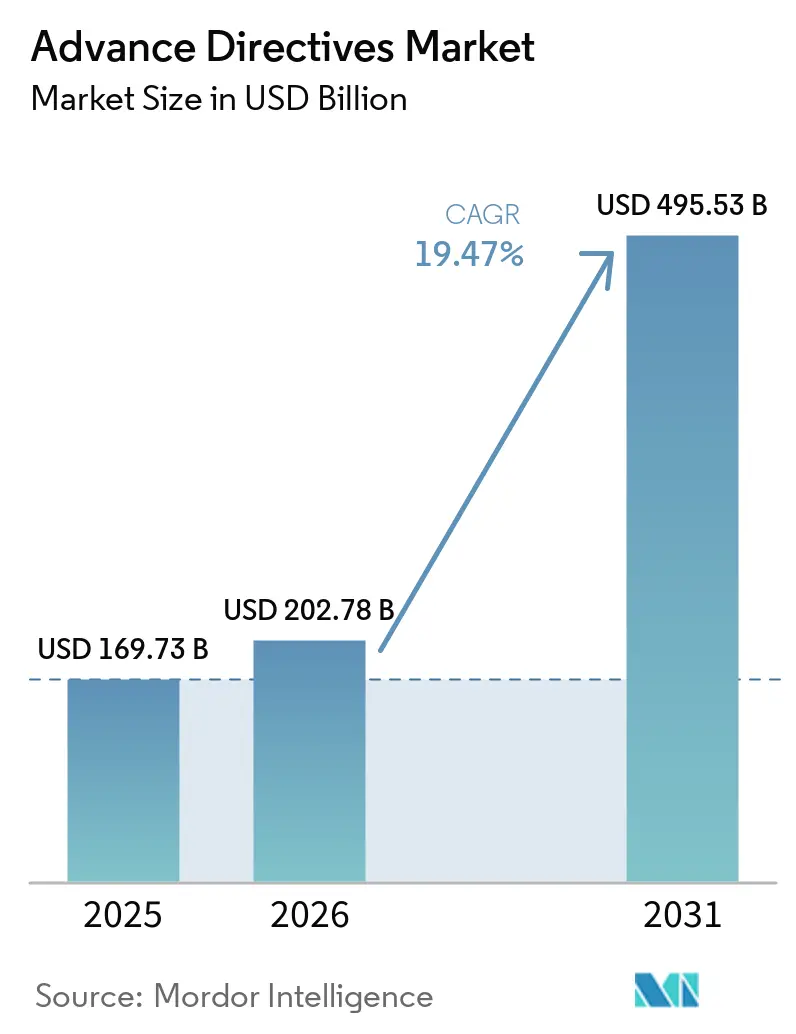
The Advance Directives Market size was valued at USD 169.73 billion in 2025 and is estimated to grow from USD 202.78 billion in 2026 to reach USD 495.53 billion by 2031, at a CAGR of 19.47% during the forecast period (2026-2031).
The advance directives market is moving beyond hospital discharge documentation as providers introduce planning earlier in primary care, ambulatory care, and consumer settings, where choices can be discussed before urgent treatment decisions limit patient participation. Electronic health record, or EHR, integration makes documented preferences easier to find during care transitions. A May 2026 Johns Hopkins study found that older adults with an EHR-documented directive at least 6 months before death had lower rates of potentially burdensome end-of-life care than adults without one. The advance directives market also benefits when reimbursement, quality measures, and data-sharing standards encourage providers to make planning part of routine care. These changes create opportunities for platforms that combine document creation, storage, retrieval, support for clinical conversations, and workflow tools that keep preferences current as a patient’s condition changes.
Key Report Takeaways
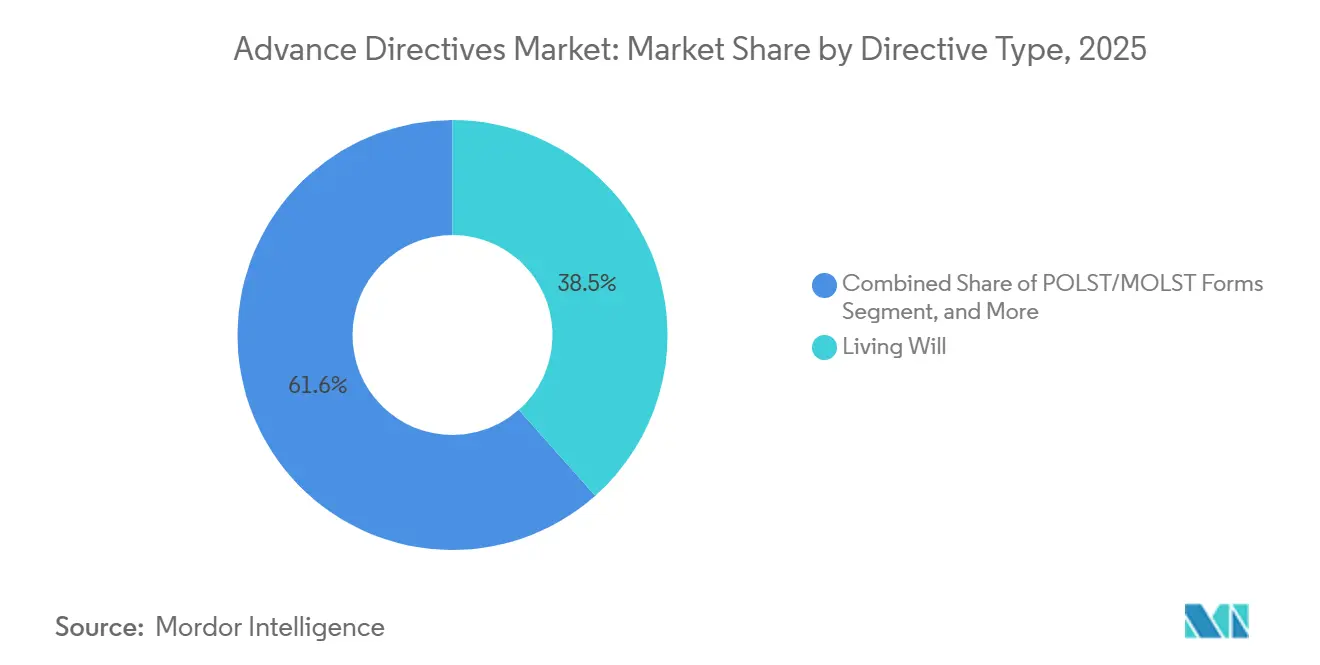
- By directive type, Living Will held 38.45% of the advance directives market share in 2025, while POLST/MOLST forms are projected to grow at a 19.89% CAGR through 2031.
- By deployment, cloud-based systems accounted for 68.23% of the advanced directives market share in 2025, while on-premises systems are forecast to grow at a 20.32% CAGR through 2031.
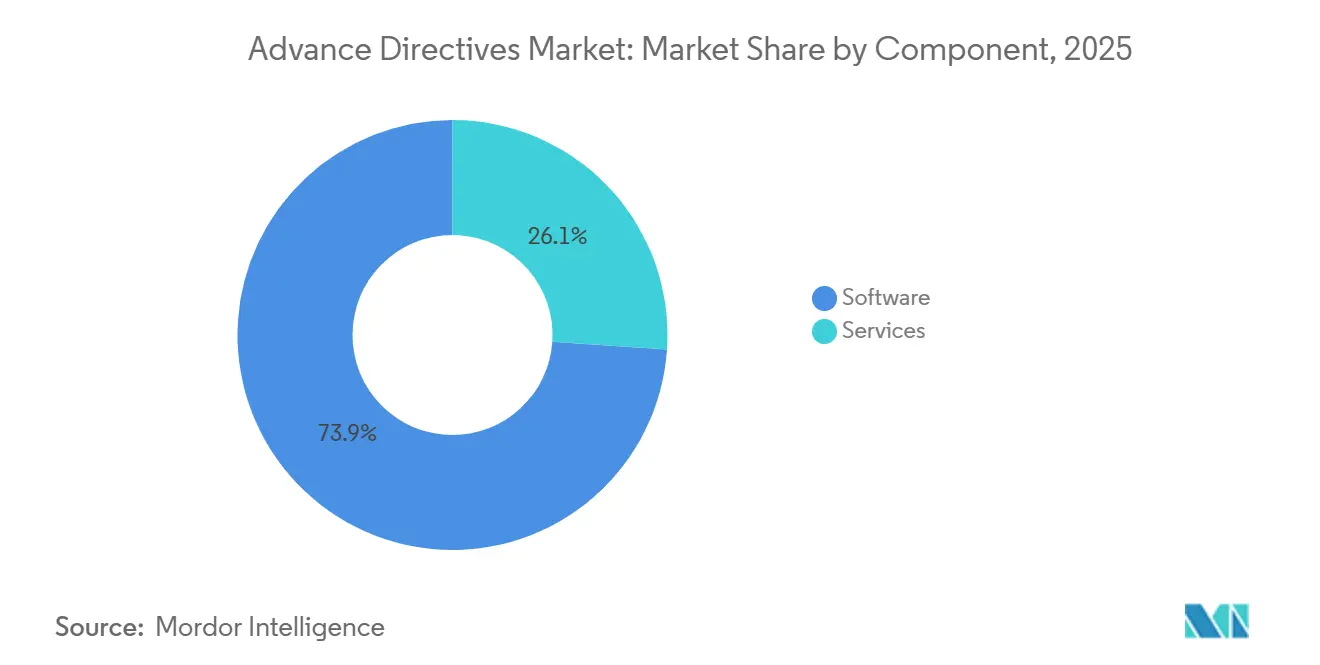
- By component, software held 73.92% share in 2025, while services are projected to expand at a 20.76% CAGR through 2031.
- By end user, hospitals accounted for 45.61% share in 2025, while hospice and palliative care centers are forecast to grow at a 21.43% CAGR through 2031.
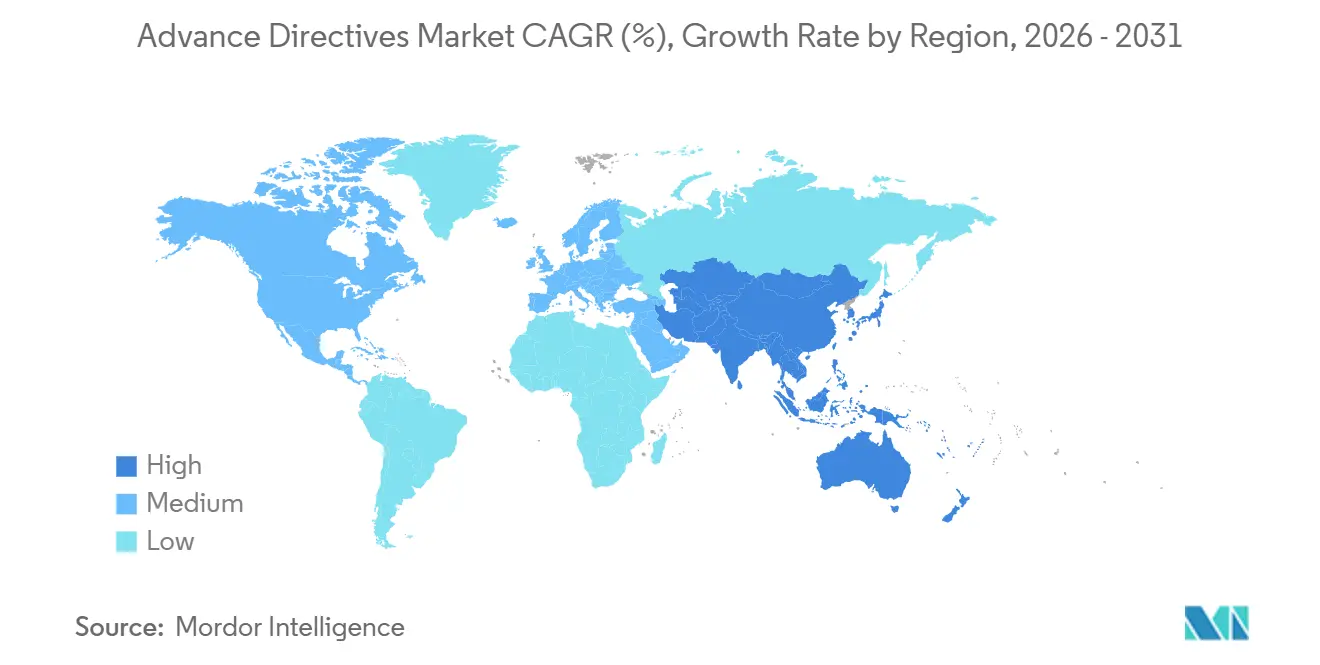
- By geography, North America held 36.72% share in 2025, while Asia-Pacific is projected to advance at a 22.49% CAGR through 2031.
Note: Market size and forecast figures in this report are generated using Mordor Intelligence’s proprietary estimation framework, updated with the latest available data and insights as of January 2026.
Market Trends and Insights
Drivers Impact Analysis of Advance Directives Market*
| Driver | (~) % Impact on CAGR Forecast | Geographic Relevance | Impact Timeline |
|---|---|---|---|
| Aging Population and Chronic, Life-Limiting Disease Burden | +5.2% | Global | Long term (≥ 4 years) |
| Government Support and Reimbursement for Advance Care Planning | +3.8% | North America & Europe | Short term (≤ 2 years) |
| Digital Health, Cloud Platforms, and EHR Integration | +4.1% | Global | Medium term (2–4 years) |
| Value-Based Care and Patient-Autonomy Quality Measures | +2.9% | North America, with early spill-over to Western Europe | Medium term (2–4 years) |
| EHR-Native Retrieval of Verifiable POLST and Advance Directive Data | +2.1% | North America | Short term (≤ 2 years) |
| Consumer-Generated, Continuously Updated Care-Preference Data | +1.8% | Global, led by US, UK, and Japan | Medium to long term (2–5 years) |
| Source: Mordor Intelligence | |||
Aging Population and Chronic, Life-Limiting Disease Burden
The World Health Organization projects that the global population aged 60 and older will reach 1.4 billion by 2030 and 2.1 billion by 2050.[1] Adults aged 80 and older have a higher chance of sudden incapacity and often need documented decisions before an acute event occurs, making early discussion more useful than documentation completed during a hospital crisis. The advance directives market, therefore, reaches people before a serious illness begins, as well as patients already receiving complex care. The WHO European Region strategy for 2026 to 2030 calls for wider advance care planning within person-centered and integrated care.[2] In China, a 2025 public health study linked the aging population and the financial burden of unwanted life-sustaining treatment with a stronger need for planning conversations. People with several chronic conditions also face repeated care transitions, giving clinicians more chances to begin or update these conversations across primary care, specialist visits, hospital stays, home care, and post-acute settings.
Government Support and Reimbursement for Advance Care Planning
Reimbursement makes advanced care planning more practical for providers who must allocate clinician time to these discussions, particularly when payment recognizes the work of explaining options, recording preferences, and engaging family members. The National Association of Community Health Centers lists a 2026 telehealth rate of USD 97.5 for ACP service G2025, with cost sharing waived when the service is billed with an Annual Wellness Visit.[3] In Germany, Section 132g of the Social Code Book V allows long-term care facilities to bill statutory health insurance for ACP consultations. The national electronic patient record, or ePA, provides a common path for uploading patient documents across care settings, which can reduce dependence on paper files and locally held records. The advance directives market can gain when payment and documentation rules move ACP from an optional service to a regular part of the provider workflow. This setting can shorten procurement decisions for health systems that need compliant, retrievable documentation and must demonstrate that planning is available within regular care pathways.
Digital Health, Cloud Platforms, and EHR Integration
The PACIO Advance Directive Interoperability Implementation Guide uses the HL7 FHIR standard to support the exchange of advance directive information between systems.[4] That work helps convert isolated state registries and hospital repositories into records that can be queried across care settings, including emergency, inpatient, post-acute, and community care environments. MyDirectives states that its A|D Vault Exchange processes more than 1.5 million queries each week and reaches more than 90% of the U.S. healthcare ecosystem through major exchange networks. This infrastructure gives the advance directives market a stronger basis for rapid retrieval, not only for document creation, because a document has limited clinical value if care teams cannot locate it quickly. EHR vendors can also build native ACP functions, which means specialist vendors need deeper workflow support, patient engagement, and analytics rather than simple document hosting. Germany's Federal Ministry of Health stated in July 2026 that the GeDIG law would expand digital health infrastructure and related interoperability requirements.
Value-Based Care and Patient-Autonomy Quality Measures
Value-based contracts give providers a financial reason to reduce unwanted care and improve documentation of patient preferences, linking ACP to outcomes that matter to patients, families, providers, and payers. The May 2026 Johns Hopkins study reported hospital deaths for 23.2% of adults with EHR-documented directives and 32.1% of adults without them. The same study reported potentially burdensome end-of-life care for 19.9% of adults with an EHR-documented directive and 26.8% of those without one. These results support adoption by accountable care organizations and health systems that carry financial risk for care outcomes, especially when end-of-life treatment can otherwise involve avoidable hospital use. The advance directives market is also supported when providers use ACP to improve quality and performance management. Better access to preferences can support fewer avoidable inpatient events and clearer care decisions across teams, while helping clinicians explain choices consistently to patients and their families.
Restraints Impact Analysis of Advance Directives Market*
| Restraint | (~) % Impact on CAGR Forecast | Geographic Relevance | Impact Timeline |
|---|---|---|---|
| Low Public Awareness, Cultural Reluctance, and Low Completion Rates | -2.3% | Global | Long term (≥ 4 years) |
| Jurisdictional Variation in Legal Forms and Execution Requirements | -1.5% | Global (concentrated in non-US and emerging markets) | Medium term (2–4 years) |
| Fragmented Document Portability, Identity Matching, and Security Liability | -1.2% | Global | Medium term (2–4 years) |
| AI Interpretation Liability and Provenance Risk in Clinical Decision Support | -0.8% | North America & Europe | Short to medium term (≤ 4 years) |
| Source: Mordor Intelligence | |||
Low Public Awareness, Cultural Reluctance, and Low Completion Rates
Low public awareness remains a major limit on adoption because planning often begins only after a crisis, when patients and relatives have less time to consider options without pressure. A 2026 systematic review protocol reported that 20% to 40% of adults in developed countries had completed some form of advance directive. Family-led decision making can reduce individual completion where cultural or religious customs give relatives a larger role in end-of-life choices, even when people have access to formal directive templates. A 2024 study of palliative care in Asia noted that Japan promoted ACP but still lacked a formal legal framework for advance directives and surrogate decision making. The study also described the role of unspoken expectations in Japan, which can make formal documentation less common. The Johns Hopkins findings showed weaker or absent protective effects among Black patients, indicating that trust, access, and culturally appropriate facilitation remain important alongside completion campaigns.
Jurisdictional Variation in Legal Forms and Execution Requirements
Legal requirements differ across countries and within federal systems, which complicates platform design and document portability. U.S. states have different rules for witnesses, notarization, and surrogate designations. A German health services study described the legal and funding environment for ACP in German nursing homes, where services operate within specific statutory arrangements. Singapore requires physical signatures for Advanced Medical Directives, while China does not have a nationwide ACP legal framework in the supplied material. A platform cannot rely on one form to provide legal validity in every jurisdiction, because a document that is accepted in one care setting may not meet requirements elsewhere. The advance directives market must therefore support jurisdiction-specific templates, execution steps, and document libraries. This burden is heavier for smaller vendors that have fewer resources to maintain legal and technical updates, test workflows, and explain changing requirements to provider customers.
*Our forecasts treat driver/restraint impacts as directional, not additive. The impact forecasts reflect baseline growth, mix effects, and variable interactions.
Advance Directives Market Segment Analysis
By Directive Type:
Living Wills Lead While POLST/MOLST Gains MomentumLiving Will held 38.45% share of the advance directives market in 2025. Its position reflects broad relevance across adult age groups and health conditions, as well as acceptance across U.S. states, which makes it a familiar starting point for patients and clinicians. A living will is often the first document used by consumer-facing ACP platforms because it can be completed before a serious illness. Healthcare Power of Attorney, also called a healthcare proxy, is often completed with a living will. Digital services such as FreeWill, Everplans, and MyDirectives commonly support this paired workflow. Mental health advance directives serve a separate need because a person may have capacity when drafting the document but lose it during a psychiatric episode, creating a documented record for a clinically distinct situation.
POLST/MOLST forms are projected to grow at a 19.89% CAGR from 2026 to 2031, the fastest rate among directive types. The advance directives market size for POLST/MOLST is supported by use in post-acute care, hospice, and serious illness settings. These forms are tied more closely to medical orders and immediate treatment decisions than living wills, so their value depends heavily on timely access by emergency and post-acute care teams. The PACIO FHIR work supports the ability to retrieve structured directive data through connected systems. In December 2025, MyDirectives announced that Oregon's POLST Registry became accessible nationwide through its A|D Vault Exchange and major exchange networks. DNR orders remain clinically important, but they are usually authored by practitioners within inpatient or hospice workflows and represent a narrower standalone software opportunity because they are commonly handled within existing clinical documentation processes.

By Deployment:
Cloud Systems Lead While On-Premises Needs GrowCloud-based systems accounted for 68.23% of the advance directives market in 2025. Their lead reflects the need for national, anytime access to directives during unexpected care events, when patients may receive treatment away from the organization where they completed their plan. Centralized cloud systems can support document storage, exchange connections, and access across different provider organizations. MyDirectives reports that its cloud-based exchange serves more than 90% of the U.S. healthcare ecosystem through national exchange networks. Japan also began a public digital directive pilot in Tsukuba City in 2025. The initiative tests data sharing among emergency, acute care, and home care settings through an ICT platform, addressing the same continuity problem that has shaped U.S. registry development.
On-premises deployment is forecast to grow at a 20.32% CAGR from 2026 to 2031. Large integrated delivery networks, Veterans Affairs facilities, and government-operated systems may prefer direct control of preference data because of their data governance duties. This buyer group can face contractual or regulatory limits on third-party data custody, and may also need control over local security policies, technical configurations, and internal access rules. Germany's national ePA architecture provides a related example of a nationally governed approach to health information. The German Federal Ministry of Health stated that GeDIG strengthens digital infrastructure and interoperability obligations. The advance directives market is therefore likely to retain both cloud registries for broad access and locally managed deployments for institutions with stricter governance needs, rather than moving entirely toward a single delivery model.
By Component:
Software Leads While Services Expand FasterSoftware held 73.92% share of the advance directives market in 2025. This position reflects sustained investment in document creation, secure storage, EHR interfaces, and identity matching, which are core functions for keeping preference data usable across complex care journeys. Hospital and payer buyers increasingly expect established security and assurance practices from software providers. These requirements can favor vendors with the resources to meet demanding procurement reviews. Software remains central because it links patient documents to clinical records and allows retrieval during care transitions, while also providing audit trails and controlled access for authorized users. It also provides the workflow foundation for consumer and provider users.
Services are forecast to grow at a 20.76% CAGR from 2026 to 2031. The advance directives market size for services rises as health systems need facilitation, training, analytics, and implementation support. Structured conversations remain necessary even when a digital form is available, because patients often need help understanding treatment preferences, naming a surrogate, and discussing decisions with relatives. WiserCare's integration of Respecting Choices' facilitator network illustrates the combination of digital engagement and human support described in the supplied material. The NACHC reimbursement guide lists USD 97.5 for the 2026 telehealth ACP service G2025, helping support virtual facilitation. Services can help organizations turn platform access into documented conversations and completed plans, especially where staff need training to introduce sensitive subjects in a consistent way.
By End User:
Hospitals Lead While Hospice and Palliative Care AccelerateHospitals accounted for 45.61% of the advance directives market in 2025. Their leading position is tied to serious illness populations, compliance needs, and the financial importance of care preferences in risk-bearing contracts, where missed preferences can lead to unwanted treatment or delayed decisions. Direct integration with Epic, Oracle Cerner, or Meditech is a key purchasing consideration because clinicians need access inside their normal workflow. In April 2025, Ochsner Health went live with MyDirectives for Clinicians in its Epic system across Louisiana and the Gulf South. This deployment centralized ACP documents and supported clinical conversations across a large health system. Long-term care facilities and ambulatory centers remain important users, although staffing limits and uneven payment can slow implementation, particularly when ACP competes with immediate clinical and administrative work.
Hospice and palliative care centers are forecast to grow at a 21.43% CAGR from 2026 to 2031. These providers need immediate access to documented preferences at admission and during changes in care, because treatment choices must often be honored soon after a referral or transfer. Earlier ACP discussions in home health and outpatient palliative care also increase the number of documents that hospice teams must locate and use. In September 2025, MyDirectives and KanTime announced an EHR integration for home health, hospice, and palliative care providers. The integration included access to ACP documentation within the post-acute EHR workflow, allowing staff to locate relevant records without leaving the system used for routine care. The advance directives market can benefit as hospice organizations use retrievable preferences to align care with documented patient choices.
Geography Analysis
North America Advance Directives Market
North America held 36.72% share of the advance directives market in 2025. The region benefits from ACP reimbursement, established health information exchange networks, and a concentration of digital ACP platform providers, which together support both provider adoption and consumer-facing services. The PACIO implementation guide offers a U.S. framework for structured advance directive data exchange. MyDirectives states that its exchange reaches more than 90% of the U.S. healthcare ecosystem through national networks. Canada has a different pattern because provincial law can vary, which complicates national deployments and requires suppliers to adapt documentation and processes to local statutory settings. Mexico remains at an earlier stage because digital health infrastructure and ACP reimbursement are less developed in the supplied material.
Europe Advance Directives Market
Europe is a strategically important region because digital health rules and national health records can create paths for secure document access, although legal forms and clinical practices still vary across countries. Germany's electronic patient record became an important national infrastructure for sharing patient documents in 2025. The German Federal Ministry of Health stated in July 2026 that GeDIG expands the ePA infrastructure and supports further interoperability obligations. The United Kingdom has established ACP frameworks and a legal basis through the Mental Capacity Act. France, Italy, and Spain have developed different approaches to directive and patient-rights law. Cross-border data rules can improve portability for providers operating across European countries, provided suppliers can align their technology with local documentation and consent requirements.
APAC, MEA and South America Advance Directives Market
Asia-Pacific is projected to grow at a 22.49% CAGR from 2026 to 2031. The advance directives market size in the region is shaped by aging populations, digital health programs, and broader attention to palliative care, although legal maturity and infrastructure differ widely among countries. Japan's Cabinet Office selected IIJ in August 2025 for a Tsukuba City pilot on data sharing across emergency, acute, and home care settings. China remains constrained by the lack of a nationwide legal ACP framework, while India's data protection law adds compliance considerations for multi-state deployments. Australia and South Korea provide more accessible settings because of stronger digital health infrastructure and end-of-life care frameworks, giving international entrants clearer routes to partnership and deployment. The Middle East and Africa remain early in adoption, with Saudi Arabia and the UAE identified in the supplied material as nearer opportunities through health digitalization programs. South America is also early in development, with Brazil and Argentina building awareness through hospice and palliative care advocacy.
Competitive Landscape
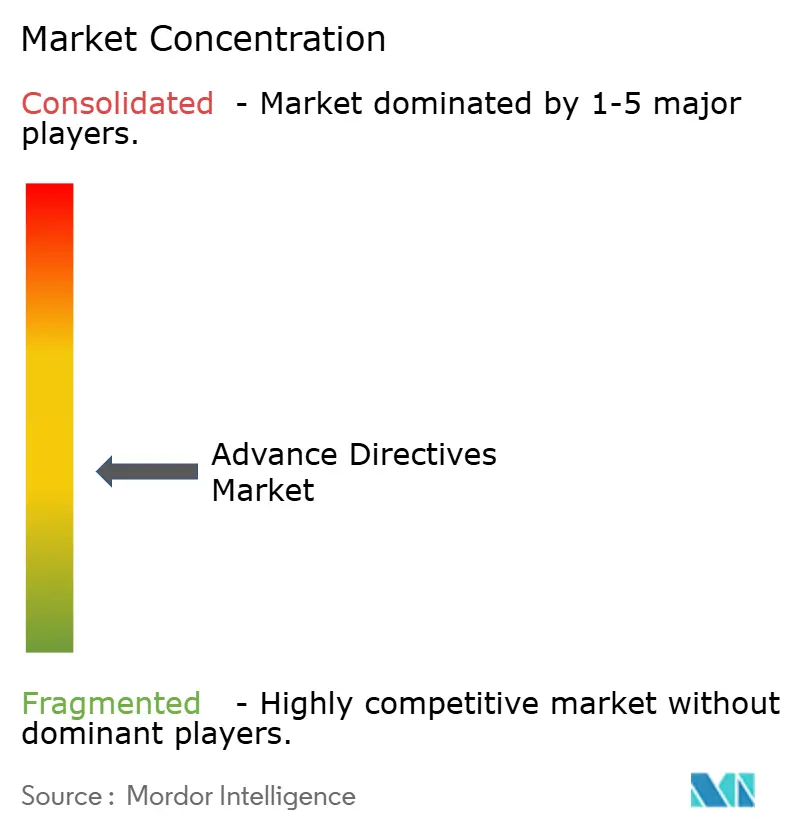
The advance directives market has a moderately fragmented platform layer, with companies addressing different parts of the workflow rather than relying on one uniform product model. MyDirectives, Koda Health, VyncaCare, WiserCare, and ACP Decisions compete with EHR-native functions from Epic and Oracle Cerner. Consumer-focused legal platforms, including FreeWill and Everplans, serve people completing documents outside a provider setting. MyDirectives reports that its A|D Vault Exchange processes more than 1.5 million weekly queries and reaches more than 90% of the U.S. healthcare ecosystem. That network reach gives the company an advantage in retrieval and exchange. Vendors without an established network may compete through clinical workflow support, facilitation, or targeted user groups, where focused services can solve problems that broad registries do not address directly.
Partnerships are a central route to wider use in the advance directives market, because providers often prefer integrated services that reduce the number of separate tools used by clinical staff. In February 2025, Backline by DrFirst, Five Wishes, and MyDirectives launched ACP Complete, combining virtual facilitation, directive documentation, video documentation, and registry storage. In April 2025, Ochsner Health introduced MyDirectives for Clinicians inside its Epic environment. In September 2025, KanTime and MyDirectives announced an integration for post-acute, home health, hospice, and palliative care users. These examples show how vendors use connected care settings to make advance directives available when clinicians need them, particularly during referrals, admissions, and transfers between acute and post-acute care.
Unmet needs remain in scalable facilitation, equity-focused engagement, and support for different legal requirements across countries. AI-assisted facilitation is one option for extending personalized conversations, but the supplied material also identifies liability and provenance concerns in clinical decision support. Trust and culturally appropriate engagement are important for communities with historically low completion levels, since access to a digital form alone does not resolve concerns about medical decision making. Smaller providers can develop positions through focused formats such as video advance directives or specialized patient engagement. The advance directives market also faces demanding privacy, security, and interoperability expectations from health systems. The resulting competitive environment favors companies that can combine compliant records, reliable retrieval, and support for real clinical workflows, while adapting their services to patient and provider needs.
Advance Directives Industry Leaders
-
MyDirectives (ADVault)
-
WiserCare Inc.
-
Koda Health
-
Affirm Health Inc.
-
Geisinger
- *Disclaimer: Major Players sorted in no particular order
Advance Directives Market Companies Covered in this Report
- MyDirectives (ADVault)
- VyncaCare (formerly Vynca)
- WiserCare Inc.
- Koda Health
- Everplans
- FreeWill Co.
- ThoroughCare, Inc.
- thanacare
- Vital Decisions LLC (Evolent Health LLC)
- Affirm Health Inc.
- Honor My Decisions LLC
- ACP Decisions (a DBA of Nous Foundation, Inc.)
- Five Wishes
- MIDEO Health
- Backline by DrFirst
- CaringInfo (National Hospice and Palliative Care Organization)
- Geisinger
- Sharp HealthCare
- Bronson Healthcare
- Island Health
- Cake Software Inc.
- LegalZoom.com Inc.
- GoodTrust Corporation
- OneAccord Health LLC
- KanTime
Recent Industry Developments in Advance Directives Market
- July 2026: Germany's Federal Cabinet approved the GeDIG law, which expands the ePA digital health infrastructure and mandates further interoperability obligations for physicians and hospitals. The legislation strengthens the regulatory basis for incorporating advance directive documents, known as Patientenverfügung, into the mandatory national electronic patient record. It also supports the use of interoperable records across the German care system.
- May 2026: A Johns Hopkins Bloomberg School of Public Health study, published in the *Journal of the American Geriatrics Society*, reported lower potentially burdensome end-of-life care and hospital death among adults aged 65 and older with EHR-accessible advance directives. The study found a 6.9 percentage point difference in potentially burdensome care and an 8.9 percentage point difference in hospital death. The findings provide clinical evidence relevant to hospital procurement and payer incentive design.
- December 2025: Oregon POLST Registry became accessible nationwide through MyDirectives' A|D Vault Exchange, Carequality, and eHealth Exchange, with Epic Care Everywhere integration through St. Charles Health System. This development made the registry available across the U.S. healthcare continuum and provided a model for other state registries seeking broader interoperable access.
Global Advance Directives Market Report Scope
As per the scope of the report, advance directives are legal documents that allow individuals to outline their preferences for medical care in situations where they may be unable to communicate. They typically include instructions such as a Living Will, Healthcare Power of Attorney, or Do‑Not‑Resuscitate (DNR) Orders. These directives ensure that healthcare providers and family members respect the patient’s wishes, offering clarity and reducing uncertainty during critical or end‑of‑life care.
The advance directives market is segmented by directive type, deployment, component, end user, and geography. By directive type, the market is segmented into living will, healthcare power of attorney (healthcare proxy), do-not-resuscitate (DNR) orders, POLST/MOLST forms, mental health advance directives, and others. By deployment, the market is segmented into cloud-based and on-premises. By component, the market is segmented into software and services. By end user, the market is segmented into hospitals, long-term care facilities, hospice & palliative care centers, ambulatory care centers, and others. The geography segment is further divided into North America, Europe, Asia-Pacific, the Middle East and Africa, and South America. The report also covers the estimated market sizes and trends for 17 countries across major regions globally. The report offers the market size and forecasts in value (USD) for the above segments.
Segmentation Overview
| Living Will |
| Healthcare Power of Attorney (Healthcare Proxy) |
| Do-Not-Resuscitate (DNR) Orders |
| POLST/MOLST Forms |
| Mental Health Advance Directives |
| Others |
| Cloud-Based |
| On-Premises |
| Software |
| Services |
| Hospitals |
| Long-Term Care Facilities |
| Hospice & Palliative Care Centers |
| Ambulatory Care Centers |
| Others |
| North America | United States |
| Canada | |
| Mexico | |
| Europe | Germany |
| United Kingdom | |
| France | |
| Italy | |
| Spain | |
| Rest of Europe | |
| Asia-Pacific | China |
| India | |
| Japan | |
| Australia | |
| South Korea | |
| Rest of Asia-Pacific | |
| Middle East and Africa | GCC |
| South Africa | |
| Rest of Middle East and Africa | |
| South America | Brazil |
| Argentina | |
| Rest of South America |
| By Directive Type | Living Will | |
| Healthcare Power of Attorney (Healthcare Proxy) | ||
| Do-Not-Resuscitate (DNR) Orders | ||
| POLST/MOLST Forms | ||
| Mental Health Advance Directives | ||
| Others | ||
| By Deployment | Cloud-Based | |
| On-Premises | ||
| By Component | Software | |
| Services | ||
| By End User | Hospitals | |
| Long-Term Care Facilities | ||
| Hospice & Palliative Care Centers | ||
| Ambulatory Care Centers | ||
| Others | ||
| By Geography | North America | United States |
| Canada | ||
| Mexico | ||
| Europe | Germany | |
| United Kingdom | ||
| France | ||
| Italy | ||
| Spain | ||
| Rest of Europe | ||
| Asia-Pacific | China | |
| India | ||
| Japan | ||
| Australia | ||
| South Korea | ||
| Rest of Asia-Pacific | ||
| Middle East and Africa | GCC | |
| South Africa | ||
| Rest of Middle East and Africa | ||
| South America | Brazil | |
| Argentina | ||
| Rest of South America | ||
Key Questions Answered in the Report
What is driving adoption of advance directives?
Aging populations, chronic disease, reimbursement, and EHR integration are expanding use. The sector is projected to grow at a 19.47% CAGR from 2026 to 2031.
Which directive type leads adoption?
Living Wills led with 38.45% share in 2025 because they apply to adults before serious illness and are widely used in consumer planning.
Which deployment model is growing fastest?
On-premises deployment is projected to grow at a 20.32% CAGR through 2031, supported by institutional data governance needs.
Why do hospitals use advance care planning platforms?
Hospitals use these platforms to document and retrieve care preferences within EHR workflows, especially for serious illness and value-based care programs.
Which region is expected to grow fastest?
Asia-Pacific is projected to grow at a 22.49% CAGR through 2031, supported by aging populations and digital health initiatives.
What limits completion of advance directives?
Low public awareness, cultural preferences for family-led decisions, and differing legal rules remain important limits to completion.