
Adsorbents Market Size and Share
Market Overview
| Study Period | 2021 - 2031 |
|---|---|
| Market Size (2026) | USD 5.44 Billion |
| Market Size (2031) | USD 7.36 Billion |
| Growth Rate (2026 - 2031) | 6.23 % |
| Fastest Growing Market | Asia-Pacific |
| Largest Market | Asia-Pacific |
| Market Concentration | Medium |
Major Players *Disclaimer: Major Players sorted in no particular order Image © Mordor Intelligence. Reuse requires attribution under CC BY 4.0. | |
Adsorbents Market Analysis by Mordor Intelligence
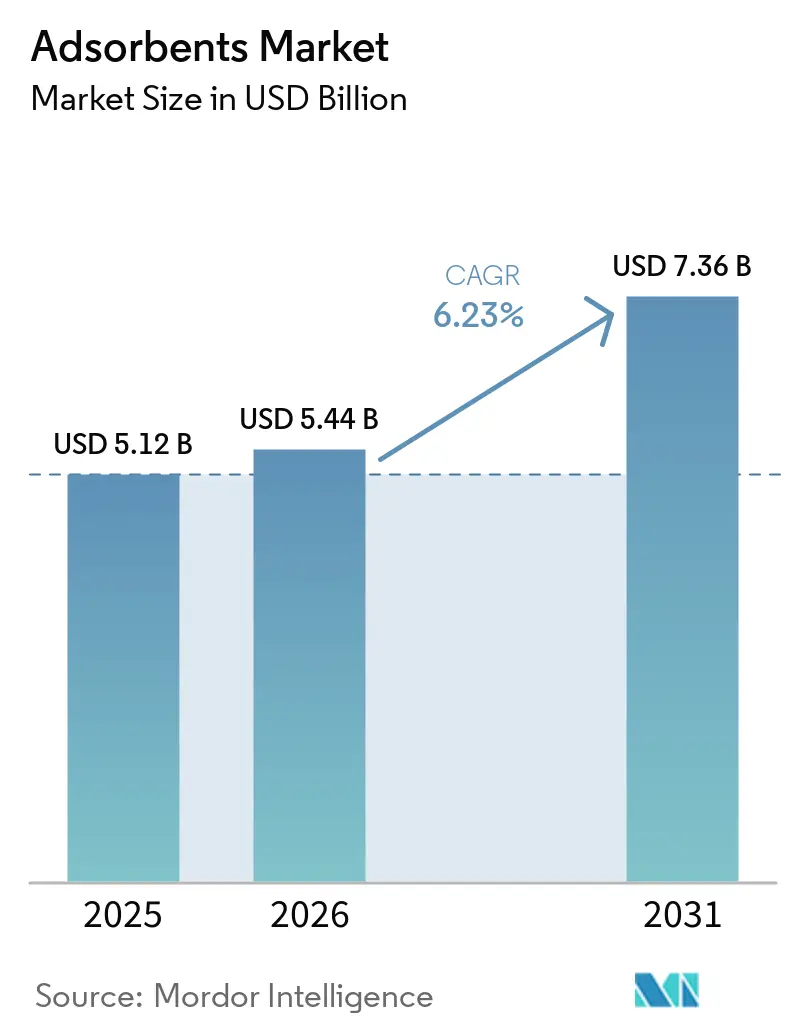
The Adsorbents Market size was valued at USD 5.12 billion in 2025 and is estimated to grow from USD 5.44 billion in 2026 to reach USD 7.36 billion by 2031, at a CAGR of 6.23% during the forecast period (2026-2031). Growth is supported by stricter water quality rules, new refinery and petrochemical capacity, and gas-treatment projects that need reliable separation media. These forces increase recurring replacement demand because adsorbents are used throughout water treatment, fuel processing, and gas purification systems. Suppliers are also moving toward higher-value grades that offer longer operating cycles and performance for difficult contaminants. The adsorbents market is becoming more sensitive to supply reliability, lifecycle cost, and technical support, rather than only the initial price of the material.
Key Report Takeaways
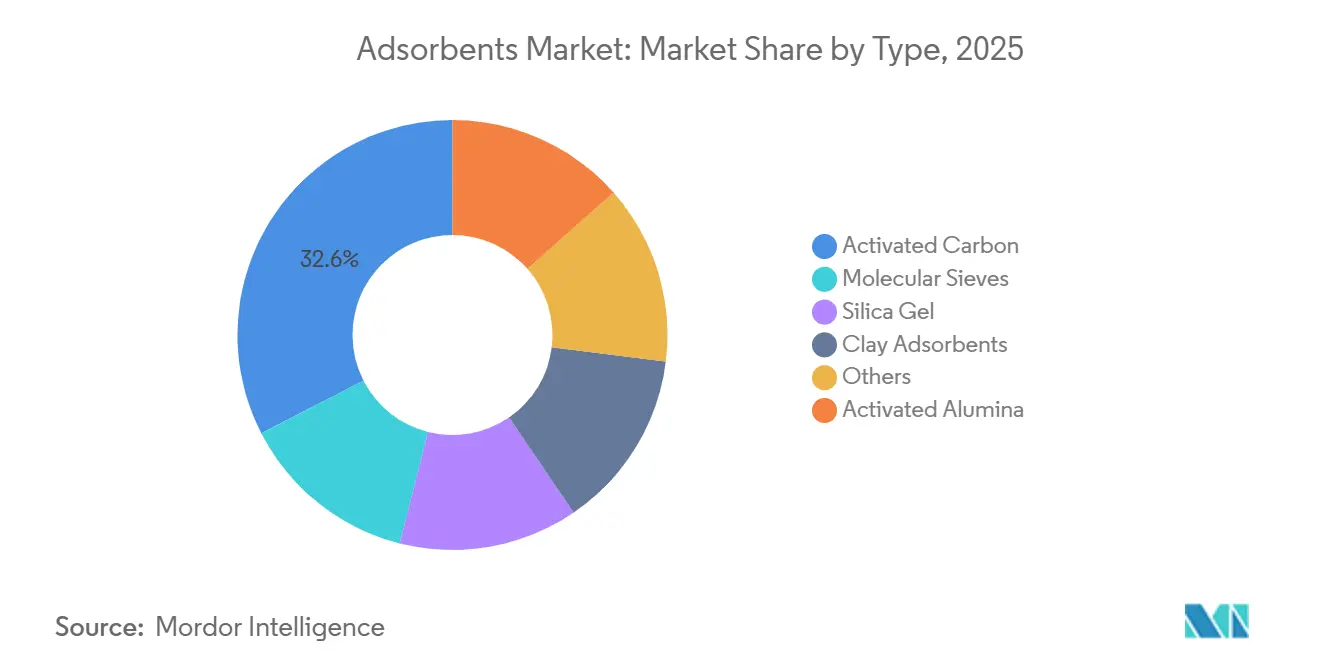
- By type, activated carbon held 32.56% of the adsorbents market share in 2025, while molecular sieves are projected to advance at a 6.78% CAGR through 2031.
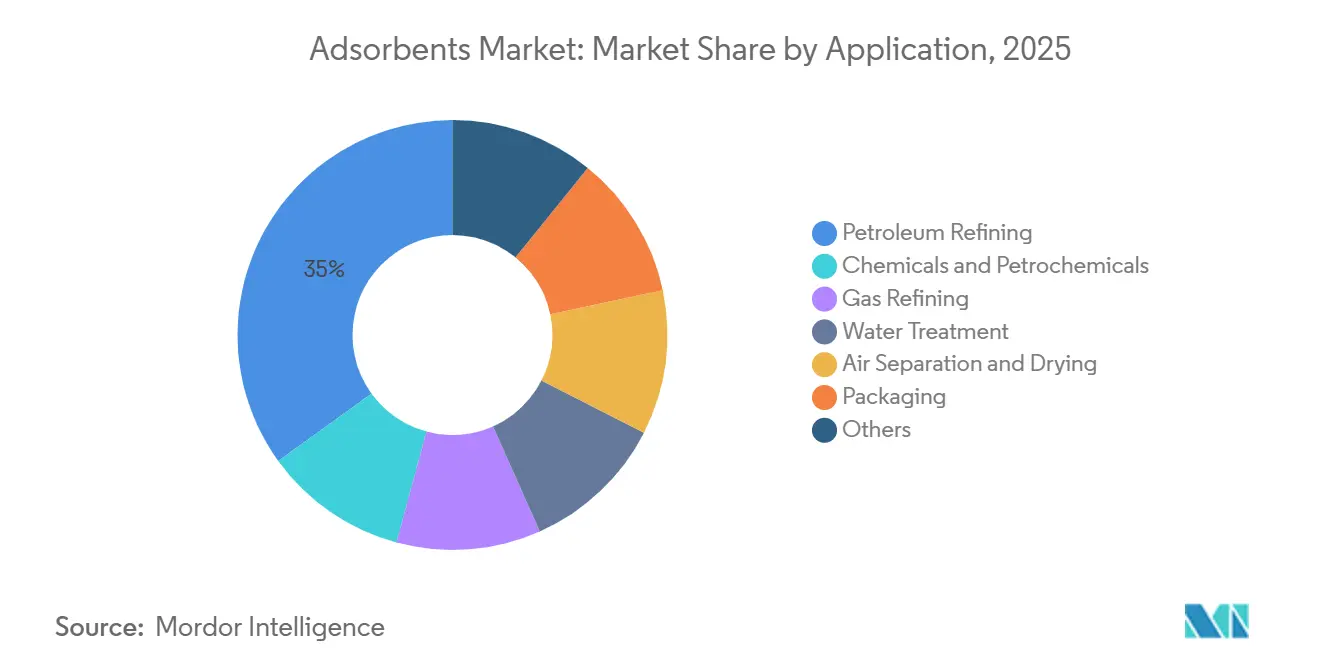
- By application, petroleum refining held 34.97% of the adsorbents market share in 2025, while water treatment is projected to advance at a 7.25% CAGR through 2031.
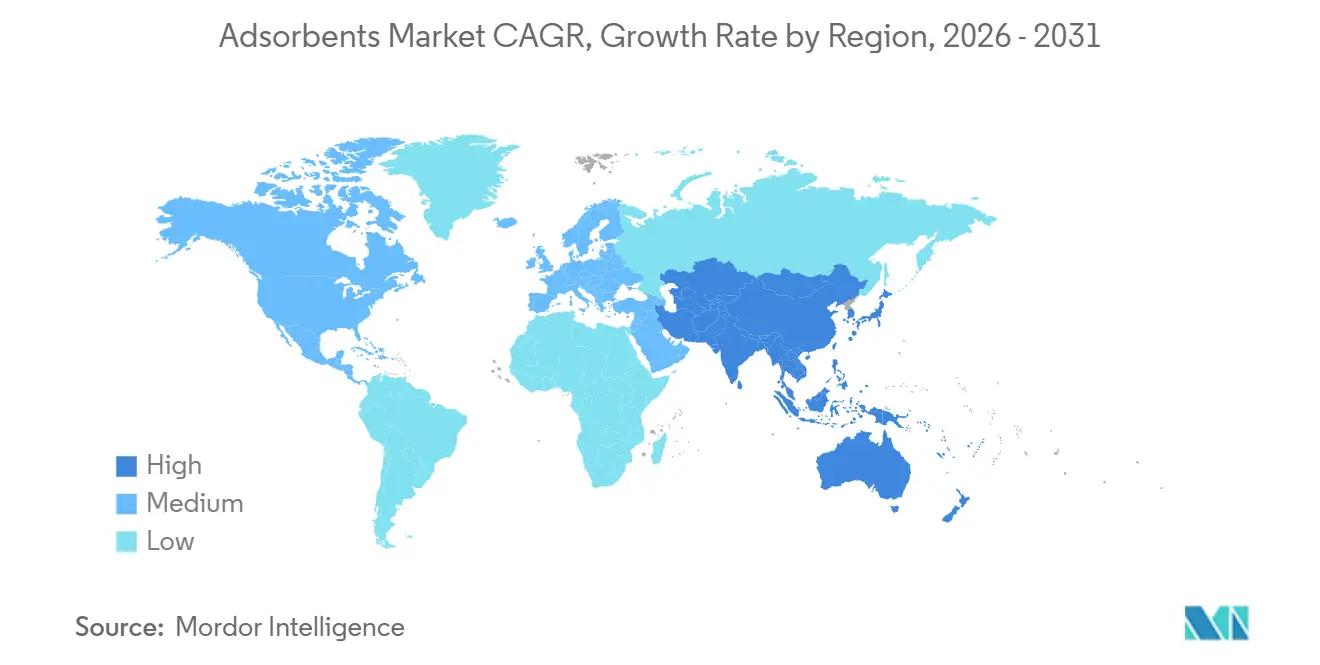
- By geography, Asia-Pacific held 37.14% of the adsorbents market share in 2025 and is projected to advance at a 7.13% CAGR through 2031.
Note: Market size and forecast figures in this report are generated using Mordor Intelligence’s proprietary estimation framework, updated with the latest available data and insights as of January 2026.
Market Trends and Insights
Drivers Impact Analysis of Adsorbents Market*
| Driver | (~) % Impact on CAGR Forecast | Geographic Relevance | Impact Timeline |
|---|---|---|---|
| Industrial Water-Quality Compliance | +1.8% | Global, with highest intensity in North America & EU | Medium term (2–4 years) |
| Refinery and Petrochemical Capacity Expansion | +1.5% | APAC core (China, India), spill-over to Middle East & Africa | Long term (≥ 4 years) |
| Natural Gas, LNG and Hydrogen Purification Demand | +1.2% | North America, APAC (Australia, India), Middle East | Long term (≥ 4 years) |
| Adsorbent-Cycle Digitalization and Predictive Replacement | +0.9% | Global, early adoption in North America & EU | Medium term (2–4 years) |
| Low-Carbon Adsorbent Materials for Difficult Contaminants | +0.7% | North America, EU; emerging in APAC | Long term (≥ 4 years) |
| Source: Mordor Intelligence | |||
Industrial Water-Quality Compliance
Tighter drinking-water limits are making treatment media a required purchase for many utilities. In April 2024, the U.S. Environmental Protection Agency set maximum contaminant levels of 4 parts per trillion for perfluorooctanoic acid and perfluorooctane sulfonic acid in drinking water[1]U.S. Environmental Protection Agency, “Per- and Polyfluoroalkyl Substances,” U.S. Environmental Protection Agency, epa.gov. The rule requires affected systems to monitor these substances and comply with the limits by 2029, which supports a defined upgrade cycle. Granular activated carbon is a familiar treatment option for many of these applications so that compliance programs can raise demand for specialized grades. The adsorbents market benefits when utilities consider media performance, replacement frequency, and spent-media handling together. This shifts purchasing toward products with proven capacity and dependable reactivation support.
Refinery and Petrochemical Capacity Expansion
Refineries and petrochemical plants use adsorbents in dehydration, purification, separation, and polishing steps. These facilities require periodic media replacement, which makes operating demand more durable than an initial equipment order. Molecular sieves and activated alumina are important in processes that need dry feedstocks or controlled impurity levels. Clay adsorbents also serve high-volume refining applications, including edible oil processing. The adsorbents market grows when new complexes add these systems and when existing plants process more difficult feedstocks. Suppliers that qualify products for critical service can secure repeat business throughout an asset’s operating life.
Natural Gas, LNG and Hydrogen Purification Demand
Natural gas and liquefied natural gas processing require very low water content to protect cryogenic equipment. Molecular sieves are widely used for deep dehydration before liquefaction and other gas-treatment steps. The need for predictable regeneration and high selectivity makes performance validation important in these projects. Hydrogen production and purification also use adsorption systems, including Pressure Swing Adsorption systems. The adsorbents market gains from these applications because they rely on specialized media and recurring regeneration or replacement. Energy infrastructure projects can therefore support long-term demand for higher-value grades.
Adsorbent-Cycle Digitalization and Predictive Replacement
Industrial users are moving from fixed replacement schedules toward decisions based on observed media condition. This approach can reduce unexpected breakthrough events and avoid removing material before it is fully used. A 2025 Scientific Reports study evaluated an Internet of Things–based system that predicted activated-carbon filter breakthrough in industrial settings with more than 80% accuracy. The study illustrates how sensor data can help operators manage filter performance. Digital monitoring may be most useful at sites with large adsorber inventories and costly disruption risks. The adsorbents market can gain when suppliers combine physical media with condition-monitoring support.
Restraints Impact Analysis of Adsorbents Market*
| Restraint | (~) % Impact on CAGR Forecast | Geographic Relevance | Impact Timeline |
|---|---|---|---|
| Raw Material and Activation-Cost Volatility | -1.4% | Global, particularly APAC producers and North American importers | Short term (≤ 2 years) |
| Regeneration Energy and Spent-Adsorbent Disposal Costs | -1.0% | Global, most acute in EU and North America | Medium term (2–4 years) |
| Qualification Friction for Application-Specific Adsorbents | -0.7% | Global, particularly specialty and high-purity segments | Long term (≥ 4 years) |
| Source: Mordor Intelligence | |||
Raw Material and Activation-Cost Volatility
Activated carbon producers depend on feedstocks, energy, and activation capacity that can experience price changes. Coconut shell, coal, wood, and other inputs are not equally available in every region. This creates exposure to weather events, energy costs, transport constraints, and local supply conditions. When input prices rise, producers must either accept lower margins or raise selling prices. The adsorbents market can face slower purchasing decisions from cost-sensitive users when those price increases are passed through. Supply uncertainty also increases the value of diversified sourcing and regional manufacturing.
Regeneration Energy and Spent-Adsorbent Disposal Costs
Regeneration and disposal can make an adsorbent system more expensive than its initial purchase price suggests. A 2025 study of spent activated carbon described the high energy demand of conventional thermal regeneration. This makes energy efficiency important for applications that replace or reactivate material frequently. The adsorbents market faces pressure when customers evaluate the full cost of transport, regeneration, disposal, and new media. Smaller utilities may find these costs especially difficult to manage. Suppliers need to explain how bed life and reactivation options affect the total cost of treatment.
*Our forecasts treat driver/restraint impacts as directional, not additive. The impact forecasts reflect baseline growth, mix effects, and variable interactions.
Adsorbents Market Segment Analysis
By Type:
Activated Carbon Leads Demand While Molecular Sieves Gain Clean-Energy DemandActivated carbon held 32.56% of the adsorbents market in 2025. Its position reflected its use in water purification, industrial emission control, gold recovery, and food decolorization. Water-treatment compliance supports demand for granular activated carbon in many municipal and industrial applications. Its broad use base helps the material retain demand across several customer groups. Activated carbon suppliers also compete on pore structure, feedstock quality, logistics, and reactivation support. This makes the segment diverse despite its leading position.
Molecular sieves are projected to advance at a 6.78% CAGR through 2031. Their growth is tied to hydrogen purification, liquefied natural gas dehydration, bioethanol processing, and air separation. These applications need selective water removal and gas separation under controlled operating conditions. The adsorbents market size for molecular sieves is supported by projects where performance requirements limit the use of lower-cost substitutes. Research on carbon molecular sieve membranes also indicates continuing work on improved selectivity. Suppliers can build value through technical specification support and dependable replacement supply.



By Application:
Petroleum Refining Anchors Revenue While Water Treatment Advances FastestPetroleum refining held 34.97% of the adsorbents market in 2025. Refiners use several adsorbent types for desulfurization, dehydration, paraffin separation, and product polishing. Large plants consume material continuously as beds are regenerated or replaced. Integrated refinery and petrochemical sites can increase media demand across multiple process units. The application remains important because it combines large operating volumes with recurring replacement requirements. Suppliers need to meet strict process specifications and maintenance schedules in this customer group.
Water treatment is projected to advance at a 7.25% CAGR through 2031. Drinking-water rules create demand for treatment solutions that can remove contaminants and maintain compliance. Municipal upgrades, industrial wastewater control, and reuse projects support the adsorbents market size for water treatment. Granular activated carbon is one option used in treatment systems, alongside other adsorbent media selected for specific contaminants. Spending decisions increasingly consider spent-media handling and the availability of reactivation services. This gives suppliers that offer lifecycle support a stronger position.
Geography Analysis
APAC Adsorbents Market
Asia-Pacific held 37.14% of the adsorbents market in 2025 and is projected to advance at a 7.13% CAGR through 2031. The region combines large refining and petrochemical activity with growing water treatment needs. China and India are important demand centers because of their industrial scale and infrastructure requirements. Southeast Asian countries also consume activated carbon in palm oil refining, municipal treatment, and petrochemical operations. The regional supply base includes both commodity producers and suppliers of specialized separation media. The adsorbents market size in Asia-Pacific is also influenced by local feedstock availability and processing capacity.
North America Adsorbents Market
North America is experiencing stronger demand for water treatment media following federal requirements for perfluoroalkyl and polyfluoroalkyl substances. In February 2026, Calgon Carbon Corporation announced a nearly USD 100 million expansion of drinking-water carbon reactivation capacity at its Columbus, Ohio, plant[2]Calgon Carbon Corporation, “Calgon Carbon Invests Nearly USD 100 Million to Expand Drinking Water Carbon Reactivation Capacity at Its Columbus, Ohio, Plant,” Calgon Carbon Corporation, calgoncarbon.com. The project is expected to begin operations in 2028. The company also announced the development of the Tyger River Plant in South Carolina under its Operation Bedrock program.
Europe Adsorbents Market
Europe has a strong focus on water quality and specialized treatment media. Its customers are likely to assess performance, compliance documentation, and end-of-life handling closely. This supports demand for activated carbon and ion-exchange products in difficult treatment applications. The region also has established chemical and industrial customers that need gas drying and purification media. Higher energy and disposal costs can make lifecycle performance particularly important. Suppliers that can demonstrate longer operating cycles may be better placed in the adsorbents market.
MEA and South America Adsorbents Market
South America and the Middle East and Africa remain smaller but important areas for future demand. Brazil has water treatment needs that support activated carbon and zeolite use in municipal and industrial systems. The Middle East has gas processing and refining projects that require dehydration and purification materials. African refining expansion can also create new use cases for process media. These regions give suppliers opportunities where energy and water infrastructure are developing.

Competitive Landscape
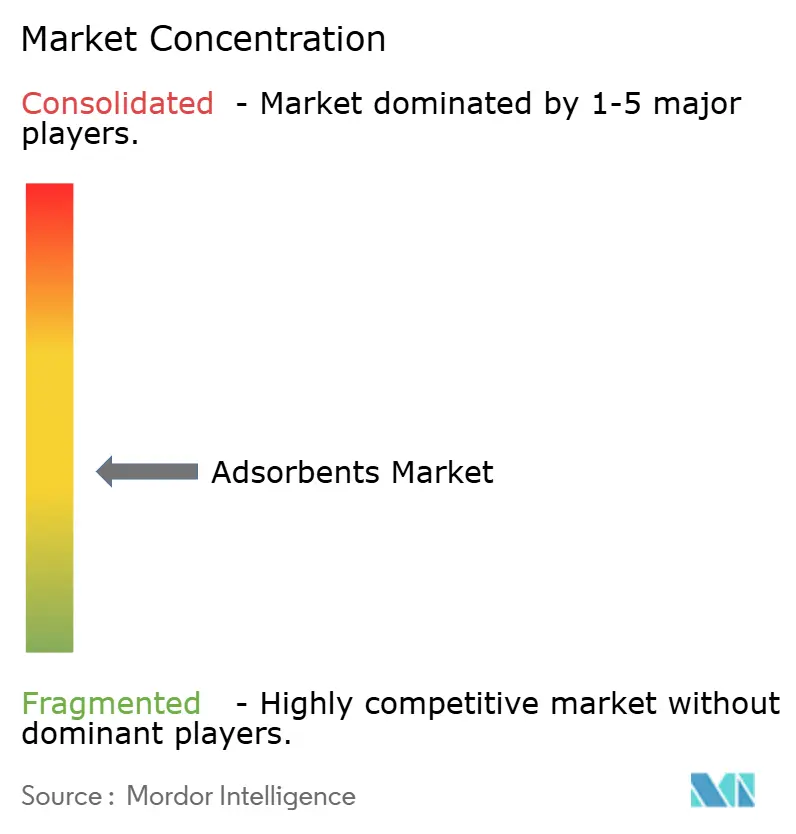
The adsorbents market is moderately concentrated, with the top five players including BASF, Honeywell International Inc, Arkema, W. R. Grace & Co.-Conn, and CLARIANT. Jacobi Carbons Group, Cabot Corporation, and Calgon Carbon Corporation are significant in activated carbon and related services. Competition differs by product because water treatment carbon, refinery media, and gas-separation materials have distinct qualification requirements. Large suppliers compete through product breadth, technical support, and regional production.
Suppliers are focusing on products for water treatment, renewable fuels, gas processing, and hydrogen purification. In the first quarter of 2026, CLARIANT reported growth in renewable-fuel applications for Tonsil products used in hydrotreated vegetable oil and sustainable aviation fuel production. Calgon Carbon Corporation’s February 2026 investment in Ohio expands domestic reactivation supply. Its planned Tyger River Plant reinforces that supply-security strategy. CLARIANT’s October 2024 memorandum of understanding with DS Dansuk supported Tonsil RNF production for hydrotreated vegetable oil and sustainable aviation fuel applications in South Korea.
Digital monitoring gives suppliers a way to differentiate through service as well as material performance. Research on filter breakthrough prediction shows how operating data can support timely media replacement. Materials innovation also includes metal-organic frameworks, polymeric materials, and advanced carbon structures for selective contaminant removal. Established suppliers benefit when buyers require validated quality systems, operating references, and reliable service infrastructure. New entrants may first succeed in demanding niches where existing media do not meet the required selectivity.
Adsorbents Industry Leaders
BASF
Honeywell International Inc
Arkema
W. R. Grace & Co.-Conn
CLARIANT
- *Disclaimer: Major Players sorted in no particular order
Adsorbents Market Companies Covered in this Report
- Arkema
- Axens
- BASF
- Cabot Corporation
- Calgon Carbon Corporation
- CLARIANT
- Ecovyst Inc.
- Honeywell International Inc
- Jacobi Carbons Group
- KURARAY CO., LTD.
- Mitsubishi Chemical Corporation
- PQ Corporation
- Tosoh Corporation
- W. R. Grace & Co.-Conn
- Zeochem

Recent Industry Developments in Adsorbents Market
- February 2026: Kemira announced plans to expand its Tarragona, Spain, site with a plant to reactivate spent activated carbon for drinking-water applications in Iberia. The additional reactivation capacity supports the circular use and regional supply of activated carbon adsorbents for drinking water and wastewater treatment.
- February 2026: KURARAY CO., LTD. announced that its subsidiary Calgon Carbon Corporation will invest nearly USD 100 million to expand activated carbon reactivation capacity at its Columbus, Ohio, plant. The investment increases the availability of reactivated carbon, supporting demand for carbon-based adsorbents in drinking-water treatment.


Global Adsorbents Market Report Scope
Adsorbents are porous materials that selectively attract and retain molecules, ions, or other substances on their surfaces, enabling the separation and removal of targeted components from gases and liquids. Their high surface area and tunable pore structures make them useful for purification, drying, contaminant removal, and separation processes across industrial applications.
The Adsorbents Market is segmented by type, application, and geography. By type, the market is segmented into activated carbon, molecular sieves, silica gel, activated alumina, clay adsorbents, and others. By application, the market is segmented into petroleum refining, chemicals and petrochemicals, gas refining, water treatment, air separation and drying, packaging, and others. The report also covers the market size and forecasts for adsorbents in 16 countries across major regions. For each segment, the market sizing and forecasts have been done on the basis of value (USD).
| Activated Carbon |
| Molecular Sieves |
| Silica Gel |
| Activated Alumina |
| Clay Adsorbents |
| Others |
| Petroleum Refining |
| Chemicals and Petrochemicals |
| Gas Refining |
| Water Treatment |
| Air Separation and Drying |
| Packaging |
| Others |
| Asia-Pacific | China |
| India | |
| Japan | |
| South Korea | |
| ASEAN Countries | |
| Rest of Asia-Pacific | |
| North America | United States |
| Canada | |
| Mexico | |
| Europe | Germany |
| United Kingdom | |
| France | |
| Italy | |
| NORDIC Countries | |
| Russia | |
| Rest of Europe | |
| South America | Brazil |
| Argentina | |
| Rest of South America | |
| Middle East and Africa | Saudi Arabia |
| South Africa | |
| Rest of Middle East and Africa |
| By Type | Activated Carbon | |
| Molecular Sieves | ||
| Silica Gel | ||
| Activated Alumina | ||
| Clay Adsorbents | ||
| Others | ||
| By Application | Petroleum Refining | |
| Chemicals and Petrochemicals | ||
| Gas Refining | ||
| Water Treatment | ||
| Air Separation and Drying | ||
| Packaging | ||
| Others | ||
| By Geography | Asia-Pacific | China |
| India | ||
| Japan | ||
| South Korea | ||
| ASEAN Countries | ||
| Rest of Asia-Pacific | ||
| North America | United States | |
| Canada | ||
| Mexico | ||
| Europe | Germany | |
| United Kingdom | ||
| France | ||
| Italy | ||
| NORDIC Countries | ||
| Russia | ||
| Rest of Europe | ||
| South America | Brazil | |
| Argentina | ||
| Rest of South America | ||
| Middle East and Africa | Saudi Arabia | |
| South Africa | ||
| Rest of Middle East and Africa | ||


Key Questions Answered in the Report
What is the size of the adsorbents market?
The adsorbents market stands at USD 5.44 billion in 2026 and is projected to reach USD 7.36 billion by 2031.
What is driving demand for adsorbents?
Water-quality compliance, refinery and petrochemical investment, and gas purification needs support demand.
Which type held the largest share in 2025?
Activated carbon held 32.56% of the adsorbents market in 2025.
Which application is projected to grow fastest through 2031?
Water treatment is projected to advance at a 7.25% CAGR through 2031.
Page last updated on:





