
Adaptive Clothing Market Size and Share
Market Overview
| Study Period | 2022 - 2032 |
|---|---|
| Market Size (2027) | USD 7.03 Billion |
| Market Size (2032) | USD 10.39 Billion |
| Growth Rate (2027 - 2032) | 8.14 % |
| Fastest Growing Market | Asia-Pacific |
| Largest Market | North America |
| Market Concentration | Low |
Major Players *Disclaimer: Major Players sorted in no particular order Image © Mordor Intelligence. Reuse requires attribution under CC BY 4.0. | |
Adaptive Clothing Market Analysis by Mordor Intelligence
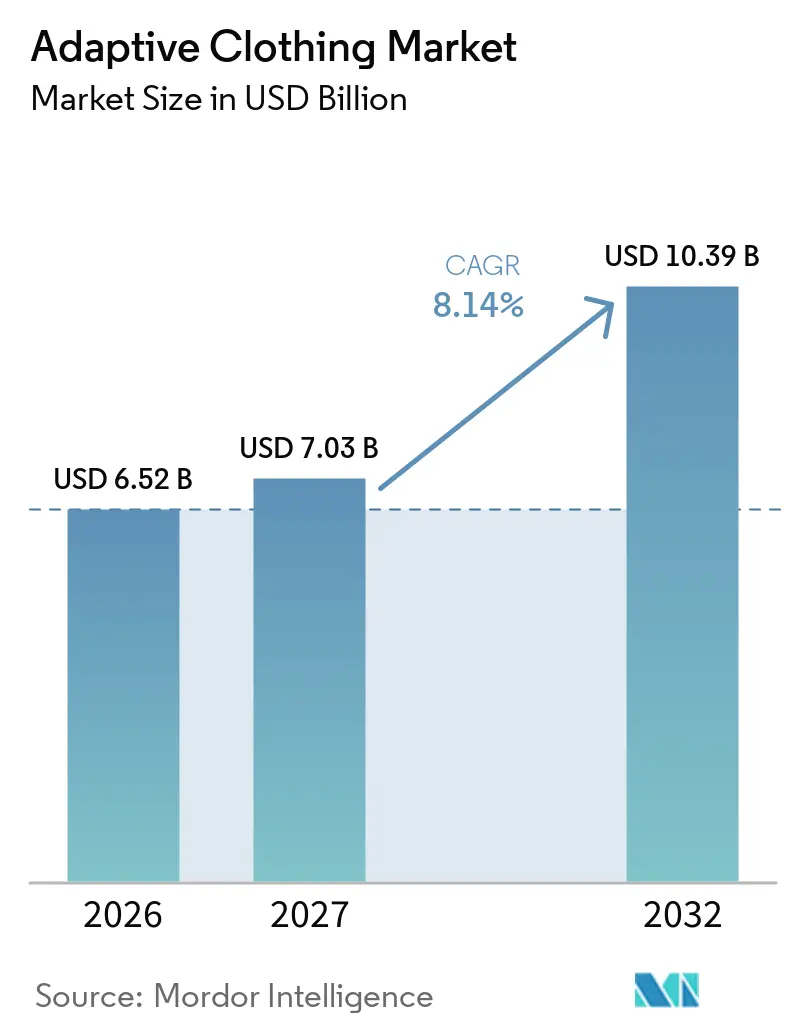
The adaptive clothing market size was valued at USD 6.52 billion in 2026 and is estimated to grow from USD 7.03 billion in 2027 to reach USD 10.39 billion by 2032, at a CAGR of 8.14% during the forecast period (2027-2032). Demand is driven by population aging and the large number of people living with disabilities, rather than seasonal fashion cycles. In October 2025, the World Health Organization reported that the global population aged 60 years and older is expected to increase to 1.4 billion by 2030, from 1.1 billion in 2023[1]. The adaptive clothing market is also shaped by practical needs related to mobility, dressing independence, medical access, and caregiver support. Retailers are expanding their product lines as consumer research identifies a shortage of fashionable, accessible options. Mainstream retailers are lowering barriers in the mass market, while specialized brands continue to serve consumers who require more technically designed garments.
Key Report Takeaways
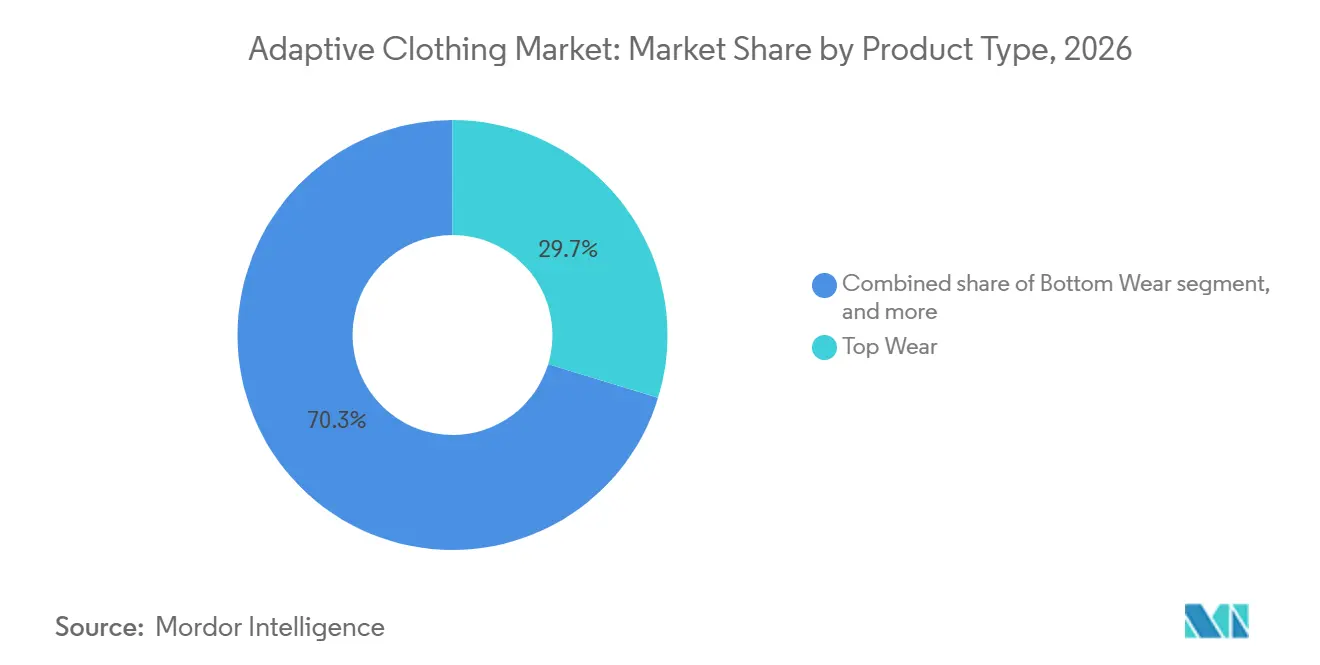
- By product type, top wear accounted for 29.72% of the adaptive clothing market share in 2026, while bottom wear is projected to grow at an 8.83% CAGR through 2032.
- By price range, mass dominated with a 61.27% share in 2026, while premium is forecast to expand at a 9.15% CAGR through 2032.
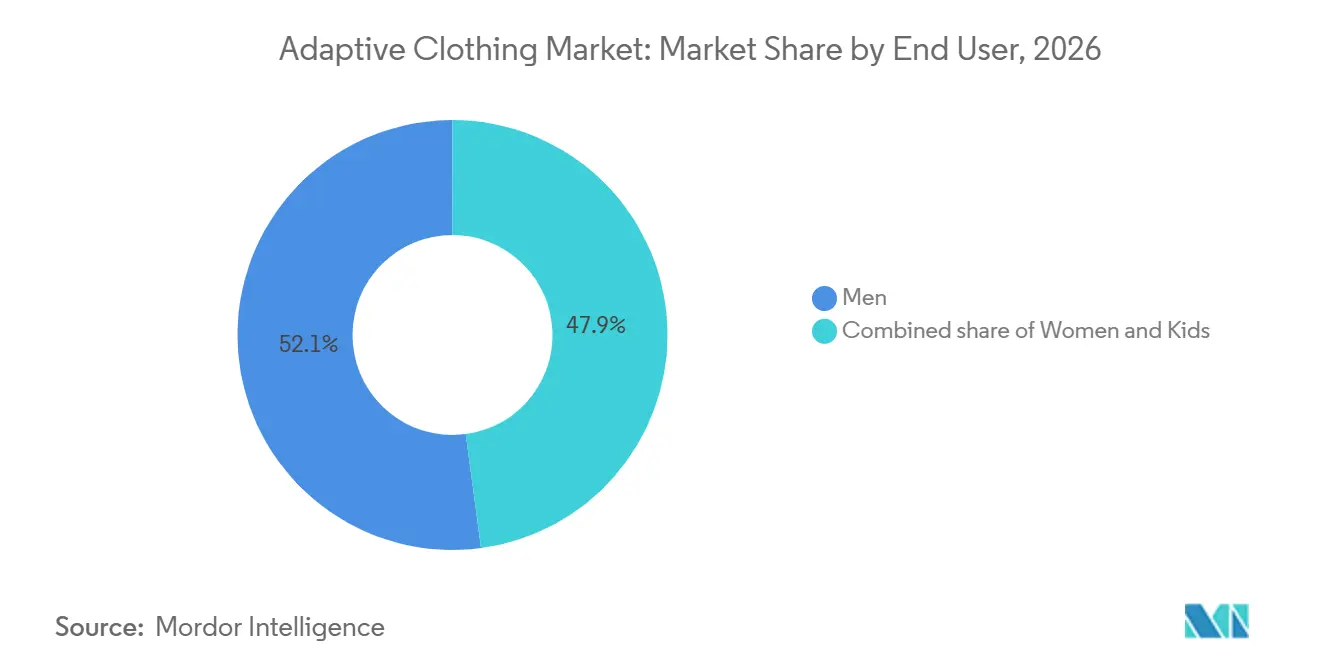
- By end user, men accounted for the largest share of 52.12% in 2026, while women is expected to register a 9.41% CAGR through 2032.
- By distribution channel, offline channels accounted for 65.21% of market share in 2026, while online channels are projected to grow at a 9.58% CAGR through 2032.
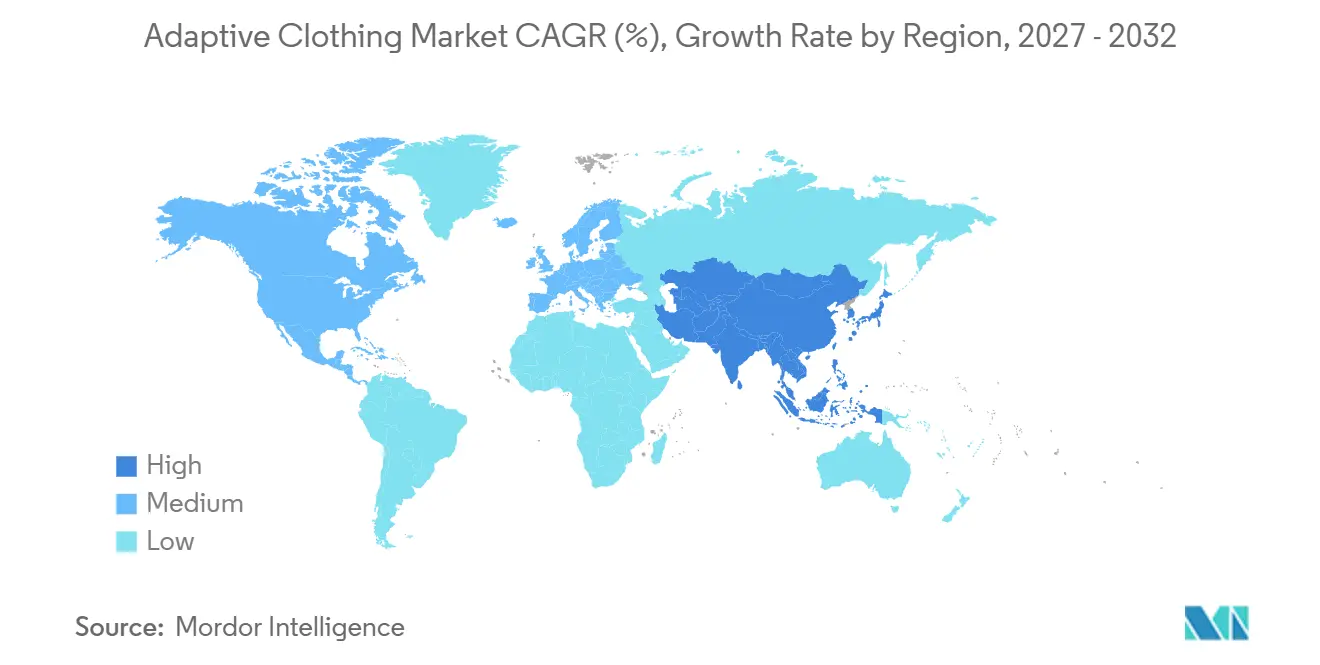
- By geography, North America held 38.12% of the adaptive clothing market share in 2026, while Asia-Pacific is forecast to register the fastest growth at a 9.71% CAGR through 2032.
Note: Market numbers in this report are based on Mordor Intelligence's proprietary estimation framework, which combines nine months of actuals with Q4 projections for base year 2026.
Market Trends and Insights
Drivers Impact Analysis of Adaptive Clothing Market*
| Driver | (~) % Impact on CAGR Forecast | Geographic Relevance | Impact Timeline |
|---|---|---|---|
| Growing geriatric population and age-related mobility limitations | +2.2% | Global, concentrated in Japan, Western Europe, and North America | Medium term (2-4 years) |
| Rising prevalence of physical disabilities | +1.8% | Global | Medium term (2-4 years) |
| Increasing demand for independent dressing and self-care solutions | +1.0% | Global, with early gains in North America and Europe | Short term (≤ 2 years) |
| Growing awareness of inclusive fashion and disability representation | +0.7% | North America and Europe, with early gains in Japan and South Korea | Long term (≥ 4 years) |
| Technological advancements in fabric design | +0.6% | Global, with innovation concentrated in North America, Europe, and Japan | Medium term (2–4 years) |
| Rising adoption of adaptive clothing among wheelchair users | +0.8% | Global, with stronger adoption in North America and Europe | Medium term (2–4 years) |
| Source: Mordor Intelligence | |||
Growing Geriatric Population and Age-Related Mobility Limitations
The growing elderly population is increasing demand for clothing that accommodates age-related physical limitations and supports independent daily activities. Aging can reduce hand dexterity, joint flexibility, muscle strength, and the ability to bend or raise the arms, making conventional garments difficult to wear. According to India’s Ministry of Social Justice and Empowerment in February 2026, 23.8% of people aged 60 and above experience at least one Activities of Daily Living (ADL) limitation, indicating varying levels of care dependency[2]. These limitations are driving demand for adaptive garments with magnetic fasteners, elastic waistbands, wider openings, and easy-access closures. Consequently, apparel manufacturers are addressing the clothing needs of older consumers through functional designs that simplify dressing, enhance comfort, and reduce reliance on caregivers.
Rising Prevalence of Physical Disabilities
The prevalence of physical disabilities and mobility limitations is driving demand for adaptive clothing that accommodates diverse physical needs. Individuals with restricted movement, limb impairments, muscular disorders, or coordination difficulties often face challenges when wearing conventional garments, particularly those with buttons, zippers, and complex fastening mechanisms. According to Malaysia's Department of Statistics in December 2025, the country recorded 805,509 registered persons with disabilities in 2024, including 286,634 individuals (35.6%) classified as having physical disabilities[3]. This sizable population underscores the need for accessible apparel with features such as magnetic closures, adjustable waistbands, wider openings, and seated-fit designs. Consequently, clothing manufacturers are developing specialized garments that simplify dressing, enhance comfort, and meet the needs of consumers with varying levels of physical mobility.
Increasing Demand for Independent Dressing and Self-Care Solutions
The growing preference for independent living among individuals with physical disabilities, limited mobility, and age-related limitations is driving demand for adaptive clothing. Conventional garments often require hand coordination, upper-body flexibility, and physical strength to operate buttons, zippers, and other fastening mechanisms. Adaptive apparel addresses these challenges through magnetic closures, Velcro fasteners, elasticated waistbands, and front-opening designs that simplify dressing and undressing. These features reduce reliance on caregivers while supporting personal dignity, comfort, and autonomy. Additionally, the increasing emphasis on home-based care and independent living is encouraging consumers to seek practical clothing solutions suited to their daily activities. Consequently, manufacturers are integrating accessible design features into everyday apparel, thereby expanding the adoption of adaptive clothing.
Growing Awareness of Inclusive Fashion and Disability Representation
Growing awareness of inclusive fashion and disability representation is prompting apparel manufacturers to develop clothing that combines accessibility with contemporary styling. Consumers increasingly seek fashionable garments that accommodate diverse physical abilities without compromising personal expression, comfort, or appearance. In response, fashion brands are launching adaptive collections, collaborating with disability advocates, and involving individuals with disabilities in product design and development. Social media campaigns, inclusive fashion shows, and accessible retail displays are further increasing the visibility of adaptive apparel among mainstream consumers. Additionally, integrating adaptive designs into regular clothing collections is reducing the perception of specialized apparel as exclusively medical clothing. These developments are driving broader consumer acceptance and supporting the expansion of the adaptive clothing market.
Restraints Impact Analysis of Adaptive Clothing Market*
| Restraint | (~) % Impact on CAGR Forecast | Geographic Relevance | Impact Timeline |
|---|---|---|---|
| High prices of adaptive clothing compared with conventional apparel | -0.9% | Global, intensified in Asia-Pacific, South America, and Middle East and Africa | Medium term (2–4 years) |
| Limited product availability and restricted retail distribution | -0.7% | Asia-Pacific, South America, and Middle East and Africa | Long term (≥ 4 years) |
| Lack of consumer awareness and understanding of adaptive apparel | -0.6% | Global, particularly Asia-Pacific, South America, and Middle East and Africa | Medium term (2–4 years) |
| Limited fashion variety and aesthetic design options | -0.5% | Global, with greater relevance in emerging markets across Asia-Pacific and South America | Medium term (2–4 years) |
| Source: Mordor Intelligence | |||
High Prices of Adaptive Clothing Compared with Conventional Apparel
The relatively high cost of adaptive clothing compared with conventional apparel may limit adoption among price-sensitive consumers. Specialized garment construction, magnetic closures, adjustable fastening systems, accessible openings, and modified sizing requirements increase manufacturing complexity and production costs. Limited production volumes and the sourcing of specialized materials further raise retail prices. In addition, individuals with disabilities and elderly consumers may need multiple specialized garments to support daily activities and meet specific mobility requirements, increasing their overall clothing expenditure. Consequently, higher product prices may restrict consumer access, reduce repeat purchases, and limit the broader penetration of adaptive clothing across mainstream apparel retail channels.
Limited Product Availability and Restricted Retail Distribution
The limited availability of adaptive clothing through mainstream retail channels restricts market penetration and consumer accessibility. Many conventional apparel retailers offer only a narrow range of adaptive garments, limiting consumer choice across product categories, sizes, designs, and functional features. Specialized manufacturers also face challenges in developing extensive distribution networks and securing retail partnerships, particularly in emerging economies. As a result, consumers often rely on specialized online platforms or niche retailers to access suitable clothing options. These distribution challenges create additional purchasing barriers for elderly individuals and consumers with mobility limitations, thereby limiting the broader adoption of adaptive clothing.
*Our forecasts treat driver/restraint impacts as directional, not additive. The impact forecasts reflect baseline growth, mix effects, and variable interactions.
Adaptive Clothing Market Segment Analysis
By Product Type:
Top Wear Leads While Bottom Wear Addresses Seated Fit NeedsTop Wear accounted for 29.72% of sales in 2026. This position reflects demand across multiple use cases, including limited dexterity, post-surgical access, sensory sensitivity, and caregiver assistance. Shirts, tops, and outer layers can incorporate magnetic closures, easy-access sleeves, open backs, and discreet medical access features without altering the garment’s core purpose. This versatility enables brands to develop products that address diverse functional needs. Top Wear is also relevant for both daily dressing and institutional care settings. Inner Wear has expanded through product development for stoma users and other consumers seeking garments that combine comfort with discreet support.
Bottom Wear is forecast to grow at a CAGR of 8.83% through 2032. Conventional trousers can create pressure points, poor waist placement, and restricted access for individuals who spend extended periods seated. Wheelchair users may require higher back hems, shorter front rises, elastic waistbands, and side openings to accommodate medical devices. The category may benefit companies that test garments in actual seated positions rather than modifying standing patterns after production. Therefore, the adaptive clothing market is expected to continue viewing Bottom Wear as an area where technical design closely aligns with consumer needs.



By Price Range:
Mass Availability Supports Volume While Premium Addresses Style NeedsMass products accounted for 61.27% of sales in 2026. The segment benefits as national retailers leverage their established sourcing, store, and online operations to offer adaptive collections. Larger retailers can distribute additional construction costs across higher unit volumes, helping reduce the price barrier for basic garments. Their participation also increases category visibility among consumers who may not actively seek specialist suppliers. The mass tier remains important because accessible clothing must be both affordable and functional.
The premium segment is forecast to grow at a CAGR of 9.15% through 2032. This segment serves consumers seeking adaptive functionality without compromising on tailoring, occasion wear, or personal style. In March 2025, WearAble by Lega launched made-to-measure adaptive suits, shirts, and tuxedos for wheelchair users in Sweden. Such offerings demonstrate how premium products can meet professional and formal dressing requirements. The segment continues to depend on consumers who can pay more for design sophistication and customization. Its growth indicates that the market is increasingly addressing functional accessibility and personal identity simultaneously.
By End User:
Men Lead Current Demand While Women Show Faster GrowthMen account for 52.12% of the adaptive clothing market size in 2026. Early offerings for men typically focused on dress shirts with magnetic closures, easy-on trousers, and other basic garments with clear functional benefits. These products established a visible entry point for adaptive apparel in mainstream retail and specialist channels. The segment also includes men who require clothing that addresses reduced dexterity, mobility limitations, or medical access needs. Children represent a smaller but important consumer group, as caregiver purchasing decisions influence product selection and repeat purchases. Child-focused products must accommodate school, play, changing routines, sensory comfort, and age-appropriate styling. However, the sector should not treat any end-user group as uniform, as conditions, lifestyle needs, and preferences vary widely.
The women’s segment is forecast to grow at a CAGR of 9.41% through 2032. Existing product gaps remain in occasion wear, extended-size ranges, intimate apparel, and clothing that combines accessibility with contemporary styling. Women’s adaptive apparel must address functional requirements without limiting product choices to basic garments. Co-design can help brands better understand requirements related to garment access, seated comfort, fabric feel, and body confidence. The opportunity extends beyond expanding product offerings; it involves improving the range of clothing available for work, social events, daily routines, and intimate settings.

By Distribution Channel:
Physical Trial Remains Important While Online Discovery ExpandsOffline channels accounted for 65.21% of sales in 2026. Physical stores enable customers to test closure systems, assess fabric comfort, and evaluate garment fit while seated or moving. This capability is particularly important for garments with catheter access, stoma openings, magnetic fastenings, or specialized waist construction. In-person retail also supports caregivers and institutional buyers who require practical guidance. Accessible changing areas and knowledgeable store staff remain important components of the offline shopping experience. The channel will continue to play a key role where fit and reassurance are as important as price and convenience.
Online sales are forecast to grow at a CAGR of 9.58% through 2032. Digital platforms can make specialized products accessible to customers beyond the geographic reach of adaptive retail stores. Product pages can provide more detailed information on closure types, body positioning, medical access features, and garment-care requirements than standard retail displays. Online channels also facilitate direct feedback and help brands reach communities organized around specific conditions or mobility needs. However, retailers must ensure that their websites are accessible to people with visual, motor, cognitive, and sensory disabilities. Easy return processes and detailed sizing information remain essential, as fit-related issues can be costly and discouraging for consumers.
Geography Analysis
North America
North America accounted for a 38.12% share in 2026. Established specialist brands and large retail groups provide consumers with more choices than in many other regions. Demand is supported by a substantial population with mobility limitations and other disabilities. The Americans with Disabilities Act continues to shape the region’s regulatory approach to accessibility and inclusion, encouraging retailers to improve the experiences of disabled customers across physical stores and digital services. The region also has an active base of online and specialist sellers. Increased use of co-design practices and accessible product information could further strengthen customer trust. Mexico and smaller regional markets remain less developed, creating opportunities for broader distribution networks and lower-priced product collections.
Asia-Pacific
Asia-Pacific is projected to expand at a CAGR of 9.71% through 2032. Japan’s aging population is driving demand for clothing that simplifies dressing and supports caregivers. The region also presents opportunities in countries where adaptive clothing remains an emerging retail category. Rising awareness among consumers, retailers, and local entrepreneurs is expected to support regional growth. These factors are driving a shift away from products with a purely clinical appearance. Australia has an active specialist market, including Christina Stephens’ wheelchair-user collection. Compliance requirements, digital accessibility standards, and price sensitivity vary significantly across the region. Therefore, brands must adopt country-specific strategies rather than relying on a single regional collection.
Europe, South America, and Middle East and Africa
Europe combines disability inclusion policies with a growing retail focus on accessible fashion. The European Accessibility Act has increased attention on accessible digital services, influencing how retailers design websites and customer journeys. Fashion choice remains important, as functional garments must also suit employment, social, and formal settings. South America shows early demand in major urban centers; however, product availability and specialist distribution remain limited. Progress across these regions will depend on accessible e-commerce platforms, local partnerships, and greater awareness among consumers and healthcare-related networks. South America, the Middle East, and Africa offer longer-term opportunities, where accessible pricing and local distribution will be critical.
Competitive Landscape
Market Concentration
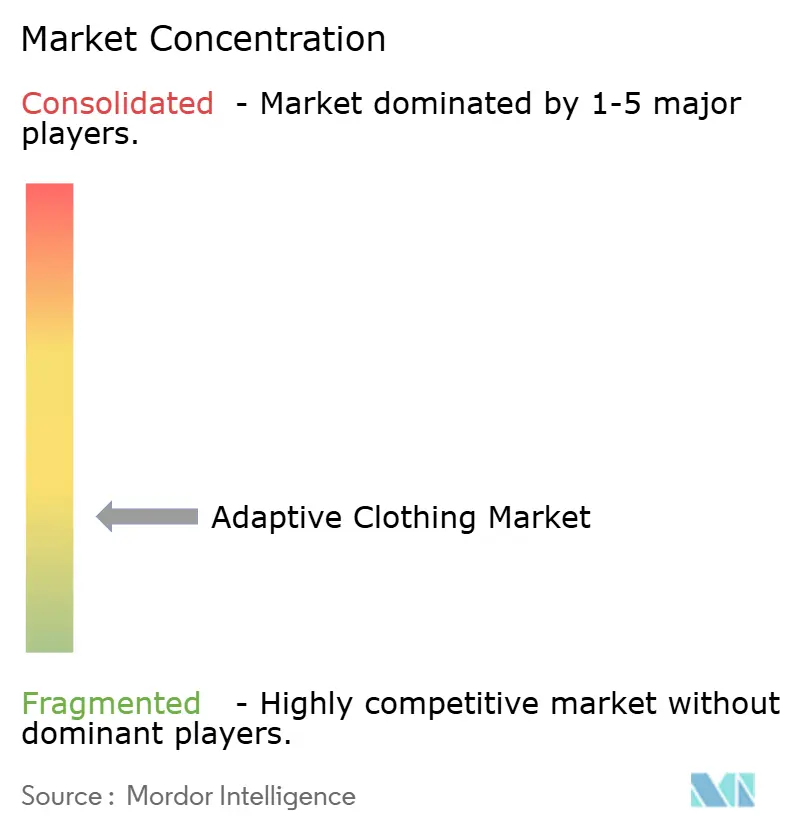
The adaptive clothing market remains fragmented, with specialist brands and mainstream retailers pursuing distinct growth strategies. Large retailers can leverage established sourcing capabilities, store networks, and online reach to introduce entry-level adaptive clothing ranges. In contrast, specialist companies can focus more closely on wheelchair use, medical access, tailored fit, and condition-specific requirements. These launches are increasing direct competition in basic garments and lower-priced product categories while raising consumer expectations regarding availability, fit, and product information. As a result, the adaptive clothing industry is becoming more visible, although it has not yet consolidated around a small group of suppliers.
Product development is becoming a key point of differentiation. The company developed the collection in collaboration with disabled customers and Tilting the Lens, making co-design an integral part of its product development process rather than a final review step. WearAble by Lega entered Sweden with made-to-measure suits, shirts, and tuxedos for wheelchair users and individuals with atypical body proportions. Its business model demonstrates how premium tailoring can address needs that mass retailers do not fully serve. Companies that understand garment construction for seated bodies, sensory comfort, and medical access can maintain differentiation even as larger retailers expand their adaptive clothing offerings. The market continues to offer opportunities in premium menswear, children’s school clothing, and garments designed for specific medical needs.
Companies’ ability to build customer trust through specialized distribution, fitting support, and accessible shopping experiences also represents an important competitive factor. Adaptive clothing purchases often require more detailed consideration of garment measurements, fastening mechanisms, seated comfort, and individual mobility requirements than conventional apparel purchases. Companies therefore compete by providing detailed product descriptions, inclusive sizing guides, personalized fitting services, flexible return policies, and direct customer support. Partnerships with healthcare providers, rehabilitation centers, disability organizations, and assisted-living facilities can also help brands reach consumers with specific clothing requirements.
Adaptive Clothing Industry Leaders
-
Tommy Hilfiger
-
Target Corporation
-
MagnaReady
-
June Adaptive Inc.
-
Marks and Spencer
- *Disclaimer: Major Players sorted in no particular order
Adaptive Clothing Market Companies Covered in this Report
- Tommy Hilfiger
- Silvert's Universal Dressing Solutions Inc.
- Target Corporation
- Nike, Inc.
- BILLY Footwear, Inc.
- IZ Adaptive
- Buck and Buck, Inc.
- Joe and Bella, Inc.
- MagnaReady
- Care+Wear
- Slick Chicks
- No Limbits
- Springrose
- Liberare
- June Adaptive Inc.
- Zappos Adaptive
- Marks and Spencer
- Kohl’s Corporation
- JCPenney
- Primark
Recent Industry Developments in Adaptive Clothing Market
- September 2026: ASOS launched an adaptive collection globally on ASOS.com. The 51-piece range spans womenswear, menswear, and curve categories, with sizes ranging from XS to 3XL and prices between GBP 32 and GBP 65. ASOS co-developed the collection with Tilting the Lens and co-created it with disabled consumers.
- September 2025: George at Asda launched a 28-piece adaptive clothing collection for adults on george.com, with prices ranging from GBP 11 to GBP 24. Developed over nearly two years with clinical and community input, the collection includes features that support PICC-line access, stoma pockets, feeding tubes, and easy-on fastenings.
- July 2025: Silverts partnered with disability advocate Brooke Eby to launch the B.E. Collection, its first adaptive fashion capsule designed for a younger, style-conscious audience. The collection featured open-back tops, T-shirt dresses, bib scarves, and sherpa shawls, available in sizes S–3XL.
Global Adaptive Clothing Market Report Scope
Adaptive clothing refers to specially designed garments that simplify dressing and undressing for individuals who face challenges wearing conventional clothing due to physical disabilities, limited mobility, age-related conditions, injuries, or medical requirements.
The adaptive clothing market is segmented by product type, price range, end user, distribution channel, and geography. By product type, the market is segmented into top wear, bottom wear, inner wear, and other product types. By price range, the market is segmented into mass and premium. By end user, the market is segmented into men, women, and kids. By distribution channel, the market is segmented into offline and online channels. Based on geography, the market is classified into North America, Europe, South America, Asia-Pacific, and the Middle East and Africa. The market forecasts are provided in terms of value (USD).
Segmentation Overview
| Top Wear |
| Bottom Wear |
| Inner Wear |
| Other Product Types |
| Mass |
| Premium |
| Men |
| Women |
| Kids |
| Offline Channel |
| Online Channel |
| North America | United States |
| Canada | |
| Mexico | |
| Rest of North America | |
| Europe | Germany |
| United Kingdom | |
| Italy | |
| France | |
| Spain | |
| Netherlands | |
| Poland | |
| Belgium | |
| Sweden | |
| Rest of Europe | |
| Asia-Pacific | China |
| India | |
| Japan | |
| Australia | |
| Indonesia | |
| South Korea | |
| Thailand | |
| Singapore | |
| Rest of Asia-Pacific | |
| South America | Brazil |
| Argentina | |
| Colombia | |
| Chile | |
| Peru | |
| Rest of South America | |
| Middle East and Africa | South Africa |
| Saudi Arabia | |
| United Arab Emirates | |
| Nigeria | |
| Egypt | |
| Morocco | |
| Turkey | |
| Rest of Middle East and Africa |
| By Product Type | Top Wear | |
| Bottom Wear | ||
| Inner Wear | ||
| Other Product Types | ||
| By Price Range | Mass | |
| Premium | ||
| By End User | Men | |
| Women | ||
| Kids | ||
| By Distribution Channel | Offline Channel | |
| Online Channel | ||
| By Geography | North America | United States |
| Canada | ||
| Mexico | ||
| Rest of North America | ||
| Europe | Germany | |
| United Kingdom | ||
| Italy | ||
| France | ||
| Spain | ||
| Netherlands | ||
| Poland | ||
| Belgium | ||
| Sweden | ||
| Rest of Europe | ||
| Asia-Pacific | China | |
| India | ||
| Japan | ||
| Australia | ||
| Indonesia | ||
| South Korea | ||
| Thailand | ||
| Singapore | ||
| Rest of Asia-Pacific | ||
| South America | Brazil | |
| Argentina | ||
| Colombia | ||
| Chile | ||
| Peru | ||
| Rest of South America | ||
| Middle East and Africa | South Africa | |
| Saudi Arabia | ||
| United Arab Emirates | ||
| Nigeria | ||
| Egypt | ||
| Morocco | ||
| Turkey | ||
| Rest of Middle East and Africa | ||
Key Questions Answered in the Report
What is the projected size of the adaptive clothing market by 2032?
The adaptive clothing market is projected to grow from USD 6.52 billion in 2026 to USD 10.39 billion by 2032, reaching USD 7.03 billion in 2027 and registering a CAGR of 8.14% during 2027-2032.
Which product type held the largest share of the adaptive clothing market in 2026?
Top wear was the largest product type segment in 2026, accounting for 29.72% of adaptive clothing market.
Which price range dominated the adaptive clothing market in 2026?
The mass-market segment led the market in 2026, capturing 61.27% of total revenue.
Which end-user segment accounted for the largest market share in 2026?
The men's segment held the largest share of the adaptive clothing market in 2026, representing 52.12% of total market revenue.
Which distribution channel generated the highest revenue in 2026?
The offline channel dominated the adaptive clothing market in 2026, accounting for 65.21% of total sales.