
Acetoacetanilide Market Size and Share
Market Overview
| Study Period | 2021 - 2031 |
|---|---|
| Market Size (2026) | USD 8.97 Billion |
| Market Size (2031) | USD 12.72 Billion |
| Growth Rate (2026 - 2031) | 7.24 % |
| Fastest Growing Market | North America |
| Largest Market | Asia-Pacific |
| Market Concentration | Medium |
Major Players *Disclaimer: Major Players sorted in no particular order Image © Mordor Intelligence. Reuse requires attribution under CC BY 4.0. | |
Acetoacetanilide Market Analysis by Mordor Intelligence
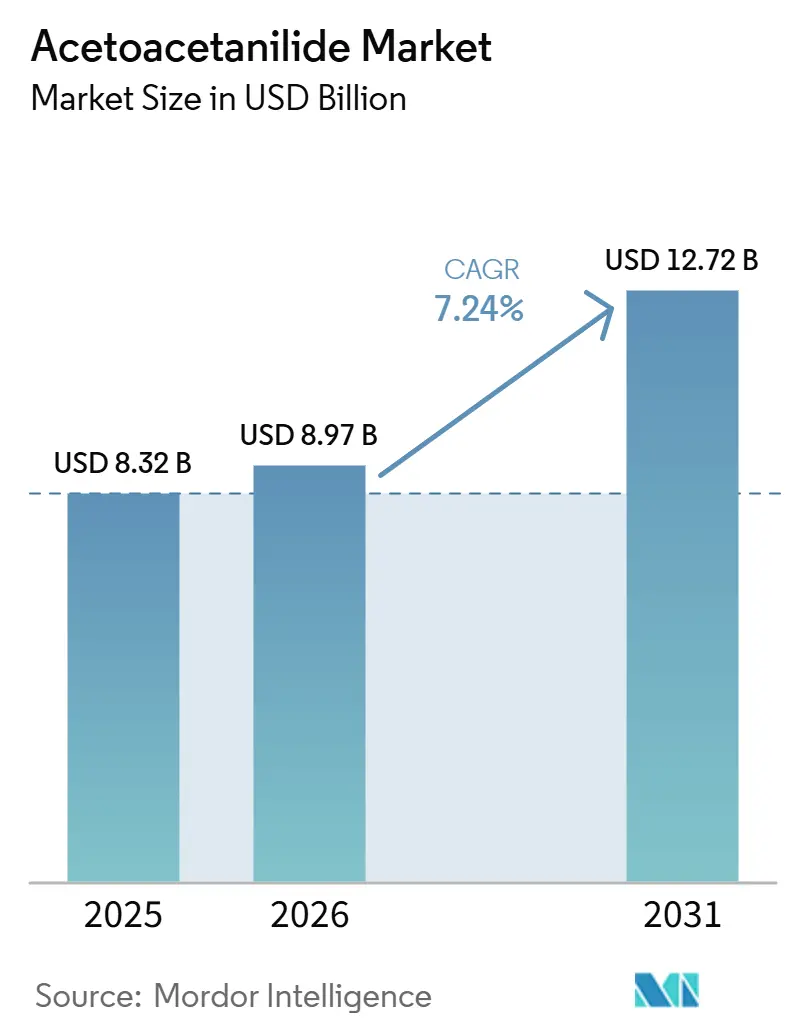
The Acetoacetanilide Market size is projected to expand from USD 8.32 billion in 2025 and USD 8.97 billion in 2026 to USD 12.72 billion by 2031, and is expected to register a CAGR of 7.24% between 2026 and 2031. The acetoacetanilide market is supported by demand from pigments, pharmaceutical intermediates, and agrochemical formulations, distributing revenue exposure across several downstream applications rather than a single end market. Its role as a coupling component for azo pigments remains the primary driver of volume demand, while rising demand for pharmacopeial-grade material is shifting part of the market toward higher-value supply. The market is also benefiting from pharmaceutical expansion across South and Southeast Asia, as well as increased activity in coatings, plastics, and packaging in developing industrial centers. At the same time, feedstock volatility in aniline and diketene, tighter purity requirements for azo colorant supply chains, and stricter manufacturing compliance are raising entry barriers for smaller suppliers. Despite these constraints, the acetoacetanilide market is projected to grow through 2031, supported by rising demand for regulated pharmaceuticals and steady pigment consumption.
Key Report Takeaways
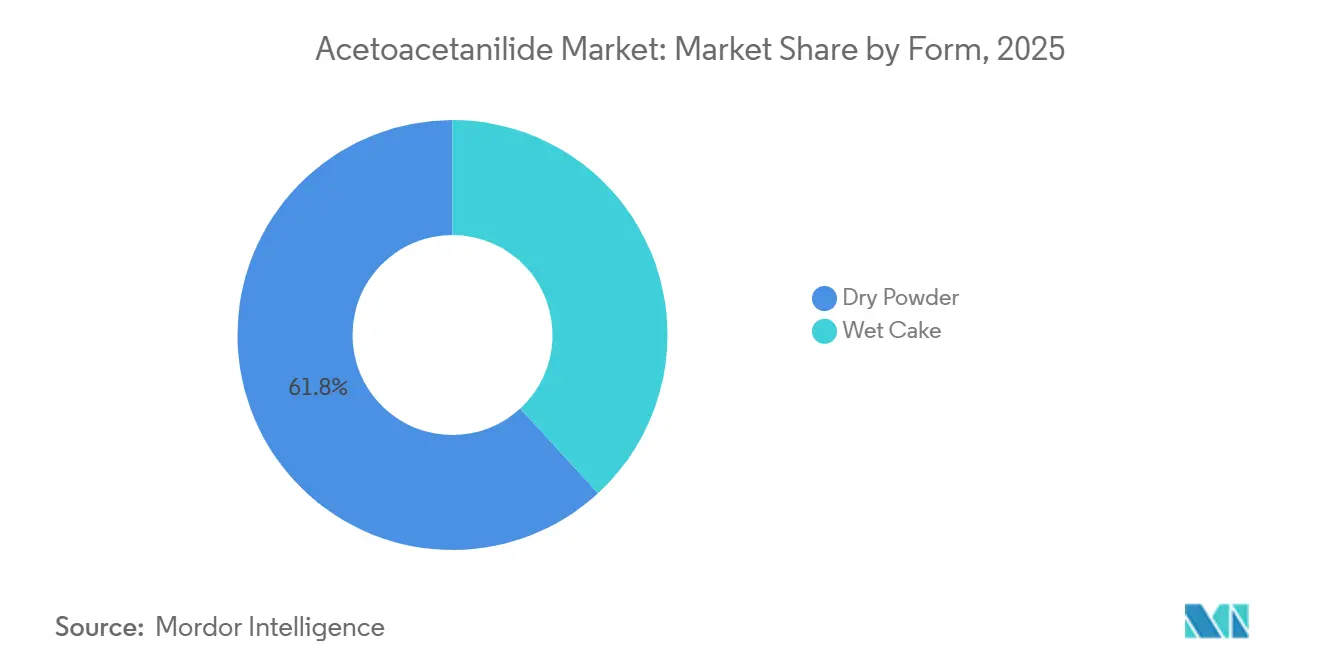
- By form, dry powder held 61.83% of the acetoacetanilide market share in 2025, while wet cake is forecast to expand at a 7.81% CAGR through 2031.
- By application, pigments accounted for 47.81% of the acetoacetanilide market size in 2025, while pharmaceuticals are forecast to grow at a CAGR of 8.36% through 2031.
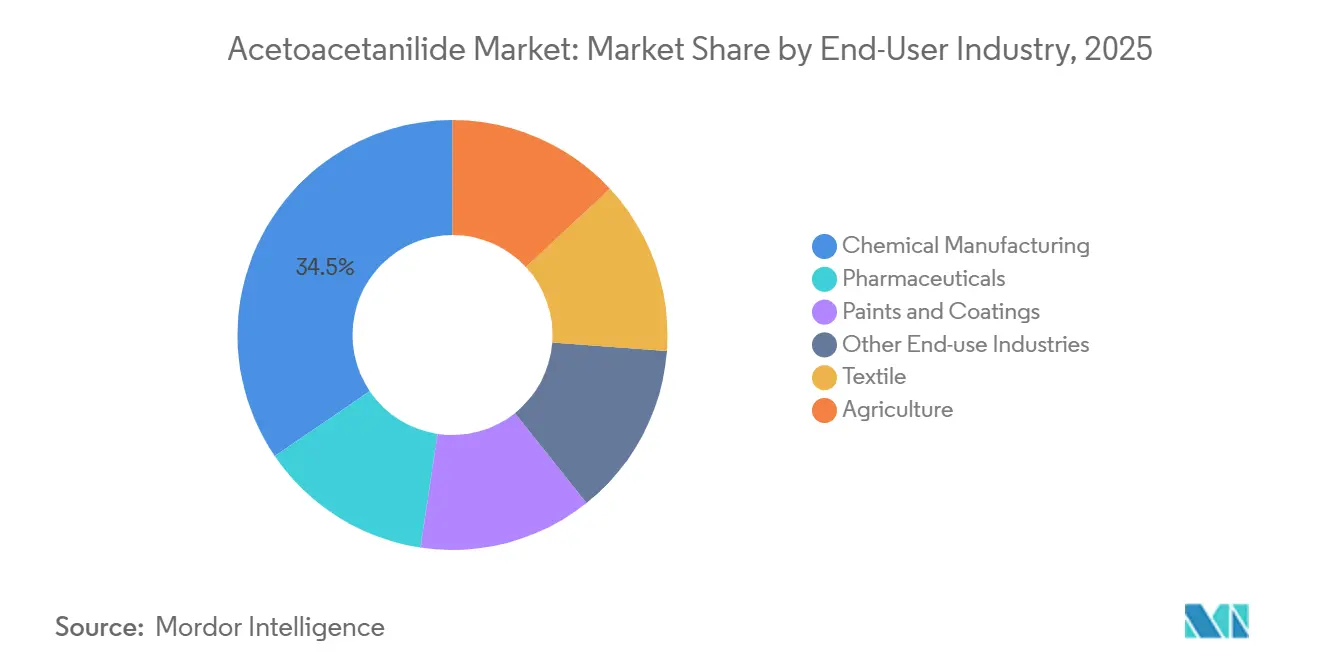
- By end-user industry, chemical manufacturing led with 34.52% of the acetoacetanilide market size in 2025, while pharmaceuticals are forecast to grow at an 8.12% CAGR through 2031.
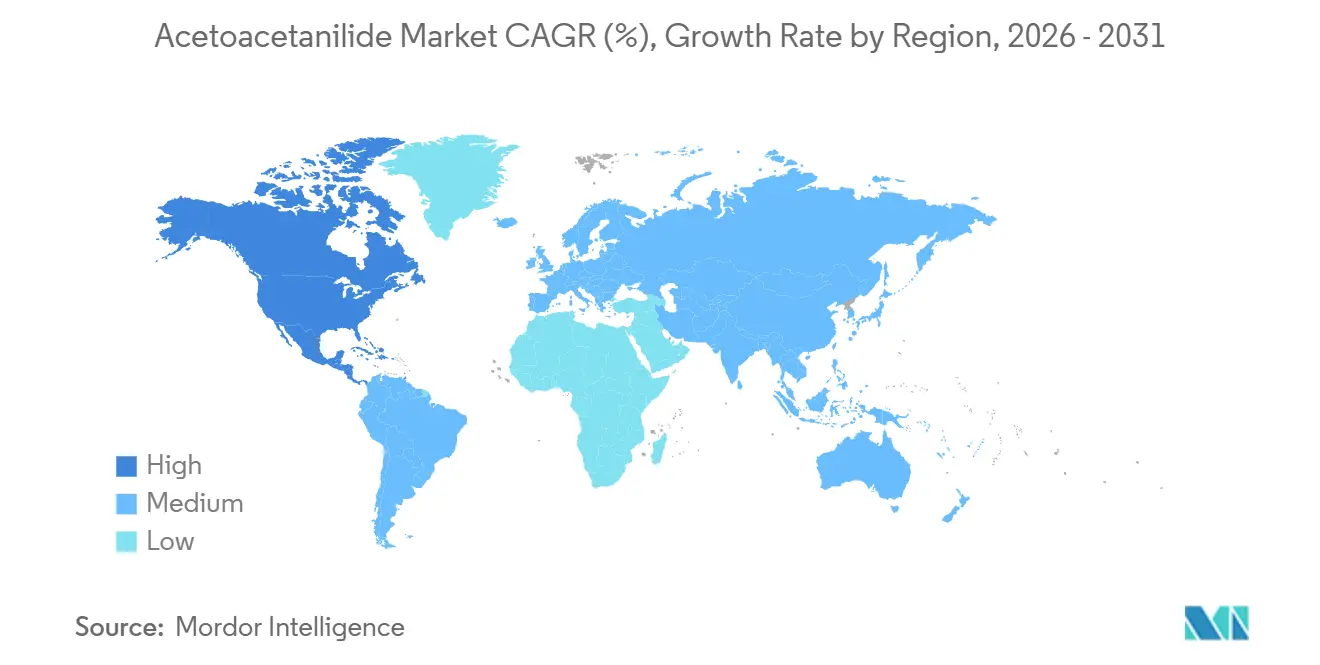
- By geography, Asia-Pacific held 41.47% of the acetoacetanilide market share in 2025, while North America is projected to grow at a CAGR of 7.86% through 2031.
Note: Market size and forecast figures in this report are generated using Mordor Intelligence’s proprietary estimation framework, updated with the latest available data and insights as of January 2026.
Market Trends and Insights
Drivers Impact Analysis of Acetoacetanilide Market*
| Drivers | (~) % Impact on CAGR Forecast | Geographic Relevance | Impact Timeline |
|---|---|---|---|
| Growing Demand for Azo Pigments | +1.8% | Global, with intensity in APAC and South America | Medium term (2-4 years) |
| Rising Consumption of Dyes | +1.2% | APAC core, spillover to MEA and Latin America | Medium term (2-4 years) |
| Increasing Demand for Pharmaceutical Intermediates | +1.1% | North America and APAC, especially India and South Korea | Short term (≤ 2 years) |
| Expansion of Specialty Chemicals | +0.8% | North America and Europe | Long term (≥ 4 years) |
| Growing Focus on Sustainability | +0.7% | Europe and North America, with gradual APAC adoption | Long term (≥ 4 years) |
| Source: Mordor Intelligence | |||
Growing Demand for Azo Pigments
The acetoacetanilide market draws its base demand from azo pigment production, as the material remains a core coupling component for monoazo and diarylide yellow pigment grades used in inks, plastics, and coatings. Pigment Yellow 1, 3, 5, and 74 remain commercially important across bright-shade printing inks, plastic colorants, and industrial coating systems, keeping pigment demand tied to broad manufacturing activity rather than a narrow specialty niche. Packaging expansion in Southeast Asia is adding to this demand, as e-commerce logistics and consumer goods distribution require more printed surfaces, labels, flexible packaging, and color-stable materials. China accounts for the largest share of consumption through its domestic pigment chain, but tighter emission enforcement is shifting demand toward producers that maintain effluent treatment and higher operating discipline. The European Union is tightening the commercial window for lower-purity azo colorant inputs through Commission Regulation (EU) 2025/1731, which increases the value of compliant acetoacetanilide grades in regulated supply chains[1]European Commission, “Commission Regulation (EU) 2025/1731 of 8 August Amending Annex XVII of REACH,” EUR-Lex, eur-lex.europa.eu. This dynamic supports the acetoacetanilide market, as downstream compliance requirements drive quality-driven demand for suppliers that meet tighter specifications.
Rising Consumption of Dyes
The acetoacetanilide market also benefits from demand for dye intermediates, particularly in textile applications that rely on azo chemistry for reactive and direct dye systems on cellulosic fibers. Large dyeing centers in Jiangsu and Zhejiang have long supported regional intermediate consumption, yet structural change is now visible in India and Bangladesh, where export-oriented textile investments are adding new demand for dye precursors. This demand is not limited to apparel output; it also extends into woven, blended, and industrial textile processing, where consistent coloration is important for export acceptance. Outside textiles, paper and packaging applications provide an additional demand layer, as water-based inks require colorants that deliver adhesion, surface performance, and rub resistance on treated substrates. The European Chemicals Agency continues to evaluate substances linked to aromatic amines derived from azo dyes, and that regulatory process is directing formulators toward safer chemical choices within azo systems. The acetoacetanilide market benefits when dye producers shift toward intermediate systems that offer a better regulatory fit without requiring major formulation changes.
Increasing Demand for Pharmaceutical Intermediates
The acetoacetanilide market is shifting toward greater value, driven by demand for pharmaceutical intermediates, as the material serves as a building block in several drug synthesis pathways, including analgesic, cardiovascular, and central nervous system (CNS) applications. This trend is reinforced by contract development and manufacturing organizations in India and South Korea that are scaling active pharmaceutical ingredient capacity for global generic supply. The change is not only in higher volume, but also in a stronger preference for pharmacopeial-grade material with documented batch quality, impurity control, and traceability. The FDA's Drug Master File framework maintains pressure on starting material documentation, and that requirement differentiates the supply base between compliant producers and technical-grade commodity suppliers. Suppliers that align with tighter quality systems can defend pricing more effectively because pharmaceutical buyers do not easily switch approved intermediates once supply qualification is in place. As a result, the acetoacetanilide market is gaining a more stable revenue layer that is less exposed to the pricing volatility common in commodity pigment and dye channels.
Expansion of Specialty Chemicals
The acetoacetanilide market is expanding beyond bulk-intermediate demand as specialty chemical applications broaden its commercial role. Polymer additive uses, including UV stabilizer and co-stabilizer formulations in polyvinyl chloride (PVC) processing, are broadening the demand base and reducing dependence on a single traditional application. Specialty buyers place greater weight on purity, batch consistency, documentation, and process control than high-volume commodity buyers do. Continuous flow synthesis is also becoming more relevant, as it can help producers manage lower batch variation, which matters for customers operating within narrow specification windows. Research published in Frontiers in Chemistry in 2025 highlighted metal-free green synthesis routes as an active direction for organic intermediate manufacturing, and acetoacetanilide chemistry aligns with solvent-minimization efforts. The acetoacetanilide market stands to benefit when specialty chemical buyers favor producers that combine cleaner process routes with strong quality certifications.
Restraints Impact Analysis of Acetoacetanilide Market*
| Restraints | (~) % Impact on CAGR Forecast | Geographic Relevance | Impact Timeline |
|---|---|---|---|
| Stringent Environmental Regulations | -1.3% | Europe and China, especially the Ministry of Ecology and Environment (MEE) enforcement zones | Short term (≤ 2 years) |
| Limited Availability of Raw Materials | -1.0% | Global, with concentration risk in APAC | Short term (≤ 2 years) |
| Quality Consistency Requirements | -0.5% | Global, most acute in North America and Europe | Medium term (2-4 years) |
| Source: Mordor Intelligence | |||
Stringent Environmental Regulations
The acetoacetanilide market faces direct pressure from environmental regulations at both the manufacturing and downstream use stages. Wastewater discharge rules in Chinese chemical parks have made it harder for smaller facilities to operate without additional compliance costs, reducing the scope for loosely controlled production. In Europe, Commission Regulation (EU) 2025/1731 tightened the downstream environment for azo colorants that may release restricted aromatic amines, which indirectly narrows the market for lower-purity grades used in regulated applications. This does not stop demand altogether, but it divides suppliers into compliant and non-compliant groups. Customers serving regulated regions are less willing to purchase material that creates uncertainty in pigment, dye, or pharmaceutical validation processes. As a result, the acetoacetanilide market remains open for compliant producers, while operators that do not meet requirements face customer losses, higher treatment costs, and reduced pricing flexibility.
Limited Availability of Raw Materials
The acetoacetanilide market remains exposed to feedstock risk, as its synthesis depends on aniline and diketene, both of which involve upstream concentration and operational constraints. Diketene is particularly important because its reactivity limits transport options, pushing production close to the point of use and clustering capacity around integrated chemical sites. This makes certain production corridors more strategic than others, particularly in Chinese industrial zones and India's chemical parks, where upstream and downstream operations can remain closely linked. Aniline availability is tied to benzene and nitrobenzene chains, so pricing and supply conditions continue to track broader petrochemical and energy cycles. Laxmi Organic Industries Ltd.'s decision to build a world-scale diketene and diketene derivatives facility at Dahej reflected backward integration as a direct response to raw material availability risk, rather than a simple capacity-expansion plan [2]Laxmi Organic Industries Ltd., “Analyst Meeting Presentation, May 20, 2025 (Corrigendum),” BSE India, bseindia.com. The acetoacetanilide market can still grow, but feedstock security will continue to favor producers with integrated access or protected, long-term sourcing arrangements.
*Our forecasts treat driver/restraint impacts as directional, not additive. The impact forecasts reflect baseline growth, mix effects, and variable interactions.
Acetoacetanilide Market Segment Analysis
By Form:
Wet Cake Gaining Ground in Specialty ApplicationsDry powder held 61.83% of the market in 2025, reflecting its widespread use across bulk pigment reactors, commodity dye plants, and high-volume handling systems. The form remains preferred in many traditional operations because it supports long shelf life, routine storage, and established movement through bags and bulk containers. These advantages matter in chemical clusters where throughput, stable inventory management, and warehouse efficiency shape purchasing behavior more than specialty processing needs. Dry powder also fits older process layouts where buyers have already standardized charging, weighing, and material transfer systems around established handling practices. For many customers, this reduces switching incentives even when newer formulations become available.
Wet cake is expected to expand at a 7.81% CAGR from 2026 to 2031, making it the fastest-growing form in the acetoacetanilide market. Its appeal comes from better immediate solubility and lower particulate exposure, both of which are useful in enclosed processing settings where operators require cleaner charging conditions. Specialty dye formulators and polymer additive producers are increasingly drawn to these advantages because handling quality can affect batch efficiency and plant safety. Wet cake also aligns more closely with aqueous reaction environments used in some pharmaceutical and specialty chemical production routes. The market is therefore seeing a gradual shift in value toward form preference, where dry powder maintains scale leadership while wet cake captures a larger share of incremental specialty demand.



By Application:
Pharmaceutical Segment Reshaping the Value MixPigments retained 47.81% of the market in 2025, reflecting the centrality of azo pigment demand to the acetoacetanilide market. This position reflects long-established formulation practice in printing inks and industrial coatings, where acetoacetanilide remains a required coupling component for several commercial yellow pigment grades. Dyes held the next major position because reactive and direct dye chemistry across South and Southeast Asian textile systems still depends on related intermediate demand. Agrochemicals also provide a stable consumption base, as acetoacetanilide serves as an intermediate for carboxin, which supports seed treatment and crop protection activities. Polymer additives represent a smaller share today, but their relevance is gradually increasing as polyvinyl chloride (PVC) and related formulations seek dependable co-stabilizer systems.
Pharmaceuticals are projected to grow at an 8.36% CAGR from 2026 to 2031, with the acetoacetanilide market size for this application supported by stronger Active Pharmaceutical Ingredient (API) output in Asia. Demand in this segment benefits from the fact that drug intermediate consumption is less seasonal than agricultural cycles and less exposed to swings in packaging or coating demand. This makes pharmaceutical growth important not only for segment expansion, but also for revenue balance across the broader market. The FDA's Drug Master File process has helped separate pharmacopeial-grade supply from commodity technical grades, supporting higher-value commercial relationships for qualified producers. The market is therefore moving toward a more mixed demand profile, where pigments still drive scale, but pharmaceuticals increasingly influence margin quality and supply discipline.
By End-User Industry:
Chemical Manufacturing Anchors Volume, Pharma Leads GrowthChemical manufacturing accounted for 34.52% of the market in 2025, reflecting the close link between acetoacetanilide demand and integrated downstream chemical production systems. In many Chinese and Indian clusters, buyers and producers operate within the same industrial ecosystem, enabling captive or near-captive consumption of pigments and intermediates for synthesis. This structure supports high turnover volumes and reduces the need for open-market price discovery in some local supply chains. Textile manufacturers formed another large end-user group, as dye intermediates remain essential for reactive and direct colorant systems used on natural and blended fibers. Agriculture and paints and coatings also remain significant, as fungicide production and industrial surface finishing continue to absorb steady material volumes.
Pharmaceuticals are the fastest-growing end-user segment, with an 8.12% CAGR from 2026 to 2031, adding a more controlled, documentation-intensive demand layer to the acetoacetanilide market. Growth in this segment follows broader expansion in generic drug manufacturing and the rise of Contract Development and Manufacturing Organizations (CDMOs) that require reliable starting materials with tighter quality records. European and global expectations around starting material control are also pushing greater discipline through the supply chain, increasing the value of suppliers that can demonstrate analytical consistency and traceability. Other smaller end-use areas, including rubber chemicals and specialty polymer processing, remain modest in revenue but help diversify the demand base. This diversification reduces overdependence on any single industrial cycle, even as chemical manufacturing continues to set the volume anchor for the acetoacetanilide market.
Geography Analysis
APAC Acetoacetanilide Market
Asia-Pacific accounted for 41.47% of the global market in 2025, making it the largest regional market for acetoacetanilide. China leads regional supply due to the concentration of integrated diketene derivative production in provinces such as Jiangsu, Zhejiang, and Hubei, where chemical infrastructure supports large-scale manufacturing. Backward integration into aniline and diketene gives Chinese producers a cost position that is difficult for many other regions to match. India is growing in importance on the demand side, as pharmaceutical intermediate production expands across industrial zones serving both domestic and export markets. Japan and South Korea have a different profile, with their roles more closely tied to higher-purity pharmaceutical demand and regulated customer programs than to commodity volume.
North America Acetoacetanilide Market
North America is the fastest-growing region, with the acetoacetanilide market projected to grow at a CAGR of 7.86% from 2026 to 2031. Growth in this region is driven by pharmaceutical reshoring, specialty chemical activity in major US chemical corridors, and a regulatory environment that favors compliant suppliers. Toxic Substances Control Act (TSCA) compliance requirements, enforced by the EPA, are restricting market access for uncertified suppliers, thereby supporting a premium segment of producers that can meet documentation and quality standards. Canada and Mexico contribute to this momentum through generic pharmaceutical manufacturing, regional trade links, and steady demand for qualified intermediate supply across the North American production base.
EMEA and South America Acetoacetanilide Market
Europe remains a significant market, as pharmaceutical and specialty chemical demand in Germany, the United Kingdom, France, and Switzerland supports consistent use of high-specification intermediates. Regional regulations on azo colorant supply chains are increasing the importance of purity and compliance, giving qualified suppliers an advantage while raising barriers to lower-quality imports. South America, led by Brazil and Argentina, provides a stable outlet for agrochemical-grade material, as fungicide and herbicide production continues to support demand cycles linked to agriculture. Brazil's role as a destination for Chinese exports also reflects the continent's continued dependence on Asia-Pacific supply. The Middle East and Africa remain early-stage markets, but Saudi Arabia's chemical sector expansion and South Africa's pharmaceutical development are establishing a more defined base for future consumption. Collectively, these regional patterns indicate that the acetoacetanilide market remains centered in Asia-Pacific for scale, while North America is emerging as the strongest growth geography for value-driven expansion.

Competitive Landscape
The acetoacetanilide market is moderately consolidated, with Chinese suppliers holding the strongest market share in terms of volume. This is due to their proximity to integrated diketene assets and established industrial park infrastructure. Companies such as Jiangsu Changyu Chemical, Jiangyan Yangtze River Chemical, Jiaozhou Fine Chemicals, Nantong Acetic Acid Chemical, and Cangzhou Goldlion Chemicals account for a substantial share of the market's commodity production base. Their competitive strength comes from scale, cost competitiveness, and proximity to upstream materials rather than from regulated-market differentiation. Japanese specialty suppliers such as Mitsuboshi Chemical hold a stronger position in higher-purity and pharmaceutical-grade segments, where customer approval history and technical certification matter more than production volume. This creates a two-tier structure in the acetoacetanilide market, where one tier competes on production efficiency, while the other competes on qualification depth and product assurance.
Indian suppliers also play a role by offering alternative sourcing outside China, which benefits buyers seeking greater geographic diversification in regulated supply chains. Laxmi Organic Industries is one such example, as its INR 710 crore (USD 85 million) Dahej expansion is aimed at building backward-integrated diketene derivatives capacity to support future participation in the pharmaceutical-grade market. This move addresses both supply security and quality positioning, which are two important competitive factors in this market. Another competitive pattern is the use of process technology, including continuous flow and solvent-minimized synthesis, to improve consistency and reduce variability in specialty applications. Japanese producers have sustained their premium standing by maintaining quality credentials that are difficult to replicate quickly in pharmaceutical and high-purity pigment channels. These examples indicate that the acetoacetanilide market is being shaped by a combination of backward integration, process control, and regulatory readiness.
Smaller participants such as A. B. Enterprises, Alpha Chemika, and Colorants International continue to serve local or niche demand through flexibility, shorter response times, and narrower product specialization. Their challenge is that limited backward integration makes it harder to absorb raw material volatility or compete for large contracts where customers require long-term supply assurance. The market is also presenting opportunities in North America and Europe, where some buyers are seeking qualified alternatives to suppliers affected by tighter Chinese environmental enforcement or more restrictive European compliance requirements. However, entry into these segments is not straightforward, as pharmaceutical-grade supply requires documentation, testing discipline, and stable process validation rather than added capacity alone. Overall, the acetoacetanilide market remains competitive, with stronger positions held by suppliers that can combine scale, compliance, and consistency within a single operating model.
Acetoacetanilide Industry Leaders
Mitsuboshi Chemical Co., Ltd.
Laxmi Organic Industries Ltd.
Shanghai Qidian Chemical Co., Ltd.
Nantong Acetic Acid Chemical Co., Ltd.
Cangzhou Goldlion Chemicals Co., Ltd.
- *Disclaimer: Major Players sorted in no particular order

Acetoacetanilide Market Companies Covered in this Report
- A. B. Enterprises
- Alpha Chemika
- Cangzhou Goldlion Chemicals Co., Ltd.
- Colorants International AG
- Emco Dyestuff Pvt. Ltd.
- Jiangsu Changyu Chemical Co., Ltd.
- Jiangyan Yangtze River Chemical Co., Ltd.
- Jiaozhou Fine Chemical Co., Ltd.
- Laxmi Organic Industries Ltd.
- Mitsuboshi Chemical Co., Ltd.
- Nantong Acetic Acid Chemical Co., Ltd.
- Pravin Dyechem Pvt. Ltd.
- Qingdao Haiwan Specialty Chemicals Co., Ltd.
- Shanghai Qidian Chemical Co., Ltd.

Recent Industry Developments in Acetoacetanilide Market
- October 2025: Laxmi Organic Industries received the commercial-to-operate (CTO) certification for Phase 1 of its Dahej diketene derivatives site, enabling the first commercial deliveries of diketene derivatives. Phase 1 is supported by a long-term supply agreement with a large customer operating a downstream complex in Gujarat, reducing initial revenue risk from the facility.
- August 2025: The European Commission published Commission Regulation (EU) 2025/1731, amending REACH Annex XVII on azo colorants. The regulation sets updated compliance timelines and tighter purity specifications for chemical intermediates, including acetoacetanilide, entering EU downstream pigment and dye supply chains. This update is expected to accelerate quality tiering in the acetoacetanilide supply market across Europe.


Global Acetoacetanilide Market Report Scope
Acetoacetanilide is an organic compound with a molar mass of 177.2 g/mol. It appears as a white to colorless crystalline solid. It primarily functions as a chemical intermediate in the synthesis of organic pigments (such as arylide yellows), dyes, and pharmaceuticals.
The acetoacetanilide market is segmented by form, application, end-user industry, and geography. By form, the market is segmented into dry powder and wet cake. By application, the market is segmented into pigments, dyes, agrochemicals, pharmaceuticals, polymer additives, and other applications. By end-user industry, the market is segmented into chemical manufacturing, textile, agriculture, pharmaceuticals, paints & coatings, and other end-use industries. The report also covers market size and forecasts for acetoacetanilide across 16 countries in major regions. The market sizes and forecasts are provided in terms of value (USD).
| Dry Powder |
| Wet Cake |
| Pigments |
| Dyes |
| Agrochemicals |
| Pharmaceuticals |
| Polymer Additives |
| Other Applications |
| Chemical Manufacturing |
| Textile |
| Agriculture |
| Pharmaceuticals |
| Paints & Coatings |
| Other End-use Industries |
| Asia-Pacific | China |
| India | |
| Japan | |
| South Korea | |
| Rest of Asia-Pacific | |
| North America | United States |
| Canada | |
| Mexico | |
| Europe | Germany |
| United Kingdom | |
| France | |
| Italy | |
| Russia | |
| Rest of Europe | |
| South America | Brazil |
| Argentina | |
| Rest of South America | |
| Middle-East and Africa | Saudi Arabia |
| South Africa | |
| Rest of Middle-East and Africa |
| By Form | Dry Powder | |
| Wet Cake | ||
| By Application | Pigments | |
| Dyes | ||
| Agrochemicals | ||
| Pharmaceuticals | ||
| Polymer Additives | ||
| Other Applications | ||
| By End-User Industry | Chemical Manufacturing | |
| Textile | ||
| Agriculture | ||
| Pharmaceuticals | ||
| Paints & Coatings | ||
| Other End-use Industries | ||
| By Geography | Asia-Pacific | China |
| India | ||
| Japan | ||
| South Korea | ||
| Rest of Asia-Pacific | ||
| North America | United States | |
| Canada | ||
| Mexico | ||
| Europe | Germany | |
| United Kingdom | ||
| France | ||
| Italy | ||
| Russia | ||
| Rest of Europe | ||
| South America | Brazil | |
| Argentina | ||
| Rest of South America | ||
| Middle-East and Africa | Saudi Arabia | |
| South Africa | ||
| Rest of Middle-East and Africa | ||


Key Questions Answered in the Report
What is current market size of Acetoacetanilide Market?
The Acetoacetanilide Market size is projected to expand from USD 8.32 billion in 2025 and USD 8.97 billion in 2026 to USD 12.72 billion by 2031, and is expected to register a CAGR of 7.24% between 2026 and 2031.
Which application area leads to current consumption?
Pigment-led application demand accounted for 47.81% in 2025, as azo pigment production still accounts for the bulk of acetoacetanilide output.
Which application is growing the fastest?
Pharmaceuticals are the fastest-growing application, expanding at an 8.36% CAGR from 2026 to 2031, driven by stronger API manufacturing and stricter traceability requirements.
Why is Asia-Pacific the largest regional market?
Asia-Pacific held 41.47% share in 2025 because China has integrated diketene and aniline supply chains, while India is expanding pharmaceutical intermediate manufacturing.
Page last updated on:





