
Access Control Software Market Size and Share
Market Overview
| Study Period | 2020 - 2031 |
|---|---|
| Market Size (2026) | USD 1.74 Billion |
| Market Size (2031) | USD 2.94 Billion |
| Growth Rate (2026 - 2031) | 11.05 % |
| Fastest Growing Market | Asia-Pacific |
| Largest Market | North America |
| Market Concentration | Low |
Major Players *Disclaimer: Major Players sorted in no particular order Image © Mordor Intelligence. Reuse requires attribution under CC BY 4.0. | |
Access Control Software Market Analysis by Mordor Intelligence
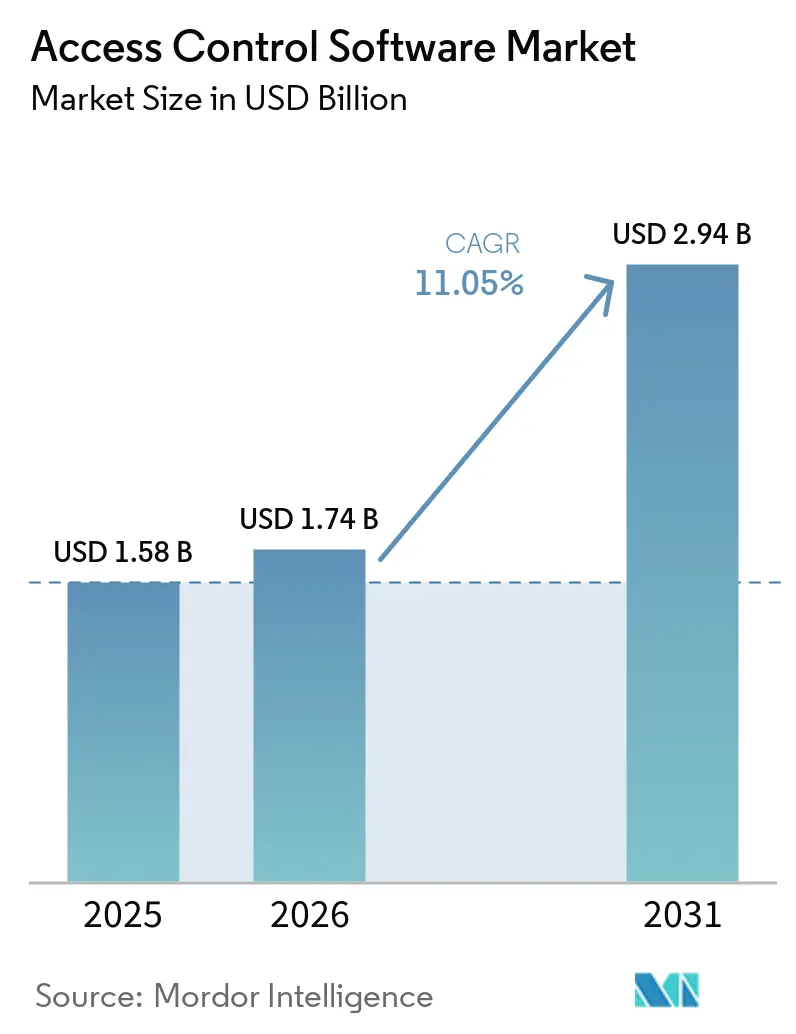
The access control software market size was valued at USD 1.58 billion in 2025 and is estimated to expand from USD 1.74 billion in 2026 to reach USD 2.94 billion by 2031, at a CAGR of 11.05% during the forecast period (2026-2031). Demand is shifting from badge-centered perimeter systems toward software that applies identity and policy controls at each access event. Zero trust programs, cloud subscriptions, and mobile credentials are moving physical access management closer to broader identity governance practices. Vendors are responding by linking access, video, visitor, and workplace functions in a single platform. This approach serves both highly regulated enterprise sites and property operators that need faster credential administration. Integration costs and cyber exposure remain important constraints because many facilities still operate mixed generations of controllers and credentials.
Key Report Takeaways
- By deployment model, on-premises systems held 38.11% share of the access control software market in 2025, while cloud-based deployment is projected to expand at a 14.32% CAGR through 2031.
- By organization size, large enterprises accounted for 63.20% share of the access control software market in 2025, while small and medium enterprises are expected to expand at a 12.50% CAGR through 2031.
- By authentication method, card-based authentication held 34.79% share of the access control software market in 2025, while mobile credential authentication is projected to expand at a 13.89% CAGR through 2031.
- By end-user vertical, commercial buildings accounted for 23.51% share of the access control software market in 2025, while the residential and smart home vertical is expected to expand at a 13.44% CAGR through 2031.
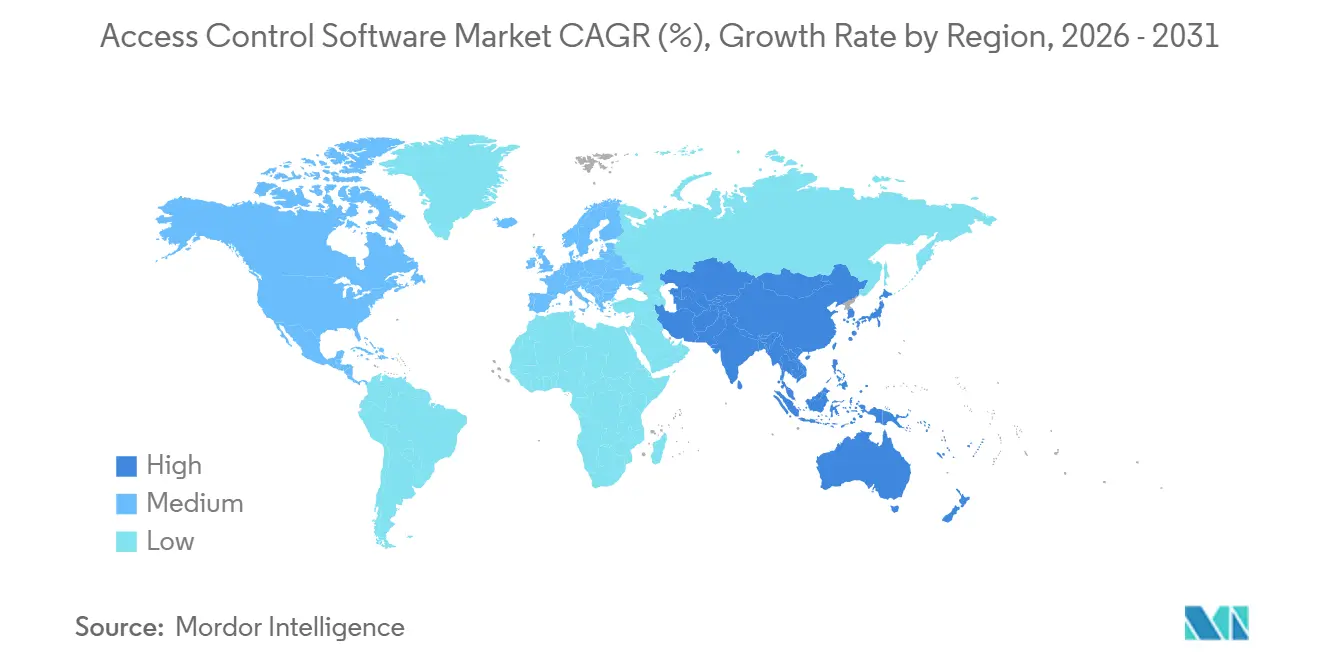
- By geography, North America held 32.10% of the access control software market share in 2025, while Asia-Pacific is projected to expand at a 13.23% CAGR through 2031.
Note: Market size and forecast figures in this report are generated using Mordor Intelligence’s proprietary estimation framework, updated with the latest available data and insights as of January 2026.
Global Access Control Software Market Trends and Insights
Drivers Impact Analysis*
| Driver | (~) % Impact on CAGR Forecast | Geographic Relevance | Impact Timeline |
|---|---|---|---|
| Zero Trust and Continuous Authentication Adoption | +2.5% | Global | Medium term (2-4 years) |
| Cloud Migration and Subscription-Based Access Management | +2.2% | Global | Short term (≤ 2 years) |
| Mobile Credentials and Contactless Entry Expansion | +1.8% | North America, Europe, Asia-Pacific | Short term (≤ 2 years) |
| Regulatory Demand for Auditable Identity and Facility Access | +1.3% | Europe, North America | Medium term (2-4 years) |
| Convergence of Physical Security, Video, and Workplace Systems | +0.8% | North America, Europe | Medium term (2-4 years) |
| Smart-City and Multi-Site Infrastructure Digitization | +0.6% | Asia-Pacific, Middle East and Africa | Long term (≥ 4 years) |
| Source: Mordor Intelligence | |||
Zero Trust and Continuous Authentication Adoption
Legacy perimeter models verified identity at login and could allow a compromised credential to support lateral movement across facilities and networks. Zero trust applies continuous, context-aware authentication that considers device health, user role, and behavioral information at each access event. RSA surveyed 2,120 global security experts in July and August 2025 and reported that 93% had not reached optimal zero trust maturity. The same study found that 57% believed they had reached an advanced stage, which showed a gap between perceived and measured security readiness. The access control software market benefits when organizations need software that connects physical-entry decisions with continuous verification and risk scoring. Suppliers that embed verification engines and risk-scoring application programming interfaces can address requirements that conventional badge and controller offerings do not fully meet, putting software capability at the center of enterprise replacement decisions.[1]
Cloud Migration and Subscription-Based Access Management
Subscription-based access services are changing vendor revenue models and reducing the barrier to entry for multi-site operators. Cloud-native platforms can eliminate the need for dedicated servers while supporting centralized credential governance, remote site management, and firmware updates. Genetec released Security Center SaaS access-control capabilities in March 2026, connecting existing hardware to cloud administration via open-architecture Cloudlink appliances. The company reported that 11% of end users had fully deployed access control in the cloud, 27% operated hybrid systems, and 48% remained fully on-premises. The remaining on-premises base gives the access control software market a substantial migration pool, especially where phased modernization can preserve controller investments. Subscription licensing can provide recurring revenue from sites whose door hardware has not changed and make access-control software easier for operators managing many locations to adopt.
Mobile Credentials and Contactless Entry Expansion
Mobile credentials are becoming a standard consideration in access deployments because they combine credential administration with the smartphones employees already use. In 2025, HID reported that 61% of respondents identified mobile credentials as a leading security trend. The 2026 HID report stated that 74% of respondents had deployed or planned to deploy mobile credentials, including 36% who had deployed them and 38% who planned to deploy them. Encrypted near-field communication at 13.56 MHz can support mutual authentication between a device and a reader, reducing dependence on legacy proximity cards. Research published in Information found that more than 40% of active cards at one university still used MIFARE Classic technology, which supported the case for a transition in settings that manage sensitive Information. The access control software market can benefit because multi-site organizations need credential issuance to work across readers, mobile wallets, and existing building systems, making software-layer interoperability more important than a full hardware replacement.
Regulatory Demand for Auditable Identity and Facility Access
Audit-trail requirements are extending from financial services and defense into healthcare, critical infrastructure, and data-center operations. The NIS2 Directive required member-state transposition in October 2024 and includes physical protection and access-control logging across 18 critical sectors. Platforms that generate timestamped and tamper-evident event records, therefore, become relevant to compliance programs as well as day-to-day security operations. Genetec received an ANSSI qualification decision no. 2777 from the French National Cybersecurity Agency in May 2026. The certification validated its system for French organizations designated as Operators of Vital Importance and can support its position in European critical-infrastructure procurements. The access control software market increasingly rewards vendors whose certifications align with government and regulated-sector shortlists, while smaller suppliers may need comparable evidence to compete for these contracts.
Restraints Impact Analysis*
| Restraint | (~) % Impact on CAGR Forecast | Geographic Relevance | Impact Timeline |
|---|---|---|---|
| Legacy Controller and Identity-Directory Integration Costs | -1.8% | Global, with concentration in North America and Europe | Medium term (2-4 years) |
| Cybersecurity Exposure in Cloud-Managed Physical Access | -1.2% | Global | Short term (≤ 2 years) |
| Privacy and Consent Constraints for Biometric Workflows | -0.8% | Europe, North America | Medium term (2-4 years) |
| Shortage of Certified Hybrid Access-Control Integrators | -0.5% | North America, Europe, Asia-Pacific | Long term (≥ 4 years) |
| Source: Mordor Intelligence | |||
Legacy Controller and Identity-Directory Integration Costs
Legacy controllers using Wiegand protocols and proprietary firmware can make system replacement expensive and disruptive. Migration can require rewiring door hardware, retiring older credential formats, and synchronizing directory services with cloud identity providers. Mercury Security surveyed more than 450 access-control professionals and reported in 2025 that nearly 25% considered their systems to lack basic cybersecurity protection, cloud capabilities, or user-friendly interfaces. The company also found that 86% of respondents valued products that support multiple hardware generations, indicating that backward compatibility frequently determines upgrade decisions. These issues can delay purchases of access control software at multi-site facilities where controller generations, APIs, and protocols vary by building. They can also lead organizations to extend the life of existing systems, creating different purchase timing for cloud-ready sites and legacy-constrained estates.[2]
Cybersecurity Exposure in Cloud-Managed Physical Access
Cloud-managed platforms simplify administration but create a larger set of connected controllers, mobile endpoints, and application programming interfaces to secure. Each connection can present a path for credential theft, unauthorized remote override, or interception of access events. RSA reported that 69% of surveyed organizations experienced a breach and that 70% characterized those breaches as severe. These findings appeared alongside the mismatch between organizations that considered themselves advanced in zero trust and those that had reached optimal maturity. The concern can slow purchases in regulated settings until technology and physical security teams establish shared governance, testing, and incident response procedures. It can extend review cycles for cloud deployments at critical sites, so the access control software market requires controls that meet IT and facility-management expectations.
*Our forecasts treat driver/restraint impacts as directional, not additive. The impact forecasts reflect baseline growth, mix effects, and variable interactions.
Segment Analysis
By Deployment Model: On-Premises Systems Remain Important as Cloud Adoption Advances
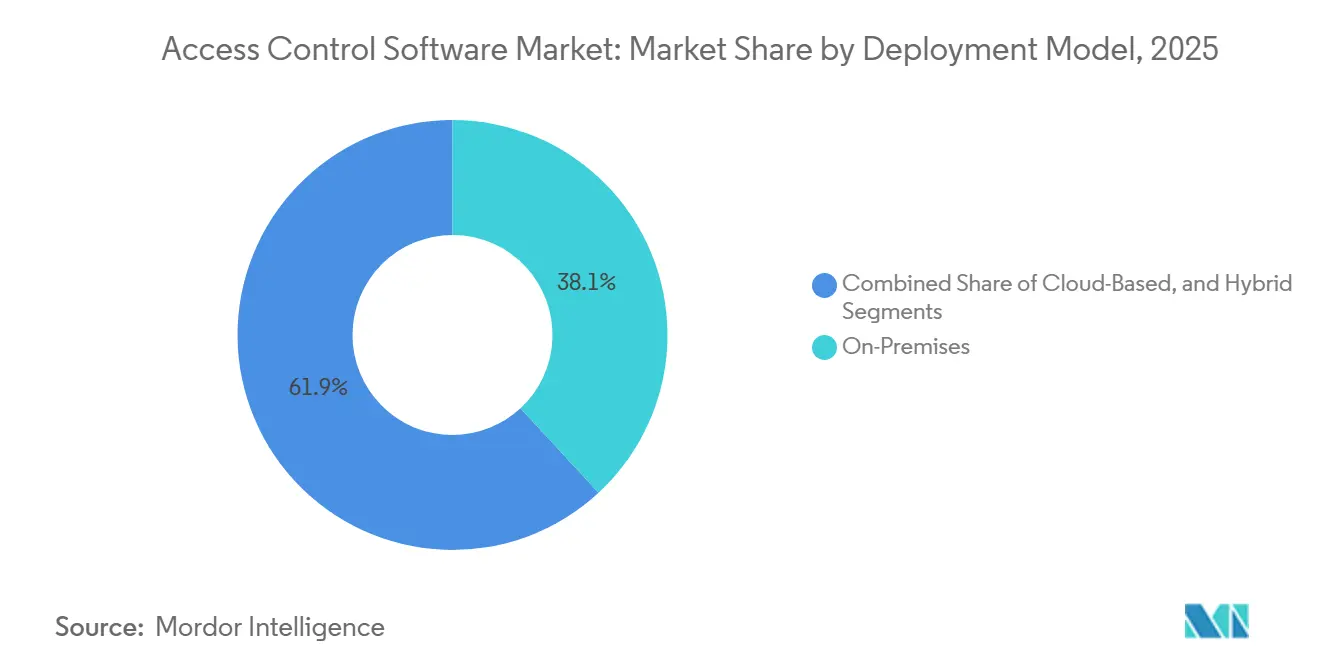
On-premises deployment held 38.11% of the access control software market in 2025. Defense facilities, critical-infrastructure operators, and healthcare sites continue to use server-based systems when data residency, air-gapped networks, or physical custody of access logs are required. Their selection is often shaped by audit obligations that restrict remote administration to authorized on-site personnel. Hybrid architecture provides a transition option that maintains local enforcement while allowing selected administrative functions to move to cloud tools. RSA reported that 75% of organizations operated hybrid cloud environments in 2025, compared with 9% that relied only on cloud infrastructure.
Genetec added access-control functions to Security Center SaaS in March 2026, using Cloudlink appliances to connect existing hardware to cloud policy and administration tools. This model leaves access decisions to local controllers while cloud dashboards manage credentials and visitor workflows, preserving investments in existing hardware. It supports enterprises that operate several controller generations and protocol standards across their estates. Platforms with modular hardware abstraction layers can therefore support contracts in which a uniform replacement program is impractical, and sites need a gradual migration path. Cloud-based deployment is expected to expand at a 14.32% CAGR from 2026 to 2031, making it the fastest deployment category in the access control software industry. The offer is particularly relevant to smaller property portfolios that were underserved by traditional enterprise licensing structures.

By Organization Size: Large Enterprises Lead Revenue While SMEs Expand Faster
Large enterprises accounted for 63.20% of 2025 organizational-size revenue. Their multi-site licenses, centralized identity requirements, and connections to human resources, IT directory, and building management systems support this position. Procurement cycles are typically long, while switching costs can be high for incumbent providers. This makes established enterprise relationships durable, but can slow platform modernization. Mercury Security found that 76% of organizations required controllers to integrate with video systems, alarms, identity services, and building automation systems.
Small and medium enterprises are projected to expand at a 12.50% CAGR from 2026 to 2031. Many can avoid the server and maintenance requirements that previously restricted the use of enterprise-grade tools. Cloud-first packages move firmware updates and operating tasks to the vendor, which is useful for operators without dedicated IT security teams or permanent specialist support. Workspace operators, fitness centers, and hybrid offices need frequent visitor credentials and flexible access rules because users, tenants, and schedules change regularly. Their demand is encouraging platforms to combine access management with space-booking and workplace tools, which broadens the competitive scope beyond conventional door-control software.
By Authentication Method: Cards Lead Installed Systems While Mobile Credentials Advance
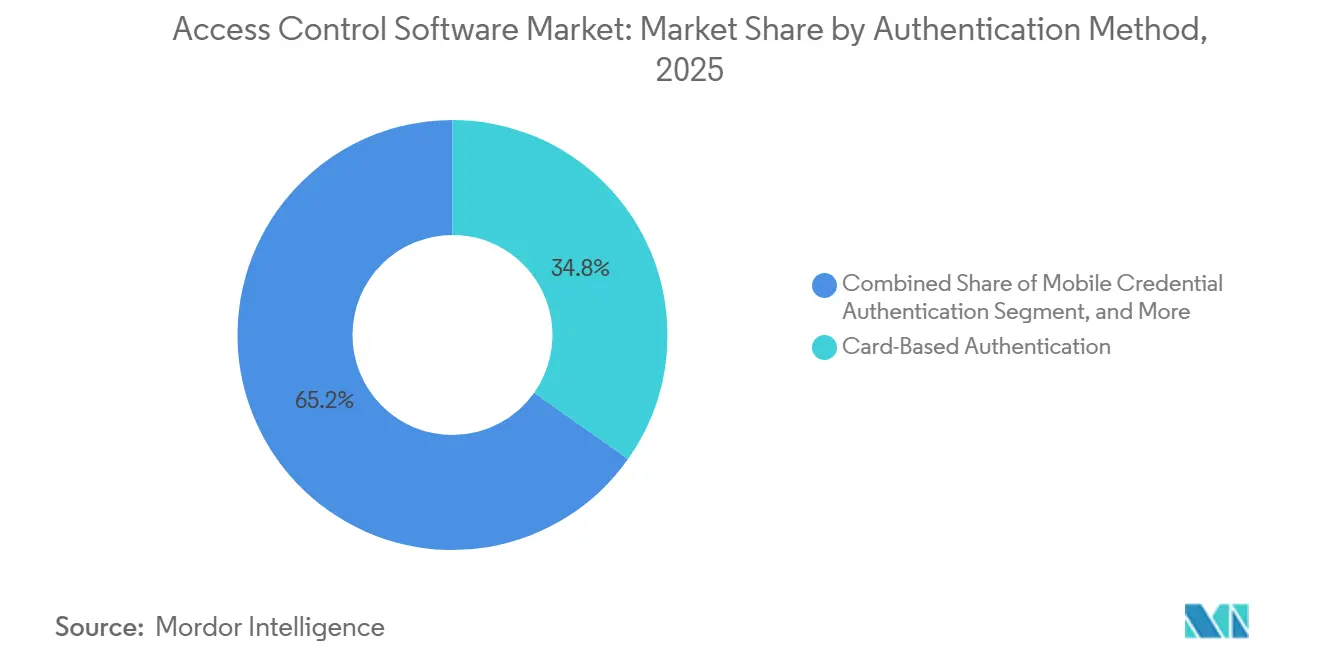
Card-based authentication held 34.79% of the access control software market in 2025. Industrial campuses, government buildings, and healthcare networks retain extensive proximity-card infrastructure, often supported by legacy Wiegand wiring and existing operating procedures. In regulated settings, multi-technology cards can combine proximity and smart-credential functions to support audit requirements. Biometric authentication is used at high-security entry points where added verification is needed. Multifactor authentication is increasingly used as a policy layer on top of a primary credential at government and critical infrastructure facilities. QR codes and temporary credentials meet the distinct needs of short-term visitors, contractors, and event participants.[3]
Mobile credential authentication is projected to expand at a 13.89% CAGR from 2026 to 2031. Near-field communication and digital wallet support reduce the cost and administrative effort associated with producing, distributing, replacing, and recovering physical cards. Genetec reported that 35% of organizations had deployed mobile credentials in cloud environments, 35% in on-premises systems, and 30% had not yet deployed them. This remaining group provides an adoption opportunity for platform providers, particularly when organizations already use smartphones for workplace and identity applications. Mobile credentials can support sites that need flexible user access across several buildings without manually issuing and collecting cards. QR codes and temporary credentials remain relevant for visitor, contractor, and event-access workflows where rapid issuance and revocation matter more than a permanent credential.
By End-User Vertical: Commercial Buildings Lead While Residential Use Accelerates
Commercial buildings held 23.51% of the 2025 end-user mix. Multi-tenant offices require visitor management, temporary credentials, and links to building management systems at multiple entry points. Access records can also support occupancy analysis, lease compliance reporting, and amenity use data. Industrial and manufacturing sites commonly connect card systems with safety management and contractor compliance tools as Industry 4.0 environments extend requirements to machine bays and server rooms, not only building entrances. This gives the access control software market a wider operational role within facility management.
The residential and smart home vertical is expected to expand at a 13.44% CAGR from 2026 to 2031. Multifamily developers are positioning access software as a tenant amenity, while smart-lock ecosystems are increasing the use of mobile credentials for residents, guests, and property staff. Military and defense sites account for a smaller share of demand but can command higher contract values due to certification requirements and isolated architectures. Healthcare campuses require access logging, role-based restrictions, and emergency lockdown functions to operate together across complex, multi-building locations. Transport and logistics operators are also connecting access systems with cargo tracking and contractor management. These uses create demand for time-limited credentials that conventional building access products are adapting to support.
Geography Analysis
North America held 32.10% of the access control software market revenue in 2025. Enterprise campuses, federal facilities, and healthcare networks support demand for audit-grade access records. The United States is the principal country contributor because commercial real estate operators have high rates of software adoption, and federal procurement favors certified platforms. This access control software market demand is reinforced where contract requirements call for detailed and dependable access-event records. Canada is seeing smart-building activity, while Mexico's government modernization and manufacturing investment create incremental demand, and Brazil leads a smaller South American market where multinational operations often apply global security standards.
Europe is shaped by a dense regulatory environment that makes compliance central to procurement. NIS2 has supported activity among energy utilities, healthcare operators, and financial institutions that need to document physical access controls. Germany, the United Kingdom, and France are the largest European countries in the report, with industrial integration and financial services requirements shaping their needs. Genetec's ANSSI qualification in May 2026 strengthened its position for French critical-infrastructure contracts, while Saudi Arabia and the United Arab Emirates support demand for smart buildings and government facilities in the Middle East and Africa. South Africa and Nigeria are the region's more developed markets, led by banking, mining, and retail, although infrastructure and integrator availability limit adoption.[4]
Asia-Pacific is projected to expand at a 13.23% CAGR from 2026 to 2031. China's smart-city programs, India's Digital India work, and biometric identity initiatives in Southeast Asia support demand for integrated access infrastructure. China's manufacturing and urban facility-management users are adopting domestic software platforms alongside encrypted biometric-storage requirements. India's Smart City Mission has directed expenditure toward physical security, connectivity, and the integration of surveillance across more than 100 designated cities. The access control software market also benefits from the adoption of mature technology in South Korea and Japan, where preferences for premium products support biometric deployments in corporate and government settings.
Competitive Landscape
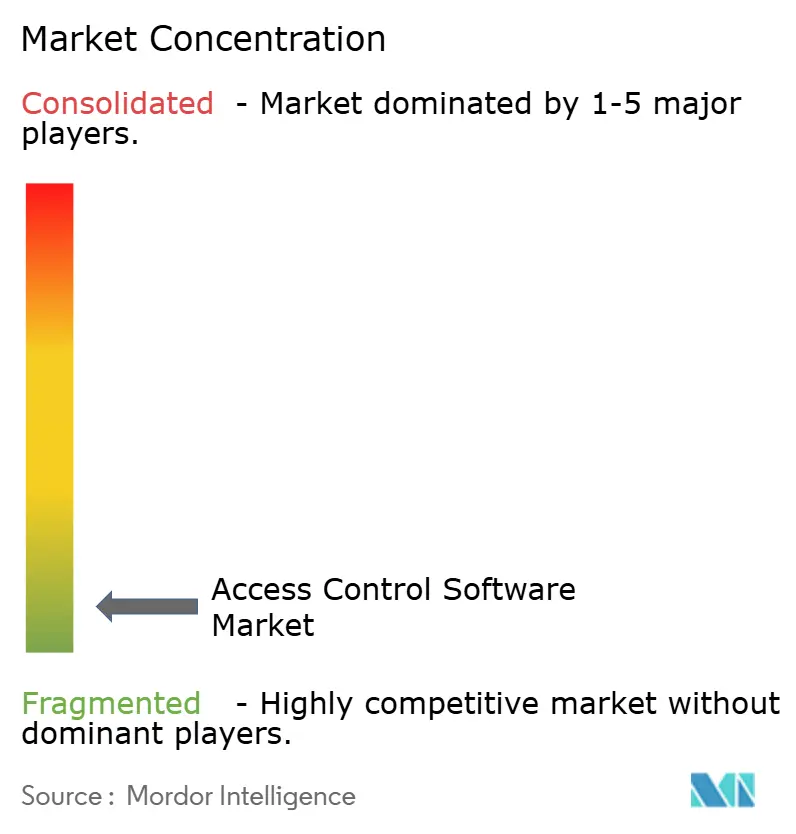
The access control software market is fragmented, with no supplier holding a dominant position across integrated enterprise platforms and cloud-native services for smaller users. Established security providers are increasing software capabilities through product development and acquisitions, while cloud-native providers are adding video analytics, visitor management, and policy tools for enterprise deployments. Suppliers compete through open application programming interfaces, mobile-first credentials, security certifications, and breadth of platforms. The competitive model is shifting from hardware replacement toward recurring software and service revenue, which can make long-term customer relationships more important than a single controller sale.
The December 2025 merger of Brivo and Eagle Eye Networks combined access control, cloud video surveillance, visitor management, analytics, and intrusion detection under the Brivo name. This move consolidated two cloud-native offerings and reinforced the value of a unified subscription platform for customers with several physical-security functions. Allegion acquired ELATEC from Summit Partners for EUR 330 million (USD 363 million) in 2025, thereby extending its credential technology portfolio to include near-field reader technology. The transaction more closely connected its hardware base to software-managed credential ecosystems. These moves show that companies are seeking wider technology coverage rather than relying on individual product categories.[5]
Opportunity remains in localized cloud platforms for small and medium enterprises in Asia-Pacific and Middle East, and Africa, where regional compliance needs can differ. Residential and multifamily users also need property management features such as audit trails and role-based access policies, rather than consumer smart lock applications alone. A shared identity layer for building entry and IT system login is still only partially available in commercial products, leaving room for further product development. Vendors that can combine physical and logical access without increasing migration complexity may be better positioned in this part of the access control software market, especially for customers operating across multiple sites and technology generations. Competition will remain active as providers balance interoperability, certifications, cybersecurity controls, ease of deployment, and the need to fit into established physical-security workflows.
Access Control Software Industry Leaders
-
Genetec Inc.
-
Brivo Inc.
-
Gallagher Security
-
Verkada Inc.
-
Acre Security
- *Disclaimer: Major Players sorted in no particular order
Recent Industry Developments
- May 2026: Genetec received the ANSSI qualification (qualification decision no. 2777) from the French National Cybersecurity Agency, becoming the only access control vendor to achieve this certification level. The qualification validated Genetec's platform for organizations designated as Operators of Vital Importance in France, including healthcare networks, airports, and energy infrastructure, and functioned as a recognized benchmark for cybersecurity rigor in EU critical infrastructure procurements.
- May 2026: Verkada launched the AC43 and AC43-G four-door controllers and made the AF64 Access Station Pro generally available. The AC43-G is a government-grade, Trade Agreements Act-compliant controller with FIPS-validated encryption, while the AF64 combines a multi-technology reader, a 5MP wide-angle camera, and a single-door controller in one Power over Ethernet device, enabling government agencies and enterprises to deploy a fully managed, compliant access control solution from a cloud-native platform.
- December 2025: Eagle Eye Networks and Brivo announced a full corporate merger on December 29, 2025, creating the world's largest AI cloud-native physical security company operating under the Brivo name. The merged entity delivers a unified platform spanning access control software, cloud AI video surveillance, visitor management, AI analytics, and intrusion detection, with headquarters in Bethesda, Maryland, and Austin, Texas, and offices in Amsterdam, Bangalore, and Tokyo.
- December 2025: Brivo launched the Brivo Genius Mobile Agent with voice-activated, site-wide emergency lockdown functionality, becoming the first physical security provider to offer conversational AI that can execute critical access-control actions, including lockdowns, via voice or text commands during emergencies.
Global Access Control Software Market Report Scope
The access control software market encompasses software platforms that manage, authenticate, authorize, monitor, and audit physical access to buildings, facilities, and secured spaces. These solutions centralize identity management, credential administration, access policies, visitor management, event monitoring, reporting, and integration with physical security devices, including door controllers, card readers, biometric readers, mobile credentials, and video surveillance systems. The market includes on-premises, cloud-based, and hybrid software deployments serving commercial, industrial, government, healthcare, transportation, residential, and other institutional end users. It excludes revenue from physical hardware, installation services, managed security services, and broader building automation platforms sold independently.
The Access Control Software Report is Segmented by Deployment Model (On-Premises, Cloud-Based, and Hybrid), Organization Size (Large Enterprises, and Small and Medium Enterprises (SMEs)), Authentication Method (Card-Based Authentication, Mobile Credential Authentication, Biometric Authentication, Multi-factor Authentication (MFA), and QR Code and Temporary Credentials), End-User Vertical (Commercial Buildings, Industrial and Manufacturing, Government and Public Sector, Transport and Logistics, Healthcare Facilities, Military and Defense Installations, Residential and Smart Homes, and Other End-User Verticals (Education Institutions, etc.)), and Geography (North America, South America, Europe, Asia-Pacific, and Middle East and Africa). The Market Forecasts are Provided in Terms of Value (USD).
| On-Premises |
| Cloud-Based |
| Hybrid |
| Large Enterprises |
| Small and Medium Enterprises (SMEs) |
| Card-Based Authentication |
| Mobile Credential Authentication |
| Biometric Authentication |
| Multi-factor Authentication (MFA) |
| QR Code and Temporary Credentials |
| Commercial Buildings |
| Industrial and Manufacturing |
| Government and Public Sector |
| Transport and Logistics |
| Healthcare Facilities |
| Military and Defense Installations |
| Residential and Smart Homes |
| Other End-user Verticals (Education Institutions, etc.) |
| North America | United States | |
| Canada | ||
| Mexico | ||
| South America | Brazil | |
| Argentina | ||
| Rest of South America | ||
| Europe | Germany | |
| United Kingdom | ||
| France | ||
| Italy | ||
| Spain | ||
| Rest of Europe | ||
| Asia-Pacific | China | |
| Japan | ||
| India | ||
| South Korea | ||
| Rest of Asia-Pacific | ||
| Middle East and Africa | Middle East | Saudi Arabia |
| United Arab Emirates | ||
| Turkey | ||
| Rest of the Middle East | ||
| Africa | South Africa | |
| Nigeria | ||
| Rest of Africa | ||
| By Deployment Model | On-Premises | ||
| Cloud-Based | |||
| Hybrid | |||
| By Organization Size | Large Enterprises | ||
| Small and Medium Enterprises (SMEs) | |||
| By Authentication Method | Card-Based Authentication | ||
| Mobile Credential Authentication | |||
| Biometric Authentication | |||
| Multi-factor Authentication (MFA) | |||
| QR Code and Temporary Credentials | |||
| By End-User Vertical | Commercial Buildings | ||
| Industrial and Manufacturing | |||
| Government and Public Sector | |||
| Transport and Logistics | |||
| Healthcare Facilities | |||
| Military and Defense Installations | |||
| Residential and Smart Homes | |||
| Other End-user Verticals (Education Institutions, etc.) | |||
| By Geography | North America | United States | |
| Canada | |||
| Mexico | |||
| South America | Brazil | ||
| Argentina | |||
| Rest of South America | |||
| Europe | Germany | ||
| United Kingdom | |||
| France | |||
| Italy | |||
| Spain | |||
| Rest of Europe | |||
| Asia-Pacific | China | ||
| Japan | |||
| India | |||
| South Korea | |||
| Rest of Asia-Pacific | |||
| Middle East and Africa | Middle East | Saudi Arabia | |
| United Arab Emirates | |||
| Turkey | |||
| Rest of the Middle East | |||
| Africa | South Africa | ||
| Nigeria | |||
| Rest of Africa | |||
Key Questions Answered in the Report
What is the size of the access control software market?
The access control software market was valued at USD 1.58 billion in 2025 and is estimated at USD 1.74 billion in 2026. It is forecast to reach USD 2.94 billion by 2031 at an 11.05% CAGR. Cloud subscriptions, mobile credentials, and identity-focused security programs support this outlook. Demand comes from both enterprise modernization programs and wider use in managed residential properties.
Which deployment model is expanding fastest?
Cloud-based deployment is projected to expand at a 14.32% CAGR from 2026 to 2031, supported by remote administration and subscription-based delivery. Hybrid options also allow sites to retain local controllers during migration and preserve existing hardware investments.
Which authentication method is gaining adoption most quickly?
Mobile credential authentication is projected to expand at a 13.89% CAGR through 2031 as organizations use NFC and digital wallet capabilities. These credentials can reduce the work of issuing and recovering physical cards.
Which end-user vertical has the strongest projected expansion?
Residential and smart home applications are expected to expand at a 13.44% CAGR through 2031, supported by multifamily property and smart-lock use cases. Developers are treating managed access as a tenant amenity, while connected locks support mobile-first entry.
Which region has the fastest forecast rate?
Asia-Pacific is projected to expand at a 13.23% CAGR from 2026 to 2031, supported by smart-city, digital identity, and infrastructure initiatives in the access control software market.
Why do enterprises retain on-premises access systems?
Regulated facilities often require data residency, air-gapped networks, and direct custody of access logs, which support continued on-premises use. These requirements are common in defense, healthcare, and critical infrastructure.