
A2 Lactose-Free Milk Market Size and Share
Market Overview
| Study Period | 2021 - 2031 |
|---|---|
| Market Size (2026) | USD 0.95 Billion |
| Market Size (2031) | USD 1.67 Billion |
| Growth Rate (2026 - 2031) | 11.94 % |
| Fastest Growing Market | Asia-Pacific |
| Largest Market | North America |
| Market Concentration | Medium |
Major Players *Disclaimer: Major Players sorted in no particular order Image © Mordor Intelligence. Reuse requires attribution under CC BY 4.0. | |
A2 Lactose-Free Milk Market Analysis by Mordor Intelligence
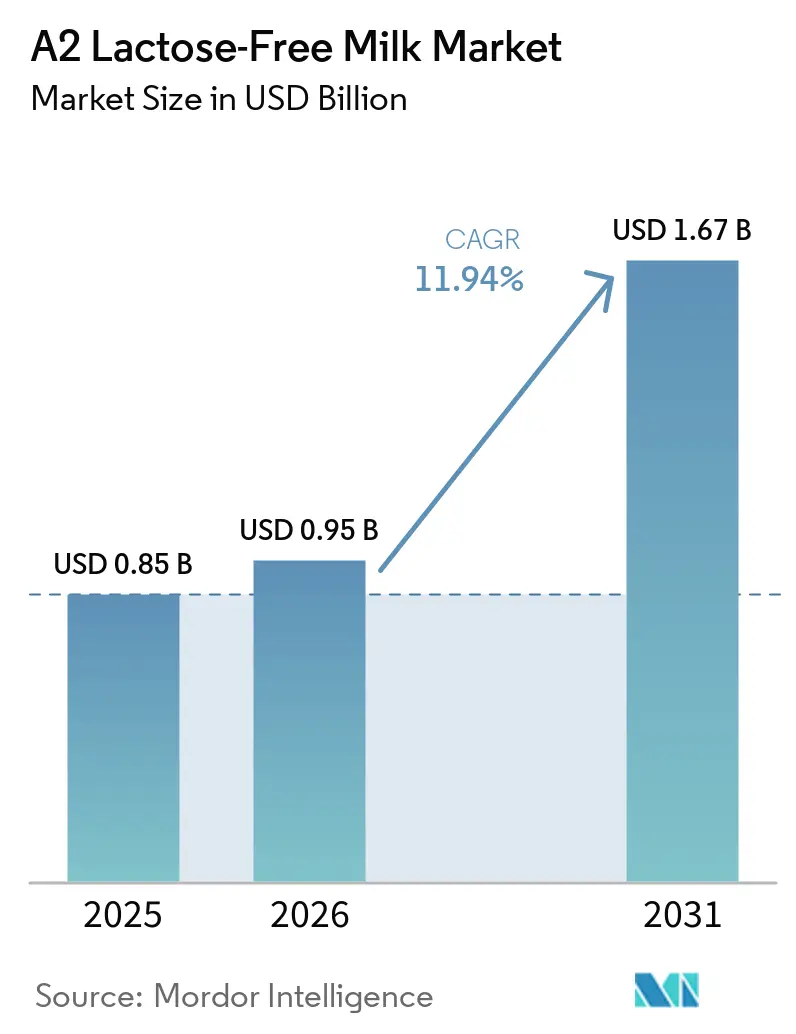
The a2 lactose-free milk market size is expected to grow from USD 0.85 billion in 2025 to USD 0.95 billion in 2026 and is forecast to reach USD 1.67 billion by 2031 at 11.94% CAGR over 2026-2031. The A2 lactose-free milk market brings together A2 beta-casein protein and lactose removal for consumers seeking a milk option that addresses separate digestive concerns. This positioning distinguishes the category from standard lactose-free milk and from products that only emphasize A2 protein. Lactase non-persistence affects a large share of adults worldwide, while prevalence is particularly high in several East and Southeast Asian populations and exceeds 50% in much of Africa and South America. Demand is also supported by consumers who report discomfort with conventional milk but do not have a lactose-intolerance diagnosis. The A2 lactose-free milk market therefore has a premium customer base that includes both condition-led buyers and wellness-oriented households.
Key Report Takeaways
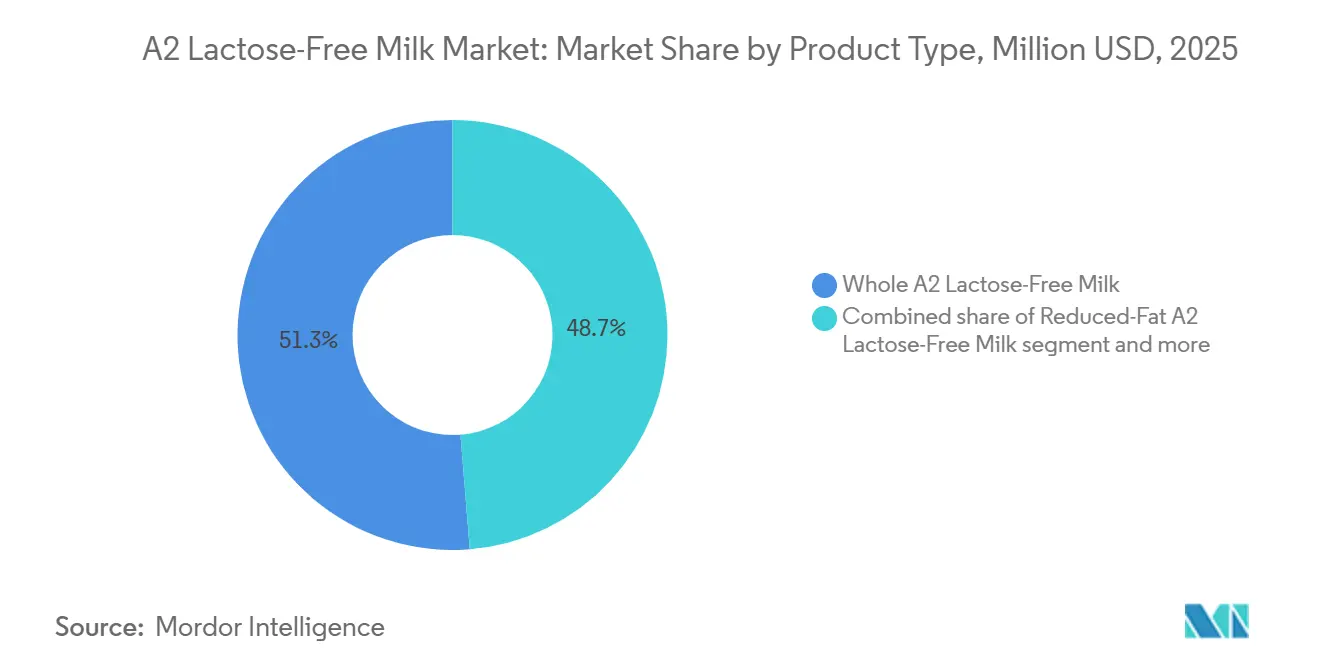
- By product type, whole A2 lactose-free milk held 51.27% of the A2 lactose-free milk market share in 2025, while reduced-fat A2 lactose-free milk is forecast to grow at a 14.32% CAGR through 2031.
- By packaging, bottles held 44.58% of the a2 lactose-free milk market share in 2025, while cartons are forecast to grow at a 14.78% CAGR through 2031.
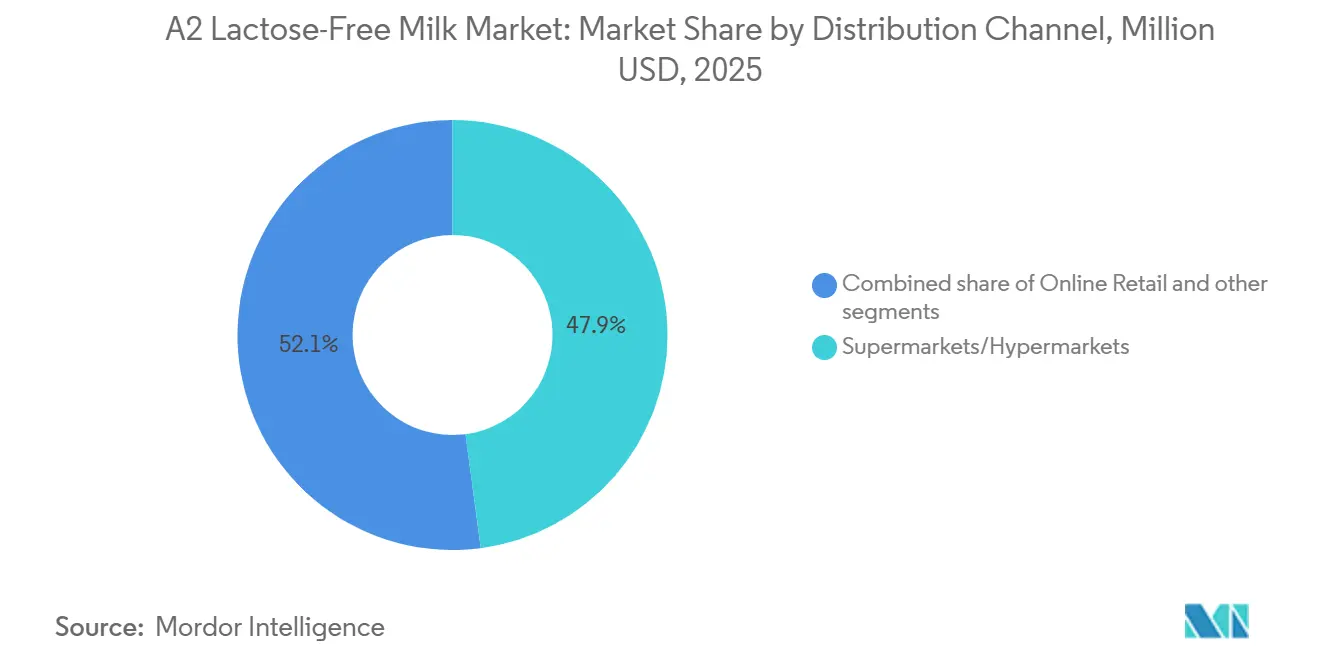
- By distribution channel, supermarkets and hypermarkets held 47.91% share in 2025, while online retail stores are forecast to grow at a 15.71% CAGR through 2031.
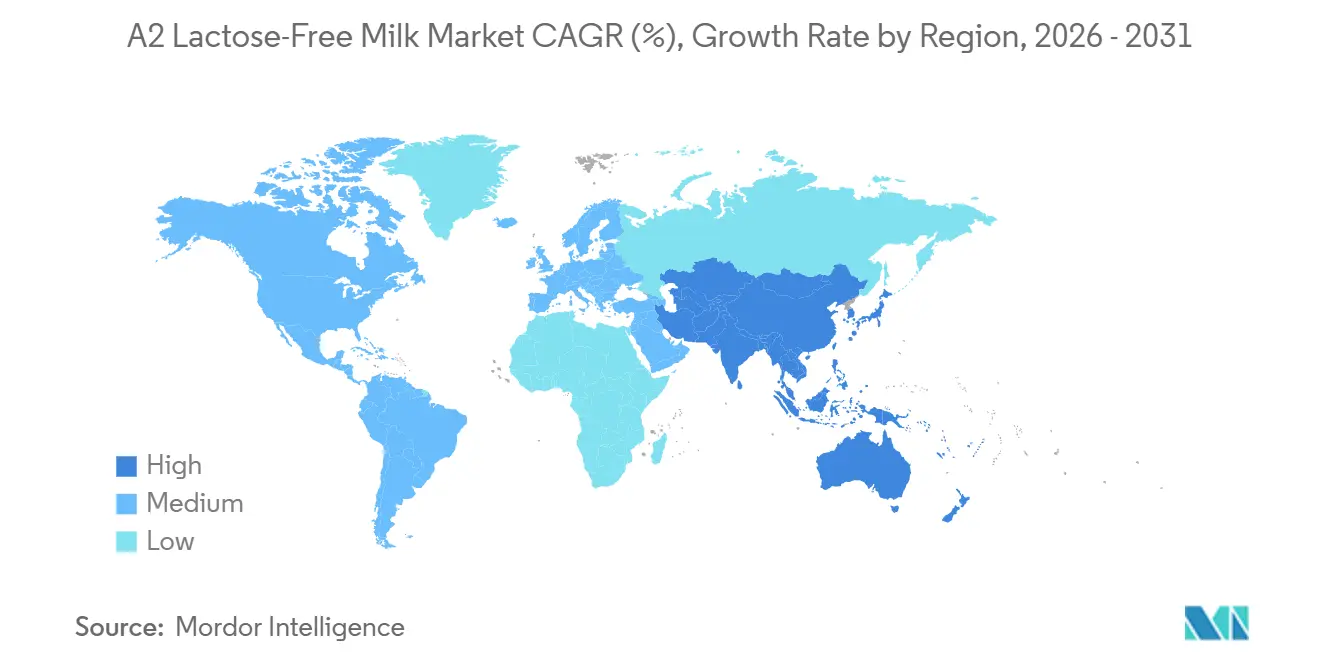
- By geography, North America held 35.01% share in 2025, while Asia-Pacific is forecast to grow at a 14.56% CAGR through 2031.
Note: Market size and forecast figures in this report are generated using Mordor Intelligence’s proprietary estimation framework, updated with the latest available data and insights as of January 2026.
Market Trends and Insights
Drivers Impact Analysis of A2 Lactose-Free Milk Market*
| Driver | (~) % Impact on CAGR Forecast | Geographic Relevance | Impact Timeline |
|---|---|---|---|
| Rising awareness of lactose intolerance | +2.5% | Global | Medium term (2-4 years) |
| Growing demand for digestive-friendly dairy | +2.0% | Global | Short term (≤ 2 years) |
| Increasing health and wellness consciousness | +1.7% | North America and Europe | Medium term (2-4 years) |
| Rising preference for premium functional dairy | +1.4% | North America and Europe | Long term (≥ 4 years) |
| Growing demand for A2 protein-based dairy | +1.8% | Asia-Pacific core, with spillover to North America | Long term (≥ 4 years) |
| Expansion of lactose-free product availability | +1.2% | Global | Short term (≤ 2 years) |
| Source: Mordor Intelligence | |||
Rising Awareness of Lactose Intolerance
The A2 lactose-free milk market benefits from wider recognition of lactose intolerance and milk-related digestive discomfort. Scientific literature places lactase non-persistence at close to 70% of the global adult population, with prevalence reaching 90% to 100% in some East and Southeast Asian communities. These patterns create a large group of consumers who may reduce or avoid conventional dairy, including households that may otherwise turn to non-dairy alternatives or remove milk from regular purchases. In China, brands in large cities are presenting A2 lactose-free products as a combined comfort option for households that had previously avoided milk because conventional dairy did not fit their needs. This can bring former dairy non-consumers back into the category rather than simply shift current drinkers between milk varieties, which broadens the relevant customer pool for producers and retailers. The Chinese Medical Association released a white paper on A2 beta-casein and health at the 2025 National Pediatric Academic Conference, which supports greater awareness through healthcare and infant nutrition channels[1].
Growing Demand for Digestive-friendly Dairy
Purchasing of lactose-free dairy is moving beyond a strictly medical need and toward routine lifestyle use. This change gives the A2 lactose-free milk market access to consumers who value digestive comfort without having a formal diagnosis, particularly people who have reduced milk consumption after occasional discomfort. A randomized controlled crossover trial of fluid-milk-avoiding participants found minimal overall gastrointestinal symptoms across conventional lactose-free milk, A2 milk, and A2 lactose-free milk. The finding supports the view that clinical need is not the only reason consumers choose these products, although it does not establish a universal health outcome for every buyer. Products that combine lactose removal with A2 protein can appeal to households looking for a simple alternative to standard milk, rather than asking them to choose between two separate specialty products. This broad appeal supports premium retail placement while keeping the category dependent on clear consumer communication and plain product labeling.
Increasing Health and Wellness Consciousness
Health and wellness preferences are increasing scrutiny of ingredient origin and processing in premium dairy. The A2 lactose-free milk market fits this preference because it combines protein differentiation with a lactose-free formulation in a familiar fluid-milk format. AURI reported that 42% of producers converted to A2 dairy because they considered it healthier, while retailers cited market trends, premium margins, and direct consumer requests as key reasons to carry A2 products[2]. Retailer private-label activity by Trader Joe’s, Costco, and Ahold Delhaize shows that A2 dairy is becoming more familiar to mainstream premium-dairy shoppers, even as branded products retain value through sourcing and product-positioning differences. The resulting choice set gives retailers a way to serve premium buyers at more than one price point and allows brands to focus their communication on provenance, processing, and digestive comfort. Wider use of genetic testing and selective-breeding communication also makes the A2 protein distinction easier for consumers to recognize at the point of purchase.
Growing Demand for A2 protein-based Dairy
A2 protein demand is extending the commercial role of the A2 lactose-free milk market beyond fluid milk. Products that pair A2 milk with protein nutrition can use the same digestive-comfort proposition in adjacent formats, including ready-to-drink products aimed at consumers with active or wellness-oriented routines. Orgain introduced an A2 milk-based, lactose-free ready-to-drink protein shake with 30g of protein in July 2026, showing the application of this positioning in functional beverages. Research published in Dairy Science and Management found willingness to pay a premium for A2 milk among consumers in multiple geographies, including health-conscious Italian consumers. Lactose malabsorption and A1 beta-casein digestion are distinct mechanisms, so lactose removal and A2 protein can serve separate consumer concerns within one product without treating the two benefits as interchangeable. That distinction supports the category’s price premium in clinical, specialty, and wellness retail channels, where buyers often compare several functional attributes before choosing a product.
Restraints Impact Analysis of A2 Lactose-Free Milk Market*
| Restraint | (~) % Impact on CAGR Forecast | Geographic Relevance | Impact Timeline |
|---|---|---|---|
| Higher price than conventional milk | -1.3% | Global | Long term (≥ 4 years) |
| Limited availability of A2-certified dairy herds | -1.0% | North America, Europe, and Asia-Pacific | Medium term (2-4 years) |
| High costs of specialized processing | -0.8% | Global | Medium term (2-4 years) |
| Limited lactose-free processing infrastructure | -0.7% | Asia-Pacific and Middle East and Africa | Long term (≥ 4 years) |
| Source: Mordor Intelligence | |||
Higher Price than Conventional Milk
The A2 lactose-free milk market has a layered cost structure because A2 herd sourcing and lactose-free processing both add cost. A2 milk in the United States carried a 60% to 70% premium over conventional milk, while branded lactose-free A2 products had a further premium over standalone A2 products[3]. This limits penetration among lower-income households, even when consumers understand the dual proposition and view it as relevant to their dietary needs. Price sensitivity is especially relevant in Asia-Pacific and South America, where purchasing decisions can remain closely tied to the everyday cost of staple foods. Private-label lactose-free products can also create retailer pressure on branded products in mature markets, because consumers may accept lactose removal without paying for the added A2 proposition. Processing improvements may gradually reduce cost pressure, but they do not remove the need for verified A2 milk supply or the cost of maintaining product quality through distribution.
Limited Availability of A2-certified Dairy Herds
A2-certified milk supply remains a practical constraint for the A2 lactose-free milk market. Converting a herd requires individual genetic testing and multiyear selective-breeding programs, and full certification can take up to 10 years before a processor can rely on a large verified supply base. This limits the speed at which processors can increase raw-milk procurement without relying on extended supply chains that add transport, cold-chain, and coordination requirements. Genomic-testing costs fell from USD 80 per animal in 2018 to less than USD 15 by 2024, making herd conversion more accessible to smaller farms. Supply expansion is still likely to remain constrained in the medium term where Jersey and Guernsey breed infrastructure is limited, because genetic testing alone cannot shorten the breeding cycle. Brownes Dairy’s November 2025 exclusive A2 milk supply agreement requires individual genetic testing for every cow in supplier herds, showing why long-term sourcing arrangements favor established processors.
*Our forecasts treat driver/restraint impacts as directional, not additive. The impact forecasts reflect baseline growth, mix effects, and variable interactions.
A2 Lactose-Free Milk Market Segment Analysis
By Product Type:
Whole Milk Leads While Reduced-Fat Options ExpandWhole A2 lactose-free milk accounted for the largest share of the A2 lactose-free milk market, capturing 51.27% of total revenue in 2025. Its strong market position is primarily driven by consumer preference for milk with a richer taste, creamier texture, and higher nutritional content. Whole milk remains a staple choice for households, children, and consumers seeking minimally processed dairy products. The combination of A2 protein and lactose-free formulation enhances its appeal among individuals with digestive sensitivity who do not want to compromise on flavor or mouthfeel. Retail availability across supermarkets, hypermarkets, convenience stores, and online grocery platforms has further strengthened demand for this segment.
Reduced-fat A2 lactose-free milk is projected to be the fastest-growing product type in the market, registering a CAGR of 14.32% during 2025–2031. The segment is benefiting from increasing consumer focus on weight management, heart health, and calorie reduction without eliminating dairy consumption. Health-conscious adults and aging populations are increasingly choosing reduced-fat dairy products that offer lower fat content while maintaining protein and calcium intake. The A2 and lactose-free positioning provides an additional digestive wellness advantage, making the product attractive to a broader consumer base.

By Packaging:
Bottles Support Freshness While Cartons Extend ReachBottles accounted for 44.58% of the A2 lactose-free milk market by packaging in 2025. The format is linked with perceptions of fresh chilled dairy and a minimally processed product. Its dependence on cold-chain capacity can limit availability where refrigeration logistics are inconsistent. Bottles remain important for whole and reduced-fat products in established fresh-dairy retail networks. They also provide a familiar format for consumers who are trying A2 lactose-free milk for the first time. This preference can preserve bottle demand even as alternative formats become more accessible.
Cartons are projected to grow at a 14.76% CAGR through 2031. Their compatibility with UHT processing allows a shelf life of 6 to 12 months without refrigeration, which improves distribution flexibility. Cartons are also efficient for e-commerce fulfillment and export shipments. For secondary cities in Asia-Pacific and distribution into the Middle East and Africa, carton UHT products can enter markets without major chilled-logistics investment. Pouches serve niche institutional buyers, including schools and hospitals in price-sensitive markets. Tetra Pak added a new lactose-free dairy chapter to its 2025 Dairy Processing Handbook, reflecting equipment supplier attention to category processing. requirements
By Distribution Channel:
Supermarkets Lead While Online Retail Gains SpeedSupermarkets and hypermarkets held 47.91% of the A2 lactose-free milk market in 2025. These outlets remain the primary destination for fresh dairy and have the cold-chain capacity required for chilled products. Broad in-store availability lets consumers compare A2 lactose-free options with conventional milk and standard lactose-free products. The channel is particularly important for whole and reduced-fat products that depend on refrigerated display. Its mature role in the United States means that future growth is likely to come increasingly from online and adjacent retail channels. Convenience stores can capture immediate purchases but generally cannot carry a full A2 lactose-free assortment.
Online retail stores are forecast to grow at a 15.71% CAGR through 2031. This channel suits a category in which consumers often research digestive-health products before they buy. Search, reviews, and product detail pages can explain the difference between A2 protein and lactose removal more fully than a shelf label can. In China, tmall, jd.com, meituan maicai, and dingdong maicai are becoming important retail touchpoints for younger urban buyers. The A2 Milk Company’s domestic online market share in China reached 4.4% in the first half of FY26, up 0.2 percentage points year over year. Digital channels can therefore support education, repeat orders, and the distribution of a wider product range.
Geography Analysis
North America A2 Lactose-Free Milk Market
North America held the largest share of the A2 lactose-free milk market, accounting for 35.01% of revenue in 2025. The region benefits from high consumer awareness of lactose intolerance and digestive health products. Strong demand for premium dairy products and functional beverages has supported the adoption of A2 lactose-free milk. Well-established retail networks and cold-chain infrastructure ensure broad product availability across supermarkets, hypermarkets, and online channels. The presence of leading dairy brands and continuous product innovation further strengthens market growth. Rising preference for clean-label and protein-rich dairy products continues to support the region’s dominant position.
APAC A2 Lactose-Free Milk Market
Asia-Pacific is projected to be the fastest-growing regional market, expanding at a CAGR of 14.56% during 2025–2031. Growth is driven by increasing lactose intolerance awareness across countries such as China, India, Australia, and New Zealand. Rapid urbanization, rising disposable incomes, and changing dietary habits are boosting demand for premium dairy products. Consumers are increasingly seeking milk products that provide digestive comfort and nutritional benefits. Expansion of modern retail formats and e-commerce platforms is improving product accessibility across the region.
EMEA and South America A2 Lactose-Free Milk Market
Europe, South America, and the Middle East and Africa also contribute to the expansion of the A2 lactose-free milk market. Europe benefits from a mature dairy industry and growing demand for specialty and health-oriented dairy products. South America is witnessing gradual adoption supported by improving retail distribution and rising awareness of lactose-free nutrition. In the Middle East and Africa, increasing urban populations and higher demand for premium packaged dairy products are supporting market growth.
Competitive Landscape
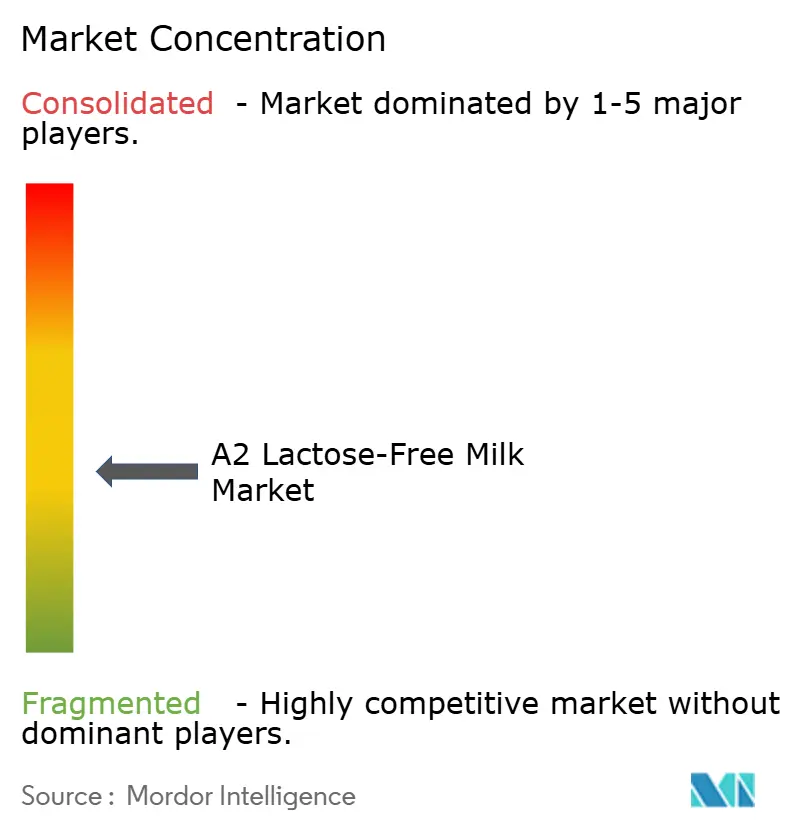
The A2 lactose-free milk market is characterized by medium level of concentration. The A2 Milk Company retains brand recognition and supply-chain advantages as the category originator, but it does not hold a majority share. Its September 2025 acquisition of the A2 Pōkeno facility for NZD 282 million, followed by June 2026 approval to register China-label infant formula products at the site, strengthens its manufacturing and regulatory position. The move provides greater control over production, product registration, and supply-chain coordination. The A2 lactose-free milk market remains open to other companies that can establish verified supply and a credible consumer proposition.
Danone, Nestlé, and Fonterra can use established lactose-free dairy or infant-nutrition brands to enter A2-related products. They face a different challenge because verified A2 raw-milk supply is harder to build at scale without dedicated herd-certification systems. Fonterra phased out its Anchor A2 milk range in New Zealand in 2025 and redirected investment toward its Anchor Zero Lacto range, showing that major processors must prioritize among premium dairy subcategories. Smaller Indian indigenous-breed operators and Southeast Asian cooperatives may have a local sourcing advantage if they can establish lactose-free processing capacity.
Processing economics are an important competitive lever in the A2 lactose-free milk market. Peer-reviewed research on 3D-printed continuous-flow reactors reported lactose-hydrolysis efficiency of at least 94%, indicating a possible route to improve production efficiency. Lower processing costs could help smaller producers compete without weakening product quality. Regulatory compliance in China and India favors businesses that can manage product registration, labeling, and supply verification, as shown by the A2 Milk Company’s China-label registration at Pōkeno. Clover Sonoma’s specialty whole-milk launch shows how stacked quality claims can serve a focused premium audience.
A2 Lactose-Free Milk Industry Leaders
-
The a2 Milk Company Limited
-
Fonterra Co-operative Group Limited
-
Danone S.A.
-
Nestlé S.A.
-
Lactalis Group
- *Disclaimer: Major Players sorted in no particular order
A2 Lactose-Free Milk Market Companies Covered in this Report
- The a2 Milk Company Limited
- Fonterra Co-operative Group Limited
- Danone S.A.
- Nestlé S.A.
- Arla Foods amba
- Lactalis Group
- Saputo Inc.
- Royal FrieslandCampina N.V.
- Gujarat Cooperative Milk Marketing Federation Ltd.
- Provilac Dairy Farms Private Limited
- CROPP Cooperative
- Green Valley Creamery, LLC
- Horizon Organic
- Shoonya Farms
- Prolactal GmbH
- Oshun Food Products
- Stonyfield Farm, Inc.
- Organic Valley
- Aurora Organic Dairy Corporation
- Freedom Foods Group Limited
Recent Industry Developments in A2 Lactose-Free Milk Market
- June 2026: The a2 Milk Company received approval from China’s State Administration for Market Regulation to register two China-label infant milk formula products at its a2 Pōkeno facility under the a2™ brand, completing the final regulatory step of its NZD 282 million facility acquisition and enabling new product launches in the second half of 2026. The company simultaneously announced a NZD 300 million special dividend, reflecting confidence in its strengthened supply chain position.
- April 2026: Tetra Pak, in collaboration with Italian dairy company Sterilgarda Alimenti, launched the first 1-liter, family-size aseptic carton that incorporated a paper-based barrier. When combined with plant-based polymers, the packaging increased renewable content to 90% and helped reduce the overall carbon footprint, supporting the shift toward more sustainable aseptic packaging solutions.
- September 2025: The a2 Milk Company completed the acquisition of Yashili New Zealand’s Pokeno manufacturing facility for NZD 282 million, or USD 168 million. The facility supported integrated nutritional manufacturing and China-label infant formula production, strengthening the company’s manufacturing capabilities and supply chain control.
Global A2 Lactose-Free Milk Market Report Scope
A2 milk is milk that contains only the A2 type of beta-casein protein, a naturally occurring protein found in cow’s milk. The A2 milk market is segmented by form, packaging, distribution channel and geography. The A2 lactose-free milk market report is segmented by product type into whole, reduced-fat, skimmed milk. Based on packaging, the market is segmented into bottles, cartons, pouches, others. Based on distribution channel, the market is segmented into supermarkets/hypermarkets, convenience stores, online retail, others. By geography, the market is segmented into North America, Europe, Asia-Pacific, South America, and Middle East and Africa. For each segment, the market sizing and forecasting have been done in value terms (USD million).
Segmentation Overview
| Whole A2 Lactose-Free Milk |
| Reduced-Fat A2 Lactose-Free Milk |
| Skimmed A2 Lactose-Free Milk |
| Bottles |
| Cartons |
| Pouches |
| Others |
| Supermarkets/Hypermarkets |
| Convenience Stores |
| Online Retail Stores |
| Other Distribution Channels |
| North America | United States |
| Canada | |
| Mexico | |
| Rest of North America | |
| Europe | Germany |
| United Kingdom | |
| Italy | |
| France | |
| Spain | |
| Rest of Europe | |
| Asia-Pacific | China |
| India | |
| Japan | |
| Australia | |
| Indonesia | |
| Rest of Asia-Pacific | |
| South America | Brazil |
| Argentina | |
| Rest of South America | |
| Middle East and Africa | South Africa |
| Saudi Arabia | |
| United Arab Emirates | |
| Rest of Middle East and Africa |
| By Product Type | Whole A2 Lactose-Free Milk | |
| Reduced-Fat A2 Lactose-Free Milk | ||
| Skimmed A2 Lactose-Free Milk | ||
| By Packaging | Bottles | |
| Cartons | ||
| Pouches | ||
| Others | ||
| By Distribution Channel | Supermarkets/Hypermarkets | |
| Convenience Stores | ||
| Online Retail Stores | ||
| Other Distribution Channels | ||
| By Geography | North America | United States |
| Canada | ||
| Mexico | ||
| Rest of North America | ||
| Europe | Germany | |
| United Kingdom | ||
| Italy | ||
| France | ||
| Spain | ||
| Rest of Europe | ||
| Asia-Pacific | China | |
| India | ||
| Japan | ||
| Australia | ||
| Indonesia | ||
| Rest of Asia-Pacific | ||
| South America | Brazil | |
| Argentina | ||
| Rest of South America | ||
| Middle East and Africa | South Africa | |
| Saudi Arabia | ||
| United Arab Emirates | ||
| Rest of Middle East and Africa | ||
Key Questions Answered in the Report
What is driving demand for A2 lactose-free milk?
Demand comes from consumers managing lactose intolerance, people seeking digestive comfort, and buyers who value A2 protein differentiation.
How large is the A2 lactose-free milk sector?
The market is expected to grow from USD 0.95 billion in 2026 to USD 1.67 billion by 2031 at an 11.94% CAGR.
Which product type leads sales?
Whole A2 lactose-free milk led with a 51.27% share in 2025, while reduced-fat products have the fastest projected growth.
Which sales channel is growing fastest?
Online retail stores are forecast to expand at a 15.71% CAGR through 2031 because consumers often research digestive-health products before purchase.