
3D-Stacked DRAM Market Size and Share
Market Overview
| Study Period | 2020 - 2031 |
|---|---|
| Market Size (2026) | USD 24.41 Billion |
| Market Size (2031) | USD 96.48 Billion |
| Growth Rate (2026 - 2031) | 31.64 % |
| Fastest Growing Market | Asia-Pacific |
| Largest Market | Asia-Pacific |
| Market Concentration | High |
Major Players *Disclaimer: Major Players sorted in no particular order Image © Mordor Intelligence. Reuse requires attribution under CC BY 4.0. | |
3D-Stacked DRAM Market Analysis by Mordor Intelligence
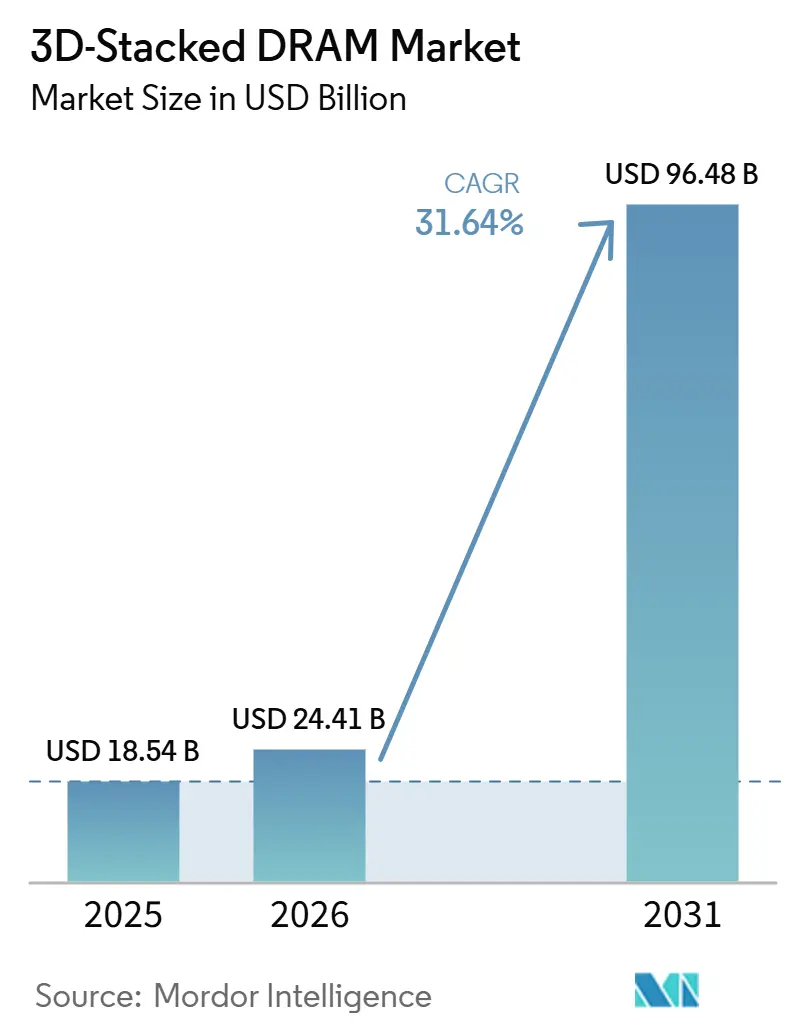
The 3D-Stacked DRAM market size is expected to grow from USD 18.54 billion in 2025 to USD 24.41 billion in 2026 and is forecast to reach USD 96.48 billion by 2031 at 31.6% CAGR over 2026-2031. The 3D-Stacked DRAM market is being pushed by rapid HBM deployment across AI server infrastructure as hyperscalers and cloud providers turn large capital budgets into active hardware rollouts. The supply picture is also different from earlier memory cycles because SK hynix, Samsung, and Micron have already indicated that their 2026 HBM capacity is fully committed, which limits the inventory swings that usually pressure commodity DRAM pricing. The 3D-Stacked DRAM market is also benefiting from faster product transitions, as HBM4 standardization and backward compatibility shorten qualification work for accelerator vendors and reduce the friction associated with each new memory generation. At the same time, the market remains exposed to a narrow manufacturing footprint centered in South Korea and Taiwan, where leading HBM fabrication and advanced packaging capacity are concentrated in a small number of sites. Demand from AI training, inference, and emerging automotive edge systems gives the 3D-Stacked DRAM market a broader base than in earlier cycles, even as export controls and backend packaging constraints continue to shape where supply can move and how quickly new capacity can be absorbed.
Key Report Takeaways
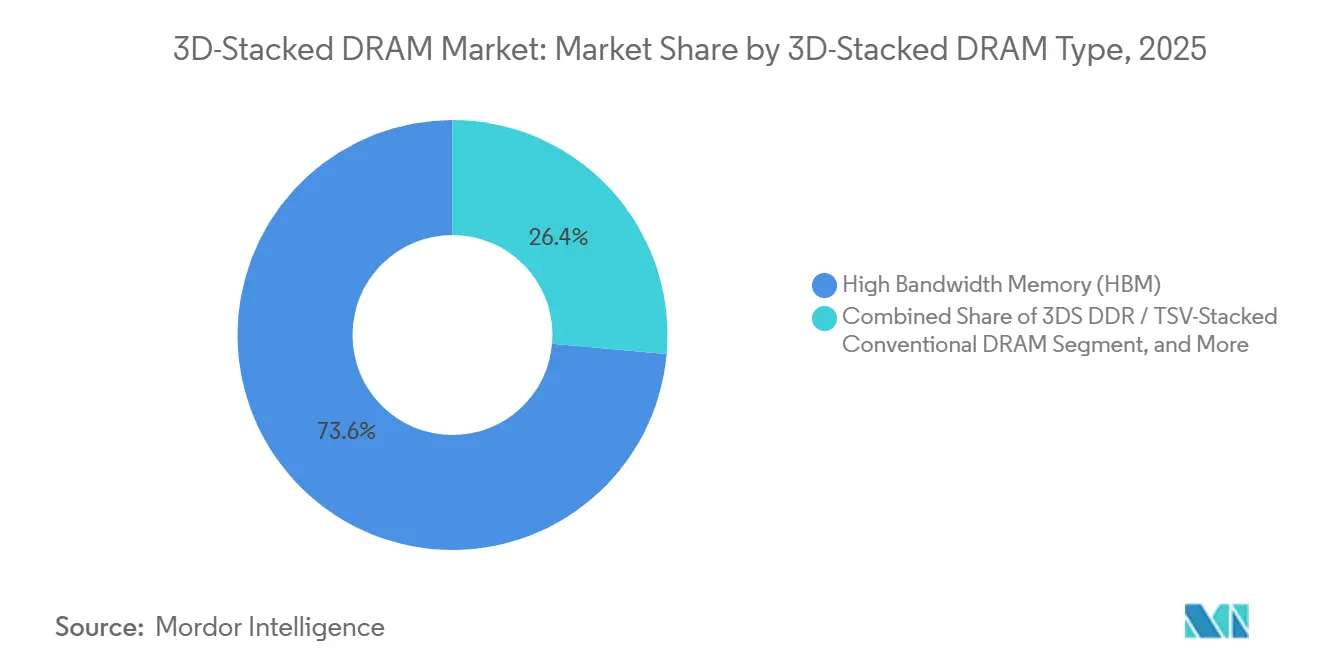
- By architecture, HBM led the 3D-stacked DRAM market with a 73.6% revenue share in 2025, while Emerging Hybrid-Bonded and Monolithic 3D DRAM are forecast to expand at a 34.4% CAGR through 2031.
- By memory capacity per stack, 16 GB held the largest 33.8% share of the 3D-stacked DRAM market in 2025, while 32 GB and Above is projected to grow at a 32.7% CAGR through 2031.
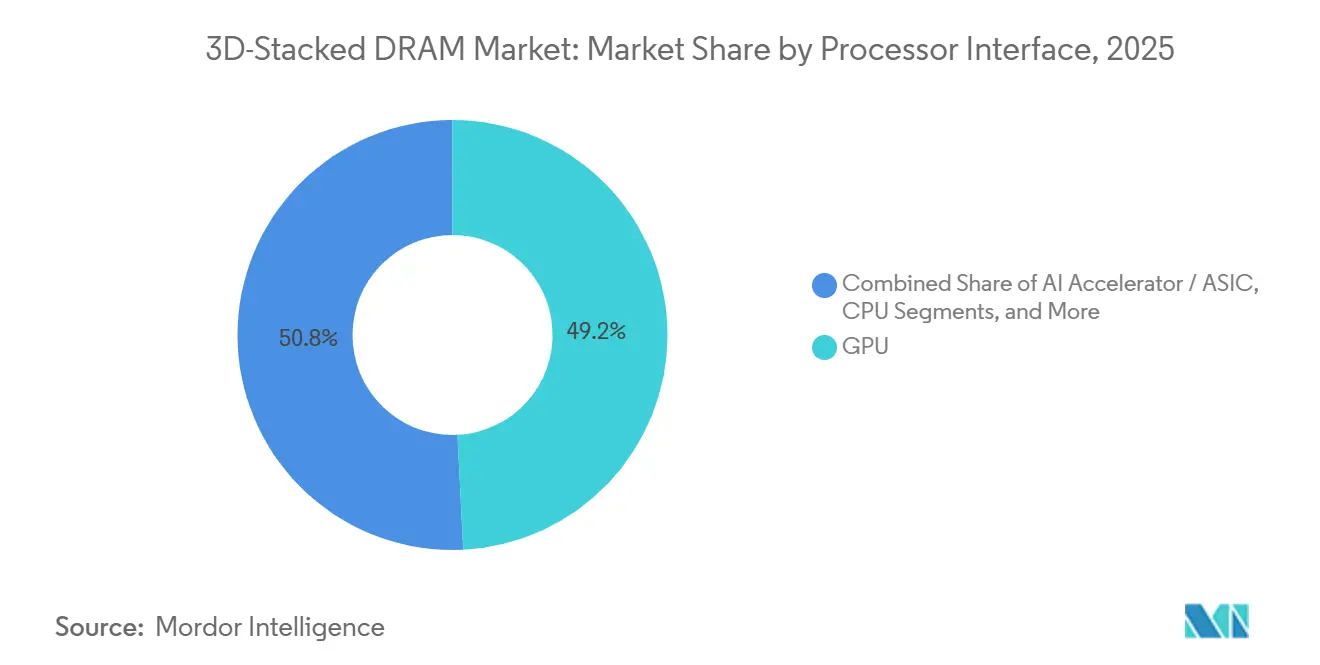
- By processor interface, GPU accounted for 49.2% of revenue in the 3D-stacked DRAM market in 2025, while AI Accelerator and ASIC are set to record the fastest CAGR at 33.6% over 2026-2031.
- By application, AI and Data Center Servers accounted for 47.9% of revenue in 2025, while Automotive and Edge AI are projected to expand at a 34.2% CAGR through 2031.
- By geography, Asia-Pacific accounted for 66.7% of the 3D-stacked DRAM market revenue in 2025 and is also projected to record the fastest CAGR of 32.4% through 2031.
Note: Market size and forecast figures in this report are generated using Mordor Intelligence’s proprietary estimation framework, updated with the latest available data and insights as of January 2026.
Market Trends and Insights
Drivers Impact Analysis of 3D-Stacked DRAM Market*
| Driver | (~) % Impact on CAGR Forecast | Geographic Relevance | Impact Timeline |
|---|---|---|---|
| AI Server And Accelerator Ramp | +7.5% | Global, concentrated in North America and Asia-Pacific | Short term (≤ 2 years) |
| HBM Migration To Inference Clusters | +6.5% | North America, with rapid adoption in APAC core and spill-over to Europe | Short term (≤ 2 years) |
| HBM4 And Higher-Stack Transition | +5.5% | Global, led by South Korea and Taiwan supply-chain nodes | Medium term (2-4 years) |
| Advanced Packaging And Hybrid Bonding Gains | +3.5% | APAC core, Taiwan and South Korea, with early gains in Singapore and the United States | Medium term (2-4 years) |
| Custom HBM Co-Design For Hyperscalers | +2.5% | North America and Asia-Pacific | Medium term (2-4 years) |
| Automotive Edge AI Memory Intensity | +1.5% | Global, with near-term leadership in Japan, South Korea, Germany, and the United States | Long term (≥ 4 years) |
| Source: Mordor Intelligence | |||
AI Server And Accelerator Ramp
The 3D-Stacked DRAM market is being reshaped by the way large-scale model training and inference have raised memory demand per system rather than simply increasing the number of servers shipped. AI accelerators now require very high local memory bandwidth, which makes stacked memory central to system design instead of a secondary bill-of-materials item. NVIDIA disclosed in January 2026 that its Rubin platform integrated 288 GB of HBM4 per GPU and delivered 22 TB/s of bandwidth, which materially lifted memory content per accelerator package compared with the prior generation.[1]NVIDIA Corporation, “NVIDIA DGX SuperPOD Sets the Stage for Rubin-Based Systems,” NVIDIA Blog, blogs.nvidia.com Samsung also moved this transition into commercial supply in February 2026 by beginning HBM4 shipments, showing that the next step in the product cycle is no longer theoretical and is already entering active deployment.[2]Samsung Electronics Co., Ltd., “Samsung Ships Industry-First Commercial HBM4 With Ultimate Performance for AI Computing,” Samsung Global Newsroom, news.samsung.com That shift changes producer incentives because advanced wafer capacity can earn far more value in HBM than in conventional DRAM, so leading suppliers have a clear reason to keep prioritizing stacked products. As a result, the 3D-Stacked DRAM market is likely to remain supported by disciplined capacity allocation even when parts of the broader memory market move through slower phases.
HBM Migration To Inference Clusters
The 3D-Stacked DRAM market is also gaining from a change in workload mix, because inference clusters need larger resident memory pools as context windows, user concurrency, and model complexity rise. This not only increases the number of memory stacks shipped, but it also raises the preferred capacity of each stack and makes denser configurations more commercially attractive. JEDEC’s HBM4 standard strengthened that transition by setting a 2,048-bit interface, 32 independent channels, and support for up to 64 GB per cube, which gives system designers a clear path to higher-capacity deployment without a full controller reset. Samsung’s February 2026 roadmap update also showed that custom HBM samples will reach customers in 2027, which points to a procurement model where hyperscalers and accelerator vendors shape memory design more directly around inference needs. That matters because the 3D-Stacked DRAM market is no longer tied only to merchant GPU cycles and is increasingly supported by a wider buyer set that wants memory closely matched to workload behavior. The result is a steadier demand floor, especially in North America, where inference buildouts are broadening the addressable base for high-capacity HBM.
HBM4 And Higher-Stack Transition
The move from HBM3E to HBM4 is one of the clearest structural supports for the 3D-Stacked DRAM market, as it improves bandwidth, increases channel parallelism, and extends practical stack density. JEDEC published the JESD270-4 HBM4 standard in April 2025, formalizing a 2,048-bit interface, 32 channels, up to 64 GB per cube, and backward compatibility with HBM3 controllers, reducing qualification friction for accelerator vendors. Samsung said its first commercial HBM4 product reached 11.7 Gb/s and 3.3 TB/s per stack, which moved the discussion from roadmap targets to shipping performance. SK hynix also stated that its HBM4, built on a 1bnm process with Advanced MR-MUF technology, delivered more than 40% better power efficiency and was being readied for mass production, which shows that performance improvement is being pursued alongside manufacturing readiness.[3]SK hynix Inc., “SK Hynix Completes World-First HBM4 Development and Readies Mass Production,” SK hynix Newsroom, news.skhynix.com As stack heights rise from 12-high toward even denser formats, the 3D-Stacked DRAM market benefits from higher revenue per package and from stronger reasons for customers to refresh accelerator platforms. This transition also keeps the market on a premium path because each new generation locks memory more tightly into accelerator system architecture.
Advanced Packaging And Hybrid Bonding Gains
For the 3D-Stacked DRAM market, memory die output alone is not enough, because commercial supply only matters when advanced packaging can turn those stacks into shippable accelerator modules. The importance of backend execution rises with every new generation, since higher-layer stacks and tighter power envelopes put more pressure on bonding accuracy, thermal behavior, and interconnect density. Samsung’s HBM4 launch highlighted a package structure that used a 4nm logic base die and laid out a path toward custom HBM and HBM4E, which shows how packaging decisions are becoming part of product differentiation rather than a background manufacturing step. SK hynix framed its HBM4 program in a similar way by tying the new stack to advanced assembly choices and better power efficiency, which supports the view that the 3D-Stacked DRAM market will reward suppliers that can combine memory process leadership with packaging integration. On the demand side, systems like NVIDIA’s Rubin-based platforms raise the need for dense co-packaged memory at the rack level, so packaging improvements directly affect how much revenue the market can convert from booked demand into deployed hardware. That is why hybrid bonding is moving from a technology discussion to a capacity discussion inside the 3D-Stacked DRAM market.
Restraints Impact Analysis of 3D-Stacked DRAM Market*
| Restraint | (~) % Impact on CAGR Forecast | Geographic Relevance | Impact Timeline |
|---|---|---|---|
| TSV And Packaging Yield Drag | -3.5% | Global, concentrated in South Korea and Taiwan production hubs | Short term (≤ 2 years) |
| CoWoS And Backend Capacity Bottlenecks | -3.0% | Taiwan, with spill-over to OSAT partners in South Korea, Singapore, and the United States | Short term (≤ 2 years) |
| Export-Control Limits On Advanced HBM | -2.0% | China, Macau, and Country Group D:5 destinations | Medium term (2-4 years) |
| Thermal Density And Interface Complexity | -1.0% | Global, with acute pressure in dense rack-scale AI deployments | Medium term (2-4 years) |
| Source: Mordor Intelligence | |||
TSV And Packaging Yield Drag
The 3D-Stacked DRAM market still faces a fundamental manufacturing challenge because vertical stacking introduces defect risk to a greater degree than conventional planar DRAM. Through-silicon vias are small, deep, and numerous, making them vulnerable to voids, seam defects, and copper-fill variation during fabrication and later assembly. SemiEngineering noted that TSV complexity remains a manufacturing bottleneck, which aligns with the persistent yield drag described across the user-supplied material. The problem becomes harder as suppliers move to 12-high, denser HBM4 stacks, because wafer thinning, stack alignment, and bond integrity become less forgiving at higher layer counts. Even when demand is strong, usable output does not scale linearly if backend losses remain elevated, which keeps the 3D-Stacked DRAM market more supply-constrained than end-market demand alone would imply. This is one reason premium pricing has remained durable, since low-yield production effectively raises the cost floor for every qualified unit that reaches customers.
CoWoS And Backend Capacity Bottlenecks
The 3D-Stacked DRAM market is also constrained by backend capacity, as memory stacks require advanced co-packaging before they can be deployed with leading-edge accelerators. That dependency creates a lag between announced memory output and actual system shipments, especially when GPU roadmaps, interposer availability, and packaging tools must align simultaneously. NVIDIA’s Rubin platform specifications illustrate the scale of this dependency, because each GPU requires very high HBM capacity and bandwidth, which pushes more value and more execution risk into the packaging stage. Samsung’s own HBM4 launch also underscored that the market has moved toward tightly integrated memory and logic packaging, making backend readiness a direct part of product competitiveness. When packaging remains tight, the largest platforms are served first, and smaller or newer programs wait longer for slots, which slows the market's ability to diversify beyond its biggest buyers. The practical effect is that strong demand does not automatically translate into proportional revenue recognition if backend bottlenecks remain in place.
*Our forecasts treat driver/restraint impacts as directional, not additive. The impact forecasts reflect baseline growth, mix effects, and variable interactions.
3D-Stacked DRAM Market Segment Analysis
By 3D-Stacked DRAM Type:
HBM Dominance Coexists With Disruptive Bonding TransitionsHBM held 73.6% of the 3D-Stacked DRAM market share in 2025, underscoring how firmly AI accelerator demand has centered on high-bandwidth, low-latency stacks. In the 3D-Stacked DRAM market, this position reflects a design reality rather than a temporary pricing effect, because leading AI chips need memory that can sit close to logic and move very large data volumes with lower power per bit. The architecture is now anchored by HBM3E and HBM4 deployment cycles across leading accelerator programs, and that has widened HBM’s lead over older stacked approaches. JEDEC’s HBM4 standard reinforced this direction by defining the next performance baseline while preserving backward compatibility with HBM3 controllers, which shortens transition work for system designers. Within the 3D-Stacked DRAM industry, that makes HBM is the reference architecture for premium accelerator memory rather than one option among several.
Other architectures still matter, but they operate in narrower use cases. The 3DS DDR and TSV-stacked conventional DRAM segment continues to serve high-reliability and server-buffered memory applications where bandwidth needs are lower, and qualification stability matters more than peak density. Hybrid Memory Cube and related designs remain present in selected networking and telecommunications roles, while other stacked variants support edge AI and mobile-adjacent workloads. The fastest-growing sub-segment is Emerging Hybrid-Bonded and Monolithic 3D DRAM, which is projected to expand at a 34.4% CAGR through 2031 as the 3D-Stacked DRAM market moves beyond conventional thermal compression bonding. Samsung’s 2026 HBM4 launch and SK hynix’s HBM4 development path both point toward a broader shift where packaging and bonding methods become part of architectural choice, not just manufacturing detail. That leaves the architecture mix in the 3D-Stacked DRAM market stable at the top but more dynamic beneath the surface, where bonding technology is setting up the next round of differentiation.



By Memory Capacity per Stack:
Higher-Density Stacks Become the Architectural DefaultThe 16 GB configuration accounted for 33.8% share of the 3D-Stacked DRAM market size in 2025, reflecting the installed base created by dominant HBM3E 8-high products in the prior accelerator cycle. In practical terms, 16 GB stacks were the volume sweet spot because they balanced bandwidth, thermals, and package complexity for large AI deployments already in production. Lower-density 4 GB and 8 GB formats still served legacy HPC, networking ASIC, and FPGA uses where memory footprints had not yet moved to the same scale as modern AI accelerators. At the same time, 24 GB configurations are gaining ground as HBM4 enters commercialization, and Samsung stated that its first commercial HBM4 shipped in both 24 GB and 36 GB versions using 12-layer stacks. JEDEC’s HBM4 standard also opened a path toward higher near-term density by supporting up to 64 GB per cube in 16-high stacks, which makes the capacity ladder clearer for customers planning multi-year accelerator platforms.
The 32 GB and Above segment is projected to record the fastest 32.7% CAGR through 2031, and that pace fits the way each new accelerator generation is lifting the minimum memory requirement per package. NVIDIA said the Rubin R100 GPU integrates 288 GB of HBM4 with 22 TB/s bandwidth, which implies a clear move toward denser stack configurations rather than simple growth in stack count alone. In the 3D-Stacked DRAM market, that change is important because interposer area and assembly slots are now just as limiting as silicon cost, so fewer and denser stacks often make more commercial sense than a larger number of smaller ones. The 3D-Stacked DRAM industry is therefore shifting from a volume discussion to a density discussion, especially as rack-scale systems push total memory needs much higher. Samsung’s 24 GB and 36 GB launch points, together with JEDEC’s 64 GB ceiling, show that the capacity roadmap is already aligned with this shift. As a result, the 3D-Stacked DRAM market is likely to see the center of demand move upward on the capacity curve through the forecast period.
By Processor Interface:
GPU Anchor Meets ASIC DisruptionGPU held 49.2% of the 3D-Stacked DRAM market share in 2025, which kept graphics-origin compute architectures at the center of demand even as the buyer mix broadened. The GPU position remained strong because NVIDIA and AMD platform roadmaps continued to raise HBM content per chip, making stacked memory central to accelerator performance rather than an optional enhancement. NVIDIA’s January 2026 Rubin disclosure showed how far this has gone, with 288 GB of HBM4 and 22 TB/s of bandwidth on a single GPU package. CPU-attached use cases remain relevant, especially when stacked memory is used as a memory-side cache or as a bandwidth support layer for AI inference preprocessing. FPGA-attached HBM remains useful for networking and telecommunications roles that value high throughput and low latency, without the full complexity of large GPU clusters.
The fastest-growing interface category is AI Accelerator and ASIC, which is projected to grow at a 33.6% CAGR through 2031 as hyperscalers move more workloads onto custom silicon. This is a meaningful shift for the 3D-Stacked DRAM market because demand is becoming less dependent on merchant GPU procurement alone and more tied to a wider set of internally designed accelerators. Samsung’s statement that custom HBM samples will reach customers in 2027 is one of the clearest signs that memory suppliers are now designing around customer-specific interface needs rather than only around standard parts. JEDEC’s backward-compatible HBM4 standard also supports that shift because it lowers the work needed to move to a higher-memory architecture without resetting every controller path. The 3D-Stacked DRAM market therefore still has a GPU anchor, but the strongest growth is now coming from platforms that sit outside the traditional GPU franchise. That mix change should make demand broader and more resilient over time, even if GPUs remain the largest interface segment through much of the forecast period.
By Application:
AI Infrastructure Leadership and the Automotive InflectionAI and Data Center Servers accounted for 47.9% of the 3D-Stacked DRAM market in 2025, confirming that the largest revenue pool still resides in hyperscale and enterprise AI infrastructure. This lead reflects a procurement model that has become more structured, with longer-term supply planning and less reliance on spot buying than earlier memory cycles. High-Performance Computing remained the second-largest application because simulation, genomics, and defense analytics continue to benefit from the bandwidth profile of stacked memory. Networking and telecommunications also keep a place in the 3D-Stacked DRAM market, where ASICs need strong memory bandwidth per watt for buffering and packet handling. Graphics cards, workstations, and gaming systems still represent a stable base, but they are growing more slowly as consumer products increasingly rely on GDDR in volume production.
Automotive and Edge AI is the fastest-growing application segment, with a forecast 34.2% CAGR over 2026-2031, and this is one of the clearest signs that the 3D-Stacked DRAM market is broadening beyond data centers. The user-supplied draft notes that fully autonomous Level 4 vehicles may require more than 300 GB of DRAM per vehicle, suggesting a significant increase in memory requirements as sensor fusion, local inference, and on-board model execution become more demanding. Qualification barriers are also high in this part of the 3D-Stacked DRAM market, because automotive memory programs require lengthy testing, strict safety documentation, and long customer validation cycles. That makes the segment small today in revenue terms, but it raises the value of each qualified design win and slows the pace at which new entrants can gain traction. The 3D-Stacked DRAM industry is therefore approaching an application mix where AI infrastructure remains the revenue center, while automotive and edge deployments create a new long-duration growth layer. This matters because it gives the market a demand path that is tied not only to cloud capex cycles, but also to the much longer product cycles of advanced vehicles and intelligent edge systems.
Geography Analysis
APAC 3D-Stacked DRAM Market
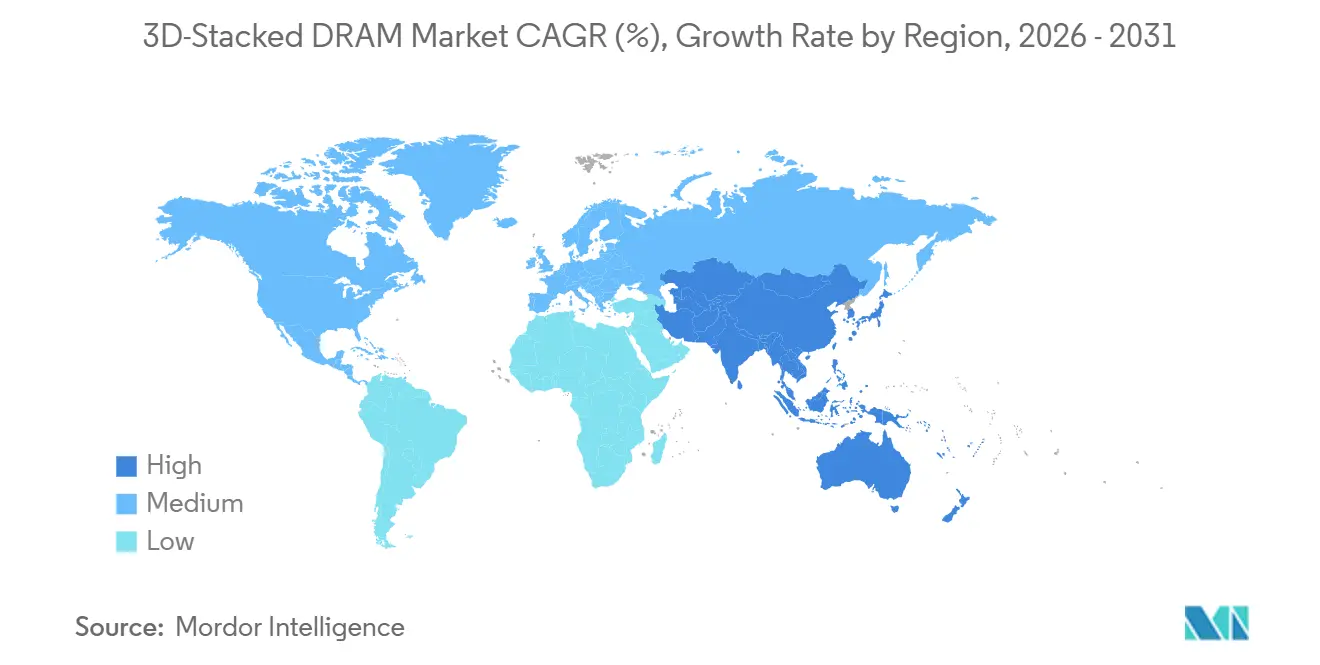
Asia-Pacific held 66.7% share of the 3D-Stacked DRAM market size in 2025 and is projected to expand at a 32.4% CAGR through 2031. The region anchors the 3D-Stacked DRAM market because South Korea houses the leading HBM manufacturers, and Taiwan remains central to advanced co-packaging and interposer work. Samsung’s February 2026 commercial HBM4 launch and SK hynix’s September 2025 HBM4 development milestone both underline how much of the market’s technical direction still comes from Korean suppliers. The geographic concentration brings scale and execution advantages, but it also means that capacity tightness or packaging delays in a few locations can affect the entire 3D-Stacked DRAM market. Japan adds to Asia-Pacific’s depth through new HBM-related investment activity and policy support aimed at improving semiconductor supply resilience, which helps the region widen beyond its current Korean and Taiwanese core.
North America and Europe 3D-Stacked DRAM Market
North America’s 3D-Stacked DRAM market is driven more by end demand than by production scale, because the region remains the largest buyer of AI accelerator systems. The strength of cloud and hyperscaler ordering makes North America the main commercial pull for the 3D-Stacked DRAM market, even when much of the supply is manufactured and packaged in Asia-Pacific. NVIDIA’s Rubin platform launch is one direct example of this demand pull, since platform changes at U.S.-based accelerator vendors quickly translate into new memory requirements across the global supply chain. U.S. industrial policy also matters because domestic semiconductor expansion and export control frameworks are shaping where advanced memory systems can be built, sold, and deployed. Europe remains a secondary demand center, but sovereign AI cloud programs and HPC installations are steadily building a more durable role for the region in the 3D-Stacked DRAM market.
China 3D-Stacked DRAM Market
Rest of the World remains smaller in the 3D-Stacked DRAM market, but new data center and sovereign AI programs are widening the future demand map. China still matters to the market even under current export limits, because domestic DRAM expansion on earlier technology can continue while present-generation HBM access stays restricted by licensing rules. That creates a two-track structure where the leading edge of the 3D-Stacked DRAM market remains concentrated outside China, while Chinese suppliers work to deepen domestic capability below the frontier. Over time, geography in the market will be defined less by where demand exists in theory and more by where fabrication, advanced packaging, export compliance, and end-system deployment can all align.

Competitive Landscape
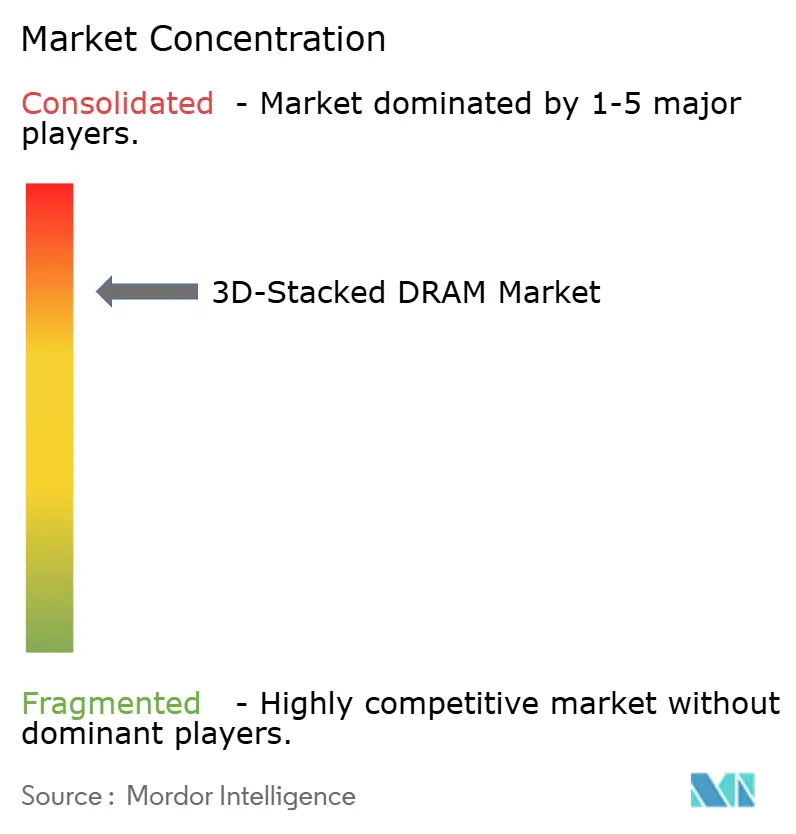
The 3D-Stacked DRAM market is highly concentrated at the production layer, with SK hynix, Samsung, and Micron collectively controlling most HBM supply capacity according to the user-supplied draft. SK hynix held a leading share of global HBM supply, reflecting its early qualification lead on major AI platforms and its ability to turn that timing advantage into a larger share of current demand. Samsung reset its position by becoming the first company to start commercial HBM4 shipments, which brought a clear technology and timing statement into the market. SK hynix also reinforced its standing by completing HBM4 development and preparing mass production, which kept the company at the front of the next product cycle rather than only defending its HBM3E base. This leaves the 3D-Stacked DRAM market unusual in one important way, because it combines very large revenue potential with a supplier structure that is still narrow and heavily qualification-driven.
Micron remains the third scaled player, and its role matters because the 3D-Stacked DRAM market needs a credible third supplier to reduce customer dependence on a two-vendor structure. Micron’s January 2025 groundbreaking for a new HBM advanced packaging facility in Singapore showed that the company is building out not only wafer capability, but also the backend infrastructure needed to participate more fully in stacked memory growth. Samsung’s commercial HBM4 launch, SK hynix’s HBM4 readiness, and Micron’s packaging expansion together form 3 clear strategic moves that define the current competitive phase of the market. A second layer of competition sits below memory fabrication, where advanced packaging firms, tool vendors, and design software providers all influence who can move fastest from qualified design to mass shipment. JEDEC’s HBM4 standard reduces fragmentation at that second layer by aligning the ecosystem around a common interface, channel structure, and compatibility path. That means the 3D-Stacked DRAM market stays concentrated at the top, even while a wider ecosystem competes to support or accelerate those top suppliers.
White-space opportunities in the 3D-Stacked DRAM market are most visible in automotive-grade HBM, custom HBM for hyperscaler ASICs, and hybrid bonding equipment. Automotive remains early because qualification cycles are long and safety requirements are strict, but that same friction can create durable revenue streams once designs are approved. Custom HBM is becoming more important because memory suppliers are moving closer to customer-specific design work, and Samsung’s roadmap for custom HBM samples in 2027 is one practical sign of that shift. The 3D-Stacked DRAM market also leaves room for equipment vendors that can help make hybrid bonding reliable at scale, since packaging performance is now tied directly to future stack heights and thermal targets. Chinese competition remains a longer-horizon variable rather than a near-term threat at the frontier, because export limits and technology gaps still separate local suppliers from the top end of HBM. Even so, the market’s next phase will depend not only on who can build the best stack, but also on who can qualify it quickly, package it efficiently, and align it with the increasingly specific needs of accelerator buyers.
3D-Stacked DRAM Industry Leaders
SK hynix Inc.
Samsung Electronics Co., Ltd.
Micron Technology, Inc.
NVIDIA Corporation
Advanced Micro Devices, Inc.
- *Disclaimer: Major Players sorted in no particular order
3D-Stacked DRAM Market Companies Covered in this Report
- SK hynix Inc.
- Samsung Electronics Co., Ltd.
- Micron Technology, Inc.
- NVIDIA Corporation
- Advanced Micro Devices, Inc.
- Taiwan Semiconductor Manufacturing Company Limited
- ASE Technology Holding Co., Ltd.
- Amkor Technology, Inc.
- Broadcom Inc.
- Marvell Technology, Inc.
- Rambus Inc.
- Cadence Design Systems, Inc.
- Synopsys, Inc.
- Siemens Industry Software Inc.
- IBIDEN Co., Ltd.
- Applied Materials, Inc.
- JCET Group Co., Ltd.

Recent Industry Developments in 3D-Stacked DRAM Market
- April 2026: Siemens Industry Software published its HBM3e and HBM4 IC design guide, providing detailed guidance on HBM4's 2048-bit interface architecture, 32-channel configuration, and 22 TB/s target bandwidth, reflecting the growing importance of EDA toolchain support for co-design workflows between memory manufacturers and accelerator designers.
- March 2026: SK hynix showcased its latest AI memory portfolio, including HBM4 and advanced stacked DRAM technologies, at MWC 2026, highlighting collaborations with ecosystem partners for next-generation AI infrastructure.
- February 2026: Samsung Electronics became the world's first company to begin commercial HBM4 mass production and shipment, delivering 12-high HBM4 at 11.7 Gb/s with 3.3 TB/s per stack bandwidth, 46% above the JEDEC 8 Gbps baseline, to NVIDIA for its Vera Rubin platform. Samsung committed that HBM4E sampling will begin in the second half of 2026 and custom HBM samples will reach customers in 2027,
- January 2026: NVIDIA unveiled the Rubin platform at CES 2026, integrating 288 GB of HBM4 per GPU with 22 TB/s bandwidth, 50 PFLOPS of FP4 inference compute, and 336 billion transistors on TSMC N3, a 5× inference performance improvement over Blackwell.


Global 3D-Stacked DRAM Market Report Scope
The 3D-Stacked DRAM market comprises dynamic random-access memory (DRAM) devices that employ three-dimensional die-stacking technologies to increase memory bandwidth, capacity, and power efficiency while reducing physical footprint. The market includes High Bandwidth Memory (HBM), TSV-stacked conventional DRAM (3DS DDR), Hybrid Memory Cube (HMC), and similar architectures, as well as emerging hybrid-bonded and monolithic 3D DRAM technologies.
The 3D-Stacked DRAM Market Report is Segmented by 3D-Stacked DRAM Type/Architecture (High Bandwidth Memory (HBM), 3DS DDR/TSV-Stacked Conventional DRAM, Hybrid Memory Cube and Similar Architectures, Emerging Hybrid-Bonded and Monolithic 3D DRAM, and Other 3D-Stacked DRAM Types), Memory Capacity per Stack (4 GB, 8 GB, 16 GB, 24 GB, and 32 GB and Above), Processor Interface (GPU, CPU, AI Accelerator/ASIC, FPGA, and Other Interfaces), Application (AI and Data Center Servers, High-Performance Computing, Networking and Telecommunications, Graphics Cards and Workstations, Gaming Systems, Automotive and Edge AI, and Other Applications), and Geography (North America, Europe, Asia-Pacific, and Rest of the World). The Market Forecasts are Provided in Terms of Value (USD).
| High Bandwidth Memory (HBM) |
| 3DS DDR / TSV-Stacked Conventional DRAM |
| Hybrid Memory Cube and Similar Architectures |
| Emerging Hybrid-Bonded and Monolithic 3D DRAM |
| Other 3D-Stacked DRAM Types |
| 4 GB |
| 8 GB |
| 16 GB |
| 24 GB |
| 32 GB and Above |
| GPU |
| CPU |
| AI Accelerator / ASIC |
| FPGA |
| Other Interfaces |
| AI and Data Center Servers |
| High-Performance Computing |
| Networking and Telecommunications |
| Graphics Cards and Workstations |
| Gaming Systems |
| Automotive and Edge AI |
| Other Applications |
| North America | |
| Europe | |
| Asia-Pacific | China |
| Japan | |
| South Korea | |
| Taiwan | |
| Rest of Asia-Pacific | |
| Rest of the World |
| By 3D-Stacked DRAM Type / Architecture | High Bandwidth Memory (HBM) | |
| 3DS DDR / TSV-Stacked Conventional DRAM | ||
| Hybrid Memory Cube and Similar Architectures | ||
| Emerging Hybrid-Bonded and Monolithic 3D DRAM | ||
| Other 3D-Stacked DRAM Types | ||
| By Memory Capacity per Stack | 4 GB | |
| 8 GB | ||
| 16 GB | ||
| 24 GB | ||
| 32 GB and Above | ||
| By Processor Interface | GPU | |
| CPU | ||
| AI Accelerator / ASIC | ||
| FPGA | ||
| Other Interfaces | ||
| By Application | AI and Data Center Servers | |
| High-Performance Computing | ||
| Networking and Telecommunications | ||
| Graphics Cards and Workstations | ||
| Gaming Systems | ||
| Automotive and Edge AI | ||
| Other Applications | ||
| By Geography | North America | |
| Europe | ||
| Asia-Pacific | China | |
| Japan | ||
| South Korea | ||
| Taiwan | ||
| Rest of Asia-Pacific | ||
| Rest of the World | ||


Key Questions Answered in the Report
What is the projected value of the 3D-Stacked DRAM market by 2031?
The 3D-Stacked DRAM market is forecast to reach USD 96.48 billion by 2031, up from USD 24.41 billion in 2026, at a 31.6% CAGR over 2026-2031.
Which architecture leads revenue in 3D-stacked DRAM?
HBM led the market with a 73.6% share in 2025 because AI accelerators depend on high-bandwidth, low-latency memory stacks placed close to logic dies.
Which capacity range is growing the fastest in stacked DRAM?
The 32 GB and Above segment is projected to post the fastest CAGR at 32.7% through 2031 as each new AI accelerator generation requires more memory per package.
Why is Asia-Pacific so dominant in this space?
Asia-Pacific held 66.7% of revenue in 2025 because South Korea houses the leading HBM suppliers and Taiwan remains central to advanced co-packaging and interposer workflows.
Which application is creating the largest demand today?
AI and Data Center Servers led with 47.9% of revenue in 2025, reflecting hyperscaler and cloud spending on AI training and inference hardware.
What is the biggest long-term growth opportunity outside data centers?
Automotive and Edge AI is the fastest-growing application at a 34.2% CAGR, supported by rising memory content in autonomous and intelligent edge platforms.
Page last updated on:





