



Client Background
A Global Biotech Firm, Five Distinct Markets
The client is a world-renowned biotechnology firm specializing in feed additives and advancing innovation in animal health and nutrition. With operations spanning multiple regions, the company commissioned a comprehensive study on the feed probiotics market across the Middle East, Africa, Asia-Pacific, and Europe to strengthen its market intelligence and global strategy.
The Challenge
From A Regional Overview to Five Answerable Questions
The client’s original brief, "Give us a market picture across five countries," became five specific questions our team needed to resolve within 10 weeks:
- What is the actual ratio of large-scale to small-scale farms in the United States, India, Brazil, Germany, and South Africa, and does that ratio dictate a direct-sales or distributor-led model in each market?
- Which corporate players and large-scale farm networks dominate each market, and where is competitive concentration low enough to enter profitably?
- Which feed millers control the largest share of volume in each region, and can we obtain verified, contactable records for the top players?
- Where do regulatory and import or export dynamics create a near-term opening, or a blocker, for entry in the next 12–18 months?
- Of the five markets, which single market offers the strongest ratio of opportunity size to competitive intensity for a first-mover launch?
Without country-specific answers to these questions, the client risked entering the wrong market first, or the right market with the wrong distribution model, in a category where a first move is expensive to reverse, given long distributor lock-in cycles.
Methodology
A Four-part Research Program, Run Over 10 Weeks

What We Delivered
From A Farm-structure Ratio to A Market-entry Decision
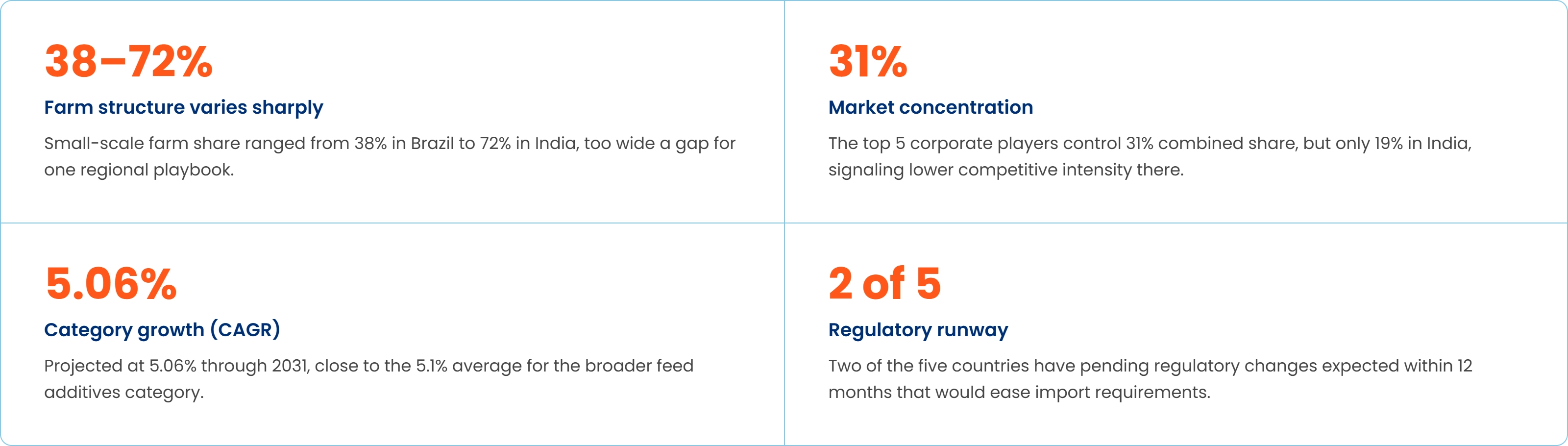
The farm-structure mapping surfaced a specific, decision-relevant finding: small-scale farms represented a far greater share of operations in India than in Brazil, a gap wide enough that the two markets needed fundamentally different go-to-market models despite similar total size.
72% of farms in India were small-scale, versus just 38% in Brazil: nearly double, despite a similar total market size.
Based on this, the client prioritized India for first-market entry and committed to a decentralized dealer-network model rather than the direct-sales approach used in its existing markets, beginning outreach to 18 of the 520 feed millers identified as highest priority.
Key Findings
Every Finding, Benchmarked Across Markets
Business Impact
With The Research as The Evidence Base, The Client:
- Prioritized India for first-market entry: Projected to unlock $17.8M in incremental distribution revenue over 3 years.
- Adopted a decentralized dealer-network model: For India specifically, diverging from the direct-sales approach used elsewhere, based directly on the farm-structure finding.
- Began outreach to 18 of the 520 verified feed millers: With 7 distribution conversations underway within 60 days of the final readout.
In Their Words
- Global Product Manager, Animal Nutrition & Feed Additives, Leading Global Animal Nutrition Company


