
Wooden Toys Market Size and Share
Market Overview
| Study Period | 2022 - 2032 |
|---|---|
| Market Size (2027) | USD 30.76 Billion |
| Market Size (2032) | USD 39 Billion |
| Growth Rate (2027 - 2032) | 4.86 % |
| Fastest Growing Market | Asia-Pacific |
| Largest Market | North America |
| Market Concentration | Medium |
Major Players *Disclaimer: Major Players sorted in no particular order Image © Mordor Intelligence. Reuse requires attribution under CC BY 4.0. | |
Wooden Toys Market Analysis by Mordor Intelligence
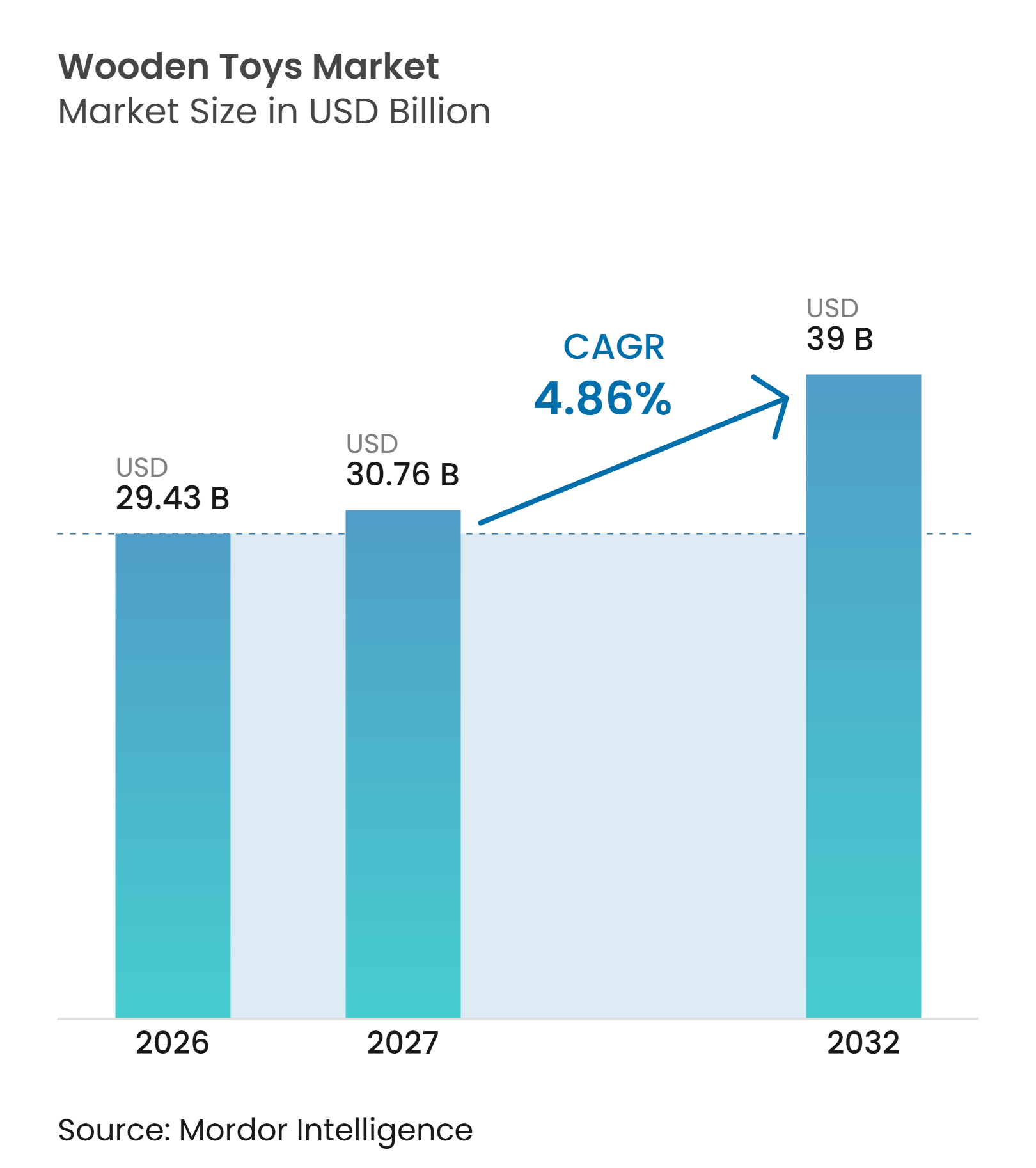
The wooden toys market size was valued at USD 29.43 billion in 2026 and is estimated to grow from USD 30.76 billion in 2027 to reach USD 39.00 billion by 2032, at a CAGR of 4.86% during the forecast period (2027-2032). Demand is shifting toward tactile, screen-free products with clear developmental benefits and safety credentials. Certifications, product traceability, and credible educational positioning are becoming central to brand strategies. These trends create opportunities for specialists offering verified materials and clearly substantiated product claims, while increasing costs for smaller suppliers. Supply concentration in China and rising trade costs remain significant risks for the wooden toys market.
Key Report Takeaways
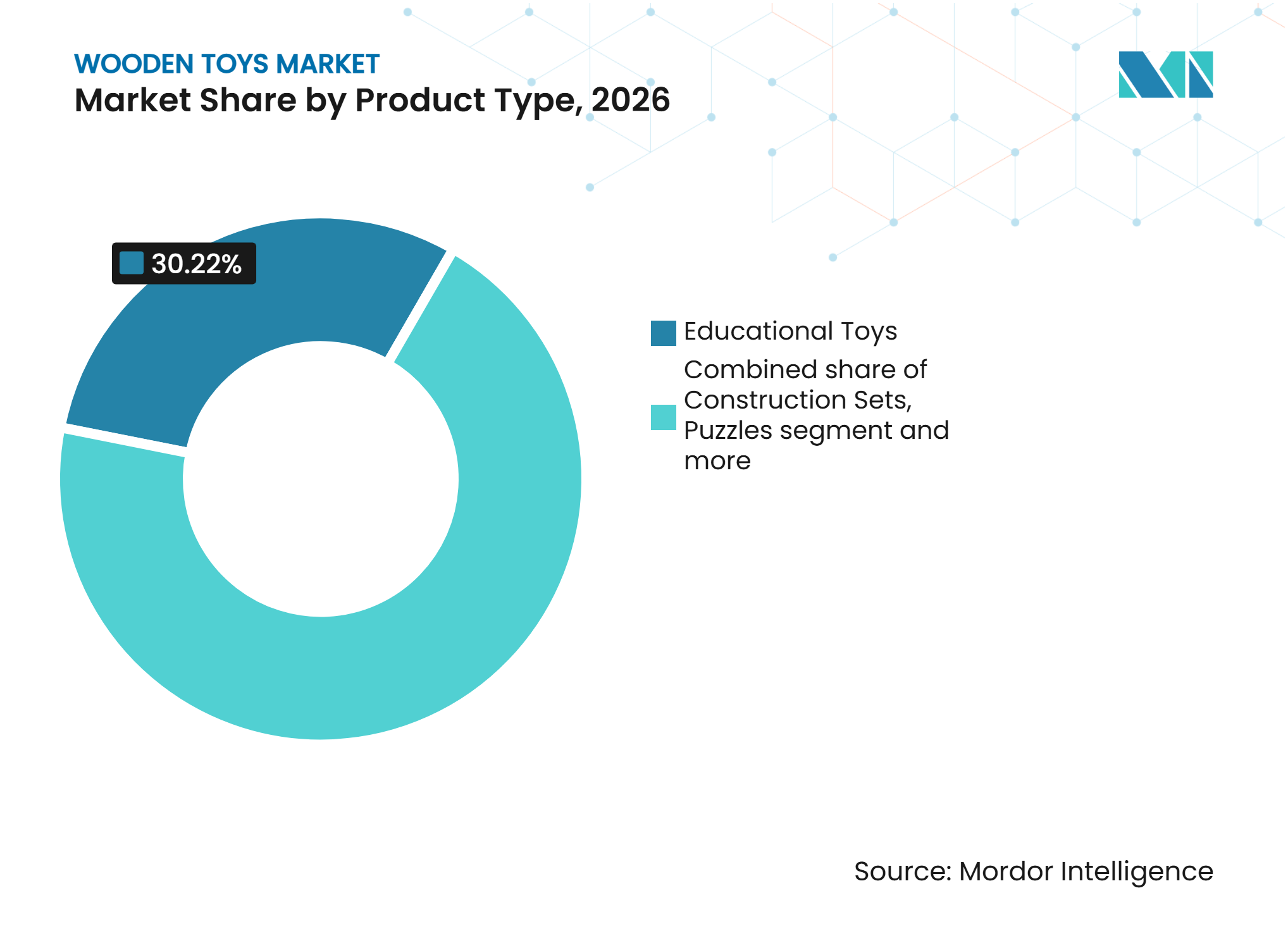
- By product type, educational toys held 30.22% of the wooden toys market share in 2026, while construction sets are projected to grow at a CAGR of 6.02% during 2027-2032.
- By age group, children/teenagers (2-18 years) held 61.32% of the market share in 2026 and are also forecast to be the fastest-growing segment, expanding at a CAGR of 5.62% during 2027-2032.
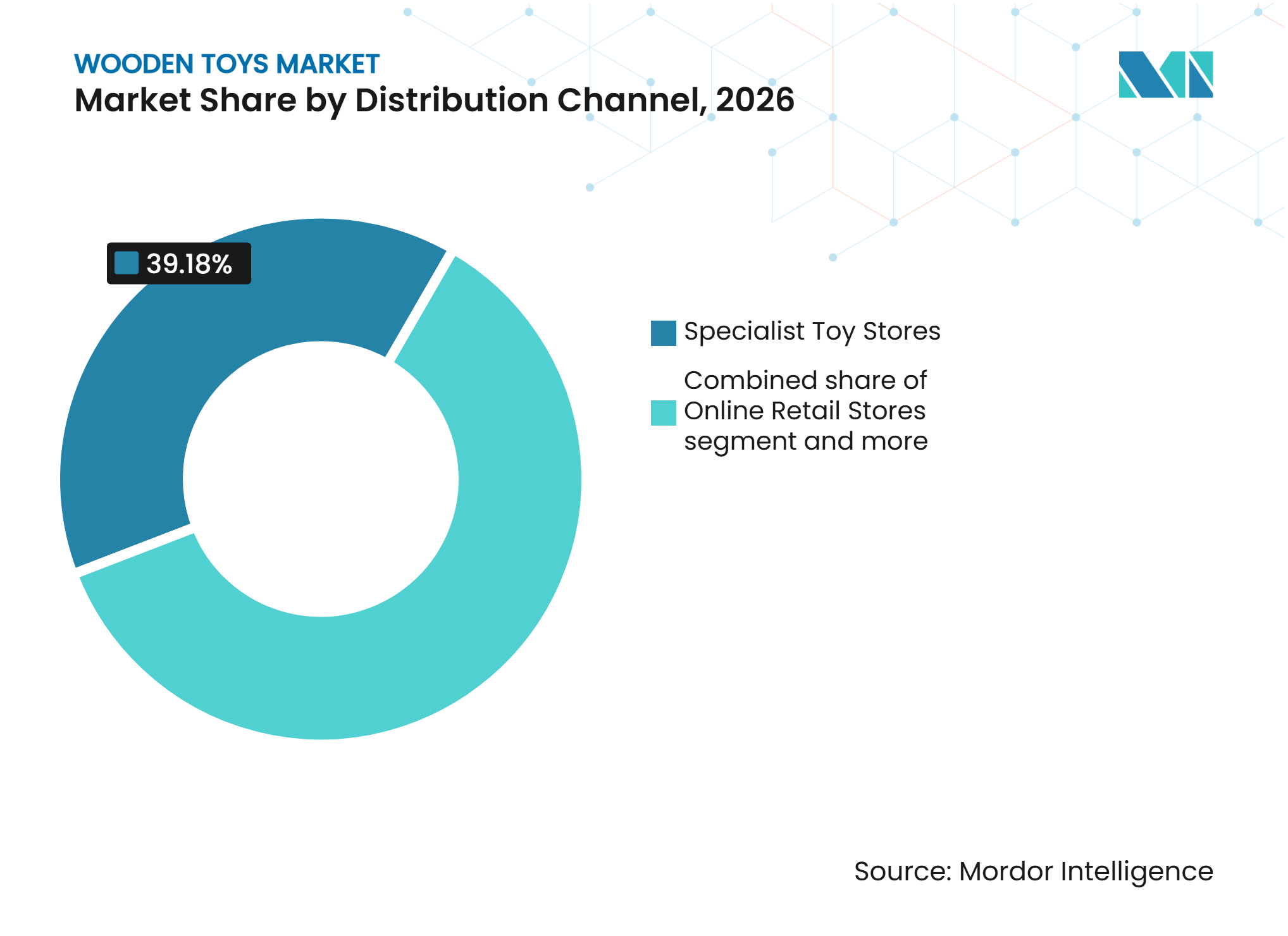
- By distribution channel, specialist toy stores held 39.18% of the market share in 2026, while online retail stores are forecast to expand at a CAGR of 6.26% during 2027-2032.
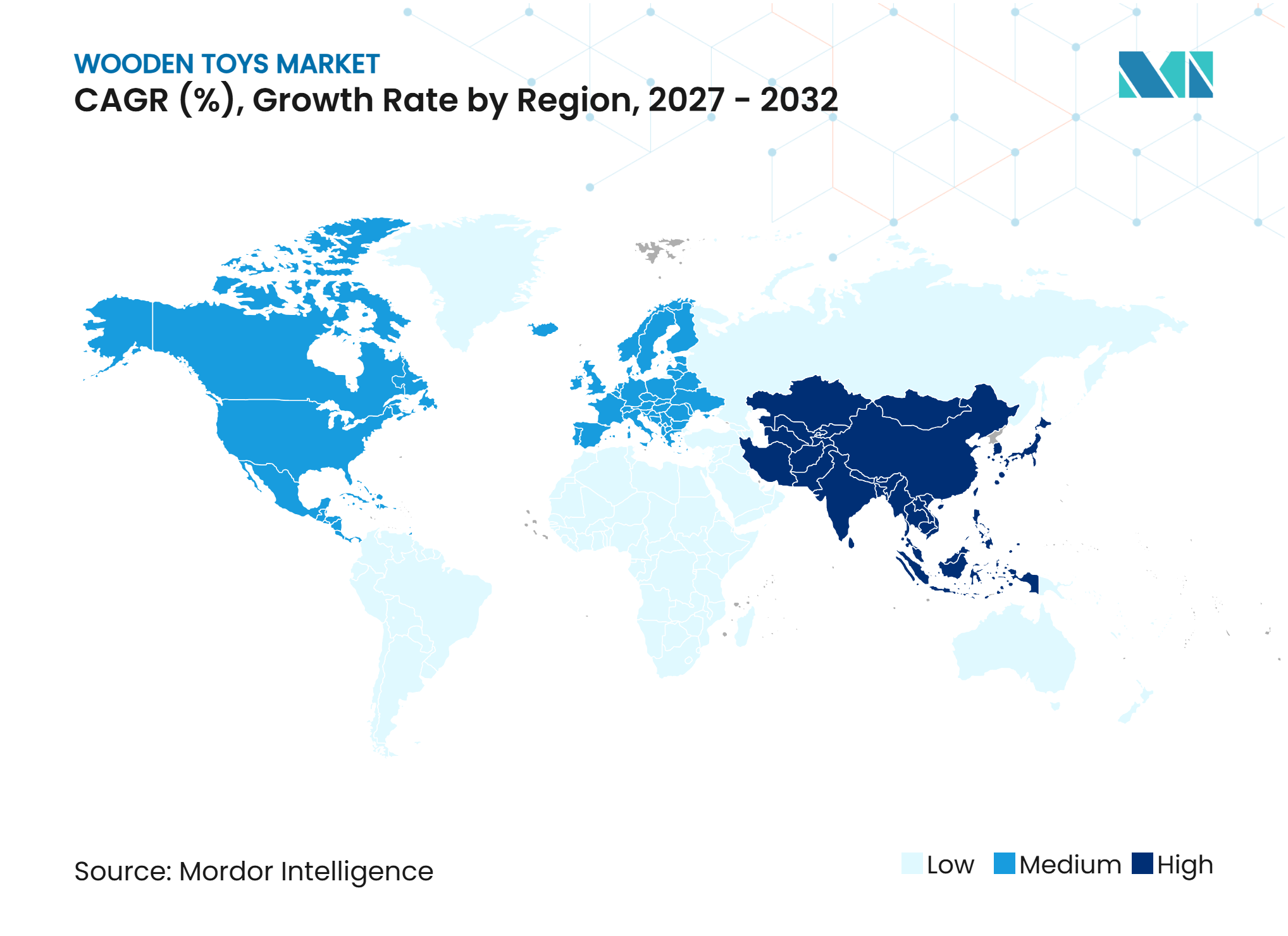
- By geography, North America held 37.68% of the wooden toys market share in 2026, while Asia-Pacific is forecast to be the fastest-growing region, expanding at a CAGR of 6.44% during 2027-2032.
Note: Market numbers in this report are based on Mordor Intelligence's proprietary estimation framework, which combines nine months of actuals with Q4 projections for base year 2026.
Market Trends and Insights
Drivers Impact Analysis of Wooden Toys Market*
| Driver | (~) % Impact on CAGR Forecast | Geographic Relevance | Impact Timeline |
|---|---|---|---|
| Consumer preference for sustainable and eco-friendly toys | +1.0% | Global, led by North America and Europe | Medium term (2-4 years) |
| Increasing parental focus on educational and developmental toys | +1.2% | Global, strongest in North America and Europe | Long term (≥ 4 years) |
| Expansion of Montessori and Waldorf education practices | +0.7% | North America, Europe, expanding to Asia-Pacific core | Medium term (2-4 years) |
| Rising concerns regarding chemical exposure and toy safety | +0.5% | Global, compliance-driven in Europe and North America | Short term (≤ 2 years) |
| Demand for screen-free and tactile play experiences | +0.4% | Global, most pronounced in North America and Europe | Long term (≥ 4 years) |
| Expansion of e-commerce and direct-to-consumer distribution | +0.6% | Global, particularly Asia-Pacific and North America | Short term (≤ 2 year |
| Source: Mordor Intelligence | |||
Consumer Preference for Sustainable and Eco-Friendly Toys
Sustainability is becoming a key purchasing requirement in premium toy retail. Consumers increasingly seek Forest Stewardship Council (FSC) certification, water-based paint declarations, and Program for the Endorsement of Forest Certification (PEFC) chain-of-custody records. A March 2025 study by the Netherlands-based Center for the Promotion of Imports found that 60% of British adults consider sustainable forest sourcing important for wood-based children’s products[1]. Forest Stewardship Council (FSC) Mix labels include certified and controlled wood; therefore, brands need to communicate their sourcing practices clearly as buyer awareness increases. The digital product passport under the European Union (EU) Toy Safety Regulation will further increase the importance of material traceability across the wooden toys market.
Increasing Parental Focus on Educational and Developmental Toys
Growing parental emphasis on early childhood education and cognitive development is driving demand for wooden toys that combine entertainment with learning outcomes. Parents increasingly prioritize products that promote problem-solving, creativity, hand-eye coordination, motor skills, and logical thinking over conventional entertainment-focused toys. Wooden puzzles, building blocks, shape sorters, counting boards, and construction sets remain particularly popular, as they facilitate hands-on learning, independent exploration, and imaginative play. Additionally, the growing adoption of Montessori-inspired learning methods supports demand for tactile and open-ended wooden toys across households, preschools, and early learning centers.
Expansion of Montessori and Waldorf Education Practices
The growing adoption of child-centered educational approaches, including Montessori and Waldorf-inspired learning practices, is driving demand for wooden toys that promote hands-on exploration, creativity, sensory development, and independent learning. These approaches emphasize practical activities, open-ended play, and interaction with physical learning materials, increasing demand for wooden building blocks, stacking toys, puzzles, sorting boards, and pretend-play products. Government initiatives that promote play-based early childhood education further support this trend. In March 2024, India’s Ministry of Women and Child Development highlighted the integration of early childhood care and education (ECCE) through Anganwadi centers, Balvatika, and preschool institutions, thereby reinforcing play-based learning for children aged 3-8 years[2]. The growing emphasis on structured early learning and activity-based education is creating opportunities for wooden toy manufacturers serving households, preschools, and early learning institutions.
Rising Concerns Regarding Chemical Exposure and Toy Safety
Growing parental awareness of chemical hazards in children's products is driving demand for wooden toys made with safe raw materials, non-toxic paints, and chemical-compliant surface coatings. Concerns about exposure to lead, heavy metals, and other potentially harmful substances are influencing purchasing decisions, particularly for products intended for infants and toddlers, who frequently put toys in their mouths. In January 2026, the United States Government Accountability Office (GAO) published a report highlighting the Consumer Product Safety Commission's (CPSC) efforts to identify children's products containing toxic substances through port inspections, lead screening, and verification of third-party laboratory testing[3]. These safety concerns are prompting wooden toy manufacturers to strengthen material selection, product testing, and quality control procedures, thereby supporting demand for safer, compliant wooden toys.
Restraints Impact Analysis of Wooden Toys Market*
| Restraint | (~) % Impact on CAGR Forecast | Geographic Relevance | Impact Timeline |
|---|---|---|---|
| Higher manufacturing costs compared to plastic toys | -0.5% | Global, most acute in mass-market segments | Medium term (2-4 years) |
| Limited availability and price volatility of quality wood | -0.4% | Global supply chain, acute in Asia-Pacific export hubs | Medium term (2-4 years) |
| Competition from low-cost plastic and electronic toys | -0.6% | Emerging markets, South America, Middle East and Africa, and Asia-Pacific periphery | Long term (≥ 4 years) |
| Limited product functionality and design flexibility | -0.3% | Global, most visible in the 8-14 age group | Long term (≥ 4 years) |
| Source: Mordor Intelligence | |||
Higher Manufacturing Costs Compared to Plastic Toys
Wooden toy manufacturing typically incurs higher production costs than plastic toy manufacturing due to the use of premium timber, specialized woodworking equipment, and skilled labor. Processes such as cutting, carving, sanding, polishing, and applying non-toxic finishes increase production time and operational expenses. Manufacturers must also maintain consistent wood quality and apply careful finishing to ensure product safety and durability. These factors raise the retail prices of wooden toys relative to mass-produced plastic alternatives, reducing their affordability for price-sensitive consumers. Consequently, high manufacturing costs may constrain mass-market penetration and limit the competitiveness of wooden toys.
Limited Availability and Price Volatility of Quality Wood
Forestry regulations, sustainable harvesting practices, seasonal supply fluctuations, and competition from the furniture and construction industries influence the availability of quality timber for wooden toy manufacturing. Manufacturers require specific wood varieties with sufficient strength, durability, and smooth textures to maintain product quality and ensure child safety. Limited access to certified, sustainably sourced timber creates procurement challenges, particularly for small and medium-sized manufacturers. Fluctuations in raw wood prices, transportation expenses, and processing costs increase overall production costs. Dependence on selected timber suppliers and imported wood varieties further exposes manufacturers to supply chain uncertainties. These factors can disrupt production planning, compress profit margins, and raise the final prices of wooden toys, potentially limiting market expansion.
*Our forecasts treat driver/restraint impacts as directional, not additive. The impact forecasts reflect baseline growth, mix effects, and variable interactions.
Wooden Toys Market Segment Analysis
By Product Type:
Educational Toys Lead as Montessori Credentials Drive Category PremiumizationEducational toys accounted for 30.22% of the wooden toys market share in 2026. This category aligns with demand for developmental play, Montessori-style products, and documented material safety. Early-learning settings and households use sorting boards, number rods, and open-ended building kits. Growing emphasis on early childhood education is further supporting the adoption of wooden products that encourage problem-solving, creativity, and independent learning. Manufacturers are also introducing multifunctional educational toys that combine entertainment with cognitive and motor-skill development.
The construction sets segment of the wooden toys market is projected to grow at a CAGR of 6.02% through 2032. Construction brands can extend product life cycles by offering play experiences that become more challenging as children age. Puzzles are also shifting toward premium material offerings. Vehicles continue to experience stable demand among toddlers, while dolls and miniatures remain relevant for gifting. Their gender-neutral designs broaden household appeal while maintaining sustainable material positioning. Increasing interest in STEM-based learning and hands-on activities is further supporting demand for wooden construction kits, interlocking blocks, and engineering-inspired building products. These products also encourage spatial reasoning, creativity, and collaborative play, strengthening their relevance across different childhood age groups.



By Age Group:
Children/Teenagers Drive Volume While Screen-Free Parenting Anchors SpendingChildren/teenagers aged 2 to 18 accounted for 61.32% of the wooden toys market in 2026 and are projected to expand at a CAGR of 5.62% through 2032. This is the only segment in which the largest group is also the fastest-growing. The segment includes Montessori-oriented materials for toddlers and construction-focused products for older children. Spending remains strongest among children aged 2 to 8, as parents often prioritize tactile, screen-free activities. These products offer manufacturers opportunities to develop age-specific designs that support distinct developmental and learning requirements.
The infant and toddler category has a smaller volume base but commands a higher unit price. Gifting occasions and safety requirements support demand for well-finished wooden products within this group. Products for older children require greater construction complexity, narrative play features, or collectible value to compete with electronic toys. The collectors-and-adults category remains a premium gifting niche. Brands serving these age groups need to clearly communicate the intended play value across retail shelves and online channels, as the same wooden materials can support different purchase motivations. Product differentiation through premium craftsmanship, personalized designs, and durable finishes can further strengthen appeal among consumers purchasing wooden toys for gifting and collecting purposes.
By Distribution Channel:
Specialist Stores Hold the Discovery Role as Online Retail Scales FastestSpecialty toy stores accounted for 39.18% of the wooden toys market share in 2026, supported by their specialized product assortments, personalized customer assistance, and opportunities for in-store product evaluation. These outlets remain important because consumers can assess material quality, surface finishes, durability, and safety features before making a purchase. Staff recommendations also help parents understand the educational benefits, age suitability, and developmental value of higher-priced wooden toys. In addition, specialty retailers often stock premium, handcrafted, and Montessori-inspired products that may be less widely available through general retail outlets.
Online retail stores are projected to expand at a CAGR of 6.26% during 2027-2032, driven by broader product accessibility and the continued expansion of digital shopping platforms. Online channels benefit the wooden toys market by providing direct access to manufacturers, detailed product descriptions, customer reviews, and certification-based product information. This distribution channel is particularly valuable for specialized brands and small manufacturers that cannot secure extensive physical retail distribution. Furthermore, direct-to-consumer websites and targeted digital marketing allow wooden toy manufacturers to reach niche consumer groups and expand their geographic presence without relying entirely on traditional retail networks.

Geography Analysis
North America
North America accounted for 37.68% of the wooden toys market share in 2026. The United States leads regional demand, as consumers increasingly view wooden toys as both educational products and sustainable purchasing options. Montessori programs and early-learning settings generate institutional demand in addition to household purchases. Canadian childcare support may facilitate institutional procurement, while Mexico represents an emerging growth opportunity in the region. Additionally, the presence of established toy brands, specialized retailers, and well-developed e-commerce networks supports product availability and market penetration across the region.
Asia-Pacific
Asia-Pacific is projected to grow at a CAGR of 6.44% during 2027-2032 in the wooden toys market. Rising parental spending on children's educational products, the expansion of early childhood education facilities, and growing awareness of sustainable play materials support regional demand. China, India, Japan, and Australia contribute to this demand through the increasing adoption of educational toys, Montessori-inspired learning products, and traditional wooden playsets. Additionally, the expansion of organized retail channels and e-commerce platforms improves access to domestic and international wooden toy brands. Growing investments in toy manufacturing capabilities, particularly in China and India, further support regional production and product availability.
North America, South America, and the Middle East and Africa
North America remains a significant market for wooden toys, driven by established toy manufacturers, strong consumer purchasing power, and growing demand for educational and sustainable children's products. The region benefits from broad product availability through specialty toy retailers, supermarkets, and e-commerce platforms. South America is an emerging market, with demand supported by urban population growth, rising awareness of early childhood education, and broader availability of affordable wooden play products. In the Middle East and Africa, market opportunities are driven by expanding retail infrastructure, rising investment in early learning facilities, and demand for premium children's products in urban centers.
Competitive Landscape
Market Concentration
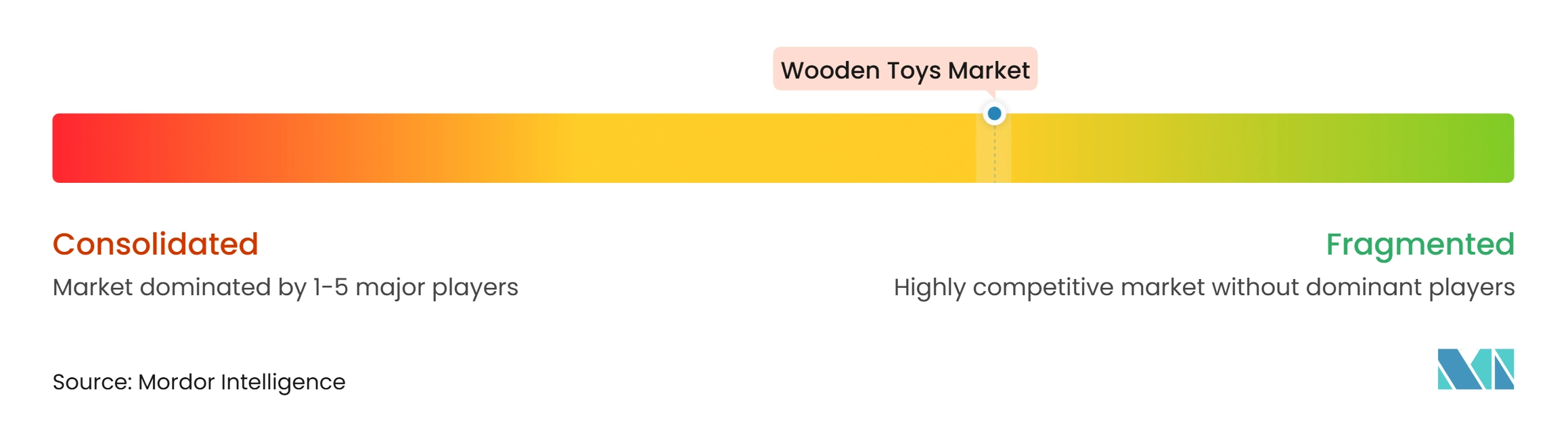
The wooden toys market is moderately fragmented, with specialist brands serving distinct product and price niches. Hape International AG, BRIO AB, PlanToys, KidKraft, Inc., HABA, and other suppliers hold notable market positions. Global-scale companies leverage broad manufacturing capabilities and extensive retail access, while boutique brands emphasize product provenance, craftsmanship, and design. Hape made a presence in 100 countries during its 40th anniversary year in 2026. Vilac highlights its French wooden-toy heritage, BAJO manufactures handcrafted products in Poland, and Grimm’s is recognized for its open-ended designs. This market structure creates opportunities for mid-tier suppliers that can establish trusted certification and distribution networks.
Distribution expansion has become a key competitive strategy. In January 2026, SMART Toys & Games became Hape’s exclusive distributor in the United Kingdom and Ireland. Hape has also identified its alliances with Eurekakids and Toy Planet in Spain as part of its strategy to expand its retail network. These initiatives reduce reliance on organic shelf-space expansion. The wooden toys market increasingly rewards verifiable environmental claims over broad sustainability messaging. Partnerships with specialized retailers and regional distributors also enable manufacturers to enhance product visibility, reach new customer segments, and strengthen their international market presence.
Supply diversification is also shaping competition. Investments in compliance with Regulation (EU) 2025/2509 further strengthened companies that already possess testing and product-documentation capabilities. Manufacturers are also focusing on supplier diversification, production efficiency, and quality-control systems to manage raw material uncertainties and maintain consistent product standards across international markets. Additionally, developing long-term relationships with certified timber suppliers can help manufacturers improve procurement stability, minimize supply disruptions, and maintain compliance with international sustainability and safety requirements.
Wooden Toys Industry Leaders
-
Hape International AG
-
BRIO AB
-
Ravensburger AG
-
Shumee India
-
Gollnest & Kiesel KG
- *Disclaimer: Major Players sorted in no particular order
Wooden Toys Market Companies Covered in this Report
- Hape International AG
- BRIO AB
- PlanToys
- Shumee India
- Ravensburger AG
- HABA
- Gollnest & Kiesel KG
- KidKraft, Inc.
- Bigjigs Toys
- Le Toy Van
- Tender Leaf Toys
- EverEarth
- The Manhattan Toy Company
- Tegu
- Vilac
- Grimm's Spiel und Holz Design
- BAJO
- Guidecraft
- Maple Landmark Woodcraft
- Margarete Ostheimer GmbH
Recent Industry Developments in Wooden Toys Market
- January 2026: Mookie Toys partnered with Magic Light Pictures to launch a Gruffalo-themed wooden toy collection. The range includes wooden educational clocks, drawing slates, blackboards, and character figures designed to encourage storytelling and creative play.
- September 2025: BRIO launched BRIO Flora across Sweden, Denmark, Norway, Finland, Germany, and Italy, featuring 18 products combining magnetic interactive figures and modular wooden structures
- June 2025: Hape International formed a joint venture with iTech Plast to establish India’s first modern wooden toy manufacturing facility in Gujarat. The facility is fully certified under India’s Toys Quality Control Order.
Global Wooden Toys Market Report Scope
Wooden toys are play products manufactured primarily from natural or processed wood, designed to provide entertainment, education, creativity, and developmental benefits to children.
The wooden toys market is segmented by product type, age group, and distribution channel. By product type, the market is segmented into educational toys, construction sets, puzzles, vehicles, dolls and miniatures, and other product types. By age group, the market is segmented into infant and toddler (below 2 years), children/teenager (2-18 years), and collectors and adults (above 18 years). By distribution channel, the market is segmented into supermarkets/hypermarkets, specialist toy stores, online retail stores, and other distribution channels. By geography, the market is segmented into North America, Europe, Asia-Pacific, South America, and the Middle East and Africa. The market forecasts are provided in terms of value (USD).
Segmentation Overview
| Educational Toys |
| Construction Sets |
| Puzzles |
| Vehicles |
| Dolls and Miniatures |
| Other Product Types |
| Infant and Toddler (Below 2 Years) |
| Children/Teenager (2-18 Years) |
| Collectors and Adult (Above 18 Years) |
| Supermarkets/Hypermarkets |
| Specialist Toy Stores |
| Online Retail Stores |
| Other Distribution Channels |
| North America | United States |
| Canada | |
| Mexico | |
| Rest of North America | |
| Europe | Germany |
| United Kingdom | |
| Italy | |
| France | |
| Spain | |
| Poland | |
| Belgium | |
| Netherlands | |
| Rest of Europe | |
| Asia-Pacific | China |
| India | |
| Japan | |
| Australia | |
| Indonesia | |
| Thailand | |
| Singapore | |
| Rest of Asia-Pacific | |
| South America | Brazil |
| Argentina | |
| Peru | |
| Colombia | |
| Rest of South America | |
| Middle East and Africa | South Africa |
| Saudi Arabia | |
| United Arab Emirates | |
| Egypt | |
| Turkey | |
| Rest of Middle East and Africa |
| By Product Type | Educational Toys | |
| Construction Sets | ||
| Puzzles | ||
| Vehicles | ||
| Dolls and Miniatures | ||
| Other Product Types | ||
| By Age Group | Infant and Toddler (Below 2 Years) | |
| Children/Teenager (2-18 Years) | ||
| Collectors and Adult (Above 18 Years) | ||
| By Distribution Channel | Supermarkets/Hypermarkets | |
| Specialist Toy Stores | ||
| Online Retail Stores | ||
| Other Distribution Channels | ||
| By Geography | North America | United States |
| Canada | ||
| Mexico | ||
| Rest of North America | ||
| Europe | Germany | |
| United Kingdom | ||
| Italy | ||
| France | ||
| Spain | ||
| Poland | ||
| Belgium | ||
| Netherlands | ||
| Rest of Europe | ||
| Asia-Pacific | China | |
| India | ||
| Japan | ||
| Australia | ||
| Indonesia | ||
| Thailand | ||
| Singapore | ||
| Rest of Asia-Pacific | ||
| South America | Brazil | |
| Argentina | ||
| Peru | ||
| Colombia | ||
| Rest of South America | ||
| Middle East and Africa | South Africa | |
| Saudi Arabia | ||
| United Arab Emirates | ||
| Egypt | ||
| Turkey | ||
| Rest of Middle East and Africa | ||
Key Questions Answered in the Report
What is the current size and future growth outlook of the wooden toys market?
The wooden toys market was valued at USD 29.43 billion in 2026 and is estimated to reach USD 30.76 billion in 2027. The market is projected to grow to USD 39.00 billion by 2032, registering a CAGR of 4.86% during 2027-2032.
Which product type held the largest share of the wooden toys market in 2026?
Educational toys was the largest product type segment in 2026, accounting for 30.22% of the wooden toys market.
Which age group held the largest share of the wooden toys market in 2026?
Children/Teenagers (2–18 Years) represented the largest age group in 2026, accounting for 61.32% of the wooden toys market.
Which distribution channel dominated the wooden toys market in 2026?
Specialist toy stores dominated the distribution channel segment in 2026, accounting for 39.18% of the market share.
Which region held the largest share of the wooden toys market in 2026?
North America held the largest geographical share in 2026, accounting for 37.68% of the wooden toys market.