
Wetroom Waterproofing Solutions Market Size and Share
Market Overview
| Study Period | 2022 - 2032 |
|---|---|
| Market Size (2027) | USD 7.63 Billion |
| Market Size (2032) | USD 9.96 Billion |
| Growth Rate (2027 - 2032) | 5.48 % |
| Fastest Growing Market | Asia-Pacific |
| Largest Market | Europe |
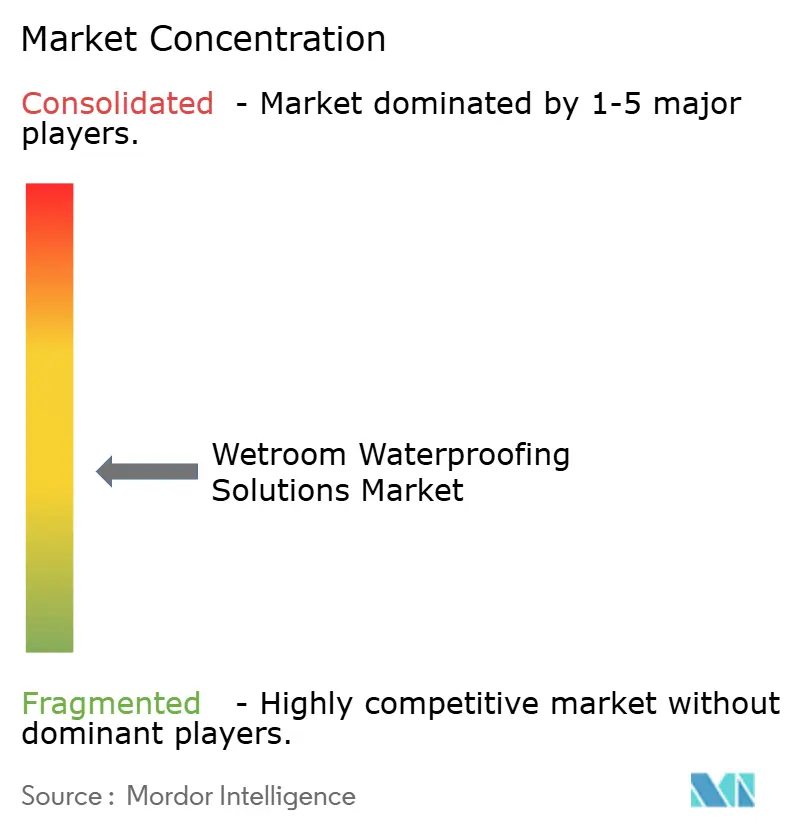
| Market Concentration | Medium |
Major Players *Disclaimer: Major Players sorted in no particular order Image © Mordor Intelligence. Reuse requires attribution under CC BY 4.0. | |
Wetroom Waterproofing Solutions Market Analysis by Mordor Intelligence
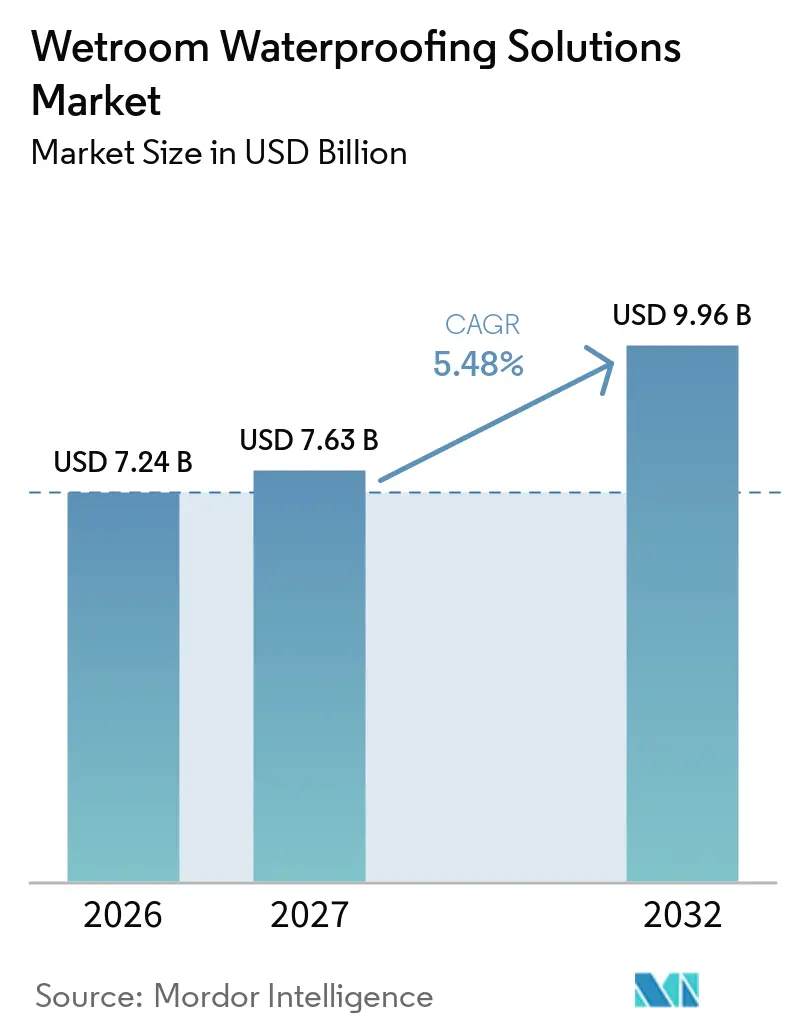
The Wetroom Waterproofing Solutions Market size was valued at USD 7.24 billion in 2026 and is estimated to grow from USD 7.63 billion in 2027 to reach USD 9.96 billion by 2032, at a CAGR of 5.48% during the forecast period (2027-2032). The wetroom waterproofing solutions market is supported by bathroom renovation spending in Europe and new residential construction across Asia-Pacific. Certified bonded systems are becoming more important as building rules in Germany, the United Kingdom, and the European Union place more emphasis on moisture control, traceability, and documented product performance. Suppliers are responding with integrated systems that combine membranes, boards, drainage elements, sealants, and installation support under one warranty. This approach can reduce responsibility gaps between trades while helping installers meet the documentation expected in regulated projects. Demand also benefits from the need for accessible bathrooms, since step-free layouts require more extensive floor and wall protection than enclosed shower trays.
Key Report Takeaways
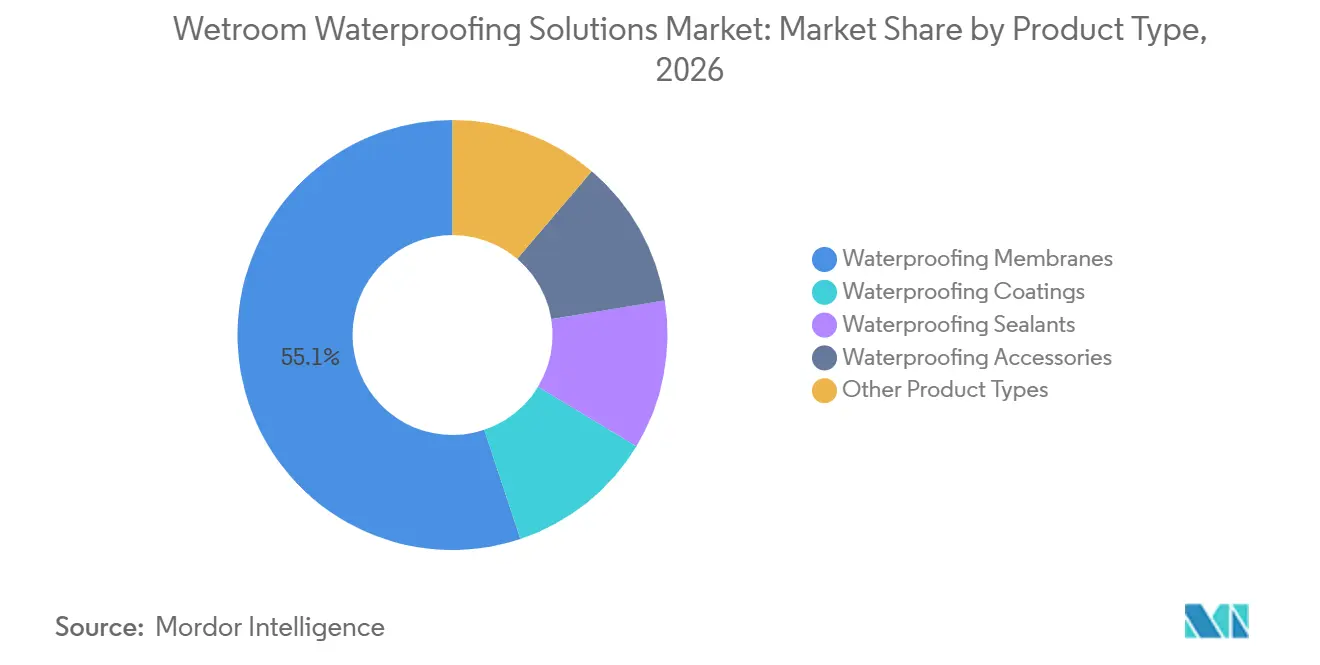
- By product type, waterproofing membranes held 55.13% of the wetroom waterproofing solutions market share in 2026, while waterproofing accessories are forecast to advance at a 5.96% CAGR through 2032.
- By technology, liquid-applied membranes held 40.78% of the wetroom waterproofing solutions market share in 2026, while pre-waterproofed substrates are forecast to advance at a 6.17% CAGR through 2032.
- By application, bathrooms held 39.19% of the wetroom waterproofing solutions market share in 2026, while shower areas are forecast to advance at a 6.33% CAGR through 2032.
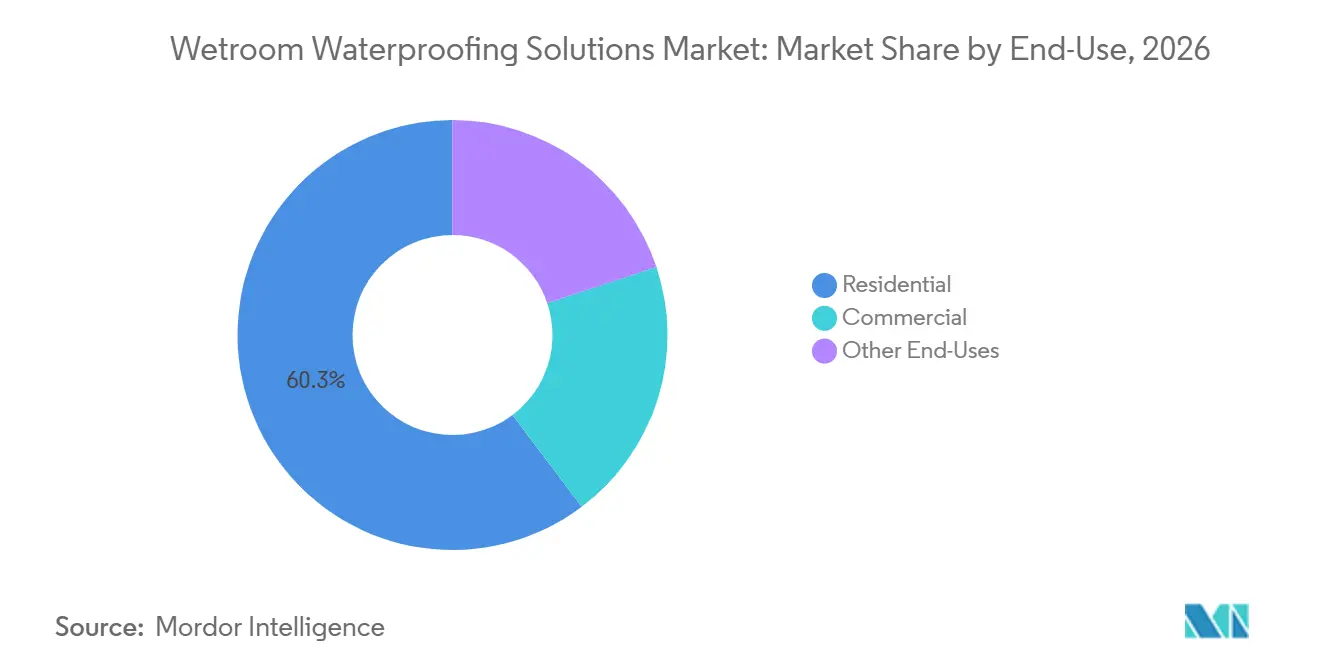
- By end-use, residential held 60.26% of the wetroom waterproofing solutions market share in 2026, while commercial is forecast to advance at a 6.88% CAGR through 2032.
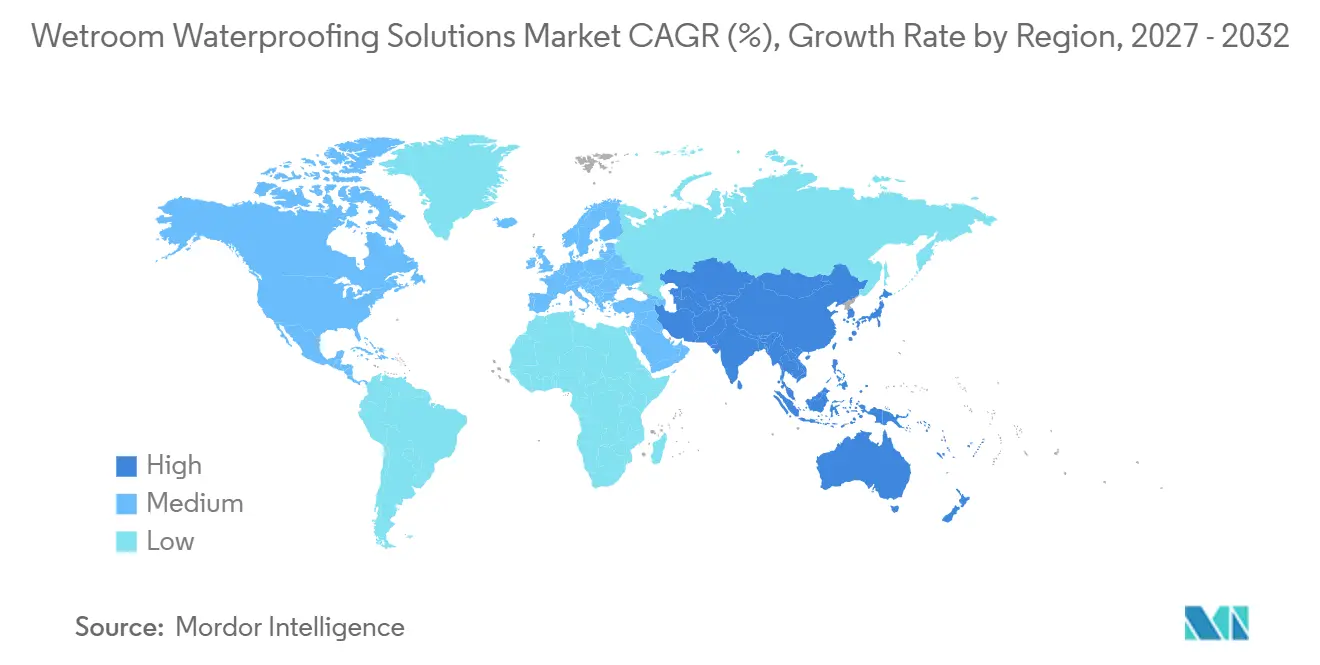
- By geography, Europe held 35.34% of the wetroom waterproofing solutions market share in 2026, while Asia-Pacific is forecast to advance at a 6.69% CAGR through 2032.
Note: Market numbers in this report are based on Mordor Intelligence's proprietary estimation framework, which combines nine months of actuals with Q4 projections for base year 2026.
Market Trends and Insights
Drivers Impact Analysis of Wetroom Waterproofing Solutions Market*
| Driver | (~) % Impact on CAGR Forecast | Geographic Relevance | Impact Timeline |
|---|---|---|---|
| Rising Wetroom Adoption in Residential Renovation | +1.5% | Global, concentrated in Europe and North America | Medium term (2-4 years) |
| Stricter Moisture Protection and Building Compliance Requirements | +1.2% | Europe, North America, with spillover to APAC | Short term (≤ 2 years) |
| Growth of Prefabricated and Modular Bathroom Construction | +0.9% | Global, particularly APAC, Europe, and North America | Medium term (2-4 years) |
| Demand for Low-Maintenance and Mold-Resistant Bathrooms | +0.7% | Global | Medium term (2-4 years) |
| Installer Productivity Gains From Ready-to-Use and Single-Source Systems | +0.5% | Global | Long term (≥ 4 years) |
| Source: Mordor Intelligence | |||
Rising Wetroom Adoption in Residential Renovation
The wetroom waterproofing solutions market gains support as homeowners replace enclosed shower trays with walk-in and low-threshold layouts. These layouts need waterproofing across a broader floor area and at wall transitions, which raises material use for each project. Accessible design also matters for older residents who want to remain in their homes as mobility needs change. Full wetroom assemblies can provide a continuous surface that is easier to clean and less dependent on a raised shower entry. Professional installation remains important because drainage falls, seams, and penetrations need to work together as a complete assembly. This supports the wetroom waterproofing solutions market where suppliers pair materials with technical guidance, installer education, and clear system documentation.
Stricter Moisture Protection and Building Compliance Requirements
Germany revised DIN (Deutsches Institut für Normung) 18534 in October 2025, with more detailed requirements for internal wet-area waterproofing, water-exposure classifications, drainage, penetrations, and pre-waterproofed substrates used in modular wetrooms. The revised standard raises the value of materials that have documented performance in defined use conditions. In the United Kingdom, wetroom systems in new homes must align with National House-Building Council requirements where applicable, strengthening demand for assessed bonded systems. The European Union Construction Products Regulation, Regulation (EU) 2024/3110, entered into force in January 2025 and supports greater product information and sustainability transparency across construction products[1]. These compliance factors make it harder for suppliers to compete solely on a low unit price. They also strengthen the wetroom waterproofing solutions market for documented, compatible systems.
Growth of Prefabricated and Modular Bathroom Construction
Prefabricated bathrooms move waterproofing work from project sites into controlled factory settings. This can reduce weather exposure, schedule disruption, and variation in the installation sequence. Pre-waterproofed boards and shower elements help manufacturers assemble panels, drains, and tile-ready surfaces before delivery. The wetroom waterproofing solutions market therefore benefits when pod builders seek standardized materials with repeatable installation instructions. Wedi GmbH offers system components for this type of construction, including waterproof building boards and flush-to-floor shower elements. Factory production also increases the importance of traceability because a defect can affect repeated units across a project. Suppliers that can provide tested system combinations are better positioned to serve pod producers and large contractors.
Demand for Low-Maintenance and Mold-Resistant Bathrooms
Homeowners and facility managers increasingly look for bathrooms that are easier to maintain and less exposed to persistent moisture. A properly installed bonded system limits pathways for water to reach the substrate behind tiles and fixtures. This can help reduce conditions that contribute to mold growth and difficult remediation work. The preference applies to homes as well as hotels, care facilities, and healthcare projects where hygiene and downtime are important. Sika AG markets its SikaProof A+ system as a waterproofing solution designed for durable protection in demanding construction settings. The resulting value proposition supports the wetroom waterproofing solutions market because it includes fewer maintenance disruptions and a clearer warranty path.
Restraints Impact Analysis of Wetroom Waterproofing Solutions Market*
| Restraint | (~) % Impact on CAGR Forecast | Geographic Relevance | Impact Timeline |
|---|---|---|---|
| High Installed Cost Compared With Basic Waterproofing Alternatives | -1.1% | Global, more pronounced in price-sensitive APAC, South America, and MEA markets | Medium term (2-4 years) |
| Shortage of Skilled Applicators and Inconsistent Installation Quality | -0.8% | Europe, North America | Medium term (2-4 years) |
| Substrate Preparation and System Compatibility Risks | -0.5% | Global | Long term (≥ 4 years) |
| Source: Mordor Intelligence | |||
High Installed Cost Compared With Basic Waterproofing Alternatives
A certified wetroom assembly can cost more than basic brush-applied treatments, especially where building-code enforcement is limited. The difference includes the membrane or board, accessories, drainage details, adhesives, labor, and flood testing. This creates a barrier for self-builders and small contractors working on price-sensitive renovation projects. The constraint is more visible in markets where basic local practices remain accepted, and water-damage risk is not priced into the initial decision. Suppliers can reduce some of the cost through fewer installation stages, pre-waterproofed components, and bundled systems. However, the cost gap remains material for the wetroom waterproofing solutions market where projects do not require a documented, tested assembly.
Shortage of Skilled Applicators and Inconsistent Installation Quality
Wetroom waterproofing depends on application quality as much as product selection. Incorrect membrane thickness, unsealed seams, poor drainage falls, and inadequate curing can lead to leaks and costly repair work. The Noble Company identifies detailed installation practices as central to durable tiled waterproofing assemblies. Contractor training helps, but trained applicators can be difficult to secure in residential renovation work. A failure can damage the reputation of the installer and the material brand, even when the product itself meets its specification. This risk makes designers and contractors more likely to choose established systems with local technical support.
*Our forecasts treat driver/restraint impacts as directional, not additive. The impact forecasts reflect baseline growth, mix effects, and variable interactions.
Wetroom Waterproofing Solutions Market Segment Analysis
By Product Type:
Waterproofing Membranes Lead, While Waterproofing Accessories ExpandWaterproofing membranes accounted for 55.13% of the market share in 2026 because a primary waterproof layer is necessary in certified bonded assemblies. Liquid, sheet, and cementitious membranes address different substrate and detailing needs, but each supports moisture protection beneath finishes. Waterproofing coatings are commonly used in lower-exposure areas or where the design does not call for a full membrane assembly. Sealants support penetrations, movement joints, and transitions between different surfaces. Primers and drainage composites complete the product range and help establish suitable conditions for the main waterproofing layer in the wetroom waterproofing solutions market.
Waterproofing accessories are projected to advance at a 5.96% CAGR through 2032. This direction reflects a shift from separate material purchases to complete systems that include sealing bands, corners, pipe collars, and drain details. LATICRETE International, Inc. expanded its HYDRO BAN Shower System in October 2025 with peel-and-stick sheet membrane accessories and pre-sloped shower pans. These components reduce the need to fabricate difficult details on site. They also help suppliers demonstrate that each interface in the assembly has a compatible solution. The wetroom waterproofing solutions industry gains from this model because installers and project owners can assign responsibility to one supplier.

By Technology:
Liquid-Applied Membranes Lead, Pre-Waterproofed Substrates Reduce On-Site StepsLiquid-applied membranes accounted for 40.78% of the market share in 2026. Their position reflects the ability to coat irregular surfaces, drain surrounds, column bases, and corner junctions without cutting several sheet pieces. Cementitious waterproofing remains useful where vapor permeability and resistance to demanding conditions are important. Sheet membranes are selected by contractors who prefer controlled thickness and established crack-bridging behavior. Bituminous waterproofing continues to serve applications that require high water resistance or below-slab protection in the wetroom waterproofing solutions market.
Pre-waterproofed substrates are projected to advance at a 6.17% CAGR through 2032. These boards and panels embed waterproofing in the substrate, reducing the number of work stages before tiling. They are useful in modular construction because the core waterproofing function can be completed in a factory. Wedi GmbH states that its building boards are waterproof and can provide a combined substrate, insulation, and waterproofing solution. The company and ARDEX Group formalized a 10-year system warranty in January 2025 for specified bathroom and wetroom installations. This approach supports the wetroom waterproofing solutions market by simplifying project coordination and component verification.
By Application:
Bathrooms Generate Revenue, Shower Areas Add Faster-Growing DemandBathrooms accounted for 39.19% of the market share in 2026. They are a frequent location for renovation because bathrooms combine regular water exposure, visible finishes, and high repair costs when moisture reaches the substrate. Wetrooms need continuous protection across the floor and at perimeter connections, which increases the importance of correct drainage design. Kitchens and laundry rooms generally involve lower-intensity splash protection, although product requirements vary by use. Commercial and healthcare wet areas can require more detailed hygiene and durability standards in the wetroom waterproofing solutions market.
Shower areas are projected to advance at a 6.33% CAGR through 2032. Open-format showers can require waterproofing beyond the immediate shower footprint because water can reach the surrounding floor. This makes drains, wall-to-floor junctions, recesses, and pipe penetrations important parts of the assembly. Schluter-Systems introduced DESIGN-NICHE in April 2025 as a prefabricated waterproof aluminum shower niche for integration with KERDI membranes. The company also introduced drainage adapter kits for selected retrofit situations in the same month.
By End-Use:
Residential Anchors Revenue, Commercial ExpandsResidential accounted for 60.26% of the market share in 2026. Demand comes from bathroom renovations, accessible-home upgrades, and new-build projects that require wet-area protection. Homeowners often make decisions based on visible design and installation cost, but water-damage risk can favor better-documented systems. The residential channel also relies on a wide base of contractors with different levels of waterproofing experience. This makes clear installation instructions and local technical support important for manufacturers active in the wetroom waterproofing solutions market.
Commercial is projected to advance at a 6.88% CAGR through 2032. Hotels, care homes, and healthcare facilities place greater importance on long service life, hygiene, and limited maintenance disruption. These projects can demand formal warranties because a failure affects several rooms, occupants, and operating schedules. ARDEX Group and wedi GmbH established their joint 10-year system warranty in January 2025 to provide documented accountability for specified wetroom installations. Institutional and industrial settings provide additional baseline demand where durable washdown surfaces are needed. The wetroom waterproofing solutions industry therefore has an opportunity to serve project owners that value lifecycle performance as much as initial material cost.
Geography Analysis
Europe
Europe accounted for 35.34% of the market share in 2026. The region combines an established renovation base with detailed standards for internal wet areas. Germany is an important regulatory reference point because the October 2025 DIN 18534 revision clarified requirements for water-exposure classes, penetrations, drainage, and modular wetroom substrates. The United Kingdom supports demand through compliance requirements for wetrooms and high-flow shower installations in relevant new-home projects. The European Union’s Construction Products Regulation supports more transparent product information and creates an additional compliance consideration for established suppliers. France, Italy, and Nordic countries add renovation demand, supported by established tile, adhesive, and wet-area construction practices. System suppliers with assessment documentation and installer networks are likely to retain an advantage as projects require more traceable material choices.
Asia-Pacific
Asia-Pacific is projected to advance at a 6.69% CAGR through 2032 in the wetroom waterproofing solutions market. China adds construction scale, while India, Association of Southeast Asian Nations countries, Japan, and South Korea contribute residential construction and renovation demand. Pidilite Industries Limited reported FY2025 consolidated revenue of INR 13,094 crore, with construction chemicals representing a material part of its activities. Its Dr. Fixit brand addresses waterproofing needs from basements and roofs to wet areas. Sika AG commissioned a production facility in Xi’an in 2025 for tile adhesives, cementitious waterproofing, and flooring solutions. Regional demand is moving beyond basic cementitious sealers as homeowners and developers place greater weight on finishing quality. This creates further room for the wetroom waterproofing solutions market in Vietnam and Indonesia as household spending improves.
North America, South America, Middle East, and Africa
North America relies on standards such as American National Standards Institute A118.10 for load-bearing waterproof membranes beneath tile, together with guidance used by building and plumbing codes. The Tile Council of North America prepared updates to its handbook process in 2025, including wet-area guidance related to capillary breaks[2]. Saint-Gobain expanded its waterproofing offer in Mexico during 2025 by adding IMPAC liquid-applied products. BASF began producing Acronal 1542 ECO in Argentina in July 2025 for elastic waterproofing coating and membrane applications. The Middle East and Africa benefit from large-scale urban development and higher construction activity in selected markets. Sika AG acquired Awazil Al Khaleej Industrial Co. in Saudi Arabia during 2025 to expand its waterproofing membrane offer in the region. MAPEI S.p.A. also continued to expand its regional waterproofing presence through acquisitions and local operations.
Competitive Landscape
The wetroom waterproofing solutions market is moderately concentrated, with the top five players including Sika AG, BASF, MAPEI S.p.A., ARDEX Group, and Saint-Gobain. Sika AG, MAPEI S.p.A., BASF, and RPM International Inc. use broad portfolios and distribution networks across multiple regions. Schluter-Systems, wedi GmbH, Noble Company, and LATICRETE International, Inc. compete through product compatibility, installer familiarity, and technical system depth. ARDEX Group, Arkema, Henry, Kemper System, Knauf Group, Pidilite Industries Limited, and Saint-Gobain extend the field with construction materials, liquid-applied systems, boards, sealants, or related waterproofing products. Competition varies by region because local codes, product approvals, contractor habits, and sales channels differ. Companies should not be assessed only on membrane supply because accessories, boards, drainage, warranties, and installer support all influence the purchase decision.
Sika AG has used targeted capacity and acquisition activity to increase its regional presence. The company opened a Xi’an facility in 2025 that includes cementitious waterproofing and tile adhesive production. It also acquired Awazil Al Khaleej Industrial Co. in Saudi Arabia during 2025, strengthening its position in bituminous waterproofing membranes and regional construction supply. MAPEI S.p. A. acquired Werner Janikowo in Poland in July 2025, adding bituminous waterproofing membrane manufacturing capacity. Its acquisition of Eurovite in the Netherlands in the same period added complementary construction product capacity. These moves demonstrate that local manufacturing and established distribution remain important competitive assets.
Product development is another major form of competition. LATICRETE International, Inc. launched HYDRO BAN 1 in August 2025 and later expanded its shower system with accessories and pre-waterproofed pans. Schluter-Systems launched DESIGN-NICHE and new drain adaptor kits in April 2025 to address installation details and retrofit work. ARDEX Group and wedi GmbH combined products under a 10-year system warranty in January 2025, giving customers a defined route for system accountability. RPM International Inc. reported USD 7.37 billion in net sales for its fiscal year ended May 2025 and continues to position its construction products around building-envelope systems. The wetroom waterproofing solutions market remains open to suppliers that can build installer capability and specification support in developing commercial segments.
Wetroom Waterproofing Solutions Industry Leaders
-
Sika AG
-
BASF
-
MAPEI S.p.A.
-
ARDEX Group
-
Saint-Gobain
- *Disclaimer: Major Players sorted in no particular order
Wetroom Waterproofing Solutions Market Companies Covered in this Report
- ARDEX Group
- Arkema
- BASF
- Henry
- Kemper System
- Knauf Group
- LATICRETE International, Inc.
- MAPEI S.p.A.
- Noble Company
- Pidilite Industries Limited
- RPM International Inc.
- Saint-Gobain
- Schluter-Systems
- Sika AG
- wedi GmbH
Recent Industry Developments in Wetroom Waterproofing Solutions Market
- October 2026: Sika AG acquired Duproof, a Dubai-based manufacturer of bituminous waterproofing membranes, to strengthen its presence in the UAE construction market. The acquisition expands Sika's local manufacturing capabilities and distribution network, supporting the wetroom waterproofing solutions market through a broader regional waterproofing product portfolio.
- March 2026: LATICRETE International, Inc. expanded its HYDRO BAN shower system and waterproofing portfolio with new drainage solutions, including redesigned bonding-flange drains and additional point-drain grate options. The product developments support the wetroom waterproofing solutions market by improving installation flexibility and expanding integrated waterproofing solutions for shower and wetroom applications.
Global Wetroom Waterproofing Solutions Market Report Scope
Wetroom waterproofing solutions are products and systems designed to prevent water penetration and moisture damage in areas exposed to frequent water use. They help protect floors, walls, and underlying building structures while maintaining the durability and integrity of wet areas.
The Wetroom Waterproofing Solutions Market is segmented by product type, technology, application, end-use, and geography. By product type, the market is segmented into waterproofing membranes, waterproofing coatings, waterproofing sealants, waterproofing accessories, and other product types. By technology, the market is segmented into cementitious waterproofing, liquid-applied membranes, sheet membranes, bituminous waterproofing, pre-waterproofed substrates, and other technologies. By application, the market is segmented into bathrooms, shower areas, wetrooms, kitchens, laundry rooms, and other applications. By end-use, the market is segmented into residential, commercial, and other end-uses. The report also covers the market size and forecasts for wetroom waterproofing solutions across 15 countries. For each segment, the market sizing and forecasts have been done on the basis of value (USD).
Segmentation Overview
| Waterproofing Membranes |
| Waterproofing Coatings |
| Waterproofing Sealants |
| Waterproofing Accessories |
| Other Product Types |
| Cementitious Waterproofing |
| Liquid-Applied Membranes |
| Sheet Membranes |
| Bituminous Waterproofing |
| Pre-Waterproofed Substrates |
| Other Technologies |
| Bathrooms |
| Shower Areas |
| Wetrooms |
| Kitchens |
| Laundry Rooms |
| Other Applications |
| Residential |
| Commercial |
| Other End-Uses |
| Asia-Pacific | China |
| India | |
| Japan | |
| South Korea | |
| ASEAN Countries | |
| Rest of Asia-Pacific | |
| North America | United States |
| Canada | |
| Mexico | |
| Europe | Germany |
| United Kingdom | |
| France | |
| Italy | |
| NORDIC Countries | |
| Rest of Europe | |
| South America | Brazil |
| Argentina | |
| Rest of South America | |
| Middle East and Africa | Saudi Arabia |
| South Africa | |
| Rest of Middle East and Africa |
| By Product Type | Waterproofing Membranes | |
| Waterproofing Coatings | ||
| Waterproofing Sealants | ||
| Waterproofing Accessories | ||
| Other Product Types | ||
| By Technology | Cementitious Waterproofing | |
| Liquid-Applied Membranes | ||
| Sheet Membranes | ||
| Bituminous Waterproofing | ||
| Pre-Waterproofed Substrates | ||
| Other Technologies | ||
| By Application | Bathrooms | |
| Shower Areas | ||
| Wetrooms | ||
| Kitchens | ||
| Laundry Rooms | ||
| Other Applications | ||
| By End-Use | Residential | |
| Commercial | ||
| Other End-Uses | ||
| By Geography | Asia-Pacific | China |
| India | ||
| Japan | ||
| South Korea | ||
| ASEAN Countries | ||
| Rest of Asia-Pacific | ||
| North America | United States | |
| Canada | ||
| Mexico | ||
| Europe | Germany | |
| United Kingdom | ||
| France | ||
| Italy | ||
| NORDIC Countries | ||
| Rest of Europe | ||
| South America | Brazil | |
| Argentina | ||
| Rest of South America | ||
| Middle East and Africa | Saudi Arabia | |
| South Africa | ||
| Rest of Middle East and Africa | ||
Key Questions Answered in the Report
What is the size of the wetroom waterproofing solutions market?
The wetroom waterproofing solutions market size was valued at USD 7.24 billion in 2026 and is estimated to grow from USD 7.63 billion in 2027 to reach USD 9.96 billion by 2032, at a CAGR of 5.48% during the forecast period (2027-2032).
What is driving demand for wetroom waterproofing solutions?
Bathroom renovations, accessible shower designs, tighter moisture-control rules, and modular bathroom construction support demand.
Which product type held the largest share in 2026?
Waterproofing membranes held a 55.13% share in 2026 because they form the primary barrier in certified bonded assemblies.
Which technology is projected to advance fastest through 2032?
Pre-waterproofed substrates are projected to advance at a 6.17% CAGR through 2032 as they reduce work stages and support off-site bathroom production.