
WebXR and Browser-Based Immersive Platform Market Size and Share
Market Overview
| Study Period | 2020 - 2031 |
|---|---|
| Market Size (2026) | USD 6.59 Billion |
| Market Size (2031) | USD 19.28 Billion |
| Growth Rate (2026 - 2031) | 23.95 % |
| Fastest Growing Market | Asia-Pacific |
| Largest Market | North America |
| Market Concentration | Medium |
Major Players *Disclaimer: Major Players sorted in no particular order Image © Mordor Intelligence. Reuse requires attribution under CC BY 4.0. | |
WebXR and Browser-Based Immersive Platform Market Analysis by Mordor Intelligence
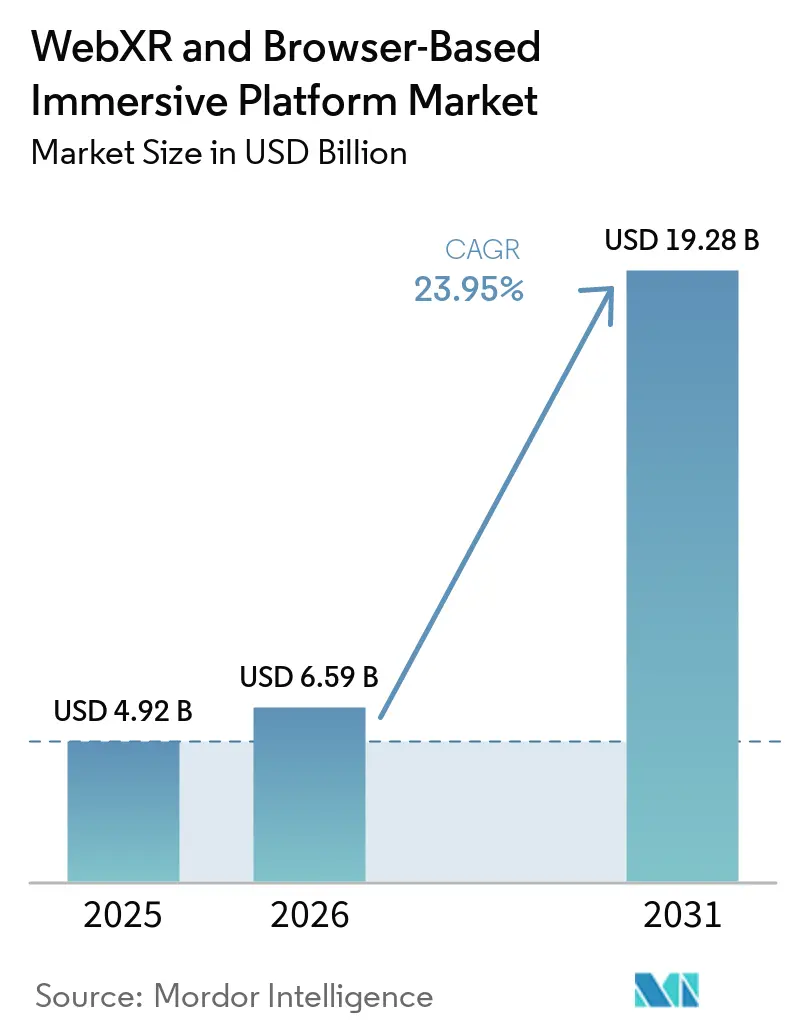
The WebXR and browser-based immersive platform market size was valued at USD 4.92 billion in 2025 and estimated to expand from USD 6.59 billion in 2026 to reach USD 19.28 billion by 2031, at a CAGR of 23.95% during the forecast period 2026-2031. The WebXR market is benefiting from broader browser support and higher rendering capability, which make browser delivery more practical for enterprise and consumer applications. A single JavaScript deployment can now reach headsets and modern mobile browsers, reducing app-store distribution requirements and device provisioning work. Cloud streaming is also widening the range of experiences that can run on lower-powered devices, although results remain linked to network quality. Competition centers on authoring tools, developer ecosystems, rendering quality, and vertical content libraries rather than price alone. Enterprise budget reviews and uneven browser feature support continue to slow some deployments, especially among smaller organizations.
Key Report Takeaways
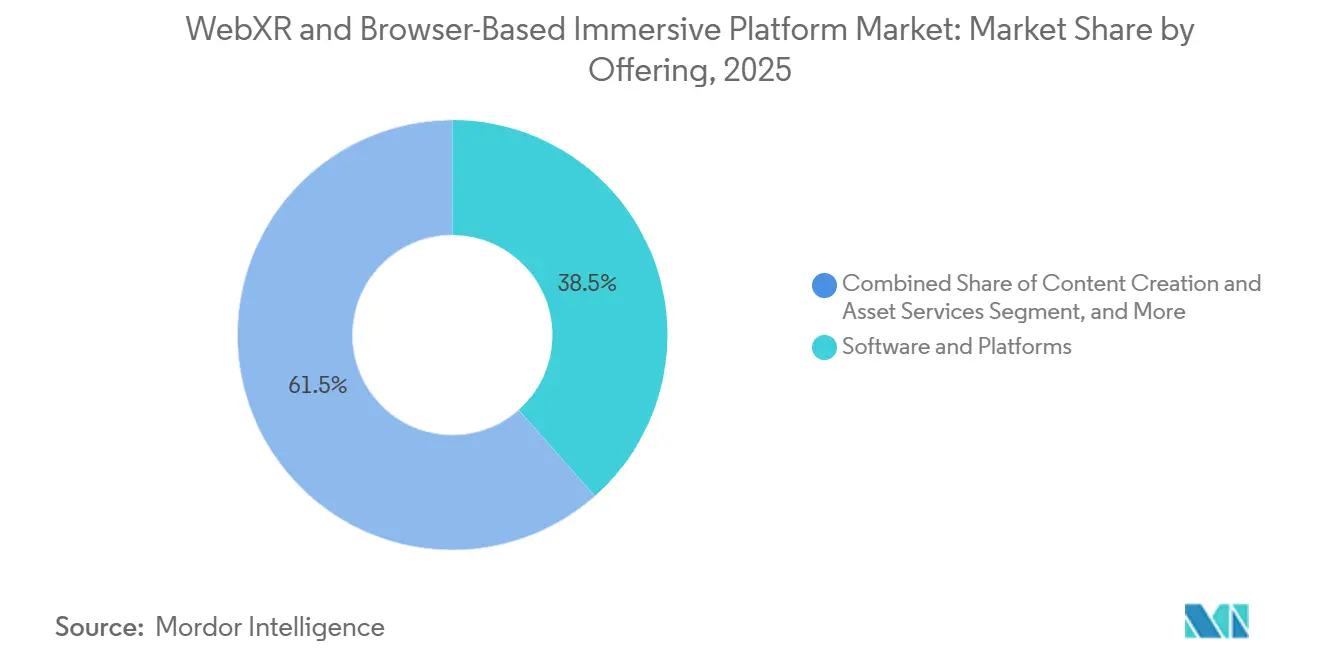
- By offering, Software and Platforms held 38.46% share in 2025, while Hosting, Streaming and Delivery Services is projected to expand at a 24.34% CAGR through 2031 in the WebXR and Browser-Based Immersive Platform Market.
- By delivery model, Cloud-Based delivery accounted for 52.60% share in 2025, while Hybrid Deployment is projected to expand at a 24.11% CAGR through 2031 in the WebXR and Browser-Based Immersive Platform Market.
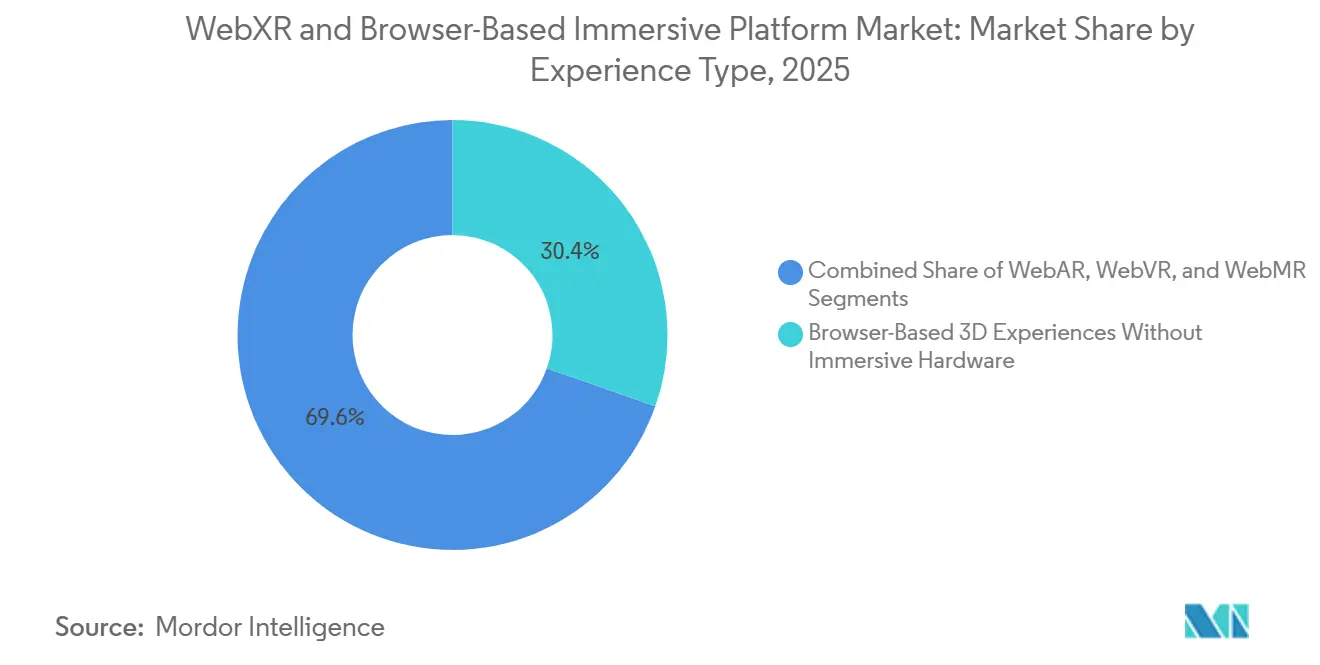
- By experience type, Browser-Based 3D Experiences Without Immersive Hardware held 30.38% share in 2025, while WebMR is projected to expand at a 24.56% CAGR through 2031.
- By application, Gaming and Interactive Entertainment held 18.24% share in 2025, while Virtual Events and Collaboration is projected to expand at a 24.43% CAGR through 2031 in the WebXR and Browser-Based Immersive Platform Market.
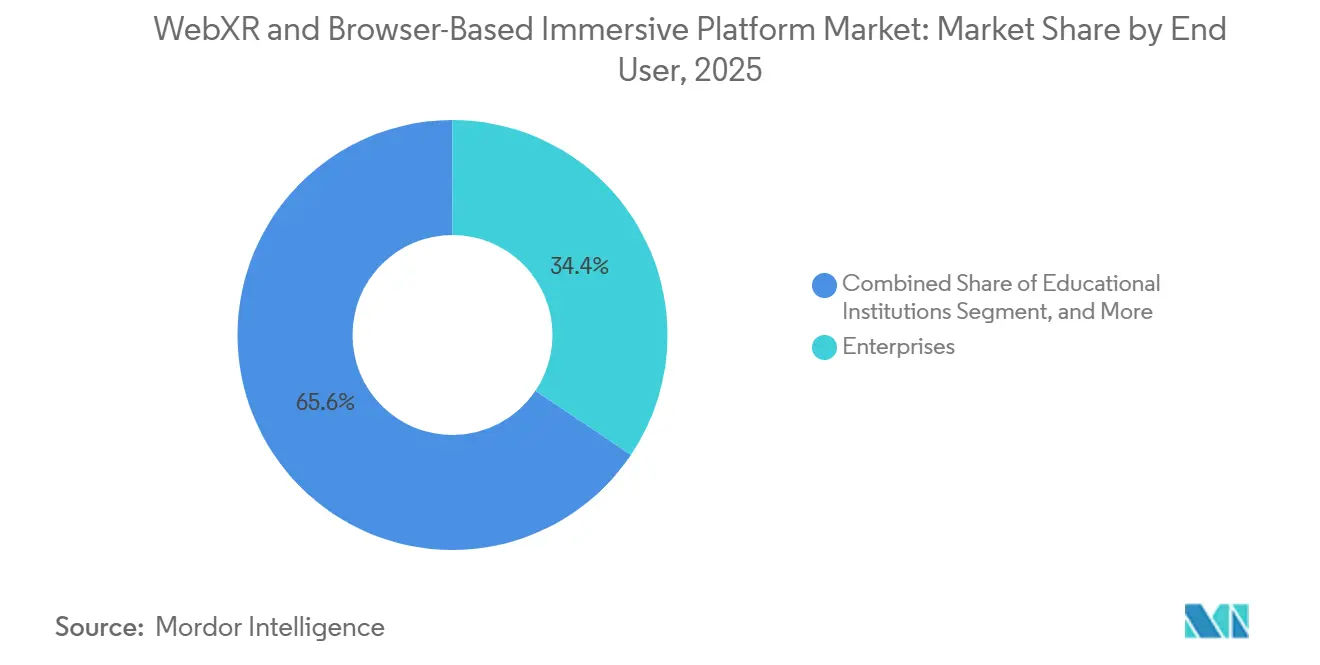
- By end user, Enterprises held 34.42% of the WebXR market in 2025, while Creative Agencies and Developers is projected to expand at a 24.76% CAGR through 2031.
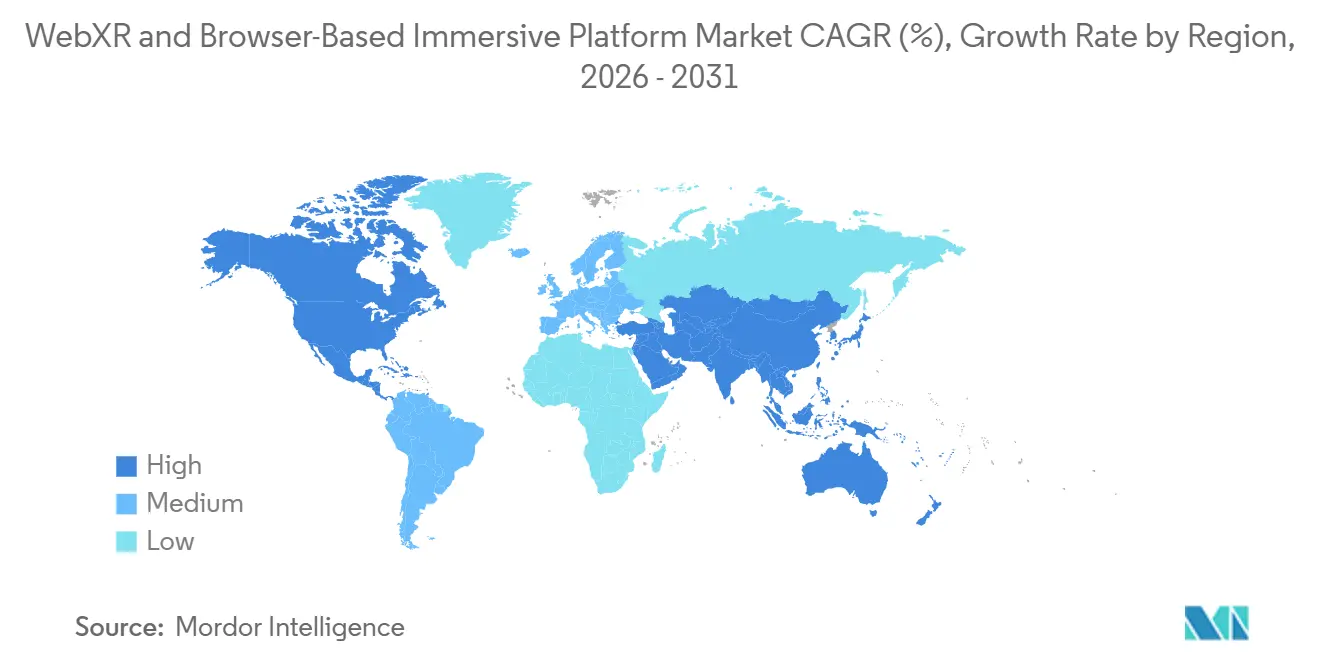
- By geography, North America held 32.38% share in 2025, while Asia-Pacific is projected to expand at a 24.32% CAGR through 2031.
Note: Market size and forecast figures in this report are generated using Mordor Intelligence’s proprietary estimation framework, updated with the latest available data and insights as of January 2026.
Market Trends and Insights
Drivers Impact Analysis of WebXR and Browser-Based Immersive Platform Market*
| Driver | (~) % Impact on CAGR Forecast | Geographic Relevance | Impact Timeline |
|---|---|---|---|
| Cross-Browser WebXR Interoperability Improvements | +5.2% | Global, with a disproportionate unlock of the iOS and iPad installed base in North America and Asia-Pacific core markets | Short term (≤ 2 years) |
| Enterprise Demand for App-Free Immersive Experiences | +4.8% | North America and Europe, with spillover to enterprise hubs in Singapore, Japan, and Australia | Medium term (2-4 years) |
| 5G, Edge Computing and Cloud Rendering Expansion | +4.1% | South Korea, Japan, China, North America, and European 5G Advanced corridors | Medium term (2-4 years) |
| Browser-Based Product Visualization and Virtual Try-On | +3.6% | Global, with the greatest density in North American, European, and Asia-Pacific e-commerce markets | Short term (≤ 2 years) |
| Immersive Training and Digital Twin Adoption | +3.0% | North America and Europe, with industrial uptake in Asia-Pacific manufacturing hubs | Medium term (2-4 years) |
| No-Code and AI-Assisted WebXR Content Creation | +2.4% | Global, with a high impact in developer-scarce markets in the Middle East, Africa, and South America | Medium term (2-4 years) |
| Source: Mordor Intelligence | |||
Cross-Browser WebXR Interoperability Improvements
The WebXR and browser-based immersive platform market is being reshaped by the transition of the WebXR Device API from an experimental tool toward a production standard. The World Wide Web Consortium published the API as a Candidate Recommendation in June 2026, a stage that requires interoperable implementation evidence from at least 2 browser engines.[1]World Wide Web Consortium, “WebXR Device API Publication History,” W3C, w3.org This process gives enterprise buyers a clearer basis for evaluating whether a browser-based deployment can serve several devices, teams, and operating environments. It also reduces the risk that a major feature will depend on a single browser supplier or a short-lived proprietary implementation. Safari support for immersive experiences across Apple operating systems has reduced a major coverage limitation for organizations that need to reach iPhone, iPad, desktop, and headset users. The remaining differences in advanced features still require testing across devices, but wider interoperability improves the business case for a shared browser codebase.
Enterprise Demand for App-Free Immersive Experiences
The WebXR and browser-based immersive platform market benefits when enterprise teams can issue a link instead of installing and managing an application. This approach can reduce device provisioning work for training programs serving dispersed workforces and avoid app store review cycles. It can also simplify content distribution when courses, product demonstrations, or remote support materials need to reach staff across many locations. Meta released its Immersive Web SDK under an MIT license in 2025, providing AI-assisted tools that write, test, and debug WebXR applications within a browser-based headset emulator.[2]Meta, “Accelerate VR Development with AI and Immersive Web SDK,” Meta Horizon OS Blog, developers.meta.com Faster testing can broaden participation beyond specialist 3D web teams and can make smaller pilots easier to launch. ENGAGE XR Holdings reported FY 2025 revenue of EUR 3.4 million (USD 3.7 million) while identifying slower enterprise budgets as a near-term headwind. The demand case is therefore real, but the timing of procurement remains sensitive to discretionary technology spending.
5G, Edge Computing, and Cloud Rendering Expansion
Cloud rendering lets the WebXR and browser-based immersive platform market deliver higher-quality content to devices that cannot complete complex rendering locally. NVIDIA introduced CloudXR 6.0 in March 2026 with an OpenXR-based streaming runtime for headsets, operating systems, and browsers, including visionOS support.[3]NVIDIA, “Stream High-Fidelity Spatial Computing Content to Any Device with NVIDIA CloudXR 6.0,” NVIDIA Technical Blog, developer.nvidia.com The company stated that the platform targets a 4K-equivalent spatial experience at 90 fps over standard 5GHz Wi-Fi. Qualcomm, Ericsson, and T-Mobile also documented 5G edge trials that kept distributed AR workloads stable in difficult radio conditions. These developments move performance risk from endpoint hardware to the network and cloud architecture. Providers must therefore plan for network capacity, server location, user concurrency, security, and continuity when they build services that rely on streamed rendering. In areas with uneven 5G coverage, adaptive bitrate delivery remains important because cloud rendering can otherwise create unequal experience quality.
Browser-Based Product Visualization and Virtual Try-On
The WebXR market is gaining retail relevance as visual product tools become part of the purchase journey rather than a stand-alone novelty. Browser delivery allows shoppers to view products in their own environment without downloading an application. GANT deployed WebAR virtual try-on across 13 markets through Fibbl in 2025 and placed 3D product content at the add-to-cart and checkout stages. NVIDIA CloudXR.js also supports streamed GPU-rendered engineering configurators and Autodesk VRED design reviews through browser clients. This model is useful when an industrial product is too complex for acceptable mobile-local rendering. It can support detailed engineering reviews without asking customers or field teams to operate a workstation-class graphics system at the point of use. Providers with streaming capacity can therefore offer a higher visual quality ceiling than competitors that rely only on device-side processing.
Restraints Impact Analysis of WebXR and Browser-Based Immersive Platform Market*
| Restraint | (~) % Impact on CAGR Forecast | Geographic Relevance | Impact Timeline |
|---|---|---|---|
| Inconsistent Browser and Device Feature Support | -1.8% | Global, with acute limitations on iOS and iPadOS and WebXR disabled by default in Firefox | Short term (≤ 2 years) |
| High Cost of Optimizing Complex 3D Assets for Mobile Delivery | -1.4% | Global, with a disproportionate burden on small and medium-sized businesses in South America, Africa, and Southeast Asia | Medium term (2-4 years) |
| Privacy and Consent Constraints for Spatial Tracking Data | -0.9% | Europe and California, with implications for global enterprise deployment standards | Long term (≥ 4 years) |
| Fragmented Monetization and Unclear Enterprise Return on Investment | -0.8% | North American and European enterprise segments, especially during pilots | Medium term (2-4 years) |
| Source: Mordor Intelligence | |||
Inconsistent Browser and Device Feature Support
The WebXR and browser-based immersive platform market still faces a practical limitation from different browser and device capabilities. Chrome and Edge on desktop and Android, Meta Quest Browser, and Samsung Internet support features such as passthrough AR, plane detection, spatial anchors, and hand tracking. Mozilla states that Firefox ships with WebXR disabled by default and that its implementation has not had active development since 2020. Safari on iOS and iPadOS supports immersive VR and AR, but it does not expose several advanced spatial features that are available in Android Chrome and Meta Quest Browser. Development teams must maintain fallback paths and test a wide matrix of browsers, operating systems, and device formats. This requirement raises quality assurance costs and creates a material burden for smaller providers. It can also make feature planning slower because teams must decide whether to wait for parity, redesign an interaction, or offer a less capable fallback.
High Cost of Optimizing Complex 3D Assets for Mobile Delivery
High-fidelity 3D assets often need manual retopology, texture compression, and level-of-detail work before they perform well in a mobile browser. This requirement can delay deployment for organizations with complex or regularly refreshed product catalogs. EON Reality released Genesis 3.1 in June 2026 and stated that it converts standard operating procedures and photographs into industrial training simulators at USD 50,000 per facility, compared with USD 300,000-700,000 for an equivalent Unity-built project. The WebXR and browser-based immersive platform market therefore faces a talent constraint because mobile-ready glTF assets require skills that differ from traditional 3D design. AI-assisted tools can help with simple shapes, but apparel, surgical instruments, and precision machinery still present difficult optimization work. Content teams must also preserve accuracy, visual clarity, and acceptable load times when they simplify assets for lower-powered phones. Privacy controls and uncertain returns from early pilots also add caution, particularly for spatial applications that handle sensitive location or biometric information.
*Our forecasts treat driver/restraint impacts as directional, not additive. The impact forecasts reflect baseline growth, mix effects, and variable interactions.
WebXR and Browser-Based Immersive Platform Market Segment Analysis
By Offering:
Software Platforms Lead While Delivery Infrastructure AcceleratesSoftware and Platforms held 38.46% of the WebXR and browser-based immersive platform market share in 2025, reflecting the value attached to authoring tools, runtime engines, and managed software platforms. The category includes browser-based game engines such as PlayCanvas and Wonderland Engine, managed platforms such as Mattercraft and Blippar’s WebAR SDK, and social XR environments such as Spatial Systems and ENGAGE XR. Development and Integration Services also retain a supporting role because many enterprise programs need custom implementation. These projects often require links to existing content, training processes, security rules, analytics, and internal systems. Buyers also need support for device testing, workflow design, content updates, and employee onboarding before a deployment becomes routine.
Hosting, Streaming and Delivery Services is projected to expand at a 24.34% CAGR through 2031, faster than the overall WebXR and browser-based immersive platform market. The WebXR industry is placing more value on this layer because streamed content can maintain visual quality without relying entirely on local device hardware. NVIDIA released CloudXR 6.0 in March 2026 with browser streaming through WebRTC and the WebXR Device API for headsets and desktop browsers. This positions streaming infrastructure as a key constraint on the fidelity available across the software stack. Content Creation and Asset Services may face lower unit costs from AI-assisted creation, while integration work may remain important as enterprise requirements become more complex. Providers also need reliable hosting, security controls, network monitoring, and delivery support when experiences are used repeatedly across locations.



By Delivery Model:
Cloud Dominates While Hybrid Emerges as the Growth FrontierCloud-Based delivery held 52.60% share in 2025, giving it the leading position within the WebXR and browser-based immersive platform market size by delivery model. The leadership reflects the need for scalable and low-latency hosting in an experience that is delivered through the browser. Cloud pricing also allows small and medium-sized businesses to test projects without major upfront infrastructure spending. This model is useful for product visualization, training, events, and other services that require broad access. It allows providers to serve a changing user base without managing separate application versions for every supported mobile device and headset. It also allows content updates to reach users without repeated software installation, which supports shorter pilot cycles and wider audience access.
Hybrid Deployment is projected to expand at a 24.11% CAGR through 2031 as organizations balance browser reach with control over sensitive workloads. Data sovereignty rules, latency-sensitive industrial use cases, and spatial data from facilities can make a purely public-cloud approach unsuitable. NVIDIA describes CloudXR 6.0 as deployable on RTX servers in on-premises or colocated environments as well as through cloud delivery. This architecture fits digital twin and training uses where enterprise data must remain within a private network perimeter. On-Premises and Private Cloud use remains relevant in financial services and defense, but the cost of GPU infrastructure limits wider adoption. Hybrid programs can preserve local control for sensitive data while using cloud capacity for broader content delivery and management.
By Experience Type:
Hardware-Independent 3D Leads While WebMR Takes the Fastest GrowthBrowser-Based 3D Experiences Without Immersive Hardware held 30.38% share in 2025, which made them the largest experience category. Product configurators, virtual property tours, and browser training modules can run on smartphone browsers and do not require a headset. This broad access supports user volume and helps platform providers reach audiences outside dedicated XR hardware ownership. It also shows that practical browser-based 3D applications account for a large portion of current commercial activity. Many of these experiences are designed for familiar screens and simple touch controls rather than specialized immersive input. These formats can be shared through common web links, which makes them suitable for retail, education, property, and basic product demonstrations.
WebMR is projected to expand at a 24.56% CAGR through 2031, making it the fastest-growing experience type in the WebXR and browser-based immersive platform market. Mixed reality can place instructions and digital objects over physical machinery, which suits manufacturing, field service, and design review. GANT’s 2025 deployment of WebAR virtual try-on in 13 markets also demonstrates an established retail use for browser-based spatial content. WebVR remains linked to consumer headset adoption, which limits its addressable audience relative to smartphone-based experiences. The WebXR and browser-based immersive platform industry may also see more country-specific platforms as buyers weigh local support, service levels, and browser compatibility. This mix allows providers to address simple screen-based viewing as well as higher-value workflows that depend on physical context and spatial overlays.
By Application:
Gaming Anchors the Top While Enterprise Collaboration Re-EmergesGaming and Interactive Entertainment held 18.24% share in 2025, supported by a large browser-game developer base and consumer familiarity with in-browser 3D content. PlayCanvas and Babylon.js offer accessible development paths that support continued activity in this application. The category has an established user base and can sustain demand even as business applications become more important. Its position also reflects the relatively direct distribution advantages of a browser link. This can support discovery through websites, social channels, product pages, and campaign materials without creating a separate installation step for a potential user. Developers can release updates quickly and can reach users who may not own a headset or want to install another application.
Virtual Events and Collaboration is projected to expand at a 24.43% CAGR through 2031. Browser-native collaboration tools can combine spatial voice, persistent objects, and straightforward sharing without a proprietary hardware requirement. Siemens introduced Digital Twin Composer at CES 2026, linking Xcelerator digital twin data and NVIDIA Omniverse libraries in a real-time spatial environment accessible from browsers and spatial computing clients. The WebXR and browser-based immersive platform market can use this type of connection to bring manufacturing execution, quality management, PLC code, and IIoT data into one context. Training, product visualization, industrial design, healthcare, education, tourism, real estate, retail, and culture broaden the range of applications beyond entertainment. Organizations can use browser access to involve remote participants without requiring every participant to use the same installed software or device.
By End User:
Enterprises Dominate While Creatives Drive the Innovation EdgeEnterprises held 34.42% share in 2025, which was the largest end-user position in the WebXR and browser-based immersive platform market. Training platforms, virtual showrooms, and digital twins receive funding where scale and business value can justify investment. Larger organizations can also support the security, integration, content preparation, procurement, and governance work required for production deployments. Small and medium-sized businesses are adopting subscription platforms, but their buying cycles can be more sensitive to costs and uncertain returns. Government and public sector organizations, along with individual consumers, add demand but generally have different budget, content, and usability requirements.
Creative Agencies and Developers is projected to expand at a 24.76% CAGR through 2031, the fastest rate in the end-user segmentation. Google Research presented Vibe Coding XR in 2026, which uses Gemini and XR Blocks to translate natural-language prompts into functional WebXR applications. Lower development effort can increase the number of teams able to produce early concepts and production applications. Educational institutions offer high user volumes but are price sensitive. Their programs often need accessible content, repeatable delivery, staff support, and clear value for learners before a pilot can become a regular course component. EON Reality and Skills Group began a Spatial AI vocational training pilot for 2,000 learners in New Zealand in June 2026. Easier prototyping can help agencies test concepts with clients before they commit to more extensive asset creation, integration, and hosting work.
Geography Analysis
North America WebXR and Browser-Based Immersive Platform Market
North America held 32.38% of the WebXR and browser-based immersive platform market share in 2025 and remained the largest regional contributor. The United States has a dense base of enterprise software buyers, WebXR developers, and early adopters in retail, e-commerce, training, and industrial software. Several foundational vendors, including PlayCanvas, EON Reality, Spatial Systems, and other providers, operate from the United States. Canada adds technology-sector demand, while Mexico is adopting browser-based training and retail visualization as lower-cost alternatives to native applications. California privacy requirements are shaping consent flows, spatial data handling, and product design for deployments that serve users in the state.
APAC WebXR and Browser-Based Immersive Platform Market
Asia-Pacific is projected to expand at a 24.32% CAGR through 2031 and is the fastest-growing regional part of the WebXR and browser-based immersive platform market. South Korea, Japan, and major Chinese urban centers benefit from extensive 5G networks that can support low-latency streaming and more responsive browser experiences. India provides a cost-competitive developer base, while Southeast Asia has a mobile-first audience that can access browser experiences without dedicated hardware. Japan’s palan Inc. launched a next-generation WebAR infrastructure stack under the STYLY WebAR brand in January 2026, presenting a local option with enterprise service-level commitments. Country-level preferences, procurement practices, and local regulation can influence platform choice and may not consistently favor global providers.
EMEA and South America WebXR and Browser-Based Immersive Platform Market
Europe ranked third by regional share, with Germany, the United Kingdom, and France acting as enterprise and developer centers. GDPR requirements and proposed European rules on emotion recognition and biometric categorization can raise compliance costs for smaller vendors. The Middle East is investing in tourism, smart city, and cultural heritage applications, although regional conflict affected some procurement cycles in 2026. South America is using browser-based training and retail tools where native XR hardware remains costly relative to income levels and business budgets. Africa remains at an earlier stage of adoption because 4G quality, device affordability, and limited access to advanced hardware constrain participation. The lack of app-install friction is particularly relevant in these regions because storage capacity, device cost, and data use influence adoption decisions. Browser access can lower the practical barrier to first use, although dependable networks and optimized assets remain essential for a consistent experience.

Competitive Landscape
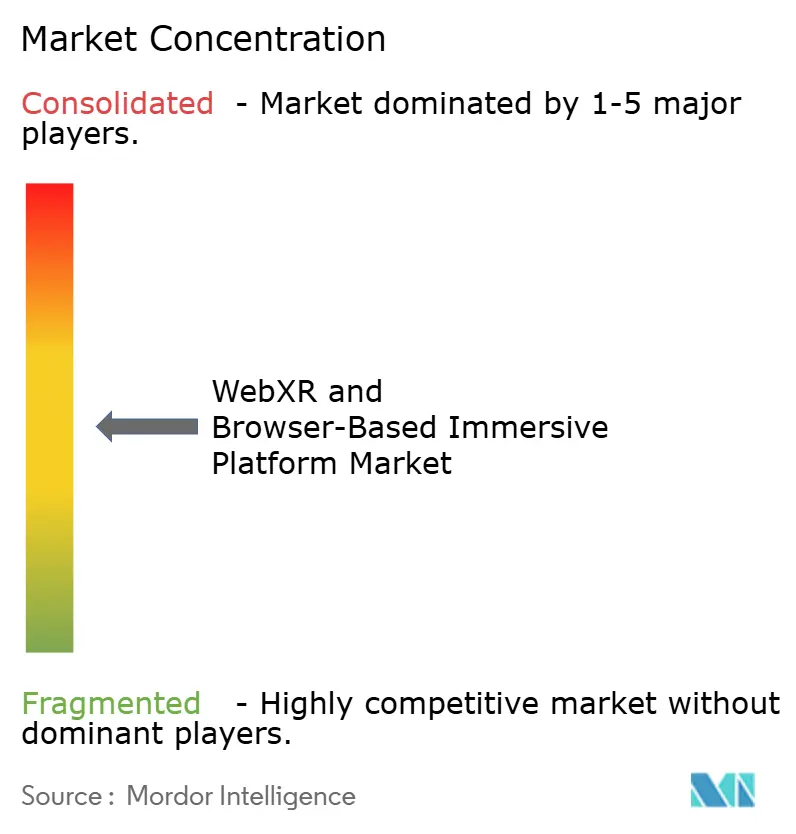
The WebXR and browser-based immersive platform market is moderately fragmented, with no single provider holding a leading position across offerings, experience types, and regions. Competition groups around full-stack enterprise platforms, specialist software development kits and toolkits, and streaming infrastructure providers. Full-stack vendors combine content creation, delivery, analytics, implementation support, and customer management for large deployments. Specialist providers compete through developer experience, rendering quality, spatial functions, partner ecosystems, and the ease of bringing existing assets to the web. Streaming operators provide an enabling layer for other vendors’ content and influence the visual quality, responsiveness, and device reach that users receive.
EON Reality introduced EON Spatial OS in May 2026, combining a generative content engine, a real-time AI co-worker, a performance platform, and workforce intelligence in a hardware-independent operating system. Zappar integrated MultiSet’s Visual Positioning System into Mattercraft in 2025 to improve indoor spatial positioning for web-based retail and enterprise navigation. Innoactive demonstrated AI-supported design review workflows with NVIDIA and KIA in June 2026 at the Autodesk Automotive Innovation Forum. These moves show that providers are adding specialized functions, data controls, and partnerships rather than relying mainly on price competition. The WebXR market has particular scope in healthcare visualization, industrial digital twin connections, and low-bandwidth deployments for emerging-market small and medium-sized businesses.
AI-assisted development tools can reduce the cost of WebXR application creation and put pressure on traditional integration services. Meta’s Immersive Web SDK and Google’s XR Blocks lower the barriers for teams that can work with AI-supported coding. WebGPU support across modern browsers also improves the visual quality available through browser delivery. Providers that have not adjusted to browser-based rendering, cloud delivery, and AI-assisted authoring may lose relevance in the mid-tier enterprise segment. The competitive field therefore favors firms that can combine practical browser access with dependable enterprise integration, security, content production, and operational support. This favors focused specialization where a provider can solve a clear customer problem while working with broader platforms and established enterprise systems.
WebXR and Browser-Based Immersive Platform Industry Leaders
Zappar Ltd
PlayCanvas Ltd
Variant 3D, Inc.
Wonderland Engine GmbH
Blippar Ltd
- *Disclaimer: Major Players sorted in no particular order
WebXR and Browser-Based Immersive Platform Market Companies Covered in this Report
- Zappar Ltd
- Variant 3D, Inc.
- Miris, Inc.
- RP1 Inc.
- PlayCanvas Ltd
- Wonderland Engine GmbH
- Blippar Ltd
- Hololight AG
- Innoactive GmbH
- Virti Limited
- ENGAGE XR Holdings plc
- Spatial Systems, Inc.
- Hadean Supercomputing Limited
- WorldViz, Inc.
- Matterport, Inc.
- EON Reality, Inc.
- Captic Technologies Ltd
- Ethereal Engine, Inc.
- LucidWeb Limited
- Scenebrook Ltd
- OXR Technologies, Inc.

Recent Industry Developments in WebXR and Browser-Based Immersive Platform Market
- June 2026: EON Reality and EON AI Ventures launched Genesis 3.1, converting standard operating procedures and ordinary photographs into interactive industrial XR training simulators priced at USD 50,000 per facility pilot, compared to a USD 300,000-700,000 Unity-built equivalent with 6-18 months development time. The release moved the platform from prototype to production status.
- June 2026: EON Reality formally launched EON Spatial OS, a hardware-agnostic operating system unifying the Genesis 3 generative content engine, Assist IQ real-time AI co-worker, Field IQ performance platform, and Career Compass workforce intelligence. The platform serves more than 4,400 institutional customers across 80 countries and is positioned as an industrial AI layer for the enterprise sector.
- June 2026: Innoactive introduced Innoactive Halo, an on-device AI agent for Apple Vision Pro that captures and acts on design review decisions running entirely on a local NVIDIA DGX Spark, with no data sent to the cloud. The product was demonstrated alongside NVIDIA and KIA at the Autodesk Automotive Innovation Forum.
- March 2026: NVIDIA announced CloudXR 6.0 at GTC 2026, delivering a universal OpenXR-based streaming runtime supporting headsets, operating systems, and browsers including native visionOS integration via privacy-protected foveated streaming. The system enables a 4K-equivalent spatial experience at 90 fps over standard 5GHz Wi-Fi and includes CloudXR.js for zero-install browser-based delivery.


Global WebXR and Browser-Based Immersive Platform Market Report Scope
The WebXR and Browser-Based Immersive Platform Market comprises software platforms, frameworks, development tools, browsers, and cloud-enabled solutions that facilitate the creation, delivery, and consumption of immersive augmented reality (AR), virtual reality (VR), and mixed reality (MR) experiences directly through web browsers without requiring dedicated native applications.
The WebXR and Browser-Based Immersive Platform Market Report is Segmented by Offering (Software and Platforms, Development and Integration Services, Content Creation and Asset Services, and Hosting, Streaming and Delivery Services), Delivery Model (Cloud-Based, On-Premises and Private Cloud, and Hybrid Deployment), Experience Type (WebAR, WebVR, WebMR, and Browser-Based 3D Experiences Without Immersive Hardware), Application (Gaming and Interactive Entertainment, Product Visualization and Virtual Try-On, Training and Simulation, Virtual Events and Collaboration, Education and Digital Learning, Healthcare and Medical Visualization, Retail, Commerce and Marketing, Industrial Design and Digital Twins, Tourism, Culture and Virtual Tours, Real Estate and Architecture, and Other Applications), End User (Enterprises, Small and Medium-Sized Businesses, Educational Institutions, Government and Public Sector Organizations, Individual Consumers, and Creative Agencies and Developers), and Geography (North America, South America, Europe, Asia-Pacific, Middle East, and Africa). The Market Forecasts are Provided in Terms of Value (USD).
| Software and Platforms |
| Development and Integration Services |
| Content Creation and Asset Services |
| Hosting, Streaming and Delivery Services |
| Cloud-Based |
| On-Premises and Private Cloud |
| Hybrid Deployment |
| WebAR |
| WebVR |
| WebMR |
| Browser-Based 3D Experiences Without Immersive Hardware |
| Gaming and Interactive Entertainment |
| Product Visualization and Virtual Try-On |
| Training and Simulation |
| Virtual Events and Collaboration |
| Education and Digital Learning |
| Healthcare and Medical Visualization |
| Retail, Commerce and Marketing |
| Industrial Design and Digital Twins |
| Tourism, Culture and Virtual Tours |
| Real Estate and Architecture |
| Other Applications |
| Enterprises |
| Small and Medium-Sized Businesses |
| Educational Institutions |
| Government and Public Sector Organizations |
| Individual Consumers |
| Creative Agencies and Developers |
| North America | United States |
| Canada | |
| Mexico | |
| South America | Brazil |
| Argentina | |
| Rest of South America | |
| Europe | Germany |
| United Kingdom | |
| France | |
| Italy | |
| Spain | |
| Russia | |
| Rest of Europe | |
| Asia-Pacific | China |
| Japan | |
| India | |
| South Korea | |
| Australia | |
| Rest of Asia-Pacific | |
| Middle East | United Arab Emirates |
| Saudi Arabia | |
| Turkey | |
| Israel | |
| Rest of Middle East | |
| Africa | South Africa |
| Nigeria | |
| Egypt | |
| Rest of Africa |
| By Offering | Software and Platforms | |
| Development and Integration Services | ||
| Content Creation and Asset Services | ||
| Hosting, Streaming and Delivery Services | ||
| By Delivery Model | Cloud-Based | |
| On-Premises and Private Cloud | ||
| Hybrid Deployment | ||
| By Experience Type | WebAR | |
| WebVR | ||
| WebMR | ||
| Browser-Based 3D Experiences Without Immersive Hardware | ||
| By Application | Gaming and Interactive Entertainment | |
| Product Visualization and Virtual Try-On | ||
| Training and Simulation | ||
| Virtual Events and Collaboration | ||
| Education and Digital Learning | ||
| Healthcare and Medical Visualization | ||
| Retail, Commerce and Marketing | ||
| Industrial Design and Digital Twins | ||
| Tourism, Culture and Virtual Tours | ||
| Real Estate and Architecture | ||
| Other Applications | ||
| By End User | Enterprises | |
| Small and Medium-Sized Businesses | ||
| Educational Institutions | ||
| Government and Public Sector Organizations | ||
| Individual Consumers | ||
| Creative Agencies and Developers | ||
| By Geography | North America | United States |
| Canada | ||
| Mexico | ||
| South America | Brazil | |
| Argentina | ||
| Rest of South America | ||
| Europe | Germany | |
| United Kingdom | ||
| France | ||
| Italy | ||
| Spain | ||
| Russia | ||
| Rest of Europe | ||
| Asia-Pacific | China | |
| Japan | ||
| India | ||
| South Korea | ||
| Australia | ||
| Rest of Asia-Pacific | ||
| Middle East | United Arab Emirates | |
| Saudi Arabia | ||
| Turkey | ||
| Israel | ||
| Rest of Middle East | ||
| Africa | South Africa | |
| Nigeria | ||
| Egypt | ||
| Rest of Africa | ||


Key Questions Answered in the Report
What is the WebXR and browser-based immersive platform market size?
The WebXR and browser-based immersive platform market was valued at USD 4.92 billion in 2025 and is estimated at USD 6.59 billion in 2026. It is forecast to reach USD 19.28 billion by 2031 at a 23.95% CAGR, reflecting the wider use of browser delivery, stronger rendering capability, and rising enterprise demand for immersive tools.
What is driving adoption of browser-based immersive platforms?
The WebXR and browser-based immersive platform market is supported by cross-browser interoperability, app-free distribution, cloud rendering, and demand for visualization and training. A browser link can reduce device setup and help organizations share content with customers, employees, partners, and remote participants across different supported devices.
Which WebXR offering is growing the fastest?
Hosting, Streaming and Delivery Services is projected to expand at a 24.34% CAGR through 2031, supported by cloud-rendered browser experiences. This category matters because streaming can deliver detailed content to lower-powered devices, provided that network capacity, latency, and service reliability are managed effectively.
Which delivery model leads browser-based immersive deployments?
Cloud-Based delivery held 52.60% share in 2025, while Hybrid Deployment is projected to expand at a 24.11% CAGR through 2031. The WebXR and browser-based immersive platform market is using hybrid models where organizations need browser access but want to retain control over sensitive spatial data or latency-sensitive processes.
Which region is expanding fastest for WebXR platforms?
Asia-Pacific is projected to expand at a 24.32% CAGR through 2031, supported by 5G coverage, digitalization programs, mobile-first use, and a broad developer base. Regional demand is shaped by local connectivity, national policy, enterprise investment, and the availability of local platforms and support.
What limits wider use of WebXR applications?
Browser feature gaps, the cost of mobile-ready 3D assets, spatial-data privacy requirements, and uncertain returns from early enterprise pilots can constrain deployment. Organizations also need to consider testing, content preparation, network quality, security, and support when moving from an initial trial to routine use.
Page last updated on:





