
Watercolors Market Size and Share
Market Overview
| Study Period | 2022 - 2032 |
|---|---|
| Market Size (2027) | USD 1.96 Billion |
| Market Size (2032) | USD 2.69 Billion |
| Fastest Growing Market | Asia-Pacific |
| Largest Market | Asia-Pacific |
| Market Concentration | Medium |
Major Players *Disclaimer: Major Players sorted in no particular order Image © Mordor Intelligence. Reuse requires attribution under CC BY 4.0. | |
Watercolors Market Analysis by Mordor Intelligence
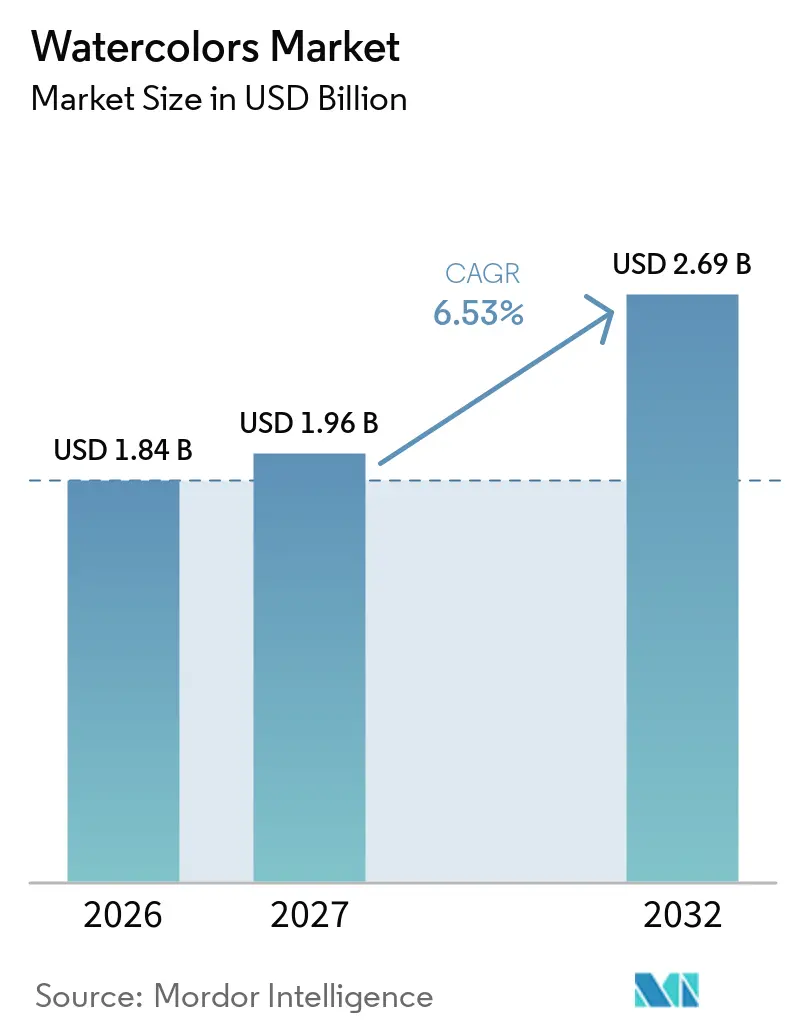
The watercolors market size was valued at USD 1.84 billion in 2026 and estimated to grow from USD 1.96 billion in 2027 to reach USD 2.69 billion by 2032, at a CAGR of 6.53% during the forecast period (2027-2032). The watercolors market is supported by wider arts education, a larger adult hobbyist base, and demand for products that work well at home, in classrooms, and while traveling. Demand is moving beyond basic student supplies as hobbyists and professional users choose better pigments, portable formats, and products with clearer performance information. Manufacturers are strengthening direct relationships with buyers through their own online stores, while specialty retailers remain important for product trials and advice. Supply pressure on gum arabic, tighter chemical rules, and counterfeits on online marketplaces create cost and trust risks that can limit growth if brands do not address them.
Key Report Takeaways
- By form, Tube Watercolors held a 37.53% share of the watercolors market in 2026, while Watercolor Markers are projected to grow at a 7.68% CAGR during 2027-2032.
- By end user, Students accounted for a 41.65% share of the watercolors market in 2026, while Hobbyists and Recreational Users are forecast to expand at a 7.43% CAGR during 2027-2032.
- By price tier, Mass held a 67.87% share of the watercolors market in 2026, while Premium is projected to grow at a 7.79% CAGR during 2027-2032.
- By distribution channel, Specialty Art Supply Stores led with a 38.56% share of the watercolors market in 2026, while Online Retail is forecast to advance at an 8.05% CAGR during 2027-2032.
- By geography, Asia-Pacific accounted for a 35.72% share of the watercolors market in 2026 and is projected to record the fastest CAGR of 7.41% during 2027-2032.
Note: Market numbers in this report are based on Mordor Intelligence's proprietary estimation framework, which combines nine months of actuals with Q4 projections for base year 2026.
Global Watercolors Market Trends and Insights
Drivers Impact Analysis*
| Driver | (~) % Impact on CAGR Forecast | Geographic Relevance | Impact Timeline |
|---|---|---|---|
| Expansion of Art Education and Curriculum Integration | +1.4% | Global; strongest in Asia-Pacific (India, China), LATAM, Southeast Asia | Long term (≥ 4 years) |
| Rising Popularity of Watercolor Tutorials and Art Content on Social Media | +1.2% | Global; core in North America, Western Europe, East Asia | Short to medium term (1–4 years) |
| Increasing Demand for Portable Watercolor Palettes and Travel Painting Sets | +0.7% | Global; highest uptake in North America, Europe, Japan | Short to medium term (1–4 years) |
| Growing Demand for Premium and Artist-grade Watercolor Paints | +0.9% | North America, Europe, Japan, South Korea | Medium to long term (2–5 years) |
| Watercolor-Medium Innovation Around Synthetic and Effect Formulations | +0.7% | Global; R&D concentrated in Germany, Japan, USA | Long term (≥ 4 years) |
| Expansion of E-commerce and Direct-to-Consumer Art Supply Sales | +1.0% | Global; accelerating in Asia-Pacific and North America | Short term (≤ 2 years) |
| Source: Mordor Intelligence | |||
Art Education And Curriculum Integration
Arts integration in school curricula is creating recurring demand for student and institutional watercolor supplies in the watercolor market. India’s National Education Policy 2020 places arts integration within primary and secondary learning, supporting a longer purchasing cycle for schools as implementation proceeds across states[1]. This approach can shift purchases from optional classroom spending toward planned teaching materials and can make ordering patterns more predictable for school-focused suppliers. It also gives suppliers a clearer reason to build products around school needs, including safe formulations, classroom packs, teacher-friendly color assortments, and predictable replenishment. The National Endowment for the Arts reported that childhood arts experiences are associated with educational and social outcomes, supporting the broader policy case for continued participation in arts programs. School demand does not eliminate consumer price sensitivity, but it can provide a steadier baseline than discretionary leisure spending alone.
Digital Discovery And Direct Art Supply Sales
Tutorials, short videos, and online art communities now influence how many buyers discover colors, techniques, and brands in the watercolor market. A 2025 academic study found that social platforms such as TikTok, Instagram, YouTube, and Facebook can extend the reach of art marketing and help build communities around creative work. These channels make product demonstrations more useful because users can compare swatches, mixing behavior, formats, and application results before purchase. Direct sales give brands a way to convert this interest without relying only on third-party listings, while also providing feedback on color preferences and repeat buying. Winsor & Newton’s UK online store reached 10,000 orders in its first 324 days, showing that a recognized brand can build a direct route to artists when the store offers an appropriate product range and clear information[2]. Specialty retailers still matter because in-person advice and product trials often support the first purchase of a higher-priced range.
Portable And Premium Watercolor Demand
Portable sets and higher-grade paints serve different needs, but both reflect buyers’ willingness to choose products suited to a specific creative routine. Travel kits and compact palettes make outdoor sketching and casual practice easier, while premium paints appeal to users who value pigment quality, lightfastness, and handling. This combination broadens the watercolors market beyond formal studio use and supports use cases from quick sketches to detailed personal projects. The premium tier is expected to grow at 7.79% CAGR during 2027-2032, even as mass products remain the larger revenue base. Schmincke expanded its Horadam Signature Edition in 2025 with artist-developed colors, illustrating how professional collaboration can support differentiated premium offerings. Brands that combine portability with credible quality information can serve entry-level users without limiting the path to premium purchases.
Synthetic And Effect Formulation Innovation
New materials and formulation methods can help brands differentiate their products without altering the basic appeal of watercolor. Research published in 2025 showed that photonic pigments could produce water-based paints using sustainable building blocks and color generated through light reflectance rather than conventional absorption[3]. Other 2025 research explored a machine-learning approach to simulating and optimizing watercolor mixing, which may eventually support color-selection tools for artists. Holbein changed its Ox Gall watercolor medium to a fully synthetic formulation after raw-material sourcing became difficult. Such changes can reduce exposure to animal-derived inputs and respond to buyers seeking alternatives, although reformulation still requires careful performance testing. The commercial value depends on whether the revised medium performs reliably across paper types, pigments, and familiar painting methods.
Restraints Impact Analysis*
| Restraint | (~) % Impact on CAGR Forecast | Geographic Relevance | Impact Timeline |
|---|---|---|---|
| High Cost Of Premium Artist-Grade Watercolors And Specialty Pigments | -0.8% | North America and Europe, with pressure during cost-sensitive periods | Medium term (2-4 years) |
| Volatile Prices For Pigments, Gum Arabic, And Binders | -0.7% | Global, especially European and Asian producers that use Sudanese gum arabic | Medium term (2-4 years) |
| Restrictions On Hazardous Pigments And Chemical Ingredients | -0.4% | European Union and China | Long term (≥ 4 years) |
| Counterfeit And Low-Quality Online Marketplace Products | -0.4% | Global, particularly North American and Asia-Pacific e-commerce platforms | Short term (≤ 2 years) |
| Source: Mordor Intelligence | |||
Volatile Prices For Pigments, Gum Arabic, And Binders
Gum arabic remains a core binder in many artist-grade products, so supply disruption can raise costs across the watercolors market. Conflict in Sudan has disrupted a supply base that has historically played an important role in the global gum arabic trade. A 2025 study of producing countries described supply-chain challenges and noted pressure on importing markets as the disruption affected trade flows. Manufacturers of low-priced student products have less flexibility to absorb higher binder costs because their selling prices are tightly controlled, and buyers can readily compare entry-level sets. Synthetic substitutes can reduce dependence on constrained inputs, but smaller producers may face added formulation and approval work before they can adopt them at scale. This leaves procurement planning, alternative sourcing, and clear product reformulation strategies important for maintaining a reliable supply.
Counterfeit And Low-Quality Online Marketplace Products
Counterfeit watercolor products can damage established brands by lowering the visible price of products that appear similar but do not meet the same performance standard. This risk is significant on marketplaces where product images make it difficult to assess pigment quality, lightfastness, or safety before purchase. Poor experiences can affect entry-level buyers the most, as they may leave the category rather than switch to a reliable brand. The watercolor market also faces a trust issue when imitations use packaging that resembles recognized brands, making the product's origin unclear. Stronger product authentication, controlled direct channels, and professional communities can help brands separate verified supplies from untested listings. Better seller controls would also reduce the chance that consumers treat an imitation as representative of watercolor performance overall.
*Our forecasts treat driver/restraint impacts as directional, not additive. The impact forecasts reflect baseline growth, mix effects, and variable interactions.
Segment Analysis
By Form: Tube Watercolors Lead While Markers Gain Wider Use
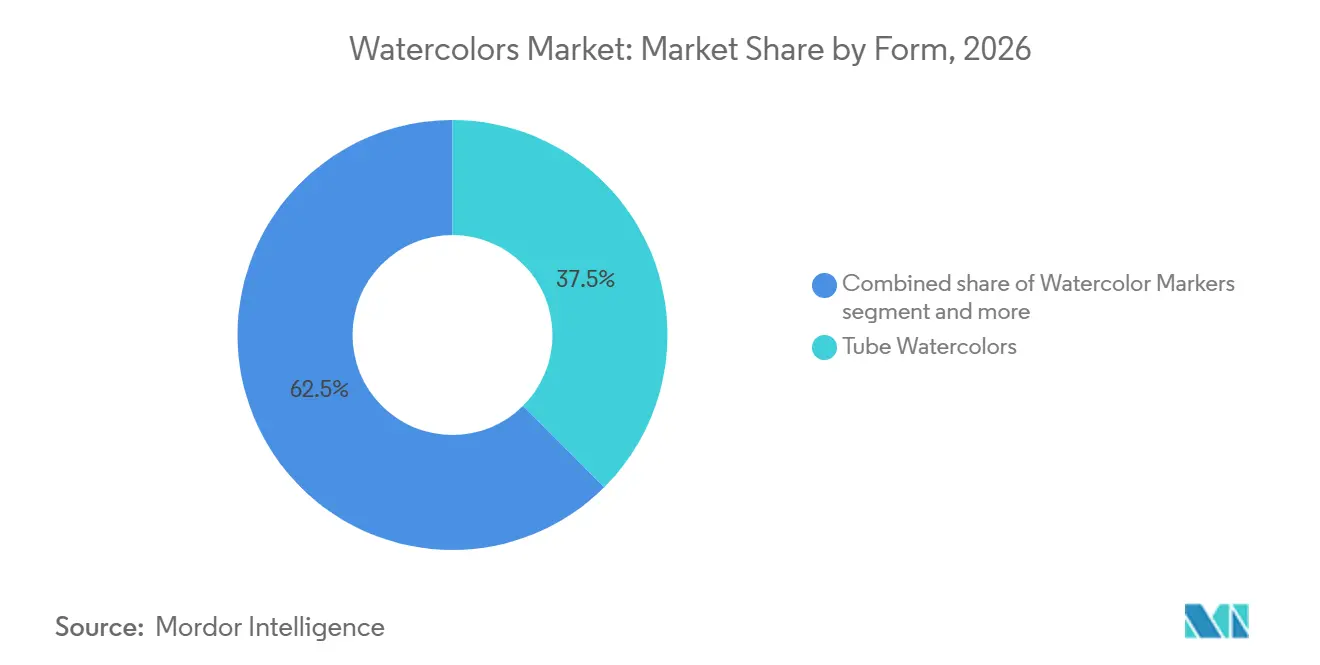
Tube Watercolors accounted for 37.53% of the watercolors market share in 2026, supported by their utility for professional artists and instructors. Users can dispense controlled amounts of paint, modify the strength of a wash, and prepare colors for larger surfaces without carrying a full studio setup. The format remains useful in studio practice because it combines pigment density with an easy-to-store, replace, and transport package. Daniel Smith added 6 Extra Fine Watercolors in 2025, bringing the range to 272 colors and reinforcing its ongoing focus on professional tube offerings. Pan formats remain important for urban sketchers and travelers who prefer paint, mixing space, and a compact palette in one product, especially when storage, quick setup, and clean transport matter more than working with a large selection of tubes.
Watercolor Markers are forecast to grow at a 7.68% CAGR during 2027-2032, the highest rate among forms in the watercolors market. Brush-pen designs allow controlled application for illustration, lettering, color studies, and small-scale work without the separate setup required for many traditional formats. They also appeal to users familiar with stationery products, making them a practical first step before trying tubes or pans. Japanese and South Korean suppliers have supported this category with products designed for portable use, controlled flow, and quick color application. Liquid watercolors, powder watercolors, and watercolor pencils remain smaller categories, while pencils retain broad appeal because they work as dry drawing tools before activation with water, letting schools, hobbyists, and illustrators move between drawing and painting without buying separate materials.

By End User: Students Provide Scale While Hobbyists Lift Repeat Demand
Students accounted for 41.65% of the watercolor market in 2026, driven by school procurement and parental spending on supplies. Large student populations in Asia-Pacific support seasonal buying patterns, classroom replenishment, and demand for accessible multipack products. Arts education programs also create a dependable need for familiar formats that teachers can use across different age groups and skill levels. This position makes student demand important to suppliers capable of meeting price, safety, product consistency, and distribution requirements. Professional artists and instructors remain a smaller group, but their material choices continue to shape product standards, color preferences, brand credibility, and the language retailers use to explain why particular pigments, formats, or papers suit more advanced work.
Hobbyists and Recreational Users are forecast to grow at a 7.43% CAGR during 2027-2032. Adult creative participation includes home practice, social media sharing, wellness activities, local classes, and community art challenges. These buyers are more likely than institutional purchasers to explore new colors, formats, papers, and higher-priced products as their confidence develops. They can also be reached through tutorials, reviews, and direct brand communication after an initial purchase. Their purchasing pattern gives the watercolors industry a larger opportunity for repeat sales, broader baskets, and gradual trade-up, because users often add colors and formats over time instead of replacing a fixed classroom supply list.
By Price Tier: Mass Products Retain Volume While Premium Products Gain Value
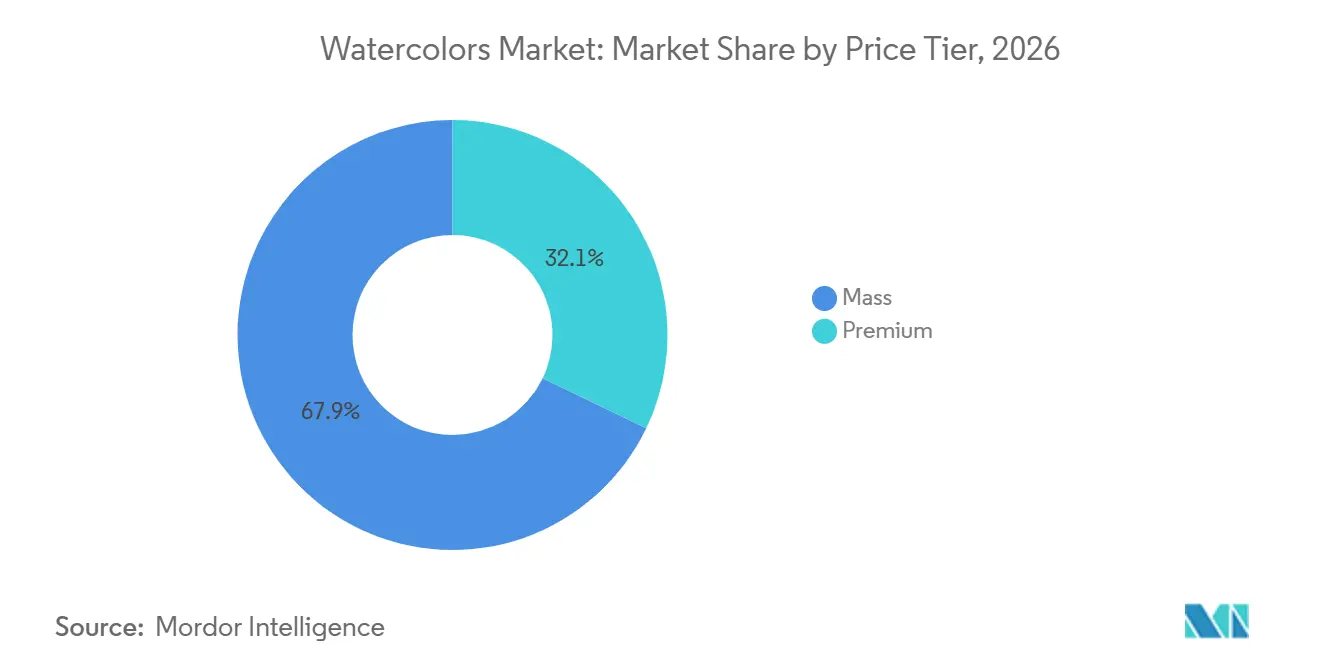
The Mass tier held a 67.87% share of the watercolor market in 2026 because student supplies, institutional purchases, and beginner sets remain central to the category's volume. Schools and families often compare products by price, pack size, and availability, which favors established suppliers with broad retail coverage. Multi-color sets are also well-suited to first-time users, classroom activities, and seasonal gift purchases. This tier serves as the primary entry point for consumers who may later choose specialist paints, papers, and accessories. Its scale makes supply reliability, consistent quality, accessible retail placement, and clear value communication important competitive factors, particularly for brands serving schools, supermarkets, and families making practical choices at the start of an academic term.
The Premium tier is forecast to grow at a 7.79% CAGR during 2027-2032, reflecting demand from adult hobbyists, professionals, and creators who want stronger color performance. Buyers in this tier may value lightfastness, pigment purity, mixing behavior, and handling characteristics that are visible in their finished work. Artist partnerships and limited color launches can help brands explain how a higher-priced range differs from a standard set. Schmincke’s 2025 Signature Edition additions used artist-developed colors, linking product development to the professional creative community. The premium watercolors market size is therefore expanding through differentiated products, customer education, and repeat purchase rather than volume alone, as experienced users often add individual colors and specialized materials after they have tested a basic professional set.
By Distribution Channel: Specialty Stores Remain Important While Online Retail Grows Fastest
Specialty Art Supply Stores led the watercolors market with a 38.56% share in 2026. These stores remain valuable because buyers can inspect colors, compare formats, and seek advice on paper compatibility, brush selection, and application methods. Their role is strongest for higher-value purchases where customers want confidence before selecting an unfamiliar pigment or professional range. They also connect brands with art classes, local creative communities, and experienced staff who can explain product differences. This channel helps manufacturers present product quality in a way that a standard online listing cannot always match, particularly when a buyer wants to compare a paint’s actual color, granulation, or behavior on different papers before committing to a purchase.
Online Retail is projected to expand at an 8.05% CAGR during 2027-2032. Brand-owned stores and other online sellers give customers wider access to specialist products that may not be available in a local store. They also allow suppliers to offer broad assortments, publish detailed product information, and communicate directly with purchasers. The channel helps the watercolors market reach repeat buyers who already know their preferred colors, paper types, and formats. A balanced approach remains important because brands need direct sales growth without weakening the specialist stores that provide product education and trial, local community links, and an accessible place for buyers to discover a new range before ordering replenishments online.
Geography Analysis
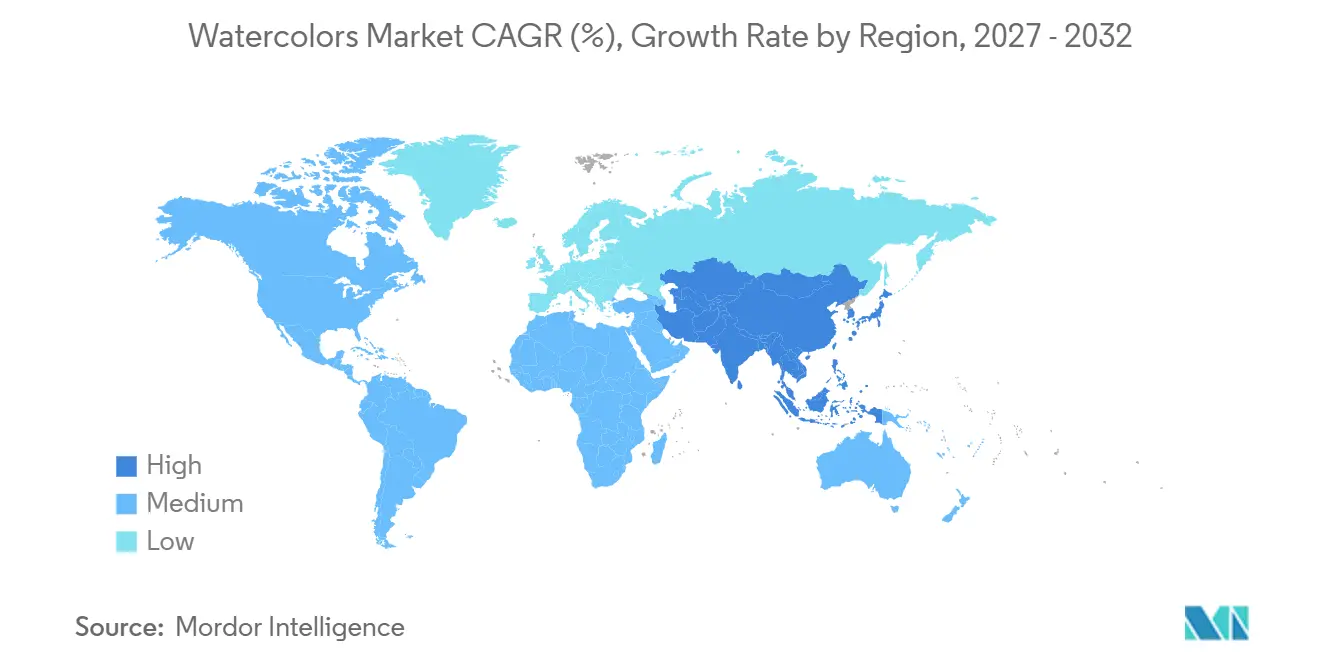
Asia-Pacific accounted for 35.72% of the watercolors market share in 2026 and is forecast to grow at a 7.41% CAGR during 2027-2032. The region combines high student demand with a growing base of hobbyists moving into higher-grade products, supported by strong access to stationery and art supplies, as well as online retail. China is an important source of volume through its school-age population, online retail infrastructure, and local manufacturing base, while Japan contributes formulation knowledge and established brands such as Holbein and Kuretake. South Korea adds format innovation and portable-use products, while India’s arts integration policy provides a longer-term basis for student-grade demand as schools adopt related learning practices.
North America remains a mature, high-value area of the watercolors market because it has a developed specialty retail network and active professional and hobbyist communities. Demand for artist-grade materials is supported by consumers who value pigment quality, clear performance information, and direct access to recognized brands. Daniel Smith and M. Graham & Co. provide a domestic base for professional products, while tutorials and online communities facilitate broader product discovery among new users. Europe has a distinct premium manufacturing position through brands including Schmincke, Winsor & Newton, and Sennelier, and the region’s chemical compliance rules increase the importance of formulation control while adding costs for smaller manufacturers.
South America and the Middle East and Africa have lower current value shares but offer room for broader participation as digital access and arts engagement increase. Brazil provides a consumer base where analog creative activities have gained visibility, while Argentina, Colombia, and Chile have active art communities with limited access to premium formats. In the Middle East and Africa, demand is concentrated in markets including the United Arab Emirates, Saudi Arabia, Nigeria, Egypt, and South Africa. Limited specialty retail infrastructure makes online and cross-border sales important channels in these regions. These differences in retail access, purchasing power, and local product availability shape how international suppliers prioritize distribution across the watercolors market.
Competitive Landscape
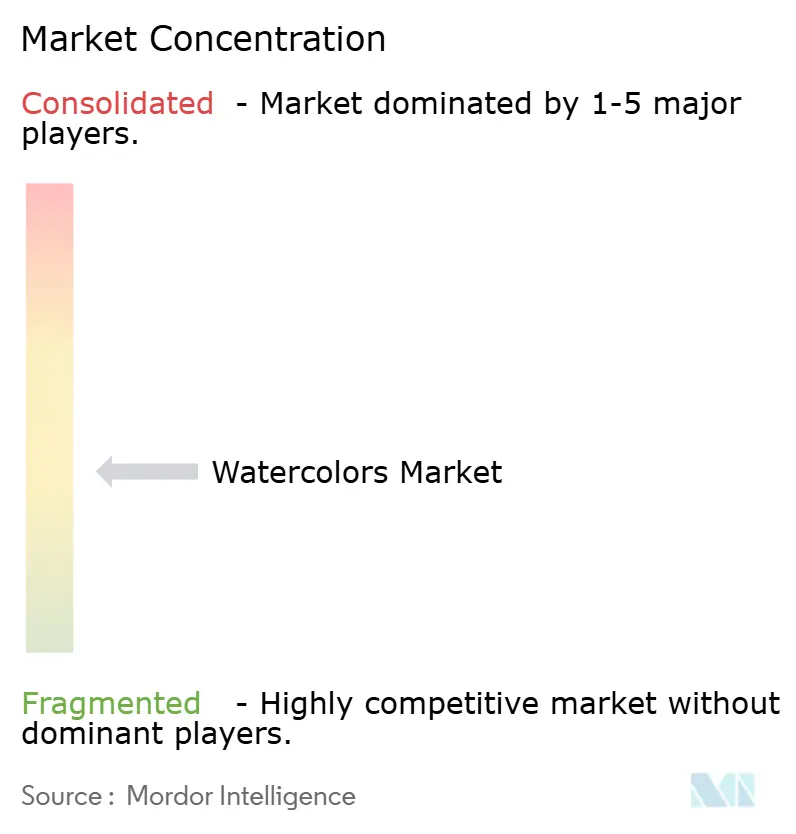
The watercolor market is moderately fragmented, with European heritage brands such as Schmincke, Winsor & Newton, and Sennelier holding strong positions in professional products for offering broad color ranges, established quality credentials, and long-standing relationships with artists. Japanese and South Korean manufacturers, including Holbein, Kuretake, ShinHan, and Mijello, compete through formulation precision, portable formats, and product designs that suit stationery and travel-painting users. This varied supplier base leaves room for regional specialists, artisanal producers, and smaller direct-to-consumer brands that can serve narrow user needs.
Product development remains a key way to compete in the watercolors market. Daniel Smith’s 2025 addition of 6 Extra Fine Watercolors expanded its range to 272 colors and reinforced its focus on professional users. Holbein’s 2025 move to a fully synthetic Ox Gall medium responded to sourcing difficulty and shows how supply-chain considerations can shape formulation decisions. Winsor & Newton collaborated with Tom’s Studio in April 2026 on Re-Crafted Professional Watercolor Synthetic brushes made using reclaimed factory waste and recycled plastic. These actions show that competition includes range expansion, materials choices, formulation management, and sustainability-related product design.
Distribution is also becoming more important as companies seek a closer relationship with artists. Winsor & Newton’s direct online store reaching 10,000 orders in 324 days shows how a legacy brand can build a direct sales channel alongside specialist retail. Smaller brands can use limited-edition colors, handmade pan sets, and community-based releases to establish a differentiated identity and encourage repeat purchases. The mid-priced set category remains an opening for suppliers that can offer clear product performance without the cost of established premium lines. Counterfeits and uneven product quality on large marketplaces remain competitive challenges because they can weaken pricing, confuse buyers, and reduce trust in established brands.
Watercolors Industry Leaders
-
ColArt Group (Winsor & Newton)
-
DANIEL SMITH Artists' Materials
-
Schmincke & Co. GmbH & Co. KG
-
Faber-Castell AG
-
Max Sauer SAS (Sennelier)
- *Disclaimer: Major Players sorted in no particular order
Recent Industry Developments
- April 2026: Winsor & Newton launched the Re-Crafted Professional Watercolor Synthetic brush line with Tom’s Studio. The direct-to-consumer range used reclaimed Winsor & Newton factory waste and recycled plastic, and supported the company’s sustainability positioning.
- March 2026: Winsor & Newton released four themed 6-tube Professional Watercolor sets, Mindful, Vibrant, Urban Sketching, and Floral, targeting distinct artist archetypes and widening accessibility to the professional range at an approachable price point.
- September 2025: ShinHan Art Materials introduced the PWC (Premium Water Color) professional range, comprising 7.5ml tubes, half pans, and curated sets, citing high single-pigment concentration, a moisture-retaining solid formulation, and an ABS-body portable set design optimized for outdoor use.
Global Watercolors Market Report Scope
Watercolors refer to water-soluble painting materials that use pigments dispersed in a water-based medium and are available in multiple formats for professional, educational, recreational, and institutional art applications. The Watercolors Market is segmented by form, end user, price tier, distribution channel, and geography. By form, the market includes Tube Watercolors, Pan Watercolors, Liquid Watercolors, Powder Watercolors, Watercolor Pencils, and Watercolor Markers. By end user, the market is segmented into Professional Artists and Art Instructors, Students, Hobbyists and Recreational Users, and Others (Institutional Buyers). By price tier, the market is categorized into Mass and Premium. By distribution channel, the market is divided into Supermarket/Hypermarkets, Specialty Art Supply Stores, Online Retail, and Others. By geography, the report covers North America, Europe, Asia-Pacific, South America, and Middle East and Africa, with market size and forecasts provided for each region. The market sizing has been done in value terms in USD for all the abovementioned segments.
| Tube Watercolors |
| Pan Watercolors |
| Liquid Watercolors |
| Powder Watercolors |
| Watercolor Pencils |
| Watercolor Markers |
| Professional Artists and Art Instructors |
| Students |
| Hobbyists and Recreational Users |
| Others (Institutional Buyers) |
| Mass |
| Premium |
| Supermarket/Hypermarkets |
| Specialty Art Supply Stores |
| Online Retail |
| Others |
| North America | United States |
| Canada | |
| Mexico | |
| Rest of North America | |
| Europe | United Kingdom |
| Germany | |
| France | |
| Italy | |
| Spain | |
| Russia | |
| Sweden | |
| Belgium | |
| Poland | |
| Netherlands | |
| Rest of Europe | |
| Asia-Pacific | China |
| Japan | |
| India | |
| Thailand | |
| Singapore | |
| Indonesia | |
| South Korea | |
| Australia | |
| New Zealand | |
| Rest of Asia-Pacific | |
| South America | Brazil |
| Argentina | |
| Colombia | |
| Chile | |
| Rest of South America | |
| Middle East and Africa | United Arab Emirates |
| South Africa | |
| Saudi Arabia | |
| Nigeria | |
| Egypt | |
| Morocco | |
| Turkey | |
| Rest of Middle East and Africa |
| By Form | Tube Watercolors | |
| Pan Watercolors | ||
| Liquid Watercolors | ||
| Powder Watercolors | ||
| Watercolor Pencils | ||
| Watercolor Markers | ||
| By End User | Professional Artists and Art Instructors | |
| Students | ||
| Hobbyists and Recreational Users | ||
| Others (Institutional Buyers) | ||
| By Price Tier | Mass | |
| Premium | ||
| By Distribution Channel | Supermarket/Hypermarkets | |
| Specialty Art Supply Stores | ||
| Online Retail | ||
| Others | ||
| By Geography | North America | United States |
| Canada | ||
| Mexico | ||
| Rest of North America | ||
| Europe | United Kingdom | |
| Germany | ||
| France | ||
| Italy | ||
| Spain | ||
| Russia | ||
| Sweden | ||
| Belgium | ||
| Poland | ||
| Netherlands | ||
| Rest of Europe | ||
| Asia-Pacific | China | |
| Japan | ||
| India | ||
| Thailand | ||
| Singapore | ||
| Indonesia | ||
| South Korea | ||
| Australia | ||
| New Zealand | ||
| Rest of Asia-Pacific | ||
| South America | Brazil | |
| Argentina | ||
| Colombia | ||
| Chile | ||
| Rest of South America | ||
| Middle East and Africa | United Arab Emirates | |
| South Africa | ||
| Saudi Arabia | ||
| Nigeria | ||
| Egypt | ||
| Morocco | ||
| Turkey | ||
| Rest of Middle East and Africa | ||
Key Questions Answered in the Report
What is the forecast growth rate for watercolors through 2032?
The watercolors market is forecast to grow at a 6.53% CAGR during 2027-2032, reaching USD 2.69 billion by 2032. Wider arts education, hobbyist participation, premium product demand, and online buying are expected to support this growth.
Which watercolor format has the largest share?
Tube Watercolors lead by form with a 37.53% share in 2026, supported by professional and instructional use.
Which user group is growing fastest?
Hobbyists and Recreational Users are projected to grow at a 7.43% CAGR during 2027-2032 as adult creative participation expands.
Which sales channel is expanding fastest?
Online Retail is projected to grow at an 8.05% CAGR during 2027-2032, supported by direct sales and wider product access.
Which region leads global demand?
Asia-Pacific leads with 35.72% share in 2026 and is also expected to grow fastest at a 7.41% CAGR during 2027-2032.