
Wall-Climbing Inspection Robot Imaging Market Size and Share
Market Overview
| Study Period | 2020 - 2031 |
|---|---|
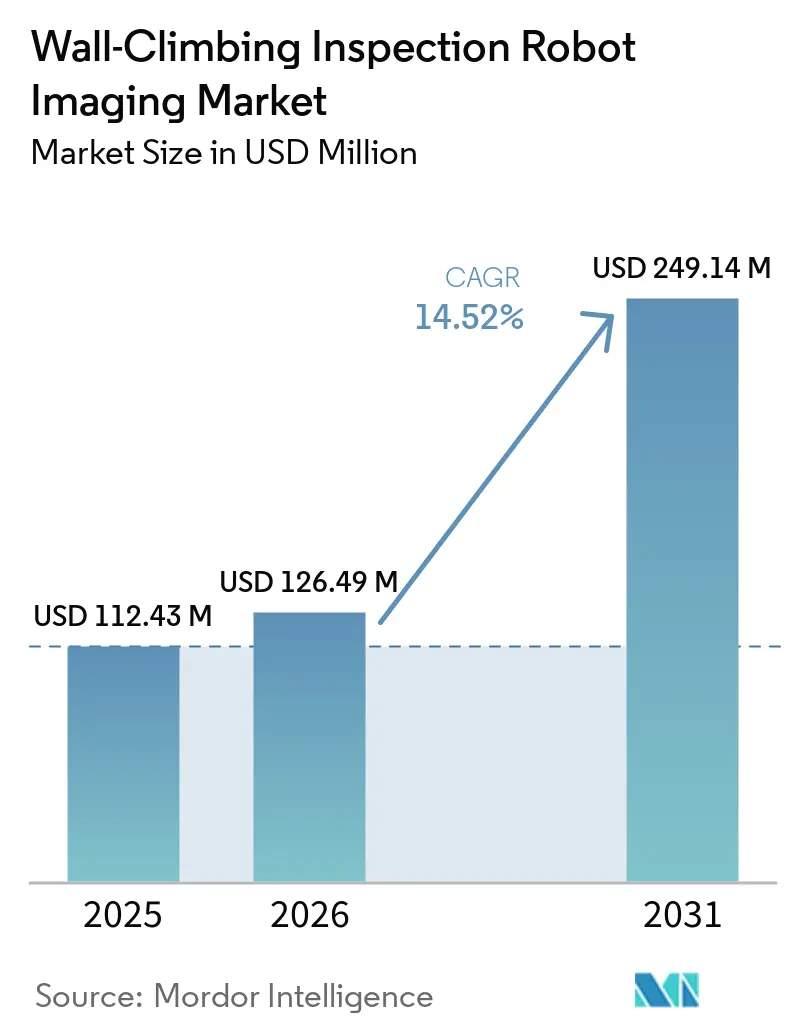
| Market Size (2026) | USD 126.49 Million |
| Market Size (2031) | USD 249.14 Million |
| Growth Rate (2026 - 2031) | 14.52 % |
| Fastest Growing Market | Asia-Pacific |
| Largest Market | Asia-Pacific |
| Market Concentration | Medium |
Major Players *Disclaimer: Major Players sorted in no particular order Image © Mordor Intelligence. Reuse requires attribution under CC BY 4.0. | |
Wall-Climbing Inspection Robot Imaging Market Analysis by Mordor Intelligence
The wall-climbing inspection robot imaging market size is projected to be USD 112.43 million in 2025, USD 126.49 million in 2026, and reach USD 249.14 million by 2031, growing at a CAGR of 14.52% from 2026 to 2031. Aging industrial and civil assets are increasing the need for repeatable condition assessments, especially where manual access is costly or unsafe. Asset owners are also placing more value on inspection data that can support maintenance planning, compliance reviews, and asset records. The wall-climbing inspection robot imaging market is therefore moving beyond a purchase decision centered on crawler hardware. Vendors increasingly compete on the ability to combine imaging payloads, analysis software, and usable records within existing integrity workflows. High system costs and difficult operating surfaces still limit adoption among smaller inspection providers and in demanding wall-climbing inspection robot imaging market applications.
Key Report Takeaways
- By imaging technology, RGB/Visible-Light Imaging held 38.81% of the wall-climbing inspection robot imaging market share in 2025, while Multispectral/Hyperspectral Imaging is forecast to grow at a 18.12% CAGR through 2031.
- By imaging systems, Camera Hardware held 47.71% share in 2025, while Imaging Processing and AI Vision Software is forecast to grow at a 16.23% CAGR through 2031.
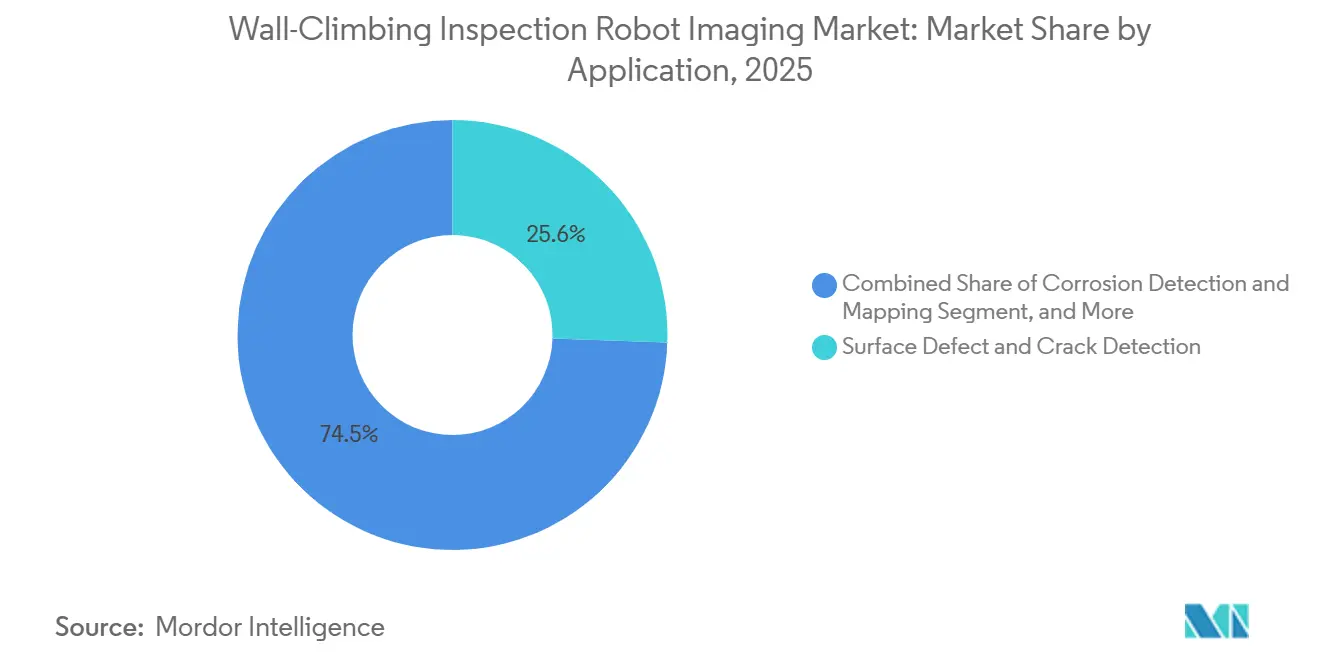
- By application, Surface Defect and Crack Detection held 25.55% share in 2025, while Corrosion Detection and Mapping is forecast to grow at a 15.67% CAGR through 2031.
- By end-user industry, Oil and Gas held 26.61% share in 2025, while Infrastructure and Construction is forecast to grow at a 15.45% CAGR through 2031.
- By geography, Asia-Pacific held 31.23% share in 2025 and is forecast to grow at a 15.34% CAGR through 2031.
Note: Market size and forecast figures in this report are generated using Mordor Intelligence’s proprietary estimation framework, updated with the latest available data and insights as of January 2026.
Market Trends and Insights
Drivers Impact Analysis of Wall-Climbing Inspection Robot Imaging Market*
| Driver | (~) % Impact on CAGR Forecast | Geographic Relevance | Impact Timeline |
|---|---|---|---|
| Aging Critical Infrastructure and Inspection Backlogs | +4.2% | Global, with concentrated demand in North America, Europe, and China | Long term (≥ 4 years) |
| Height-Safety Compliance and Rope-Access Risk Reduction | +3.0% | North America and Europe, with growing relevance in Middle East and Africa and Asia-Pacific | Medium term (2-4 years) |
| Demand for Repeatable Digital Asset-Integrity Records | +2.5% | Global, led by oil and gas operators in North America, the Middle East, and Asia-Pacific | Medium term (2-4 years) |
| Expansion of Multimodal NDT Imaging Payloads | +2.0% | Asia-Pacific, with expansion into North America and Europe | Long term (≥ 4 years) |
| Workforce Constraints in Hazardous Inspection Trades | +1.6% | North America and Europe, with emerging relevance in Asia-Pacific | Short term (≤ 2 years) |
| Robotic Chimney and Rough-Concrete Tomography Validation | +0.8% | Europe and North America, with expansion into Asia-Pacific industrial applications | Medium term (2-4 years) |
| Source: Mordor Intelligence | |||
Aging Critical Infrastructure and Inspection Backlogs
Deferred maintenance has created inspection backlogs across power plants, refineries, bridges, and marine terminals. The American Society of Civil Engineers reported more than USD 2.6 trillion in U.S. infrastructure funding gaps in its 2025 assessment.[1]American Society of Civil Engineers, “2025 Report Card for America’s Infrastructure,” American Society of Civil Engineers, infrastructurereportcard.org These gaps underscore the need for clear condition data before owners can prioritize maintenance work. The wall-climbing inspection robot imaging market benefits when crawlers can inspect tanks, piers, and chimney stacks without extended scaffold work. HausBots, EDF, and ACS-Solutions completed robotic ultrasonic tomography trials on a 200 m concrete chimney during 2025. The demonstration supported the use of robotic surveys for tall concrete structures and added practical evidence for higher-frequency inspection programs.
Height-Safety Compliance and Rope-Access Risk Reduction
Working at height remains a major constraint in conventional inspection planning. OSHA fall-protection requirements increase the need to control exposure during inspection work. Robotic access can reduce the need for personnel to work on elevated or difficult surfaces. HausBots used its HB3 crawler for an ultrasonic inspection of a 70 m Cemex rotary kiln in 2025 without personnel working at height during the survey. This changes the evaluation from equipment cost alone to risk management and site access planning. The wall-climbing inspection robot imaging market can gain where operators must document safe inspection methods across regulated assets.[2]Yuwu Song et al., “Advancing Operational Integrity Through Multimodal AI-Powered Robotic Inspection,” Offshore Technology Conference, doi.org
Demand for Repeatable Digital Asset-Integrity Records
Operators in oil and gas, power generation, and marine activities are replacing paper-based records with structured digital integrity data. API Standard 653 requires inspections of aboveground storage tanks and corrosion-rate calculations based on measured thickness data. Robots can collect images and measurements that feed into these records. Gecko Robotics and NAES announced a partnership valued at more than USD 100 million in February 2025 to deploy robots and the Cantilever AI platform across U.S. power facilities.[3]Gecko Robotics, “NAES and Gecko Announce USD 100M Deal,” Gecko Robotics, geckorobotics.com This model makes data management part of the procurement case. The wall-climbing inspection robot imaging market favors providers that connect inspection outputs with asset management processes.
Expansion of Multimodal NDT Imaging Payloads
A single crawler can increasingly carry visible-light cameras, thermal imagers, ultrasonic probes, and other payloads. This reduces the need for separate deployments for each inspection method. Avestec Technologies and bp completed an offshore proof of concept in July 2025 using a UAV-delivered magnetic crawler with cameras and an electromagnetic acoustic transducer sensor. The project demonstrated access to an otherwise difficult above-water riser area. Research published in 2025 also described automated Time-of-Flight Diffraction weld inspection of spherical tanks using a magnetic-adhesion robot. These developments increase the importance of payload integration and common data workflows across the wall-climbing inspection robot imaging market.
Restraints Impact Analysis of Wall-Climbing Inspection Robot Imaging Market*
| Restraint | (~) % Impact on CAGR Forecast | Geographic Relevance | Impact Timeline |
|---|---|---|---|
| High System Cost and Specialist Integration Requirements | -2.5% | Global, most acute in South America, Middle East and Africa, and smaller Asia-Pacific economies | Medium term (2-4 years) |
| Surface-Condition and Adhesion Reliability Limits | -1.8% | Global, especially challenging in offshore, chemical, and rough-concrete applications | Long term (≥ 4 years) |
| Defect-Classification Liability and Third-Party Validation Requirements | -0.7% | North America and Europe, where certification requirements are more stringent | Medium term (2-4 years) |
| Inconsistent Data Standards Across Asset Owners and NDT Workflows | -0.5% | Global, with greater friction in multi-operator pipelines and offshore platforms | Long term (≥ 4 years) |
| Source: Mordor Intelligence | |||
High System Cost and Specialist Integration Requirements
Advanced multimodal systems commonly cost from USD 150,000 to more than USD 500,000 when crawler hardware, sensors, software, training, and integration are included. The upfront cost can exceed the procurement capacity of smaller inspection companies. It also creates a longer approval process in price-sensitive applications. The availability of experienced NDT and integration personnel adds to the challenge. Service and rental models can reduce the initial capital burden for operators that want to test robotic methods. The wall-climbing inspection robot imaging market may therefore expand first through larger owners and service providers that can absorb integration costs.[4]American Petroleum Institute, “Standard 653,” American Petroleum Institute, api.org
Surface-Condition and Adhesion Reliability Limits
Surface conditions remain a practical limit on crawler deployment. Magnetic systems work best on clean ferrous steel and can lose holding force on scaled, coated, curved, or damaged surfaces. Suction-based approaches can address non-ferrous and rough concrete applications but remain sensitive to contamination and wind conditions. HausBots states that its AEROGRIP system combines suction and airflow technology for challenging surfaces. A 2026 building facade study found that surface variability interrupted locomotion during field trials and reported a defect segmentation mean average precision of 0.775. Asset owners in the wall-climbing inspection robot imaging market must still plan for access interruptions, especially in offshore, chemical, wind, and aging concrete applications.
*Our forecasts treat driver/restraint impacts as directional, not additive. The impact forecasts reflect baseline growth, mix effects, and variable interactions.
Wall-Climbing Inspection Robot Imaging Market Segment Analysis
By Imaging Technology:
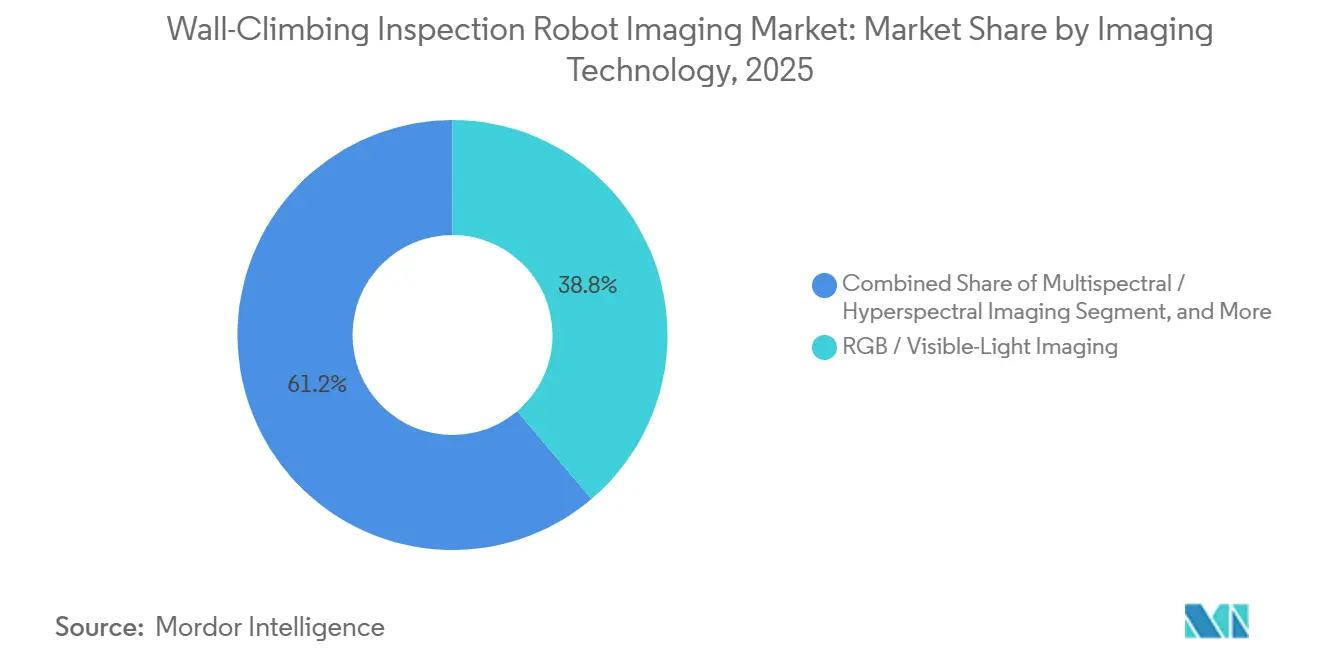
RGB Retains Scale While Hyperspectral Imaging Grows FastestMultispectral/Hyperspectral Imaging is forecast to grow at an 18.12% CAGR through 2031. This category supports material-level surface analysis beyond standard visual inspection. A 2025 review found that hyperspectral imaging can distinguish material composition at the pixel level in mobile robot applications. This capability can help identify corrosion chemistry, coating degradation, and moisture ingress.
RGB/Visible-Light Imaging accounted for 38.81% of the wall-climbing inspection robot imaging market size in 2025. It remains widely used because it fits established camera systems and supports mature defect-detection models. A 2026 study reported a crack-width relative error of 0.53% for an onboard real-time segmentation network on a negative-pressure wall-climbing robot. Thermal/Infrared Imaging remains important for corrosion under insulation and subsurface delamination. 3D/Stereo Imaging supports defect geometry measurement for inspection reports. Other imaging technologies, including radar and acoustic approaches, remain suited to reinforced concrete cases that require deeper assessment in the wall-climbing inspection robot imaging market.



By Imaging Systems:
Camera Hardware Leads While AI Vision Software Adds GrowthCamera Hardware held 47.71% share of the imaging systems segment in 2025. Cameras remain the primary imaging payload across a broad installed base of wall-climbing crawlers. Replacement needs and broader deployment support demand for this component in the wall-climbing inspection robot imaging market. Thermal cameras and 3D systems address defined needs such as hotspot detection, structural measurement, and weld mapping.
Imaging Processing and AI Vision Software is forecast to grow at a 16.23% CAGR through 2031. Robotic campaigns generate large image and sensor datasets that require automated sorting and classification. The 2026 building facade study reported inspection-cycle latency of 2.8 to 4.8 seconds for real-time defect segmentation. A 2026 marine-hull study reported a ROC AUC of 0.97 for a gradient-boosted classifier that inferred corrosion from ultrasonic thickness data gathered by a wall-climbing robot. These results make software performance increasingly relevant to the wall-climbing inspection robot imaging industry. Providers can strengthen their position by integrating analytics with the owner’s existing asset data systems.
By End-User Industry:
Oil and Gas Leads While Infrastructure and Construction Expand FastestOil and Gas held 26.61% share in 2025. Inspection requirements are tied to the value and safety profile of tanks, vessels, pipelines, and processing infrastructure. API Standard 653 shapes tank inspection needs through defined intervals and thickness-based corrosion assessment. Gecko Robotics and ADNOC formalized 3 collaborative programs in 2025 for the deployment of robotics and AI across upstream and downstream operations.
Infrastructure and Construction is forecast to grow at a 15.45% CAGR through 2031. Hoban Construction completed a demonstration of an AI-based exterior wall crack inspection robot with FD Tech in May 2026. The system combined 4 cameras with nondestructive acoustic and ultrasonic methods to detect crack locations and depths. Ixis received NETIS registration in January 2026 for its Kabekokan Doctor AI wall crack inspection system. The registration allows the specification of Japanese government-funded infrastructure projects. Manufacturing, aerospace, and nuclear facilities create additional demand for purpose-specific crawler and sensing configurations in the wall-climbing inspection robot imaging market.
Geography Analysis
APAC Wall-Climbing Inspection Robot Imaging Market
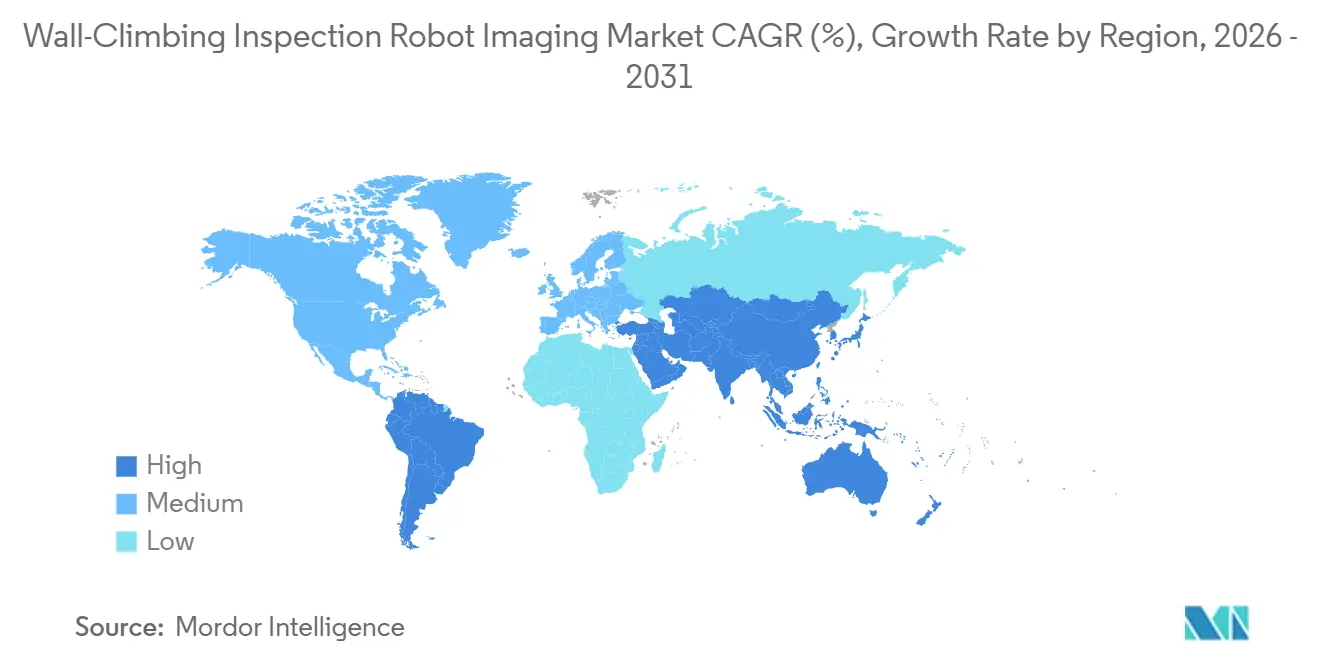
Asia-Pacific held 31.23% of the wall-climbing inspection robot imaging market share in 2025 and is forecast to grow at a 15.34% CAGR through 2031. China’s storage tank base, Japan’s bridge inspection requirements, India’s rehabilitation activity, and South Korea’s shipbuilding investment support varied demand across the region. Japan’s NETIS framework can make registered systems eligible for government-funded project specifications. Didon Robotics developed an electromagnetic permanent-magnet climbing quadruped and had supply agreements with 2 Korean shipyards and 1 European customer by December 2025. Domestic suppliers are also pursuing inspection work in Indian and Middle Eastern oil and gas applications.
North America and Europe Wall-Climbing Inspection Robot Imaging Market
North America and Europe are high-value demand centers due to mature NDT services, industrial asset density, and inspection requirements. Height-safety rules, bridge inspection frameworks, and investment in aging infrastructure support U.S. demandThe. The U.S. Navy awarded Gecko Robotics a five-year IDIQ contract in March 2026, with an initial value of USD 54 million and a ceiling of USD 71 million, for inspection and maintenance-planning activities. European demand includes applications involving chimneys, cooling towers, and offshore structures. HausBots reported 300% turnover growth in 2025 and more than USD 2 million in new deals while expanding distribution in Japan, Singapore, and South Korea.
MEA and South America Wall-Climbing Inspection Robot Imaging Market
The Middle East, Africa, and South America remain smaller demand pools with specific long-term opportunities. ADNOC’s 2025 agreements with Gecko Robotics included the deployment of robotics and Emirati technician training. Brazil’s offshore fields and Nigeria’s aging pipeline and tank infrastructure offer potential applications as service models that reduce first-deployment costs. The wall-climbing inspection robot imaging market can expand in these regions as providers demonstrate reliable field outcomes and workable service pricing.

Competitive Landscape
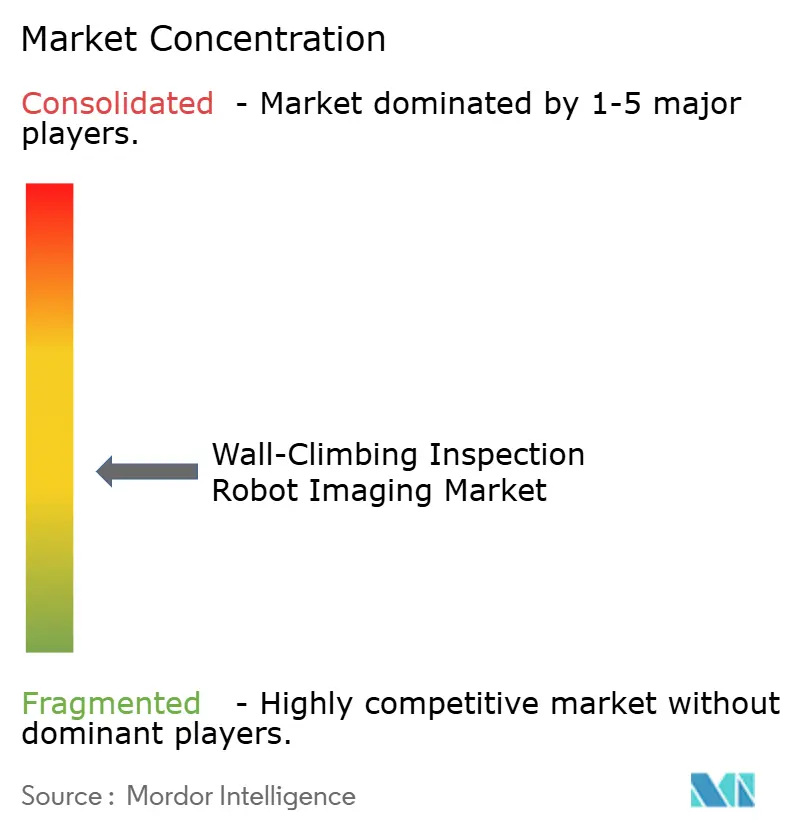
The wall-climbing inspection robot imaging market remains moderately fragmented, with no company holding a leading position across crawler platforms, sensor payloads, and software. Gecko Robotics, HausBots, Invert Robotics, International Climbing Machines, and Nexxis compete through platform design, adhesion approaches, and service options. HausBots states that its HB3 platform can integrate customer-owned NDT equipment through its AEROGRIP system. The competitive focus is shifting toward the ability to make inspection data usable after field collection.
Gecko Robotics illustrates this direction through Cantilever, which combines robot, drone, and fixed-sensor data in a broader infrastructure intelligence platform. The company raised USD 125 million in a June 2025 Series D round, reaching a USD 1.25 billion valuation. Its NAES partnership also links robotic data collection with power-facility operations. HausBots’ work with EDF and ACS-Solutions demonstrated a path to robotic ultrasonic imaging on tall concrete assets. Avestec and BP demonstrated a combined UAV-and-mini-crawler approach for riser inspection.
Rough surfaces, non-ferrous materials, and offshore wind conditions remain areas where existing platforms face limits. Smaller providers are also pursuing modular systems and inspection-as-a-service models for specific asset types in the wall-climbing inspection robot imaging market. NDT payload suppliers are becoming more concentrated following announced corporate transactions involving Eddyfi and Waygate during 2026. ASTM E2853/E2853M-22 remains relevant to remote visual examination systems used in regulated inspection settings. The wall-climbing inspection robot imaging market will favor participants that can demonstrate both operating reliability and credible inspection workflows.
Wall-Climbing Inspection Robot Imaging Industry Leaders
Gecko Robotics, Inc.
HiBot Corporation
Invert Robotics Group Limited
International Climbing Machines, Inc.
Eddyfi Technologies Inc.
- *Disclaimer: Major Players sorted in no particular order
Wall-Climbing Inspection Robot Imaging Market Companies Covered in this Report
- Gecko Robotics, Inc.
- HiBot Corporation
- Invert Robotics Group Limited
- International Climbing Machines, Inc.
- Eddyfi Technologies Inc.
- HausBots Ltd
- Waygate Technologies GmbH
- GE Vernova Inc.
- ANYbotics AG
- Boston Dynamics, Inc.
- Deep Trekker Inc.
- CUES, Inc.
- Rausch GmbH
- Minicam Limited
- Inspector Systems GmbH
- Kummert GmbH
- NDT Global GmbH and Co. KG
- MFE Inspection Solutions, LLC
- Nexxis
- SuperDroid Robots, Inc.

Recent Industry Developments in Wall-Climbing Inspection Robot Imaging Market
- April 2026: Hexagon announced the acquisition of Waygate Technologies from Baker Hughes for approximately USD 1.45 billion, consolidating phased-array ultrasonic, eddy current, and digital radiography inspection payload technologies within Hexagon's industrial measurement division. The transaction directly reshapes the independent supplier base for NDT imaging payloads used in wall-climbing robot configurations.
- March 2026: Gecko Robotics signed a five-year Indefinite Delivery, Indefinite Quantity contract with the U.S. Navy and the General Services Administration, starting at a USD 54 million initial award with a USD 71 million ceiling. The contract covers hull-scaling robots and AI-driven inspection for Pacific Fleet destroyers, amphibious warships, and littoral combat ships, establishing defense assets as a structured procurement channel for wall-climbing imaging systems.
- February 2026: ESAB Corporation announced a definitive agreement to acquire Eddyfi Technologies for USD 1.45 billion. Eddyfi is projected to generate approximately USD 270 million in revenue and USD 80 million in adjusted EBITDA in 2026. The combination expands ESAB's total addressable market by approximately USD 5 billion and provides direct access to Eddyfi's robotics, phased-array, and remote monitoring portfolio for critical asset inspection.
- January 2026: Ixis (Japan) received national NETIS registration from Japan's Ministry of Land, Infrastructure, Transport and Tourism for its "Kabekokan Doctor" AI-powered wall crack inspection robot and AI analysis system, making it eligible for specification on government-funded infrastructure projects throughout Japan.


Global Wall-Climbing Inspection Robot Imaging Market Report Scope
Wall-Climbing Inspection Robot Imaging refers to specialized visual perception systems integrated into magnetic, vacuum, or adhesion-based robots that capture high-resolution data from vertical and complex surfaces, enabling automated defect detection, structural integrity assessment, and predictive maintenance in hazardous or hard-to-reach environments.
The Wall-Climbing Inspection Robot Imaging Market Report is Segmented by Imaging Technology (RGB / Visible-Light Imaging, Thermal / Infrared Imaging, 3D / Stereo Imaging, Multispectral / Hyperspectral Imaging, and Other Imaging Technologies), Imaging Systems (Camera Hardware, Thermal Cameras, 3D Imaging Systems, Lighting / Optical Accessories, and Imaging Processing and AI Vision Software), Application (Surface Defect and Crack Detection, Corrosion Detection and Mapping, Weld Inspection, Coating / Paint Inspection, Structural Condition Assessment, and Other Applications), End-User Industry (Oil and Gas, Power Generation and Utilities, Infrastructure and Construction, Marine and Offshore, Wind Energy, Manufacturing, and Other End-User Industries), and Geography (North America, South America, Europe, Asia-Pacific, Middle East and Africa). The Market Forecasts are Provided in Terms of Value (USD).
| RGB / Visible-Light Imaging |
| Thermal / Infrared Imaging |
| 3D / Stereo Imaging |
| Multispectral / Hyperspectral Imaging |
| Other Imaging Technologies |
| Camera Hardware |
| Thermal Cameras |
| 3D Imaging Systems |
| Lighting / Optical Accessories |
| Imaging Processing and AI Vision Software |
| Surface Defect and Crack Detection |
| Corrosion Detection and Mapping |
| Weld Inspection |
| Coating / Paint Inspection |
| Structural Condition Assessment |
| Other Applications |
| Oil and Gas |
| Power Generation and Utilities |
| Infrastructure and Construction |
| Marine and Offshore |
| Wind Energy |
| Manufacturing |
| Other End-User Industries |
| North America | United States | |
| Canada | ||
| Mexico | ||
| South America | Brazil | |
| Argentina | ||
| Rest of South America | ||
| Europe | Germany | |
| United Kingdom | ||
| France | ||
| Italy | ||
| Spain | ||
| Rest of Europe | ||
| Asia-Pacific | China | |
| Japan | ||
| India | ||
| South Korea | ||
| Rest of Asia-Pacific | ||
| Middle East and Africa | Middle East | Saudi Arabia |
| United Arab Emirates | ||
| Turkey | ||
| Rest of the Middle East | ||
| Africa | South Africa | |
| Nigeria | ||
| Rest of Africa | ||
| By Imaging Technology | RGB / Visible-Light Imaging | ||
| Thermal / Infrared Imaging | |||
| 3D / Stereo Imaging | |||
| Multispectral / Hyperspectral Imaging | |||
| Other Imaging Technologies | |||
| By Imaging Systems | Camera Hardware | ||
| Thermal Cameras | |||
| 3D Imaging Systems | |||
| Lighting / Optical Accessories | |||
| Imaging Processing and AI Vision Software | |||
| By Application | Surface Defect and Crack Detection | ||
| Corrosion Detection and Mapping | |||
| Weld Inspection | |||
| Coating / Paint Inspection | |||
| Structural Condition Assessment | |||
| Other Applications | |||
| By End-User Industry | Oil and Gas | ||
| Power Generation and Utilities | |||
| Infrastructure and Construction | |||
| Marine and Offshore | |||
| Wind Energy | |||
| Manufacturing | |||
| Other End-User Industries | |||
| By Geography | North America | United States | |
| Canada | |||
| Mexico | |||
| South America | Brazil | ||
| Argentina | |||
| Rest of South America | |||
| Europe | Germany | ||
| United Kingdom | |||
| France | |||
| Italy | |||
| Spain | |||
| Rest of Europe | |||
| Asia-Pacific | China | ||
| Japan | |||
| India | |||
| South Korea | |||
| Rest of Asia-Pacific | |||
| Middle East and Africa | Middle East | Saudi Arabia | |
| United Arab Emirates | |||
| Turkey | |||
| Rest of the Middle East | |||
| Africa | South Africa | ||
| Nigeria | |||
| Rest of Africa | |||


Key Questions Answered in the Report
What is the wall-climbing inspection robot imaging market size?
The market was USD 126.49 million in 2026 and is projected to reach USD 249.14 million by 2031 at a 14.52% CAGR.
Which imaging technology leads wall-climbing robot inspection?
RGB/Visible-Light Imaging led with 38.81% share in 2025 because it works with established camera systems and defect-detection workflows.
Which component is growing fastest in wall-climbing inspection systems?
Imaging Processing and AI Vision Software is forecast to grow at a 16.23% CAGR through 2031 as operators need faster analysis of robotic inspection data.
Why are wall-climbing robots used for asset inspection?
They can reduce personnel exposure during elevated inspections and collect repeatable imaging and measurement data for integrity records.
Which end-user field has the fastest projected growth?
Infrastructure and Construction is forecast to grow at a 15.45% CAGR through 2031, supported by bridge, building, and civil inspection needs.
Which region is expected to grow fastest through 2031?
Asia-Pacific is forecast to grow at a 15.34% CAGR through 2031, supported by inspection activity across industrial and civil assets.
Page last updated on:





