
Voice Of Customer Software Market Size and Share
Market Overview
| Study Period | 2020 - 2031 |
|---|---|
| Market Size (2026) | USD 9.18 Billion |
| Market Size (2031) | USD 19.83 Billion |
| Growth Rate (2026 - 2031) | 16.65 % |
| Fastest Growing Market | Asia-Pacific |
| Largest Market | North America |
| Market Concentration | Medium |
Major Players *Disclaimer: Major Players sorted in no particular order Image © Mordor Intelligence. Reuse requires attribution under CC BY 4.0. | |
Voice Of Customer Software Market Analysis by Mordor Intelligence
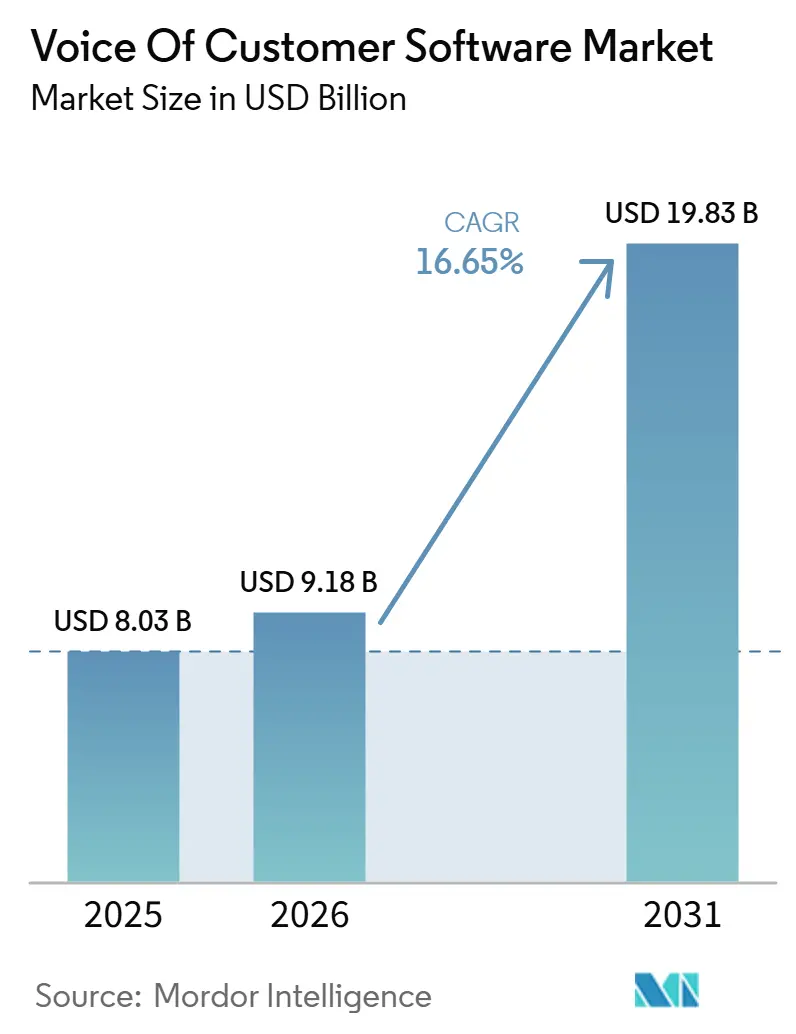
The voice of customer software market size is projected to expand from USD 8.03 billion in 2025 and USD 9.18 billion in 2026 to USD 19.83 billion by 2031, registering a CAGR of 16.65% between 2026 and 2031. Organizations are moving from periodic surveys toward ongoing listening programs that collect feedback across service, product, and marketing interactions. This shift places customer feedback closer to operational decisions, including service recovery, product planning, and campaign management. AI-based text, voice, and behavioral analysis reduces the time required to interpret large volumes of feedback. It also broadens spending beyond customer experience teams because product, operations, and marketing leaders can use the same signals. The depth of AI capabilities increasingly shapes competition, the range of available data, and the ability to integrate with existing enterprise systems.
Key Report Takeaways
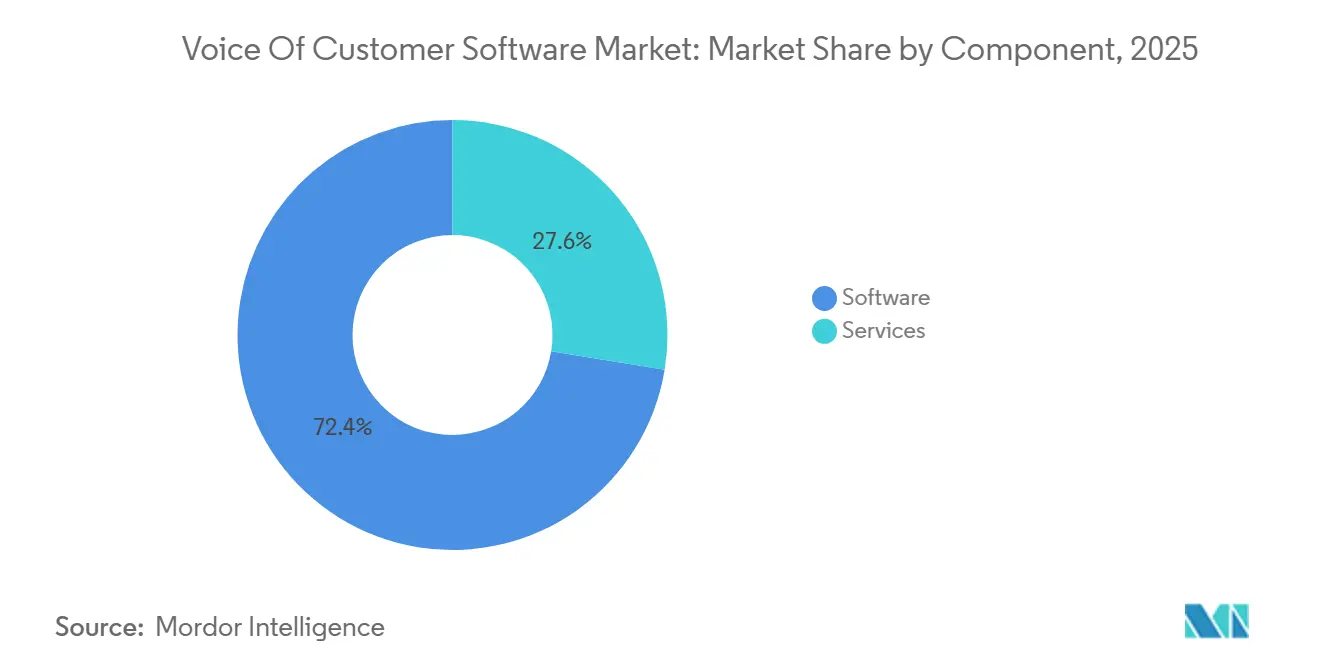
- By component, software held 72.41% of the voice of customer software market share in 2025, while services are projected to expand at a 19.82% CAGR through 2031.
- By deployment mode, cloud accounted for 68.19% of the voice of customer software market size in 2025, while hybrid deployment is projected to expand at an 18.43% CAGR through 2031.
- By application, customer journey optimization accounted for 26.74% share in 2025, while campaign performance and experience measurement are projected to grow at a 20.16% CAGR through 2031.
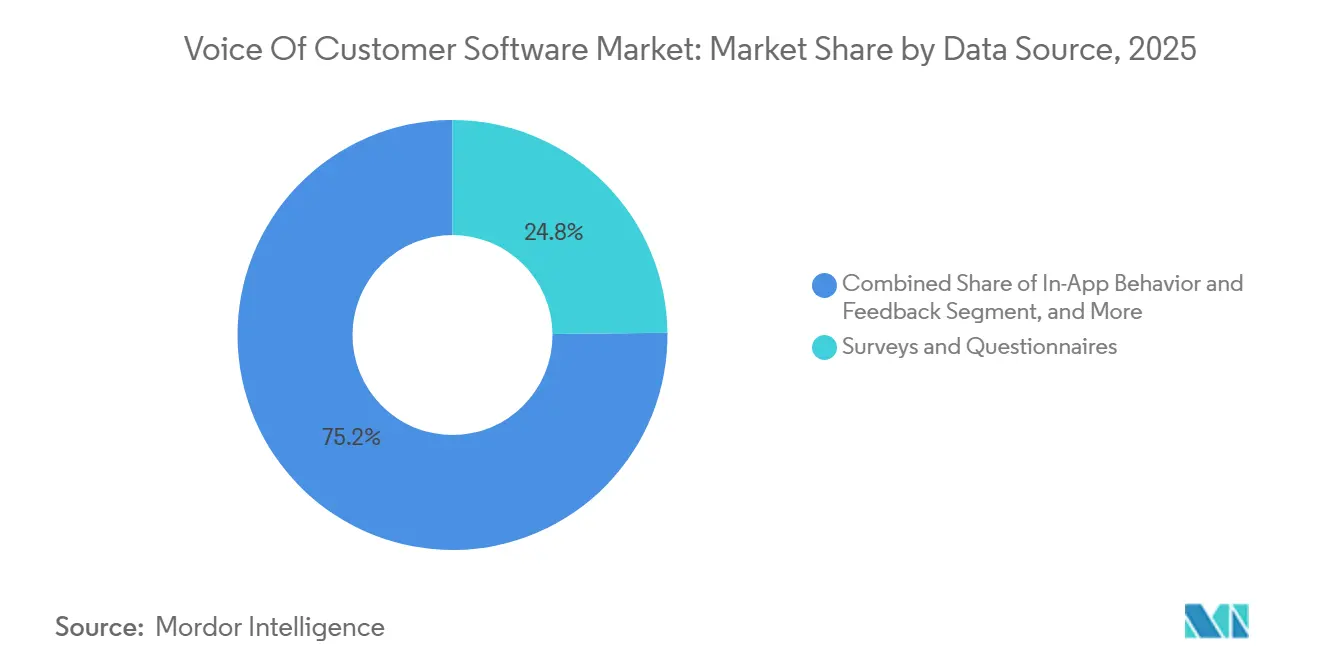
- By data source, surveys and questionnaires accounted for 24.83% share in the voice of customer software market in 2025, while in-app behavior and feedback are projected to grow at a 21.34% CAGR through 2031.
- By end user, retail and e-commerce held 24.36% share in 2025, while healthcare and life sciences are projected to expand at a 19.48% CAGR through 2031.
- By geography, North America held 34.62% share in 2025, while Asia-Pacific is projected to expand at a 20.71% CAGR through 2031.
Note: Market size and forecast figures in this report are generated using Mordor Intelligence’s proprietary estimation framework, updated with the latest available data and insights as of January 2026.
Market Trends and Insights
Drivers Impact Analysis of Voice Of Customer Software Market*
| Driver | (~) % Impact on CAGR Forecast | Geographic Relevance | Impact Timeline |
|---|---|---|---|
| Shift From Survey Snapshots to Continuous Listening | +4.2% | Global, concentrated in North America and Europe | Long term (≥ 4 years) |
| AI-Native Analysis of Unstructured Feedback | +3.5% | Global, with early adoption in North America and Asia-Pacific core | Medium term (2-4 years) |
| Omnichannel Experience and Closed-Loop Action | +2.8% | North America, Europe, Asia-Pacific core | Medium term (2-4 years) |
| Cloud Access for Midmarket Buyers | +2.0% | North America and Europe, with spillover to South America and Middle East and Africa | Short term (≤ 2 years) |
| Privacy, Consent, and Auditability Requirements | +1.4% | North America, Europe, India, with spillover to Asia-Pacific | Medium term (2-4 years) |
| Product-Led Feedback Loops | +1.0% | North America, Europe, Asia-Pacific core | Short term (≤ 2 years) |
| Source: Mordor Intelligence | |||
Enterprise Shift From Survey Snapshots to Continuous Listening
The voice of customer software market is being shaped by a shift away from quarterly NPS programs toward continuous, multichannel listening. These programs capture behavioral signals, conversations, and product feedback as customer interactions take place. Enterprises are treating each interaction as usable input rather than waiting for a scheduled survey event. Continuous programs can support churn prediction and service recovery workflows that operate throughout the customer journey. In March 2026, Qualtrics reported that its AI Experience Agents resolved 51% of post-service customer concerns for TruGreen in an initial deployment and reduced escalations by more than 30% during the first week.[1]Qualtrics International Inc., “Qualtrics Announces New CX Capabilities at X4 2026,” Qualtrics, qualtrics.com Vendors that establish these ongoing listening programs can extend their role from survey collection to a broader operational platform.
AI-Native Analysis of Unstructured Feedback at Scale
Customer feedback now arrives through calls, chat logs, app reviews, social comments, and digital behavior data. The volume of this material makes manual coding and rule-based categorization difficult to sustain. AI tools help organizations identify topics and sentiment from text and voice data more quickly. Qualtrics stated in March 2026 that Automated Text Analytics reduced deployment time from months to hours and reduced analytical costs by 4 to 5 times. Lower analysis costs make advanced feedback tools more accessible to organizations beyond the largest enterprises. The voice of customer software market, therefore, places greater value on tools that connect a customer signal with a practical action.
Omnichannel Customer Experience and Closed-Loop Action Requirements
Organizations increasingly want feedback from contact centers, digital channels, stores, and social platforms to be consolidated into a unified customer view. This requirement favors platforms that can combine data and initiate actions in CRM, contact center, and service management systems. It also reduces the value of stand-alone tools that collect feedback but offer no follow-up. In January 2026, Medallia and Ada announced a partnership combining Medallia's customer intelligence with Ada's agentic AI for automated issue resolution, purchase guidance, and workflow coordination.[4]Medallia and Ada, “Medallia and Ada Announce Strategic Partnership to Unite Customer Intelligence With Agentic AI to Elevate Customer Experiences,” Business Wire, businesswire.com Buyers now assess platforms by integration depth, action tracking, and the ability to link feedback to operational results. This underscores the importance of connected workflows across the voice of customer software market.
Cloud Deployment Expanding Access for Midmarket Buyers
Cloud-based platforms reduce the infrastructure requirements that once limited advanced feedback programs to large organizations. Subscription pricing, pre-built connectors, and no-code tools simplify adoption for smaller customer experience teams. Connectors to Salesforce, Genesys, HubSpot, and Zendesk can also reduce the internal technology work needed to launch a program. Qualtrics introduced connectors for Genesys, NICE, and Salesforce in March 2026, stating they could be deployed up to 4 times faster than previous integrations. Retail, e-commerce, and hospitality organizations benefit because variable demand and frequent customer interactions suit cloud capacity. The voice of customer software market can therefore gain volume from buyer groups that had limited access to enterprise-grade tools.
Restraints Impact Analysis of Voice Of Customer Software Market*
| Restraint | (~) % Impact on CAGR Forecast | Geographic Relevance | Impact Timeline |
|---|---|---|---|
| Low Response Rates and Survey Fatigue | -2.6% | Global, most acute in North America and Western Europe | Medium term (2-4 years) |
| Legacy Experience System Integration Complexity | -2.1% | North America, Europe, emerging in Asia-Pacific core | Long term (≥ 4 years) |
| Privacy-Safe Voice, Text, and Behavioral Data Handling | -1.5% | Europe, North America, India, with spillover to Asia-Pacific | Medium term (2-4 years) |
| Bundled Basic Feedback Features | -1.1% | Global, concentrated in North America and Europe | Short term (≤ 2 years) |
| Source: Mordor Intelligence | |||
Low Response Rates and Customer Survey Fatigue
Survey fatigue can undermine the representativeness of customer feedback programs, as respondents may not reflect the full customer base. The American Customer Satisfaction Index stated in April 2026 that lower participation can create bias toward satisfaction extremes, while customers in the middle disengage.[3]American Customer Satisfaction Index, “Can Fewer Surveys Provide Better Customer Insights?,” American Customer Satisfaction Index, theacsi.org This weakens the data that NPS programs and churn models use for decisions. Lower response levels also encourage organizations to collect passive signals from in-app behavior, voice interactions, and website activity. Privacy rules can narrow the window for outbound contact and require clear consent practices. The voice of customer software market must therefore support survey methods while offering reliable alternatives that do not rely only on direct responses
Integration Complexity Across Legacy Experience Systems
Large enterprises often operate legacy CRM systems, on-premises contact center tools, internal NPS applications, and newer cloud services simultaneously. These systems can keep customer data in separate structures with different consent and governance requirements. Connecting them to a modern feedback platform requires API work, data lineage controls, and agreement on data handling. This work can delay value realization and create a gap between expected and actual implementation timelines. The challenge is greater in healthcare and financial services because voice, chat, and behavioral data must meet HIPAA or PCI-DSS requirements before analysis begins. For midmarket buyers, a difficult implementation can use professional services budgets that are already limited.
*Our forecasts treat driver/restraint impacts as directional, not additive. The impact forecasts reflect baseline growth, mix effects, and variable interactions.
Voice Of Customer Software Market Segment Analysis
By Component:
Services Grow Faster as Implementation Needs IncreaseSoftware held 72.41% of the voice of customer software market in 2025, reflecting enterprise demand for platforms that bring survey management, analytics, and workflow tools into a single operating environment. The software component remains the primary purchase because it provides the data-collection layer, the analytics interface, and controls that enable multiple teams to work from the same feedback record. Organizations are replacing disconnected survey, text analytics, and feedback management applications when separate tools create inconsistent definitions of a customer issue. A consolidated platform can give product teams, service leaders, and marketing teams a shared view of recurring themes, while each team can still use the information for its own purposes. This preference does not remove the need for specialist tools, but it gives broad platforms an advantage when buyers want fewer vendors, common data controls, and less duplication of customer information. The role of software is also changing as providers add AI-based text analysis, guided action planning, and integrations with CRM and contact center systems. These functions make the platform more useful after feedback has been collected because users can connect a signal to an owner, a workflow, or a follow-up action. Large enterprises often favor this approach because it reduces the effort required to move information between a survey tool, a reporting tool, and an operational system. The platform-first model also supports recurring software spending, as the system is used across multiple customer journeys rather than just a single research exercise. The voice of the customer software industry, therefore, continues to center on integrated software environments even as buyers seek flexibility in how individual capabilities are deployed.
Services are projected to expand at a 19.82% CAGR through 2031, faster than the software component, because sophisticated platforms require more than routine installation. Organizations need support to connect feedback applications with CRM, contact center, marketing, and internal data systems that may use different customer identifiers and data rules. They also need assistance defining data models, assigning permissions, setting up workflows, and adapting reports to business users' needs. These requirements are especially important during migration from legacy survey and experience systems, where historical records and existing processes cannot always be moved directly into a new platform. The faster growth of services reflects the practical work needed to make feedback data usable across the enterprise rather than simply available in a dashboard. Sprinklr reported fiscal 2026 revenue of USD 857 million, up 8% year over year, from a platform spanning customer feedback, social media management, and contact center AI.[4]Sprinklr Inc., “Sprinklr Unveils Next Wave of AI-Native Customer Experience Innovation With Spring '26 (26.4) Release,” Sprinklr, sprinklr.com A platform with this scope can require configuration beyond a basic software subscription. Professional services and managed analytics can help organizations adjust workflows as new channels, customer groups, and regulatory requirements emerge. AI automation may gradually reduce manual configuration, but it does not eliminate the need to connect systems or establish rules for data use. Services remain important in the near term because enterprises are introducing AI-powered closed-loop programs while still operating substantial legacy technology estates.


By Deployment Mode:
Hybrid Adoption Reflects Data Residency NeedsCloud deployment accounted for 68.19% of the voice of customer software market in 2025, reflecting the continuing shift toward SaaS purchasing and the need to make feedback tools available to teams in multiple locations. Cloud platforms can be deployed without the infrastructure investment required by traditional on-premises systems, helping organizations launch feedback programs with smaller internal technology teams. They can also provide regular product updates and flexible capacity when customer interaction volumes rise during a campaign, a seasonal period, or a service disruption. Shared access is valuable for distributed product, marketing, and service teams that need to review the same customer themes without maintaining separate local systems. Pre-built connectors and configuration tools further support cloud adoption by reducing the work required for routine integrations. Cloud delivery is particularly useful for commercial buyers who want to extend feedback collection across digital channels without a long infrastructure project. Retail, e-commerce, and hospitality firms can use it to respond to varied demand patterns and high volumes of customer interaction. The model also supports midmarket organizations that need enterprise functions but may not have large internal teams to administer a complex platform. These advantages make the cloud the main delivery model for many buyers, even when sensitive data or local requirements limit a fully cloud-based approach. The voice of customer software market consequently retains a strong cloud foundation while buyers choose different deployment models for different data types and operating conditions.
Hybrid deployment is projected to expand at an 18.43% CAGR through 2031 as regulated organizations seek cloud analytics while retaining close control over sensitive information. Healthcare providers, financial institutions, and government organizations may store patient interaction records, financial data, or restricted operational data in controlled environments. They can then use cloud-based reporting and analysis for data that meets their security and governance requirements. This approach lets organizations obtain the flexibility of modern analytics without moving every customer record into a single external environment. The demand is not only about technology preference, since residency rules, contractual obligations, and internal risk policies may determine how the data can be stored and processed. On-premise deployment remains relevant for sovereign entities and industrial organizations with requirements tied to national security, operational technology, or local data residency. Hybrid models address this need by allowing selected functions to remain on-premise while other functions use cloud capacity. Qualtrics reported FedRAMP High authorization and ISO 42001 certification, which supports its position in regulated procurement settings. Such credentials can matter when buyers need evidence that a provider can meet formal information security and AI governance requirements. This combination of cloud convenience and controlled data handling keeps cloud, hybrid, and on-premises options relevant across the voice of customer software market.
By Application:
Journey Optimization Leads While Campaign Measurement AdvancesCustomer journey optimization accounted for 26.74% of the voice of customer software market size in 2025, making it the largest application because organizations need to understand how customers experience a sequence of interactions. The application combines feedback from several points in a journey and helps teams identify where an issue began, where it became more serious, and which team can address it. It is useful across digital and physical touchpoints, including websites, applications, support interactions, stores, and delivery experiences. This broad scope makes journey optimization relevant to service quality, retention, and product improvement, rather than to a single department or campaign. Enterprises use it to create a more consistent view of the customer experience when ownership of different touchpoints is spread across multiple internal groups. Closed-loop feedback management and customer retention and churn management are also important applications because they turn feedback into a defined action process. A feedback platform can route an issue to a responsible team, record the response, and allow managers to see whether the action addressed the underlying concern. This shifts the use of feedback from periodic reporting toward day-to-day management of customer outcomes. It also makes the platform more relevant in revenue-pressure situations, where reducing attrition and improving service recovery are direct business priorities. The continued importance of these applications supports spending on platforms that can integrate with existing operational systems rather than producing only reports.
Campaign performance and experience measurement is projected to grow at a 20.16% CAGR through 2031. The application brings marketing measurement closer to live customer experience analysis, allowing teams to see how customers react while a campaign is active. This can reduce reliance on research that is reviewed only after media spending and campaign decisions have already been completed. It can also introduce marketing leaders as direct users and budget holders for feedback technology. As a result, campaign measurement can expand the set of internal stakeholders who see value in a shared customer intelligence platform. Qualtrics introduced a synthetic panel capability for U.S. consumers in 2026 and planned to expand it to the United Kingdom, Canada, and Australia later that year. The capability is intended to help organizations test likely campaign responses with lower cost than traditional panel recruitment. Product and service development also benefit from earlier visibility into customer preferences and recurring service issues. Brand and reputation management uses indirect feedback, reviews, and broader public commentary to identify emerging concerns. Together, these applications show how the voice-of-the customer software market serves both direct customer interaction management and broader planning decisions.
By Data Source:
In-App Feedback Expands While Surveys Remain FoundationalSurveys and questionnaires accounted for 24.83% of the voice of customer software market in 2025, reflecting their established role in structured customer measurement. They provide comparable responses at defined moments in the customer journey and can be used to ask questions that behavioral data cannot answer directly. Organizations can set a consistent question set, monitor changes over time, and compare results across customer groups, locations, or service stages. This makes surveys useful for programs that require a clear audit trail and recognized measurement methods. They remain a foundational input even as companies face lower response rates and introduce a wider mix of passive data sources. The continuing role of surveys does not mean that they are sufficient on their own. A survey may capture a customer’s stated view after an interaction, while other sources can show behavior before, during, and after that interaction. Organizations are therefore combining survey responses with conversational records, digital activity, ratings, reviews, and contextual transaction information. This mixed approach can give a fuller picture of customer needs, while structured surveys maintain a clear method for tracking defined measures. The balance between structured and unstructured information remains central to the design of feedback programs.
In-app behavior and feedback are projected to grow at a 21.34% CAGR through 2031. Product teams collect signals from user sessions, microinteractions, and contextual prompts to capture intent without interrupting a customer’s activity. These data points can identify friction during a digital journey and help teams understand what happens when a customer does not complete a task. Customer service conversations are also becoming more useful as transcription and sentiment analysis turn support interactions into a source of feedback without a separate collection step. This is widening the practical sources of customer insight available to product and service teams. Social media, ratings, and reviews form another important category of indirect customer signals. In September 2025, Alchemer acquired Chatmeter to combine survey feedback with reviews, social media, and customer comments into a single intelligence platform. Digital behavior and web analytics provide additional context for online journeys, while in-store and in-person interactions are important in retail and hospitality. Email and messaging can serve specialized needs where customers interact through direct communication channels. The voice of customer software market is therefore moving toward a model in which different sources complement one another rather than compete for a single role.

By End User:
Retail Leads While Healthcare and Life Sciences AccelerateRetail and e-commerce accounted for 24.36% of the voice of customer software market share in 2025. The sector produces customer signals across websites, mobile apps, stores, delivery services, loyalty programs, and support channels. This interaction volume creates both a need to organize feedback and a large set of records from which to identify recurring experience issues. Customer experience can influence repeat purchasing and brand choice, so feedback programs are closely connected to commercial decisions. Retailers also operate across changing demand cycles, which increases the value of cloud capacity and timely analysis of customer interactions. The sector’s leading position also reflects the value of direct feedback loops in digital commerce. Online transactions make it easier to connect feedback with a particular visit, product search, purchase, delivery event, or support request. Retail organizations can use this context to understand whether an issue is isolated or part of a wider pattern. High interaction volumes can also support the use of AI tools that identify common themes across large sets of comments and conversations. These characteristics make retail and e-commerce a major testing ground for connected feedback, service recovery, and journey optimization capabilities.
The healthcare and life sciences industry is projected to expand at a 19.48% CAGR through 2031. Patient experience requirements, digital health use, and clinical quality improvement programs are raising demand for feedback analytics in the sector. Healthcare organizations need platforms that can capture and analyze patient feedback while meeting strict requirements for handling sensitive information. This makes governance, access controls, and data handling practices as important as analytical features. Vendors that can meet these requirements have an opportunity to serve a sector where feedback is linked to patient care, service quality, and regulatory obligations. HIPAA business associate obligations and security risk assessment expectations raise the standard for platform providers working with healthcare data. The U.S. Department of Health and Human Services continues to enforce HIPAA requirements, making data safeguards an important procurement consideration. IT and telecommunications, BFSI, and industrial manufacturing remain established users with steady needs for customer intelligence. Education and research institutions, government and administration, media and entertainment, and travel and hospitality represent further areas where digital engagement can increase the use of feedback platforms. These sector differences give the voice-of-customer software market a broad base of demand while requiring vendors to address varying workflows and data requirements.
Geography Analysis
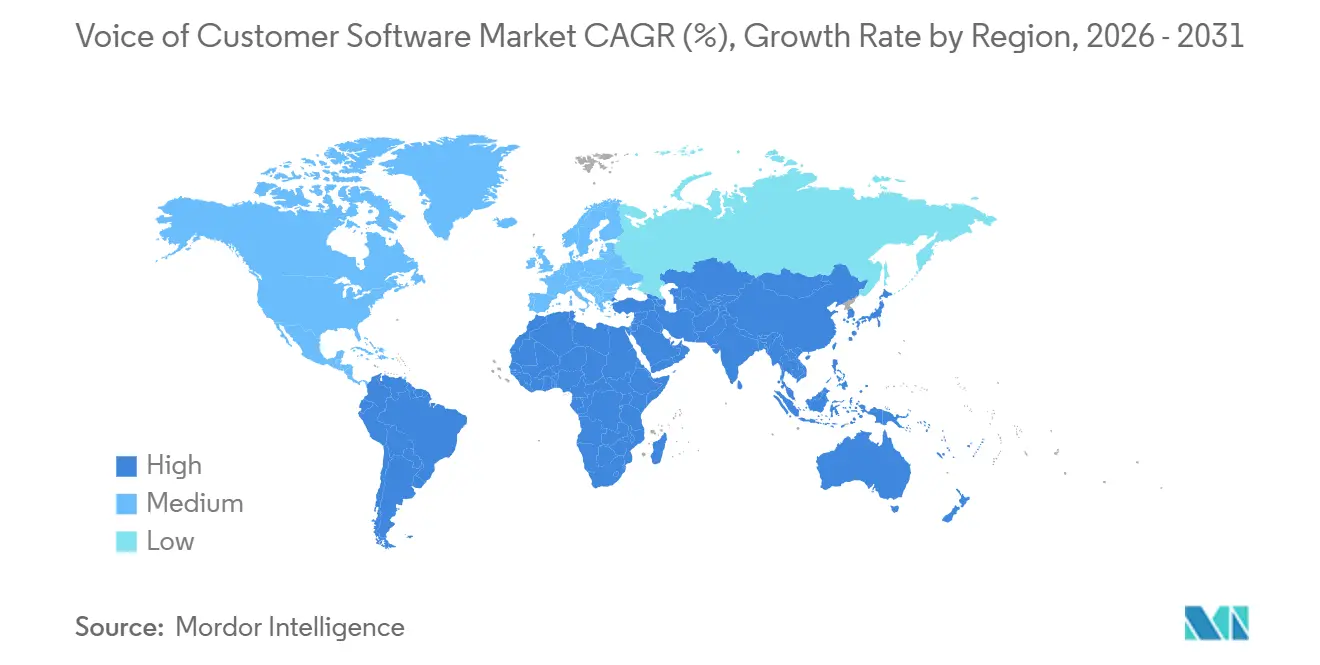
North America and Europe Voice of Customer Software Market
North America held 34.62% of the voice of customer software market in 2025. The region benefits from mature enterprise SaaS adoption, a well-developed customer experience culture, and the presence of major platform providers. U.S. firms in financial services, technology, and retail increasingly use feedback systems as part of operational planning, focusing on churn reduction, service recovery, and workflow automation. Canada supports demand through bilingual feedback requirements and SaaS adoption across financial services and technology, while Mexico is developing as retail and hospitality firms build structured programs with digital commerce growth. Europe is the second-largest regional block, led by Germany, the United Kingdom, and France, where GDPR makes consent management, documented data flows, and processing controls central to platform selection.
APAC Voice of Customer Software Market
Asia-Pacific is projected to expand at a 20.71% CAGR through 2031, the highest regional rate. Mobile-first customer behavior, expanding retail and healthcare sectors, and digital economy programs support the region’s adoption of customer feedback systems. Genesys reported that 44% of Asia-Pacific customer experience organizations use agentic AI-powered virtual agents, compared with a global average of 41%. China’s mobile retail and digital payment activities generate large datasets that require language-specific analysis under cross-border data restrictions. India’s Digital Personal Data Protection Act of 2023 underscores the need for consent-aware collection and governance, while South Korea, Indonesia, Vietnam, and the Philippines are expanding in-app and conversational feedback in digital commerce.
South America and MEA Voice of Customer Software Market
South America is an emerging region, with Brazil supported by e-commerce expansion, financial inclusion programs, and midmarket digitalization. The Middle East and Africa are at an earlier stage, although Saudi Arabia and the United Arab Emirates are increasing investment in customer experience across government services, retail, hospitality, finance, and logistics. South Africa and Nigeria offer longer-term potential as digital infrastructure develops and more organizations create formal customer feedback programs. Many buyers in the region start with cloud survey tools before moving toward broader analytics and omnichannel listening, reflecting the progression seen earlier in more mature regions.

Competitive Landscape
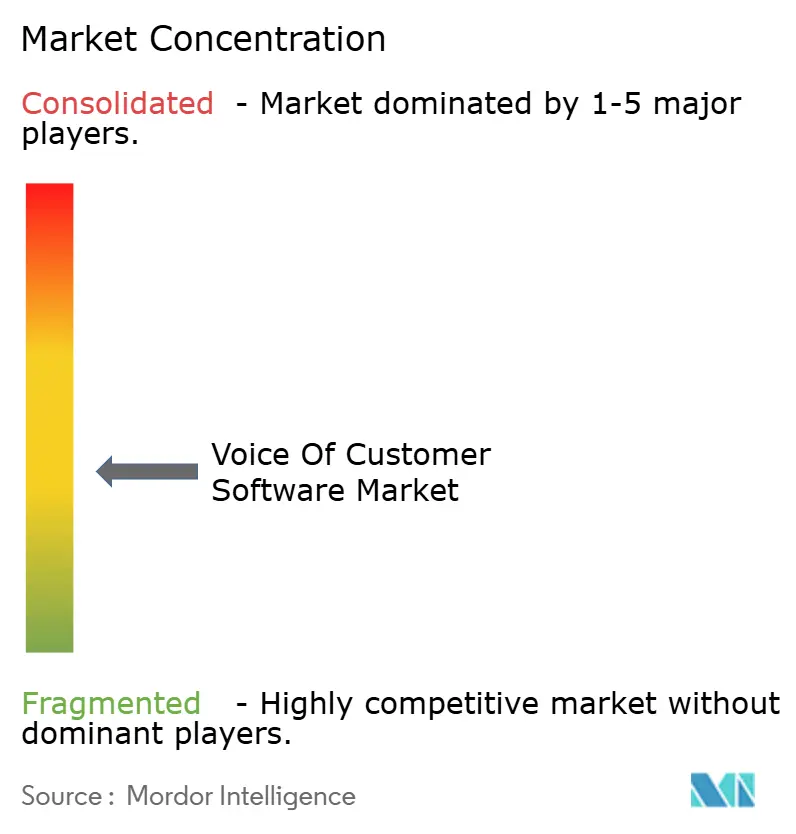
The voice of customer software market has a moderately consolidated enterprise tier and a fragmented group of midmarket and vertical-focused providers. Qualtrics and Medallia are prominent in enterprise buying decisions, while Sprinklr, Press Ganey, Forsta, Alchemer, Pisano, and other providers address different customer needs. Large platforms compete through AI capability, data depth, implementation reach, and industry-specific functions. Smaller providers can differentiate through focused workflows, local requirements, or particular customer groups. Bundled features from CRM and contact center vendors add pressure because basic feedback collection may already be available within systems customers use.
Qualtrics announced an agreement to acquire Press Ganey Forsta for USD 6.75 billion in October 2025. The transaction combines enterprise experience management with healthcare benchmarking data covering more than 41,000 healthcare provider organizations. It shows why vertical data and healthcare-specific capability have become important competitive factors. Alchemer acquired Chatmeter in September 2025 to combine direct survey responses with reviews, social media, and customer comments. This move shows how mid-tier companies are expanding from direct feedback to broader customer intelligence, while industrial manufacturing, government administration, and education remain areas where specialized language and compliance requirements can limit the use of generic platforms.
Technology investment continues to distinguish providers in the voice of customer software market. In July 2026, Sprinklr introduced Sprinklr MCP in beta, allowing AI assistants to access customer insights through its platform. Medallia announced a recapitalization in June 2026 that included USD 150 million in new capital and continued support for its USD 500 million AI investment commitment. These moves aim to embed customer intelligence into everyday workflows and reinforce the importance of data quality, industry knowledge, and system integration as AI functions become more common.
Voice Of Customer Software Industry Leaders
Qualtrics International Inc.
Medallia, Inc.
NICE Ltd.
Momentive Global Inc.
Verint Systems Inc.
- *Disclaimer: Major Players sorted in no particular order
Voice Of Customer Software Market Companies Covered in this Report
- Qualtrics International Inc.
- Medallia, Inc.
- InMoment, Inc.
- NICE Ltd.
- Verint Systems Inc.
- Momentive Global Inc.
- QuestionPro Inc.
- Sogolytics, Inc.
- Alida Inc.
- Forsta AS
- Sprinklr, Inc.
- Alchemer LLC
- Typeform S.L.
- SurveySparrow Inc.
- Survicate Sp. z o.o.
- Zonka Technologies Private Limited
- Feedier SAS
- Qualaroo Inc.
- UserVoice, Inc.
- Wonderflow B.V.
- Enterpret, Inc.
- Chattermill Ltd.
- SANDSIV AG
- Birdeye, Inc.
- Service Management Group, Inc.

Recent Industry Developments in Voice Of Customer Software Market
- July 2026: Sprinklr released its Summer '26 update, introducing Sprinklr MCP (Beta) for accessing customer insights through Microsoft Copilot, ChatGPT, and Claude; the release also included the acquisition of ViralMoment, extending voice of customer analytics from text and images to video content, and new integrations with Adobe, Microsoft, and TikTok to distribute CX intelligence across enterprise marketing and service workflows.
- June 2026: Medallia entered a recapitalization agreement with a lender group led by Blackstone, Apollo, and FS KKR Capital Corp., significantly reducing the company's outstanding debt, providing USD 150 million in new capital, and transitioning ownership from Thoma Bravo, advancing Medallia's existing USD 500 million commitment to AI-driven product investment.
- May 2026: NICE launched its joint solution with ServiceNow, enabling organizations to trigger complex enterprise back-office workflows the moment a customer interaction begins, operationally closing the gap between front-office CX feedback data and back-office execution systems for the first time through a single integration.
- March 2026: Qualtrics announced its Omnichannel Experience Management capabilities at X4 2026, including out-of-the-box connectors for Genesys, NICE, and Salesforce deploying up to 4 times faster than prior integrations, AI-powered Experience Agents resolving over 51% of customer concerns autonomously in initial deployments, Automated Text Analytics reducing analysis time from months to hours, and U.S. consumer synthetic panels operating at half the cost of traditional recruitment panels.


Global Voice Of Customer Software Market Report Scope
The voice of customer software market refers to the ecosystem of software solutions and associated services that capture, aggregate, and analyze customer feedback, sentiment, and interactions across multiple omnichannel touchpoints. Unlike basic survey tools, VoC software integrates diverse, unstructured data sources such as customer service conversations, digital and in-app behavioral analytics, social media reviews, email interactions, and in-person store feedback, utilizing artificial intelligence, natural language processing (NLP), and advanced analytics to derive deep, actionable insights. Deployed across cloud, on-premises, or hybrid environments, these platforms cater to organizations of all sizes across industries such as retail, BFSI, healthcare, and IT. By enabling critical applications such as customer journey optimization, closed-loop feedback management, product development, and churn management, VoC software empowers businesses to move beyond reactive data collection to proactive experience management, aligning their operational and strategic initiatives with actual customer expectations to drive brand loyalty, improve retention, and achieve sustainable revenue growth.
The Voice of Customer Software Market Report is Segmented by Component (Software, and Services), Deployment Mode (Cloud, On-Premise, and Hybrid), Application (Customer Journey Optimization, Closed-Loop Feedback Management, Product and Service Development, Brand and Reputation Management, Customer Retention and Churn Management, and Campaign Performance and Experience Measurement), Data Source (Surveys and Questionnaires, Customer Service Conversations, Digital Behavior and Web Analytics, In-App Behavior and Feedback, Social Media, Ratings and Reviews, Store and In-Person Interactions, and Email and Messaging), End User (IT and Telecommunication, BFSI, Healthcare and Life Sciences, Retail and E-Commerce, Industrial Manufacturing, Education and Research Institutions, Media and Entertainment, Government and Administration, Travel and Hospitality, and Other End Users), and Geography (North America, South America, Europe, Asia-Pacific, and Middle East and Africa). The Market Forecasts are Provided in Terms of Value (USD).
| Software |
| Services |
| Cloud |
| On-Premise |
| Hybrid |
| Customer Journey Optimization |
| Closed-Loop Feedback Management |
| Product and Service Development |
| Brand and Reputation Management |
| Customer Retention and Churn Management |
| Campaign Performance and Experience Measurement |
| Surveys and Questionnaires |
| Customer Service Conversations |
| Digital Behavior and Web Analytics |
| In-App Behavior and Feedback |
| Social Media, Ratings and Reviews |
| Store and In-Person Interactions |
| Email and Messaging |
| IT and Telecommunication |
| BFSI |
| Healthcare and Life Sciences |
| Retail and E-Commerce |
| Industrial Manufacturing |
| Education and Research Institutions |
| Media and Entertainment |
| Government and Administration |
| Travel and Hospitality |
| Other End Users |
| North America | United States | |
| Canada | ||
| Mexico | ||
| South America | Brazil | |
| Argentina | ||
| Rest of South America | ||
| Europe | Germany | |
| United Kingdom | ||
| France | ||
| Russia | ||
| Spain | ||
| Rest of Europe | ||
| Asia-Pacific | China | |
| Japan | ||
| India | ||
| South Korea | ||
| Southeast Asia | ||
| Rest of Asia-Pacific | ||
| Middle East and Africa | Middle East | Saudi Arabia |
| United Arab Emirates | ||
| Rest of Middle East | ||
| Africa | South Africa | |
| Nigeria | ||
| Rest of Africa | ||
| By Component | Software | ||
| Services | |||
| By Deployment Mode | Cloud | ||
| On-Premise | |||
| Hybrid | |||
| By Application | Customer Journey Optimization | ||
| Closed-Loop Feedback Management | |||
| Product and Service Development | |||
| Brand and Reputation Management | |||
| Customer Retention and Churn Management | |||
| Campaign Performance and Experience Measurement | |||
| By Data Source | Surveys and Questionnaires | ||
| Customer Service Conversations | |||
| Digital Behavior and Web Analytics | |||
| In-App Behavior and Feedback | |||
| Social Media, Ratings and Reviews | |||
| Store and In-Person Interactions | |||
| Email and Messaging | |||
| By End User | IT and Telecommunication | ||
| BFSI | |||
| Healthcare and Life Sciences | |||
| Retail and E-Commerce | |||
| Industrial Manufacturing | |||
| Education and Research Institutions | |||
| Media and Entertainment | |||
| Government and Administration | |||
| Travel and Hospitality | |||
| Other End Users | |||
| By Geography | North America | United States | |
| Canada | |||
| Mexico | |||
| South America | Brazil | ||
| Argentina | |||
| Rest of South America | |||
| Europe | Germany | ||
| United Kingdom | |||
| France | |||
| Russia | |||
| Spain | |||
| Rest of Europe | |||
| Asia-Pacific | China | ||
| Japan | |||
| India | |||
| South Korea | |||
| Southeast Asia | |||
| Rest of Asia-Pacific | |||
| Middle East and Africa | Middle East | Saudi Arabia | |
| United Arab Emirates | |||
| Rest of Middle East | |||
| Africa | South Africa | ||
| Nigeria | |||
| Rest of Africa | |||


Key Questions Answered in the Report
What is the voice of customer software market size?
The voice of customer software market is projected to grow from USD 9.18 billion in 2026 to USD 19.83 billion by 2031 at a 16.65% CAGR.
What is driving adoption of voice of customer software?
Continuous listening, AI analysis of unstructured feedback, omnichannel workflows, and cloud access are increasing adoption.
Which deployment model is most widely used for voice of customer platforms?
Cloud deployment held 68.19% share in 2025, while hybrid deployment is projected to grow faster at an 18.43% CAGR through 2031.
Which application has the largest share in customer feedback software?
Customer journey optimization held the largest application share at 26.74% in 2025.
Which end-user sector is growing fastest for voice of customer tools?
Healthcare and life sciences is projected to expand at a 19.48% CAGR through 2031, supported by patient experience and data governance requirements.
Which region is projected to grow fastest for voice of customer platforms?
Asia-Pacific is projected to expand at a 20.71% CAGR through 2031, supported by mobile-first engagement and digital economy programs.
Page last updated on:





