
Virtual Event Marketing Services Market Size and Share
Market Overview
| Study Period | 2020 - 2031 |
|---|---|
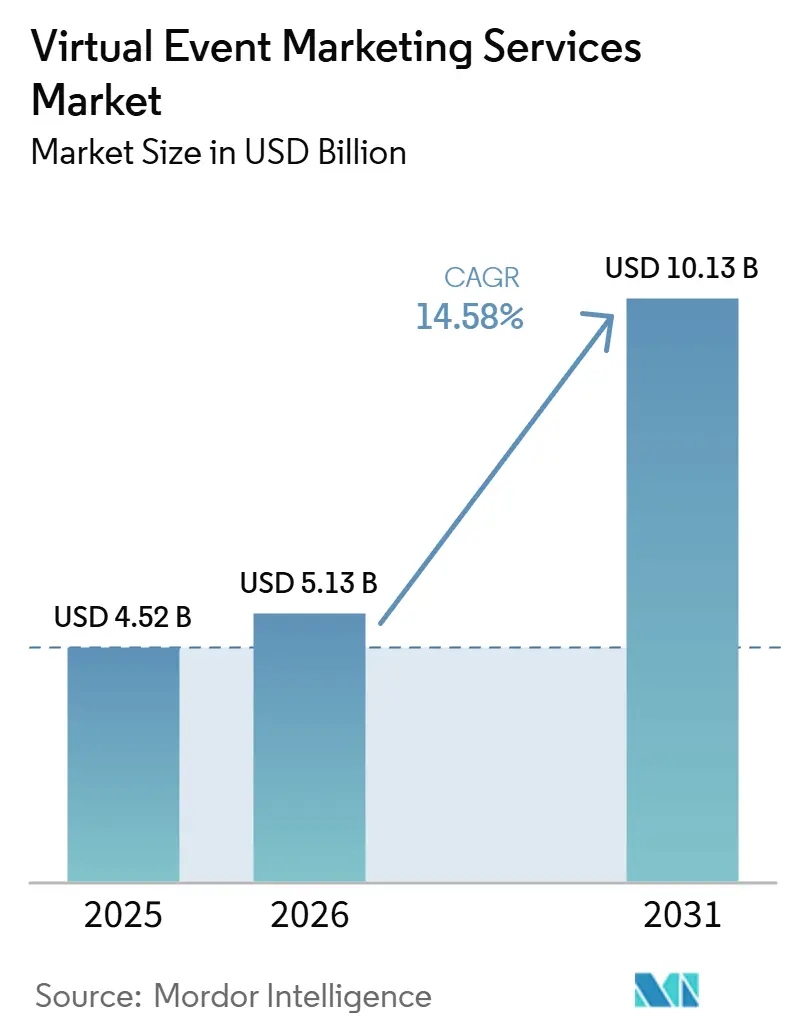
| Market Size (2026) | USD 5.13 Billion |
| Market Size (2031) | USD 10.13 Billion |
| Growth Rate (2026 - 2031) | 14.58 % |
| Fastest Growing Market | Asia-Pacific |
| Largest Market | North America |
| Market Concentration | Medium |
Major Players *Disclaimer: Major Players sorted in no particular order Image © Mordor Intelligence. Reuse requires attribution under CC BY 4.0. | |
Virtual Event Marketing Services Market Analysis by Mordor Intelligence
The Virtual Event Marketing Services Market size is projected to expand from USD 4.52 billion in 2025 and USD 5.13 billion in 2026 to USD 10.13 billion by 2031, registering a CAGR of 14.58% between 2026 and 2031. The Virtual Event Marketing Services Market is supported by distributed workforces that need reliable digital ways to reach customers, partners, and employees. Marketing teams are also using virtual programs to collect consented engagement data while third-party cookies become less useful. AI tools are reducing the work needed to personalize sessions and turn recordings into follow-up content. Buyers increasingly assess providers on how well event data connects with CRM and marketing systems, not only on streaming or registration features. This gives providers that combine data integration, content tools, and managed delivery a clearer opportunity to retain enterprise accounts.
Key Report Takeaways
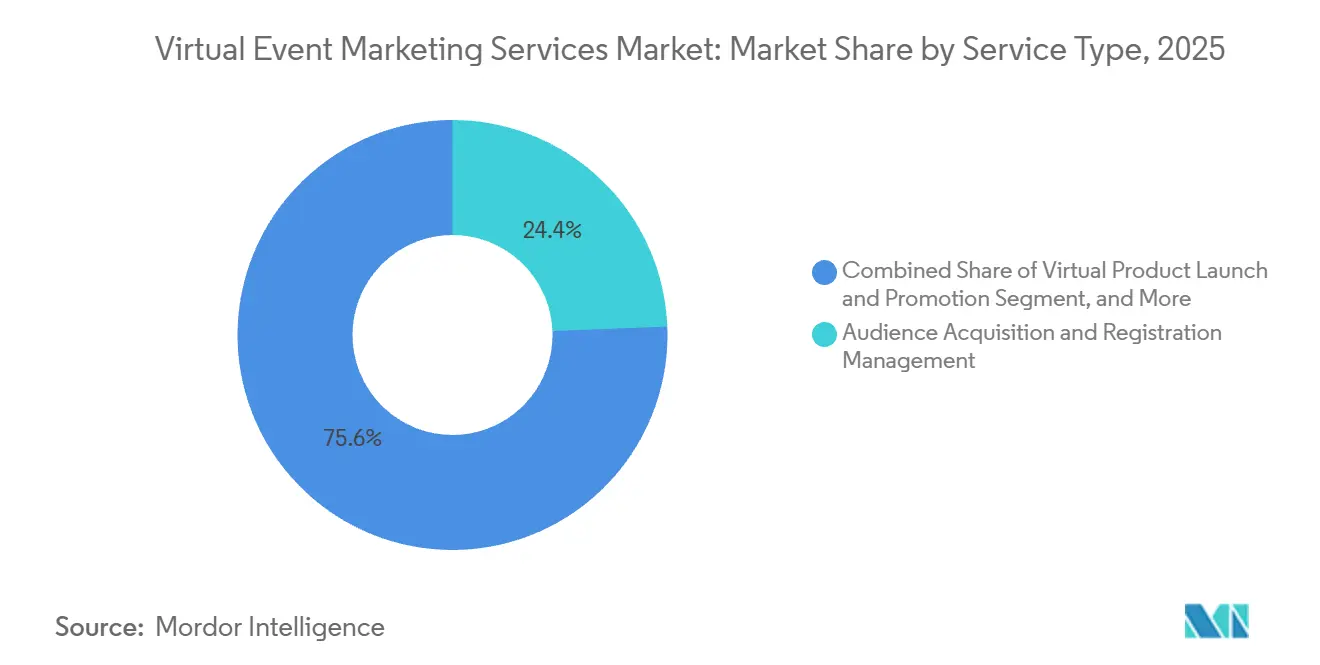
- By service type, audience acquisition and registration management held 24.37% of the Virtual Event Marketing Services Market share in 2025, while virtual product launch and live-stream promotion is projected to expand at a 16.69% CAGR through 2031.
- By event format, webinars accounted for 46.17% of the Virtual Event Marketing Services Market share in 2025, while virtual trade shows and expos are projected to expand at a 15.81% CAGR through 2031.
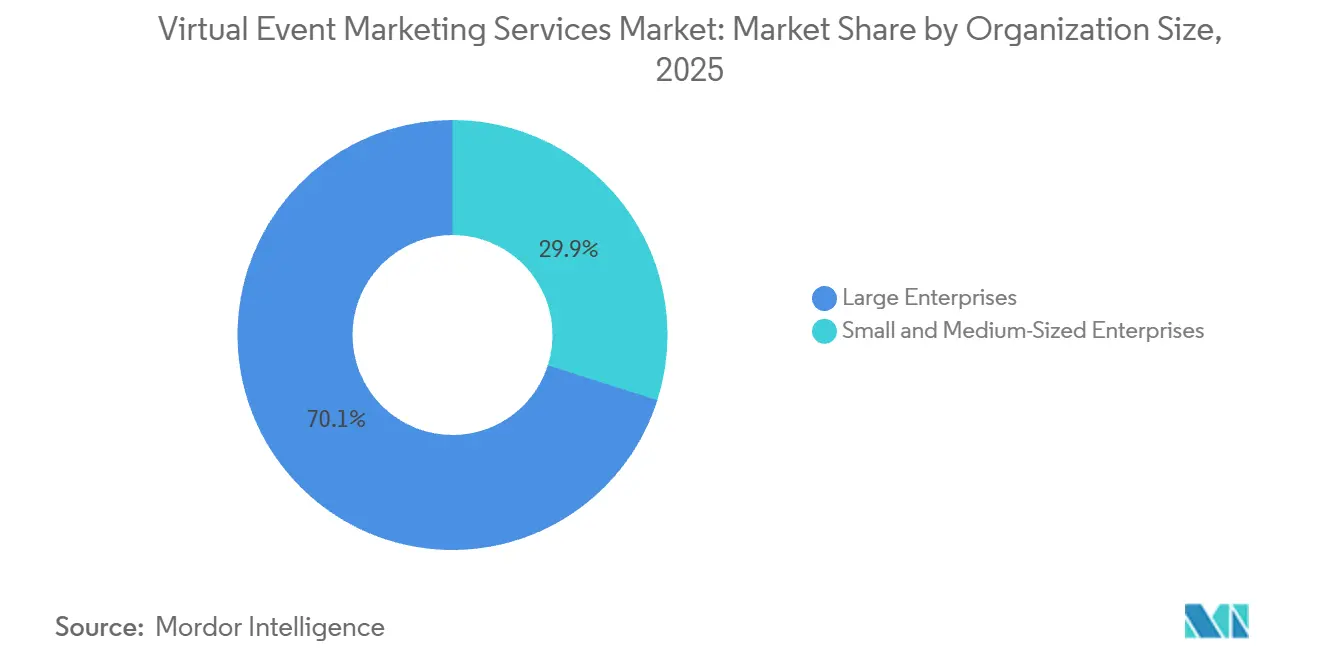
- By organization size, large enterprises held 70.10% share in 2025, while SMEs are projected to expand at a 16.32% CAGR through 2031.
- By end-user industry, IT and telecommunications accounted for 26.78% share in 2025, while healthcare and life sciences is projected to expand at a 17.06% CAGR through 2031.
- By geography, North America held 39.86% share in Virtual Event Marketing Services Market 2025, while Asia-Pacific is projected to expand at a 17.24% CAGR through 2031.
Note: Market size and forecast figures in this report are generated using Mordor Intelligence’s proprietary estimation framework, updated with the latest available data and insights as of January 2026.
Global Virtual Event Marketing Services Market Trends and Insights
Drivers Impact Analysis*
| Driver | (~) % Impact on CAGR Forecast | Geographic Relevance | Impact Timeline |
|---|---|---|---|
| Remote and Hybrid Work Programs Expand Digital Event Budgets | +2.5% | Global, highest in North America and Europe | Short term (≤ 2 years) |
| Artificial Intelligence-Driven Personalization and Content Repurposing Lift Conversion | +2.2% | Global, early adoption in North America and scaling in Asia-Pacific | Medium term (2-4 years) |
| First-Party Engagement Data Improves Revenue Attribution | +1.8% | North America and Europe, with expansion into Asia-Pacific | Medium term (2-4 years) |
| Always-On On-Demand Content Hubs Extend Campaign Life | +1.5% | North America and Europe, with growth in Asia-Pacific | Medium term (2-4 years) |
| Cost-Efficient Global Reach Improves Virtual Event Economics | +1.2% | Global, with greatest uplift in Asia-Pacific, South America, and Africa | Short term (≤ 2 years) |
| Sponsor Demand for Measurable Digital Activation Boosts Service Spend | +1.0% | North America and Europe, with early gains in UAE and Singapore | Long term (≥ 4 years) |
| Source: Mordor Intelligence | |||
Remote and Hybrid Work Programs Expand Digital Event Budgets
Hybrid work has created a dispersed audience that physical-only programs cannot fully serve. The Virtual Event Marketing Services Market benefits when businesses need a consistent way to involve employees, buyers, and partners across locations, especially when audience participation is not limited by travel schedules or venue capacity. Events accounted for up to 30% of program budgets in manufacturing, professional services, and technology, according to the referenced 2026 Forrester analysis. The same analysis reported that the share of organizations increasing event budgets by more than 10% doubled year over year. Bizzabo reported that 74% of Fortune 1000 marketers planned to increase event budgets in 2026, while 40% of all organizers expected budget growth. Accessibility requirements, including WCAG 2.2 and the European Accessibility Act, also favor services that provide captioning and multilingual delivery as standard capabilities.
Artificial Intelligence-Driven Personalization and Content Repurposing Lift Conversion
AI is changing how service providers prepare, deliver, and extend virtual programs. ON24 reported that personalized virtual event landing pages delivered a 3X increase in demo requests and a 2X rise in meetings booked in its life sciences benchmarks. The company also reported a 6X year-over-year increase in content output from a single webinar recording when teams used AI-generated derivative assets. Cvent stated that its CventIQ engine processes 12.7 billion attendee interactions annually and uses this data for attendance models, networking suggestions, and content recommendations. Goldcast’s AI Content Lab can produce short video highlights and related assets from session recordings. These capabilities enable the Virtual Event Marketing Services Market to support campaigns that continue after the live session without requiring a corresponding increase in manual production work.[1]ON24, “Key Takeaways From the 2026 Digital Experience Benchmarks for Life Sciences,” ON24, on24.com
First-Party Engagement Data Improves Revenue Attribution
Virtual events generate registered, consented behavioral signals from session views, polls, downloads, and other interactions. When those signals reach CRM and marketing automation systems quickly, they can support lead scoring and follow-up activity. This is important for the Virtual Event Marketing Services Market because buyers increasingly want evidence that event spending contributes to the pipeline rather than only attendance, using engagement records that show which topics and follow-up actions attracted interest. In May 2026, ON24 launched a LinkedIn integration that lets marketers use first-party engagement segments in LinkedIn Audience Match campaigns. The connected workflow reduces the need for manual exports between event and paid media systems. It also strengthens the value of providers that can manage consent, audience data, and campaign activation in one service model.[2]ON24, “ON24 Unveils New LinkedIn Integration to Help B2B Marketers Reach the Right Buyers and Accelerate Pipeline,” Morningstar, morningstar.com
Always-On On-Demand Content Hubs Extend Campaign Life
Many organizers now treat a live session as the start of a longer content program. Bizzabo reported that 82% of organizers create video-on-demand content from events, and 53% gate at least part of that content behind registration. ON24’s Engagement Hub organizes branded content and tracks individual consumption behavior for CRM use. Goldcast Video Hubs add AI-generated summaries and metadata to improve the discovery of recorded content. This approach lets a single program continue to qualify and score leads after the live date. For teams that run 25 events a year, the Virtual Event Marketing Services Market can help turn individual recordings into reusable assets across product release cycles, instead of treating each live session as a short-lived campaign activity.[3]Bizzabo, “2026 Event Marketing Statistics, Trends, and Benchmarks,” Bizzabo, bizzabo.com
Restraints Impact Analysis*
| Restraint | (~) % Impact on CAGR Forecast | Geographic Relevance | Impact Timeline |
|---|---|---|---|
| Webinar Fatigue Weakens Live Engagement and Networking | -2.0% | Global, most acute in North America and Europe | Short term (≤ 2 years) |
| Data Privacy and Cross-Border Compliance Complexity Raises Delivery Risk | -1.5% | Europe, with effects in North America, Asia-Pacific, and South America | Medium term (2-4 years) |
| Fragmented Event Technology Stacks Create Data Silos and Friction | -1.2% | Global | Medium term (2-4 years) |
| Return-on-Investment Proof Gaps Slow Budget Approval Cycles | -1.0% | Global | Short term (≤ 2 years) |
| Source: Mordor Intelligence | |||
Webinar Fatigue Weakens Live Engagement and Networking
Heavy webinar calendars can reduce live participation and weaken networking results. The referenced Forrester survey found that nearly 70% of event leaders were reducing their total event count while protecting the quality of each program. Bizzabo reported that organizations with strong results averaged 412 registrations and a 52% event attendance rate. These figures indicate that buyers are placing more weight on relevance, production quality, and tailored interaction. The Virtual Event Marketing Services Market, therefore, faces pressure to deliver stronger outcomes rather than low-cost volume, including clear reasons for attendance and more useful opportunities for guided interaction. Providers that can show measurable results may gain funding from programs that would otherwise have been spread across basic webinar tools.
Data Privacy and Cross-Border Compliance Complexity Raises Delivery Risk
Global programs must manage privacy, consent, and data transfer across multiple legal jurisdictions. The European Union reached an agreement in July 2025 on measures intended to streamline cross-border GDPR enforcement, including a 15-month investigation deadline for complex cases. The EU AI Act also adds requirements for AI-enabled functions that use behavioral profiling, sentiment analysis, or voice recording. Brazil’s LGPD, California’s CPRA, and India’s Digital Personal Data Protection Act introduce additional complexities to planning and data residency decisions. This raises delivery costs and can extend planning time for multiregional programs. The Virtual Event Marketing Services Market favors vendors that offer consent controls, data residency options, and documentation within the service rather than as later configuration work.[4]European Data Protection Board, “EU Reaches Agreement to Streamline Cross-Border GDPR Enforcement,” Global Compliance News, globalcompliancenews.com
*Our forecasts treat driver/restraint impacts as directional, not additive. The impact forecasts reflect baseline growth, mix effects, and variable interactions.
Segment Analysis
By Service Type: Registration Services Lead While Product Launch Support Grows
Audience acquisition and registration management held 24.37% of the Virtual Event Marketing Services Market share in 2025. It meets a basic need because every program requires a qualified, permissioned audience before event delivery begins, and because downstream follow-up depends on accurate registration records. Enterprise teams increasingly judge registrations by lead quality, data completeness, readiness for campaign follow-up, and the ability to connect those records to existing customer systems. Registration workflows also establish the consent record needed to use engagement data responsibly after the event. This makes the service a practical entry point for providers that manage broader digital event campaigns.
Virtual product launch and live-stream promotion are projected to expand at a 16.69% CAGR from 2026 to 2031. Marketing teams use these formats to coordinate launches across regions without replicating physical programs. A live digital activation can generate first-party intent data while it introduces a product to a wider audience. Platform setup and operations remain important where teams need dependable integration across complex systems. Webinar, conference, engagement, and networking services gain relevance when personalized agendas and matched introductions are expected rather than optional.



By Event Format: Webinars Lead as Virtual Trade Shows Gain Momentum
Webinars accounted for 46.17% of the Virtual Event Marketing Services Market share in 2025. Their leading position reflects broad use in B2B demand generation and a delivery model that can be repeated across campaigns. Bizzabo reported that 53% of attendees planned to attend more webinars in 2026. The company also reported year-over-year attendance increases for 61% of organizers. These results support continued webinar use, even as audiences expect more relevant content and better production quality.
Virtual trade shows and expos are projected to expand at a 15.81% CAGR from 2026 to 2031, as exhibitors use extended digital lead-capture periods after live event dates and maintain contact with prospective buyers. Exhibitors value the lead-capture period that can remain open after the live event has ended. Virtual conferences and summits support higher-profile brand and executive communication programs. Live-streamed corporate events support investor relations and internal communication needs that require authentication, recording, and multiregion delivery. Training and workshop formats help distributed workforces avoid the cost of in-person certification travel, showing that the Virtual Event Marketing Services Market supports different requirements across formats.
By Organization Size: Enterprises Account for Most Spending as SMEs Expand
Large enterprises held 70.10% of the Virtual Event Marketing Services Market share in 2025. This spending reflects dedicated event functions, enterprise platform agreements, mature marketing technology systems, and established processes for coordinating campaigns across several countries and business units. Large businesses also run global conferences, launches, and training programs that are costly to deliver only in person. Their systems can convert event engagement into behavioral data for sales and marketing activity. Requirements for integration, governance, and multiregion support keep full-service enterprise contracts important for providers.
SMEs are projected to expand at a 16.32% CAGR from 2026 to 2031. Self-service architectures have lowered the barrier to producing professional webinars and virtual sessions, giving smaller teams more control over program timing, audience invitations, and content reuse. Basic webinar delivery was placed at USD 500 per event, while larger formats cost USD 5,000 to USD 30,000. This cost difference allows smaller businesses to test digital outreach without long procurement cycles. AI tools are also helping small teams narrow capability gaps that were once more closely tied to enterprise resources.
By End-User Industry: IT and Telecom Leads While Healthcare and Life Sciences Advances
IT and telecommunications represented 26.78% of the Virtual Event Marketing Services Market share in 2025. The sector has an established digital presence and runs frequent developer events, partner programs, technical webinars, and product education sessions that require ongoing audience engagement. Software vendors use webinar series to maintain demand generation through extended sales cycles. This supports recurring demand for registration, delivery, engagement, and follow-up services across the Virtual Event Marketing Services Market. Buyers in this sector also expect event data to be delivered to sales systems quickly and reliably.
The healthcare and life sciences industry is projected to expand at a 17.06% CAGR from 2026 to 2031. In its life sciences benchmarks, ON24 reported a 91% increase in demo bookings per webinar from personalized virtual experiences. The company also reported a 28% increase in continuing medical education certifications issued per webinar. BFSI uses virtual programs for regulated education, advisor onboarding, and investor communications that require compliant recording and data residency. Retail and e-commerce, media and entertainment, travel and hospitality, and manufacturing also contribute. Manufacturers use virtual demonstrations when showing equipment to global buyers; in-person is difficult, costly, or limited by the logistics of moving large equipment.
Geography Analysis
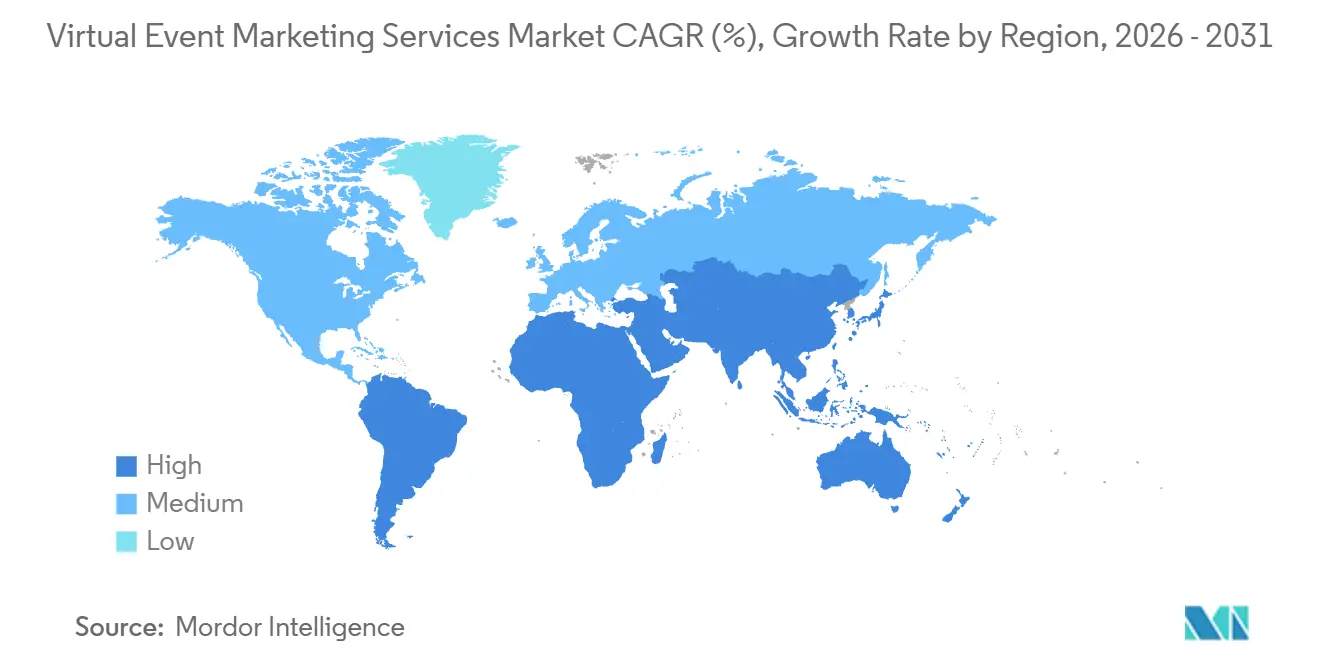
North America held 39.86% of the Virtual Event Marketing Services Market share in 2025. The region brings together enterprise software vendors, marketing technology platforms, and event technology providers in a mature business environment, which supports a broad base of experienced buyers and specialist service providers. The United States drives demand across IT, BFSI, and healthcare, where customers seek integrated digital engagement. Cvent and Bizzabo are among the regional platform providers serving these needs. Canada supports financial services and government programs, while Mexico benefits from bilingual service demand from US-based multinationals.
Europe has a compliance-focused buyer base, led by Germany, the United Kingdom, and France. The European Union’s 2025 GDPR enforcement agreement and the EU AI Act’s full enforcement in 2026 are affecting platform evaluations. Providers with data residency settings, consent management, and AI documentation can gain an advantage in procurement reviews, as these controls address requirements that marketing teams cannot address through campaign design alone. Italy and Spain are secondary markets in manufacturing and professional services, while the United Kingdom’s UK GDPR remains close enough to European rules to limit friction for regional programs.
Asia-Pacific is projected to expand at a 17.24% CAGR from 2026 to 2031, the fastest regional rate in the Virtual Event Marketing Services Market. India, China, Japan, and South Korea are the main demand centers, each supported by large technology, financial services, or business-to-business communications activity. India’s IT services workforce, along with its BFSI and technology programs, supports frequent virtual engagement. A 2025 IT Communication Company survey ranked online seminars among the top 3 marketing activities for Japanese companies, and 51.9% of participants in media-hosted online seminars reported high effectiveness. China’s enterprise digitalization supports webinar and conference use, while South Korea and Australia add demand from technology and financial services.

Competitive Landscape
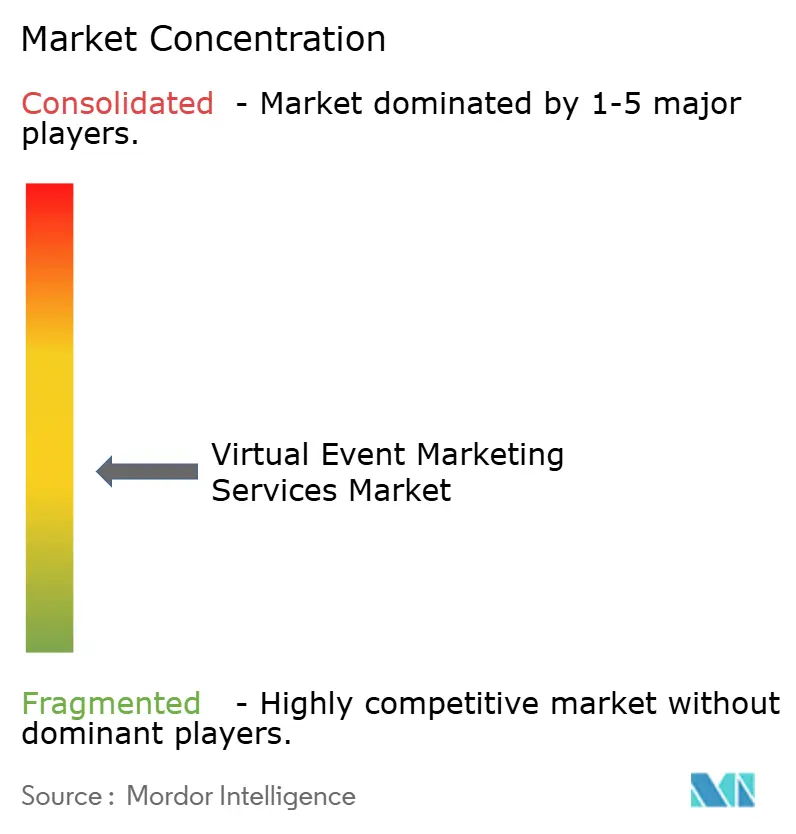
The Virtual Event Marketing Services Market remains moderately fragmented among platforms, although larger providers are consolidating capabilities. Contract retention increasingly depends on data integration and the ability to support the full event lifecycle, from audience acquisition and registration through delivery, content reuse, and reporting. Cvent completed its Goldcast acquisition in December 2025 and its ON24 acquisition in April 2026. The combined portfolio brings event management, webinar delivery, AI content tools, and digital engagement under one provider. Cvent stated that it has committed USD 1 billion to multi-year technology investments and that CventIQ processes 12.7 billion attendee interactions each year.
Specialist providers compete through specific use cases rather than platform breadth, aligning their offerings with the needs of trade show organizers, community programs, or conference teams. vFairs focuses on trade show formats, Airmeet on community networking, and Bizzabo on conference programs that require attribution. These positions can limit direct competition with broader suppliers while narrowing the revenue areas each firm can address. Cvent’s integration of ON24 multilingual delivery and Goldcast content repurposing tools shows the growing demand for registration, delivery, personalization, and post-event content within a single relationship. Smaller vendors that rely on several integrations face a higher standard from enterprise buyers.
Brandlive acquired Hubilo in September 2025, adding a 30-person AI and streaming research and development hub in Bengaluru, India. The acquisition was Brandlive’s fifth in 18 months, and Hubilo customers moved to Virtual PRO. The move shows competition around automated video production, personalized content delivery, and streaming quality. Privacy and compliance are also becoming competitive factors, especially when legal teams review platforms before marketing teams, and when global programs require documented controls before data can be collected.
Virtual Event Marketing Services Industry Leaders
Cvent Holding Corp.
Zoom Communications, Inc.
Microsoft Corporation
Cisco Systems, Inc.
George P. Johnson
- *Disclaimer: Major Players sorted in no particular order

Recent Industry Developments
- July 2026: Cvent unveiled over 70 product innovations at Cvent CONNECT 2026, backed by a multi-year USD 1 billion technology investment. The CventIQ engine now processes 12.7 billion attendee interactions annually and powers 34 net-new AI capabilities including the Cvent Assistant, AI-driven Agenda Builder, and Jifflenow AI Meeting Summaries. Goldcast and ON24 were formally integrated into the unified Cvent digital events portfolio, with Goldcast's Highlight Reel generator and ON24's AI-powered multilingual delivery across 34 languages available to the combined customer base.
- May 2026: ON24, operating as a Cvent company, launched a LinkedIn integration enabling B2B marketers to activate first-party event engagement data as LinkedIn Audience Match segments and publish event Key Moments as LinkedIn video ads from within the ON24 platform, directly connecting virtual event intelligence with paid media pipeline activation.
- May 2026: Cvent completed the acquisition of ON24 for USD 400 million, adding enterprise-scale webinar delivery in 34 languages, compliance controls, and AI-powered deep personalization to the Cvent portfolio. ON24 continues to operate under its brand as part of Cvent's event-led growth platform.
- March 2026: ON24 expanded platform capabilities ahead of acquisition completion, launching AI Translate for multilingual virtual event delivery, the AI-powered Analytics and Content Engine, ACE, and enhanced LinkedIn campaign integrations, enabling a single digital event to be deployed as a full global campaign lifecycle.


Global Virtual Event Marketing Services Market Report Scope
The virtual event marketing services market refers to the ecosystem of specialized professional services designed to plan, execute, promote, and optimize marketing campaigns for online and hybrid events. This encompasses strategic campaign planning, targeted audience acquisition and registration management, platform-specific event operations, live-stream promotion, and interactive networking and engagement services. The market supports a wide array of digital event formats, ranging from intimate webinars and virtual training workshops to large-scale virtual conferences, online product launches, and digital trade shows. Catering to both large enterprises and small and medium-sized enterprises across diverse industries such as IT, BFSI, retail, and healthcare, these services help organizations overcome the geographic and logistical limitations of traditional in-person events. By leveraging digital marketing channels, data-driven targeting, and interactive technologies, virtual event marketing service providers enable businesses to maximize attendee reach, enhance digital audience engagement, generate high-quality leads, and accurately measure event ROI in an increasingly digital-first business landscape.
The Virtual Event Marketing Services Market Report is Segmented by Service Type (Strategy and Campaign Planning, Audience Acquisition and Registration Management, Platform Setup and Event Operations, Webinar and Virtual Conference Marketing, Virtual Product Launch and Live-Stream Promotion, Audience Engagement and Networking Services, and Others), Event Format (Webinars, Virtual Conferences and Summits, Online Product Launches, Virtual Trade Shows and Expos, Live-Streamed Corporate Events, and Virtual Training and Workshops), Organization Size (Large Enterprises, and Small and Medium-Sized Enterprises), End-User Industry (Retail and E-commerce, IT and Telecommunications, BFSI, Healthcare and Life Sciences, Media and Entertainment, Travel and Hospitality, Manufacturing and Industrials, and Others (Automotive, Public Sector, Others)), and Geography (North America, South America, Europe, Asia-Pacific, Middle East, and Africa). The Market Forecasts are Provided in Terms of Value (USD).
| Strategy and Campaign Planning |
| Audience Acquisition and Registration Management |
| Platform Setup and Event Operations |
| Webinar and Virtual Conference Marketing |
| Virtual Product Launch and Live-Stream Promotion |
| Audience Engagement and Networking Services |
| Other Service Types |
| Webinars |
| Virtual Conferences and Summits |
| Online Product Launches |
| Virtual Trade Shows and Expos |
| Live-Streamed Corporate Events |
| Virtual Training and Workshops |
| Large Enterprises |
| Small and Medium-Sized Enterprises |
| Retail and E-commerce |
| IT and Telecommunications |
| BFSI |
| Healthcare and Life Sciences |
| Media and Entertainment |
| Travel and Hospitality |
| Manufacturing and Industrials |
| Other End-User Industries (Automotive, Public Sector, amongst Others) |
| North America | United States |
| Canada | |
| Mexico | |
| South America | Brazil |
| Argentina | |
| Chile | |
| Rest of South America | |
| Europe | Germany |
| United Kingdom | |
| France | |
| Italy | |
| Spain | |
| Rest of Europe | |
| Asia-Pacific | China |
| Japan | |
| India | |
| South Korea | |
| Australia | |
| Rest of Asia-Pacific | |
| Middle East | United Arab Emirates |
| Saudi Arabia | |
| Qatar | |
| Rest of Middle East | |
| Africa | South Africa |
| Egypt | |
| Nigeria | |
| Rest of Africa |
| By Service Type | Strategy and Campaign Planning | |
| Audience Acquisition and Registration Management | ||
| Platform Setup and Event Operations | ||
| Webinar and Virtual Conference Marketing | ||
| Virtual Product Launch and Live-Stream Promotion | ||
| Audience Engagement and Networking Services | ||
| Other Service Types | ||
| By Event Format | Webinars | |
| Virtual Conferences and Summits | ||
| Online Product Launches | ||
| Virtual Trade Shows and Expos | ||
| Live-Streamed Corporate Events | ||
| Virtual Training and Workshops | ||
| By Organization Size | Large Enterprises | |
| Small and Medium-Sized Enterprises | ||
| By End-User Industry | Retail and E-commerce | |
| IT and Telecommunications | ||
| BFSI | ||
| Healthcare and Life Sciences | ||
| Media and Entertainment | ||
| Travel and Hospitality | ||
| Manufacturing and Industrials | ||
| Other End-User Industries (Automotive, Public Sector, amongst Others) | ||
| By Geography | North America | United States |
| Canada | ||
| Mexico | ||
| South America | Brazil | |
| Argentina | ||
| Chile | ||
| Rest of South America | ||
| Europe | Germany | |
| United Kingdom | ||
| France | ||
| Italy | ||
| Spain | ||
| Rest of Europe | ||
| Asia-Pacific | China | |
| Japan | ||
| India | ||
| South Korea | ||
| Australia | ||
| Rest of Asia-Pacific | ||
| Middle East | United Arab Emirates | |
| Saudi Arabia | ||
| Qatar | ||
| Rest of Middle East | ||
| Africa | South Africa | |
| Egypt | ||
| Nigeria | ||
| Rest of Africa | ||


Key Questions Answered in the Report
What is the size of the Virtual Event Marketing Services Market?
The Virtual Event Marketing Services Market is projected to expand from USD 5.13 billion in 2026 to USD 10.13 billion by 2031 at a 14.58% CAGR, supported by distributed workforces, AI-enabled content workflows, and greater demand for consented first-party engagement data.
Which service type held the largest share in 2025?
Audience acquisition and registration management held the largest share at 24.37% in 2025, reflecting the need to build qualified audiences and maintain complete records for campaign follow-up, consent management, and sales activity.
Which virtual event format is growing fastest?
Virtual trade shows and expos are projected to expand at a 15.81% CAGR from 2026 to 2031, as exhibitors use extended digital lead-capture periods after live event dates and maintain contact with prospective buyers.
Why do companies use virtual event marketing services?
Companies use the Virtual Event Marketing Services Market services to manage registrations, deliver sessions, collect consented engagement data, and extend content use after live events. They help teams connect participation with CRM workflows, lead scoring, campaign activation, and ongoing content programs across product release cycles and recurring customer education activity.
Which end-user sector is expected to grow fastest?
Healthcare and life sciences is projected to expand at a 17.06% CAGR through 2031, supported by use cases such as digital medical education, physician engagement, regulated communications, and personalized webinar experiences that help teams measure follow-up activity.
Which region is expected to grow fastest?
Asia-Pacific is projected to expand at a 17.24% CAGR from 2026 to 2031, led by demand in India, China, Japan, and South Korea across technology, BFSI, business communications, and digital engagement programs.
Page last updated on:





