
Vietnam Textile Machinery Market Size and Share
Market Overview
| Study Period | 2020 - 2031 |
|---|---|
| Forecast Data Period | 2026 - 2031 |
| Base Year Market Size (2025) | USD 0.75 Billion |
| Market Size (2026) | USD 0.79 Billion |
| Market Size (2031) | USD 1.05 Billion |
| Growth Rate (2026 - 2031) | 5.86 % |
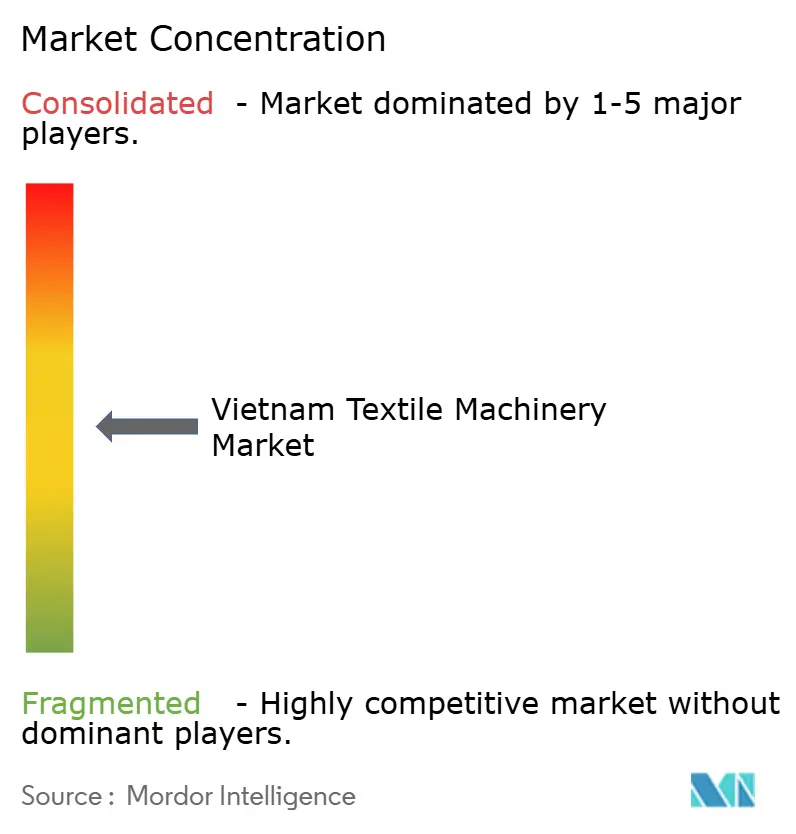
| Market Concentration | Medium |
Major Players *Disclaimer: Major Players sorted in no particular order Image © Mordor Intelligence. Reuse requires attribution under CC BY 4.0. | |
Vietnam Textile Machinery Market Analysis by Mordor Intelligence
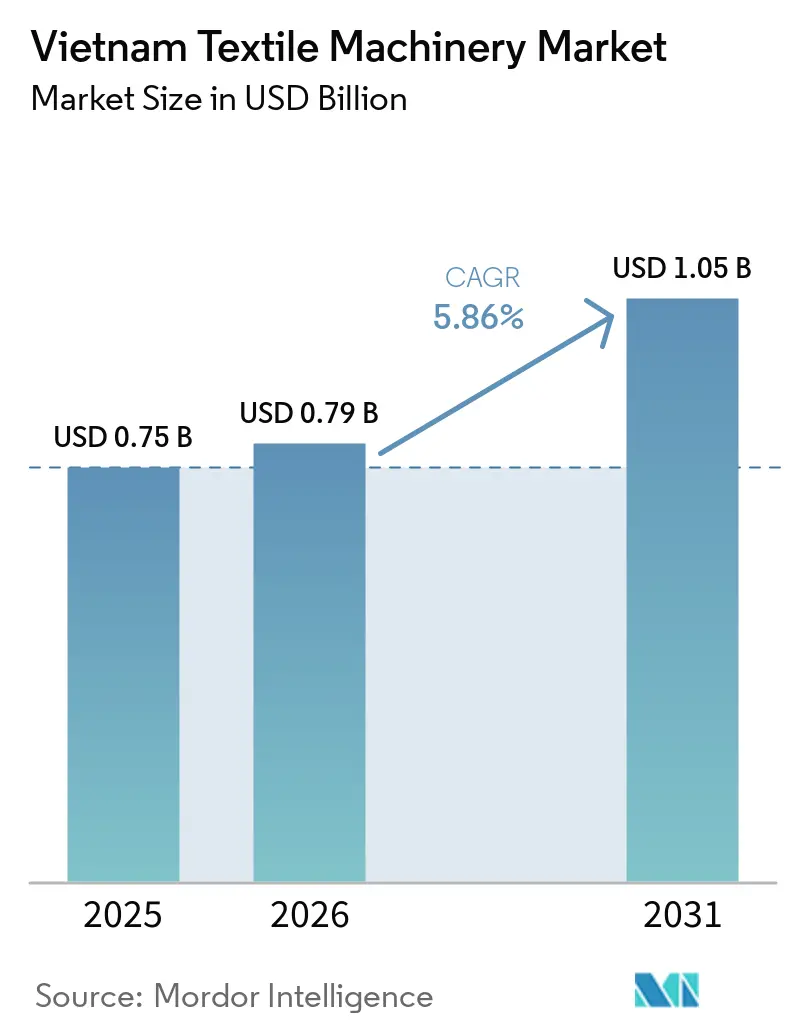
The Vietnam Textile Machinery Market size is expected to grow from USD 0.75 billion in 2025 to USD 0.79 billion in 2026 and is forecast to reach USD 1.05 billion by 2031 at 5.86% CAGR over 2026-2031.
Textile and garment exports reached USD 46 billion in 2025, and the industry targets USD 48 billion to USD 49 billion in 2026, supporting continued equipment spending across production lines. Vietnam’s free trade agreements have shifted procurement priorities toward equipment that supports traceability, origin compliance, and more integrated production. Vietnam was among the three largest destinations for open-end rotor investments in 2025, with investments increasing by 17% year-on-year, according to the International Textile Manufacturers Federation (ITMF). Separately, global shuttle-less loom shipments declined by 27.5% to 164,000 units in 2025, also according to ITMF. The Vietnam textile machinery market also faces pressure from higher labor costs, environmental requirements, imported equipment dependence, and shortages of skilled operators. Larger state-linked groups and foreign-invested manufacturers have greater capacity to act on these needs, while smaller producers face a more difficult financing decision.
Key Report Takeaways
- By product and process equipment, spinning and yarn manufacturing machinery held 29.95% of the Vietnam textile machinery market share in 2025, while textile printing machinery is forecast to grow at a 6.95% CAGR through 2031.
- By source of supply, imported machinery accounted for 68.9% of the Vietnam textile machinery market share in 2025 and is projected to expand at a 5.9% CAGR through 2031.
- By end-use application, apparel and fashion manufacturing represented 64.5% of the Vietnam textile machinery market size in 2025, while industrial and technical textiles is forecast to advance at a 7.45% CAGR through 2031.
Note: Market size and forecast figures in this report are generated using Mordor Intelligence’s proprietary estimation framework, updated with the latest available data and insights as of January 2026.
Vietnam Textile Machinery Market Trends and Insights
Drivers Impact Analysis*
| Driver | (~) % Impact on CAGR Forecast | Geographic Relevance | Impact Timeline |
|---|---|---|---|
| Export-Oriented Textile Capacity Expansion | +1.6% | National, with the strongest concentration in northern spinning zones and southern apparel clusters | Short term (≤ 2 years) |
| Factory Automation to Offset Rising Labor Costs | +1.2% | National, with early adoption in high-volume southern garment mills and integrated northern spinning complexes | Medium term (2-4 years) |
| Green and Smart-Factory Investment for Buyer Compliance | +1% | National, with the highest impact in dyeing and finishing clusters and export-oriented apparel zones | Medium term (2-4 years) |
| Localized Upstream Capacity to Satisfy Rules of Origin | +0.8% | National, concentrated in foreign-invested northern spinning and weaving industrial parks. | Long term (≥ 4 years) |
| Retrofit Demand for Energy and Water Efficiency | +0.6% | National, with priority in dyeing and finishing clusters subject to QCVN 40:2025/BTNMT | Short term (≤ 2 years) |
| Shorter Production Runs Increasing Demand for Flexible Digital Equipment | +0.4% | Greater Ho Chi Minh City, serving fast-fashion and international buyer programs | Medium term (2-4 years) |
| Source: Mordor Intelligence | |||
Export-Oriented Textile Capacity Expansion
Vietnam’s export-led manufacturing model supports capital spending on textile production equipment. Textile and garment exports reached USD 46 billion in 2025, and the 2026 target is USD 48 billion to USD 49 billion.[1] Higher order volumes require greater throughput, more consistent delivery performance, and better product traceability across spinning, fabric formation, garment production, and finishing. Vietnam was among the world’s top 3 investors in open-end rotors in 2025, as shipments rose 17% even as investment in several global machinery categories weakened. The country’s United States garment share rose to 19.9% in 2025, while its share in Japan remained 18.5%, supporting longer-term buyer commitments.
Factory Automation to Offset Rising Labor Costs
Rising labor costs and pressure to improve productivity are strengthening the case for automation among Vietnam textile producers. In 2025, average nominal monthly wages in Vietnam textile market were approximately USD 275, increasing the incentive for manufacturers to reduce labor dependency and improve operational efficiency. Rather than applying a single production-cost premium across Indonesia, Malaysia, and Myanmar, cost competitiveness should be assessed separately because labor and operating-cost structures differ substantially across these markets. This pressure is making advanced machinery increasingly important for improving labor productivity. A reported 50,000-spindle spinning facility that adopted Industry 4.0 technologies reduced its operating workforce from approximately 200–300 workers to 30–40 workers, demonstrating the potential for substantial labor savings. Industry sources also report 20%–30% productivity gains from automated production systems. However, automation adoption remains at an early stage, with only around 30% of textile businesses reported to have introduced automation at some stage of production, while connected-system adoption remains limited.
Green and Smart-Factory Investment for Buyer Compliance
Buyer requirements for verified environmental performance are changing how Vietnamese textile factories select equipment. Vietnam’s National Green Growth Strategy for 2021 to 2030 includes energy efficiency, water recycling, and carbon reporting objectives that factory equipment must support. Older equipment often lacks the process data needed for reporting, increasing the relevance of machinery with monitoring, control, and data-collection functions. QCVN 40:2025/BTNMT applies to new or expanded dyeing projects approved after September 2025 and adds wastewater monitoring requirements for microplastics, dioxins and furans, persistent organic pollutants, and chlorinated solvents. The new requirements favor closed-loop water systems, low-liquor-ratio dyeing equipment, and real-time effluent monitoring, while creating immediate retrofit demand in existing facilities. The Vietnam textile machinery market benefits from the change, but suppliers face a higher technical selection standard for new dyeing park projects.
Localized Upstream Capacity to Satisfy Rules of Origin
Vietnam’s trade agreement network is directing investment toward upstream textile production. CPTPP’s yarn-forward rule requires yarn spinning, fabric weaving, dyeing, finishing, and garment assembly to occur within member territories for qualifying products. At the same time, EVFTA’s fabric-forward requirement calls for Vietnamese-origin fabric for preferential EU tariffs.[3] Vietnam’s garment-led production base was not built to meet every upstream requirement, increasing interest in spinning frames, texturing lines, looms, and wet-processing capacity. MOIT’s Circular No. 23/2025/TT-BCT updated origin certification management in May 2025 and signaled more active compliance attention. Dyeing and finishing remain the missing intermediate stage between Vietnamese yarn and certifiable finished fabric, attracting industrial park development and foreign investment. The Vietnam textile machinery market benefits from these investments, while shorter production runs also support demand for flexible digital equipment.
Restraints Impact Analysis*
| Restraint | (~) % Impact on CAGR Forecast | Geographic Relevance | Impact Timeline |
|---|---|---|---|
| High Upfront Cost and Extended Payback for Integrated Lines | -1.2% | National, most acute for SME-dominated clusters outside major foreign-invested industrial zones | Medium term (2-4 years) |
| Dependence on Imported Machinery, Parts, and Technical Service | -0.9% | National, most pronounced in central Vietnam and smaller provinces with limited OEM service presence | Long term (≥ 4 years) |
| Fragmented Mill-Supplier Data and Limited Digital Interoperability | -0.5% | National, with the highest impact in dispersed garment SME networks | Medium term (2-4 years) |
| Operator and Maintenance Skills Bottleneck for Advanced Equipment | -0.3% | National, most severe in secondary and tertiary manufacturing clusters | Long term (≥ 4 years) |
| Source: Mordor Intelligence | |||
High Upfront Cost and Extended Payback for Integrated Lines
Capital intensity remains the main constraint on modernization, especially for small and medium-sized enterprises that account for more than 70% of Vietnam’s textile production capacity. European and Japanese integrated spinning or weaving systems can require USD 20 million to USD 50 million or more at a meaningful scale. In contrast, lower-cost Chinese alternatives still require difficult financial planning for mills with short order books. The Vietnam textile machinery market has strong modernization demand, but many potential buyers cannot make an immediate purchase when projects combine spinning, weaving, dyeing, finishing, and automation. APO found that real capital investment rose 169% from 2012 to 2022 but was concentrated among large state-linked groups and foreign-invested enterprises. Wage pressure makes automation more necessary while reducing the cash flow available to fund it, and the fifth consecutive minimum wage increase in 2026 narrows the decision window for mills that delayed investment. Smaller mills may select partial automation or upgrades instead of integrated lines, extending replacement cycles for high-value equipment.
Dependence on Imported Machinery, Parts, and Technical Service
Imported machines represented 68.9% of the Vietnam textile machinery market in 2025, covering advanced spinning, weaving, finishing systems, parts, and specialist service. Domestic producers mainly supply simple garment equipment, material-handling systems, and refurbished machinery because they lack the precision casting, electronics integration, and metrology capacity needed for high-speed looms, spinning frames, and finishing ranges. The Vietnam textile machinery market remains exposed to foreign production and service networks, which shape equipment availability, pricing, maintenance planning, and replacement decisions. Geopolitical disruption, tariff changes, and longer waits for technical support outside Hanoi and Ho Chi Minh City can affect mill operations. Red Sea disruption added 14 to 20 days to European equipment delivery times in 2025. A shortage of operators and maintenance technicians further slows the use of advanced systems, particularly in secondary manufacturing clusters.
*Our forecasts treat driver/restraint impacts as directional, not additive. The impact forecasts reflect baseline growth, mix effects, and variable interactions.
Segment Analysis
By Product and Process Equipment: Spinning Infrastructure Anchors the Market, Digital Printing Accelerates
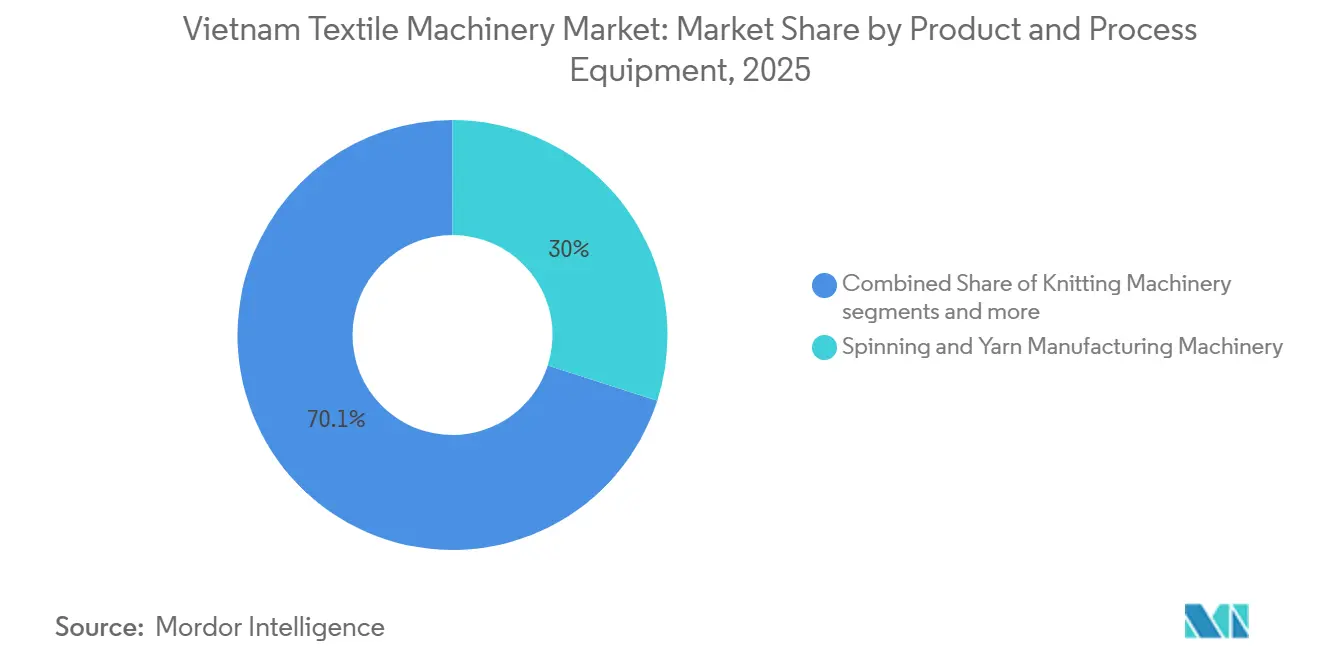
Spinning and yarn manufacturing machinery held 29.95% of the Vietnam textile machinery market share in 2025. Its position reflects upstream investment needed to meet the CPTPP rules of origin. Vietnam also ranked among the world’s top 3 destinations for open-end rotor investment in 2025, as shipments rose 17% year over year. The category includes ring spinning, open-end rotor, and air-jet systems, which differ in supplier base and operating requirements. Mills select these systems based on yarn quality, output, energy use, automation needs, and intended product mix.
Textile printing machinery is forecast to record the fastest product growth at a 6.95% CAGR through 2031, as mills move from analog screen and rotary systems to digital inkjet platforms. Shorter buyer order cycles, on-demand customization, improved color management, and chemical traceability support this shift. Weaving and weaving-preparation machinery is the second-largest product category, with rapier and air-jet looms prominent in new woven-fabric installations. Vietnam received 1,800 large circular knitting machines in 2025 and ranked third after China and India, despite a 13% decline in global shipments. Flat-bed knitting, nonwoven machinery, and testing and quality-control equipment are also gaining relevance as technical-textile, hygiene, medical, buyer-audit, and certification requirements increase.

By Source of Supply: Import Dependence, Structurally Entrenched, Chinese Volumes Dominant
Imported machinery accounted for 68.9% of the Vietnam textile machinery market share in 2025 and is forecast to grow at a 5.9% CAGR through 2031. This rate is expected to preserve and slightly increase the import share because overseas suppliers cover performance tiers that domestic manufacturers do not produce. The Vietnam textile machinery market size for imported equipment is closely tied to investment by large integrated mills and foreign-invested operations. China leads volumes in spinning preparation equipment, including carding machines and draw frames, and in entry-level nonwoven lines. Germany, Japan, and India serve premium positions in precision equipment for integrated mills, while Germany supplied USD 728.7 million in total machinery imports to Vietnam in 2025.
Domestic machinery represented 31.1% of the Vietnam textile machinery market in 2025. Local production is concentrated in simple garment assembly equipment, material-handling systems, and refurbished imported machines. It has limited capacity in the advanced spinning, high-speed weaving, and finishing equipment that needs precision components, electronics, process knowledge, and broad service networks. MOIT Circular No. 23/2025/TT-BCT updated origin certification and electronic customs management for imported goods in 2025. Imported technology, parts, delivery times, and local service coverage will therefore remain the main supply-side considerations during the forecast period.
By End-Use Application: Apparel Sustains Scale, Industrial Textiles Capture Growth Premium
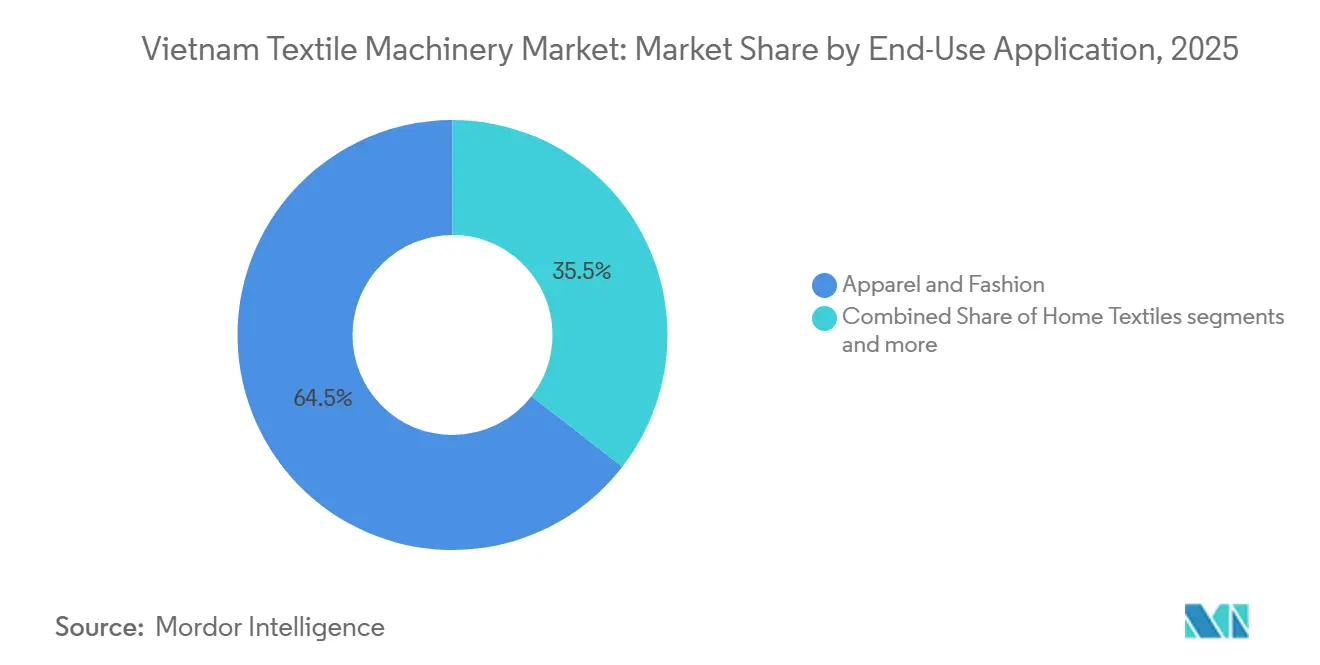
Apparel and fashion manufacturing absorbed 64.5% of machinery investment in 2025. This Vietnam textile machinery market size reflects the country’s established role in global garment production and its large installed base of sewing, cutting, and apparel-finishing equipment. Vietnam’s share of the U.S. garment market increased to 19.9% in 2025 from 18.9% in 2024, while its share in Japan held at 18.5%. These export links support spending on sewing systems, automated cutting equipment, and apparel-specific finishing lines. The Vietnam textile machinery market remains anchored by apparel, even as other end uses expand faster.
Industrial and technical textiles are forecast to grow at a 7.45% CAGR through 2031, supported by demand for automotive fabrics, geotextiles, and nonwoven hygiene and medical materials. A March 2025 partnership between Acme Mills and Vietnamese producers for nonwoven supply to the United States reflects the role of supply-chain diversification in this application. Home textiles, including towels, bed linens, and curtains, require weaving, finishing, yarn preparation, and water-treatment capacity. Sanbang Textile’s planned Nam Dinh project targets 15,000 tons of towels, 14 million meters of woven fabric, and 15,000 tons of DTY yarn annually.
Geography Analysis
Northern Vietnam has the most established textile manufacturing infrastructure and the largest concentration of wet-processing machinery investment. Aurora IP in Nam Dinh is a 519-hectare textile industrial park with an industrial wastewater treatment capacity of 110,000 cubic meters per day. Top Textiles began operations in 2024 at a USD 203 million dyeing and weaving facility with an annual capacity of 60 million meters. Sanbang Textile committed USD 30 million in the same industrial park. At the same time, Jinnor broke ground in February 2025 on a USD 9 million yarn and textile-dyeing plant with planned annual fabric capacity of 50 million square meters. These projects and spinning complexes in Hung Yen, Ha Nam, Thai Binh, and Ninh Binh support demand for dyeing, water-treatment, yarn-preparation, carding, and drawing equipment.
Southern Vietnam is the largest garment cluster and a major demand center for sewing systems, intelligent hanging conveyors, automated cutting equipment, and apparel-finishing lines. Ho Chi Minh City, Binh Duong, and Dong Nai are central to this demand, and SaigonTex 2026 drew major global OEMs to Ho Chi Minh City. Productivity gains from INA conveyor and robotics installations reached 20% to 30% for lingerie and sportswear producers in the region. Vertically integrated denim operations, including Saitex in Long Tho, also use premium European weaving and finishing equipment.
Central Vietnam is developing as a specialized location for circular economy and technical textile investment. SYRE committed USD 1 billion in April 2025 to a Binh Dinh polyester fabric recycling complex with 250,000 tons of annual design capacity, targeted to begin operations by the end of 2028. Suedwolle opened a USD 21 million dyeing plant in Ninh Thuan that uses 30% less water and 20% less energy than conventional systems, with an initial annual capacity of 2,000 tons and a planned second phase to 4,000 tons. Da Nang supports regional logistics, while QCVN 40:2025/BTNMT makes equipment selection more demanding for new dyeing and finishing projects.
Competitive Landscape
The Vietnam textile machinery market is moderately fragmented, with global OEMs competing by technology tier rather than across every product range. European suppliers are strongest in specialized spinning, weaving preparation, warp knitting, and finishing. Chinese manufacturers are gaining ground in entry-level and mid-range spinning and nonwovens where cost is important. This structure supports premium positions for suppliers with stronger quality, durability, and process-control credentials.
Rieter integrated OC Oerlikon’s Barmag Division as its Man-Made Fiber Division in January 2026. The combined organization now covers short-staple natural-fiber spinning and synthetic-yarn texturing, which is relevant as Vietnamese mills expand polyester and nylon capacity for FTA origin compliance. KARL MAYER expanded its HKS warp-knitting platform, and Itema launched the Galileo-AX air-jet machine at ITMA Asia 2025 for cost-sensitive Asian buyers. These moves suggest that European OEMs are pursuing a broader price range rather than withdrawing from mid-market competition. Mills will compare these offers with Chinese alternatives based on financing, parts availability, local service, and operating performance.
Service proximity, digital connection, and verified sustainability performance increasingly differentiate equipment suppliers. Trützschler has local technical teams, spare-parts inventory, and the My Mill real-time monitoring platform in Vietnam, while PEJA Vietnam and ILLIES Engineering Vietnam support procurement, customs, installation, and service for global OEM portfolios. Picanol’s EcoBoost for the OmniPlus-i Connect can reduce air-jet energy use by up to 1.5 kW per machine, addressing energy-cost and carbon-reporting requirements. Testing and quality-control systems and retrofit digital printing remain opportunities because their penetration is below that of production equipment.
Vietnam Textile Machinery Industry Leaders
-
Rieter Holding AG
-
Trützschler Group SE
-
Saurer Intelligent Technology AG
-
OC Oerlikon
-
KARL MAYER
- *Disclaimer: Major Players sorted in no particular order
Recent Industry Developments
- July 2026: KARL MAYER launched the HKS 4-S EL, a high-speed four-bar short-stroke tricot machine combining elastic and rigid warp-knit capability on a single platform. The machine targets Vietnamese mills serving fast-fashion buyers and the growing activewear segment, where rapid pattern changeovers and consistent quality across elastic and rigid fabrics are critical to order retention.
- April 2026: Saurer Group signed a digital transformation cooperation agreement with NGHE TINH YARN JSC, one of Vietnam’s major cotton yarn producers, at SaigonTex 2026 in Ho Chi Minh City. The agreement extends Saurer’s BD rotor spinning technology deployment at the mill and integrates Saurer’s sensesmill digital platform to build an intelligent manufacturing benchmark for Vietnamese spinning.
- April 2026: Rieter participated in SaigonTex 2026 through local representative networks, showcasing ring and compact spinning components under the Accotex and Bräcker brands. This appearance represented the first major trade presence following Rieter’s January 2026 integration of Barmag and positioned the combined group as a provider of natural- and man-made-fiber spinning systems.
- April 2026: Trützschler showcased spinning and nonwoven equipment at SaigonTex 2026, including X-Series carding machines for high-speed spunlace wipes and air-through bonding diaper-component lines. The X-Series serves Vietnam’s growing hygiene nonwoven production segment, where domestic machinery supply remains limited.
Vietnam Textile Machinery Market Report Scope
The Vietnam Textile Machinery Market Report is Segmented by Product and Process Equipment (Spinning and Yarn Manufacturing Machinery, Weaving and Weaving Preparation Machinery, and More), by Source of Supply (Domestically Manufactured Machinery, Imported Machinery), by End-Use Application (Apparel and Fashion, Home Textiles, Industrial and Technical Textiles, Others). The Market Forecasts are Provided in Terms of Value (USD).
| Spinning and Yarn Manufacturing Machinery |
| Weaving and Weaving Preparation Machinery |
| Knitting Machinery |
| Nonwoven Machinery |
| Textile Dyeing, Processing and Finishing Machinery |
| Textile Printing Machinery |
| Textile Testing, Inspection and Quality-Control Equipment |
| Others (Textile Material Handling Equipment, Humidification Systems, fibre-recovery machinery, doffing and packaging systems, etc.) |
| Domestically Manufactured Machinery |
| Imported Machinery |
| Apparel and Fashion |
| Home Textiles |
| Industrial and Technical Textiles |
| Others (Automotive Textiles, Medical and Hygiene Textiles, Geotextiles, Agrotextiles, Protective Textiles, Carpets and Floor Coverings, and Specialty Textile Applications) |
| By Product and Process Equipment | Spinning and Yarn Manufacturing Machinery |
| Weaving and Weaving Preparation Machinery | |
| Knitting Machinery | |
| Nonwoven Machinery | |
| Textile Dyeing, Processing and Finishing Machinery | |
| Textile Printing Machinery | |
| Textile Testing, Inspection and Quality-Control Equipment | |
| Others (Textile Material Handling Equipment, Humidification Systems, fibre-recovery machinery, doffing and packaging systems, etc.) | |
| By Source of Supply | Domestically Manufactured Machinery |
| Imported Machinery | |
| By End-Use Application | Apparel and Fashion |
| Home Textiles | |
| Industrial and Technical Textiles | |
| Others (Automotive Textiles, Medical and Hygiene Textiles, Geotextiles, Agrotextiles, Protective Textiles, Carpets and Floor Coverings, and Specialty Textile Applications) |
Key Questions Answered in the Report
What is the projected value of Vietnam textile machinery market by 2031?
The market is projected to reach USD 1.05 billion by 2031, from USD 0.79 billion in 2026, at a 5.9% CAGR.
Which equipment category held the largest share in Vietnam in 2025?
Spinning and yarn manufacturing machinery held the largest product share at 29.95% in 2025.
Which application is growing fastest for textile equipment in Vietnam?
Industrial and technical textiles are forecast to grow at a 7.45% CAGR through 2031, supported by automotive, geotextile, hygiene, and medical fabric demand.
Why do free trade agreements affect textile equipment purchases in Vietnam?
CPTPP and EVFTA origin rules encourage investment in local spinning, weaving, dyeing, and finishing capacity so exporters can qualify for preferential tariffs.
Why is imported equipment important to Vietnamese textile manufacturers?
Imported machinery accounted for 68.9% of the supply in 2025 because domestic producers have limited capacity in advanced spinning, weaving, and finishing systems.
What is driving automation spending by Vietnamese mills?
Rising labor costs, the fifth consecutive minimum-wage increase in 2026, and the need to improve output and traceability are encouraging automation investment.