
Vietnam Modern Methods Of Construction Market Size and Share
Market Overview
| Study Period | 2021 - 2032 |
|---|---|
| Forecast Data Period | 2027 - 2032 |
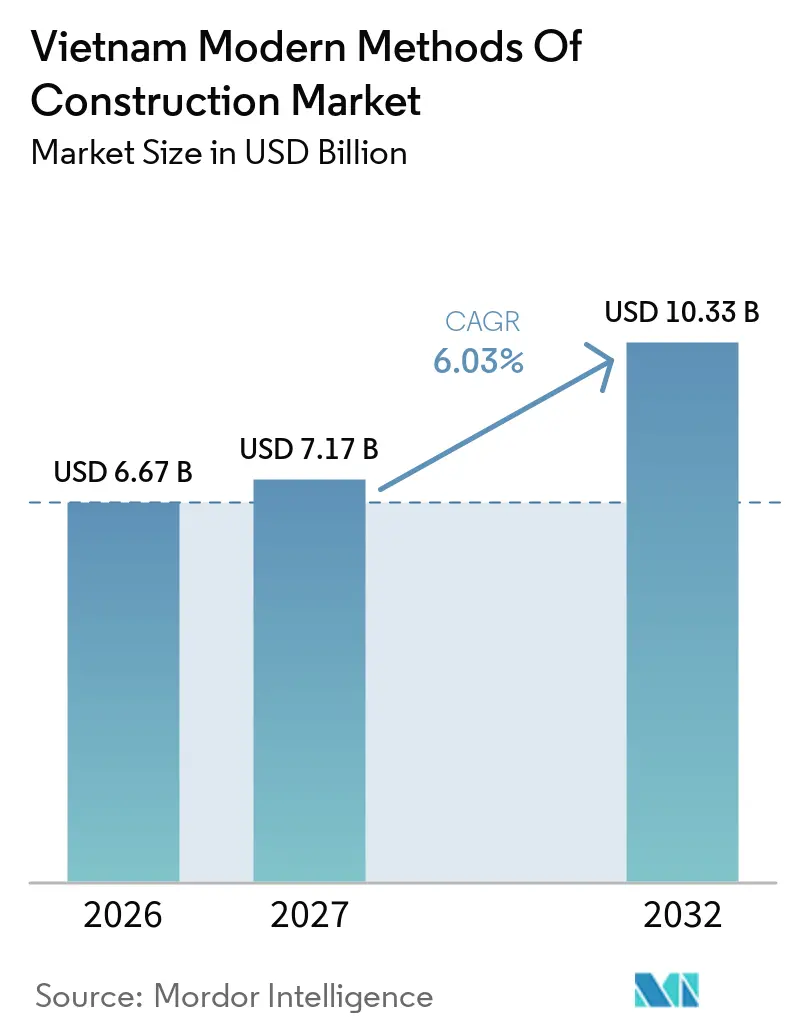
| Base Year Market Size (2026) | USD 6.67 Billion |
| Market Size (2027) | USD 7.17 Billion |
| Market Size (2032) | USD 10.33 Billion |
| Growth Rate (2027 - 2032) | 6.03 % |
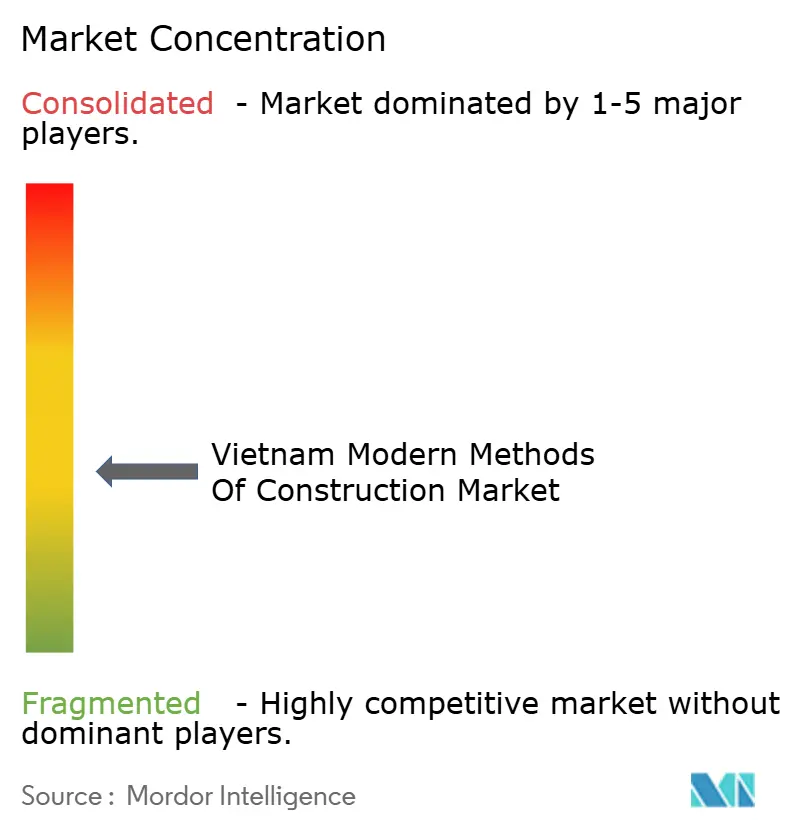
| Market Concentration | Medium |
Major Players *Disclaimer: Major Players sorted in no particular order Image © Mordor Intelligence. Reuse requires attribution under CC BY 4.0. | |
Vietnam Modern Methods Of Construction Market Analysis by Mordor Intelligence
The Vietnam Modern Methods Of Construction Market size is projected to expand from USD 6.67 billion in 2026 and USD 7.17 billion in 2027 to USD 10.33 billion by 2032, registering a CAGR of 6.03% between 2027 and 2032.
The Vietnam modern methods of construction market is moving beyond specialized industrial buildings as housing, factory, logistics, and infrastructure projects require more predictable delivery. Urban development and industrial park activity create recurring building formats that are suited to factory-produced components. Labor shortages also make it harder for contractors to depend on large on-site crews for time-sensitive work. The Vietnam modern methods of construction market therefore benefits when developers place greater value on scheduling certainty, quality control, and less exposure to weather disruption. The main opportunity is in systems that can be repeated across social housing, factories, worker accommodation, and commercial facilities.
Key Report Takeaways
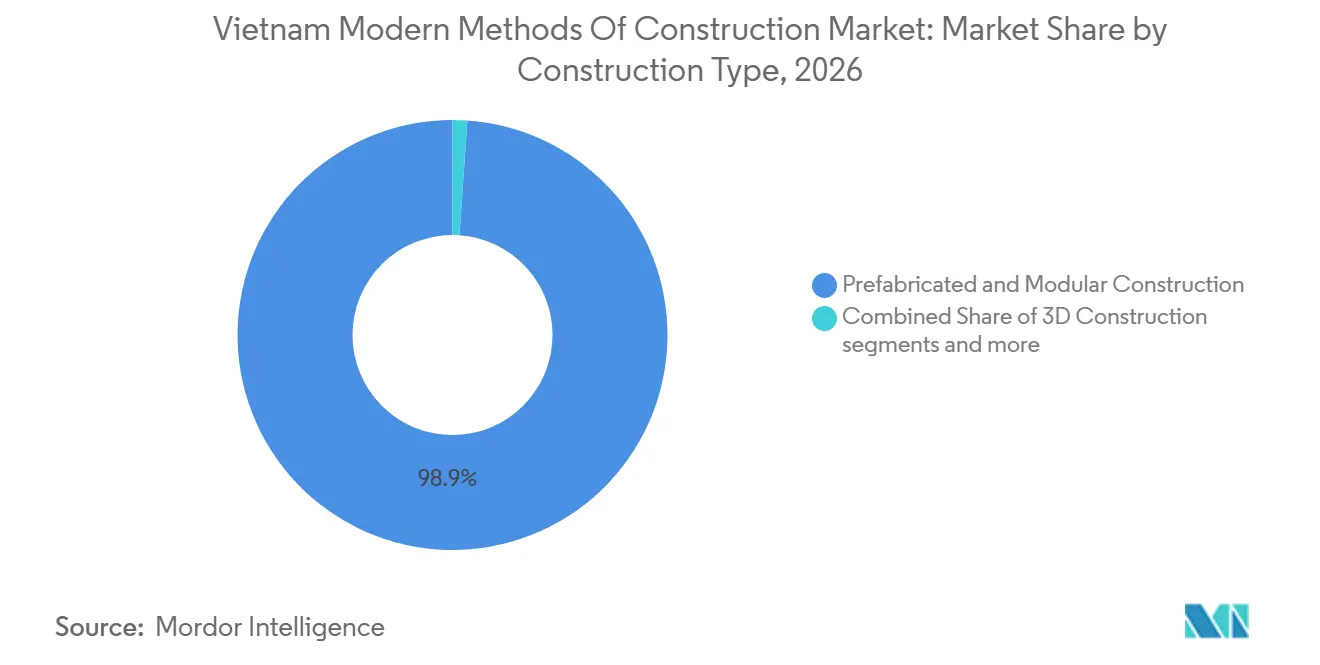
By construction type, prefabricated and modular construction held 98.90% of the Vietnam modern methods of construction market share in 2026, while 3D construction is forecast to expand at a 29.20% CAGR through 2032.
By material type, concrete accounted for 50.78% of the Vietnam modern methods of construction market size in 2026, while timber recorded the highest projected CAGR at 8.28% through 2032.
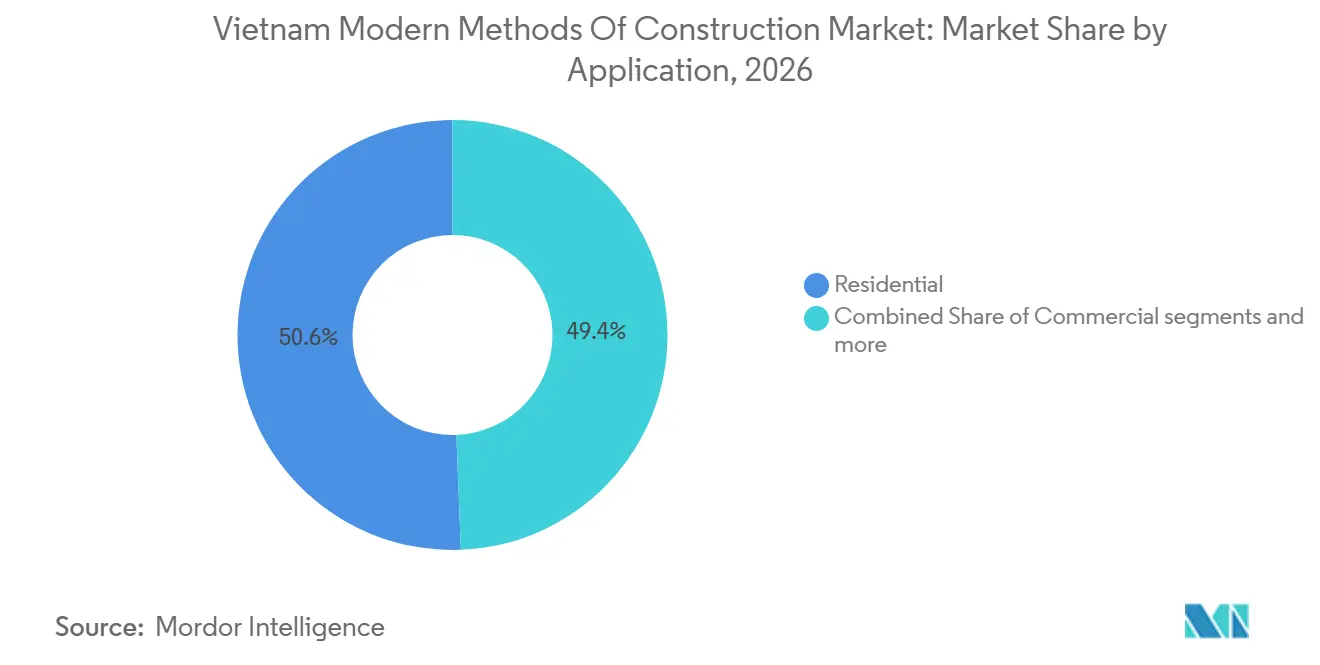
By application, residential construction held 50.62% of the 2026 value, while commercial construction is forecast to grow at a 7.95% CAGR through 2032.
By geography, Ho Chi Minh City accounted for 21.12% of the 2026 value, while Da Nang is forecast to grow at an 8.44% CAGR through 2032.
Note: Market numbers in this report are based on Mordor Intelligence's proprietary estimation framework, which combines nine months of actuals with Q4 projections for base year 2026.
Vietnam Modern Methods Of Construction Market Trends and Insights
Drivers Impact Analysis*
| Drivers | % Impact on CAGR Forecast | Geographic Relevance | Impact Timeline |
|---|---|---|---|
| Urban Housing and Industrial-Park Expansion | +1.5% | National; concentrated in Ho Chi Minh City, Hanoi, Binh Duong, Dong Nai | Short term (≤ 2 years) |
| Manufacturing and Export-Facility Construction | +1.2% | Northern & Southern industrial corridors, Hai Phong, Hanoi, Ho Chi Minh City, Dong Nai | Medium term (2–4 years) |
| Affordable-Housing and Social-Housing Programs | +1.0% | National; strongest uptake in Ho Chi Minh City, Hanoi, Binh Duong | Short term (≤ 2 years) |
| Construction Labor Productivity and Schedule Pressure | +0.8% | National; most acute in Tier 1 cities facing acute site-crew shortfalls | Medium term (2–4 years) |
| Foreign Investment in Standardized Industrial Buildings | +0.7% | Key Foreign Direct Investment (FDI) zones, Binh Duong, Dong Nai, Hai Phong, Long An | Medium term (2–4 years) |
| Demand for Flood- and Climate-Resilient Construction | +0.5% | Coastal and delta regions, Mekong Delta, Central Coast, Ho Chi Minh City | Long term (≥ 4 years) |
| Source: Mordor Intelligence | |||
Urban Housing and Industrial-Park Expansion
The Vietnam modern methods of construction market gains support from urban growth and a broad pipeline of industrial development. Vietnam has more than 470 industrial zones and export processing zones in operation, which create a continuing requirement for repeatable factory and support buildings[1]. These sites favor pre-engineered steel structures and prefabricated elements because specifications can be reused across facilities. Housing demand has a similar effect, where developers need consistent floor plans and shorter construction cycles. Flood exposure in the Mekong Delta, central coastal areas, and parts of Ho Chi Minh City also increases interest in elevated and factory-built structural solutions. This combination gives contractors a reason to use standardized systems across several building types rather than treating off-site construction as a premium option.
Manufacturing and Export-Facility Construction
The Vietnam modern methods of construction market benefits from projects that require wide spans, controlled building conditions, and consistent tolerances. The United States Department of State identifies manufacturing as a significant part of Vietnam’s investment environment, including activity in higher-value production segments. These facilities often need steel frames, service modules, and coordinated building systems that can be produced before site work is complete. Five approved Vietnam Singapore Industrial Park projects cover more than 2,300 hectares and focus on high-tech and green manufacturing tenants. Their requirements make digital coordination and repeatable structural design more relevant to suppliers. The result is a pipeline that supports faster procurement cycles for fabrication specialists and modular fit-out providers.
Affordable-Housing and Social-Housing Programs
Social housing provides a large source of repetitive demand for Vietnam's modern methods of construction market. Vietnam completed 102,630 social housing units in 2025, exceeding its annual target of 100,275 units. The government’s policy framework has sought to simplify investor selection and approvals for social housing projects, which can make production-based construction models more practical. Repeated apartment layouts suit precast components, panelized light-gauge steel systems, and volumetric room modules. These approaches can help developers manage a large housing pipeline while limiting variation between projects. The Vietnam modern methods of construction industry can find stable demand in projects with defined specifications and affordable price targets.
Construction Labor Productivity and Schedule Pressure
Construction labor conditions make off-site production more relevant in Vietnam's modern methods of construction market. The International Monetary Fund identifies population aging, skill mismatches, and outward movement of skilled workers as structural constraints on Vietnam’s labor productivity[2]. Factory fabrication reduces dependence on several weather-sensitive and labor-intensive site activities, including reinforcement preparation, formwork, and interior pod installation. It also allows structural, mechanical, and finishing work to progress in parallel when designs are coordinated early. Sun Group reported productivity gains of 60% and construction schedule reductions of 30% from its modular experience at Phu Quoc developments. This evidence shows that methods that reduce exposure to an increasingly constrained on-site labor pool are valuable.
Restraints Impact Analysis*
| Restraints | % Impact on CAGR Forecast | Geographic Relevance | Impact Timeline |
|---|---|---|---|
| Fragmented Local Approvals and Technical Standards | -1.2% | National; sharpest friction in provincial and Tier 2 / Tier 3 municipalities | Short term (≤ 2 years) |
| Limited Domestic Supply of Advanced Modular Components | -0.9% | National; severity highest in non-urban provinces distant from port-linked supply chains | Medium term (2–4 years) |
| Port, Road, and Inland-Transport Bottlenecks | -0.7% | Inland provinces, Central Highlands, Mekong Delta, spill-over to MEA-linked export corridors | Medium term (2–4 years) |
| Buyer Familiarity and Financing Preference for Conventional Construction | -0.5% | National; most persistent in Tier 2 and Tier 3 cities where conventional builds dominate lending structures | Long term (≥ 4 years) |
| Source: Mordor Intelligence | |||
Fragmented Local Approvals and Technical Standards
The Vietnam modern methods of construction market faces delays when technical approvals differ between locations. Vietnam has standards for structural steel and masonry blocks, but a single national rulebook for volumetric modular buildings is not yet applied consistently across local authorities. A system approved for one city may need another technical review elsewhere. This can reduce the time advantage that developers expect from prefabrication. Research involving 256 construction professionals identified inflexible permitting and a lack of standardized design processes as significant barriers to modular social housing in Vietnam[3]. Conventional construction remains familiar to many buyers and lenders so that approval uncertainty can reinforce existing financing and procurement preferences.
Limited Domestic Supply of Advanced Modular Components
Domestic suppliers are strong in steel fabrication and precast concrete, but advanced modules still require imported components in several cases. The Ho Chi Minh City Structure Architecture Wood Association reported that only 10 projects nationwide had used engineered wood, with most components imported. Imported engineered panels, high-tolerance bathroom modules, acoustic systems, and fire-rated wall systems can add cost and logistics exposure. Large modules also need dependable road, port, and inland transport routes, which can be difficult in the Mekong Delta, central provinces, and distant industrial zones. Vietnam’s large wood-products export base does not yet provide a full domestic certification and testing system for multi-story engineered timber use. Suppliers that localize components and plan transport early will be better placed to address this constraint.
*Our forecasts treat driver/restraint impacts as directional, not additive. The impact forecasts reflect baseline growth, mix effects, and variable interactions.
Segment Analysis
By Construction Type: Prefabricated & Modular Systems Remain the Core Format
Prefabricated and modular construction held 98.90% of 2026 value, making it the clear foundation of the Vietnam modern methods of construction market. Steel-framed factory buildings and precast residential blocks account for much of this position. Panelized systems, including light-gauge steel and structurally insulated panels, fit projects with repeated layouts and controlled specifications. Volumetric modules are also useful where site access, labor availability, or construction sequencing creates pressure. Zamil Steel Buildings Vietnam expanded and consolidated operations at its Dong Nai facility in 2026, with automated fabrication lines and building information modeling integration for complex structures. The investment reflects continued demand for precision-engineered industrial buildings.
3D construction is the fastest-growing construction type and is forecast to grow at a 29.20% CAGR through 2032. Research linked to Ho Chi Minh City Polytechnic University has tested concrete extrusion for resettlement housing applications. A reported prototype reduced structural-phase construction time by 70% and showed 10% to 20% cost savings for comparable building forms. The lack of dedicated standards for printed materials, construction processes, and acceptance testing currently limits its practical use. The technology is most suitable for low-rise buildings with repeatable layouts. The Vietnam modern methods of construction industry may gain a distinct capability if testing, certification, and public procurement develop alongside domestic machine research.

By Material Type: Concrete Leads While Timber Builds a New Supply Base
Concrete accounted for 50.78% of 2026 value in the Vietnam modern methods of construction market. Its lead rests on established precast supply chains and widespread familiarity with reinforced-concrete design. Precast products can support apartment structures, transport projects, factory foundations, and other repeatable work. Xuan Mai Corp has focused on precast technology for expressways, metro tunnels, and social housing projects. In September 2026, the company signed a comprehensive strategic cooperation agreement with BAC A BANK to support its precast manufacturing expansion. Metal, glass, and other materials continue to serve specialist roles in cladding, envelopes, and commercial building applications.
Timber is forecast to grow at an 8.28% CAGR through 2032, the fastest rate among materials. Vietnam recorded USD 16.7 billion in wood-product exports in 2025, showing a sizable processing base that may support future structural applications. Modulux Homes, part of TranDuc, commissioned Southeast Asia’s first cross-laminated timber production line in Vietnam during 2025 with technical supervision from Life Design Kabaya of Japan. This facility provides a local starting point for mass-timber systems. Wider use will depend on structural standards, testing capacity, supply-chain traceability, and acceptance by developers. Timber’s small base means it has room to expand, although concrete is likely to remain the main material in the near term.
By Application: Residential Demand Provides Scale, and Commercial Buildings Grow Faster
Residential construction held 50.62% of the Vietnam modern methods of construction market in 2026. Social housing targets provide a consistent need for apartment designs that can be repeated across projects. Decision 444/QD-TTg set a national target of 995,445 social housing apartments for the 2025 to 2030 period. Panelized walls, precast frames, and modular room elements can help contractors handle repeated floor plans. Worker accommodation near industrial parks adds another demand stream with similar specifications. Residential providers still need to manage buyer preferences, financing structures, and local approvals before standard systems can scale further.
Commercial construction is forecast to grow at a 7.95% CAGR through 2032. Logistics facilities, data centers, hospitality assets, schools, offices, and mixed-use projects are broadening the demand base beyond central business district buildings. Vinaconex 25 has projects spanning offices, schools, artificial intelligence centers, and urban developments in Da Nang, Quy Nhon, and Hue. Such projects value predictable schedules and coordinated installation of building systems. Industrial, institutional, energy, utility, and transport applications also offer support, especially where structures require precast or standardized steel components. The Vietnam modern methods of construction market can therefore reach a wider range of buyers as project types diversify.
Geography Analysis
Ho Chi Minh City accounted for 21.12% of the 2026 value and remains the largest geographic contributor to Vietnam's modern methods of construction market. Its role reflects high-rise residential development and factory activity in the surrounding provinces. Projects in Thu Duc City are increasing attention to flood-resilient design and elevated structural approaches. The Ring Road 3 project and Ho Chi Minh City Long Thanh expressway packages extend the construction catchment toward industrial and logistics areas. KNIC Nam Long Thanh Industrial Park is progressing its first phase, including infrastructure, an operations center, and worker accommodation. This corridor gives suppliers access to residential, factory, and support-building work within a dense delivery network.
Hanoi and the northern industrial belt remain important contributors because of housing needs and expanding factory capacity. The northern corridor includes mature industrial locations and newer sites that serve electronics and semiconductor tenants. Vietnam Singapore Industrial Park received approvals for five new industrial parks in 2026, several of which are in northern Vietnam. These locations can favor standardized steel structures, prefabricated service systems, and coordinated fit-out work. Vinaconex has deployed work across the Hong River Bridge, Ring Road 3, airport projects, hydropower plants, and the La Son Hoa Lien expressway package. This infrastructure activity supports demand for precast and structural components across the extended northern market.
Da Nang is forecast to record the fastest geographic growth at an 8.44% CAGR through 2032. The city reported strong construction output in the first 9 months of 2026, with foreign-invested construction enterprise output rising more than 60%. The Hoa Ninh Eco-Industrial Park began construction in July 2026 and covers 400 hectares. The city’s free trade zone status can attract manufacturers that require international building standards and short delivery times. Elsewhere, the Mekong Delta, Central Highlands, and coastal provinces offer demand through worker housing, agro-processing, and climate-resilient development. The World Bank completed the Can Tho Urban Development and Resilience Project, showing the importance of flood-management and resilience investment in the delta.
Competitive Landscape
The Vietnam modern methods of construction market has a moderately fragmented competitive structure. Steel-building specialists and precast producers have the strongest established production positions. Zamil Steel Buildings Vietnam combines a long domestic production base with a 60,000 metric-ton capacity facility in Dong Nai. Xuan Mai Corp is focusing on precast concrete for infrastructure and social housing, supported by its 2026 cooperation agreement with BAC A BANK. Their positions reflect the importance of factory capacity, technical credibility, and relationships with large project owners. Smaller providers compete where flexibility, specialized modules, and design service matter more than scale.
Technology and delivery capability separate suppliers in the Vietnam modern methods of construction market. Building information modeling helps fabrication teams coordinate designs before components reach the site. Glodon’s BIM UP Vietnam 2025 program attracted more than 1,000 registrations and 800 live attendees, while 96 engineering teams entered its Vietnam 5D BIM Contest. This level of participation points to wider professional familiarity with digital construction processes. Firms that connect digital design with factory fabrication can better serve foreign-invested manufacturers that expect coordinated documentation. Internationally connected suppliers also use validated connection systems and recognized technical methods to strengthen their offer.
New formats create room for companies that can address gaps not fully served by large steel or precast producers. VNPrecast launched a turnkey plant setup offer for prefabricated prefinished volumetric construction, including hydraulic molds for housing modules and prefabricated bathroom units. Modulux Homes established a domestic cross-laminated timber production line, creating a foundation for locally supplied mass-timber elements. TLC Modular, CT Modulex, and Minh Phát Modular focus on residential modular construction and eco-tourism projects. Their ability to compete depends on building buyer confidence, managing component supply, and meeting local approval expectations. The Vietnam modern methods of construction market is likely to reward companies that combine repeatable production with project-specific design support.
Vietnam Modern Methods Of Construction Industry Leaders
-
Zamil Steel Buildings Vietnam Co., Ltd.
-
SEICO (Steel Structure and Industrial Equipment Joint Stock Company)
-
AMC Industrial Manufacturing Joint Stock Company
-
Fuji Vietnam Industrial Joint Stock Company
-
GB Steel
- *Disclaimer: Major Players sorted in no particular order
Recent Industry Developments
- September 2026: Xuan Mai Corp signed a comprehensive strategic cooperation agreement with BAC A BANK to finance the expansion of precast concrete manufacturing for infrastructure and social housing.
- September 2026: Bắc Ninh Province and Fuji Phúc Long Development Co. broke ground on the expanded Việt-Hàn Industrial Park, covering 147 hectares and targeting completion in the first quarter of 2027.
- June 2026: Zamil Steel Buildings Vietnam announced the consolidation of manufacturing operations into its expanded Dong Nai facility, with automated fabrication lines and building information modeling integration.
Vietnam Modern Methods Of Construction Market Report Scope
| Prefabricated & Modular Construction | Panelized Systems | Structural Insulated Panels (SIPs) |
| Timber/Wood Frame Panels | ||
| Light Gauge Steel (LGS) Panels | ||
| Others | ||
| Volumetric Modules | Steel-Framed Volumetric Modules | |
| Timber-Framed Volumetric Modules | ||
| Concrete (Precast/Monolithic) Volumetric Modules | ||
| Others | ||
| Hybrid Modular Construction | ||
| 3D Construction | Extrusion Method | |
| Power Bonding Method | ||
| Others | ||
| Other Construction Methods | ||
| Concrete |
| Glass |
| Metal |
| Timber |
| Other Material Type |
| Residential |
| Commercial |
| Other Application (Industrial, Institutional, Energy and Utilities, Infrastructure) |
| Ho Chi Minh City |
| Hanoi |
| Da Nang |
| Rest of Vietnam |
| By Construction Type | Prefabricated & Modular Construction | Panelized Systems | Structural Insulated Panels (SIPs) |
| Timber/Wood Frame Panels | |||
| Light Gauge Steel (LGS) Panels | |||
| Others | |||
| Volumetric Modules | Steel-Framed Volumetric Modules | ||
| Timber-Framed Volumetric Modules | |||
| Concrete (Precast/Monolithic) Volumetric Modules | |||
| Others | |||
| Hybrid Modular Construction | |||
| 3D Construction | Extrusion Method | ||
| Power Bonding Method | |||
| Others | |||
| Other Construction Methods | |||
| By Material Type | Concrete | ||
| Glass | |||
| Metal | |||
| Timber | |||
| Other Material Type | |||
| By Application | Residential | ||
| Commercial | |||
| Other Application (Industrial, Institutional, Energy and Utilities, Infrastructure) | |||
| By Geography | Ho Chi Minh City | ||
| Hanoi | |||
| Da Nang | |||
| Rest of Vietnam | |||
Key Questions Answered in the Report
What is the forecast for modern methods of construction in Vietnam?
The value is forecast to rise from USD 7.17 billion in 2027 to USD 10.33 billion by 2032, at a 6.03% CAGR.
Which construction method leads in Vietnam?
Prefabricated & modular construction leads with 98.90% of 2026 value, supported by steel buildings and precast residential systems.
Why is 3D construction growing quickly in Vietnam?
It is forecast to grow at a 29.20% CAGR through 2032. Pilot work has shown faster structural construction for repeatable low-rise housing.
What material has the strongest outlook for off-site construction?
Timber is forecast to grow at an 8.28% CAGR through 2032, helped by the domestic cross-laminated timber production line commissioned by Modulux Homes.
Which application has the greatest demand for modern construction methods?
Residential construction held 50.62% of 2026 value, with social housing and worker accommodation creating repeatable demand.
Which Vietnamese city is growing fastest for these building methods?
Da Nang is forecast to grow at an 8.44% CAGR through 2032, supported by industrial park development and free trade zone activity.