
Vietnam Hydraulic Presses Market Size and Share
Market Overview
| Study Period | 2020 - 2031 |
|---|---|
| Forecast Data Period | 2026 - 2031 |
| Base Year Market Size (2025) | USD 59.5 Million |
| Market Size (2026) | USD 64.30 Million |
| Market Size (2031) | USD 94.40 Million |
| Growth Rate (2026 - 2031) | 7.98 % |
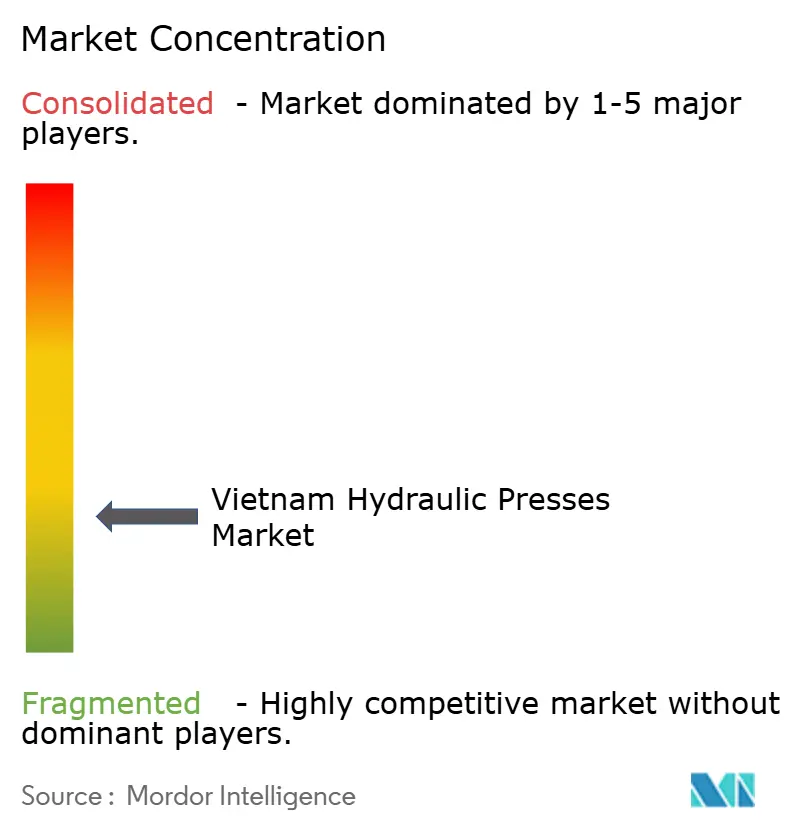
| Market Concentration | Low |
Major Players *Disclaimer: Major Players sorted in no particular order Image © Mordor Intelligence. Reuse requires attribution under CC BY 4.0. | |
Vietnam Hydraulic Presses Market Analysis by Mordor Intelligence
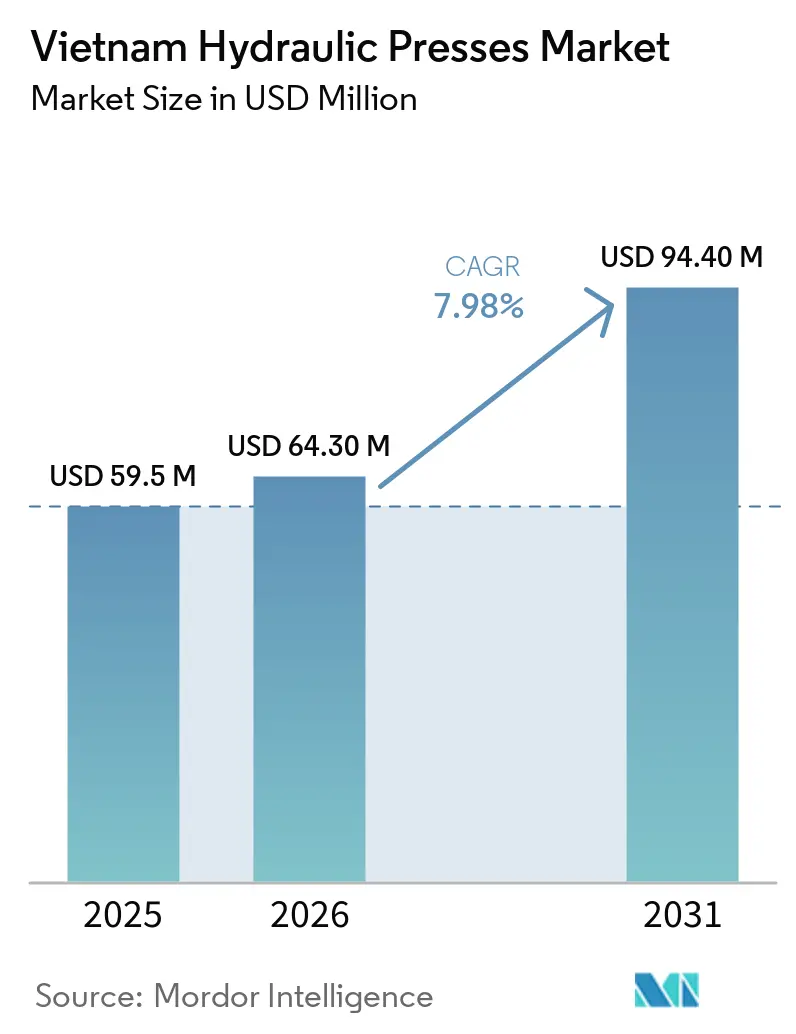
The Vietnam Hydraulic Presses Market size is expected to increase from USD 59.5 million in 2025 to USD 64.30 million in 2026 and reach USD 94.40 million by 2031, growing at a CAGR of 7.98% over 2026-2031.
Manufacturing output remained a central demand base, as Vietnam’s manufacturing and processing sector grew 10.5% in 2025 and the Index of Industrial Production increased 9.2%, compared with 8.2% in 2024. Rising factory investments and capacity additions are supporting demand for metal-forming equipment across automotive, electronics, machinery, and industrial components. The Vietnam hydraulic presses market is moving beyond project-based purchases as automotive, electronics, and heavy fabrication plants add forming capacity. Demand is also shifting toward higher-tonnage, digitally controlled, and energy-efficient presses that can support repeatable production and tighter quality requirements. Localized EV components and more precise electronics parts are increasing the requirements for reliable presses, controls, and supporting tooling. As manufacturers expand localized production, equipment suppliers are increasingly expected to provide application engineering, automation integration, spare parts, and after-sales support alongside the press itself. Suppliers that combine equipment support with commissioning, maintenance, and access to financing can address gaps that equipment specifications alone do not resolve.
Key Report Takeaways
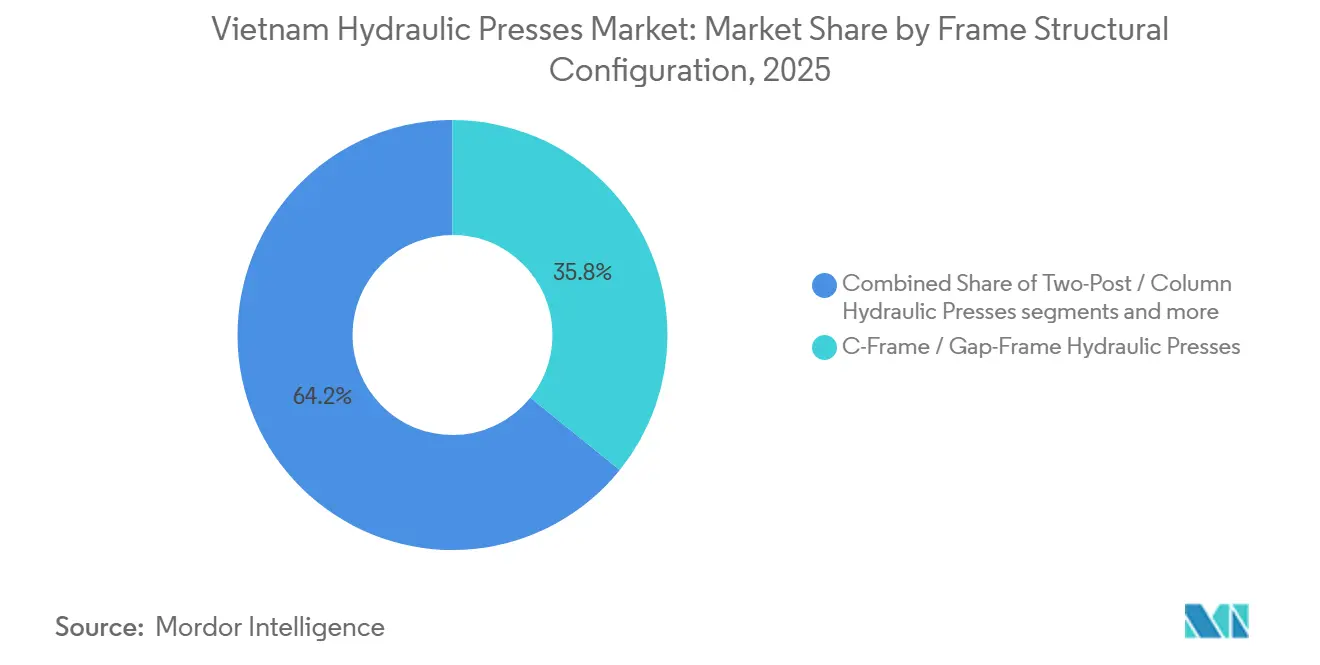
- By frame and structural configuration, C-frame and gap-frame hydraulic presses held 35.8% of the Vietnam hydraulic presses market size in 2025, while H-Frame, straight-side, and gib-guided hydraulic presses are forecast to expand at a 10.1% CAGR through 2031.
- By tonnage and press force, 101–500-ton presses held 38% of the Vietnam hydraulic presses market share in 2025, while presses above 2,000 tons are forecast to grow at a 10.4% CAGR through 2031.
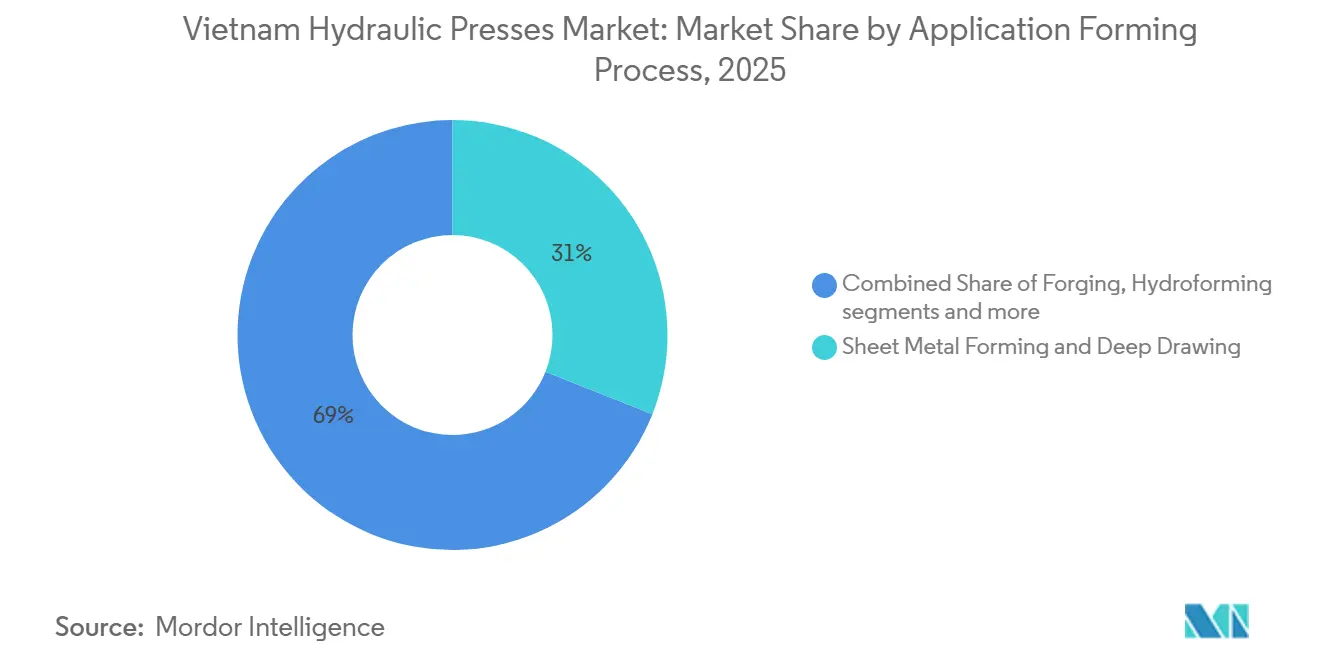
- By application and forming process, sheet metal forming and deep drawing held 31% of revenue in 2025, while compression molding is forecast to grow at a 10.8% CAGR through 2031.
- By end-use industry, automotive and transportation held 34% of revenue in 2025, while other specialized applications are forecast to expand at a 9.7% CAGR through 2031.
Note: Market size and forecast figures in this report are generated using Mordor Intelligence’s proprietary estimation framework, updated with the latest available data and insights as of January 2026.
Vietnam Hydraulic Presses Market Trends and Insights
Drivers Impact Analysis*
| Driver | (~) % Impact on CAGR Forecast | Geographic Relevance | Impact Timeline |
|---|---|---|---|
| Automotive and EV Component Localization | +2.5% | National, concentrated in Phu Tho, Bac Ninh, Ha Tinh, and Ho Chi Minh City clusters. | Medium term (2-4 years) |
| Expansion of Automotive Body and Chassis Pressing Capacity | +2.0% | National, with early gains in Phu Tho, Chu Lai, and Binh Duong | Medium term (2-4 years) |
| Electronics, Electrical Equipment and Appliance Manufacturing Growth | +1.5% | The Northern corridor and the southern Ho Chi Minh City cluster | Short term (≤ 2 years) |
| Automation, Robotics and Connected Press Adoption | +1.0% | National, including export-oriented manufacturers | Long term (≥ 4 years) |
| Brownfield Replacement of Obsolete Presses and Controls | +0.7% | National, particularly Hanoi, Ho Chi Minh City, and Binh Duong, legacy parks | Medium term (2-4 years) |
| Regional Tooling, Die and Process-Validation Ecosystem Development | +0.5% | National, with early activity in Bac Ninh, Bac Giang, Hai Phong, and Chu Lai | Long term (≥ 4 years) |
| Source: Mordor Intelligence | |||
Automotive and EV Component Localization
Vietnam’s EV localization effort is a major source of new hydraulic press procurement in 2026. VinFast stated that its localization rate reached 60% by late 2025 and that it targets 80% in 2026 as VinES battery-cell output in Ha Tinh reaches full capacity. Higher local content requires suppliers to form battery casings and structural brackets within Vietnam rather than source finished components. That requirement supports purchases of presses below 2,000 tons across first-tier and second-tier supply networks. Decision 929/QĐ-TTg sets an automotive-component localization target of 22% to 30% by 2030, which increases the need for domestic forming lines among eligible suppliers. The Vietnam hydraulic presses market, therefore, benefits from a policy direction that extends beyond a single vehicle maker’s production cycle.
Expansion of Automotive Body and Chassis Pressing Capacity
Automotive investment is generating requirements for several machines across body and chassis production lines. Toyota Motor Vietnam received approval in August 2026 to raise registered investment above USD 373 million and add a stamping workshop for fenders, doors, hoods, and floor pans, with operations planned for 2029.[1]Phu Tho People’s Committee and Toyota Motor Vietnam, “Toyota to Invest USD 373 Million to Expand Vietnam Plant, Add Hybrid Vehicle Production,” The Investor, theinvestor.vn. Local stamping replaces imports of finished parts and creates related demand among body-panel suppliers. THACO Industries opened a USD 70 million manufacturing complex in Da Nang in February 2026 with automated production lines and a USD 60 million export target for 2026.[2]Hyundai Thanh Cong, “Over 10,000 Hyundai Vehicles Manufactured in Vietnam Will Be Exported in 2026,” Vietnam Government News, vietnam.vn. Hyundai Thanh Cong also targets exports of 15,280 vehicle units and component sets in 2026, including Creta shipments to Mexico. These projects give the Vietnam hydraulic presses market a longer order horizon than typical short equipment replacement cycles.
Electronics, Electrical Equipment, and Appliance Manufacturing Growth
Electronics manufacturing adds a second large source of demand for forming equipment. Electronics and component exports reached USD 107.75 billion in 2025, up 48.4% from the prior year, and represented 23% of national exports. Plants are adding more mechanically precise parts, including bus bars, terminal housings, heat-spreader plates, and battery-module enclosures. Those parts require hydraulic stamping capacity that was less common when many facilities focused on circuit-board assembly. This change supports higher-value purchases in the Vietnam hydraulic presses market, especially in northern foreign-invested clusters. Vietnam’s position among the world’s top 10 electronics exporters reinforces the need for deeper component production capabilities. The shift also spreads demand beyond automotive production schedules and widens the supplier base for press makers.
Automation, Robotics, and Connected Press Adoption
Connected equipment is becoming more relevant in plants linked to Japanese and South Korean supply chains. These facilities increasingly need force-displacement records and maintenance data for customer quality processes. ANDRITZ Schuler launched the HFA plus+ fineblanking press series in January 2026 with forces from 3,200 kN to 15,500 kN, speeds of up to 85 strokes per minute, a servo-controlled hydraulic pump drive, and integrated process monitoring. Such specifications place connected controls closer to a purchasing requirement in higher-value applications. Robot loading and automated die changes can also reduce handling constraints in multi-product plants. The Vietnam hydraulic presses market has room for suppliers that can install, validate, and maintain these systems locally. A domestic digital-twin program for small and medium-sized mechanical manufacturers also indicates growing interest in data-based production tools.
Restraints Impact Analysis*
| Restraint | (~) % Impact on CAGR Forecast | Geographic Relevance | Impact Timeline |
|---|---|---|---|
| High Capital Cost and Limited SME Financing | -1.5% | National, particularly legacy SME fabrication hubs in Hanoi, Ho Chi Minh City, and Binh Duong | Short term (≤ 2 years) |
| Competition from Mechanical, Electric and Alternative Forming Technologies | -1.0% | National, particularly the sub-500-ton precision-stamping segment | Medium term (2-4 years) |
| Shortage of Hydraulic, Controls and Commissioning Specialists | -0.7% | National, particularly northern foreign-invested industrial parks | Medium term (2-4 years) |
| Imported Components, Service Delays and Compliance Complexity | -0.5% | National, with the highest exposure in Hanoi, Ho Chi Minh City, and Hai Phong customs zones | Short term (≤ 2 years) |
| Source: Mordor Intelligence | |||
High Capital Cost and Limited SME Financing
Capital costs can delay hydraulic press purchases by small and medium-sized manufacturers. Access to formal credit remains uneven, which limits the ability of smaller fabricators to replace older equipment. This constraint is strongest in lower-tonnage purchases, where buyers often rely on internal cash flow. Existing public support mechanisms have not fully removed collateral and lending barriers for machinery-intensive firms. The Vietnam hydraulic presses market can therefore experience longer replacement cycles even when production demand improves. Financing partnerships and leasing arrangements could improve equipment access, but their availability remains an important condition for smaller buyers.
Competition from Mechanical, Electric, and Alternative Forming Technologies
Servo-electric and high-speed mechanical presses compete directly with hydraulic systems in precision stamping below 500 tons. AIDA Engineering reported projected press-order growth of 11.9% for fiscal year 2027, supported by renewed automotive demand for servo presses. Komatsu’s H2FM progressive servo press has a 630-ton capacity and uses a high-torque liquid-cooled servo motor. These alternatives appeal where energy use, oil handling, and maintenance requirements shape factory approval decisions. Hydraulic presses retain advantages in applications that need sustained force, deep drawing, compression molding, or larger-format workpieces. The Vietnam hydraulic presses market must therefore compete on application fit, productivity, service support, and process control rather than on purchase price alone.
*Our forecasts treat driver/restraint impacts as directional, not additive. The impact forecasts reflect baseline growth, mix effects, and variable interactions.
Segment Analysis
By Frame / Structural Configuration: C-Frame Presses Lead, While H-Frame Presses Grow Faster
C-Frame and gap-frame hydraulic presses held 35.8% of the Vietnam hydraulic presses market share in 2025. Their open three-sided construction supports sheet metal, stamping, bending, punching, and assembly work across electronics, appliances, automotive components, and general fabrication. The configuration can accommodate robotic material handlers without redesigning the entire press cell, supporting gradual automation in manufacturing facilities. This flexibility suits small and medium-sized shops that change dies often and produce multiple parts. It also supports electronics assembly lines that require accessible work areas and frequent setup changes. Demand is further supported by Vietnam’s expanding manufacturing base, where suppliers increasingly require compact presses that can be integrated with CNC equipment, automated feeding systems, and in-line inspection.
H-Frame, straight-side, and gib-guided hydraulic presses are forecast to grow at a 10.1% CAGR through 2031. Their ram parallelism is valuable where uneven loads and tighter panel tolerances are present. These presses are increasingly suitable for automotive body components, structural parts, heavy sheet-metal forming, and industrial fabrication, where higher rigidity and repeatability are required. Four-post presses serve deep drawing and composite molding applications that require force across large platens. Their ability to distribute pressure more uniformly also supports applications involving larger workpieces and multi-stage forming operations. Two-post and benchtop systems address smaller applications in electronics assembly, maintenance operations, and prototype work. Compliance with TCVN 11310:2015 is encouraging standardized configurations with traceable safety documentation in OEM-linked plants. As Vietnamese manufacturers increase automation and move toward higher-value production, press selection is increasingly influenced by programmable controls, servo-hydraulic systems, energy efficiency, safety interlocks, and compatibility with automated loading and unloading equipment.



By Tonnage / Press Force: Mid-Range Presses Lead Revenue, While High-Tonnage Equipment Grows Faster
The 101–500-ton category held 38% of revenue in 2025. It serves automotive Tier-2 suppliers, electronics housing producers, and appliance-frame fabricators. This tonnage range fits the investment capacity of many mid-sized, foreign-invested suppliers and aligns with common requirements for brackets, housings, panels, frames, and formed sheet components. It also supports progressive stamping, bending, punching, and forming operations where moderate force and frequent die changes are required. Demand is reinforced by Vietnam’s growing electronics, automotive-component, electrical equipment, and appliance manufacturing base. Suppliers increasingly seek presses that can integrate with automated feeding, robotic handling, programmable controls, and in-line inspection systems. As a result, the Vietnam hydraulic presses industry has a wide and stable base of mid-range equipment demand.
Presses above 2,000 tons are forecast to grow at a 10.4% CAGR through 2031. Demand comes from commercial-vehicle chassis, structural battery enclosures, forging, and rail manufacturing. That facility introduces a new source of higher-force press requirements. Large-capacity presses are also suited to oversized structural parts, heavy-duty forming, and applications requiring high bed rigidity and consistent force distribution. The 501–1,000-ton and 1,001–2,000-ton ranges continue to support truck bodies, agricultural equipment, construction machinery, and heavier sheet-metal fabrication. Across these tonnage bands, buyers are increasingly prioritizing automation compatibility, cycle-time efficiency, pressure control, operator safety, and energy consumption alongside rated pressing capacity.
By Application / Forming Process: Sheet Metal Forming Leads, While Compression Molding Grows Faster
Sheet metal forming and deep drawing held 31% of the Vietnam hydraulic presses market size in 2025. Automotive body panels, electronics enclosures, appliance components, and structural brackets support the largest production volumes. The process is widely used for repeat parts that require predictable output, dimensional consistency, and established tooling. Local production gives suppliers greater reason to add capacity near assembly facilities, reducing material movement and supporting shorter production cycles. The growing localization of automotive and electronics component manufacturing is also creating demand for presses that can handle higher production volumes and integrate with automated blank feeding and robotic part handling. Deep drawing remains important for door skins, hoods, fender shells, tanks, and similar formed parts. Presses used in these applications increasingly require controlled ram movement and programmable pressure profiles to maintain surface quality and minimize defects during repeated forming cycles.
Compression molding is forecast to grow at a 10.8% CAGR through 2031. Battery-module enclosures and composite EV components are increasing the need for this process. Vingroup’s USD 810 million EV-parts industrial hub in Ha Tinh was approved in September 2025 and is planned for completion in June 2027. The hub is expected to support battery-insulation and structural-composite production. This expansion could increase requirements for high-force presses capable of processing fiber-reinforced composites and larger molded components, particularly as EV manufacturers localize more component production. Hydroforming and powder compaction remain specialized applications for aerospace, defense, automotive, and advanced-materials customers, with smaller volumes but higher equipment value per machine. These applications place greater emphasis on pressure accuracy, process repeatability, tooling compatibility, and specialized controls, allowing equipment suppliers to serve higher-value production niches beyond conventional sheet-metal forming.
By End-Use Industry: Automotive Leads Revenue, While Other Specialized Applications Grows Faster
Automotive and transportation held 34% of the Vietnam hydraulic presses market share in 2025. Toyota, Hyundai Thanh Cong, and THACO are creating direct investment demand and related orders across supplier networks. OEM-linked facilities favor equipment with recognized documentation, process controls, and consistent operating performance. IATF 16949 requirements support demand for certified systems, including Japanese and German equipment. Tier-1 and Tier-2 suppliers are also expanding capabilities for body panels, chassis components, brackets, structural parts, and battery-related components, increasing requirements for automated feeding, precise force control, and repeatable cycle performance. Automotive remains the clearest route to larger press installations and more complex forming lines. The shift toward EVs is further broadening equipment requirements as suppliers add capacity for battery trays, motor housings, structural components, and lightweight formed parts.
Other specialized applications are forecast to grow at a 9.7% CAGR through 2031. These applications include higher-value requirements with strict technical documentation, process traceability, and application-specific tooling. Electrical and electronics remain a large demand area for connectors, housings, terminals, precision brackets, and battery-related components. These manufacturers generally favor compact, high-repeatability presses that can be integrated into automated production cells and support frequent product changeovers. Rail and marine applications are also emerging as manufacturers add structural and body-panel capacity. Demand from construction equipment, agricultural machinery, and industrial components provides an additional customer base for medium- and high-tonnage systems. Together, these end uses broaden the Vietnam hydraulic presses industry beyond its traditional automotive base and create demand across both standardized and application-specific press configurations.
Geography Analysis
The Hanoi, Phu Tho, Vinh Phuc, Bac Ninh, Bac Giang, Hai Phong, and Thai Nguyen corridor combines automotive plants with major electronics clusters. Toyota’s approved expansion includes local stamping capacity for fenders, doors, hoods, and floor pans beginning in 2029. Samsung, Foxconn, and LG investments also support demand for mid-tonnage presses used in connectors, heat spreaders, and housings. The region’s dense supply networks favor internationally certified models with strong quality and documentation support, even as domestic alternatives improve.
Southern Vietnam is the second-largest regional demand pool in 2026. Ho Chi Minh City, Binh Duong, and Dong Nai contain many SME fabricators, appliance producers, and composite suppliers. Their production mix supports smaller C-Frame and benchtop presses for high-mix, lower-volume work. Much of the installed base dates to the 2005–2015 expansion cycle and is approaching the end of its life. THACO’s March 2026 groundbreaking for a 320-hectare railway and multipurpose mechanical complex in Ho Chi Minh City also points to heavier capacity needs. Both routine replacement demand and new industrial investment therefore support the Vietnam hydraulic presses market share in the south.
Central Vietnam is the fastest-growing regional cluster through 2031. Da Nang, Quang Nam, Chu Lai, and the Ha Tinh Economic Zone are gaining importance through automotive and EV component projects. THACO’s Da Nang complex opened with automated lines in February 2026. Vingroup’s Ha Tinh hub is expected to attract battery-casing and structural-bracket suppliers. Kim Long Motor also targeted 80% battery localization by the second quarter of 2026 through its arrangement with LG Energy Solution. These projects establish new press-intensive production activity in a region with less mature installed infrastructure.
Competitive Landscape
The Vietnam hydraulic presses market exhibits a low level of market concentration. Domestic manufacturers include THACO Industries, An Hung Mechanical and Equipment, Vietsteel Machinery, AUTOMECH, and CUNMAC. They compete mainly through price, local service, and delivery times for lower-tonnage applications. Japanese and European suppliers focus on automotive and electronics buyers that require performance certification and detailed process records. Chinese manufacturers are expanding service presence and improving quality credentials in the mid-range segment, adding pressure on suppliers that depend on a brand premium without comparable local support.
Technology and service capability are becoming key competitive factors. ANDRITZ Schuler’s HFA plus+ series uses a servo-controlled hydraulic pump drive and integrated monitoring, illustrating a response to energy and data requirements. SMS group reported that its hydraulic compact drive reduced average energy consumption by 50% and peak power demand by 60% on a 12.5 MN forging press commissioned at Nakamura Iron Works in January 2026.[3]SMS group, “Nakamura Signs FAC for Open-Die Forging Press From SMS Group,” Association for Iron and Steel Technology, aist.org. Beckwood Press expanded manufacturing capacity by 40% in 2025 and received an order for a 1,500-ton four-post press for a shipbuilder. These actions show that large-press suppliers are preparing for heavier equipment applications and higher efficiency expectations.
THACO Industries completed more than 15 conveyor-structure projects for European manufacturers totaling nearly 200 tonnes in the first half of 2026. This work indicates a stronger domestic manufacturing capability for export-oriented projects. Suppliers can differentiate by offering commissioning, maintenance, spare parts support, and help with financing arrangements. Those services are particularly relevant where SME buyers cannot readily fund new equipment. Rules for used machinery in high-tech applications also favor suppliers with established compliance documentation. No combined market share for leading suppliers was provided, which is consistent with a fragmented competitive structure.
Vietnam Hydraulic Presses Industry Leaders
THACO INDUSTRIES
Vietsteel Machinery Co., Ltd.
CUNMAC Company Limited
Schuler AG
Komatsu Ltd.
- *Disclaimer: Major Players sorted in no particular order

Recent Industry Developments
- September 2026: THACO INDUSTRIES completed over 15 OEM conveyor-structure projects for European manufacturers totaling nearly 200 tonnes in H1 2026, demonstrating large-scale press-dependent manufacturing capability at international standards and opening pathways for further OEM export contracts.
- August 2026: The Phu Tho People’s Committee approved Toyota Motor Vietnam’s amended investment, raising total capital above USD 373 million, including USD 283.7 million for a stamping workshop and paint shop. The stamping facility will press fenders, doors, hoods, and floor pans locally, with construction beginning in May 2027 and operations targeted for 2029.
- May 2026: Vietnam’s Prime Minister signed Decision 929/QĐ-TTg, mandating 22% to 30% automotive component localization by 2030. This directive creates hydraulic press procurement requirements for Tier-2 suppliers that need domestic forming capacity.
- February 2026: THACO Industries inaugurated a USD 70 million three-factory manufacturing complex in Da Nang with fully automated production lines and smart-factory integration. The company targets USD 60 million in export revenue for 2026 and USD 100 million for 2027.


Vietnam Hydraulic Presses Market Report Scope
The Vietnam Hydraulic Presses Market Report is Segmented by Frame / Structural Configuration (C-Frame / Gap-Frame Hydraulic Presses, H-Frame / Straight-Side, and More), by Tonnage / Press Force (Up To 100 Tons, 101–500 Tons, and More), by Application (Forging, Hydroforming, and More), by End-Use Industry (Automotive and Transportation, Electrical and Electronics, and More). The Market Forecasts are Provided in Terms of Value (USD).
| C-Frame / Gap-Frame Hydraulic Presses |
| H-Frame / Straight-Side / Gib-Guided Hydraulic Presses |
| Four-Post / Four-Column Hydraulic Presses |
| Two-Post / Column Hydraulic Presses |
| Benchtop / Workshop Hydraulic Presses |
| Other Specialized Hydraulic Press Configurations |
| Up to 100 Tons |
| 101–500 Tons |
| 501–1,000 Tons |
| 1,001–2,000 Tons |
| Above 2,000 Tons |
| Sheet Metal Forming and Deep Drawing |
| Forging |
| Bending and Straightening |
| Punching, Blanking and Coining |
| Compression Molding |
| Powder Compaction |
| Hydroforming |
| Assembly, Press-Fitting and General Pressing |
| Other Specialized Applications |
| Automotive and Transportation |
| Aerospace and Defense |
| Industrial Machinery and General Manufacturing |
| Electrical and Electronics |
| Plastics, Rubber and Composites |
| Construction and Heavy Equipment |
| Energy and Power Equipment |
| Rail and Marine |
| Powder Metallurgy, Ceramics and Advanced Materials |
| Other End-Use Industries |
| By Frame / Structural Configuration | C-Frame / Gap-Frame Hydraulic Presses |
| H-Frame / Straight-Side / Gib-Guided Hydraulic Presses | |
| Four-Post / Four-Column Hydraulic Presses | |
| Two-Post / Column Hydraulic Presses | |
| Benchtop / Workshop Hydraulic Presses | |
| Other Specialized Hydraulic Press Configurations | |
| By Tonnage / Press Force | Up to 100 Tons |
| 101–500 Tons | |
| 501–1,000 Tons | |
| 1,001–2,000 Tons | |
| Above 2,000 Tons | |
| By Application / Forming Process | Sheet Metal Forming and Deep Drawing |
| Forging | |
| Bending and Straightening | |
| Punching, Blanking and Coining | |
| Compression Molding | |
| Powder Compaction | |
| Hydroforming | |
| Assembly, Press-Fitting and General Pressing | |
| Other Specialized Applications | |
| By End-Use Industry | Automotive and Transportation |
| Aerospace and Defense | |
| Industrial Machinery and General Manufacturing | |
| Electrical and Electronics | |
| Plastics, Rubber and Composites | |
| Construction and Heavy Equipment | |
| Energy and Power Equipment | |
| Rail and Marine | |
| Powder Metallurgy, Ceramics and Advanced Materials | |
| Other End-Use Industries |


Key Questions Answered in the Report
What is the projected value of Vietnam's hydraulic presses in 2031?
The Vietnam hydraulic presses market size is projected to reach USD 94.4 million by 2031, from USD 64.2 million in 2026.
What is driving demand for hydraulic presses in Vietnam?
Automotive localization, EV components, electronics manufacturing, and new body and chassis capacity are key demand factors.
Which press frame is most widely used in Vietnam?
C-Frame presses held the largest installed base in 2025 because they support diverse fabrication and assembly work.
Which tonnage range has the largest revenue base?
The 101–500-ton range held the broadest revenue base in 2025 across automotive, electronics, and appliance fabrication.
Which applications are expanding fastest?
Compression molding is the fastest-growing application because EV battery enclosures and composite components require this process.
Which Vietnamese region is growing fastest for press demand?
Central Vietnam is the fastest-growing cluster, supported by projects in Da Nang, Chu Lai, and the Ha Tinh Economic Zone.
Page last updated on:





