
Vietnam Construction Equipment Market Size and Share
Market Overview
| Study Period | 2020 - 2032 |
|---|---|
| Forecast Data Period | 2027 - 2032 |
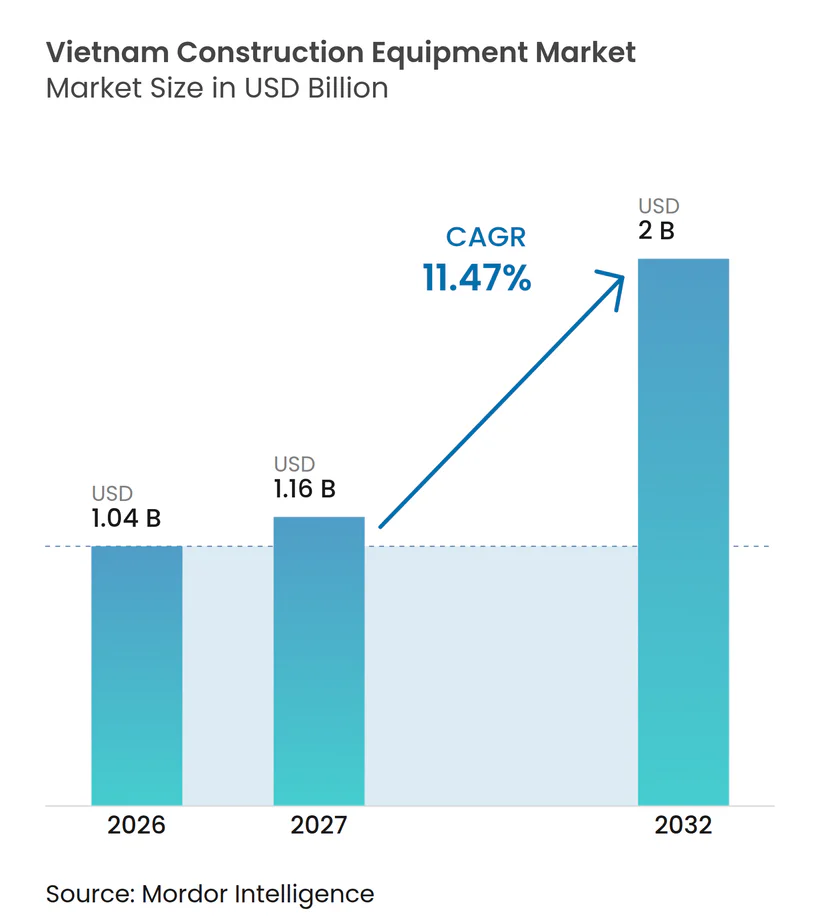
| Base Year Market Size (2026) | USD 1.04 Billion |
| Market Size (2027) | USD 1.16 Billion |
| Market Size (2032) | USD 2 Billion |
| Growth Rate (2027 - 2032) | 11.47 % |
| Market Concentration | Medium |
Major Players *Disclaimer: Major Players sorted in no particular order Image © Mordor Intelligence. Reuse requires attribution under CC BY 4.0. | |
Vietnam Construction Equipment Market Analysis by Mordor Intelligence
The Vietnam construction equipment market size was valued at USD 1.04 billion in 2026 and is expected to grow from USD 1.16 billion in 2027 to USD 2.00 billion by 2032, at a CAGR of 11.47% during 2027-2032. Public transport and urban infrastructure programs support demand for machines used in earthworks, roads, foundations, and materials handling. Manufacturing investment is also extending construction activity beyond established industrial centers into newer provincial locations. Contractors must balance equipment availability against delayed public disbursement, imported-equipment costs, and shortages of qualified operators. These conditions can favor rental and fleet-sharing models when contractors need capacity without large upfront purchases. The Vietnam construction equipment market also gives suppliers an opening to pair machines with service, finance, and training support.
Key Report Takeaways
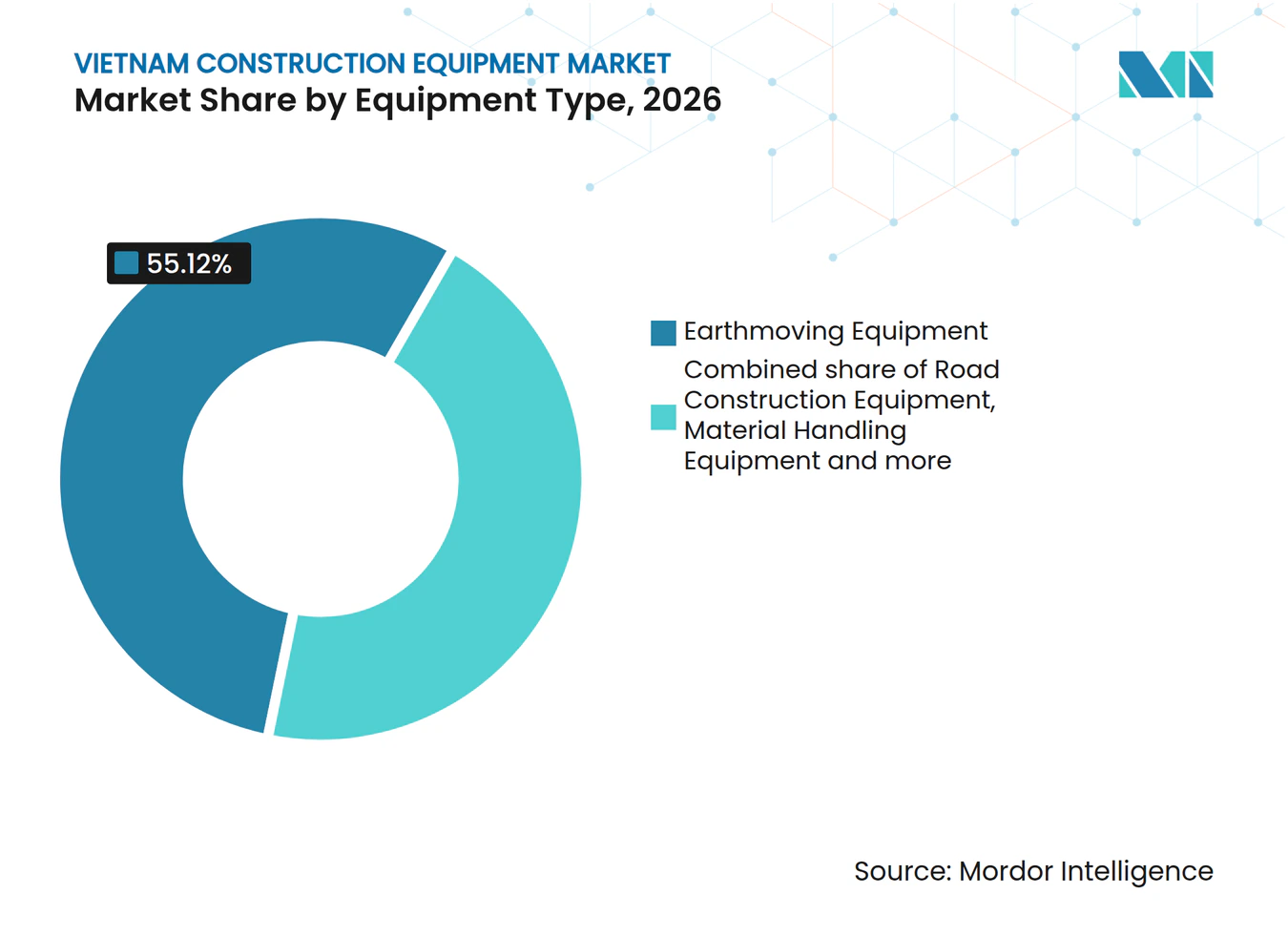
- By equipment type, earthmoving equipment held 55.12% revenue share in 2026 and is forecast to grow at an 11.43% CAGR through 2032.
- By propulsion type, conventional hydraulic/diesel equipment held 94.26% revenue share in 2026, while electric/hybrid equipment is forecast to grow at a 22.54% CAGR through 2032.
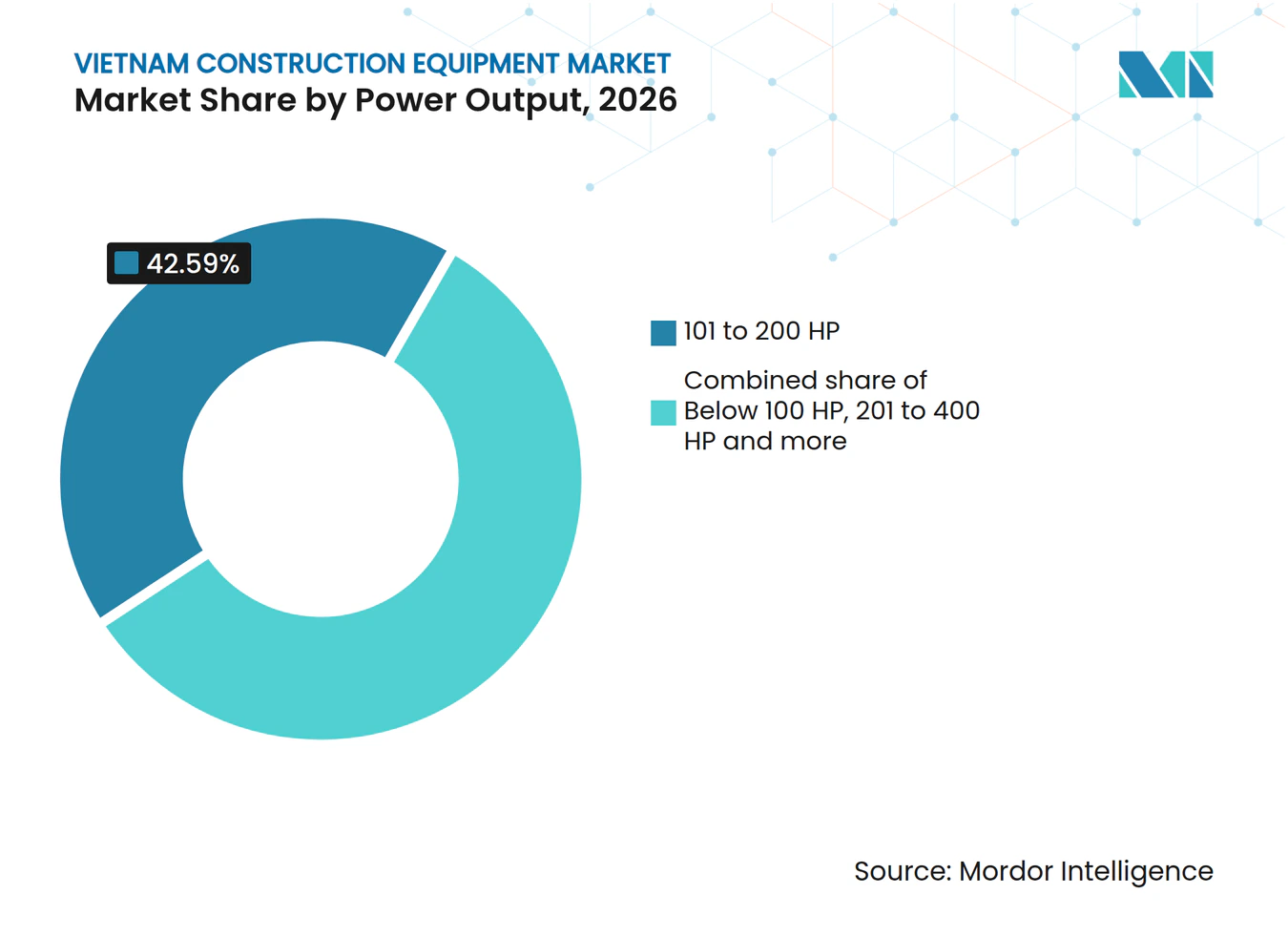
- By power output, the 101 to 200 HP segment held 42.59% revenue share in 2026, while below 100 HP equipment is forecast to grow at a 10.43% CAGR through 2032.
- By end-user industry, infrastructure held 44.31% revenue share in 2026, while industrial and manufacturing is forecast to grow at a 9.27% CAGR through 2032.
Note: Market numbers in this report are based on Mordor Intelligence's proprietary estimation framework, which combines nine months of actuals with Q4 projections for base year 2026.
Market Trends and Insights
Drivers Impact Analysis of Vietnam Construction Equipment Market*
| Driver | (~) % Impact on CAGR Forecast | Geographic Relevance | Impact Timeline |
|---|---|---|---|
| Public Infrastructure and Transport Investment | +2.2% | Hanoi, Ho Chi Minh City, Hai Phong, Ninh Binh, Quang Ngai, Binh Dinh | Short term (≤ 2 years) |
| Manufacturing FDI and Industrial-Park Expansion | +1.8% | Binh Duong, Bac Ninh, Dong Nai, Thai Nguyen, Hai Phong, Ha Nam | Medium term (2–4 years) |
| Urban Redevelopment and Housing Construction | +1.0% | Ho Chi Minh City, Hanoi, Da Nang, Can Tho | Medium term (2–4 years) |
| Mining, Quarrying, and Renewable-Energy Site Development | +0.8% | Quang Ninh, Nghe An, Ninh Thuan, Binh Thuan, Gia Lai, Kon Tum | Long term (≥ 4 years) |
| Contractor Preference for Compact, Multi-Application Equipment | +0.5% | Ho Chi Minh City, Hanoi, Da Nang, Hai Phong | Short term (≤ 2 years) |
| Equipment-as-a-Service and Digital Rental Adoption | +0.3% | Ho Chi Minh City, Hanoi, Binh Duong, Dong Nai | Medium term (2–4 years) |
| Source: Mordor Intelligence | |||
Public Infrastructure and Transport Investment
Public investment remains an important source of demand for the Vietnam construction equipment market. Major road, expressway, railway, port, and urban transport works require excavators, rollers, pavers, drilling machines, cranes, and concrete equipment. The national expressway program is expanding construction activity across multiple provincial corridors, limiting contractors' ability to move idle equipment between sites. This pattern can keep rental fleets active while project owners schedule work in stages. The transport agenda also gives distributors a reason to strengthen field service capacity near active construction corridors. The quality and safety requirements under Vietnam’s technical regulations favor suppliers that can demonstrate compliant equipment and dependable support.
Manufacturing FDI and Industrial-Park Expansion
Manufacturing investment is widening the construction base that supports the Vietnam construction equipment market. Industrial parks need site preparation, internal roads, drainage systems, factory foundations, warehouses, and utility connections before production starts. These requirements create demand for earthmoving, concrete, lifting, and materials-handling equipment. Established locations such as Binh Duong and Bac Ninh remain important, while Thai Nguyen, Ba Ria-Vung Tau, Tay Ninh, and Ha Nam add new activity. Kinh Bac’s Phu Binh Industrial Park in Thai Nguyen illustrates the extension of high-technology construction into a northern midland location[1]. Equipment demand can follow project announcements as developers move from land preparation to construction packages.
Urban Redevelopment and Housing Construction
Urban redevelopment supports a different mix of equipment than large greenfield transport projects. Dense sites need compact excavators, aerial work platforms, concrete pumps, and machines that can operate within constrained access routes. Ho Chi Minh City and Hanoi remain the main centers for this work, while Da Nang and Can Tho provide additional urban demand. New real estate legislation has improved the setting for projects that had been delayed by legal and permitting uncertainty. Rail, drainage, metro, and ring-road projects also require specialized piling and drilling work. As a result, the Vietnam construction equipment market benefits from demand across both major civil works and smaller urban job sites.
Mining, Quarrying, and Renewable-Energy Site Development
Mining, quarrying, and renewable-energy sites create demand for specialized and durable equipment. Quarries require loaders, crushers, screening plants, and drilling equipment to prepare aggregates for public works and private construction. Renewable-energy projects require access roads, foundations, material movement, and supporting utility construction. The activity is spread across coal and quarrying areas, the Central Highlands, and wind and solar locations. Contractors can use flexible fleets across quarrying, energy, and transport projects when local work schedules overlap. This makes machine reliability, parts availability, and operator capability important purchase considerations in the Vietnam construction equipment market.
Restraints Impact Analysis of Vietnam Construction Equipment Market*
| Restraint | (~) % Impact on CAGR Forecast | Geographic Relevance | Impact Timeline |
|---|---|---|---|
| Imported-Equipment Cost Exposure and VND Depreciation | -1.2% | National, concentrated in Hanoi, Ho Chi Minh City, Hai Phong (major import entry points) | Short term (≤ 2 years) |
| Skilled-Operator Shortage and High Machine Utilization Risk | -0.7% | Hanoi, Ho Chi Minh City, Da Nang, and expressway construction corridors in Nghe An, Thanh Hoa | Medium term (2–4 years) |
| Fragmented Public-Project Disbursement and Delayed Procurement | -0.5% | National, highest impact in Hanoi and northern provinces with central-government project concentration | Short term (≤ 2 years) |
| Limited Charging, Service, and Residual-Value Infrastructure for Electric Equipment | -0.3% | Ho Chi Minh City, Hanoi, Da Nang (urban centers with nascent charging coverage) | Long term (≥ 4 years) |
| Source: Mordor Intelligence | |||
Imported-Equipment Cost Exposure and VND Depreciation
Vietnam depends heavily on imported construction equipment from Japan, China, South Korea, and Europe. Currency movements can raise local-currency equipment costs when suppliers price machines in foreign currencies. This pressure is difficult for contractors that have fixed-price contracts and limited flexibility to revise project budgets. It can also shift interest toward suppliers offering local financing or payment arrangements. Chinese manufacturers can benefit where their pricing and financing packages improve the initial purchase case. The Vietnam construction equipment market therefore remains sensitive to import costs even when project pipelines remain active.
Skilled-Operator Shortage and High Machine Utilization Risk
A shortage of experienced operators can limit the productive use of equipment on active worksites. The issue is particularly important for excavation, piling, drilling, and compaction equipment that needs skilled handling. Construction employers reported stronger recruitment needs while applicant availability weakened during 2025[2]. Training needs and competition among concurrent projects can extend the shortage. An idle machine generates costs but does not contribute to project output. OEMs and distributors can address part of this constraint through operator training, technical assistance, and maintenance support.
*Our forecasts treat driver/restraint impacts as directional, not additive. The impact forecasts reflect baseline growth, mix effects, and variable interactions.
Vietnam Construction Equipment Market Segment Analysis
By Equipment Type:
Earthmoving Equipment Holds the Broadest Demand BaseEarthmoving equipment held 55.12% of the Vietnam construction equipment market share in 2026, and the segment is forecast to grow at an 11.43% CAGR through 2032. Its position reflects the constant need for excavation, grading, soil movement, and loading across public and private works. Excavators are used across highways, industrial parks, urban redevelopment, mining, and utility projects. Small and medium machines are relevant where access is limited or site conditions change frequently. Larger machines remain useful for road construction, mining, and major earthworks. The category benefits from its ability to serve many different job types rather than one narrow application.
Road construction equipment follows the timing of public spending and contractor mobilization. Pavers, rollers, finishers, and cold planers are most exposed to the pace of transport works. Material-handling equipment serves factories, warehouses, ports, and logistics construction, where lifting and placement tasks are important. Concrete equipment supports building foundations, urban redevelopment, and large civil projects. Material processing and crushing equipment are linked to the need for aggregates at transport and infrastructure sites. Suppliers that offer dependable parts, field support, and a broad equipment range can serve these related needs more effectively.



By Propulsion Type:
Conventional Equipment Remains the Operating StandardConventional hydraulic/diesel equipment held 94.26% of equipment demand in 2026, while electric/hybrid equipment is forecast to grow at a 22.54% CAGR through 2032. Diesel machines remain widely used because they are familiar to operators and can work where charging access is limited. Existing service networks also make routine maintenance easier for conventional fleets. Contractors working on remote transport, quarrying, and mining sites may continue to prioritize equipment with established fuel and service arrangements. This preserves a large role for conventional machines during the forecast period. Electric and hybrid equipment starts from a smaller base but has strong potential in more controlled operations.
Early electric adoption is most practical in captive fleets at industrial, quarrying, cement, and port sites. These users can manage charging, maintenance, and machine utilization within defined operating areas. LiuGong and Xuan Thien Group handed over Vietnam's first batch of fully electric construction machinery and vehicles in March 2026 for use at Xuan Thien industrial and cement projects [3]. The development shows that electric machines can move beyond product demonstrations when a fleet owner can provide the supporting conditions. Wider adoption still depends on charging access, after-sales support, and confidence in residual values. This leaves hybrid machines relevant for users seeking lower fuel use without full dependence on charging.
By Power Output:
Mid-Range Equipment Supports Core Construction WorkThe 101 to 200 HP range held 42.59% of equipment demand in 2026, while equipment with below 100 HP is forecast to grow at a 10.43% CAGR through 2032. Mid-range machines can support road work, industrial-site preparation, and general construction without the cost or operating demands of very large equipment. This range includes equipment suitable for common excavating and loading tasks. Contractors can deploy these machines across different projects as workloads shift. That flexibility supports the role of the 101 to 200 HP range in the Vietnam construction equipment industry. It also helps distributors maintain demand across a wide contractor base.
Below 100 HP equipment benefits from urban construction and works in more confined industrial locations. Compact excavators, mini-loaders, and smaller electric-drive machines can be easier to move and operate in restricted areas. The range is relevant for factory interiors, drainage work, local roads, municipal construction, and smaller development sites. Equipment in the 201 to 400 HP range serves demanding expressway and mining activities where durability and uptime are essential. Machines above 400 HP remain focused on the largest rail, port, dam, and heavy civil applications. This creates a power-output mix that changes with project scale and site access.

By End-User Industry:
Infrastructure Provides the Largest Demand PlatformInfrastructure held 44.31% of equipment demand in 2026, while industrial and manufacturing is forecast to grow at a 9.27% CAGR through 2032. Expressways, ports, railway works, urban transport, and utility projects create a broad requirement for heavy equipment. These projects use earthmoving, road-building, lifting, drilling, crushing, and concrete machines through different phases. Work is distributed across several regions rather than centered on a single site. This can sustain equipment utilization when contractors have fleets assigned to multiple projects. Infrastructure, therefore, remains the primary driver of demand in the Vietnam construction equipment market.
Industrial and manufacturing construction is increasing the demand for equipment around factories, industrial parks, logistics buildings, and support utilities. Residential and commercial projects are also returning as legal changes help revive delayed private developments. Mining and quarrying use specialized machines in Quang Ninh and the Central Highlands. Oil, gas, pipeline, utility, and power projects require drilling, lifting, and heavy material-handling equipment for defined applications. Caterpillar has continued to build relationships with mining users in Vietnam, reflecting the value of direct support for specialized equipment fleets. The combined end-user mix reduces reliance on any one construction category, even though public infrastructure remains central.
Geography Analysis
Southern Vietnam, centered on Ho Chi Minh City, forms the largest construction demand concentration in the country. The wider southern corridor combines urban development, industrial parks, logistics facilities, and port-related construction. The 2025 administrative changes that incorporated former Binh Duong and Ba Ria-Vung Tau areas strengthened the connection between these activity centers. Major infrastructure works in Ho Chi Minh City include the ring road, the metro, and the drainage projects. Industrial construction in the south also creates demand for site preparation, concrete, lifting, and warehouse-related equipment. Contractors in this area often value access to rental equipment because several projects can proceed simultaneously.
Northern Vietnam is anchored by Hanoi and manufacturing locations including Bac Ninh, Thai Nguyen, and Hai Phong. The regional construction base includes expressways, rail corridors, industrial parks, logistics facilities, and port-connected development. Hai Phong’s economic zone activity supports construction connected with manufacturing and trade infrastructure. Hanoi and the surrounding provinces also face strong demand for skilled operators and equipment across concurrent public projects. The northern region needs both heavy civil equipment and machines suitable for factory and logistics construction. Its position in the Vietnam construction equipment market is supported by the link between transport investment and manufacturing expansion.
Central Vietnam and the rest of the country have a more varied equipment profile. Da Nang and the former Quang Nam area are connected to port, tourism, urban, and logistics development along the East-West Economic Corridor. Energy logistics, coastal construction, and local infrastructure can require cranes, piling equipment, road machines, and concrete equipment. The Mekong Delta contributes demand from transport, irrigation, bridge, and dredging work. The Central Highlands and renewable-energy locations add mining, quarrying, access-road, and foundation requirements. This geographic spread supports suppliers that can adapt equipment, parts, and service coverage to different job conditions.
Competitive Landscape
Market Concentration
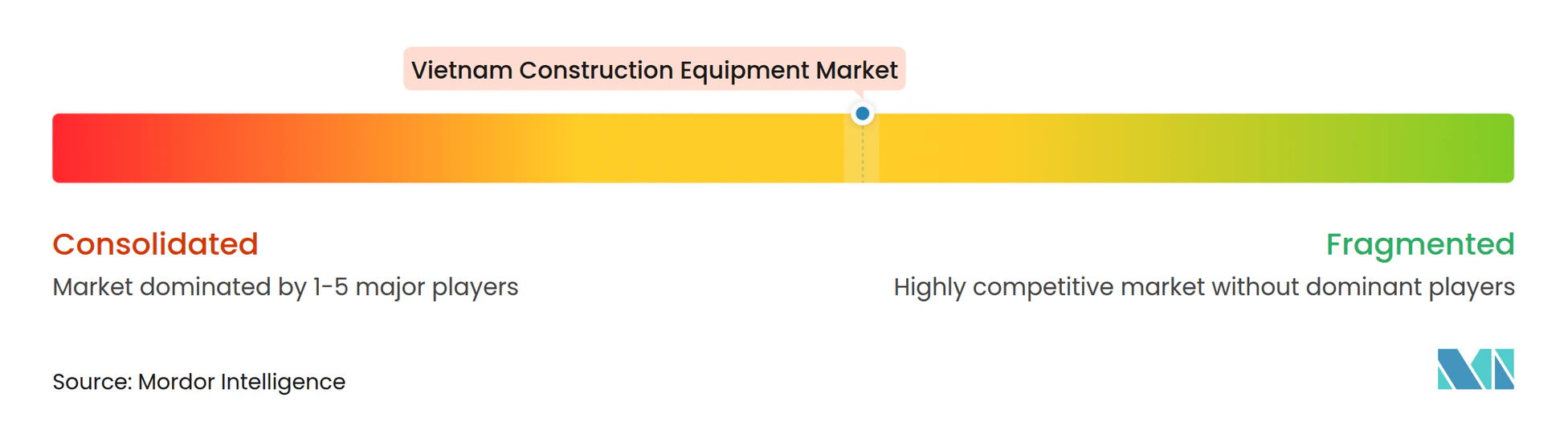
The Vietnam construction equipment market is moderately concentrated. Komatsu, XCMG, DEVELON, SANY, and Caterpillar are leading participants, but no group has closed off the market to local distributors or specialist suppliers. Japanese brands retain their value through established dealer networks, durable equipment, and familiar service practices. Chinese manufacturers are gaining attention through competitive pricing, localized support, and a growing selection of electric and hybrid machines. Korean suppliers also have a presence that benefits from regional manufacturing links and experience with infrastructure projects. The competitive environment gives contractors multiple choices across price points and applications.
XCMG has expanded its local approach by offering product configurations tailored to Vietnamese worksites. Its growing range of electric loaders and excavators reflects a focus on green equipment for local operating conditions. SANY has pursued distribution arrangements and customer service coverage for its electric vehicle and equipment operations. LiuGong has partnered with a local industrial group to deploy electric construction equipment in a defined operating environment. These moves show that competition extends beyond selling individual machines. Suppliers are also competing on service response, local partnerships, financing, and the ability to support new propulsion technologies.
Open areas remain in equipment rental, digital fleet management, charging support, and technical training. A rental operator with reliable maintenance and fleet visibility can help smaller contractors avoid the cost of outright ownership. Electric-equipment suppliers need charging, repair, and parts capability before they can serve a wider range of customers. Strong after-sales support remains important for conventional equipment as well, especially in provincial project locations. Manufacturers that can tailor machines to humid conditions, varied terrain, and urban access limits may improve their local position. These factors keep competition active across the Vietnam construction equipment industry rather than reducing it to price alone.
Vietnam Construction Equipment Industry Leaders
-
Caterpillar Inc.
-
SANY Group
-
DEVELON
-
Xuzhou Construction Machinery Group Co., Ltd. (XCMG)
-
Komatsu Ltd.
- *Disclaimer: Major Players sorted in no particular order
Vietnam Construction Equipment Market Companies Covered in this Report
- Caterpillar Inc.
- Komatsu Ltd.
- Hitachi Construction Machinery Co., Ltd.
- SANY Group
- Xuzhou Construction Machinery Group Co., Ltd. (XCMG)
- Volvo Construction Equipment
- DEVELON
- JCB
- Kobelco Construction Machinery Co., Ltd.
- Liebherr Group
- Zoomlion Heavy Industry Science and Technology Co., Ltd.
- LiuGong Machinery Co., Ltd.
- Shantui Construction Machinery Co., Ltd.
- CNH Industrial N.V.
- Sumitomo Construction Machinery Co., Ltd.
- Tadano Ltd.
- Terex Corporation
- Yanmar Holdings Co., Ltd.
- Takeuchi Manufacturing Co., Ltd.
- Manitou Group
Recent Industry Developments in Vietnam Construction Equipment Market
- July 2026: Shandong Heavy Industry Group showcased electric commercial vehicles, hydrogen fuel-cell trucks, and AI-powered construction machinery at its Global Partners Conference and Green Intelligent Products Exhibition in Hanoi.
- March 2026: Xuan Thien Group and LiuGong handed over the first batch of fully electric construction machinery and vehicles in Vietnam for use at Xuan Thien industrial and cement projects.
- January 2026: Wirtgen Group appointed Binh Minh Investment Equipment JSC as its authorized dealer in Vietnam for the Wirtgen, Vogele, Hamm, Kleemann, and Benninghoven brands.
- December 2025: Kinh Bac City Development broke ground on the USD 437 million, 675-hectare Phu Binh Industrial Park in Thai Nguyen province.
Vietnam Construction Equipment Market Report Scope
The Vietnam construction equipment market is segmented by equipment type, propulsion type, power output, and end-user industry. By Equipment Type, the market is segmented into Earthmoving Equipment (Excavator, Backhoe Loader, Wheeled Loader, Bulldozer, and Motor Grader), Road Construction Equipment (Asphalt Paver and Finishers, Cold Planers and Milling Machines, and Compaction Roller), Material Handling Equipment (Mobile Cranes, Forklift and Telehandler, and Aerial Work Platforms), Concrete Equipment (Transit Mixer, Concrete Pump, and Batching Plant), and Material Processing, Crushing, and Foundation Equipment (Jaw and Cone Crushers, Screening Plants, and Pile-Driving and Drilling Rigs). By Propulsion Type, the market is segmented into Conventional Hydraulic/Diesel and Electric/Hybrid. By Power Output, the market is segmented into Below 100 HP, 101 to 200 HP, 201 to 400 HP, and Above 400 HP. By End-User Industry, the market is segmented into Infrastructure, Residential and Commercial Construction, Mining and Quarrying, Oil and Gas/Pipelines, Industrial and Manufacturing, and Utilities and Power Generation. Market forecasts are provided in terms of Value (USD) and Volume (Units).
Segmentation Overview
| Earthmoving Equipment | Excavator |
| Backhoe Loader | |
| Wheeled Loader | |
| Bulldozer | |
| Motor Grader | |
| Road Construction Equipment | Asphalt Paver and Finishers |
| Cold Planers and Milling Machines | |
| Compaction Roller | |
| Material Handling Equipment | Mobile Cranes |
| Forklift and Telehandler | |
| Aerial Work Platforms | |
| Concrete Equipment | Transit Mixer |
| Concrete Pump | |
| Batching Plant | |
| Material Processing, Crushing, and Foundation Equipment | Jaw and Cone Crushers |
| Screening Plants | |
| Pile-Driving and Drilling Rigs |
| Conventional Hydraulic/Diesel |
| Electric/Hybrid |
| Below 100 HP |
| 101 to 200 HP |
| 201 to 400 HP |
| Above 400 HP |
| Infrastructure |
| Residential and Commercial Construction |
| Mining and Quarrying |
| Oil and Gas/Pipelines |
| Industrial and Manufacturing |
| Utilities and Power Generation |
| By Equipment Type | Earthmoving Equipment | Excavator |
| Backhoe Loader | ||
| Wheeled Loader | ||
| Bulldozer | ||
| Motor Grader | ||
| Road Construction Equipment | Asphalt Paver and Finishers | |
| Cold Planers and Milling Machines | ||
| Compaction Roller | ||
| Material Handling Equipment | Mobile Cranes | |
| Forklift and Telehandler | ||
| Aerial Work Platforms | ||
| Concrete Equipment | Transit Mixer | |
| Concrete Pump | ||
| Batching Plant | ||
| Material Processing, Crushing, and Foundation Equipment | Jaw and Cone Crushers | |
| Screening Plants | ||
| Pile-Driving and Drilling Rigs | ||
| By Propulsion Type | Conventional Hydraulic/Diesel | |
| Electric/Hybrid | ||
| By Power Output | Below 100 HP | |
| 101 to 200 HP | ||
| 201 to 400 HP | ||
| Above 400 HP | ||
| By End-User Industry | Infrastructure | |
| Residential and Commercial Construction | ||
| Mining and Quarrying | ||
| Oil and Gas/Pipelines | ||
| Industrial and Manufacturing | ||
| Utilities and Power Generation | ||
Key Questions Answered in the Report
What is the outlook for the Vietnam construction equipment market?
The Vietnam construction equipment market is expected to grow from USD 1.16 billion in 2027 to USD 2.00 billion by 2032, at an 11.47% CAGR. Public infrastructure, industrial parks, and urban work support this outlook, while project timing and operator availability remain important.
Which equipment type leads demand in Vietnam?
Earthmoving equipment led demand with a 55.12% share in 2026 and is expected to grow at an 11.43% CAGR through 2032. It is used across transport works, industrial sites, urban projects, utility construction, and mining activity.
Is electric construction equipment gaining traction in Vietnam?
Yes. Electric and hybrid equipment is forecast to grow at a 22.54% CAGR, supported by early fleet deployments at industrial and quarry sites. Broader use depends on charging access, service support, and equipment-value confidence.
Which end-user creates the greatest demand for construction machinery?
Infrastructure was the largest end-user in 2026 with a 44.31% share, supported by road, rail, port, and urban transport construction. These projects require equipment through excavation, foundation, material handling, road building, and finishing work.