
Vertical Strawberry Farming Market Size and Share
Market Overview
| Study Period | 2022 - 2032 |
|---|---|
| Market Size (2027) | USD 500 Million |
| Market Size (2032) | USD 860 Million |
| Growth Rate (2027 - 2032) | 11.46 % |
| Fastest Growing Market | Asia-Pacific |
| Largest Market | North America |
| Market Concentration | Low |
Major Players *Disclaimer: Major Players sorted in no particular order Image © Mordor Intelligence. Reuse requires attribution under CC BY 4.0. | |
Vertical Strawberry Farming Market Analysis by Mordor Intelligence
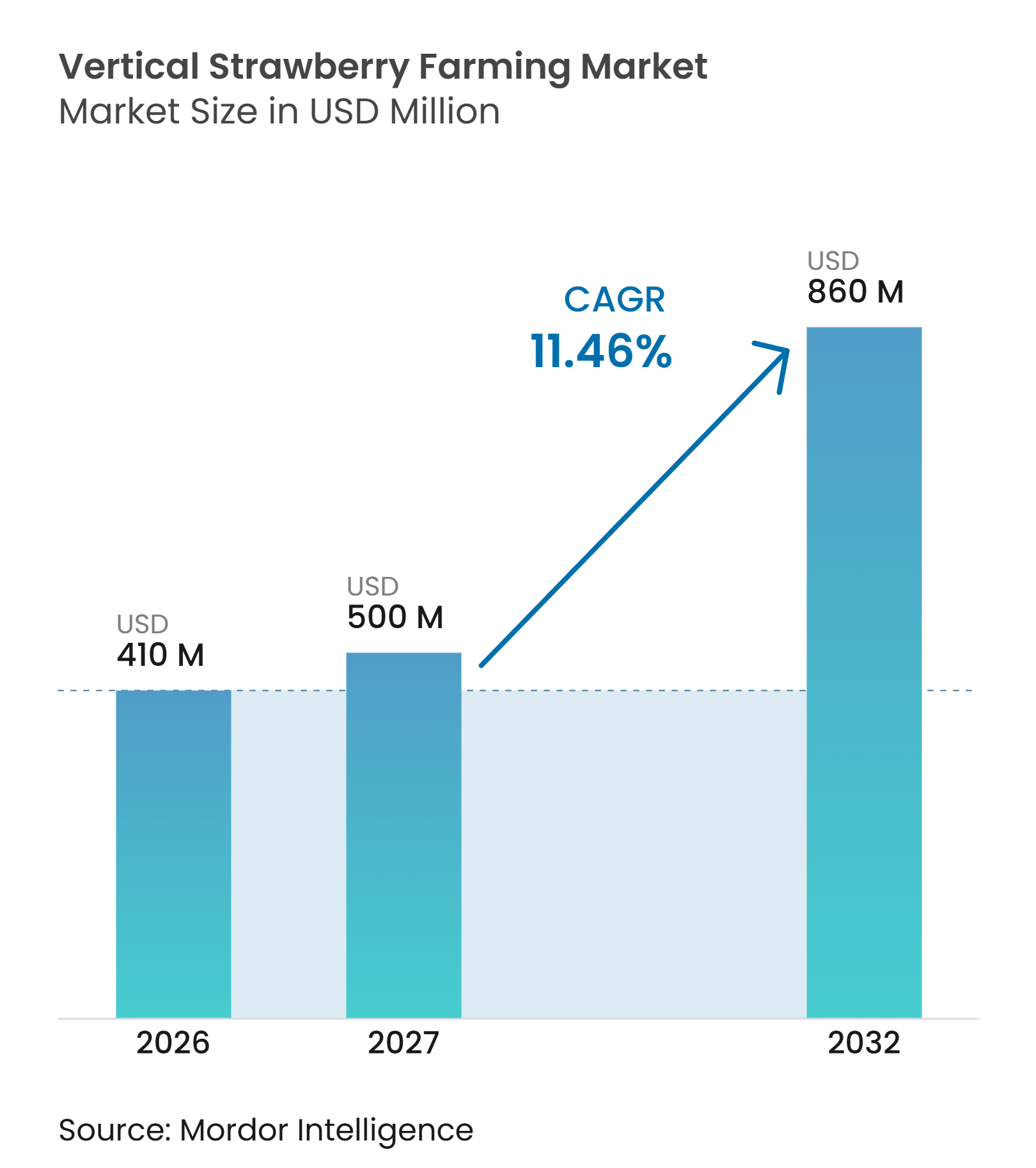
The vertical strawberry farming market size was valued at USD 410 million in 2026 and is forecast to grow from USD 500 million in 2027 to USD 860 million by 2032, at a CAGR of 11.46% during 2027 to 2032. The market serves premium food retail, food security programs, and controlled-environment production, giving it a distinct role from conventional berry supply. Growth depends on operators demonstrating that indoor production can meet premium retail demand while managing electricity use and facility costs. Public food-resilience policies in Japan, Singapore, the United Arab Emirates, and Canada are directing attention toward high-value fruiting crops rather than leafy greens. Dynamic-spectrum lighting, aeroponic irrigation, and crop-specific digital models are expanding technology options for new facilities. The market is growing through selective investment in proven operating models rather than rapid expansion without established unit economics.
Key Report Takeaways
- By growing mechanism, hydroponics accounted for 52% of the market share in 2026, while aeroponics is forecast to grow at a CAGR of 13.1% from 2027 to 2032.
- By farm structure, building-based vertical farms accounted for 68% of the market share in 2026, while shipping-container vertical farms are forecast to grow at a CAGR of 12.3% from 2027 to 2032.
- By distribution channel, supermarkets and hypermarkets accounted for 46% of the market share in 2026, while online retail is forecast to grow at a CAGR of 11.8% from 2027 to 2032.
- By geography, North America accounted for 38% of the market share in 2026, while Asia-Pacific is forecast to grow at a CAGR of 12.8% from 2027 to 2032.
Note: Market numbers in this report are based on Mordor Intelligence's proprietary estimation framework, which combines nine months of actuals with Q4 projections for base year 2026.
Market Trends and Insights
Drivers Impact Analysis of Vertical Strawberry Farming Market*
| Driver | (~) % Impact on CAGR Forecast | Geographic Relevance | Impact Timeline |
|---|---|---|---|
| Year-Round Availability of Premium Strawberries Near Consumption Centers | +3.5% | Global, with strongest pull in the United States, Canada, Japan, the United Kingdom, and the United Arab Emirates | Short term (≤ 2 years) |
| Retail Demand for Consistent Strawberry Quality and Traceability | +2.5% | North America and Europe, with spillover to Japan and South Korea | Medium term (2-4 years) |
| Investment in Local Strawberry Production and Food Resilience | +2% | Asia-Pacific, especially Singapore and Japan, the Middle East, and Canada | Medium term (2-4 years) |
| Declining Costs of LED Lighting, Automation, and Sensor Technologies | +1.5% | Global, with strongest hardware-cost reduction in the United States, Germany, Japan, and China | Long term (≥ 4 years) |
| Crop-Specific Genetics and Propagation Protocols for Controlled Environments | +1% | The United Kingdom, the United States, Japan, and the Netherlands | Long term (≥ 4 years) |
| Digital Twin Optimization of Light, Pollination, and Climate Events | +0.8% | The United States, Canada, Japan, and Israel | Long term (≥ 4 years) |
| Source: Mordor Intelligence | |||
Year-Round Availability of Premium Strawberries Near Consumption Centers
Outdoor strawberry production is constrained by seasonality, climatic conditions, and the distance between growing regions and urban consumers. Vertical strawberry farming addresses these limitations by enabling controlled, year-round production closer to premium retail markets. According to a 2025 study published in Frontiers in Horticulture, the number of U.S. controlled-environment operations growing and selling at least USD 10,000 worth of strawberries doubled over the study period. During the same period, total strawberry production under protected environments tripled, while hydroponic production increased from 6.7 to 93 metric tons[1]. Locating production facilities within 150 miles of high-density retail areas can reduce transportation time and spoilage while preserving fruit quality. These advantages support a more consistent supply of premium strawberries and help producers serve nearby markets with shorter distribution chains.
Retail Demand for Consistent Strawberry Quality and Traceability
Retail chains increasingly require consistent flavor, firmness, sweetness, and traceability from fresh strawberry suppliers. Controlled-environment farms allow growers to regulate temperature, lighting, irrigation, and nutrient delivery more precisely than open-field operations, which are exposed to seasonal weather variability. These controls can help producers maintain more consistent fruit quality and align growing protocols with retailer specifications. The United States Department of Agriculture's Agricultural Research Service notes that indoor farms provide environmental control that supports year-round production[2]. In addition, food safety requirements, including produce safety and traceability provisions under the United States Food and Drug Administration's Food Safety Modernization Act, underscore the importance of maintaining reliable production records. Vertical strawberry farms can integrate digital monitoring and recordkeeping throughout the production cycle, helping suppliers document growing practices and improve traceability. These capabilities strengthen the market's appeal to retailers seeking dependable supplies and consistent product specifications.
Investment in Local Strawberry Production and Food Resilience
Food security concerns and dependence on imported fresh produce are encouraging interest in local production systems, including controlled-environment agriculture. Vertical strawberry farming can support this shift by enabling production closer to urban consumption centers and reducing reliance on long-distance supply chains. Unlike seasonal field cultivation, indoor farms can maintain year-round production by controlling temperature, lighting, irrigation, and nutrient delivery. This capability is particularly relevant in markets where climatic conditions, limited agricultural land, or transportation requirements affect the availability of fresh strawberries. Investment in local production infrastructure can also help suppliers improve the consistency of deliveries to retailers and food-service buyers. However, the commercial contribution of vertical strawberry farming to food resilience depends on production costs, energy availability, and the ability to compete with imported and conventionally grown strawberries. Continued investment in suitable facilities and production technologies may support the development of local supply capacity in import-dependent markets.
Declining Costs of LED Lighting, Automation, and Sensor Technologies
Advances in LED lighting, automation, and sensor technologies are improving the operational capabilities of controlled-environment strawberry farms. More precise lighting systems allow growers to adjust light intensity and spectrum to suit crop requirements, while sensors and automated fertigation systems support closer monitoring of growing conditions and nutrient delivery. A 2025 study published in Agronomy found that a purpose-engineered 160 W LED system increased strawberry fruit weight per plant by 36% compared with a 12-hour static-lighting control[3]. This result shifts attention from simply lowering fixture costs to selecting light recipes that support fruit yield and quality. Robotic harvesting and sensor-based monitoring may help operators improve labor efficiency and production consistency as these technologies develop. Together, these advances can support the commercial viability of vertical strawberry farming when technology investments translate into measurable yield and operational benefits.
Restraints Impact Analysis of Vertical Strawberry Farming Market*
| Restraint | (~) % Impact on CAGR Forecast | Geographic Relevance | Impact Timeline |
|---|---|---|---|
| High Energy Requirements for Vertical Strawberry Production | -2.5% | Global, with sharpest drag in the United States, Canada, Germany, the United Kingdom, and Australia | Short term (≤ 2 years) |
| High Capital Intensity and Long Facility Payback Periods | -2% | The United States, Canada, the United Kingdom, and France | Medium term (2-4 years) |
| Pollination and Fruit-Set Variability in Fully Enclosed Farms | -1.5% | The United States, Canada, the United Kingdom, Japan, and the Netherlands | Medium term (2-4 years) |
| Limited Commercial Evidence for Commodity-Price Competitiveness | -1% | The United States, Canada, the United Kingdom, and Australia | Long term (≥ 4 years) |
| Source: Mordor Intelligence | |||
High Energy Requirements for Vertical Strawberry Production
Strawberries require more artificial light and tighter climate control than leafy greens. A 2025 study published in the Journal of Applied Botany and Food Quality reported that total energy demand in a container-based vertical indoor farm growing strawberries ranged from 4.4 to 6.4 kWh per m² per day. This creates operating-cost exposure where electricity prices are elevated, or renewable electricity options are limited. The issue is especially significant in Germany and the United Kingdom, where premium demand for indoor strawberries coincides with high industrial electricity tariffs. The vertical strawberry farming market remains exposed when project financing does not incorporate renewable energy offtake or on-site generation. As a result, high and volatile energy costs can constrain profit margins and delay investment in new vertical strawberry production facilities.
High Capital Intensity and Long Facility Payback Periods
Building a fruiting-crop facility requires capital for lighting, climate control, fertigation, automation, and production space. Facility payback periods can extend beyond five years, increasing financing risk, as operators must maintain reliable production and access to premium sales channels over an extended period. Insolvency proceedings involving Vertical Future Ltd. and Winter Farm in 2025 illustrate that premium positioning alone cannot overcome weak operational execution. The vertical strawberry farming market is more likely to attract sustained investment when early facilities demonstrate operational discipline before additional fixed assets are added. High upfront costs can also limit market entry for smaller operators and make expansion dependent on access to external financing. In addition, energy consumption, labor requirements, and ongoing equipment maintenance can increase operating expenses, making it more difficult to achieve profitability during the initial years of operation.
*Our forecasts treat driver/restraint impacts as directional, not additive. The impact forecasts reflect baseline growth, mix effects, and variable interactions.
Vertical Strawberry Farming Market Segment Analysis
By Growing Mechanism:
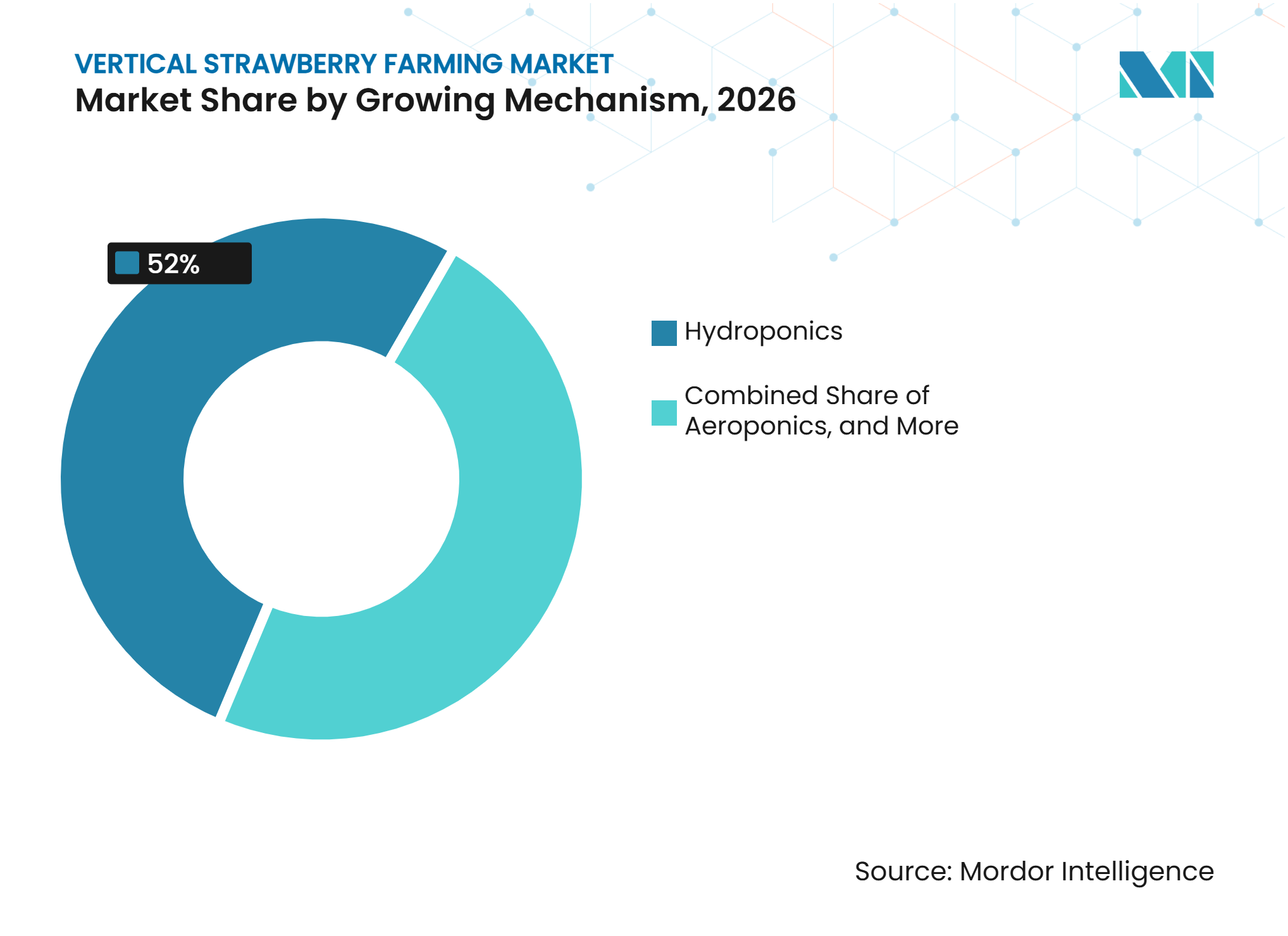
Hydroponics Leads, While Aeroponics Grows FastestHydroponics accounted for 52% of the vertical strawberry farming market share in 2026, making it the dominant growing method. Its position reflects established knowledge in soilless strawberry cultivation adapted from greenhouse production. A 2025 study published in Frontiers in Plant Science found that substrate-culture systems outperformed water-culture systems in strawberry yield and resource-use efficiency under greenhouse conditions. Sensor-controlled fertigation can refine nutrient delivery in response to crop demand. The vertical strawberry farming industry uses these systems to connect crop measurements with daily irrigation decisions.
Aeroponics is forecast to grow at a CAGR of 13.1% from 2027 to 2032, supported by growing interest in resource-efficient production systems. A 2026 study published in Horticulturae examined a closed, two-tier aeroponic system for strawberry production. This supports interest in systems that reduce water use and avoid soil contact. OnePointOne Inc.'s Opollo Three platform is expanding operator interest in vertical plane aeroponics for strawberries. Recirculating deep-water culture and hybrid substrate-aeroponic formats remain at a smaller commercial scale but are attracting research interest for lower-intensity nutrient delivery.



By Farm Structure:
Building-Based Vertical Farms Lead, While Shipping-Container Vertical Farms Grow FastestBuilding-based vertical farms held 68% of the vertical strawberry farming market's 2026 share. These facilities can house stacked growing tiers, climate systems, and dedicated automation within a single production site. Their larger canopy area allows equipment costs for lighting, fertigation, and robotics to be distributed across greater output. Building, electrical, and wastewater permitting also shape where these facilities can be located. Oishii Farm Corporation describes its Amatelas Farm as a multi-level indoor strawberry facility with robotics, water purification, and year-round production.
Shipping-container vertical farms are forecast to grow at a CAGR of 12.3% from 2027 to 2032, the fastest rate among farm structures. Their modular format supports deployment in food-import-dependent markets, urban locations, and cold climates without a purpose-built building. The lower entry-capital requirement can help operators test unit economics before committing to a larger fixed asset. This is relevant to Asia-Pacific and Middle Eastern markets that are building early controlled-environment capacity. Greenhouse-adjacent vertical bays serve narrower use cases but do not offer the same scale or relocation benefits.
By Distribution Channel:
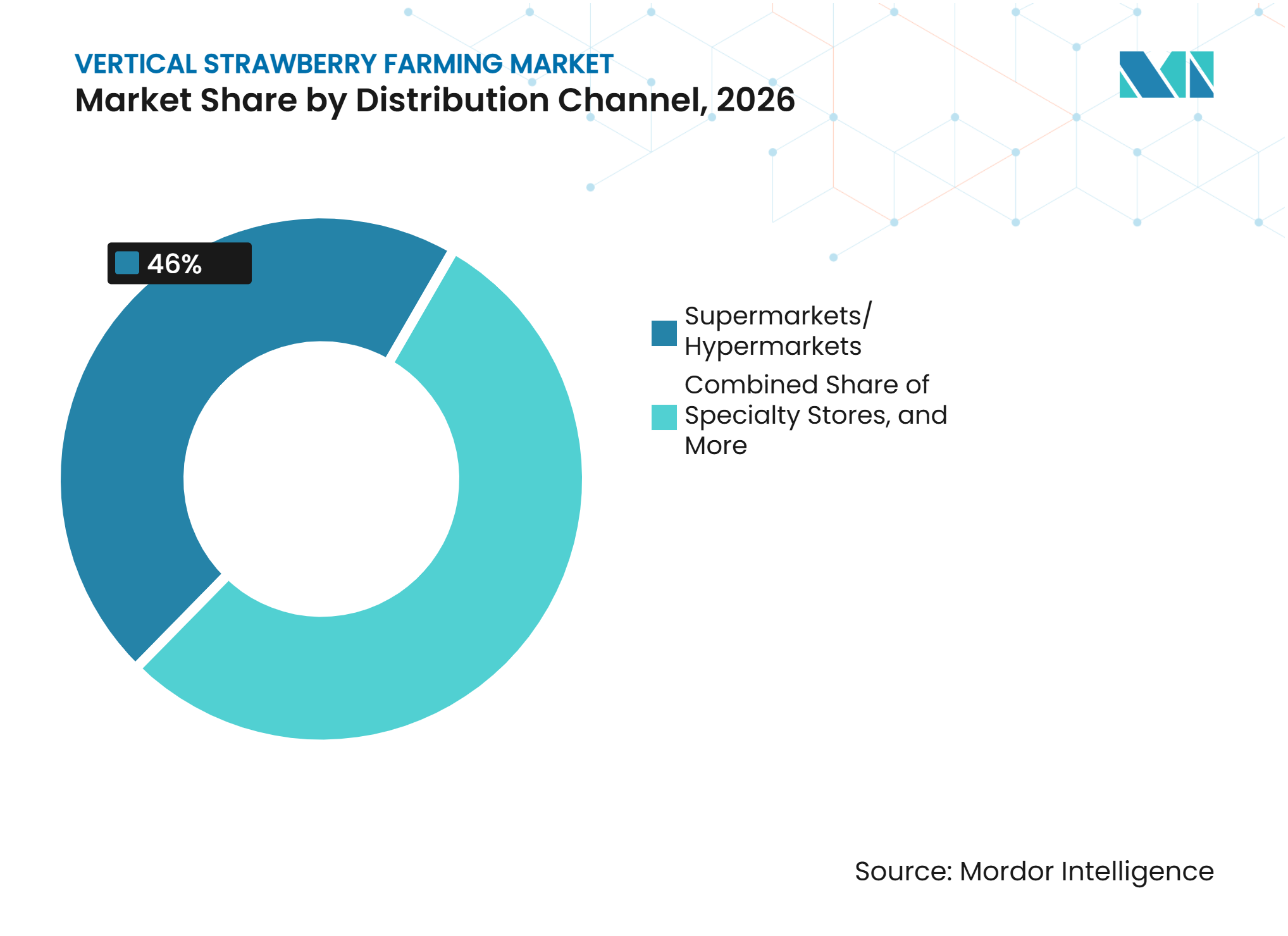
Supermarkets/Hypermarkets Lead, While Online Retail Grows FastestSupermarkets/hypermarkets held 46% of the vertical strawberry farming market's 2026 share. Premium grocery remains the primary commercial channel for vertically farmed strawberries, as retailers can manage cold-chain logistics and shopper access. This channel also supports the consistent flavor, firmness, and traceability requirements described in the supplied research. Specialty stores serve shoppers seeking exclusivity beyond mainstream grocery. Foodservice demand is concentrated among premium hotel and restaurant groups in the United Arab Emirates, Japan, and Singapore.
Online retail is forecast to grow at a CAGR of 11.8% from 2027 to 2032, the fastest rate among distribution channels. Direct-to-consumer subscriptions allow operators to retain a larger share of the retail margin. They also allow growers to communicate product provenance in more detail than retail packaging can provide. Foodservice is gaining relevance in high-income markets where procurement teams seek to limit seasonal variability in field supply. The vertical strawberry farming market presents opportunities across retailer-led and direct channels, but each requires dependable cold-chain and fulfillment execution.

Geography Analysis
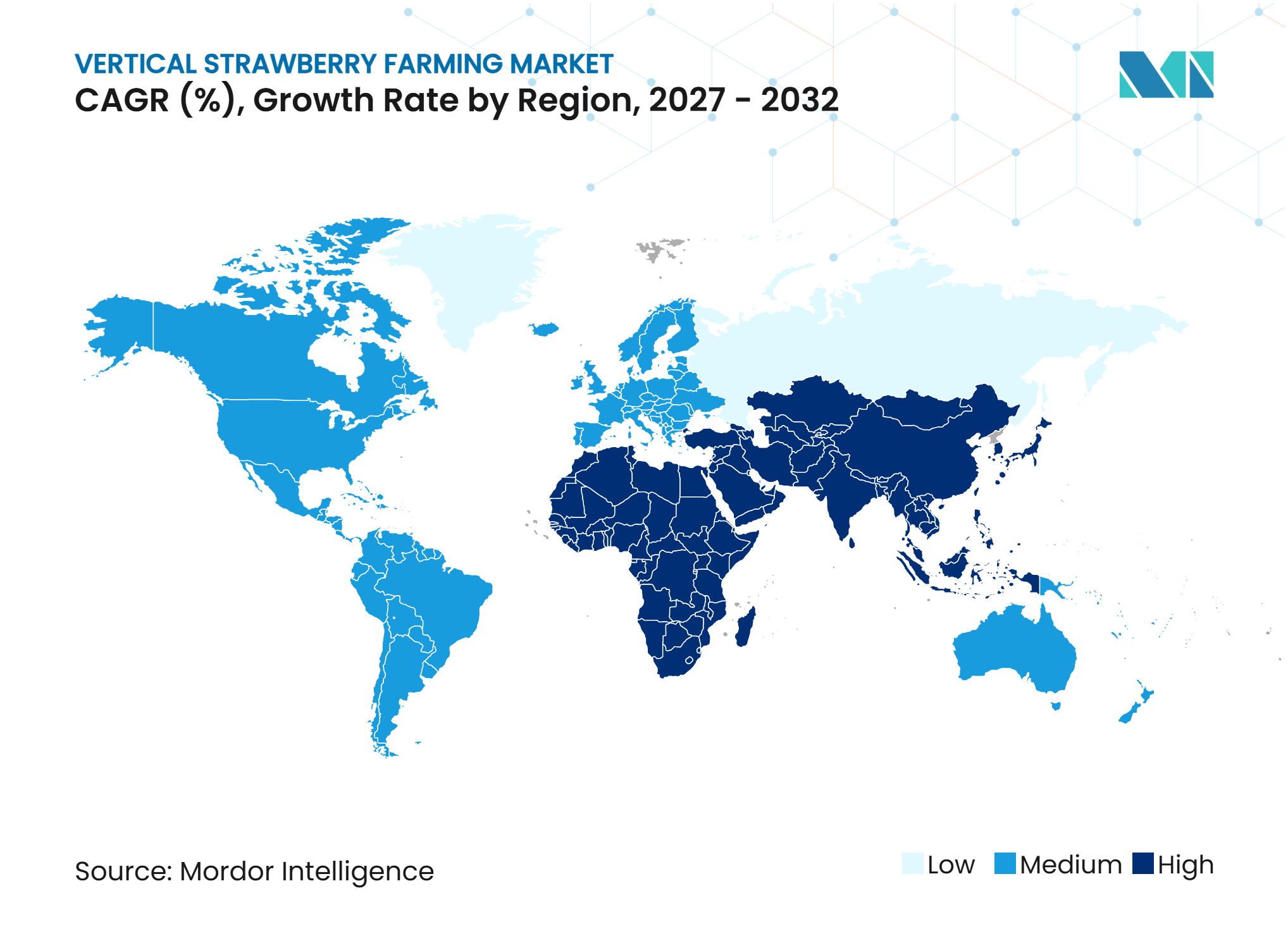
North America accounted for 38% of the vertical strawberry farming market share in 2026, supported by a mature premium berry consumer base, concentrated urban demand across major metropolitan areas, and early investment in building-based vertical farming facilities. Established controlled-environment agriculture capabilities and access to premium retail channels support year-round strawberry production, enabling growers to serve consumers seeking consistent quality and availability. These factors reinforce North America's position as a prominent market for commercial vertical strawberry farming, particularly in urban areas where proximity to consumers helps maintain fruit freshness and reduce transportation distances.
Asia-Pacific is forecast to grow at a CAGR of 12.8% from 2027 to 2032, driven by food-safety concerns, urban land scarcity, and investment in controlled-environment agriculture. Japan is a prominent market for premium vertically farmed strawberries, with year-round retail availability offering an alternative to seasonal field production. In May 2026, Japan Green Investment Corp. for Carbon Neutrality made a USD 10 million equity investment in Oishii Farm Corporation, reflecting continued investment in indoor strawberry production technology. Japan Green Investment Corp. for Carbon Neutrality. Singapore, South Korea, India, and Australia also represent potential growth markets as controlled-environment farming gains attention for its ability to support local production in urban and land-constrained areas.
Europe has opportunities for vertical strawberry farming, particularly in the Netherlands, Germany, and the United Kingdom, where established expertise in controlled-environment horticulture and greenhouse production can be applied to indoor strawberry cultivation. European Union food safety frameworks for residue limits and produce traceability may support demand for pesticide-free indoor strawberries. Interest in vertical strawberry production is also emerging in other regions. In South America, Brazil, Chile, and Argentina represent potential markets, while the United Arab Emirates and Saudi Arabia offer opportunities in the Middle East, where controlled-environment agriculture can help address challenging growing conditions. In Africa, South Africa, Kenya, and Egypt represent potential markets for vertical strawberry farming.
Competitive Landscape
Market Concentration
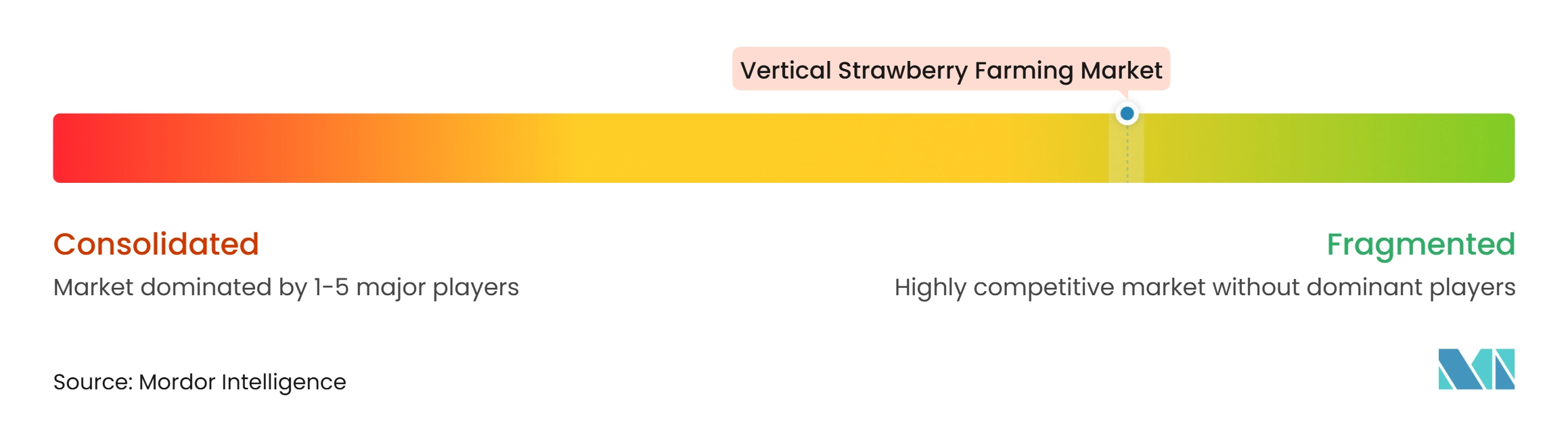
The vertical strawberry farming market was fragmented in 2026, with competition distributed across specialized farm operators, component suppliers, lighting providers, genetics companies, and propagation specialists. Key players include Oishii Farm Corporation, Winter Farm, OnePointOne Inc., Grow-Tec, and Vertiberry BV. Oishii Farm Corporation integrates genetics, robotics, and branded retail distribution, and its patent filings for indoor smart farms provide an intellectual property advantage beyond hardware supply.
OnePointOne Inc. combines its aeroponic farm technology with California Giant Berry Farms cultivar expertise. Vertiberry BV uses its TCEA propagation and production platform, while Grow-Tec is positioning scalable indoor vertical systems for commercial deployment. Sollum Technologies Inc. reported 22.0 kg per m² of commercially graded greenhouse strawberries over 43 weeks in a Biophi trial, providing operators with a performance reference for the procurement of dynamic lighting.
Ridder Group provides climate, irrigation, and labor management systems that can integrate multiple vendors within a controlled-environment facility. In 2025, Ridder Group and Signify formalized a partnership to integrate horticultural lighting with Ridder Hortimax Pro through the Horti Lighting Protocol standard. MISUMI Group Inc. and Oishii Farm Corporation formalized a business and capital alliance in March 2026 to support the supply of mechanical components and agricultural automation research. Competition in the market is focused on crop performance, production reliability, capital discipline, and access to premium channels.
Vertical Strawberry Farming Industry Leaders
-
Oishii Farm Corporation
-
Winter Farm (Ferme d’Hiver)
-
OnePointOne Inc.
-
Grow-Tec
-
Vertiberry BV
- *Disclaimer: Major Players sorted in no particular order
Vertical Strawberry Farming Market Companies Covered in this Report
- Oishii (Oishii Farm Corporation)
- Winter Farm (Ferme d’Hiver)
- OnePointOne Inc.
- Vertiberry BV
- Grow-Tec
- IntelliFarm
- Driscoll’s, Inc.
- California Giant Berry Farms
- Plenty Unlimited Inc.
- Fragaria Fruits Pvt. Ltd.
- Winter Farm (Ferme d’Hiver)
Recent Industry Developments in Vertical Strawberry Farming Market
- May 2026: Oishii Farm Corporation closed the first tranche of its USD 150 million Series C financing round, led by SPARX Asset Management Co., Ltd., with participation from Nomura Real Estate Development Co., Ltd., MISUMI Group Inc., and Mizuho Bank Ltd. The funding will support production capacity expansion, robotics integration, and research and development for its indoor farming operations in the United States and Japan.
- November 2025: ISU Chemical Co., Ltd., through its joint venture Ju Young-ISU Future Grow, completed a 220-square-meter indoor vertical strawberry farm in Vietnam. The facility uses LED lighting, hydroponic cultivation, automated climate control, and a mobile planting system, with planned annual production exceeding 10 metric tons.
- November 2024: Vertiberry BV integrated Sollum Technologies' dynamic LED hardware into its new indoor strawberry facility in L'Assomption, Quebec. The deployment enables the facility to serve as a test bed, using real-time adjustments to spectrum and intensity to study strawberry propagation and production workflows.
Global Vertical Strawberry Farming Market Report Scope
The vertical strawberry farming market refers to the cultivation of strawberries in vertically stacked indoor farming systems that use controlled-environment technologies, including artificial lighting, hydroponics, and automated climate control, to optimize growing conditions and support year-round production.
The Vertical Strawberry Farming Market is Segmented by Growing Mechanism (Hydroponics, Aeroponics, and Other Growing Methods), by Farm Structure (Building-Based Vertical Farms, Shipping-Container Vertical Farms, and Other Farm Structures), by Distribution Channel (Supermarkets/Hypermarkets, Specialty Stores, Online Retail, and Others), and by Geography (North America, Europe, Asia-Pacific, South America, Middle East, and Africa). The Market Forecasts are Provided in Terms of Value (USD) and Volume (Metric Tons).
Segmentation Overview
| Hydroponics |
| Aeroponics |
| Other Growing Methods |
| Building-Based Vertical Farms |
| Shipping-Container Vertical Farms |
| Other Farm Structures |
| Supermarkets/Hypermarkets |
| Specialty Stores |
| Online Retail |
| Others |
| North America | United States |
| Canada | |
| Mexico | |
| Rest of North America | |
| Europe | Germany |
| United Kingdom | |
| France | |
| Netherlands | |
| Spain | |
| Russia | |
| Rest of Europe | |
| Asia-Pacific | China |
| Japan | |
| India | |
| Singapore | |
| South Korea | |
| Australia | |
| Rest of Asia-Pacific | |
| South America | Brazil |
| Argentina | |
| Chile | |
| Rest of South America | |
| Middle East | United Arab Emirates |
| Saudi Arabia | |
| Israel | |
| Turkey | |
| Rest of Middle East | |
| Africa | South Africa |
| Kenya | |
| Egypt | |
| Rest of Africa |
| By Growing Mechanism | Hydroponics | |
| Aeroponics | ||
| Other Growing Methods | ||
| By Farm Structure | Building-Based Vertical Farms | |
| Shipping-Container Vertical Farms | ||
| Other Farm Structures | ||
| By Distribution Channel | Supermarkets/Hypermarkets | |
| Specialty Stores | ||
| Online Retail | ||
| Others | ||
| By Geography | North America | United States |
| Canada | ||
| Mexico | ||
| Rest of North America | ||
| Europe | Germany | |
| United Kingdom | ||
| France | ||
| Netherlands | ||
| Spain | ||
| Russia | ||
| Rest of Europe | ||
| Asia-Pacific | China | |
| Japan | ||
| India | ||
| Singapore | ||
| South Korea | ||
| Australia | ||
| Rest of Asia-Pacific | ||
| South America | Brazil | |
| Argentina | ||
| Chile | ||
| Rest of South America | ||
| Middle East | United Arab Emirates | |
| Saudi Arabia | ||
| Israel | ||
| Turkey | ||
| Rest of Middle East | ||
| Africa | South Africa | |
| Kenya | ||
| Egypt | ||
| Rest of Africa | ||
Key Questions Answered in the Report
What is the size of the vertical strawberry farming market?
The vertical strawberry farming market size was valued at USD 410 million in 2026.
What is driving demand for vertical strawberry farming?
Demand is supported by year-round availability of premium strawberries near urban consumers, retail demand for consistent fruit quality, and investment in local production to strengthen food resilience in import-dependent markets.
Which growing system leads vertical strawberry farming?
Hydroponics accounted for 52% of the vertical strawberry farming market share in 2026, supported by established soilless cultivation practices and research into yield and resource-use efficiency.
Which region is growing fastest in the vertical strawberry farming market?
Asia-Pacific is forecast to grow at a CAGR of 12.8% from 2027 to 2032, supported by food-safety priorities, land constraints, and investment in controlled-environment agriculture.