
United States Laundry Care Market Size and Share
Market Overview
| Study Period | 2021 - 2031 |
|---|---|
| Forecast Data Period | 2026 - 2031 |
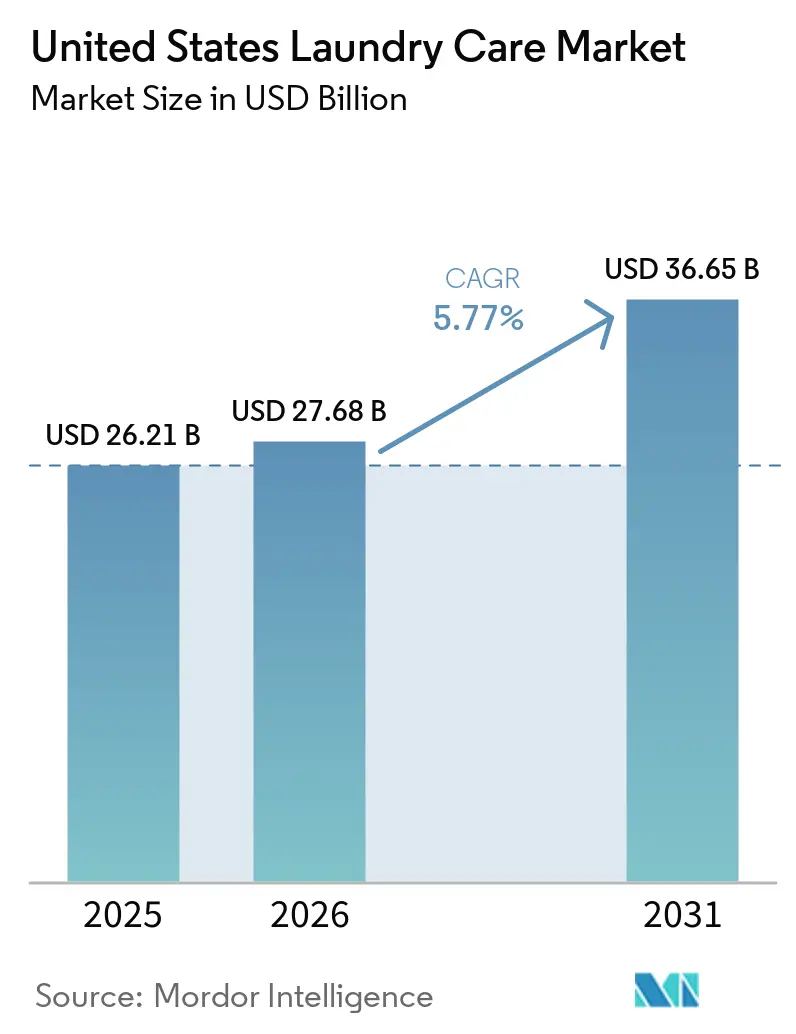
| Base Year Market Size (2025) | USD 26.21 Billion |
| Market Size (2026) | USD 27.68 Billion |
| Market Size (2031) | USD 36.65 Billion |
| Growth Rate (2026 - 2031) | 5.77 % |
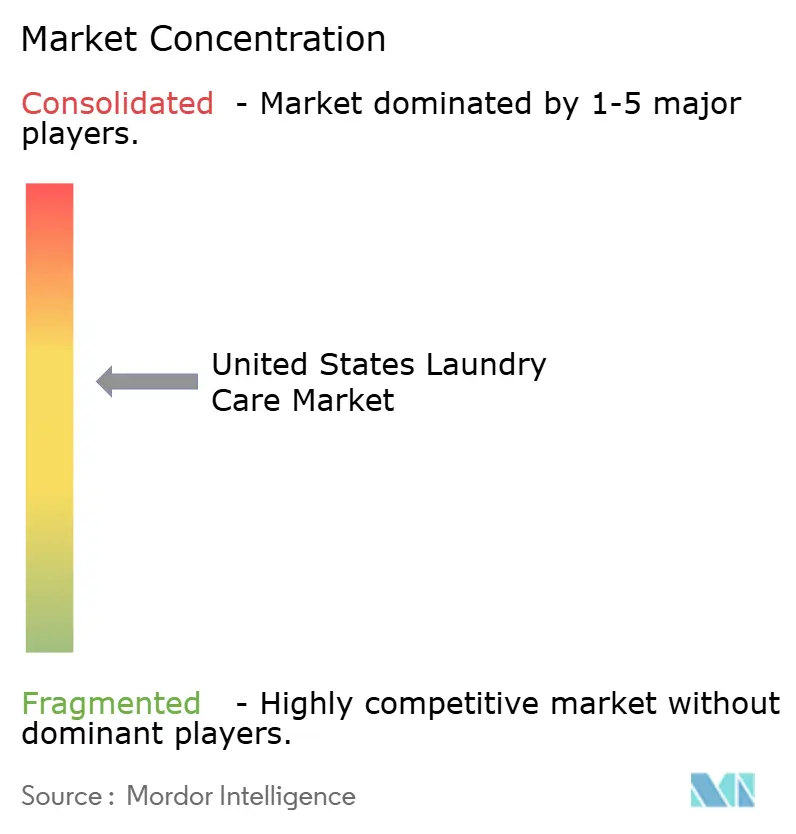
| Market Concentration | Medium |
Major Players *Disclaimer: Major Players sorted in no particular order Image © Mordor Intelligence. Reuse requires attribution under CC BY 4.0. | |
United States Laundry Care Market Analysis by Mordor Intelligence
The United States Laundry Care Market was valued at USD 26.21 billion in 2025 and is estimated to grow from USD 27.68 billion in 2026 to reach USD 36.65 billion by 2031, at a CAGR of 5.77% during the forecast period (2026–2031). Format premiumization, durable hygiene routines, and lower-waste products support value growth in the United States laundry care market. Regulatory requirements for packaging and ingredients are also changing product design and investment priorities across the United States laundry care market. Commercial demand adds support as healthcare, hospitality, and institutional buyers seek compliant products and larger service providers expand their operations. The United States laundry care market, therefore, favors companies that can combine product performance, easier use, lower packaging use, and regulatory compliance.
Key Report Takeaways
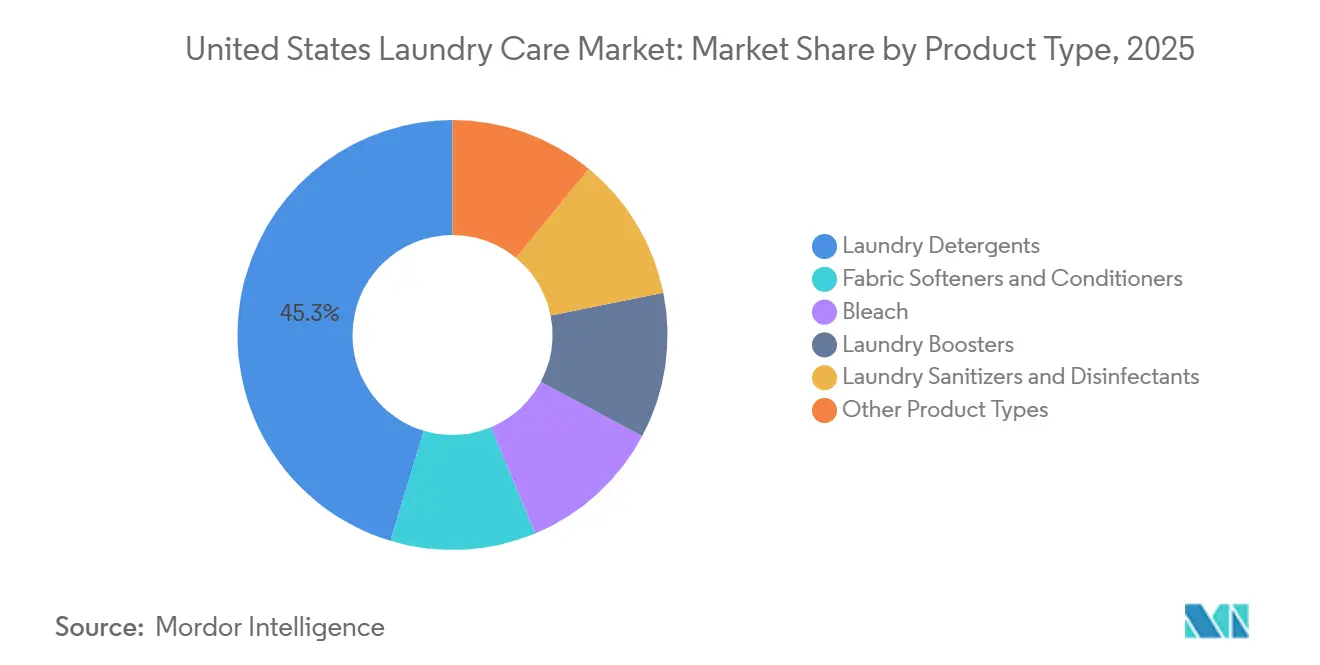
- By product type, laundry detergents held 45.34% of the United States laundry care market share in 2025, while laundry sanitizers and disinfectants are forecast to grow at a 6.82% CAGR through 2031.
- By form, liquid held 48.91% of the United States laundry care market share in 2025, while sheets are forecast to grow at a 7.25% CAGR through 2031.
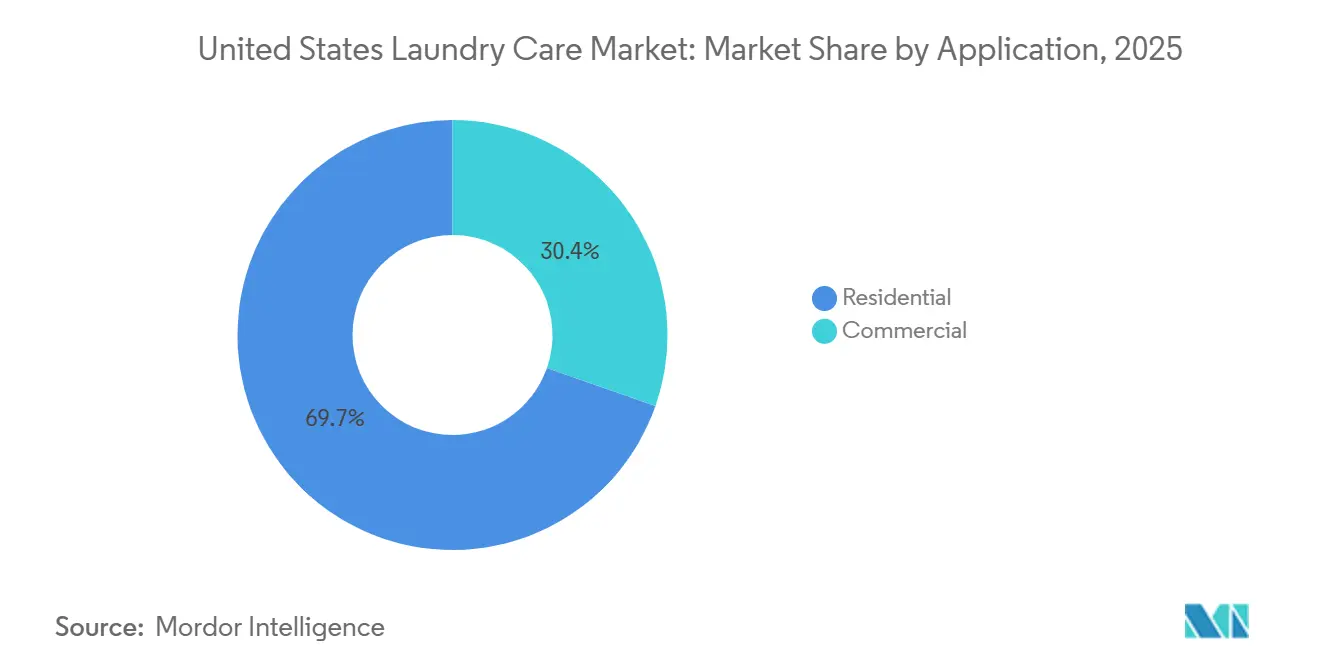
- By application, residential held 69.65% of the United States laundry care market share in 2025, while commercial is forecast to grow at a 6.66% CAGR through 2031.
Note: Market size and forecast figures in this report are generated using Mordor Intelligence’s proprietary estimation framework, updated with the latest available data and insights as of January 2026.
United States Laundry Care Market Trends and Insights
Drivers Impact Analysis*
| Driver | (~) % Impact on CAGR Forecast | Geographic Relevance | Impact Timeline |
|---|---|---|---|
| Heightened Hygiene and Cleanliness Routines | +1.3% | National, concentrated in Northeast and South U.S. markets | Short term (≤ 2 years) |
| Convenience-Led Adoption of Unit-Dose and Concentrated Formats | +1.1% | National, with early concentration in New York, Los Angeles, and Chicago | Medium term (2-4 years) |
| Sustainability Demand for Low-Water and Lower-Packaging Solutions | +0.9% | West Coast and Northeast, with spillover to the Midwest through national retail distribution | Medium term (2-4 years) |
| Premiumization Through Multifunctional Fabric-Care Benefits | +0.8% | National, with stronger traction in high-income suburban markets | Medium term (2-4 years) |
| Cold-Water Enzyme Performance and High-Efficiency Washer Compatibility | +0.7% | National, led by the Sun Belt and the Midwest, high-efficiency washer use | Long term (≥ 4 years) |
| Source: Mordor Intelligence | |||
Heightened Hygiene and Cleanliness Routines
Private label growth puts sustained pressure on branded suppliers in the United States laundry care market. Store brands reached 21.3% dollar share and 23.5% unit share across U.S. retail categories for the 52 weeks ending December 28, 2025. Store brands also captured 47% of dollar sales gains in U.S. retail during 2025. Private label fabric-care additives recorded 31.6%-dollar growth and 21.2%-unit growth in 2025. As retailers expand their own-label shelf space, national brands need more promotional spending and placement investment to defend visibility. This pressure is strongest for conventional branded products that do not offer a clear format, performance, or price advantage.
Convenience-Led Adoption of Unit-Dose and Concentrated Formats
Unit-dose pods and water-soluble sheets shift product comparisons from price per ounce to price per load in the United States laundry care market. This change helps brands support per-load pricing where consumers value easier dosing and less handling. Dedicated cold-wash cycles in newer washing machines can reinforce the use of compatible concentrated formats. Clean Cult launched laundry detergent sheets at Costco nationwide in January 2026, offering a 180-sheet pack for USD 22.99. The launch provided a national club-retail route for sheets and placed the format before routine bulk shoppers. Pre-measured products also reduce dosing uncertainty, which supports convenience for households that want a simpler wash routine.
Sustainability Demand for Low-Water and Lower-Packaging Solutions
Sustainability requirements now affect formulation and packaging decisions in the United States laundry care market. Retailer policies, consumer preferences, and state regulations have increased pressure to use less water and plastic. California filed permanent Senate Bill (SB) 54 packaging regulations on May 1, 2026, setting recyclability requirements that affect packaged laundry products through 2032[1]. Henkel reformulated all Persil and Snuggle liquid lines in March 2025 with a 16% average dose concentration increase and 50% recycled plastic per bottle. The change reduced plastic use by 5%, equal to 20 million one-gallon milk jugs, and was expected to save more than 4,000 metric tons of CO₂ annually. P&G introduced Tide evo nationally in February 2026, using a waterless tile and recyclable cardboard to support cold-water washing.
Premiumization Through Multifunctional Fabric-Care Benefits
Consumers increasingly expect laundry products to deliver more than basic cleaning in the United States laundry care market. Stain removal, allergen reduction, color protection, lasting fragrance, and fabric conditioning can support higher-priced product formats. Multi-chamber pods combine cleaning and fabric-care functions in one product and give brands a route to differentiate their offerings. P&G uses Tide for a mass-premium performance position and Gain for a mass scent-focused position, allowing it to address distinct consumer needs. Church & Dwight reported a 14% revenue increase for its Clean & Simple detergent line, supported by a sodium bicarbonate-based formulation and competitive cost structure. Fragrance personalization, luxury fabric care, and hypoallergenic positioning remain relevant areas for products that seek to offer specific household benefits.
Restraints Impact Analysis*
| Restraint | (~) % Impact on CAGR Forecast | Geographic Relevance | Impact Timeline |
|---|---|---|---|
| Private-Label Expansion and Promotional Price Pressure | -0.9% | National, highest impact in Midwest and Southeast value-retail corridors | Short term (≤ 2 years) |
| State-Level Environmental Claims and Packaging Compliance Complexity | -0.6% | California, New York, Colorado core; spill-over via national brand packaging programs | Medium term (2-4 years) |
| Polymer-Film, Residue, and Ingredient-Scrutiny Risk | -0.4% | National, concentrated in coastal markets with higher regulatory and consumer sensitivity | Medium term (2-4 years) |
| Source: Mordor Intelligence | |||
Private-Label Expansion and Promotional Price Pressure
Private label growth puts sustained pressure on branded suppliers in the United States laundry care market. Store brands reached 21.30% dollar share and 23.50% unit share across U.S. retail categories for the 52 weeks ending December 28, 2025. Store brands also captured 47% of dollar sales gains in U.S. retail during 2025. As retailers expand their own-label shelf space, national brands need more promotional spending and placement investment to defend visibility. This pressure is strongest for conventional branded products that do not offer a clear format, performance, or price advantage.
State-Level Environmental Claims and Packaging Compliance Complexity
State requirements create added compliance work for national product portfolios in the United States laundry care market. California designated laundry detergents containing nonylphenol ethoxylates as a Priority Product effective October 1, 2024, requiring notifications and follow-on alternatives assessments. California SB 54 also requires packaging changes that will affect single-use plastic packaging through 2032. New York’s proposed Packaging Reduction and Recycling Infrastructure Act adds uncertainty for companies planning packaging changes across several years[2]. Plastic-film concerns, product residue concerns, and closer ingredient scrutiny add further risks for brands selling nationally. Companies using plastic-free packaging or already-compliant formulations may face less incremental work than producers of conventional large-format liquid products.
*Our forecasts treat driver/restraint impacts as directional, not additive. The impact forecasts reflect baseline growth, mix effects, and variable interactions.
Segment Analysis
By Product Type: Laundry Sanitizers and Disinfectants Scale Up Against a Laundry Detergents Dominant Base
Laundry detergents accounted for 45.34% of the United States laundry care market size in 2025. Their leading position reflects wide retail availability, deep household use across income groups, and long-established brand recognition. Within the category, value is moving from standard liquids toward concentrated pods, waterless tiles, and cold-water sheets. These formats can carry a higher price per load and improve per-load margins for branded suppliers and sustainability-focused challengers. Fabric softeners and conditioners remain the second-largest product type because consumers value fragrance, fabric protection, and longer-lasting scent. Laundry boosters are also gaining relevance as in-wash scent and enzyme products that add to a detergent routine without requiring a complete product switch.
Laundry sanitizers and disinfectants are forecast to grow at a 6.82% CAGR from 2026 to 2031. The United States laundry care market size for this product group benefits from residential hygiene routines and commercial purchasing requirements. Healthcare and hospitality buyers can favor products with Environmental Protection Agency (EPA)-related credentials when setting supplier requirements. That requirement can make certified lines more attractive in institutional contracts. The category also raises potential household spending because sanitizers are used alongside detergent rather than instead of it. Bleach retains institutional demand in healthcare laundry and food service, although multifunction sanitizing products have taken some of its residential role.

By Form: Sheets Disrupt a Liquid Led Category
Liquid held 48.91% of the United States laundry care market size in 2025. Their position rests on consumer familiarity, the broadest retail presence, and established performance across wash temperatures. Powder remains relevant in commercial and value-focused household use because bulk buying and shelf life are important practical benefits. Pods and capsules remain a premium everyday option for households that value dosing precision and ease of use. The format has particular appeal in urban homes and among younger buyers who prefer products that reduce handling and measuring. Each form, therefore, serves a different balance of price, storage, convenience, and cleaning expectations.
Sheets are forecast to grow at a 7.25% CAGR from 2026 to 2031. The January 2026 Clean Cult Costco launch showed that sheets can reach club shoppers at national scale. Plastic-free packaging, cod-water compatibility, and pre-measured dosing give sheets a distinct value proposition. These features bring sustainability, convenience, and dosing consistency into one product format. Solid and tablet products remain smaller by value, but they are gaining attention in direct-to-consumer channels among households seeking to avoid plastic packaging. EPA Safer Choice labeling on some sheet and solid products can also support confidence among environmentally focused purchasers.
By Application: Residential Leads While Commercial Accelerates
Residential represented 69.65% of the United States laundry care market share in 2025. The segment is supported by 130 million U.S. households, which form the category’s most stable and frequent demand base. Premium pods and sheets capture more value among higher-income households. Private label liquids gain unit demand among value-focused households. This leaves conventional mid-tier branded products exposed when they lack format distinction and cannot match store-brand pricing. Household preferences also vary by family size, preferred fragrance, and expectations for stain removal.
Commercial use is forecast to grow at a 6.66% CAGR from 2026 to 2031. Demand comes from healthcare facilities, hotel chains, and institutional food service operators that maintain stringent hygiene requirements. The U.S. Census Bureau reported USD 1,107.1 billion in healthcare and social assistance revenue in the first quarter of 2026. PureStar acquired Emerald Textiles in January 2026, combining its hospitality network with Emerald’s 12 West Coast healthcare laundry facilities. NSF International (NSF) and EPA-related requirements can influence commercial procurement and make it harder for products without the needed specifications to compete. These requirements help distinguish institutional laundry demand from more price-sensitive household purchasing.
Geography Analysis
In the United States, California and the wider West Coast show a strong interest in eco-friendly laundry products. California consumers reported a preference for eco-friendly products of more than 70% in the cited consumer research. California’s Nonylphenol Ethoxylates (NPE) Priority Product regulation took effect on October 1, 2024, and SB 54 regulations were filed on May 1, 2026. These rules encourage ingredient substitution and packaging redesign that can shape national product portfolios.
The Northeast favors premium unit-dose and concentrated formats because urban homes often have less space for large packs. Consumers in New York and New England can also place more value on compact, high-efficacy, and lower-plastic products. New York’s pending packaging legislation could add to this regional influence on packaging plans. Migration, housing affordability, and employment growth are supporting household formation in these areas. Hotel development and healthcare expansion in Texas and Florida also support commercial demand for products with antimicrobial or sanitizing specifications.
The Midwest and Central United States remain important for private-label penetration and value-focused purchasing. Walmart, Kroger, and regional grocery chains have positioned their own-label laundry products as credible alternatives to national brands. Hispanic households are a high-frequency laundry user group because of larger average household sizes. Their preferences for scent and stain-removal claims create an opportunity for brands that offer relevant benefits across several formats. The United States laundry care market must therefore balance regional sustainability expectations, price sensitivity, and institutional product requirements.
Competitive Landscape
The United States laundry care market is moderately concentrated, with the top five players including Procter & Gamble, Church & Dwight Co., Inc., Henkel AG & Co. KGaA, The Clorox Company, and Unilever. P&G’s Tide and Gain strategy serves performance-focused and scent-focused consumers through separate brand positions. This leadership gives P&G substantial scale, but it does not remove pressure from private labels, direct-to-consumer brands, and sustainability-focused challengers.
Henkel’s March 2025 reformulation of all, Persil, and Snuggle demonstrated how product concentration and recycled content can be used as a competitive strategy. The company increased average dose concentration by 16% and reduced plastic use by 5% across these lines. P&G launched Tide evo nationally in February 2026 as a waterless tile for cold-water washing. Ecolab and Betco remain well placed in institutional settings because established channel relationships and registered product portfolios are important to procurement. Certified formulations and disclosed ingredients can become important competitive conditions in healthcare and hospitality.
Cents raised USD 140 million in a Series C round in March 2026 and acquired Insight Systems in July 2026. These moves direct more attention toward data and operating systems in commercial laundry services. That development can affect which product brands are specified in commercial contracts over time. EVI Industries also announced an agreement in July 2026 to acquire Sudsies, expanding into consumer garment care services. The United States laundry care market remains competitive because product suppliers must manage pricing pressure while also meeting changing packaging and institutional requirements.
United States Laundry Care Industry Leaders
-
Procter & Gamble
-
Church & Dwight Co., Inc.
-
Henkel AG & Co. KGaA
-
The Clorox Company
-
Unilever
- *Disclaimer: Major Players sorted in no particular order
Recent Industry Developments
- July 2026: Orange House launched its 3-in-1 Stain & Odor Removal Powder in the United States, a laundry booster designed to work alongside existing detergents rather than replace them. The powder combines food-grade d-limonene, naturally derived from orange oil, protease enzyme technology, and mineral-based cleaning agents.
- February 2026: Procter & Gamble launched Tide Evo in the United States, a 100% concentrated, waterless laundry tile with six cleaning layers. The product activates instantly in cold water, utilizing cleaning technologies such as all-in-one scrubbers, pre-treaters, brighteners, and fresheners, with no fillers, no added water, and no plastic bottles.
United States Laundry Care Market Report Scope
Laundry care products are formulated to clean, sanitize, protect, and enhance the appearance of fabrics while maintaining their quality and longevity. They include a wide range of detergents, fabric conditioners, bleach, and specialty products available in multiple formats for both household and commercial laundry applications.
The United States Laundry Care Market is segmented by product type, form, and application. By product type, the market is segmented into laundry detergents, fabric softeners and conditioners, bleach, laundry boosters, laundry sanitizers and disinfectants, and other product types. By form, the market is segmented into liquid, powder, pods and capsules, sheets, and solid and tablet. By application, the market is segmented into residential and commercial. For each segment, the market sizing and forecasts have been done on the basis of value (USD).
| Laundry Detergents |
| Fabric Softeners and Conditioners |
| Bleach |
| Laundry Boosters |
| Laundry Sanitizers and Disinfectants |
| Other Product Types |
| Liquid |
| Powder |
| Pods and Capsules |
| Sheets |
| Solid and Tablet |
| Residential |
| Commercial |
| By Product Type | Laundry Detergents |
| Fabric Softeners and Conditioners | |
| Bleach | |
| Laundry Boosters | |
| Laundry Sanitizers and Disinfectants | |
| Other Product Types | |
| By Form | Liquid |
| Powder | |
| Pods and Capsules | |
| Sheets | |
| Solid and Tablet | |
| By Application | Residential |
| Commercial |
Key Questions Answered in the Report
What is the size of the United States laundry care market?
The United States laundry care market stands at USD 27.68 billion in 2026 and is forecast to reach USD 36.65 billion by 2031.
Which product type is expected to grow fastest through 2031?
Laundry sanitizers and disinfectants are projected to grow at a 6.82% CAGR through 2031.
Why are sheets gaining adoption?
Sheets combine pre-measured dosing, cold-water compatibility, and plastic-free packaging. They are projected to grow at a 7.25% CAGR through 2031.
Which application led the market share in 2025?
The residential led with a 69.65% share in 2025, supported by frequent household washing needs across households.