
United States Kiwi Fruit Market Size and Share
United States Kiwi Fruit Market Analysis by Mordor Intelligence
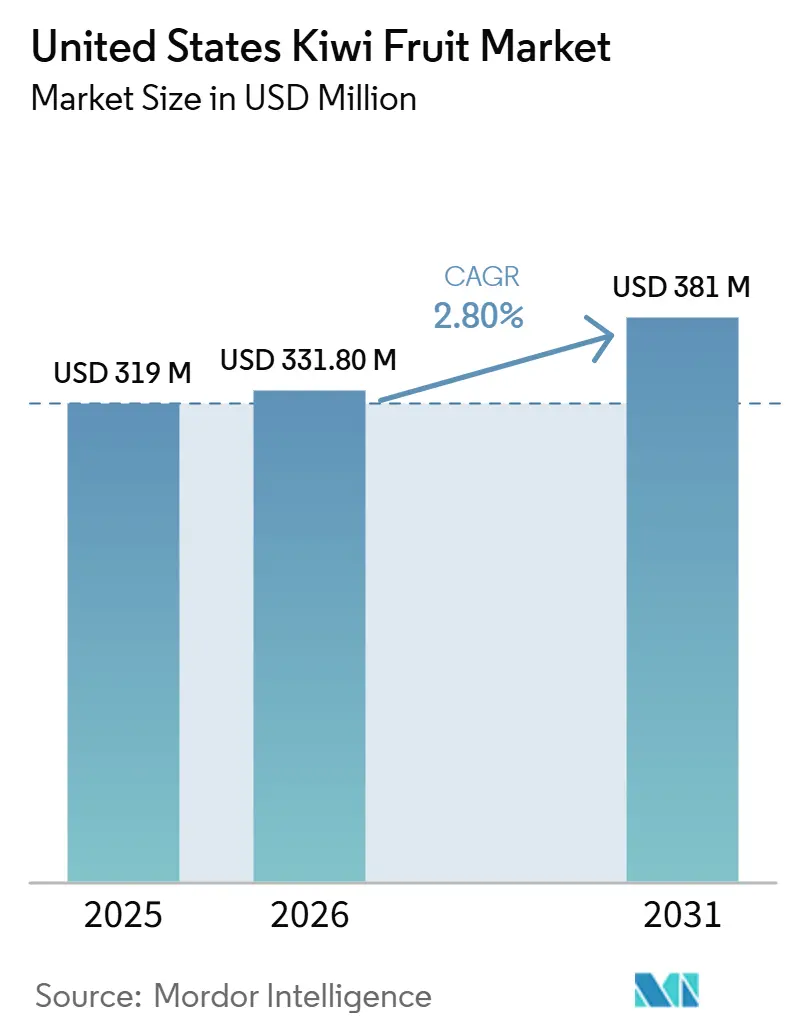
The United States kiwi fruit market was valued at USD 319.0 million in 2025 and is projected to grow from USD 331.80 million in 2026 to USD 381.0 million by 2031, at a CAGR of 2.80% during the forecast period (2026-2031). The market is shaped by steady demand for premium fruit, while supply remains heavily dependent on imports from New Zealand, Chile, Italy, and Greece. Consumer interest in nutrient-dense fruit suitable for everyday snacking supports repeat purchases, even as total volume growth remains modest. A significant portion of value growth is driven by a shift in the mix away from standard green kiwifruit toward higher-priced gold, organic, and red varieties, which increases revenue per unit faster than volume. Retail execution continues to influence market development, as branded programs, ripening control, and packaged formats improve shelf presentation, reduce shrink, and support higher checkout values. At the same time, the market faces constraints from import dependence, freight exposure, perishability, and California's limited acreage base, which keeps long-term expansion measured rather than rapid.
Key Report Takeaways
- California accounts for more than 95% of the United States kiwifruit production, while production in other states remains limited.
Note: Market size and forecast figures in this report are generated using Mordor Intelligence’s proprietary estimation framework, updated with the latest available data and insights as of January 2026.
United States Kiwi Fruit Market Trends and Insights
Drivers Impact Analysis*
| Driver | (~) % Impact on CAGR Forecast | Geographic Relevance | Impact Timeline |
|---|---|---|---|
| Rising demand for nutrient-dense fruit snacking | +0.35% | National, with stronger gains in West Coast and Northeast urban markets | Short term (≤ 2 years) |
| Premiumization through gold and red varieties | +0.30% | National, with faster adoption in coastal and metro markets | Medium term (2-4 years) |
| Retail promotion and in-store merchandising intensity | +0.25% | National across major grocery chains | Short term (≤ 2 years) |
| Growth in organic and clean-label produce demand | +0.20% | National, led by Pacific and Mountain regions | Medium term (2-4 years) |
| Wider availability through controlled ripening and cold chain execution | +0.20% | National, with operational hubs in California and major import gateways | Medium term (2-4 years) |
| Export diversification by supplier markets into the United States | +0.15% | National, with import flows tied to Los Angeles and Philadelphia gateways | Long term (≥ 4 years) |
| Source: Mordor Intelligence | |||
Rising Demand for Nutrient-Dense Fruit Snacking
Consumer preference for nutrient-dense fresh fruit is increasing as healthy snacking increasingly replaces processed alternatives in the United States. Kiwifruit is well-positioned in this trend due to its high levels of vitamin C, dietary fiber, potassium, folate, vitamin E, and antioxidants, making it attractive to health-conscious consumers. The United States Department of Agriculture National Retail Report recorded 443 retail advertisements for Hayward kiwifruit sold individually during the week ending January 10, 2025, compared with 206 the previous week, indicating stronger retail promotion and consumer demand[1]Source: United States Department of Agriculture Agricultural Marketing Service, “National Retail Report – Specialty Crops,” esmis.nal.usda.gov.. This growing retail presence continues to support sustained kiwifruit consumption nationwide.
Premiumization Through Gold and Red Varieties
Premium kiwi varieties are influencing consumer purchasing patterns by offering enhanced flavor, distinctive appearance, and stronger nutritional appeal, enabling retailers to capture higher value per sale. Gold- and red-fleshed kiwifruit continue to gain shelf space as consumers increasingly seek premium fresh produce. According to Zespri International Limited's Five-Year Outlook 2025, red kiwifruit achieves an average retail price 15% above gold varieties, indicating consumers' willingness to pay more for differentiated premium fruit[2]Source: Zespri International Limited, “Zespri Five-Year Outlook 2025,” zespri.com.. This pricing environment encourages continued investment in premium cultivar development and supports value growth across the United States kiwi fruit market.
Retail Promotion and In-Store Merchandising Intensity
Retail promotions and in-store merchandising support kiwi fruit sales by improving product visibility and encouraging repeat purchases in the fresh produce aisle. Attractive displays, branded packaging, seasonal promotions, and strategic shelf placement help kiwi fruit compete with other fresh fruit categories while increasing consumer awareness. According to Dole plc's 2024 Annual Report, the company distributes fresh produce, including kiwifruit, across more than 85 countries through retail, wholesale, foodservice, and e-commerce channels. This distribution network strengthens shelf availability and merchandising execution, supporting consumer access and demand for kiwi fruit in the United States.
Growth in Organic and Clean-Label Produce Demand
Consumer preference for organic and clean-label produce continues to grow as shoppers increasingly prioritize products with transparent sourcing, certified production, and minimal processing. This trend supports demand for premium fresh fruits, including organic kiwifruit, across retail channels. According to the Organic Trade Association's 2026 Organic Market Report, United States sales of certified organic products reached USD 76.6 billion in 2025, while organic food sales totaled USD 70.1 billion, with fresh produce remaining the largest organic category. The expanding organic market presents a favorable environment for higher-value organic kiwifruit offerings in the United States.
Restraints Impact Analysis*
| Restraint | (~) % Impact on CAGR Forecast | Geographic Relevance | Impact Timeline |
|---|---|---|---|
| Heavy dependence on imported supply | -0.30% | National, with port and route exposure tied to Los Angeles and Philadelphia | Long term (≥ 4 years) |
| High perishability and cold chain cost sensitivity | -0.25% | National, especially in interior and temperature-sensitive distribution lanes | Medium term (2-4 years) |
| Seasonal supply gaps and retail price volatility | -0.20% | National, most visible during the October through April transition window | Short term (≤ 2 years) |
| Limited domestic orchard scale and yield concentration | -0.10% | California only, mainly in the San Joaquin Valley and Sacramento Valley | Long term (≥ 4 years) |
| Source: Mordor Intelligence | |||
High Perishability and Cold Chain Cost Sensitivity
Kiwifruit requires strict postharvest handling and continuous cold-chain management to preserve quality during storage, transportation, and distribution, thereby increasing logistics costs across the supply chain. Specialized storage infrastructure and precise temperature control are essential to minimize quality deterioration, particularly for imported fruit traveling long distances. According to a 2025 review published in Current Issues in Molecular Biology, kiwifruit is highly perishable, with postharvest life constrained by rapid softening, chilling injury, pathogen-induced soft rot, off-flavor development, and uneven ripening. These physiological challenges increase handling costs, elevate spoilage risks, and limit market expansion in the United States.
Limited Domestic Orchard Scale and Yield Concentration
Domestic kiwifruit production remains geographically concentrated, limiting the local supply's ability to reduce reliance on imports. Commercial production is confined primarily to California, making the domestic supply chain vulnerable to localized weather events, water availability, and production risks. According to the United States Department of Agriculture National Agricultural Statistics Service, California's bearing kiwifruit acreage remained unchanged at 5,200 acres in both 2024 and 2025, indicating that domestic production capacity has not expanded despite continued market demand[3]Source: United States Department of Agriculture National Agricultural Statistics Service, “Noncitrus Fruits and Nuts 2025 Summary,” esmis.nal.usda.gov.. The lack of orchard expansion limits long-term supply growth and constrains the market's ability to substitute imported kiwifruit with domestic production.
*Our forecasts treat driver/restraint impacts as directional, not additive. The impact forecasts reflect baseline growth, mix effects, and variable interactions.
Geography Analysis
California is the center of commercial kiwifruit cultivation in the United States, supported by its Mediterranean climate, fertile soils, and well-developed irrigation systems. Production is concentrated mainly in the San Joaquin Valley, where established orchards and experienced growers ensure consistent fruit quality. Limited cultivation also takes place in parts of the Sacramento Valley, although these areas contribute only marginally to domestic supply. Since commercial production remains geographically concentrated, regional weather patterns, water resources, and orchard productivity in California closely influence domestic availability.
Domestic kiwifruit production remains highly concentrated in California, while other states contribute little to commercial output due to limited suitable climatic conditions and orchard acreage. This geographic concentration limits opportunities to diversify production across multiple growing regions and increases reliance on California for locally produced fruit. As a result, importers play an essential role in maintaining year-round availability by supplying fruit outside the domestic harvest season. Stable import programs also help retailers maintain consistent inventory levels and product quality throughout the year, despite seasonal fluctuations in local production.
California also serves as the primary export origin for domestically produced kiwifruit, supported by its established packing infrastructure and proximity to international shipping routes. Canada remains the leading overseas destination due to strong trade relationships and efficient transportation networks between the two countries. According to the United States Department of Agriculture Foreign Agricultural Service (USDA FAS), Canada imported USD 1.66 billion of fresh fruit from the United States in 2025, making it the largest export destination for United States fresh fruit, including California-grown kiwifruit.
Competitive Landscape
Competition in the United States kiwifruit market is driven by premium cultivar development, year-round supply capabilities, established retail distribution networks, and consistent fruit quality. Market participants differentiate through proprietary varieties, sustainable production practices, advanced post-harvest handling, and strategic sourcing from domestic and international growers. Growing consumer demand for premium, organic, and specialty kiwifruit continues to drive investment in product innovation, supply chain efficiency, and long-term retail partnerships.
Competition increasingly centers on supply chain efficiency, premium variety expansion, and operational investments that improve product quality and market availability. Companies continue to strengthen sourcing partnerships and postharvest infrastructure to maintain a consistent year-round supply. Automation, advanced sorting technologies, and packhouse modernization are becoming key competitive differentiators as suppliers improve handling efficiency and reduce operating costs. These investments also enhance fruit consistency, support premium positioning, and strengthen relationships with retailers seeking dependable year-round kiwifruit availability across the United States while maintaining high food quality standards.
Strategic investment continues to strengthen the competitive positioning of global suppliers serving the United States. According to Zespri International Limited's 2024/25 Annual Report, the company sold 220.9 million trays of kiwifruit during the 2024/25 season, compared with 164.2 million trays in the previous season. This increase reflects a significant expansion in global supply supporting international markets, including the United States. Continued investment in premium varieties, grower partnerships, and global distribution networks enables leading suppliers to strengthen retailer relationships while meeting growing consumer demand for premium fresh kiwifruit.
Recent Industry Developments
- May 2026: The United States Department of Agriculture Agricultural Marketing Service (USDA AMS) announced a continuance referendum for the California Kiwifruit Marketing Order, allowing eligible growers to vote on whether to maintain the federal marketing order that governs quality, grading, inspection, and marketing standards for California-grown kiwifruit.
- April 2026: Zespri International Limited launched RubyRed Kiwifruit across the United States after a successful trial on the West Coast. The premium red-fleshed variety expanded Zespri’s North American portfolio, and the company supported the launch with a nationwide retail and marketing campaign targeting health-conscious consumers.
- December 2025: The company commercialized the new Red80 red-fleshed kiwifruit variety to extend the RubyRed selling season and improve year-round availability. The variety will complement Red19 and strengthen the premium supply for export markets, including the United States.


United States Kiwi Fruit Market Report Scope
Kiwi, also known as kiwifruit, is a nutrient-rich edible berry with green, gold, or red flesh and a fuzzy or smooth skin, cultivated commercially for fresh consumption and food processing applications.
The United States kiwi fruit market report includes production analysis (volume, area harvested, and yield), consumption analysis (value and volume), import analysis (value and volume), export analysis (value and volume), wholesale price trend analysis and forecast, regulatory framework, logistics and infrastructure, and seasonality analysis. The market forecasts are provided in terms of value (USD) and volume (metric tons).
| Production Volume |
| Area Harvested and Yield |
| Import Market Analysis | Import Value and Volume |
| Key Supplying Markets | |
| Export Market Analysis | Export Value and Volume |
| Key Destinations Markets |
| Production Analysis | Production Volume | |
| Area Harvested and Yield | ||
| Trade Analysis (Value and Volume) | Import Market Analysis | Import Value and Volume |
| Key Supplying Markets | ||
| Export Market Analysis | Export Value and Volume | |
| Key Destinations Markets | ||


Key Questions Answered in the Report
How large is the United States kiwi fruit sector in 2026 and what will be projected growth in 2031?
United States kiwi fruit is valued at USD 331.80 million in 2026 and is projected to reach USD 381.0 million by 2031 at a 2.80% CAGR.
What is driving demand for kiwi fruit in the United States?
Demand is being supported by nutrient-dense snacking, premium variety adoption, stronger organic sales, and better retail execution.
Why does New Zealand matter so much to United States buyers?
New Zealand is the leading supplier of imported kiwi fruit and sets the tone for premium assortment and pricing through large-scale licensed variety programs.
Which sales channel matters most for kiwi fruit purchases?
Supermarkets, hypermarkets, and club stores remain the main channel, while online grocery is gaining relevance for packaged formats.
Page last updated on:





