
United States Dried Fruit Market Size and Share
Market Overview
| Study Period | 2022 - 2032 |
|---|---|
| Forecast Data Period | 2027 - 2032 |
| Base Year Market Size (2026) | USD 2.34 Billion |
| Market Size (2027) | USD 2.48 Billion |
| Market Size (2032) | USD 3.45 Billion |
| Growth Rate (2027 - 2032) | 6.82 % |
| Market Concentration | Low |
Major Players *Disclaimer: Major Players sorted in no particular order Image © Mordor Intelligence. Reuse requires attribution under CC BY 4.0. | |
United States Dried Fruit Market Analysis by Mordor Intelligence
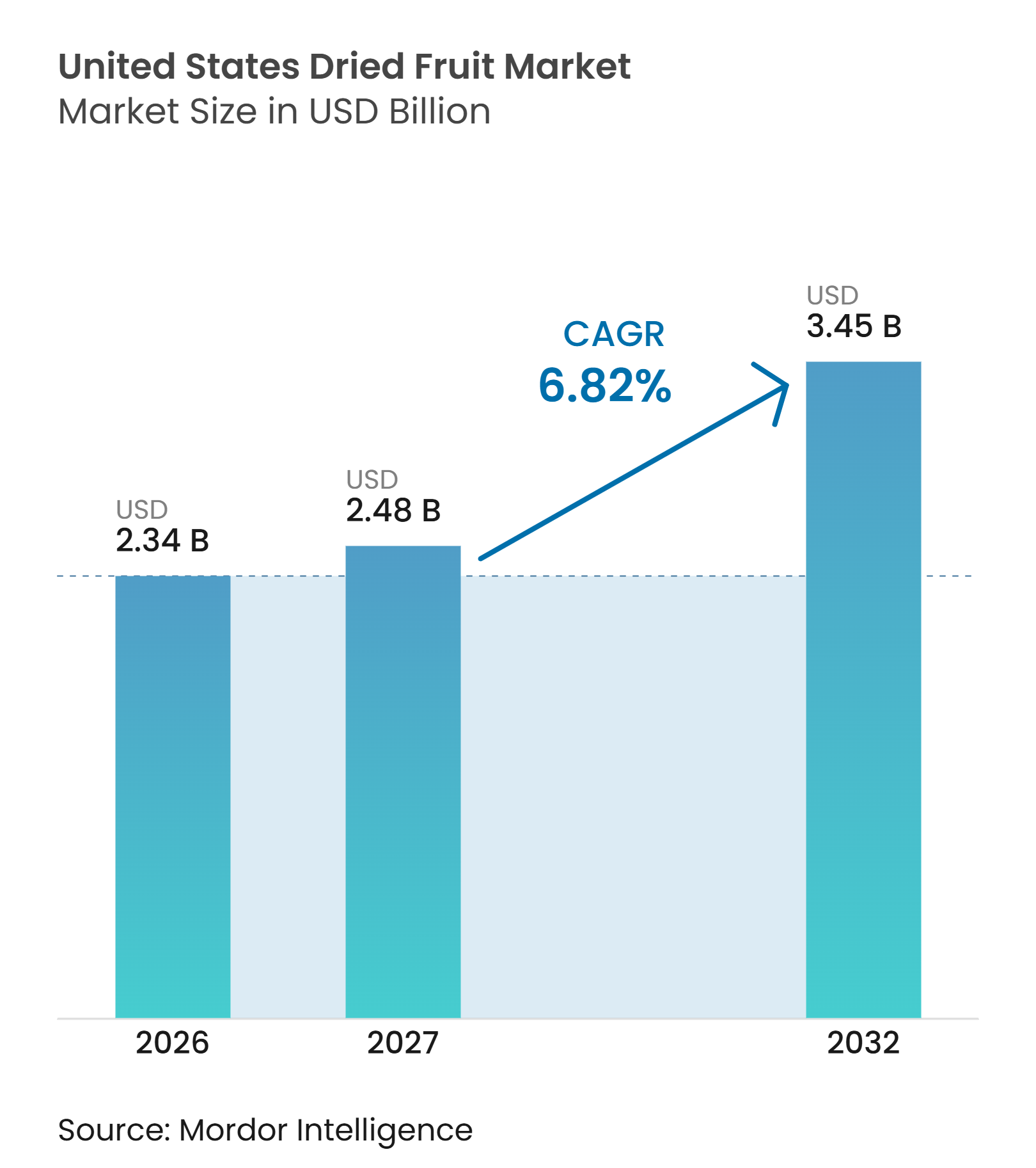
The United States dried fruit market was valued at USD 2.34 billion in 2026 and is estimated to grow from USD 2.48 billion in 2027 to reach USD 3.45 billion by 2032, registering a CAGR of 6.82% during 2027–2032. The market is experiencing steady growth, supported by increasing consumer preference for convenient, nutrient-rich, and shelf-stable fruit products. Growing awareness of the nutritional attributes of dried fruits, including dietary fiber, naturally occurring vitamins, minerals, and antioxidants, is encouraging their incorporation into everyday diets as alternatives to conventional packaged snacks. Additionally, the growing preference for clean-label and minimally processed food products is driving demand for dried fruits with simple ingredient formulations, no added sugars, and fewer artificial additives.
Key Report Takeaways
- By product type, raisins held 31.24% of the United States dried fruit market share in 2026, while mango is forecast to grow at a CAGR of 7.73% through 2032.
- By form, whole and chunks accounted for 45.32% of the United States dried fruit market share in 2026, while powdered and granulated formats are projected to expand at a CAGR of 7.53% through 2032.
- By drying technology, sun and air drying captured 56.43% of the United States dried fruit market share in 2026, while freeze drying is forecast to record a CAGR of 7.49% through 2032.
- By nature, conventional dried fruit held 76.34% of the United States dried fruit market share in 2026, while organic dried fruit is projected to advance at a CAGR of 8.65% through 2032.
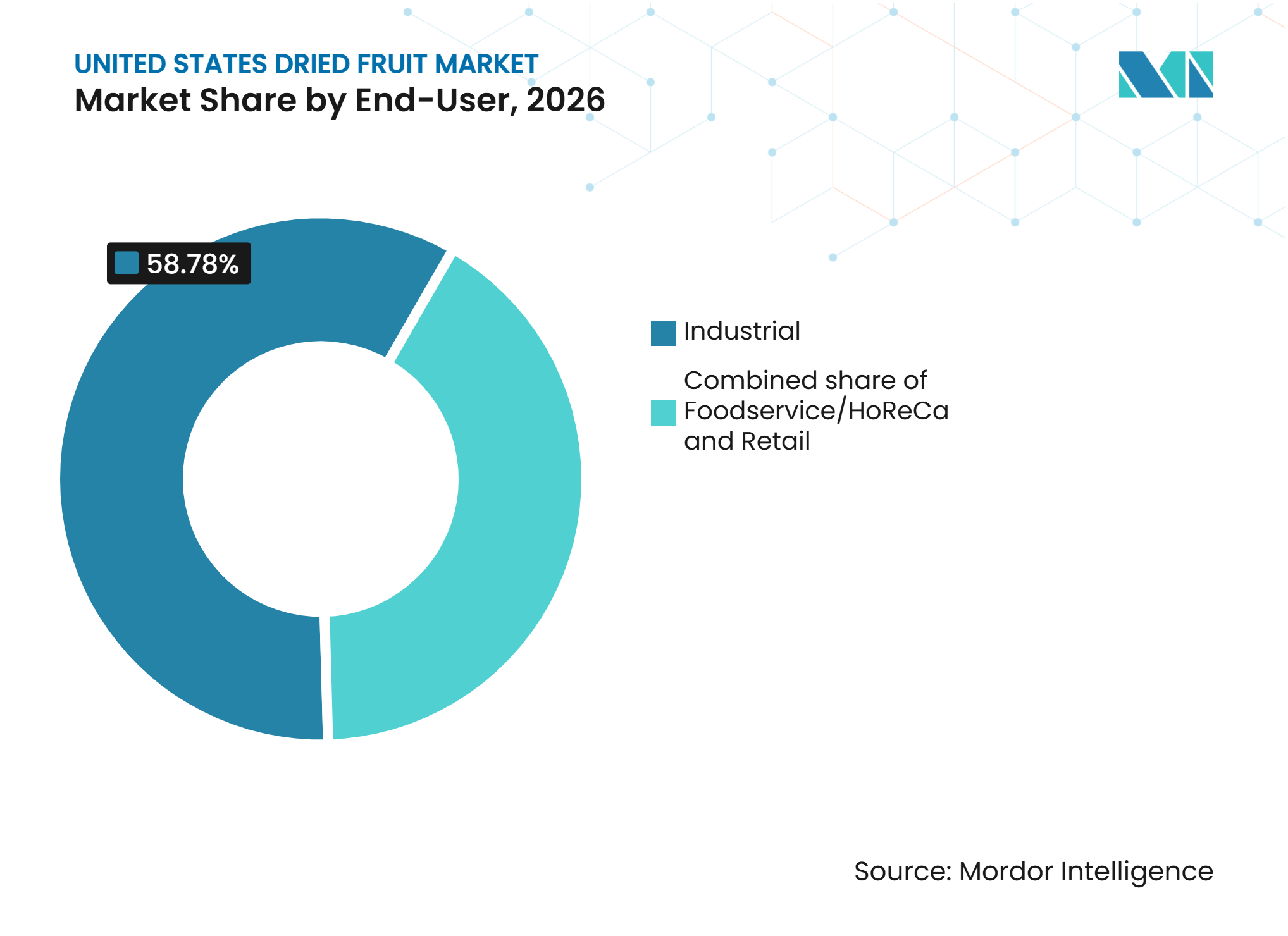
- By end-user, industrial users accounted for 58.78% of the United States dried fruit market share in 2026, while retail is forecast to grow at a CAGR of 8.79% through 2032.
Note: Market numbers in this report are based on Mordor Intelligence's proprietary estimation framework, which combines nine months of actuals with Q4 projections for base year 2026.
Market Trends and Insights
Drivers Impact Analysis of United States Dried Fruit Market*
| Driver | (~) % Impact on CAGR Forecast | Geographic Relevance | Impact Timeline |
|---|---|---|---|
| Consumer preference for healthy snacking options | +1.2% | National, with outsized uptake in West Coast and Northeast urban corridors | Medium term (2–4 years) |
| Demand for clean-label and minimally processed food products | +0.9% | National | Medium term (2–4 years) |
| Popularity of convenient and on-the-go food products | +0.6% | National, accelerated in suburban and transit-corridor markets | Short term (≤ 2 years) |
| Consumer interest in exotic and tropical fruit varieties | +0.8% | National, with highest density in multicultural metropolitan markets | Medium term (2–4 years) |
| Innovation in packaging to maintain freshness, convenience, and traceability | +0.4% | United States compliance shaped by Food and Drug Administration traceability rule | Medium term (2–4 years) |
| Demand for plant-based and fruit-based food ingredients | +0.7% | National, with industrial concentration in Midwest food manufacturing belt | Long term (≥ 4 years) |
| Source: Mordor Intelligence | |||
Consumer Preference for Healthy Snacking Options
Growing consumer preference for healthier snacking options is supporting the growth of the United States dried fruit market, as consumers increasingly seek convenient alternatives to conventional processed snacks, confectionery, and sugar-based products. Rising awareness of dietary fiber, naturally occurring vitamins, minerals, and antioxidants is encouraging the inclusion of dried fruit in everyday snacking routines. Dried fruits offer a convenient way to consume fruit-derived nutrients in a compact format, while their naturally concentrated sweetness serves as an alternative to snacks with high levels of added sugars. Additionally, growing interest in portion-controlled snacking and products with recognizable ingredients is driving demand for unsweetened and minimally processed dried fruit varieties.
Demand for Clean-Label and Minimally Processed Food Products
Growing demand for clean-label and minimally processed food products is supporting the adoption of dried fruits in the United States, as consumers increasingly examine ingredient lists and prefer products with recognizable ingredients and fewer artificial additives. This preference is encouraging manufacturers to offer dried fruit products with simple formulations, particularly those without added sugars, artificial colors, flavors, or unnecessary preservatives. Naturally dried and freeze-dried products are gaining attention because their processing methods remove moisture while retaining the fruit's inherent characteristics, aligning with consumer expectations for less processed food options. For instance, according to the International Food Information Council (IFIC), in 2025, 28% of Americans identified minimally processed foods as an important consideration in their food purchasing decisions[1].
Popularity of Convenient and On-the-Go Food Products
The growing popularity of convenient, on-the-go food products is driven by consumers increasingly preferring snack options that require minimal preparation, are easy to carry, and can be consumed across various daily activities. Dried fruits offer several advantages through their reduced moisture content, compact structure, and extended shelf stability, eliminating the need for refrigeration and reducing concerns related to rapid spoilage. Their availability in resealable pouches, single-serving packs, snack-sized portions, and lightweight packaging further enhances convenience for workplace consumption, commuting, travel, and outdoor activities. Additionally, individually portioned products and resealable packaging help manufacturers maintain product freshness after opening while improving portability and storage convenience.
Consumer Interest in Exotic and Tropical Fruit Varieties
Growing consumer interest in exotic and tropical fruit varieties is driving the market, as consumers seek distinctive flavor profiles and alternatives to conventional fruit-based snacks. Increasing familiarity with tropical fruit varieties, alongside the expanding availability of internationally inspired food products, is encouraging demand for dried fruit options that offer naturally sweet, tangy, and distinctive sensory characteristics. Furthermore, the availability of different product formats, including dried slices, strips, dices, and fruit pieces, is allowing manufacturers to cater to varying texture and flavor preferences. For instance, according to the National Mango Board, mango achieved 27.14% household penetration in the United States in 2025, reflecting its established presence in American households and growing consumer familiarity with the fruit[2]. This familiarity provides a favorable foundation for expanding dried mango offerings and strengthening demand for tropical fruit-based products.
Restraints Impact Analysis of United States Dried Fruit Market*
| Restraint | (~) % Impact on CAGR Forecast | Geographic Relevance | Impact Timeline |
|---|---|---|---|
| High natural sugar concentration in dried fruits | -0.5% | National | Short term (≤ 2 years) |
| Availability of fresh fruit and alternative healthy snacks | -0.4% | National, amplified in metropolitan markets with year-round fresh produce access | Medium term (2–4 years) |
| High processing and production costs | -0.4% | California supply belt; ripple effects across national pricing | Medium term (2–4 years) |
| Variability in raw fruit availability and seasonal supply | -0.5% | California primarily, with downstream impact on national and export supply | Long term (≥ 4 years) |
| Source: Mordor Intelligence | |||
High Natural Sugar Concentration in Dried Fruits
The high concentration of naturally occurring sugars in dried fruits can restrain market growth, particularly among health-conscious consumers who monitor their sugar and carbohydrate intake. The dehydration process removes a substantial proportion of the fruit's water content, concentrating its naturally occurring sugars and increasing sugar content per unit weight compared with fresh fruit. This raises concerns among consumers managing blood glucose levels or following low-sugar diets, potentially limiting their consumption of dried fruit products. Additionally, certain commercially available dried fruits contain added sugars, syrups, or sweeteners to enhance taste and palatability, which may further discourage consumers seeking products with reduced sugar content.
Availability of Fresh Fruit and Alternative Healthy Snacks
The widespread availability of fresh fruits and alternative healthy snack products creates competitive pressure on the United States dried fruit market by offering consumers multiple substitutes with similar nutritional and convenience benefits. Fresh fruits are often preferred due to their higher moisture content, natural juiciness, and perception of being less processed, particularly among consumers who prioritize minimally prepared food options. The growing availability of fruit cups, fruit purees, vegetable chips, roasted legumes, protein snacks, and other nutrient-focused packaged products is also expanding the range of alternatives available to health-conscious consumers. Additionally, ready-to-eat fresh fruit packs and pre-cut fruit products are addressing some of the preparation and portability disadvantages traditionally associated with fresh produce.
*Our forecasts treat driver/restraint impacts as directional, not additive. The impact forecasts reflect baseline growth, mix effects, and variable interactions.
United States Dried Fruit Market Segment Analysis
By Product Type:
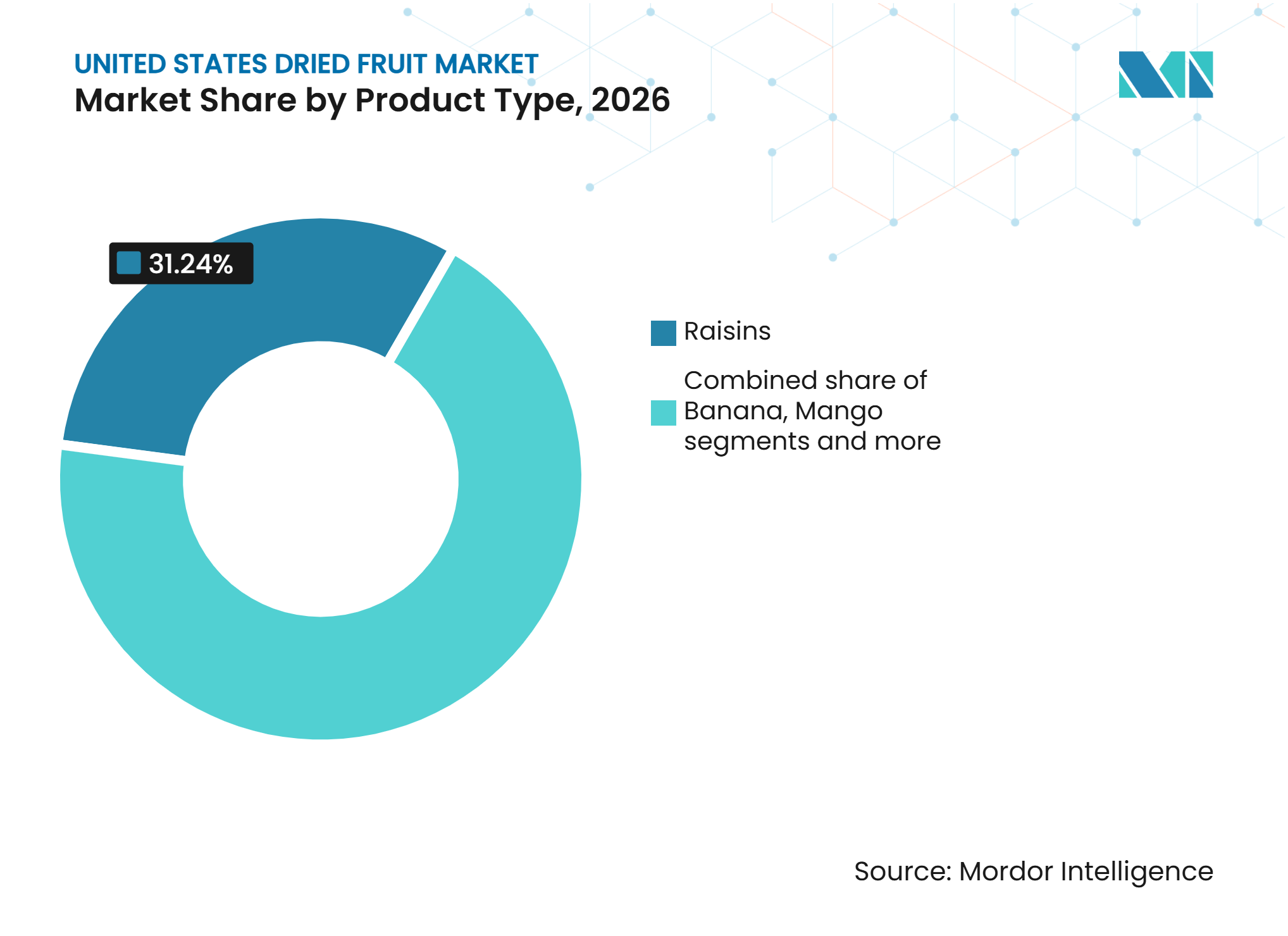
Raisins Anchor Volume, Mango Commands Growth TrajectoryRaisins accounted for 31.24% of the United States dried fruit market by value in 2026, supported by an established production base, consistent raw material availability, and strong consumer familiarity with different raisin varieties. The segment benefits from established processing infrastructure for converting grapes into dried products, alongside specialized handling, grading, cleaning, and sorting capabilities that support product consistency and quality. The availability of seedless, golden, dark, and specialty raisin varieties caters to different consumer preferences in terms of sweetness, color, texture, and appearance. Continued production and processing activity also supports the segment's ability to maintain a consistent supply of finished products. For instance, according to the California Department of Food and Agriculture (CDFA), free raisin tonnage produced by handlers in 2025 totaled 15,413 tons, reflecting continued raisin production and processing activity in the United States market[3].
Mango is the fastest-growing product type in the United States dried fruit market, registering a forecast CAGR of 7.73% during 2027–2032. The segment's growth is supported by increasing consumer interest in tropical fruit varieties, distinctive flavor profiles, and naturally sweet snack alternatives. Mango offers a characteristic sweet-tangy flavor, appealing color, and soft, chewy texture, differentiating it from more traditional dried fruit varieties. Its suitability for different processing formats, including dried slices, strips, dices, and freeze-dried pieces, allows manufacturers to offer products with varying textures and consumption experiences. The availability of unsweetened, organic, preservative-free, and flavored dried mango varieties is also broadening consumer choice, particularly among consumers seeking recognizable fruit ingredients and minimally processed snacks.



By Form:
Whole Formats Drive Shelf Innovation, Powdered Forms Redefine Industrial SourcingWhole and chunks accounted for 45.32% of the United States dried fruit market by value in 2026, driven by their ability to retain the recognizable appearance, natural texture, and characteristic flavor of the original fruit. This format benefits from minimal physical modification, allowing consumers and food manufacturers to identify the original fruit variety while maintaining its distinctive shape and eating characteristics. The availability of different cutting styles, including whole pieces, halves, slices, diced, and chunks, provides flexibility in product presentation and portion sizes. Furthermore, whole and chunk formats generally require fewer additional processing steps than finely milled fruit ingredients, supporting their positioning as relatively straightforward dried fruit products.
Powdered and granulated dried fruit is the fastest-growing form segment, registering a forecast CAGR of 7.53% during 2027–2032. Growth is supported by increasing demand for concentrated fruit ingredients that can be easily incorporated into different food formulations without the handling and size constraints associated with whole fruit pieces. These formats offer advantages in terms of controlled ingredient dosing, uniform distribution, convenient storage, and formulation flexibility. Dried mango, banana, apple, and strawberry powders provide concentrated fruit flavor, color, and natural sweetness, making them attractive ingredients for manufacturers seeking fruit-derived alternatives to conventional flavoring and coloring ingredients. Additionally, advancements in spray drying, freeze drying, and milling technologies are improving powder consistency, solubility, particle-size control, and flavor retention.
By Drying Technology:
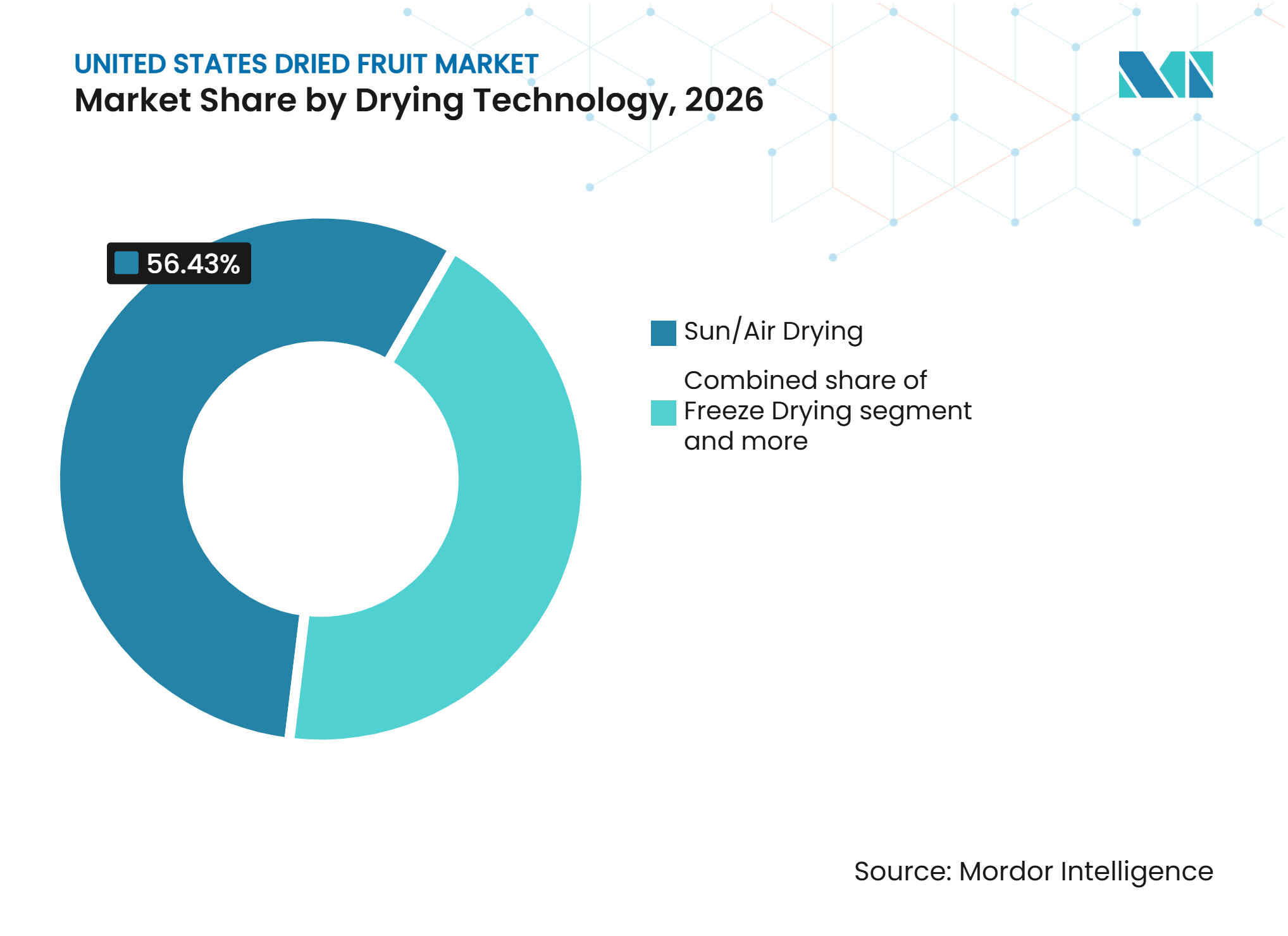
Traditional Methods Sustain Scale, Freeze Drying Unlocks Premium ValueSun and air drying accounted for 56.43% of the United States dried fruit market by value in 2026, driven by established processing infrastructure, operational simplicity, and suitability for large-scale commercial production. These methods benefit from relatively straightforward equipment requirements and established operating practices, allowing processors to handle substantial quantities of raw materials without the complex machinery and energy-intensive conditions associated with advanced drying technologies. Sun drying utilizes natural solar energy, while controlled air drying provides greater flexibility in regulating temperature, airflow, and moisture removal. Improvements in industrial dehydration systems, including automated airflow controls, temperature monitoring, and humidity regulation, are helping processors achieve more uniform moisture distribution, reduce product inconsistencies, and improve processing efficiency.
Freeze drying is the fastest-growing drying technology segment, registering a forecast CAGR of 7.49% during 2027–2032. Growth is driven by increasing demand for premium dried fruit ingredients that retain their original structure, color, flavor, and sensory characteristics during moisture removal. The sublimation-based process removes water from frozen materials under vacuum conditions, producing lightweight, porous, and crispy products without relying on conventional high-temperature dehydration. This differentiates freeze-dried products through their distinctive texture, rapid rehydration characteristics, and comparatively strong retention of heat-sensitive nutritional compounds. Advancements in vacuum pump systems, freezing equipment, automated process controls, and sublimation management are further improving drying consistency and operational efficiency.

By Nature:
Conventional Scale vs. Organic AccelerationConventional dried fruits accounted for 76.34% of the United States dried fruit market by value in 2026, driven by their established commercial availability, extensive supplier networks, and broad accessibility across different product categories. The segment benefits from well-established agricultural sourcing and processing systems that allow manufacturers to procure raw materials through conventional farming channels and maintain consistent production volumes. Compared with certified organic products, conventional dried fruits generally involve fewer certification-related requirements, providing processors with greater flexibility in sourcing and supplier selection. Established processing practices, standardized quality specifications, and widely available conventional-grade raw materials further support efficient procurement, grading, and manufacturing operations.
Organic dried fruits represent the fastest-growing segment by nature, registering a forecast CAGR of 8.65% during 2027–2032, supported by strong consumer and institutional demand for certified organic food ingredients. Increasing scrutiny of agricultural production practices, pesticide use, and ingredient traceability is encouraging consumers to seek dried fruits produced under recognized organic farming standards. The segment benefits from the growing emphasis on transparent sourcing, environmentally responsible cultivation, and the avoidance of prohibited synthetic agricultural inputs. Growing availability of certified organic raw materials, improvements in organic processing and segregation practices, and greater participation of specialty food suppliers are also supporting the segment's development.
By End-User:
Industrial Depth, Retail VelocityIndustrial end-users accounted for 58.78% of the United States dried fruit market by value in 2026, driven by their requirement for consistent, standardized, and large-volume dried fruit ingredients for commercial food manufacturing. The segment benefits from the ability to supply dried fruits in different specifications, including whole pieces, dices, flakes, granules, and powders, allowing manufacturers to select ingredients according to their formulation and processing requirements. The relatively low moisture content of dried fruit ingredients also supports easier bulk storage, inventory management, and transportation compared with fresh fruit inputs. Established procurement arrangements, long-term supplier relationships, and standardized quality specifications further enable industrial buyers to maintain consistency across production batches.
Retail is the fastest-growing end-user channel, registering a forecast CAGR of 8.79% during 2027–2032, supported by increasing consumer interest in convenient, ready-to-consume fruit-based products and greater availability of differentiated packaged dried fruits. The segment benefits from the expansion of resealable packaging, single-serve portions, and multipack formats that improve product convenience, freshness management, and portability. Increasing product differentiation through unsweetened, no-added-sugar, organic, flavored, and specialty dried fruit varieties is broadening consumer choice and encouraging manufacturers to introduce more targeted retail offerings. The growing availability of specialty dried fruit varieties through organized grocery retail and online shopping platforms is further improving product accessibility.
Geography Analysis
The California Supply Belt
California serves as the primary production base for the United States dried fruit market, supported by its established fruit-growing ecosystem, favorable climatic conditions, extensive agricultural infrastructure, and well-developed processing capabilities. The state's Central Valley provides suitable growing conditions for several fruit varieties, while its concentration of agricultural producers, packing facilities, dehydration units, and fruit-processing operations supports an integrated supply chain from cultivation to finished dried fruit production. Key producing counties, including Fresno, Sutter, Madera, Merced, Tulare, and Kern, contribute to the state's fruit production and processing ecosystem. The availability of established irrigation infrastructure, agricultural expertise, specialized harvesting practices, and proximity to processing facilities enables producers to maintain consistent raw material supplies and manage seasonal harvests efficiently.
The Eastern Consumption Corridor
The northeastern and Mid-Atlantic states represent an important consumption market for premium and organic dried fruits, supported by concentrated urban retail networks, established specialty grocery infrastructure, and consumer interest in differentiated food products. States such as New York, New Jersey, Massachusetts, Pennsylvania, and Maryland offer well-developed grocery retail systems, natural food stores, and specialty retailers that provide access to organic, minimally processed, and premium packaged dried fruit products. Consumer interest in ingredient transparency, organic certification, reduced-added-sugar formulations, and recognizable fruit ingredients is encouraging the availability of differentiated dried fruit offerings across these markets. Additionally, established e-commerce penetration and the presence of specialty food retailers improve access to niche products, including freeze-dried and organically certified varieties.
Midwest and Southern Growth in Broadening Markets
Dried fruit demand across the Midwest and South is increasing as health-oriented snacking preferences extend beyond traditional coastal consumption markets and dried fruit products become more accessible through mainstream retail channels. The expansion of supermarket chains, discount grocery outlets, warehouse clubs, and suburban retail formats is improving the availability of packaged dried fruits across a wider range of consumer markets. In particular, warehouse clubs and larger grocery retailers are strengthening product accessibility through family-sized packs, multipacks, and value-oriented packaging formats. Growing interest in convenient fruit-based snacks, lunchbox products, and portable food options is also supporting broader acceptance of dried fruits among consumers seeking alternatives to conventional packaged snacks.
Competitive Landscape
Market Concentration
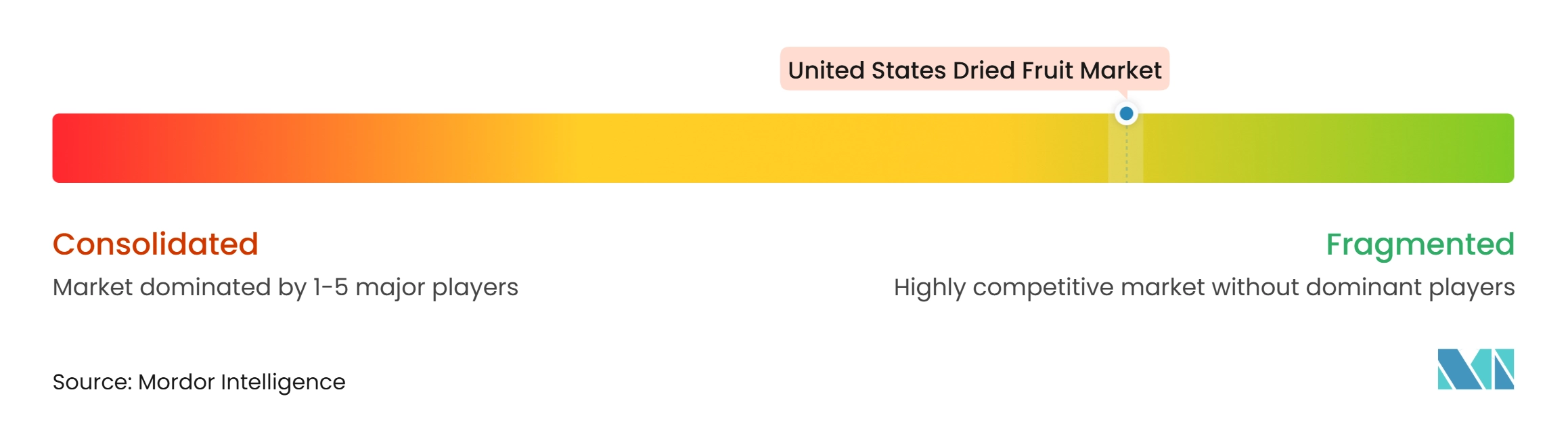
The United States dried fruit market is fragmented, with established grower-owned cooperatives, specialized dried fruit processors, organic product manufacturers, ingredient suppliers, and regional producers. Competition is primarily driven by product quality, raw material sourcing capabilities, processing technologies, product differentiation, organic certifications, and distribution reach. Major participants include Sun-Maid Growers of California, Ocean Spray Cranberries, Inc., Sunsweet Growers Inc., Mariani Packing Company, Inc., and Graceland Fruit, Inc. These companies maintain their market presence through established procurement networks, diversified dried fruit portfolios, and investments in processing and packaging capabilities.
Competition is increasingly influenced by product portfolio diversification, organic certifications, and investments in advanced drying technologies. Manufacturers are expanding their offerings through organic-certified, unsweetened, preservative-free, and specialty dried fruit varieties to address changing consumer preferences and differentiated ingredient requirements. The growing adoption of freeze-drying, controlled-air dehydration, and other advanced processing techniques is enabling the development of products with improved texture, color retention, and flavor characteristics. The availability of different product specifications, including whole fruits, slices, and powders, is allowing processors to differentiate their portfolios and cater to varying quality and processing requirements across the market.
Market participants are also strengthening their competitive positions through strategic partnerships, agricultural sourcing relationships, processing capacity improvements, and distribution expansion. Long-term relationships with growers and raw material suppliers help ensure consistent fruit availability, improve sourcing traceability, and maintain quality standards. Partnerships with retailers, food manufacturers, and ingredient distributors support wider market access and the development of customized product specifications. Investments in sustainable packaging, automated sorting, quality control systems, and moisture management technologies are further helping manufacturers improve operational efficiency and product consistency.
United States Dried Fruit Industry Leaders
-
Sun-Maid Growers of California
-
Ocean Spray Cranberries, Inc.
-
Sunsweet Growers Inc.
-
Mariani Packing Co., Inc.
-
Graceland Fruit, Inc.
- *Disclaimer: Major Players sorted in no particular order
United States Dried Fruit Market Companies Covered in this Report
- Sun-Maid Growers of California
- Ocean Spray Cranberries, Inc.
- Sunsweet Growers Inc.
- Mariani Packing Co., Inc.
- National Raisin Company
- Graceland Fruit, Inc.
- Traina Foods
- Valley Fig Growers
- Bella Viva Orchards
- Bergin Fruit and Nut Company
- Made In Nature
- Brothers All Natural
- Dole Packaged Foods, LLC
- Red River Foods, Inc.
- Sunbeam Foods
- Paradise Fruits Solutions
- Importaco North America
- Dohler North America
- Del Monte Foods, Inc.
- TreeHouse Foods, Inc.
Recent Industry Developments in United States Dried Fruit Market
- September 2026: Sun-Maid Growers of California launched its Charcuterie Pairings product line, featuring four curated varieties of portioned dried fruit and berry assortments, available at Walmart and Target locations nationwide. The product line targets the premium entertaining snack occasion.
- July 2026: Fruit Bliss announced that its products are available across all 12 Erewhon locations in Southern California. The company uses a hydration process that infuses organic dried fruit with water to create a soft, juicy texture, with no added sugar.
- April 2026: Laird Superfood, Inc. completed the acquisition of Terrasoul Superfoods, LLC for USD 48 million in cash. Terrasoul offers a portfolio of superfood ingredients, including dried fruits, nuts, seeds, powders, and baking ingredients, supported by its vertically integrated sourcing and processing.
United States Dried Fruit Market Report Scope
Dry fruits are fruits that have had almost all of their water content removed, either naturally through sun-drying or through industrial and freeze-drying methods. The United States Dried Fruit Market is segmented by product type, form, drying technology, nature, and end user. Based on product type, the market is segmented into mango, banana, apple, pineapple, papaya, raisins, and others. Based on form, the market is segmented into whole and chunks, sliced, powdered/granulated, and paste and puree concentrates. Based on drying technology, the market is segmented into sun/air drying, freeze drying, spray drying, vacuum/microwave and infrared drying, and osmotic infusion and dehydration. Based on nature, the market is segmented into conventional and organic. Based on end user, the market is segmented into industrial, foodservice/HoReCa, and retail, with retail further segmented into supermarkets/hypermarkets, convenience/grocery stores, online retail stores, and other distribution channels. The report provides market size and forecasts in both value (USD) and volume (Tons) for all the mentioned segments.
Segmentation Overview
| Mango |
| Banana |
| Apple |
| Pineapple |
| Papaya |
| Raisins |
| Others |
| Whole and Chunks |
| Sliced |
| Powdered/Granulated |
| Paste and Puree Concentrates |
| Sun/Air Drying |
| Freeze Drying |
| Spray Drying |
| Vacuum/Microwave and Infrared Drying |
| Osmotic Infusion and Dehydration |
| Conventional |
| Organic |
| Industrial | |
| Foodservice/HoReCa | |
| Retail | Supermarkets/Hypermarkets |
| Convenience/Grocery Stores | |
| Online Retail Stores | |
| Other Distribution Channels |
| By Product Type | Mango | |
| Banana | ||
| Apple | ||
| Pineapple | ||
| Papaya | ||
| Raisins | ||
| Others | ||
| By Form | Whole and Chunks | |
| Sliced | ||
| Powdered/Granulated | ||
| Paste and Puree Concentrates | ||
| By Drying Technology | Sun/Air Drying | |
| Freeze Drying | ||
| Spray Drying | ||
| Vacuum/Microwave and Infrared Drying | ||
| Osmotic Infusion and Dehydration | ||
| By Nature | Conventional | |
| Organic | ||
| By End-User | Industrial | |
| Foodservice/HoReCa | ||
| Retail | Supermarkets/Hypermarkets | |
| Convenience/Grocery Stores | ||
| Online Retail Stores | ||
| Other Distribution Channels | ||
Key Questions Answered in the Report
What is the size of the United States dried fruit market?
The United States dried fruit market is valued at USD 2.34 billion in 2026 and is projected to reach USD 3.45 billion by 2032, at a CAGR of 6.82% from 2027 to 2032.
Which dried fruit product leads sales in the United States?
Raisins lead sales, accounting for 31.24% of the United States dried fruit market share in 2026. California produces 100% of U.S. raisins within a concentrated production area near Fresno.
Which product category is growing fastest in the United States dried fruit sector?
Mango is the fastest-growing product category, with a projected CAGR of 7.73% through 2032. According to the National Mango Board, United States household penetration of mangoes reached 27.14% in 2025, reflecting growing consumer familiarity and acceptance of mango products.
Which drying technology has the highest growth potential?
Freeze drying is forecast to expand at a CAGR of 7.49% through 2032, supported by demand for products with preserved texture, longer shelf life, and nutrient retention.