
United States Azelaic Acid Cosmetics Market Size and Share
Market Overview
| Study Period | 2022 - 2032 |
|---|---|
| Forecast Data Period | 2027 - 2032 |
| Base Year Market Size (2026) | USD 82.56 Million |
| Market Size (2027) | USD 90.71 Million |
| Market Size (2032) | USD 142.99 Million |
| Growth Rate (2027 - 2032) | 9.53 % |
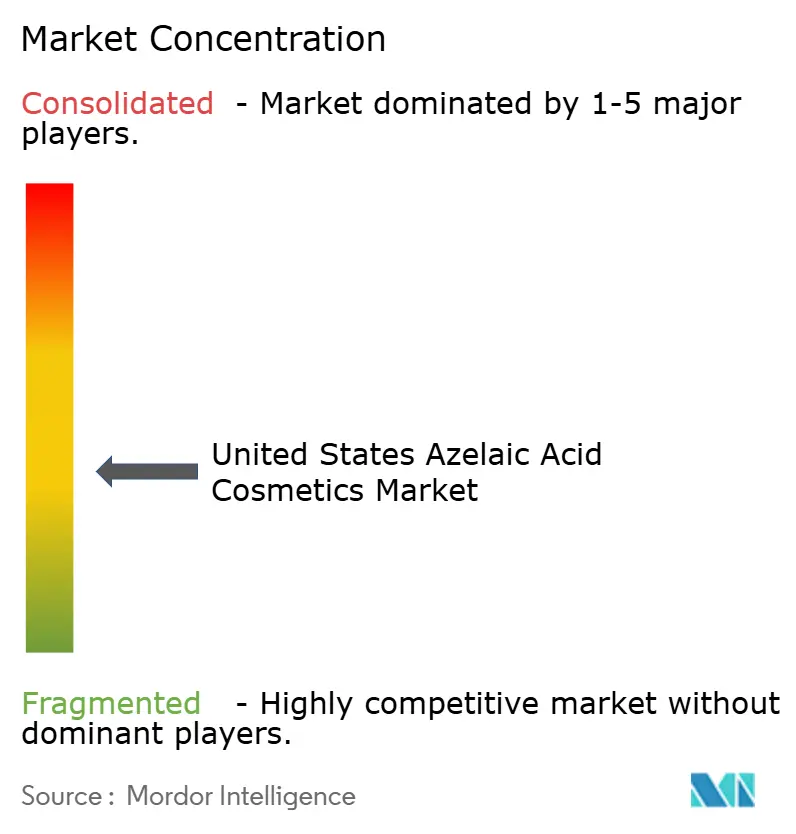
| Market Concentration | Medium |
Major Players *Disclaimer: Major Players sorted in no particular order Image © Mordor Intelligence. Reuse requires attribution under CC BY 4.0. | |
United States Azelaic Acid Cosmetics Market Analysis by Mordor Intelligence
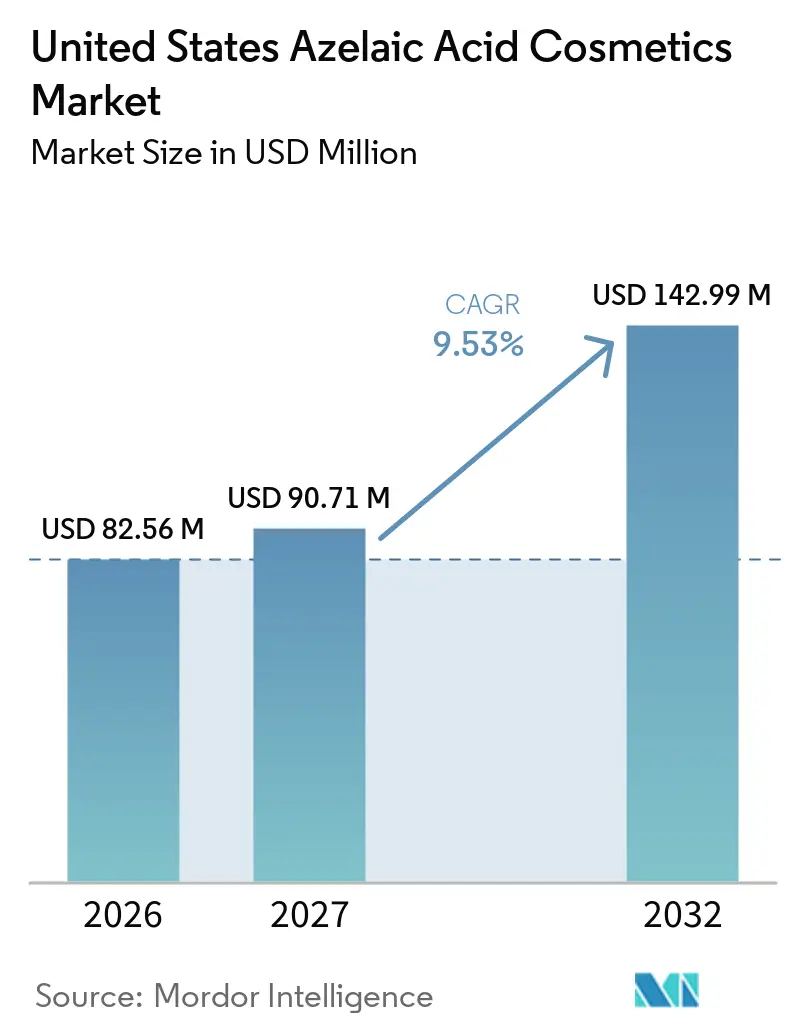
The United States azelaic acid cosmetics market was valued at USD 82.56 million in 2026 and is estimated to grow from USD 90.71 million in 2027 to reach USD 142.99 million by 2032, registering a CAGR of 9.53% during the forecast period (2027–2032). Market growth is driven by increasing consumer interest in targeted skincare solutions, rising awareness of active ingredients, and growing demand for products addressing hyperpigmentation, post-acne marks, and visible redness. The growing preference for science-backed skincare and multifunctional formulations is further supporting the adoption of azelaic acid as a cosmetic ingredient. Additionally, digital skincare education and greater access to ingredient-specific information are improving consumer familiarity with azelaic acid and its cosmetic benefits, supporting market expansion over the forecast period.
Key Report Takeaways
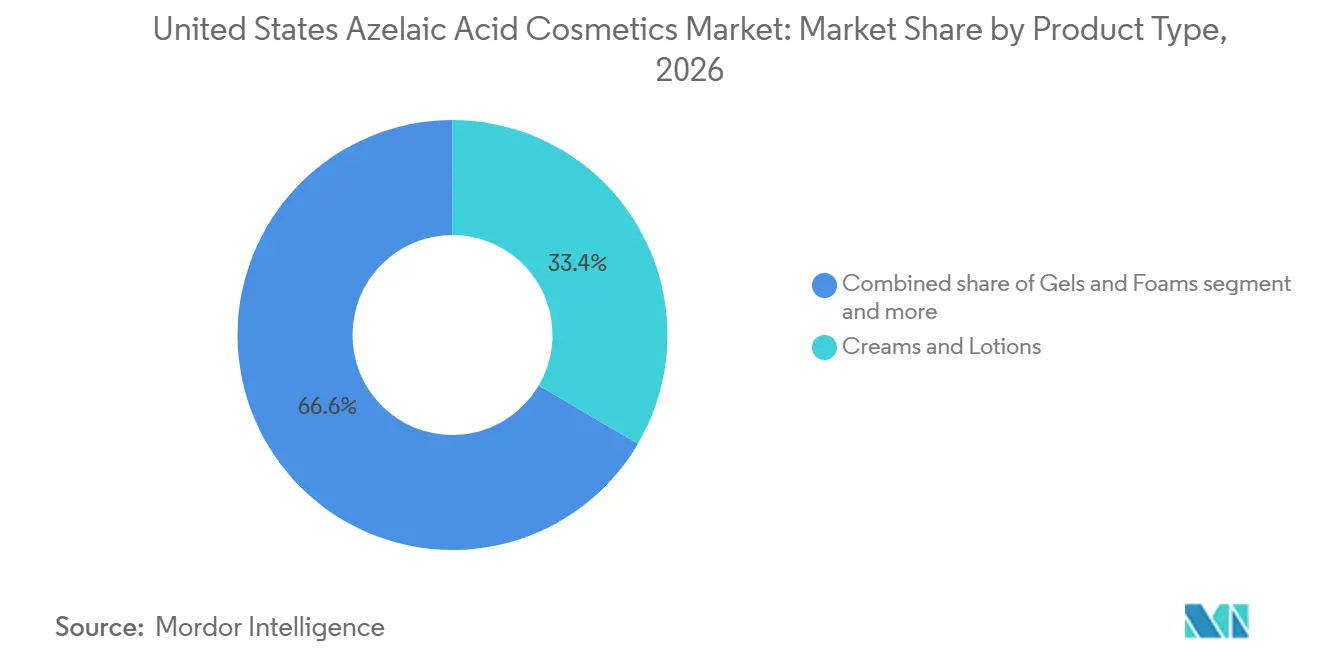
- By product type, creams and lotions held 33.44% of the United States azelaic acid skin care market share in 2026, while serums, ampoules, and essences are projected to grow at a 10.67% CAGR through 2032.
- By concentration, moderate concentration products accounted for 47.19% of the United States azelaic acid skin care market share in 2026, while medical-grade cosmetics are forecast to expand at a 10.73% CAGR through 2032.
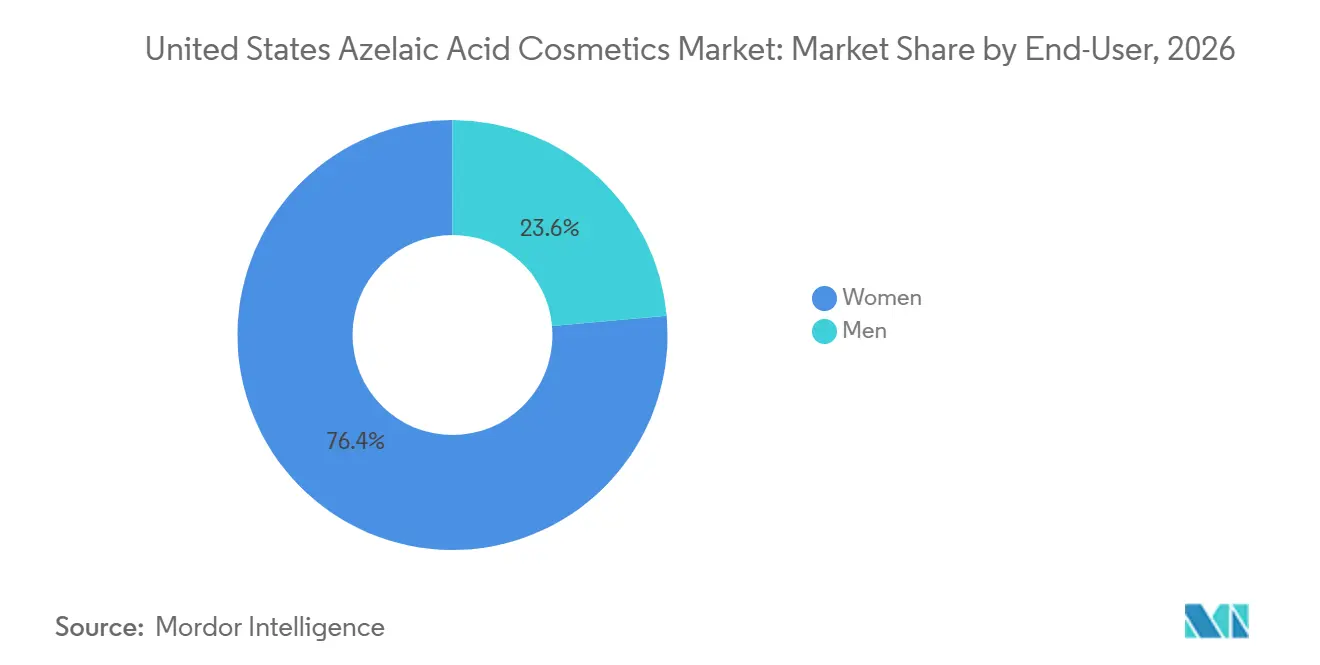
- By end user, women represented 76.43% of spending in 2026, while men are projected to record the highest CAGR of 10.09% through 2032.
- By distribution channel, specialty beauty and health stores retained 42.65% of the market in 2026, while online retail is forecast to grow at an 11.56% CAGR through 2032.
Note: Market numbers in this report are based on Mordor Intelligence's proprietary estimation framework, which combines nine months of actuals with Q4 projections for base year 2026.
United States Azelaic Acid Cosmetics Market Trends and Insights
Drivers Impact Analysis*
| Driver | (~) % Impact on CAGR Forecast | Geographic Relevance | Impact Timeline |
|---|---|---|---|
| Increasing demand for hyperpigmentation and dark spot treatments | +1.8% | National, with early gains in Florida, New York, and California | Medium term (2–4 years) |
| Growing focus on rosacea-prone skin care | +1.4% | National, concentrated in Northeast and Sun Belt states | Medium term (2–4 years) |
| Innovation in combination-based skincare formulations | +1.5% | National | Long term (≥ 4 years) |
| Expansion of dermatologist-recommended skincare routines | +1.3% | National, urban markets with high dermatologist density | Medium term (2–4 years) |
| Social-commerce discovery of ingredient-led routines | +1.6% | National, Gen Z and Millennial concentrated states (New York, Texas) | Short term (≤ 2 years) |
| Increasing popularity of targeted facial serums and treatments | +1.2% | National | Medium term (2–4 years) |
| Source: Mordor Intelligence | |||
Rising Clinical Demand for Hyperpigmentation and Dark Spot Correction
Growing demand for treatments targeting hyperpigmentation and dark spots is supporting the United States azelaic acid cosmetics market. Consumers increasingly seek solutions for post-inflammatory hyperpigmentation, acne marks, and uneven skin tone. Azelaic acid is valued in dermatological skincare for its effects on melanin production and its role in managing discoloration, making it an important active ingredient in complexion-correcting formulations. Its ability to address both blemishes and pigmentation concerns appeals to consumers seeking ingredients that target multiple skin issues within a single skincare routine. Greater attention to persistent dark spots and the desire for a more even complexion are further encouraging demand for azelaic acid-based serums, creams, and other topical products.
Accelerating Clinical Interest in Rosacea-Prone Skin Care
Growing awareness of rosacea and the need for skincare products suitable for redness-prone and sensitive skin are supporting demand for azelaic acid cosmetics in the United States. Consumers increasingly seek topical formulations that help improve the appearance of persistent facial redness, blemishes, and uneven skin texture associated with rosacea-prone skin. Azelaic acid's established role in dermatological care and its availability in cosmetic skincare formulations make it relevant to consumers looking for targeted complexion care. According to the National Rosacea Society (NRS), more than 16 million Americans were affected by rosacea in 2025[1]. This substantially affected population highlights the relevance of redness-focused skincare and creates opportunities for azelaic acid-based products designed to address related cosmetic concerns.
Innovation in Combination-Based Skincare Formulations
Innovation in combination-based skincare formulations is supporting the United States azelaic acid cosmetics market by enabling brands to address multiple skin concerns through a single product. Combining azelaic acid with complementary ingredients allows formulations to target uneven skin tone while supporting skin comfort, hydration, or the appearance of redness. This approach allows brands to differentiate products based on ingredient combinations, texture, and specific skincare needs rather than relying solely on azelaic acid concentration. For instance, The INKEY List offers its 10% Azelaic Acid Serum for Redness Relief, formulated with 0.3% allantoin to soothe the skin and green pigments to help neutralize the appearance of redness, illustrating how combining azelaic acid with complementary ingredients can support differentiated formulations for redness-prone skin.
Expansion of Dermatologist-Recommended Skincare Routines
The growing adoption of dermatologist-recommended skincare routines is driving demand for azelaic acid cosmetics in the United States, as consumers increasingly incorporate targeted active ingredients into their regular facial care regimens. Greater awareness of ingredient-based skincare is encouraging consumers to seek products that address acne-related discoloration, uneven skin tone, and visible redness. Azelaic acid's ability to address multiple complexion concerns makes it relevant to routines focused on improving skin appearance without relying on single-purpose treatments. Growing interest in science-backed skincare and personalized product selection further supports the inclusion of azelaic acid in serums, creams, and other topical formulations designed for consistent use.
Restraints Impact Analysis*
| Restraint | (~) % Impact on CAGR Forecast | Geographic Relevance | Impact Timeline |
|---|---|---|---|
| Formulation difficulty from low water solubility | -0.9% | National; affects all product formulations equally | Long term (≥ 4 years) |
| Substitution by retinoids, salicylic acid, niacinamide, and tranexamic acid | -1.3% | National | Medium term (2–4 years) |
| Limited consumer awareness of azelaic acid | -0.8% | National, especially non-coastal markets | Short term (≤ 2 years) |
| Risk of misleading or overstated product claims | -0.7% | National; Federal Trade Commission (FTC) compliance exposure relevant | Medium term (2–4 years) |
| Source: Mordor Intelligence | |||
Formulation Complexity from Low Aqueous Solubility
Azelaic acid's low aqueous solubility presents a formulation challenge for the United States azelaic acid cosmetics market. Incorporating this ingredient into stable, uniform, and aesthetically appealing skincare products requires careful selection of formulation vehicles and excipients. Limited solubility can lead to crystallization, gritty textures, and difficulties in maintaining consistent ingredient dispersion, which may affect product spreadability and consumer experience. Formulators may need to optimize particle size, emulsifier systems, or delivery technologies to achieve the desired product characteristics, increasing research, development, and testing requirements. These challenges can also limit flexibility when developing lightweight serums, gels, and other formulations where smooth texture and stability are important, potentially slowing product development.
Substitution by Retinoids, Salicylic Acid, Niacinamide, and Tranexamic Acid
The availability of alternative skincare actives restrains the United States azelaic acid cosmetics market by intensifying competition among consumers seeking solutions for acne, hyperpigmentation, and uneven skin tone. Retinoids are widely used in skincare routines targeting acne and skin texture, while salicylic acid appeals to consumers seeking exfoliation and management of clogged pores. Niacinamide serves as an alternative for addressing uneven skin tone and supporting the skin barrier, whereas tranexamic acid is used in formulations targeting dark spots and discoloration. These ingredients benefit from established consumer awareness and broad representation across skincare product categories, which may divert demand away from azelaic acid formulations.
*Our forecasts treat driver/restraint impacts as directional, not additive. The impact forecasts reflect baseline growth, mix effects, and variable interactions.
Segment Analysis
By Product Type: Creams and Lotions Lead While Serum Innovation Accelerates
Creams and lotions accounted for 33.44% of the United States azelaic acid skin care market in 2026, supported by their versatility in accommodating different skincare preferences and formulation requirements. Creams offer richer textures suited to consumers who prefer moisturized skin after application, while lotions provide lighter consistency and easier spreading across broader facial areas. This flexibility allows formulators to adjust viscosity, emollient content, and absorption characteristics to suit different product positioning strategies. Azelaic acid's limited water solubility also makes the selection of a formulation vehicle important for maintaining uniform ingredient distribution and product stability.
Serums, ampoules, and essences are the fastest-growing format, projected to grow at a CAGR of 10.67% through 2032, driven by consumer preference for lightweight, targeted skincare formulations that fit easily into multi-step routines. Their fluid textures allow convenient layering with moisturizers, sunscreens, and other skincare products without the heavier feel associated with richer formulations. These formats also support the development of ingredient-focused products that emphasize azelaic acid concentration, complementary active ingredients, and specific formulation benefits, making it easier for consumers to select products based on their skincare preferences. The growing popularity of treatment-oriented skincare and online ingredient education further drives interest in these formats, as consumers increasingly compare formulations based on composition and intended benefits.

By Concentration: Moderate Tiers Anchor Volume, Medical-Grade Captures Growth Premium
Moderate-concentration products held 47.19% of the United States azelaic acid skin care market in 2026, supported by their suitability for developing formulations that balance active ingredient content with product usability. Moderate concentrations provide formulators with flexibility to design products for regular skincare routines while managing texture, spreadability, and overall formulation tolerability. This concentration range also allows brands to differentiate products through complementary ingredients, moisturization properties, and targeted cosmetic positioning without relying exclusively on higher active ingredient levels. In addition, moderate concentrations appeal to consumers who prefer a measured approach to introducing active ingredients into established skincare routines.
Medical-grade cosmetic formulations are the fastest-growing concentration tier, projected to grow at a CAGR of 10.73% through 2032, driven by increasing consumer interest in higher-strength, science-based skincare products that offer targeted cosmetic benefits. Consumers seeking specialized solutions for persistent blemish marks and uneven skin tone are drawn to formulations positioned around precise active ingredient levels and evidence-based product development. This tier also benefits from demand for skincare that bridges everyday beauty routines and dermatologist-informed approaches, with greater emphasis on ingredient transparency, usage guidance, and clearly defined product benefits.
By End-User: Women Anchor Demand While Men Register Accelerating Category Uptake
Women accounted for 76.43% of the United States azelaic acid skin care market in 2026, supported by established engagement with multi-step facial skincare routines and targeted products addressing uneven skin tone, blemishes, and visible redness. Regular use of facial serums, moisturizers, and corrective treatments creates opportunities for azelaic acid products to be incorporated into daily and nighttime skincare regimens. Interest in achieving a more even complexion and addressing post-blemish marks further supports continued demand for active-ingredient-based skincare. Beauty-focused digital content, ingredient education, and online product reviews also help consumers compare formulations and identify products suited to their individual skincare concerns.
Men represent the fastest-growing end-user segment, with a projected CAGR of 10.09% through 2032, driven by increasing interest in targeted facial skincare and the growing integration of specialized products into men's personal care routines. Greater attention to blemishes, post-acne marks, uneven skin tone, and visible redness is creating demand for azelaic acid-based formulations designed to address specific skincare needs. The availability of lightweight serums, facial moisturizers, and straightforward skincare products may further encourage adoption among men seeking simple routines without multiple specialized steps. Growing awareness of active skincare ingredients and dermatologist-recommended approaches is also supporting interest in azelaic acid as an option for addressing common complexion concerns, contributing to the segment's growth.
By Distribution Channel: Specialty Retail Sustains Discovery While Online Channels Accelerate
Specialty beauty and health stores held 42.65% of the United States azelaic acid skin care market in 2026, supported by their specialized product assortments, in-person shopping experience, and access to skincare guidance. These retailers allow consumers to compare formulations, understand ingredient characteristics, and select products based on their individual skincare preferences. Their curated ranges also improve the visibility of specialized active ingredients such as azelaic acid, helping consumers discover targeted facial care products alongside complementary skincare solutions. For instance, Ulta Beauty operated 1,505 stores across the United States as of January 31, 2026. Its extensive store network and dedicated skincare offerings provide consumers with opportunities to explore specialized facial care products through physical retail channels, supporting the accessibility of azelaic acid-based skincare formulations.
Online retail is the fastest-growing distribution channel, projected to register a CAGR of 11.56% through 2032. This growth is driven by the convenience of digital product discovery, access to specialized skincare formulations, and the ability to compare ingredient compositions, product reviews, and usage guidance before purchasing. Online platforms also allow consumers to explore a broader range of azelaic acid serums, creams, and targeted treatments than may be available at individual physical retail outlets. For instance, according to the United States Census Bureau, retail e-commerce sales reached USD 1.234 trillion in 2025, increasing 5.4% from 2024[2]. This expansion of online retail provides a favorable distribution environment for azelaic acid skincare brands seeking to improve product accessibility and reach consumers searching for targeted skincare solutions.
Geography Analysis
The United States azelaic acid cosmetics market is shaped by regional differences in skincare needs, consumer awareness of active ingredients, and the availability of specialized beauty products. California, New York, Texas, and Florida are key states, as their established beauty retail networks and broad selection of skincare products support consumer access to targeted facial treatments. Demand for formulations addressing blemishes, post-acne marks, uneven skin tone, and visible redness creates opportunities for azelaic acid products across both specialty retail and online distribution channels. Regional differences in skincare preferences and product discovery also influence how brands position their formulations and reach consumers.
Florida represents a notable personal care market in the United States. According to the United States Department of Commerce, personal care spending in Florida reached USD 1,914 per person in 2025[3]. This reflects the state's personal care market and its relevance within the broader beauty and skincare industry. Growing consumer engagement with skincare maintenance, complexion care, and active ingredient-based products provides relevant context for the azelaic acid cosmetics market, as consumers increasingly explore specialized ingredients to address their skincare needs.
California and New York offer opportunities for azelaic acid cosmetics through specialty beauty retailers, skincare-focused e-commerce platforms, and established markets for ingredient-led formulations. Texas also offers scope for wider distribution through national beauty chains, pharmacies, and online retailers, while other states can contribute to market expansion as specialized skincare products become more accessible. The presence of multiple purchasing channels enables brands to reach consumers with varying shopping preferences and levels of familiarity with active ingredients. Overall, regional growth opportunities depend on product availability, consumer awareness, and the effectiveness of distribution strategies, although state-specific sales figures for azelaic acid cosmetics are not publicly available.
Competitive Landscape
The United States azelaic acid skin care market is moderately fragmented, comprising multinational beauty and personal care companies, established dermatology-focused brands, and ingredient-focused independent skincare players. Competition is shaped by product formulation, active ingredient combinations, brand positioning, and consumer trust in science-led skincare. Companies such as L'Oréal S.A., The Estée Lauder Companies Inc., Shiseido Company, Limited, The Procter & Gamble Company, and Unilever PLC participate in the broader skincare market, competing across product categories that address acne, uneven skin tone, and other complexion concerns. Alongside these large players, specialized skincare brands contribute to market diversity by focusing on targeted formulations and ingredient transparency.
Product differentiation is an important competitive strategy, with brands emphasizing azelaic acid concentration, complementary active ingredients, texture, and suitability for different skincare routines. Formulations combining azelaic acid with ingredients such as niacinamide, allantoin, and hydrating agents allow companies to address multiple consumer concerns within a single product. Innovation in delivery systems and formulation stability also provides opportunities to improve ingredient dispersion, application characteristics, and overall product experience. These approaches are particularly relevant for brands seeking to distinguish their offerings from products based on retinoids, salicylic acid, and other ingredients with overlapping cosmetic benefits.
Competition is further influenced by the growth of digital skincare education, online product discovery, and dermatologist-informed brand positioning. Ingredient-focused independent brands can use social media, direct-to-consumer platforms, and online retail to communicate formulation benefits and engage specific consumer groups, while established companies can draw on their broader brand portfolios and product development capabilities. Dermatologist-founded brands and specialized skincare businesses also contribute to competition through targeted product positioning and consumer education.
United States Azelaic Acid Cosmetics Industry Leaders
-
L'Oréal S.A.
-
The Estée Lauder Companies Inc.
-
Shiseido Company, Limited
-
The Procter & Gamble Company
-
Unilever PLC
- *Disclaimer: Major Players sorted in no particular order
Recent Industry Developments
- October 2026: Galderma Group AG agreed to acquire ZO Skin Health Inc. for USD 1.5 billion in an all-cash transaction, expanding its physician-dispensed skincare portfolio in the United States.
- September 2026: Remedy has introduced the Azelaic Acid Advanced Clarifying Serum. The product features a 10% pure azelaic acid formula designed to visibly reduce redness, dark spots, and blemishes, without the grit or tackiness commonly associated with azelaic acid formulas.
- September 2026: Biotrade introduced a new azelaic acid product that complements the existing AzeB3 intensive cream, which contains 20% azelaic acid and 6% niacinamide, and offers another way to incorporate azelaic acid into a daily skincare routine.
United States Azelaic Acid Cosmetics Market Report Scope
Azelaic acid in cosmetics refers to a naturally occurring dicarboxylic acid used as a topical ingredient in creams, gels, and serums to treat acne, rosacea, and dark spots. The United States Azelaic Acid Cosmetics Market is segmented by product type, concentration, end-user, and distribution channel. Based on product type, the market is segmented into creams and lotions, gels and foams, serums, ampoules, and essences, masks and peels, and other product types. Based on concentration, the market is segmented into low concentration, moderate concentration, high concentration, and medical-grade cosmetics. Based on end-user, the market is segmented into men and women. Based on distribution channel, the market is segmented into supermarkets and hypermarkets, specialty beauty and health stores, online retail stores, and other distribution channels. For each segment, the market sizing and forecast have been done based on the value (in USD).
| Creams and Lotions |
| Gels and Foams |
| Serums, Ampoules, and Essences |
| Masks and Peels |
| Other Product Types |
| Low Concentration |
| Moderate Concentration |
| High Concentration |
| Medical-Grade Cosmetic |
| Men |
| Women |
| Supermarkets and Hypermarkets |
| Specialty Beauty and Health Stores |
| Online Retail Stores |
| Other Distribution Channel |
| By Product Type | Creams and Lotions |
| Gels and Foams | |
| Serums, Ampoules, and Essences | |
| Masks and Peels | |
| Other Product Types | |
| By Concentration | Low Concentration |
| Moderate Concentration | |
| High Concentration | |
| Medical-Grade Cosmetic | |
| By End-User | Men |
| Women | |
| By Distribution Channel | Supermarkets and Hypermarkets |
| Specialty Beauty and Health Stores | |
| Online Retail Stores | |
| Other Distribution Channel |
Key Questions Answered in the Report
What is the size of the United States azelaic acid skin care market?
The United States azelaic acid skin care market is valued at USD 82.56 million in 2026 and is projected to reach USD 142.99 million by 2032, growing at a CAGR of 9.53% from 2027 to 2032.
What is driving demand for azelaic acid skin care in the United States?
Demand is supported by growing clinical attention to rosacea, acne, melasma, dark spots, and post-inflammatory hyperpigmentation.
Which product format leads sales for azelaic acid skin care products?
Creams and lotions lead the category with a 33.44% share in 2026 because they suit barrier-supporting routines for consumers with rosacea-prone and sensitive skin.
Which azelaic acid product format is growing fastest?
Serums, ampoules, and essences are the fastest-growing product format, with a projected CAGR of 10.67% through 2032. Their growth depends on advances that improve texture and stability in water-light formulations.