
United Kingdom Autonomous Agricultural Tractors Market Size and Share
Market Overview
| Study Period | 2021 - 2031 |
|---|---|
| Forecast Data Period | 2026 - 2031 |
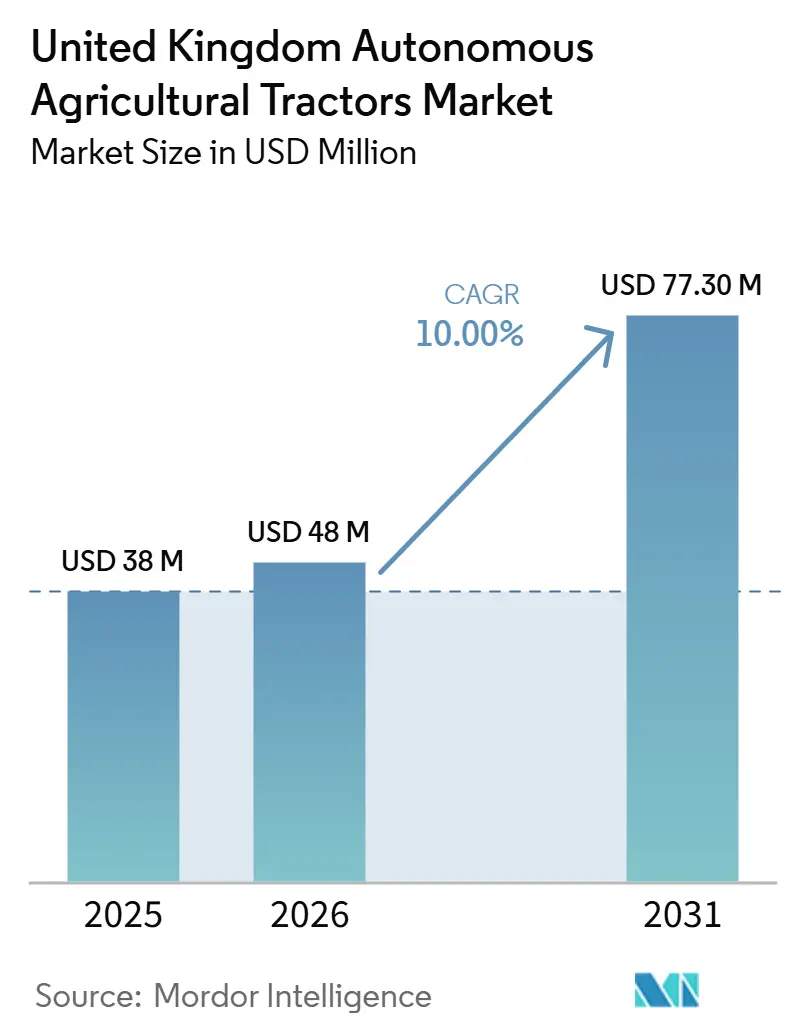
| Base Year Market Size (2025) | USD 38 Million |
| Market Size (2026) | USD 48 Million |
| Market Size (2031) | USD 77.30 Million |
| Growth Rate (2026 - 2031) | 10.00 % |
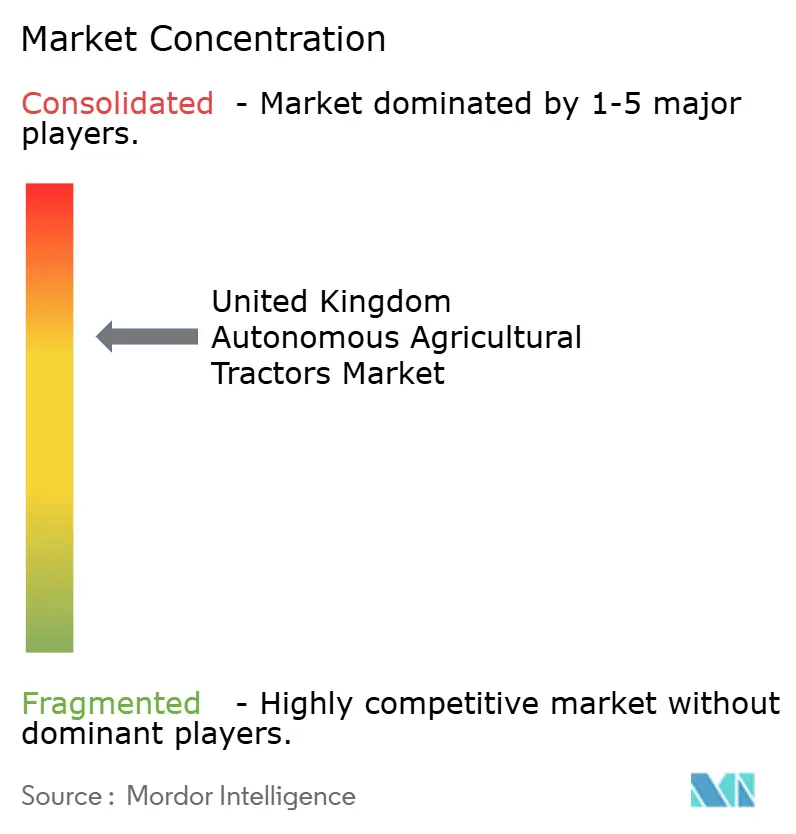
| Market Concentration | Medium |
Major Players *Disclaimer: Major Players sorted in no particular order Image © Mordor Intelligence. Reuse requires attribution under CC BY 4.0. | |
United Kingdom Autonomous Agricultural Tractors Market Analysis by Mordor Intelligence
The United Kingdom autonomous agricultural tractors market size was valued at USD 38 million in 2025 and estimated to grow from USD 48 million in 2026 to reach USD 77.3 million by 2031, at a CAGR of 10.0% during the forecast period (2026-2031). The United Kingdom autonomous agricultural tractors market is growing faster than many neighboring European markets. Farm operators are managing a tighter labor pool, narrower fieldwork windows, and a stronger need to improve machine utilization across each season. The installed base of guidance-enabled tractors provides a practical upgrade path, allowing farms to transition from assisted steering to higher autonomy without replacing entire fleets at once. Public funding supports adoption by reducing upfront costs and linking automation to higher productivity, more precise use of inputs, and lower-emission farm operations. The competitive structure remains moderately concentrated, though the market still offers room for autonomy specialists, retrofit suppliers, sensor vendors, and regional distributors that can support mixed fleets. The strongest near-term opportunities exist where autonomy can deliver repeated field passes, extended working hours, and easier supervision across larger acreages or labor-intensive specialty crop rows.
Key Report Takeaways
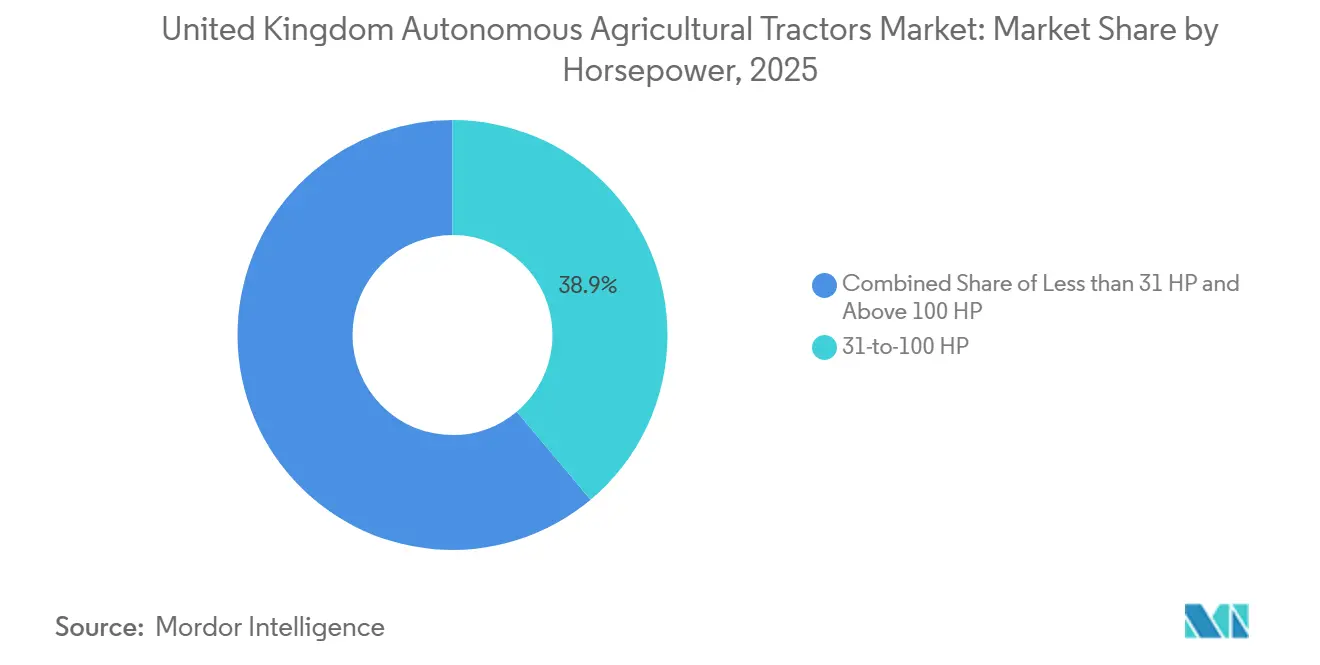
- By horsepower, the 31-to-100 HP segment held 38.9% share in 2025, while the above 100 HP segment is forecast to expand at a 11.5% CAGR through 2031.
- By automation level, semi-autonomous systems accounted for 67.6% of the United Kingdom autonomous agricultural tractor market share in 2025, while fully autonomous systems recorded the highest projected CAGR at 13.0% through 2031.
- By drive type, diesel-powered tractors accounted for 75.7% share in 2025, while battery-electric platforms are projected to grow at a 13.5% CAGR through 2031.
- By application, tillage accounted for 36.9% of the United Kingdom autonomous agricultural tractors market size in 2025, while orchard and vineyard operations are advancing at a 11.5% CAGR through 2031.
- By component, GPS and GNSS modules led with 34.9% share in 2025, while LiDAR and Radar modules are forecast to grow at a 12.5% CAGR through 2031.
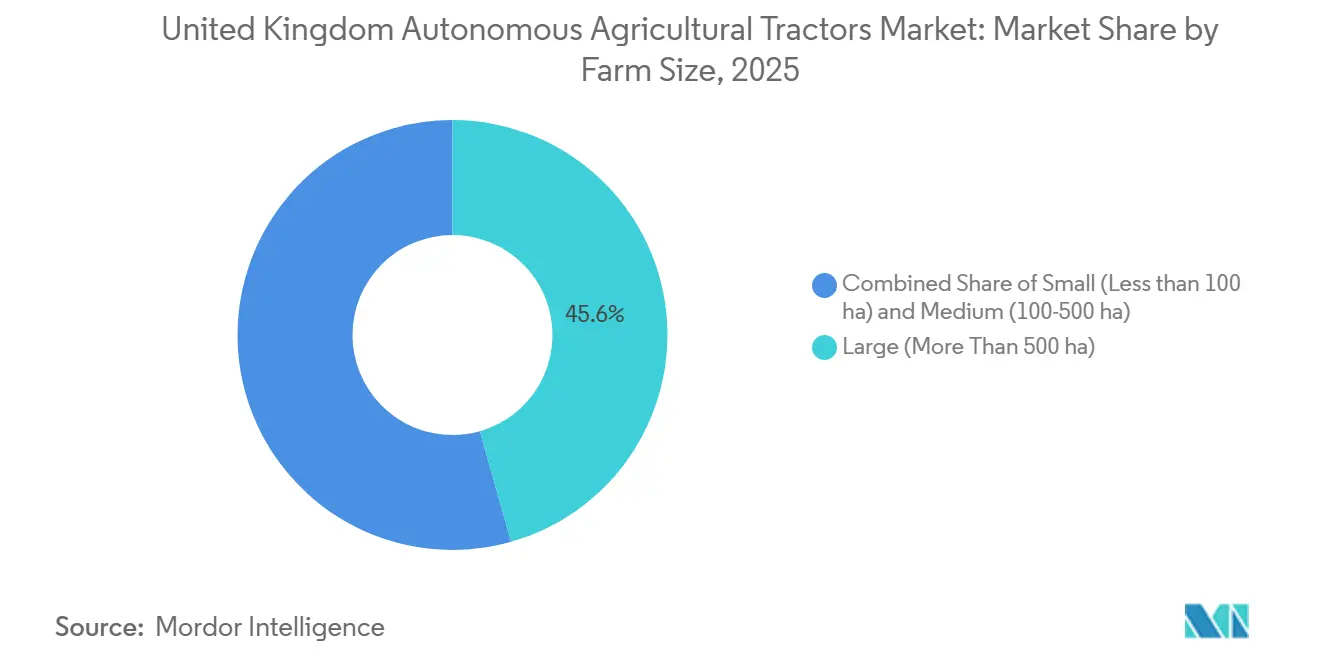
- By farm size, large farms above 500 ha held 45.6% share in 2025, while medium farms of 100 to 500 ha are projected to expand at a 11.0% CAGR through 2031.
Note: Market size and forecast figures in this report are generated using Mordor Intelligence’s proprietary estimation framework, updated with the latest available data and insights as of January 2026.
United Kingdom Autonomous Agricultural Tractors Market Trends and Insights
Drivers Impact Analysis*
| Driver | (~) % Impact on CAGR Forecast | Geographic Relevance | Impact Timeline |
|---|---|---|---|
| Farm labor shortages and skilled operator scarcity | +3.5% | United Kingdom core market, with spillover to European Union arable regions | Short term (≤ 2 years) |
| Precision agriculture and connected guidance stack adoption | +4.1% | Global, with highest penetration in the United Kingdom | Medium term (2-4 years) |
| Government Funding Accelerates Autonomous Tractor Adoption | +2.8% | United Kingdom | Medium term (2-4 years) |
| Productivity gains from 24-hour field operations and multi-machine supervision | +2.2% | United Kingdom core market and large Europe Union arable operations | Short term (≤ 2 years) |
| Retrofit autonomy kits and autonomy-ready tractor platforms lower adoption friction | +1.9% | United Kingdom | Medium term (2-4 years) |
| Specialty-crop mechanization in orchards and vineyards creates a high-value use case | +1.6% | United Kingdom and Southern Europe | Medium term (2-4 years) |
| Source: Mordor Intelligence | |||
Farm Labor Shortages and Skilled Operator Scarcity
The United Kingdom autonomous agricultural tractors market is benefiting from a labor shift that has become structural rather than temporary. Post-Brexit migration changes reduced the annual inflow of seasonal European Union farm workers into the United Kingdom by an estimated 40,000 to 70,000 in 2024 compared with pre-2020 levels, and that gap has altered the economics of field operations across horticulture and arable farming[1]. The pressure is not limited to general field labor, as experienced tractor operators and supervisors are also becoming harder to replace as older workers leave the workforce. This is relevant because early autonomy performs best in repetitive activities such as tillage and drilling, where farms previously relied on skilled operators to maintain accuracy over long hours. As that labor pool shrinks, the United Kingdom autonomous agricultural tractors market becomes more attractive to farms seeking to reduce dependence on scarce operators while maintaining work quality. This is one reason the mid-range and high-horsepower classes continue to draw most of the commercial attention in large arable regions.
Precision Agriculture and Connected Guidance Stack Adoption
Growth in the United Kingdom autonomous agricultural tractors market is supported by the increasing adoption of precision agriculture across major arable holdings. According to Agriculture and Horticulture Development Board (AHDB), more than 65% of large arable farms in the country in 2025 already use tractors equipped with factory-fitted or retrofit RTK-GNSS steering systems[2]. This means a significant share of the existing fleet already has the core positioning infrastructure required for higher levels of autonomy. This installed base reduces adoption barriers, as autonomy can be introduced through software, sensor, and control upgrades rather than full machine replacement in every case. John Deere has pursued this staged approach through its connected machine and operations ecosystem, which supports path planning and field execution based on existing precision workflows. As more guidance-ready tractors enter the fleet, they expand the addressable base for autonomous upgrades, making current precision agriculture investments a direct contributor to growth in the United Kingdom autonomous agricultural tractors market over the next several years.
Government Funding Accelerates Autonomous Tractor Adoption
Public funding is a meaningful driver of the United Kingdom autonomous agricultural tractors market, as it reduces the effective cost of adopting automation. Under the Improving Farm Productivity grant in the 2023 to 2024 cycle, Department for Environment, Food and Rural Affairs (DEFRA) covered up to 40% of eligible costs for robotic and automated equipment, with support ranging from GBP 25,000 (USD 31,500) to GBP 500,000 (USD 630,000) per applicant. This level of support brought early deployments within reach for farms that would otherwise have delayed automation plans. The policy effect extends beyond direct subsidies, as farm programs increasingly reward precision input use, lower soil compaction, and cleaner operations, all of which align with autonomous and semi-autonomous systems. As a result, adoption decisions are now linked to both equipment efficiency and broader farm support outcomes, moving the United Kingdom autonomous agricultural tractors market beyond pilot interest and into more credible commercial planning.
Productivity Gains from 24-Hour Field Operations and Multi-Machine Supervision
The United Kingdom autonomous agricultural tractor market is gaining traction because autonomy enables farms to better utilize short fieldwork windows, rather than simply reducing hourly labor costs. Many United Kingdom's arable operations work within narrow, weather-driven periods for cultivation, sowing, and harvest preparation, making the value of extended operating hours substantial. Autonomous and supervised autonomy systems allow work to continue with greater consistency across long shifts and overnight periods, particularly in repetitive field tasks with lower obstacle density. This creates a direct benefit in large cereal and root crop systems, where timing affects soil condition, seed placement, and later field access. It also improves machine utilization, as one supervisor can oversee more work than a single conventional operator could complete in the same period. This operating logic is one of the clearest reasons the United Kingdom autonomous agricultural tractors market is advancing first in large-field arable geographies.
Restraints Impact Analysis*
| Restraint | (~) % Impact on CAGR Forecast | Geographic Relevance | Impact Timeline |
|---|---|---|---|
| High acquisition cost limits reach beyond large enterprises | -2.1% | Highest pressure on United Kingdom farms below 100 ha | Medium term (2-4 years) |
| Regulatory ambiguity delays fully unattended deployment | -1.5% | United Kingdom | Medium term (2-4 years) |
| Connectivity and positioning weaknesses reduce operating confidence | -0.9% | United Kingdom rural and upland areas | Long term (≥ 4 years) |
| Mixed-fleet compatibility and service readiness still need work | -0.6% | United Kingdom | Medium term (2-4 years) |
| Source: Mordor Intelligence | |||
High Acquisition Cost Limits Reach Beyond Large Enterprises
High upfront cost remains one of the clearest barriers to the United Kingdom autonomous agricultural tractors market. The premium attached to fully autonomous packages in the higher horsepower range is difficult for smaller farms to justify when annual machine use is limited and payback periods extend beyond normal replacement cycles. In 2024, Department for Environment, Food and Rural Affairs (DEFRA) data show that farms below 100 ha account for a large share of total holdings, which means much of the farm base does not naturally fit the early economics of premium automation. Although retrofit options reduce the entry point, the business case still depends on utilization, field layout, and access to skilled support. As a result, adoption remains strongest among large farms and contractors, which can spread the technology across more acres and operating hours. Until ownership models such as leasing, contracting, and cross-farm sharing become more common, cost will continue to slow adoption in the United Kingdom autonomous agricultural tractors market.
Regulatory Ambiguity Delays Fully Unattended Deployment
The market faces a significant regulatory constraint, as the pathway for fully unattended field operation remains unclear. As of 2026, farms can commercialize semi-autonomous systems more easily than fully driverless ones, since supervision, liability, and safety obligations are more manageable in that category. Machinery regulation in Europe now places greater emphasis on formal risk assessment for autonomous systems, raising the threshold for launch planning, insurance acceptance, and operational approval[3]. This does not halt product development, but it does slow commercial scale-up in the United Kingdom, as buyers require confidence that machines can be operated legally and insured practically under real working conditions. As a result, many farms continue to treat autonomy as a supervised tool rather than a fully independent operating asset. Until clearer United Kingdom guidance emerges, this restraint will keep the United Kingdom's autonomous agricultural tractors industry weighted toward semi-autonomous deployments.
*Our forecasts treat driver/restraint impacts as directional, not additive. The impact forecasts reflect baseline growth, mix effects, and variable interactions.
Segment Analysis
By Horsepower: Mid-Range Power Anchors Volume, While High Horsepower Drives Growth
The 31-to-100 HP segment held 38.9% of the United Kingdom autonomous agricultural tractors market in 2025, making it the largest horsepower band by revenue. This position reflects the prevalence of mixed arable and combinable-crop farms that rely on versatile mid-range tractors for cultivation, sowing, and spraying throughout English lowland agriculture. The segment also benefits from a practical balance between equipment cost, field versatility, and suitability for guided or semi-autonomous operation. Across much of the United Kingdom's autonomous agricultural tractor market, this range remains the most realistic entry point for farms seeking automation without immediately transitioning to the largest machines.
The above-100 HP segment is forecast to grow at a 11.5% CAGR through 2031, indicating where stronger expansion is anticipated. This growth is tied to large cereal and root crop operations, where high-draft work, long field runs, and overnight operations generate a stronger return on investment in autonomy. AGCO Corporation reinforced this direction with the launch of the Fendt 1000 Vario Gen4 series, which includes factory-integrated autonomy options for tillage and grain cart operations, with deliveries beginning in 2026. The smallest horsepower tier remains limited to narrower specialty uses, keeping it well behind the mainstream field equipment classes in the United Kingdom autonomous agricultural tractors market. As commercial adoption broadens, horsepower growth is estimated to remain strongest where large machines can operate for longer hours across more acres.

By Automation Level: Semi-Autonomous Volume with Fully Autonomous Momentum
Semi-autonomous systems held 67.6% of the United Kingdom autonomous agricultural tractors market share in 2025, making them the dominant automation level. This position reflects current insurance, safety, and regulatory conditions, which favor systems that keep an operator in or near the working loop. Semi-autonomous machines deliver value through path execution, headland management, and implement coordination while remaining within accepted operating practices. As a result, supervised autonomy has become the most commercially viable category in the United Kingdom autonomous agricultural tractors market for 2025 and 2026.
Fully autonomous systems are projected to grow at a 13.0% CAGR through 2031, despite currently lower volumes. This growth outlook is supported by product launches from large manufacturers, including John Deere and Kubota Corporation, that are already commercializing higher-autonomy platforms for field and specialty-crop use. This indicates that product readiness is advancing even as regulation remains incomplete. As safety validation improves and legal clarity increases, a larger share of the United Kingdom autonomous agricultural tractors market is estimated to shift from supervised execution to unattended field operation. This transition will likely begin with repetitive tasks in geofenced field conditions before extending to more variable applications.
By Drive Type: Diesel Maintains Market Leadership, While Electric Tractors Expand Rapidly
Diesel-powered tractors accounted for 75.7% of the United Kingdom autonomous agricultural tractors market in 2025, reflecting that current adoption remains heavily dependent on conventional powertrains. Diesel is well-suited to long operating hours, higher horsepower, and field conditions where refueling logistics outweigh the benefits of alternative drivetrains. This is particularly relevant in larger arable operations where autonomy is first being deployed for heavy or extended-duty tasks. As a result, diesel maintains its dominant share in the United Kingdom autonomous agricultural tractors market even as powertrain experimentation grows.
Battery-electric tractors are projected to grow at a 13.5% CAGR through 2031, making them the fastest-growing drive type. This growth reflects the convergence of autonomy, low-emission farm policy, and demand for cleaner machine operation aligned with the Department for Environment, Food and Rural Affairs (DEFRA)'s long-term net-zero goals. In 2025, Kubota Corporation unveiled an autonomous hydrogen fuel cell tractor concept, indicating that the industry is exploring post-diesel options for autonomous work. Electric and related low-emission platforms account for a smaller share of current deployments, but their growth rate suggests they will become more prominent in the United Kingdom autonomous agricultural tractors market as policy frameworks and charging and fueling ecosystems develop. Hybrid systems are anticipated to remain a transitional option for operators seeking emissions reductions without sacrificing field flexibility.
By Application: Tillage Leads Current Use While Orchard and Vineyard Work Expands Fastest
Tillage accounted for 36.9% of the United Kingdom autonomous agricultural tractors market in 2025, making it the largest application segment. This position reflects the nature of tillage operations, which involve repeatable movement patterns, lower obstacle density, and simpler field planning than other agricultural tasks. As a result, first-generation autonomy systems entered commercial use in tillage before expanding into more complex applications. Within the United Kingdom autonomous agricultural tractors market, tillage remains the most practical starting point for farms seeking measurable gains from extended machine use and consistent field execution.
Orchard and vineyard operations are forecast to grow at a 11.5% CAGR through 2031, making them the fastest-growing application segment. This growth is linked to the expansion of English vineyards, the high labor requirement per row pass, and the increasing availability of narrow autonomous platforms designed for specialty-crop conditions. This application segment presents a strong case for autonomy, combining labor pressure, repetitive task patterns, and premium crop economics. Sowing and harvesting operations are also anticipated to advance, but currently lag behind tillage and specialty row applications in terms of commercial readiness. As a result, growth within the United Kingdom autonomous agricultural tractors market remains split between established field-scale volume and a rapidly expanding specialty crop niche.
By Component: Positioning Holds the Base While Perception Systems Gain Weight
GPS and GNSS modules held the largest share of the component mix at 34.9% in 2025, reflecting their foundational role in path planning and machine positioning. This share reflects how earlier investment in guidance technology now supports the broader autonomy stack. In the United Kingdom autonomous agricultural tractors market, positioning hardware serves as the foundation for supervision, path control, and automated execution. It also explains why farms with mature precision systems are better positioned to adopt higher levels of autonomy than those starting from scratch.
LiDAR and radar modules are projected to grow at a 12.5% CAGR through 2031, reflecting the rising importance of perception and obstacle detection. As machines move toward unattended operation, sensing must become more robust so that field awareness does not depend on a single positioning stream or basic camera input. John Deere has been advancing this direction with expanded perception architecture in its autonomous systems, while Kubota Corporation has also been working on more reliable remote connectivity for autonomous machinery. As a result, the component profile of the United Kingdom autonomous agricultural tractors market will gradually shift from guidance-heavy systems to broader sensing and software integration. Control and navigation software, along with vision systems, will also gain strategic value as autonomy moves beyond simple repeatable passes.
By Farm Size: Large Holdings Anchor Revenue, While Medium Farms Add the Next Wave
Large farms ( more than 500 ha) held 45.6% of the United Kingdom autonomous agricultural tractors market share in 2025, reflecting how strongly adoption depends on scale. These holdings benefit from longer field runs, higher annual machine utilization, better access to capital, and clearer payback cases for autonomous equipment. Department for Environment, Food and Rural Affairs (DEFRA) data show that a small share of large farms manages a disproportionately high share of agricultural land, amplifying their influence on equipment demand. As a result, large operations continue to anchor current revenue in the United Kingdom autonomous agricultural tractors market.
Medium farms of 100 to 500 ha are forecast to grow at a 11.0% CAGR through 2031, making them the fastest-growing farm-size segment. This growth reflects improving access to retrofit options, phased adoption models, and supplier support that reduces the cost of trialing autonomy before full commitment. SoilEssentials has been distributing AgXeed autonomous equipment in Scotland and Northern England, giving medium-scale operators a more direct route to evaluate commercial use. Medium farms are therefore becoming the next significant growth pool for the United Kingdom autonomous agricultural tractors market. Small farms remain constrained by field fragmentation and lower annual machine use, though contract farming and shared machinery models could gradually draw a broader farm base into the category over time.
Geography Analysis
England held the largest share of the United Kingdom autonomous agricultural tractors market in 2025 and remains the primary center of commercial activity. It's 4.3 million hectares of arable and cropping land in 2025, giving the country's largest farm economy the scale required for autonomous tillage, drilling, and spraying to be commercially viable. The East of England, the East Midlands, and Yorkshire and the Humber remain the strongest demand zones, as farm structures in these areas support longer field runs and better machine utilization. England also benefits from a denser dealer and service network for major brands with precision and autonomy capability. This combination of land structure, service access, and early user confidence keeps England at the center of the United Kingdom autonomous agricultural tractors market.
Scotland is the fastest-growing regional opportunity within the United Kingdom autonomous agricultural tractors market, as average farm sizes in parts of the country support stronger returns on continuous machine use. Areas such as Aberdeenshire, Angus, and the Borders have more large holdings than many other parts of the United Kingdom, making higher-horsepower autonomous systems more commercially relevant. Dealer expansion supports this trend, with SDF UK adding Deutz-Fahr representation in Scotland in 2026 ahead of anticipated growth. JCB also directed clear attention toward Scotland in 2026 through public demonstrations and show activity around the Fastrac 6300, reflecting the region's relevance to advanced arable and mixed farming.
Wales and Northern Ireland accounted for a smaller share of the United Kingdom autonomous agricultural tractors market in 2025, as their farm structures are less suited to current-generation field autonomy. Livestock-heavy systems, smaller fields, irregular boundaries, and hedge-lined terrain reduce the immediate fit for GNSS-led autonomous operations. That said, Northern Ireland retains niche potential in more precision-oriented arable segments such as potato and flax cultivation. Connectivity improvements will be important in these regions, as rural coverage gaps continue to affect confidence in remote monitoring and reliable machine communications. The Shared Rural Network should gradually improve these conditions, but the geographic distribution of the United Kingdom autonomous agricultural tractors market will remain tilted toward England and selected parts of Scotland in the near term.
Competitive Landscape
The United Kingdom autonomous agricultural tractors market remained moderately concentrated in 2025, with major players being Deere and Company, CNH Industrial N.V., AGCO Corporation, CLAAS KGaA mbH, and Kubota Corporation. Deere and Company is one of the prominent players, supported by early work in factory-integrated autonomy and a well-established United Kingdom dealer network. CNH Industrial N.V. uses its brand portfolio to address multiple crop and power classes while continuing broader work in AI-led agricultural innovation. AGCO Corporation has differentiated itself through platform flexibility, factory integration, and the PTx Trimble structure that strengthens its autonomy offering. This structure keeps the United Kingdom autonomous agricultural tractors market concentrated enough for scale benefits, while remaining open to targeted challengers.
A key competitive development has been the shift from concept-stage autonomy to orderable and deliverable equipment. AGCO Corporation advanced this by making the Fendt 1000 Vario Gen4 available with factory-optioned autonomy, beginning with orders in late 2025 and deliveries in 2026. Kubota Corporation took a different approach by targeting specialty-crop rows through the autonomous M5 Narrow commercial launch at CES 2026, which directly addresses orchard and vineyard operators. CLAAS KGaA mbH focused on supervised automation through its Xerion 12 update and AgXeed-linked control approach, which aligns well with current European safety conditions. These developments indicate that competition in the United Kingdom autonomous agricultural tractors market is no longer centered solely on prototypes.
The strongest white space remains in specialty rows, mixed-brand retrofit environments, and medium-sized farm operations seeking staged adoption rather than full fleet replacement. Kubota Corporation, AgXeed, and other focused players are well positioned in these narrower but valuable segments. JCB also represents a relevant domestic manufacturing presence, as its precision-ready tractors meet the needs of professional United Kingdom arable operators even before full autonomy becomes standard. Competition is therefore likely to intensify through software capability, sensing quality, retrofit flexibility, and dealer support rather than through price alone. This dynamic is anticipated to persist despite the strong position held by the largest global machinery groups.
United Kingdom Autonomous Agricultural Tractors Industry Leaders
-
CLAAS KGaA mbH
-
Kubota Corporation
-
AGCO Corporation
-
Deere and Company
-
CNH Industrial N.V.
- *Disclaimer: Major Players sorted in no particular order
Recent Industry Developments
- June 2026: JCB, through its dealer Scot Agri, showcased the new 335 hp Fastrac 6300 at the Royal Highland Show in Edinburgh. The tractor features factory-installed precision farming technologies, including dual satellite guidance, automated headland turn patterns, and multi-mode four-wheel steering, which improve operational accuracy and productivity for professional UK arable farmers and contractors. In January 2026, the JCB Fastrac 6000 Series received the Machine of the Year Gold Award at LAMMA 2026, reinforcing the company's position in the high-horsepower tractor segment.
- April 2026: CLAAS KGaA mbH announced that the XERION 12 large tractor will be equipped with a Vehicle Control Unit (VCU), developed in collaboration with AgXeed, available from mid-2026. The system enables pre-programmed work orders to be executed automatically under driver supervision using the TIM (Tractor Implement Management) protocol. Work orders are transferred cloud-to-cloud from CLAAS Connect to AgXeed's TraXwise platform, supporting automated steering, headland management, obstacle avoidance, and site-specific field operations, while allowing operators to intervene whenever required.
- September 2025: Kubota Corporation unveiled the world's first concept model of an autonomous hydrogen fuel cell tractor at Expo 2025 Osaka, Kansai. The concept combines a 100-hp diesel-equivalent hydrogen fuel cell powertrain with autonomous driving and remote operation technologies, enabling zero-emission, unmanned field operations.
United Kingdom Autonomous Agricultural Tractors Market Report Scope
Autonomous agricultural tractors are self-driving farm tractors that use AI, GPS, sensors, and onboard control systems to perform agricultural operations with minimal or no human intervention.
The United Kingdom autonomous tractors market report is segmented by horsepower (up to 30 hp, 31 to 100 hp, and above 100 hp), by automation level (fully automated and semi-automated), by drive type (diesel, hybrid, and more), by application (tillage, sowing, harvesting, and more), by component (GPS and GNSS, and more), and by farm size (small, medium, and large). The market forecasts are provided in terms of value (USD).
| Up to 30 HP |
| 31 to 100 HP |
| Above 100 HP |
| Semi-Autonomous |
| Fully Autonomous |
| Diesel |
| Hybrid |
| Battery-Electric |
| Tillage |
| Sowing |
| Harvesting |
| Orchard and Vineyard Operations |
| GPS and GNSS |
| Sensors and Vision Systems |
| LiDAR and Radar Modules |
| Control and Navigation Software |
| Small (Less than 100 ha) |
| Medium (100 to 500 ha) |
| Large (More than 500 ha) |
| By Horsepower | Up to 30 HP |
| 31 to 100 HP | |
| Above 100 HP | |
| By Automation Level | Semi-Autonomous |
| Fully Autonomous | |
| By Drive Type | Diesel |
| Hybrid | |
| Battery-Electric | |
| By Application | Tillage |
| Sowing | |
| Harvesting | |
| Orchard and Vineyard Operations | |
| By Component | GPS and GNSS |
| Sensors and Vision Systems | |
| LiDAR and Radar Modules | |
| Control and Navigation Software | |
| By Farm Size | Small (Less than 100 ha) |
| Medium (100 to 500 ha) | |
| Large (More than 500 ha) |
Key Questions Answered in the Report
What is the projected value of the United Kingdom autonomous agricultural tractors market by 2031?
The United Kingdom autonomous agricultural tractors market is projected to reach USD 77.3 million by 2031 from USD 48 million in 2026, growing at a 10.0% CAGR over 2026 to 2031.
Which horsepower segment currently leads adoption in the United Kingdom?
The 31-to-100 HP segment led in 2025 with 38.9% share in 2025, because it fits the operating needs of mixed arable and combinable crop farms.
Why are semi-autonomous tractors ahead of fully autonomous systems in the United Kingdom?
Semi-autonomous systems held 67.6% share in 2025 because they fit the current regulatory, insurance, and field-supervision environment better than unattended systems.
Which application is growing the fastest in this market?
Orchard and vineyard operations are projected to grow at a CAGR of 11.5% through 2031, supported by vineyard expansion and high labor intensity in row-based specialty farming.