
United Arab Emirates Fresh Herbs Market Size and Share
Market Overview
| Study Period | 2021 - 2031 |
|---|---|
| Forecast Data Period | 2026 - 2031 |
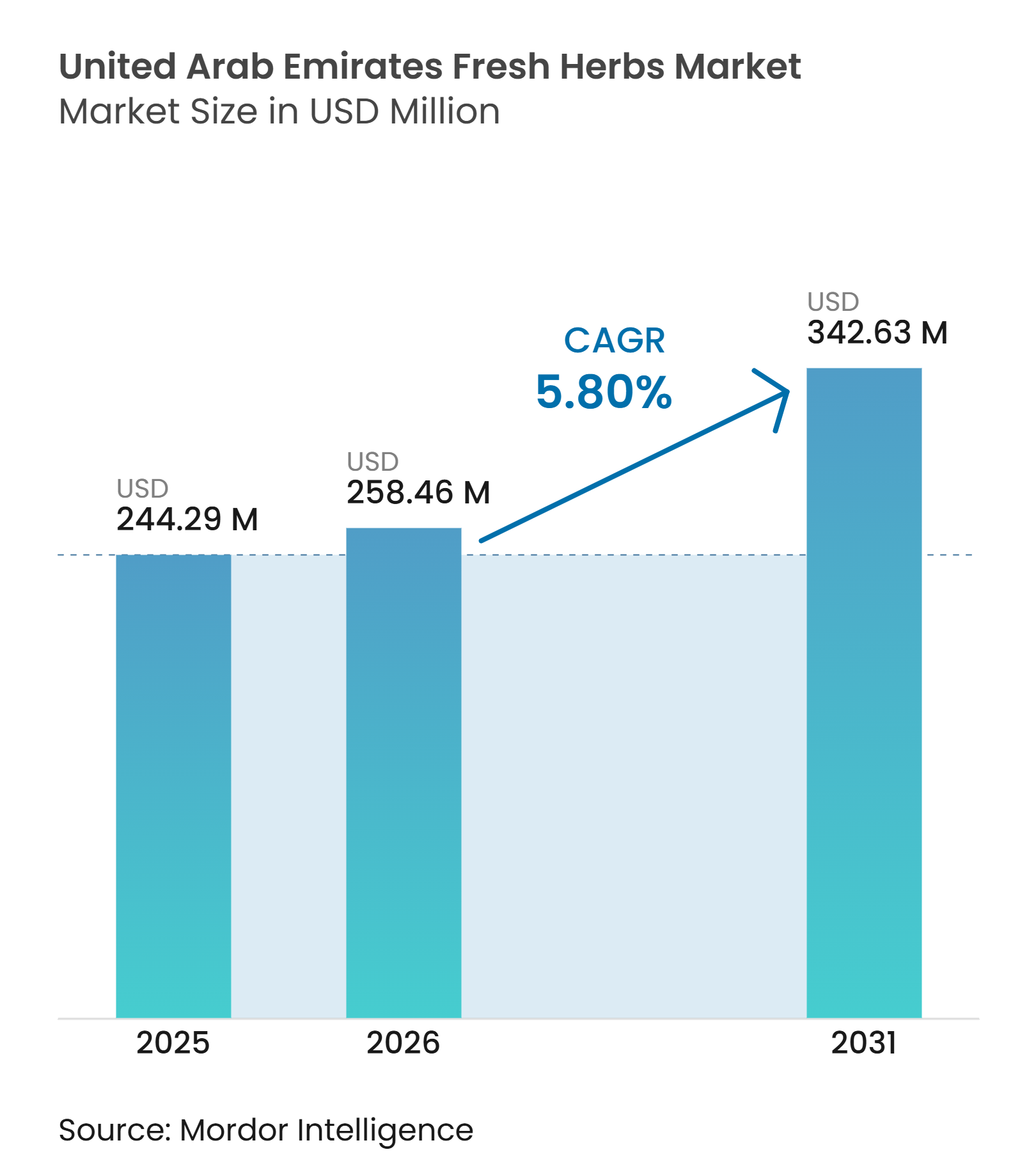
| Base Year Market Size (2025) | USD 244.29 Million |
| Market Size (2026) | USD 258.46 Million |
| Market Size (2031) | USD 342.63 Million |
| Growth Rate (2026 - 2031) | 5.80 % |
| Market Concentration | Low |
Major Players *Disclaimer: Major Players sorted in no particular order Image © Mordor Intelligence. Reuse requires attribution under CC BY 4.0. | |
United Arab Emirates Fresh Herbs Market Analysis by Mordor Intelligence
The United Arab Emirates fresh herbs market was valued at USD 244.29 million in 2025 and is projected to grow from USD 258.46 million in 2026 to USD 342.63 million by 2031, at a CAGR of 5.80% during the forecast period (2026–2031). Controlled-environment agriculture (CEA) is improving year-round supply reliability by reducing exposure to seasonal production constraints and import dependence. National food-security policies and local-procurement initiatives are encouraging greater domestic sourcing among retailers, hotels, restaurants, and institutional buyers. Demand from the hospitality sector, including restaurants, hotels, catering businesses, and foodservice operators, also supports fresh herb consumption. The market continues to face competition from imported herbs, while energy requirements and cold-chain management add to production and distribution costs. Local producers are responding by adopting protected cultivation, implementing traceability systems, improving postharvest handling, and entering into supply agreements to support consistent quality and reliable availability.
Key Report Takeaways
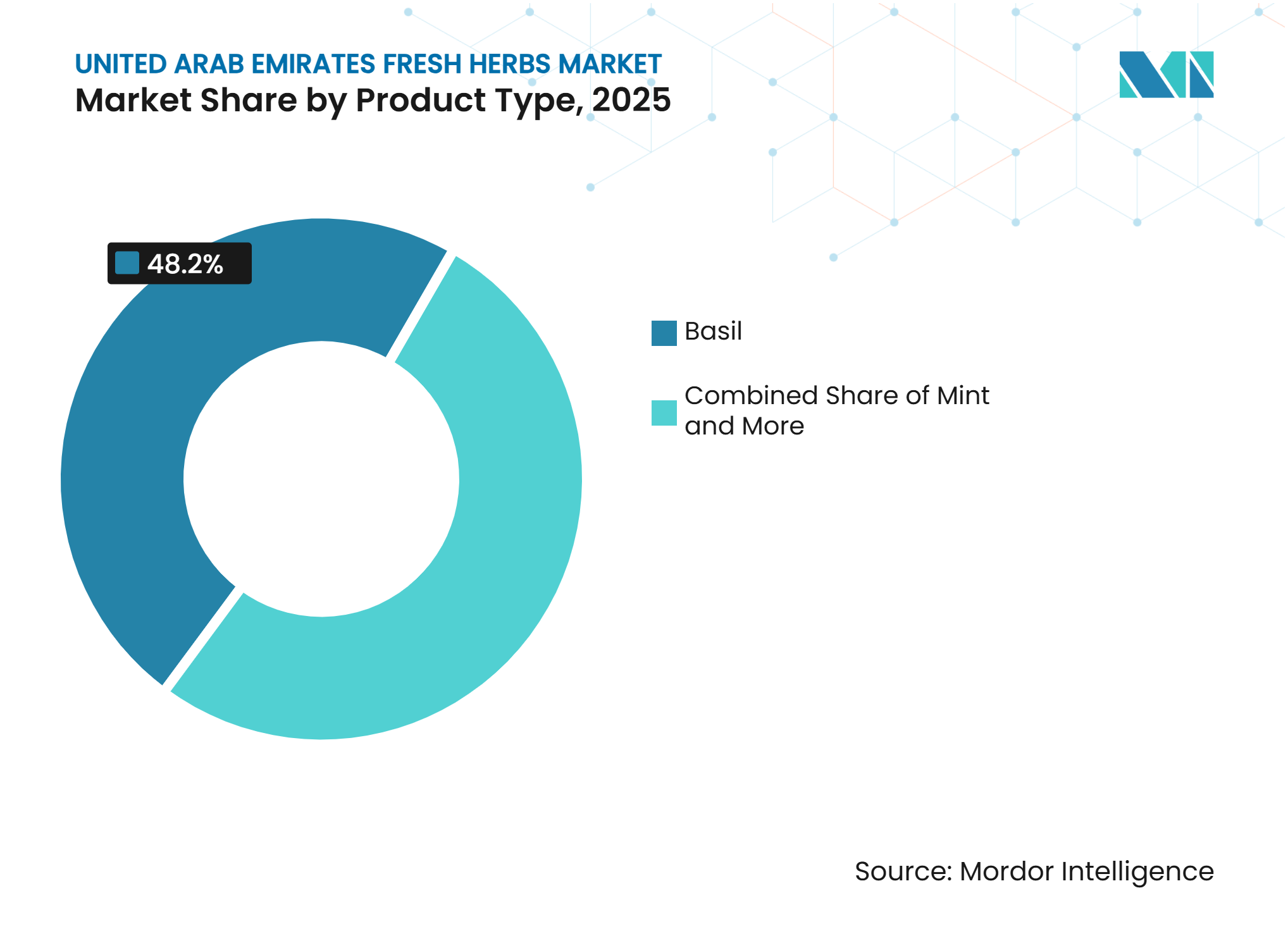
- By product type, basil accounted for the largest 48.2% of the United Arab Emirates fresh herbs market share in 2025, while mint is projected to grow at the fastest CAGR of 7.1% from 2026 to 2031.
- By category, conventional accounted for the largest share at 78.0% in 2025, while the United Arab Emirates fresh herbs market size for organic is projected to grow at the fastest CAGR of 8.2% from 2026 to 2031.
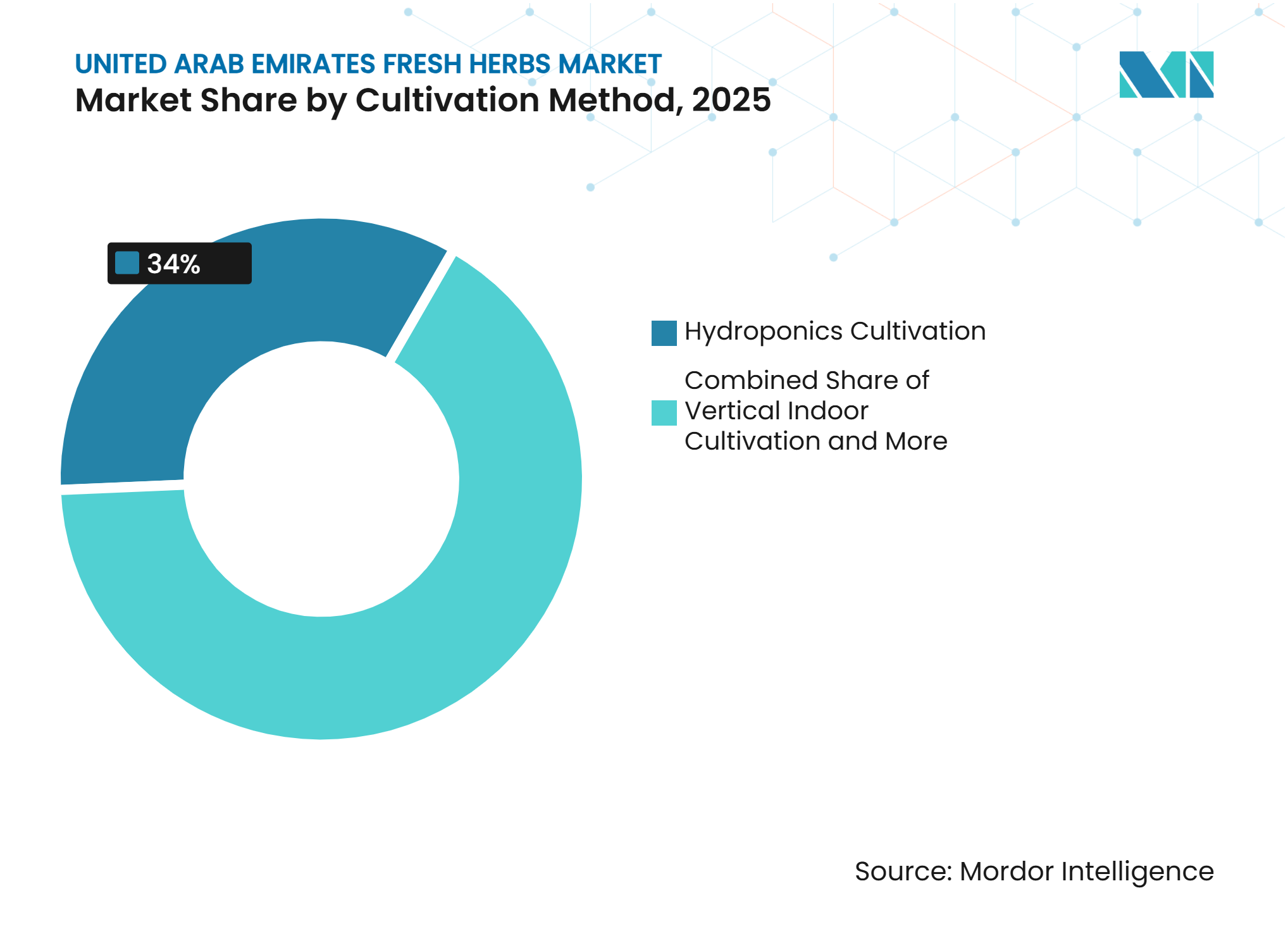
- By cultivation method, hydroponic cultivation accounted for the largest share at 34.0% in 2025, while vertical indoor cultivation is projected to grow at the fastest CAGR of 9.0% from 2026 to 2031.
- By end user, food retail accounted for the largest share at 43.6% in 2025, while foodservice is projected to grow at the fastest CAGR of 7.5% from 2026 to 2031.
Note: Market size and forecast figures in this report are generated using Mordor Intelligence’s proprietary estimation framework, updated with the latest available data and insights as of January 2026.
Market Trends and Insights
Drivers Impact Analysis of United Arab Emirates Fresh Herbs Market*
| Driver | (~) % Impact on CAGR Forecast | Geographic Relevance | Impact Timeline |
|---|---|---|---|
| Foodservice and Hospitality Demand | 1.8% | Dubai and Abu Dhabi core markets, Sharjah and Northern Emirates secondary markets | Short term (≤ 2 years) |
| Retail Fresh Produce Expansion | 1.1% | United Arab Emirates-wide, concentrated in Dubai and Abu Dhabi retail corridors | Short term (≤ 2 years) |
| Food Security and Import Substitution | 0.7% | National, with strongest uptake in Abu Dhabi and Artificial Intelligence in agricultural zones | Long term (≥ 4 years) |
| Controlled Environment Agriculture Expansion | 0.8% | Dubai, Abu Dhabi, and Al Ain controlled-environment agriculture clusters | Medium term (2-4 years) |
| Harvest-to-Delivery Premium | 0.5% | Dubai hospitality corridor and Abu Dhabi premium retail | Medium term (2-4 years) |
| Traceable Local Procurement | 0.3% | National, with early concentration among Abu Dhabi institutional buyers | Long term (≥ 4 years) |
| Source: Mordor Intelligence | |||
Foodservice And Hospitality Demand
The United Arab Emirates fresh herbs market benefits from growing demand from the foodservice and hospitality sector, as restaurants, hotels, and catering establishments require reliable supplies of fresh herbs across diverse cuisines. In January 2026, the Ministry of Climate Change and Environment (MOCCAE) launched the Sustainable Product initiative, targeting 25% local sourcing of agricultural and animal products across the restaurant and hotel sector[1]. This initiative strengthens connections between local farms and hospitality establishments, supporting more predictable procurement and encouraging local production. As a result, growing opportunities in hospitality procurement are supporting demand for basil, cilantro, mint, parsley, and other fresh herbs.
Food Security and Import Substitution
Government policies continue to strengthen domestic agricultural production, supporting long-term growth of the United Arab Emirates fresh herbs market. According to the United Arab Emirates Ministry of Climate Change and Environment (2025), the Plant the Emirates National Program aims to achieve a 20% increase in farm production, a 25% increase in organic farms, and a 30% improvement in climate-smart farm adoption over five years[2]. These initiatives encourage investment in protected cultivation, hydroponics, and modern farming technologies, enabling local herb producers to reduce import dependence, improve supply resilience, and participate in institutional procurement programs.
Controlled Environment Agriculture Expansion
The expansion of controlled-environment agriculture is strengthening domestic production capacity in the United Arab Emirates fresh herbs market by enabling year-round cultivation under desert conditions. According to Silal (2025), Silal Food and Technology L.L.C. (ADQ) and Shouguang Vegetable Industry Group committed USD 38 million to establish an artificial intelligence- and robotics-enabled vegetable production hub in Al Foah, Al Ain. The investment supports advanced greenhouse production, improves supply consistency, shortens harvest-to-market timelines, and enhances the availability of locally grown fresh herbs for retail and foodservice customers.
Traceable Local Procurement
Traceable local procurement supports the United Arab Emirates fresh herbs market by enabling buyers to verify product origin, handling, and food safety information across supply chains. In 2025, the Dubai Municipality established requirements for food businesses to maintain traceability systems that identify food sources and distribution destinations, strengthening documentation across the food chain. These requirements encourage growers and suppliers to maintain accessible production and handling records, which can improve buyer confidence and support procurement by retailers, hospitality operators, and institutional customers. As a result, traceability expands market opportunities for suppliers that offer transparent, consistently documented fresh herbs.
Restraints Impact Analysis of United Arab Emirates Fresh Herbs Market*
| Restraint | (~) % Impact on CAGR Forecast | Geographic Relevance | Impact Timeline |
|---|---|---|---|
| Water and Energy Costs | -1.2% | National, most acute in Abu Dhabi and Dubai controlled-environment agriculture clusters | Long term (≥ 4 years) |
| Import Price Competition | -0.9% | United Arab Emirates-wide, most intense in wholesale and mid-market retail | Short term (≤ 2 years) |
| Cold-Chain and Shelf-Life Losses | -0.6% | National logistics routes between Abu Dhabi, Dubai, and Northern Emirates | Medium term (2-4 years) |
| Limited Herb-Specific Offtake Scale | -0.5% | National, more pronounced outside the Dubai and Abu Dhabi corridor | Long term (≥ 4 years) |
| Source: Mordor Intelligence | |||
Water and Energy Costs
Water scarcity, salinity, and irrigation maintenance are key operational challenges for fresh herb producers, as cultivation in arid climates depends on reliable water supplies and efficient irrigation systems. Saline groundwater and harsh environmental conditions increase maintenance requirements for irrigation equipment and water treatment infrastructure, particularly for growers operating outside fully controlled environments. According to the United Arab Emirates Government (2026), the country has 87 commercial hydroponic farms using water-efficient technology[3], reflecting the industry's shift toward advanced production systems that require continuous technical maintenance and investment to sustain reliable year-round cultivation.
Cold-Chain And Shelf-Life Losses
Cold-chain and post-harvest limitations can reduce the quality and marketable value of fresh herbs before they reach customers. A 2025 study published in the Journal of Food Science found that 11% of 187 herb samples imported into the United Arab Emirates did not comply with one or more quality criteria, highlighting quality-control challenges within the herb supply chain. Fresh herbs are particularly sensitive to handling and storage conditions, and their quality can deteriorate rapidly. Such supply chain challenges can increase waste and reduce usable product quality, thereby restraining market growth.
*Our forecasts treat driver/restraint impacts as directional, not additive. The impact forecasts reflect baseline growth, mix effects, and variable interactions.
United Arab Emirates Fresh Herbs Market Segment Analysis
By Product Type, Basil Provides Volume While Mint Leads Growth
Basil accounted for 48.2% of the United Arab Emirates fresh herbs market share in 2025. Its dominant position reflects broad culinary use across Italian, Mediterranean, and Southeast Asian cuisines, particularly in restaurants, hotels, and household cooking. Basil also adapts well to controlled-environment cultivation, supporting frequent harvesting and consistent availability for commercial buyers. Its suitability for hydroponic systems allows producers to manage challenging climatic conditions while maintaining quality. These characteristics support recurring demand across foodservice and retail channels and reinforce basil's position as a core product within the country's fresh herbs market.
Mint is projected to grow at the fastest CAGR of 7.1% from 2026 to 2031. Its growth is driven by widespread use across beverages, tea, tabouli, fattoush, desserts, and other culinary applications. Mint's versatility allows suppliers to serve diverse consumer preferences and foodservice requirements, while controlled cultivation helps maintain consistent production under challenging climatic conditions. Other products, including cilantro, parsley, chives, thyme, rosemary, sage, dill, and oregano, address specialized culinary applications and broaden supplier portfolios. This product diversity enables growers to serve multiple cuisines and customer groups while reducing reliance on any single application.



By Category, Conventional Herbs Retain Scale While Organic Demand Advances
The conventional segment accounted for the largest share at 78.0% in 2025. Conventional production benefits from established cultivation, distribution, and procurement practices across retail, foodservice, catering, and food-processing channels. Buyers seeking consistent availability and standardized quality can source conventional herbs through established agricultural and distribution networks. This category also provides producers with the flexibility to serve broad customer requirements without the additional certification considerations associated with organic production. Conventional herbs remain an important supply base nationwide, supporting regular procurement by commercial buyers and providing broad availability of fresh herbs across multiple consumption channels.
The United Arab Emirates fresh herbs market size for organic is projected to grow at the fastest CAGR of 8.2% from 2026 to 2031. Demand is supported by consumers and professional buyers seeking products associated with documented cultivation practices, pesticide restrictions, and differentiated production standards. Indoor and controlled-environment farms can provide growing conditions that support traceability and consistent production practices. Organic products can serve premium retail and foodservice requirements where buyers place greater emphasis on production methods and product attributes. This creates opportunities for producers with appropriate certification, documentation, and supply capabilities to develop differentiated offerings within the country's fresh herbs market.
By Cultivation Method, Hydroponics Cultivation Leads While Vertical Indoor Cultivation Expand
Hydroponic cultivation accounted for the largest share at 34.0% in 2025. Hydroponic systems are well-suited to the United Arab Emirates as they allow growers to manage water, nutrients, temperature, and other cultivation conditions more precisely than conventional outdoor production. These systems support consistent herb quality and supply while reducing exposure to climatic variability. Hydroponic production also suits commercial operations near major consumption centers, where controlled environments enable frequent harvesting and reliable distribution. Its established application in local horticulture provides a foundation for continued adoption among producers serving retail, hospitality, and foodservice customers.
Vertical indoor cultivation is projected to grow at the fastest CAGR of 9.0% from 2026 to 2031. Multi-tier systems allow producers to use limited land more efficiently while maintaining tightly controlled growing conditions. This approach supports year-round production near urban demand centers, reducing exposure to seasonal weather and improving supply planning. Vertical farms can also integrate automated monitoring, precise nutrient management, and controlled lighting to maintain consistent growing conditions. These capabilities make the cultivation method relevant to producers seeking predictable output, efficient land utilization, and reliable quality for premium retail and foodservice applications.

By End User, Food Retail Holds The Largest Position While Foodservice Grows Faster
Food retail accounted for the largest share at 43.6% in 2025. Supermarkets, hypermarkets, premium grocery stores, and specialty retailers provide broad access to household consumers and generate recurring procurement requirements for fresh herbs. Retail buyers typically require consistent quality, suitable packaging, dependable shelf life, and reliable replenishment. These requirements encourage suppliers to strengthen their harvesting, packing, storage, and distribution capabilities. Retail channels also provide opportunities for differentiated products, such as specialty and pesticide-free herbs, to reach consumers seeking specific attributes. As a result, food retail remains an important commercialization channel supporting the broad availability of fresh herbs across the country.
Foodservice is projected to grow at the fastest CAGR of 7.5% from 2026 to 2031. Hotels, restaurants, catering operators, and institutional kitchens require dependable herb supplies for diverse cuisines and menu formats. Demand spans both common culinary herbs and specialty varieties used in premium hospitality applications. Food processing drives additional demand for sauces, marinades, prepared meals, and other products that require consistent herb inputs. Pharmaceutical and nutraceutical applications create further opportunities for herb-derived ingredients, while other end users include specialty distributors and exporters. These diverse applications broaden the customer base and support continued commercial development across the fresh herbs market.
Geography Analysis
Dubai and Abu Dhabi are key centers of demand and production, supported by significant activity in hospitality, retail, distribution, and controlled-environment agriculture. Dubai benefits from extensive hotel, restaurant, and premium grocery networks that require reliable supplies of fresh herbs. Abu Dhabi combines agricultural production with government-supported agrifood development, creating opportunities for modern cultivation and local sourcing. Controlled-environment farms in both emirates can serve urban buyers while managing climatic constraints. The concentration of commercial customers and agricultural infrastructure in these emirates supports regular procurement and distribution, making them important locations for fresh herb production, commercialization, and consumption across the country.
Al Ain and the surrounding Abu Dhabi agricultural areas provide an important production base due to established farming activity and growing adoption of advanced agricultural technologies. Government-supported initiatives encourage modern cultivation methods, local production, and improved resource efficiency. Dubai's urban environment generates strong demand for locally sourced herbs, while nearby production facilities can reduce distribution distances and improve replenishment. Together, these locations support connections between growers, retailers, hospitality operators, and foodservice distributors. The combination of agricultural infrastructure, technology adoption, and proximity to major consumption centers strengthens regional supply capabilities and supports broader market development.
Al Ain is also attracting substantial smart-agriculture investment that can strengthen the country's controlled-production infrastructure. In 2025, Silal and Shouguang Vegetable Industry Group confirmed plans for a 100,000-square-meter smart agriculture facility in Al Ain, incorporating photovoltaic glass greenhouse technology. This infrastructure can support protected cultivation and resource-efficient production suited to fresh herbs, while strengthening local supply capabilities. Sharjah, Ras Al Khaimah, and other Northern Emirates also offer opportunities for greenhouse and open-field production. Together, these regions diversify production locations and improve the ability to supply retailers, hospitality operators, and foodservice customers.
Competitive Landscape
Market Concentration
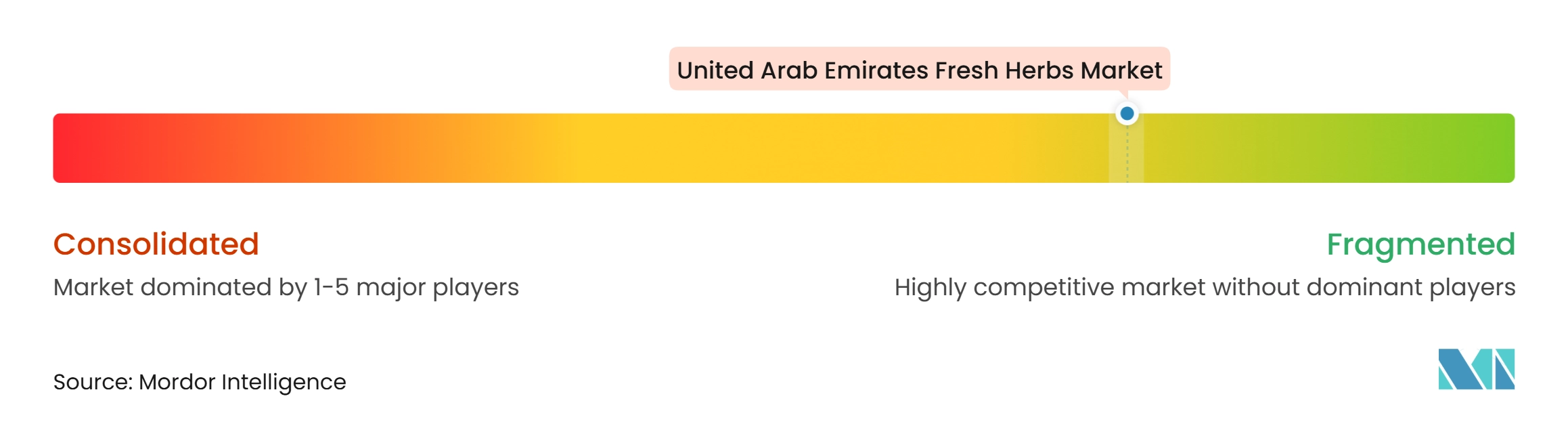
The United Arab Emirates fresh herbs market is fragmented in 2025, with Emirates Hydroponics Farms for Vegetables (RMB Group), Pure Harvest Smart Farms Ltd., UNS Vertical Farms L.L.C. (Speedex Group), Madar Farms L.L.C., and Greeneration FZCO among the key players. These companies serve different customer requirements through controlled-environment agriculture, hydroponic production, vertical farming, specialty herbs, and other fresh-produce offerings. Producers compete on cultivation technology, product quality, traceability, packaging, supply consistency, and distribution capabilities. Operational capabilities, product specialization, customer relationships, and reliable supply remain important areas of differentiation.
Key participants are strengthening their capabilities through technology investment, agricultural partnerships, and supply chain integration. Controlled-environment producers can manage growing conditions more precisely and supply consistent products to premium retail and hospitality customers. Integrated agricultural companies can combine production, distribution, traceability, and farmer-support activities to address broader procurement requirements. Technology adoption also supports resource management and production planning in a climate where water and temperature conditions influence cultivation decisions. Companies differentiate through production systems, product portfolios, quality controls, distribution reach, and their ability to meet specific requirements from commercial buyers.
The competitive environment is also supported by initiatives that connect local growers with consumers and commercial channels. In November 2025, Dubai Municipality opened registration for the fifth season of its Farmers' Market, which specifically included herbs and pickles among the eligible product categories. Such platforms provide local producers with additional routes to market and opportunities to build direct customer relationships. Alongside organized retail, hospitality, and foodservice channels, these routes can broaden market access for fresh herb suppliers and encourage differentiation through local sourcing, product quality, and direct engagement with consumers and buyers.
United Arab Emirates Fresh Herbs Industry Leaders
-
Emirates Hydroponics Farms for Vegetables (RMB Group)
-
Pure Harvest Smart Farms Ltd.
-
UNS Vertical Farms L.L.C. (Speedex Group)
-
Madar Farms L.L.C.
-
Greeneration FZCO
- *Disclaimer: Major Players sorted in no particular order
United Arab Emirates Fresh Herbs Market Companies Covered in this Report
- Pure Harvest Smart Farms Ltd.
- Armela Farms L.L.C.
- UNS Vertical Farms L.L.C. (Speedex Group)
- Madar Farms L.L.C.
- Badia Farms L.L.C. (Gulf Islamic Investments LLC)
- Emirates Hydroponics Farms for Vegetables (RMB Group)
- Elite Agro Holding L.L.C.
- Silal Food and Technology L.L.C. (ADQ)
- Al Dahra Agriculture Company L.L.C. (Al Dahra Holding L.L.C.)
- Greeneration FZCO
- VeggiTech Hydroponic Technologies Private Limited (SNASCO Holding Company)
Recent Industry Developments in United Arab Emirates Fresh Herbs Market
- May 2026: Silal Food and Technology L.L.C. (ADQ) launched the AI-powered environmental, social, and governance (ESG) platform ZERO, developed with Olive Gaea, to automate sustainability reporting and carbon tracking across its agri-food operations, including fresh herbs.
- March 2026: Silal Food and Technology L.L.C. (ADQ), in partnership with the National Agricultural Centre, established a crop collection center in Ras Al Khaimah to expand the domestic fresh produce supply chain to the northern emirates.
- November 2025: Silal Food and Technology L.L.C. (ADQ) and Shouguang Vegetable Industry Group (SVG) formed a joint venture to develop a USD 38 million AI- and robotics-powered greenhouse production hub in Al Ain, which supports the production of fresh herbs.
United Arab Emirates Fresh Herbs Market Report Scope
Fresh herbs are aromatic, edible plant leaves and stems that are harvested and sold without drying. They are widely used to enhance flavor, aroma, and presentation in culinary applications, beverages, food processing, and select medicinal and nutraceutical preparations.
The United Arab Emirates fresh herbs market report is segmented by product type (basil, cilantro/coriander, mint, parsley, chives, oregano, rosemary, thyme, sage, dill, and other fresh herbs), by category (conventional and organic), by cultivation method (open-field cultivation, greenhouse cultivation, hydroponic cultivation, aeroponic cultivation, and vertical indoor cultivation), and by end user (foodservice, food retail, food processing, pharmaceutical and nutraceutical, and other). The market forecasts are provided in terms of value (USD).
Segmentation Overview
| Basil |
| Cilantro/Coriander |
| Mint |
| Parsley |
| Chives |
| Oregano |
| Rosemary |
| Thyme |
| Sage |
| Dill |
| Other Fresh Herbs |
| Conventional |
| Organic |
| Open-Field Cultivation |
| Greenhouse Cultivation |
| Hydroponic Cultivation |
| Aeroponic Cultivation |
| Vertical Indoor Cultivation |
| Foodservice |
| Food Retail |
| Food Processing |
| Pharmaceutical and Nutraceutical |
| Other |
| By Product Type | Basil |
| Cilantro/Coriander | |
| Mint | |
| Parsley | |
| Chives | |
| Oregano | |
| Rosemary | |
| Thyme | |
| Sage | |
| Dill | |
| Other Fresh Herbs | |
| By Category | Conventional |
| Organic | |
| By Cultivation Method | Open-Field Cultivation |
| Greenhouse Cultivation | |
| Hydroponic Cultivation | |
| Aeroponic Cultivation | |
| Vertical Indoor Cultivation | |
| By End User | Foodservice |
| Food Retail | |
| Food Processing | |
| Pharmaceutical and Nutraceutical | |
| Other |
Key Questions Answered in the Report
What is the projected growth rate for fresh herbs in the United Arab Emirates?
The United Arab Emirates fresh herbs market is projected to grow at a 5.80% CAGR from 2026 to 2031.
Which herb has the largest revenue share in the United Arab Emirates?
Basil accounted for the largest share at 48.2% in 2025.
Which product is projected to grow fastest through 2031?
Mint is forecast to grow at the fastest CAGR of 7.1% from 2026 to 2031.
Which cultivation method leads local fresh-herb production?
Hydroponics Cultivation accounted for the largest share at 34.0% in 2025.