
Market Overview
| Study Period | 2021 - 2031 |
|---|---|
| Forecast Data Period | 2026 - 2031 |
| Historical Data Period | 2021 - 2024 |
| Growth Rate | 1.12 % |
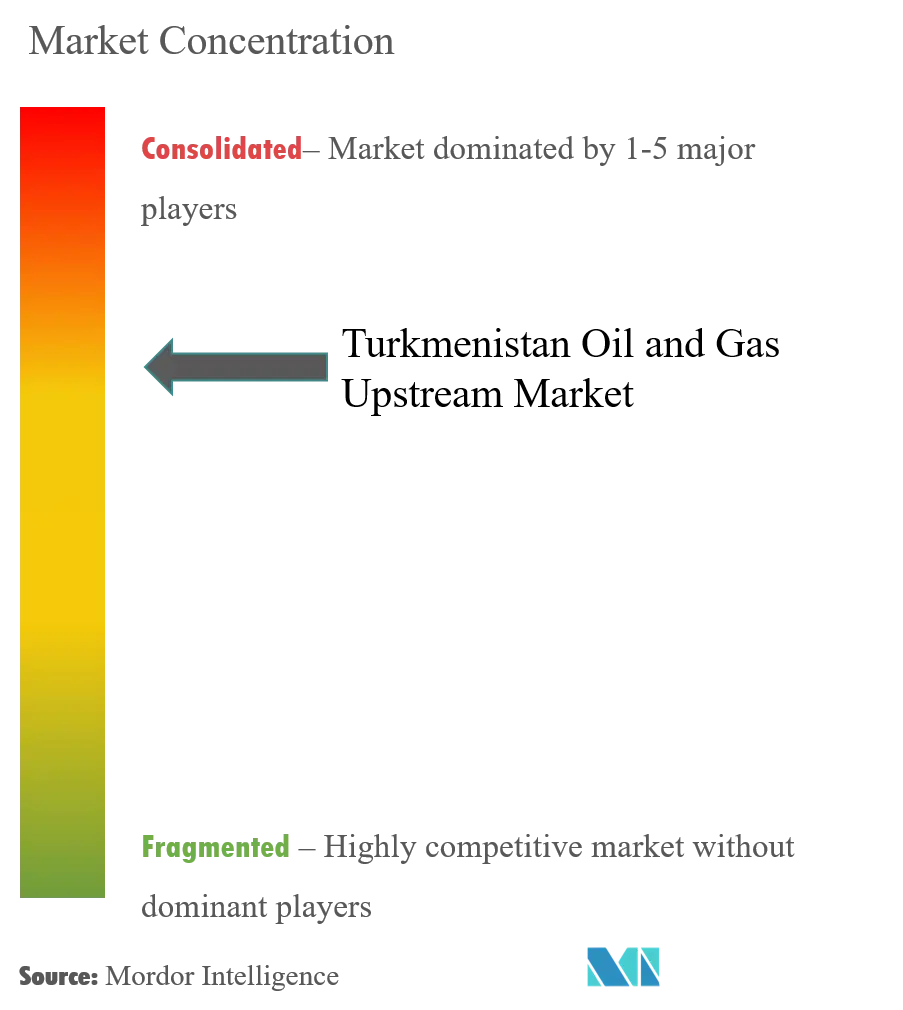
| Market Concentration | Medium |
Major Players *Disclaimer: Major Players sorted in no particular order Image © Mordor Intelligence. Reuse requires attribution under CC BY 4.0. | |
Turkmenistan Oil And Gas Upstream Market Analysis by Mordor Intelligence
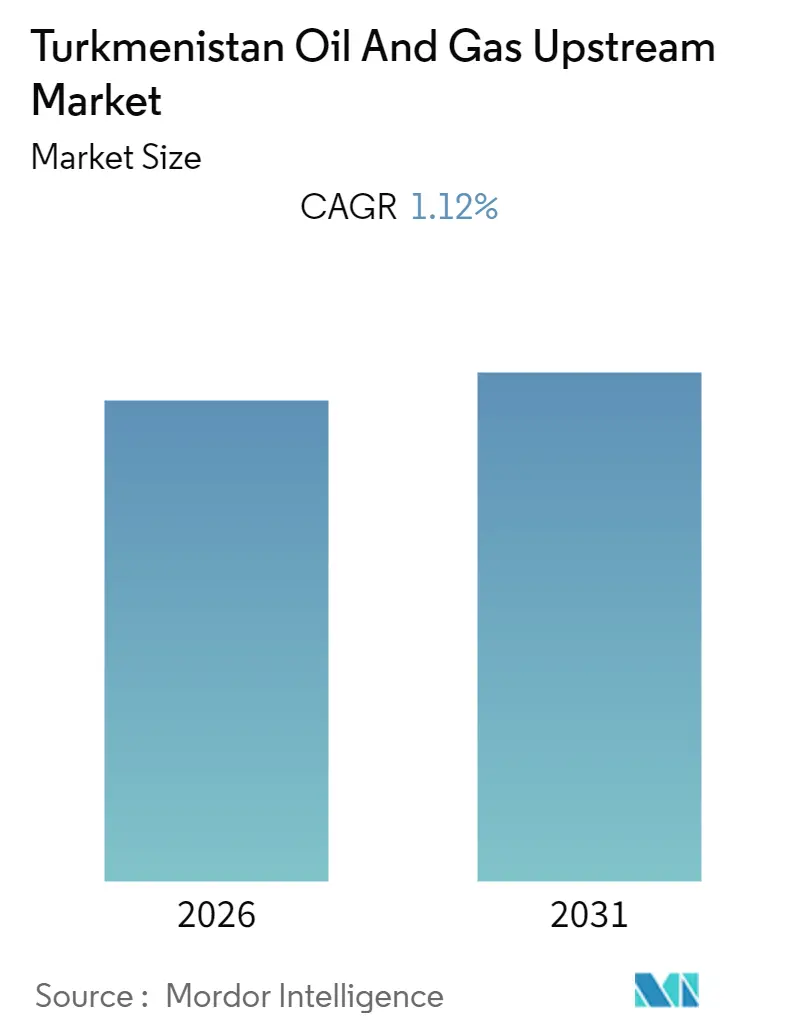
The Turkmenistan Oil and Gas Upstream Market size is expected to register a CAGR of 1.12% during the forecast period 2026-2031.
- Most of the economically viable oil and gas fields in the country are situated inland. Therefore, it is evident that the onshore segment is expected to be dominated in the market.
- The oil and gas industry is a key contributor to the economic success of Turkmenistan. Together with the development of a stable legal foundation, in line with international standards, Turkmenistan has established the necessary conditions for attracting investment to oil and gas sector. In addition, advancement of the oil and gas industry is one of the main policy priorities for the country, which in turn, likely to provide opportunities in the market in the future.
Note: Market size and forecast figures in this report are generated using Mordor Intelligence’s proprietary estimation framework, updated with the latest available data and insights as of 2026.
Turkmenistan Oil And Gas Upstream Market Trends and Insights
Onshore Segment to Dominate the Market
- Turkmenistan had proven oil reserves of 0.6 thousand million barrels in 2018. Most of the country's oilfields are situated in the South Caspian Basin and the Garashyzlyk onshore area in the west of the country. Most of the countries proved oil reserves are held in onshore.
- Turkmenistan ranks in the top countries for natural gas reserves in the world and also in terms of gas production. Turkmenistan has proven natural gas reserves of 688.1 Trillion cubic feet (Tcf) at the end of 2018. Turkmenistan has several of the world's largest gas fields, including the Amu Darya basin in the southeast, the Murgab Basin, and the South Caspian basin in the west.
- The Dauletabad Gas Field, located in the Amu Darya basin in the southeast, is one of Turkmenistan's largest and oldest gas-producing fields. Major discoveries at the Galkynysh gas field, formerly known as the South Yoloten in the prolific eastern part of the country are expected to offset most declines in other large and mature gas fields and are likely to add to the existing proven reserve amounts. The Galkynysh Gas Fields is expected to hold gas reserves of more than 27 trillion cubic meters.
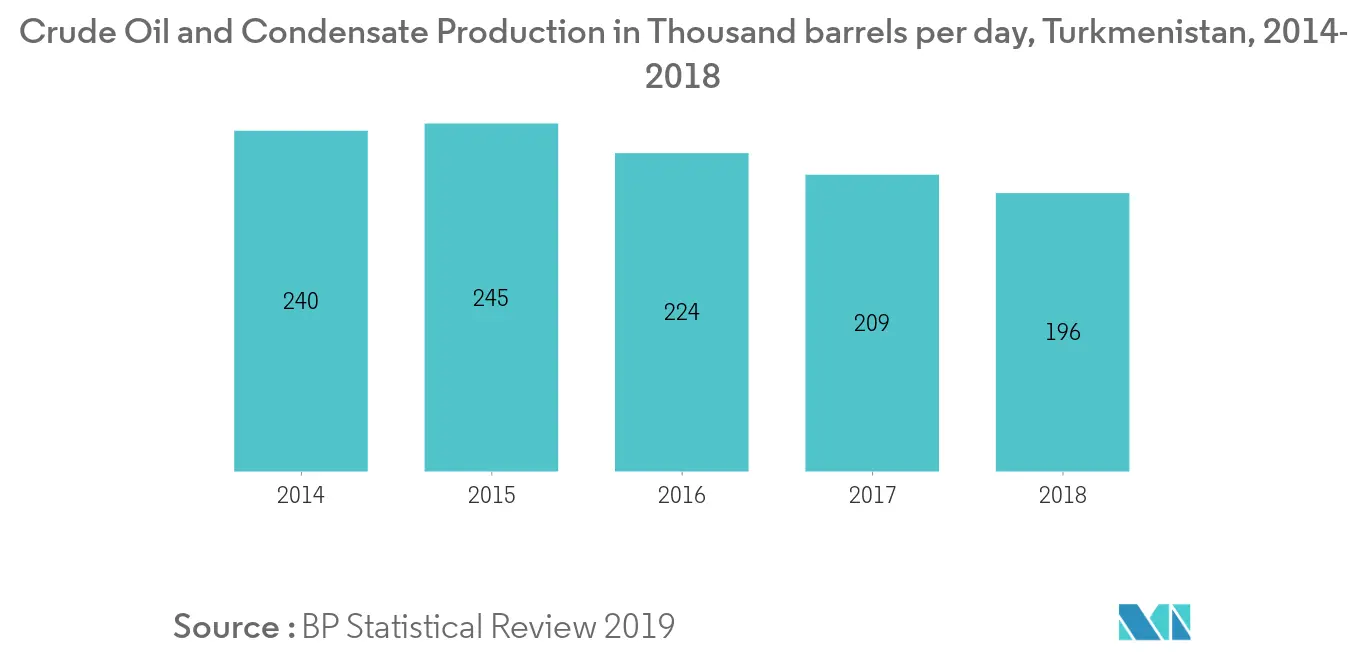
- In 2018, crude oil and condensate production has declined to 196 thousand barrels per day owing to the decline in oil exports from Turkmenistan, attributed it to price disagreements. As most of the country's proven reserve are in onshore and with several upstream projects undergoing development in Turkmenistan, the onshore oil and gas fields are expected to dominate the market.
Increasing Demand for Natural Gas to Drive the Market
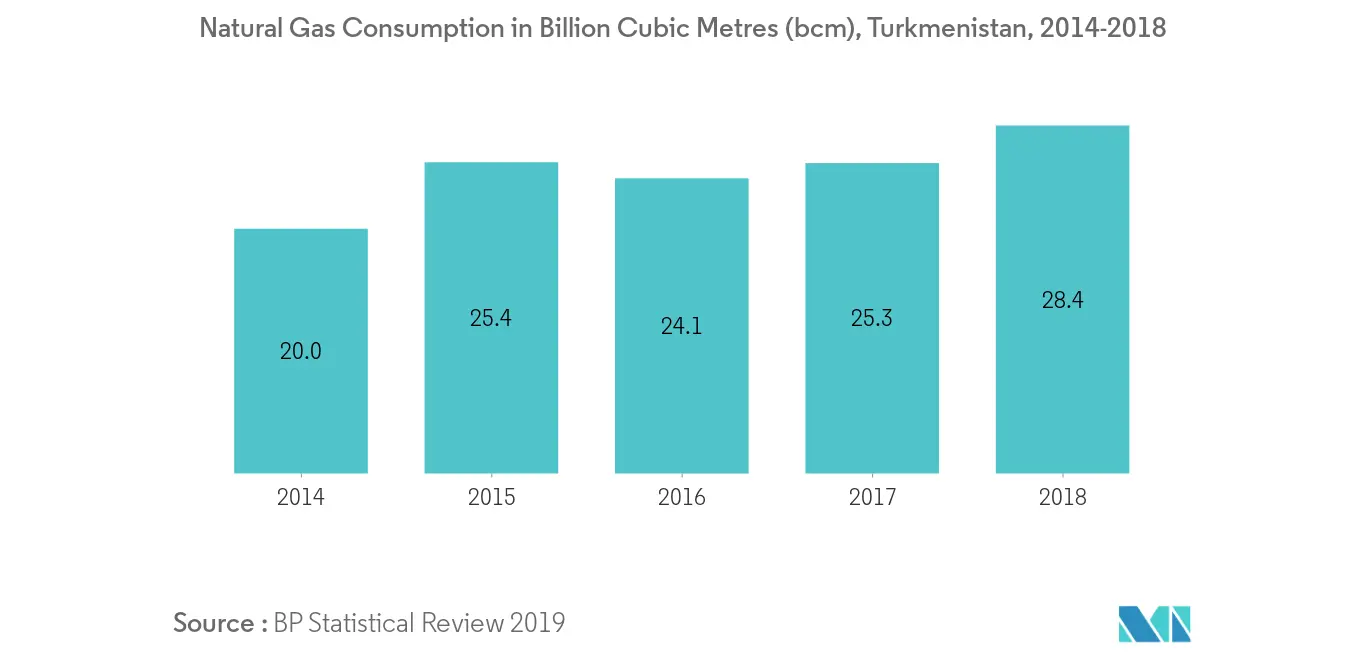
- Turkmenistan's economy depends heavily on exports of natural gas. Turkmenistan has some of the world's largest natural gas reserves, but most of them remain undeveloped. The upgradation of domestic and export infrastructure is likely to make the country a major gas supplier. In 2018, natural gas consumption has reached 28.4 billion cubic meters representing an increase in the consumption rate of about 12.2% over the previous year owing to the increase in demand.
- Turkmenistan's most important gas fields include the Galkynysh gas field, Yashlar-Minara, and Bagtyarlik. The government in capital Ashgabad opted to develop these giant fields through concessions and service contracts with Petrofac, LG International, CNPC, and Hyundai Engineering and Construction Co. for a specific timeframe instead of the popular Production Sharing Agreement model (PSA).
- The Turkmenistan-Afghanistan-Pakistan-India Pipeline (TAPI), also known as Trans-Afghanistan Pipeline, is a natural gas pipeline project being developed by the Galkynysh - TAPI Pipeline Company Limited. The pipeline is expected to transport natural gas from the Galkynysh Gas Field in Turkmenistan through Afghanistan into Pakistan and then to India. Construction on the project started in Turkmenistan in 2015.
- The country's aim is to form routes for exporting energy resources through diversification and the creation of multi-vector pipeline systems. Turkmenistan is expected to implement large-scale projects to build major energy bridges to both the east and west. The aim of the Ashgabat authorities is to increase gas production rates, thus boosting exports of gas.
- Therefore, the upcoming projects in the oil and gas industry is expected to contribute to an integrated industrialization of Turkmenistan and the dynamic development of the national economy.
Regulatory Landscape
Turkmenistan retains state ownership of hydrocarbon resources under the Law on Hydrocarbon Resources (No. 208-III of 2008, amended through 2021). The law provides the framework for exploration and production rights, contracting, and state control of strategic assets. Sector governance and operating oversight are handled by state bodies and vertically integrated state concerns, including State Concern Turkmennebit for oil operations, alongside the Oil and Gas Complex of Turkmenistan and the Ministry of Energy.
Although licensing and cooperation models exist for foreign participation, the state continues to steer upstream priorities through sectoral directives and project approvals. In February 2026, a sectoral meeting summarizing 2025 results highlighted acceleration of TAPI pipeline work (including the Serhetabat-Herat section) and production-capacity actions linked to domestic processing hubs, reinforcing a policy line that ties upstream activity to export route development and national energy-security objectives.
Value Chain Analysis
Turkmenistan's upstream value chain is anchored by state resource ownership and field development led by state concerns, including Turkmengas for gas and Turkmennebit for oil, with foreign operators and contractors participating through structured agreements and project contracts. The chain runs from geological studies and licensing through exploration, drilling, and surface facilities, then into gas treatment and processing and integration into trunk pipelines. Offshore Caspian activity also feeds this chain through PSAs and seismic programs, including Petronas and partners on selected blocks.
The recent contracting pattern shows where capital and execution are concentrated. Turkmengas and a CNPC subsidiary contracted Phase 4 development at the Galkynysh gas field, a multi-phase mega-project, aimed at adding 10 bcm per year of processing capacity. Offshore cooperation has also broadened via agreements involving Turkmennebit, Petronas, and Gulf-linked capital in the Caspian. Midstream linkages influence upstream monetization, with export dependence on the China route and active workstreams around additional outlets such as TAPI, making compressor stations, pipeline interfaces, and processing capacity key enablers and constraints for field ramp-ups.
Competitive Landscape
The Turkmenistan oil and gas upstream market is moderately consolidated. Some of the key players in this market include Buried Hill Energy, China National Petroleum Corp, Dragon Oil PLC, Hyundai Engineering & Construction Co., and Eni SpA.
Turkmenistan Oil And Gas Upstream Industry Leaders
-
Buried Hill Energy
-
China National Petroleum Corp
-
Dragon Oil PLC
-
Hyundai Engineering & Construction Co.
-
Eni SpA
- *Disclaimer: Major Players sorted in no particular order
Market Opportunities and Future Outlook
Large-scale brownfield and phased development at cornerstone gas assets continues to support contracting and service demand across drilling, EPC, gas processing, and field infrastructure. A near-term anchor is the Phase IV contract for Galkynysh, signed between Turkmengas and CNPC counterparts in April 2026, structured around adding 10 bcm/year of gas processing capacity. That capacity focus expands work scopes for surface facilities, utilities, and integration into export and domestic networks.
Offshore Caspian acreage is also a visible opportunity lane, backed by signed agreements rather than exploratory intent alone. In June 2026, Petronas signed a PSA for Blocks 19 and 20 (100% interest) and a cooperation agreement covering 2D seismic studies across Northern Offshore Blocks (11-14). In July 2026, Petronas confirmed exploration and drilling activities scheduled for December 2026. Together, these steps broaden active upstream work beyond onshore gas and deepen demand for seismic acquisition, subsurface services, offshore drilling support, and early-stage development planning as Turkmenistan diversifies its upstream partner set and portfolio.
Recent Industry Developments
- July 2026: Petronas confirmed the start of exploration and drilling activities on Turkmenistan's Caspian blocks from December 2026, following its newly expanded offshore position. The announcement operationalizes the June 2026 acreage additions and signals near-term demand for offshore drilling support, seismic-to-well conversion, and associated logistics.
- June 2026: Petronas Carigali (Turkmenistan) signed a Production Sharing Agreement for Offshore Blocks 19 and 20 and a cooperation agreement for 2D seismic studies over Northern Offshore Blocks (11-14) with State Concern Turkmennebit and State Enterprise Hazarnebit. The deals increase active offshore work programs and diversify the upstream partner mix alongside longstanding onshore-led development.
- April 2026: State Concern Turkmengas and CNPC AmuDarya Petroleum Company Ltd signed a contract for Phase IV development of the Galkynysh gas field, framed around a major capacity addition (10 bcm/year of processing). The agreement reinforces Galkynysh as the central upstream growth engine and expands EPC, drilling, and surface-facility scopes tied to export and domestic supply integration.
Research Methodology Framework and Report Scope
Market Definition and Coverage
For this study, the Turkmenistan oil and gas upstream market is defined as the value of exploration, field development, drilling, and production activities carried out within Turkmenistan for crude oil and natural gas, covering both onshore and offshore operations.
Scope exclusions: Downstream refining, petrochemicals, fuel retailing, and midstream pipeline and LNG transport services are not counted in this market value.
Segmentation Overview
- Location
- Onshore
- Offshore
Data Sources, Market Sizing, and Validation
Desk Research
Desk research is used to set the factual base of upstream activity and to pin down what is realistically happening on the ground before assumptions are made. We typically start with publicly available energy and macro data, and then cross-check it with upstream indicators such as production levels, field development timelines, and export capacity signals.
Sources referenced include official and non-paywalled materials such as national statistics releases, energy ministry or regulator publications, OPEC and IEA statistical tables, World Bank macro series, and UN Comtrade trade statistics, along with technical papers in peer reviewed journals when a specific basin or field topic needs clarification. Company annual reports and project updates, association websites, and reputed press coverage are also used to validate capex cycles and project status. In addition, select paid subscriptions for company financials, news and financials, patent lookups, and shipment level trade visibility are used where they help confirm timing and investment direction. The examples listed here are not exhaustive, and many other sources were used for data collection, validation, and research clarification.
Primary Interviews and Surveys
Expert interviews and targeted surveys with operators, contractors, equipment suppliers, regulators, and energy analysts active in Turkmenistan are used to test production plans, drilling schedules, field development timing, service prices, export assumptions, and gaps in public data before the model is finalized. Respondent input also helps distinguish recurring upstream activity from one-off project spending in the Turkmenistan market.
Distribution of primary research fieldwork respondents
| Company type | Respondent position |
|---|---|
| Top tier: 27% | CXOs: 12% |
| Mid tier: 48% | Functional/Unit leaders: 33% |
| Smaller Players: 25% | Managers: 55% |
Market-Sizing & Forecasting
Sizing is built using a top-down and bottom-up blend, where national upstream activity is reconstructed first and then tested using selective roll-ups. On the top-down side, we translate Turkmenistan oil and gas production and development activity into spend pools by aligning field activity levels with typical upstream cost structures, and then we keep the onshore and offshore split consistent with disclosed project pipelines.
To make the model practical, several market-specific inputs are tracked and updated, such as crude oil and natural gas production trends, drilling and workover intensity, the share of offshore development versus onshore brownfield work, the timing of major field development milestones, and inflation and currency conversion timing for USD reporting. Where a bottom-up check is possible, sampled contract values, typical day rates for drilling and key services, and equipment and service demand patterns are used to validate whether the implied spend is realistic. When coverage is incomplete, gaps are handled by using conservative activity-to-spend ratios that are agreed with primary respondents, and then adjusted only when multiple signals move in the same direction.
For forecasting, scenario analysis is used to reflect how upstream spending changes when project timelines shift, when production targets are revised, or when offshore development is delayed, and the chosen scenario is then cross-checked with what experts expect for near-term activity levels. This approach stays repeatable because each forecast step is tied back to a small set of observable activity variables rather than overly detailed assumptions.
Data Validation & Update Cycle
Validation is done through multiple passes that look for internal consistency and for alignment with external signals. We compare the model outputs against independent metrics such as production trends, visible project announcements, and import and trade signals tied to upstream equipment, and then investigate any year-on-year jumps that do not match the activity story.
Before sign-off, the numbers are reviewed by another analyst to check scope discipline, unit handling, and currency timing, and then any material variance triggers a re-contact with interviewees to confirm what changed. The report is refreshed annually, with interim updates when there is a material event such as a major project sanction, a policy shift affecting investment, or a clear production change. Right before delivery, a final pass is done so clients receive the latest updated view.
Mordor Intelligence's Turkmenistan Oil and Gas Upstream Market Size Compared With Other Published Estimates
Published market values for Turkmenistan upstream do not always line up because the line between upstream activity spend and broader oil and gas value is drawn differently across sources, and the years used for conversion and inflation adjustments can vary. Differences also show up when one estimate relies mainly on high-level growth targets, while another ties the numbers to observed drilling, development, and production activity.
The biggest gap drivers in this market are whether the estimate counts only E&P activity inside the country versus adding midstream transport or downstream linked spending, and whether offshore plans are treated as fully realized spend or staged over time based on project progress. Assumptions on cost per well, service pricing changes, and the timing of currency conversion can move the final USD value meaningfully, especially in a market where project timing drives the spending curve. The table shows the spread, which is largely explained by excluding midstream and downstream add-ons and by staging offshore development based on project readiness, a modeling choice applied near the end of the build by Mordor Intelligence.
Benchmark comparison
| Source | Market Size | Gaps in Research Methodology |
|---|---|---|
| Mordor Intelligence | USD 4.00 B (2024) | |
| Global Advisory A | USD 5.66 B (2024) | This figure appears to use a wider oil and gas upstream revenue definition and may embed broader E&P stage and associated spending assumptions that raise the total versus a strict activity-linked spend pool. |
| Industry Publisher B | USD 3.80 B (2026) | This estimate is anchored to a later year and can differ due to base year selection, forecast window choice, and how offshore ramps are treated early in the period, which can understate near-term activity. |
Taken together, the spread is mainly about scope discipline and timing. When upstream is kept to country-level E&P activity and offshore spend is phased based on actual project progression, the market value stays traceable to clear activity drivers and can be repeated when new production or project signals emerge.
Key Questions Answered in the Report
What is the current Turkmenistan Oil and Gas Upstream Market size?
The Turkmenistan Oil and Gas Upstream Market is projected to register a CAGR of 1.12% during the forecast period (2026-2031)
Who are the key players in Turkmenistan Oil and Gas Upstream Market?
Buried Hill Energy, China National Petroleum Corp, Dragon Oil PLC, Hyundai Engineering & Construction Co. and Eni SpA are the major companies operating in the Turkmenistan Oil and Gas Upstream Market.
What years does this Turkmenistan Oil and Gas Upstream Market cover?
The report covers the Turkmenistan Oil and Gas Upstream Market historical market size for years: 2020, 2021, 2022, 2023 and 2024. The report also forecasts the Turkmenistan Oil and Gas Upstream Market size for years: 2026, 2027, 2028, 2029, 2030 and 2031.