
Turkey Wire and Cable Market Size and Share
Market Overview
| Study Period | 2020 - 2031 |
|---|---|
| Forecast Data Period | 2026 - 2031 |
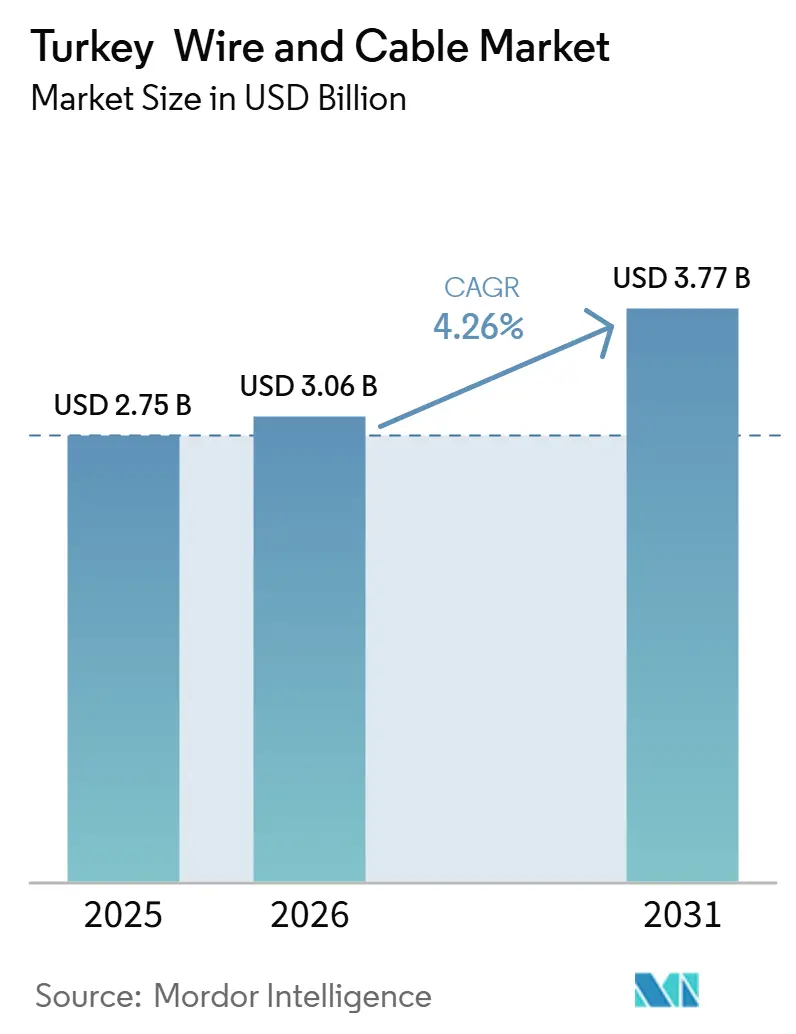
| Base Year Market Size (2025) | USD 2.75 Billion |
| Market Size (2026) | USD 3.06 Billion |
| Market Size (2031) | USD 3.77 Billion |
| Growth Rate (2026 - 2031) | 4.26 % |
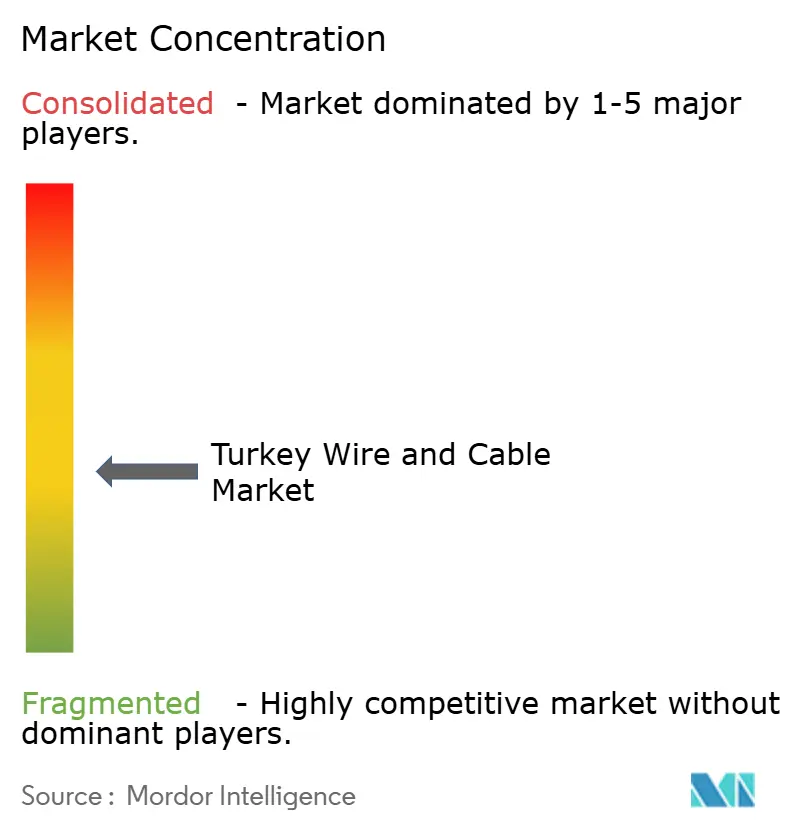
| Market Concentration | Medium |
Major Players *Disclaimer: Major Players sorted in no particular order Image © Mordor Intelligence. Reuse requires attribution under CC BY 4.0. | |
Turkey Wire and Cable Market Analysis by Mordor Intelligence
The Turkey wire and cable market size is projected to be USD 2.75 billion in 2025, USD 3.06 billion in 2026, and reach USD 3.77 billion by 2031, growing at a CAGR of 4.26% from 2026 to 2031. Transmission modernization, earthquake reconstruction, and digital infrastructure investment are supporting demand across power, fiber-optic, and building cable applications. Turkey's planned grid investments are also raising demand for higher-specification products, particularly where underground routes and high-voltage networks are required. Export activity gives manufacturers an additional outlet when domestic credit conditions remain restrictive. Producers with testing capability, integrated copper processing, and established export channels are better placed to manage the shift toward more demanding specifications. Copper-price swings, inflation, and expensive working capital continue to limit margins for firms that depend on imported inputs.
Key Report Takeaways
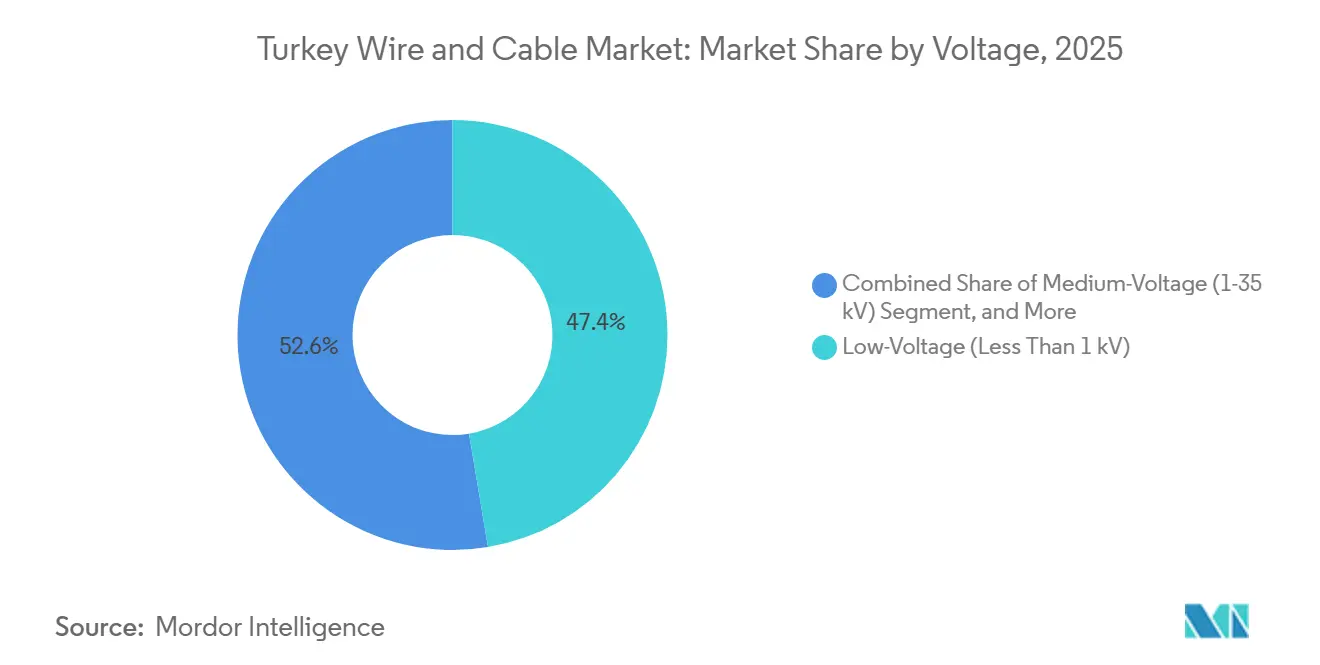
- By voltage, low-voltage (below 1 kV) cable held 47.36% of revenue share in the Turkey wire and cable market in 2025, while extra- and high-voltage cable is projected to expand at a 5.58% CAGR through 2031.
- By cable type, power cable accounted for 69.32% of revenue share in the Turkey wire and cable market in 2025, while fiber-optic cable is expected to grow at a 5.94% CAGR through 2031.
- By conductor material, copper accounted for 58.22% of revenue share in the Turkey wire and cable market in 2025, while optical glass/polymer is projected to grow at a 6.08% CAGR through 2031.
- By installation, underground cable accounted for 50.76% of revenue share in the Turkey wire and cable market in 2025 and is expected to expand at a 5.12% CAGR through 2031.
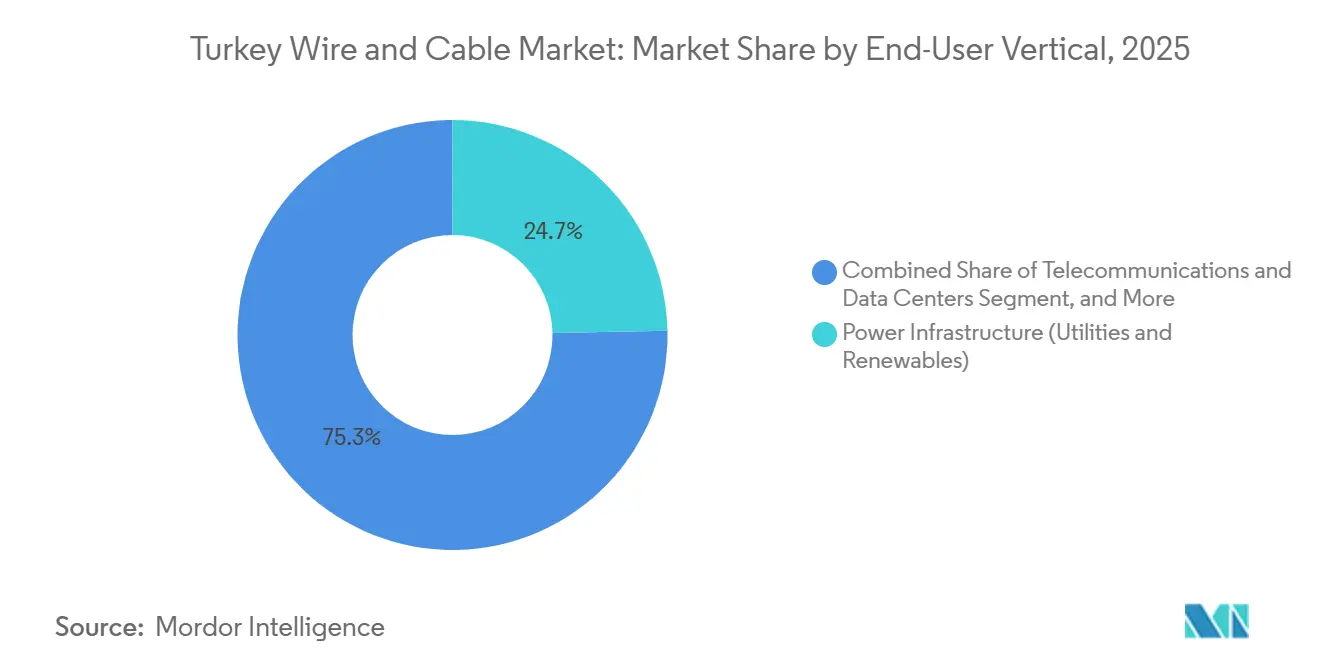
- By end-user vertical, power infrastructure held 24.68% of revenue share in the Turkey wire and cable market in 2025 and is projected to grow at a 5.76% CAGR through 2031.
- By insulation, insulated cable accounted for 89.14% of revenue share in the Turkey wire and cable market in 2025 and is expected to advance at a 4.43% CAGR through 2031.
Note: Market size and forecast figures in this report are generated using Mordor Intelligence’s proprietary estimation framework, updated with the latest available data and insights as of January 2026.
Turkey Wire and Cable Market Trends and Insights
Drivers Impact Analysis*
| Driver | (~) % Impact on CAGR Forecast | Geographic Relevance | Impact Timeline |
|---|---|---|---|
| Renewable Energy Grid Expansion and Transmission Modernization | +1.4% | National, with concentrated activity in Eastern and Western Anatolia transmission corridors | Long term (≥ 4 years) |
| Post-Earthquake Urban Transformation and Building Rewiring | +0.9% | Southeast Turkey, including Kahramanmaraş, Hatay, Adıyaman, Gaziantep, and adjacent 11 provinces | Medium term (2-4 years) |
| Fiber Backhaul, Data Center, and 5G Infrastructure Investment | +0.8% | National, with early concentration in Istanbul, Ankara, and İzmir technology corridors | Short term (≤ 2 years) |
| Export-Led Production and Nearshoring Demand From Europe and Adjacent Markets | +0.6% | Marmara industrial belt, Aegean coastal zones, and spillover to the Black Sea, including Samsun | Medium term (2-4 years) |
| Electrification of Mobility, Rail, and Industrial Equipment | +0.4% | Istanbul, Kocaeli, and İzmit automotive corridors, plus national rail corridors | Long term (≥ 4 years) |
| Higher Fire-Safety and Energy-Efficiency Cable Specifications | +0.3% | National, with early adoption in Istanbul and Ankara commercial construction hubs | Medium term (2-4 years) |
| Source: Mordor Intelligence | |||
Renewable Energy Grid Expansion and Transmission Modernization
Turkey's renewable energy plans are increasing the need for new substations, transmission lines, and underground cable corridors. The World Bank approved USD 748 million in August 2025 for the Transforming Power Transmission System Project, which supports the integration of 1.7 GW of renewable energy.[1]World Bank, “World Bank and Clean Technology Fund Support Türkiye's Renewable Energy Goals With Power Transmission Project,” World Bank, worldbank.org The electricity distribution sector planned TRY 777 billion (USD 19 billion) of network renewal investment for the 2026-2030 tariff period. These projects require cables that meet higher voltage, insulation, and testing requirements than standard building wiring. The resulting procurement favors suppliers that can provide XLPE-insulated products, documented compliance, and installation support. This requirement is strengthening the premium end of the Turkey wire and cable market as grid work proceeds. It also makes proven factory testing, conductor quality, and delivery records more important during supplier selection, because a failure in a transmission corridor can delay a much larger grid program.
Post-Earthquake Urban Transformation and Building Rewiring
Reconstruction in the earthquake-affected provinces is supporting demand for low-voltage building wiring and medium-voltage distribution equipment. The Islamic Development Bank and Turkey signed a EUR 200 million (USD 235 million) financing package in July 2025 for sustainable municipal infrastructure.[2]Islamic Development Bank, “Islamic Development Bank and Türkiye Sign EUR 200 Million Financing Agreements to Strengthen Sustainable Municipal Infrastructure,” Islamic Development Bank, isdb.org The package allocated EUR 150 million (USD 176.3 million) to water, wastewater, and stormwater reconstruction and EUR 50 million (USD 58.75 million) to urban transport improvements. Rebuilt homes need wiring that meets current TS EN requirements, while reconstructed districts require feeders, transformers, and municipal connections. This work continues after the initial structural phase because network renewal and final building fit-out follow different schedules. Municipal systems, neighborhood feeders, and completed homes do not require the same cable mix, thereby spreading purchasing across several construction stages. It provides a multi-year source of demand for the Turkey wire and cable market in southeastern provinces.
Fiber Backhaul, Data Center, and 5G Infrastructure Investment
The national 5G rollout is increasing the need for fiber backhaul, power distribution, and structured cabling. Turkey's 5G spectrum auction in October 2025 raised USD 2.95 billion, exceeding the USD 2.125 billion government floor. The rollout that began on April 1, 2026, drove TRY 263 billion (USD 5.6 billion) of telecom infrastructure investment in the first quarter of 2026. Turkey's fiber-optic cable length increased from 618,000 km to 697,000 km during the year. Turkcell and Google Cloud committed USD 3 billion to a hyperscale regional data center in Ankara, with construction expected to start in 2026. These facilities need fiber links as well as LSZH copper power cables, which broadens the opportunity for suppliers serving the Turkey wire and cable market. Their concentration in large urban technology corridors also gives cable producers identifiable locations for sales and technical support.
Export-Led Production and Nearshoring Demand From Europe and Adjacent Markets
Export demand is helping cable producers balance domestic working-capital pressure. Türk Prysmian Kablo reported that sector exports grew 16% in 2025 to USD 3.9 billion. Turkey's electrical and electronics sector recorded USD 9.1 billion of exports in the first half of 2026. Manufacturers in Cerkezkoy, Mudanya, Denizli, and Corlu already serve international customers through IEC and EN certification. Producers that sustain export volumes while building recognized brands can partly offset cost pressure in domestic contracts. Turkey's location and customs union links make shorter supply chains attractive to European buyers. This supports manufacturing investment ahead of some domestic demand categories in the Turkish wire and cable market. Export capability also rewards producers who maintain consistent documentation, quality controls, and lead times for customers in several jurisdictions.
Restraints Impact Analysis*
| Restraint | (~) % Impact on CAGR Forecast | Geographic Relevance | Impact Timeline |
|---|---|---|---|
| Copper, Aluminum, and Polymer Cost Volatility | -0.8% | Global, with direct pass-through to cable manufacturing clusters in Marmara and Aegean industrial zones | Short term (≤ 2 years) |
| High Inflation, Currency Depreciation, and Working-Capital Pressure | -0.6% | National, most acute for domestic mid-tier manufacturers without USD-denominated export revenue | Medium term (2-4 years) |
| Fragmented Low-Voltage Competition and Price-Based Procurement | -0.3% | National, concentrated in residential and commercial construction procurement channels | Medium term (2-4 years) |
| Import Dependence for High-End Fiber, Submarine, and Specialized Cables | -0.2% | National, with import exposure concentrated in Istanbul and Marmara distribution hubs | Long term (≥ 4 years) |
| Source: Mordor Intelligence | |||
Copper, Aluminum, and Polymer Cost Volatility
Copper remained the primary conductor in 58.22% of Turkey's cable output in 2025, leaving producers highly exposed to fluctuations in material prices. LME 3-month copper prices ranged from USD 8,105 to USD 12,960 per metric ton in 2025 and increased 42.30% over the year. Mine disruptions and strategic stockpiling contributed to this volatility. Firms without wire-rod integration or USD-denominated export revenue face more immediate margin pressure when input costs rise. HFFR and XLPE compound costs also rose as petrochemical feedstocks followed oil-price movements. Framework contracts increasingly include material-cost escalation clauses, shifting part of the risk from manufacturers to project owners.
High Inflation, Currency Depreciation, and Working-Capital Pressure
High financing costs continue to constrain producers that must fund copper and polymer inventories before receiving payment. Turkey's annual consumer price inflation declined from 75.45% in May 2024 to 30.9% in December 2025. The policy rate stood at 37% in mid-2026 after a 100-basis-point cut, keeping borrowing expensive for capital-intensive plants. Turkey's manufacturing capacity utilization averaged 74.5% in 2025, indicating that installed capacity was not fully utilized despite project activity. Manufacturers with imported copper exposure faced higher local-currency input costs following a 11.35% depreciation of the U.S. dollar in 2025. Firms with export revenue received a partial offset, while easing credit conditions later in 2026 could support residential and commercial demand.
*Our forecasts treat driver/restraint impacts as directional, not additive. The impact forecasts reflect baseline growth, mix effects, and variable interactions.
Segment Analysis
By Voltage: High-Voltage Projects Support Premium Demand
Low-voltage cables below 1 kV held 47.36% of the wire and cable segment share in 2025. Residential wiring, commercial construction, industrial installations, and general electrical work supported this broad base of demand. The segment remains the largest by volume and active project count. Many smaller domestic suppliers compete on price in this part of the Turkey wire and cable market. Medium-voltage cables from 1 to 35 kV serve industrial facilities, distribution substations, and interconnections for renewable power plants. Solar and wind project commissioning, together with rewiring in southeastern provinces, supports this category.
Extra- and high-voltage cable above 35 kV is projected to grow at a 5.58% CAGR from 2026 to 2031. Turkey plans 15,000 km of HVDC lines with a combined capacity of 40 GW, linking renewable generation areas with demand centers. These projects need long-run underground cables with XLPE insulation and high performance at 154 kV and above. The USD 748 million World Bank project supports substations and underground transmission corridors. Turk Prysmian's Mudanya facility is among the local sites capable of meeting IEC 60840 requirements. Suppliers able to deliver EPC work at this tier have a clearer position than firms concentrated in price-led low-voltage supply.



By Cable Type: Fiber-Optic Demand Rises With Digital Infrastructure
Power cable accounted for 69.32% of the wire and cable segment value in 2025. Grid expansion, distribution renewal, and post-earthquake utilities reconstruction underpin this lead. Signal and control cable is used in process automation, rail signaling, and EV charging monitoring. Coaxial and data cables continue to serve broadband and CCTV applications. Manufacturers have aligned many power-cable portfolios with the EU Construction Products Regulation and IEC 60332 fire-performance standards. This approach supports export access and strengthens eligibility for public tenders that specify fire-reaction classes.
Fiber-optic cable is expected to expand at a 5.94% CAGR from 2026 to 2031, the highest rate among cable types. Fiber length rose from 618,000 km to 697,000 km in 1 year as 5G infrastructure expanded. The Ankara hyperscale data center will add demand for fiber interconnects and supporting power systems. Fiber routes also require power and LSZH copper cables for active equipment. This connection means that digital investment can support multiple cable categories simultaneously. It gives the Turkish wire and cable market a demand source beyond conventional power construction. Cable suppliers, therefore, need product ranges that connect digital infrastructure requirements with power reliability, fire safety, and installation needs within dense equipment rooms.
By Conductor Material: Optical Glass and Polymer Advance With Fiber Networks
Copper held 58.22% of the wire and cable segment share in 2025. Its conductivity keeps it central to power and control cable applications across voltage levels. Aluminum ranked second and is favored for overhead transmission and low-voltage aerial bundled cable in rural distribution. Larger aluminum cross-sections can reduce the effect of lower conductivity where weight and cost allow. Öznur Cable targets 70,000 metric tons of annual copper wire-rod output from its integrated Çerkezköy complex. This local capacity supports the supply chain behind copper's continued role.
Optical glass/polymer is projected to grow at a 6.08% CAGR from 2026 to 2031. Expansion of fiber networks and data centers directly supports this material category. Copper's 42.30% price increase in 2025 is also encouraging the evaluation of aluminum substitution in selected low-voltage power cables. In residential work, larger aluminum conductors can compensate for lower conductivity in suitable applications. Cost discipline in mass-housing contracts is bringing this option into procurement discussions. Copper will remain important, but material choice is becoming more sensitive to project economics. Integrated producers have greater flexibility when customers request alternatives, whereas firms that buy material externally must manage price changes and specification limits simultaneously.
By Installation: Underground Cable Holds Both Scale and Growth
Underground cable accounted for 50.76% of the wire and cable segment value in 2025. It is also expected to grow at a 5.12% CAGR from 2026 to 2031. Urban infrastructure renewal and renewable-grid development explain this combination of scale and growth. Underground routes are important in dense areas and in high-voltage transmission projects. In January 2026, Türk Prysmian Kablo secured a TRY 934.3 million (USD 26.7 million) contract for the HKABY.16 İzmir project.[3]Türk Prysmian Kablo, “TRY 934 Million Energy Infrastructure Project From Türk Prysmian Kablo,” Türk Prysmian Kablo, tr.prysmian.com The project covers 31,500 m of 154 kV XLPE-insulated underground cable.
Overhead cable remains a cost-effective option for rural distribution and inter-substation connections in less dense eastern regions. Submarine cable is a smaller but strategically important category. The Bosphorus, the Dardanelles, and planned offshore wind projects in the Sea of Marmara create project-specific demand. These projects often require specialized imports or partnerships with global submarine cable suppliers. The Asian Infrastructure Investment Bank committed up to USD 1.5 billion for the Istanbul North Rail Crossing project. The electrified crossing can support demand for underground and marine-type cable systems. Each installation method serves a different physical setting, so suppliers must match cable design, jointing capabilities, and field support to the conditions of each project.
By End-User Vertical: Power Infrastructure Leads Demand
Power infrastructure, including utilities and renewables, accounted for 24.68% of the wire and cable segment's value in 2025. It is projected to grow at a 5.76% CAGR from 2026 to 2031. Grid upgrades, renewable connections, and distribution investment create this dual lead. The distribution sector planned to allocate TRY 777 billion (USD 19 billion) for network renewal over 2026-2030. Telecommunications and data centers are the second-fastest-growing vertical. Turkcell's data center operations had reached EUR 585 million (USD 655 million) in cumulative investment by the end of 2025.
Residential construction remains an important buyer because reconstruction and urban transformation require full rewiring to current TS EN standards. Commercial buildings, including offices, hotels, retail sites, and data center campuses, also need power and data cabling. Turkey recorded 240,000 EV sales in 2025, boosting demand for traction cables, charging cables, and high-temperature wire harnesses. Hyundai Motor Turkey is investing EUR 715 million (USD 801 million) in an IONIQ 3 EV facility and battery assembly plant in İzmit. Oil and gas, petrochemicals, and industrial manufacturing continue to see steady demand driven by maintenance and process-plant work. These end users broaden the Turkey wire and cable market beyond public infrastructure contracts. Their requirements vary by operating environment, which supports the demand for specialized cable designs rather than a single standard product across all customer groups.
By Insulation: Fire-Rated Materials Gain Importance
Insulated cable held 89.14% of the wire and cable segment share in 2025. It is expected to expand at a 4.43% CAGR from 2026 to 2031. Insulated products are used across nearly all end-use applications, which explains their dominant position. Non-insulated conductors primarily include bare ACSR and AAAC products for overhead transmission and rural distribution. The broader shift toward underground installation constrains their role. The category remains important for selected grid and rural projects.
Within insulated cables, PVC is being replaced by XLPE at medium and high voltages. XLPE offers stronger thermal performance, lower dielectric losses, and compatibility with larger conductor cross-sections. HFFR cables are gaining use in commercial buildings, hospitals, hotels, and data centers because they produce less smoke and fewer toxic combustion products. Nexans Türkiye adopted CPR Cca-class cable as its portfolio baseline in February 2026, replacing the earlier Eca class. The change was developed through the company's Denizli and Tuzla research and development centers. It reflects a higher fire-safety specification threshold in the Turkey wire and cable market. Suppliers that can document compliant materials and fire performance should be better prepared for applications where safety requirements are a decisive purchasing condition.
Geography Analysis
Western Turkey, centered on the Marmara region, represents the largest concentration of cable production and demand in the Turkish wire and cable market. The region includes facilities operated by Türk Prysmian in Mudanya, Nexans Türkiye in Tuzla, Öznur Cable in Çerkezköy, Vatan Cable in Çorlu, and ETK Kablo in Sancaktepe. Proximity to Istanbul ports, copper inputs, and technical skills support efficient supply chains. Its demand includes residential wiring, industrial and commercial cable, and metropolitan transmission work. Türk Prysmian's January 2026 İzmir contract covered 31,500 m of 154 kV XLPE-insulated underground cable and reflected demand from the Aegean industrial zones.
Ankara and Central Anatolia are becoming important demand areas for telecommunications and data center cables. The USD 3 billion Turkcell and Google Cloud project in Ankara is expected to purchase LSZH power cable, structured fiber, and signal cable. Eastern Turkey is an energy-generation area where planned HVDC corridors will connect renewable resources to western demand centers. Turkey's National Energy Plan targets 510 TWh of electricity consumption and 189.7 GW of installed capacity by 2035. Transmission procurement along this route is expected to sustain demand for extra- and high-voltage cable through the forecast period.
Southeastern Turkey is a separate demand area because post-earthquake reconstruction requires residential rewiring, utility restoration, municipal network cable, and electrified transport connections. External financing for recovery across 11 provinces reached USD 8.7 billion by 2026. The Black Sea coast is gaining in importance as a supply hub through Borsan Cable's USD 180 million integrated facility in Samsun. The facility is expected to increase the region's production capacity by 150%. Its location supports domestic Black Sea projects and routes toward Central Asia. The European Union, the Middle East, and Central Asia remain important export destinations for Turkey-based producers.
Competitive Landscape
The Turkey wire and cable market has a two-tier structure that varies by voltage class. High-voltage and specialty products are supplied by a smaller group of technically capable firms, including Turk Prysmian, Nexans Turkey, and domestic producers with testing and EPC capability. These firms compete for large TEİAŞ and TEDAŞ contracts through type-test certificates, execution capacity, and financial resources. Prysmian invested EUR 65 million (USD 72.8 million) in its Turkey operations in 2025. The investment reinforced Mudanya's role in high-voltage engineering and in supplying European projects. Nakkaş Holding acquired HES Kablo through a TMSF-managed tender in February 2026, marking a significant change in ownership in the sector.
Low- and medium-voltage supply is more fragmented, with more than 200 domestic manufacturers competing in residential and commercial procurement. Competition in this tier is often price-led, particularly for standard products. HFFR and fire-rated products create an opening for firms that can meet more stringent CPR requirements. Producers with copper wire-rod production, compound lines, and internal laboratories can protect margins as specifications rise. Borsan Cable's USD 180 million Samsun facility is an example of this integrated-capacity approach. Oznur Cable's Çerkezkoy complex, which targets 70,000 metric tons of annual copper wire-rod capacity, follows a similar model.
Export diversification is becoming a meaningful competitive tool for Turkey-based manufacturers. Companies already serve more than 100 countries through established European compliance documentation. Turk Prysmian secured its first 500 kV turnkey project in Central Asia in 2025, covering supply, supervision, installation, and on-site testing in Tajikistan. Nexans Turkey also raised its portfolio baseline to CPR Cca-class cables in 2026. These actions show how technical standards and international project delivery can differentiate suppliers. The available information does not provide combined top-player market share, so a market concentration score cannot be assigned using the required share-based method.
Turkey Wire and Cable Industry Leaders
HES Hacılar Elektrik Industry and Trade Inc. (Hes Kablo)
Seval Cable Lighting Devices Import Export Industry and Trade Inc. (Seval Kablo)
Vatan Cable Metal Industry and Trade Inc. (Vatan Kablo)
Turk Prysmian Cable and Systems Inc.
Nexans Turkey Industry and Trade Inc.
- *Disclaimer: Major Players sorted in no particular order

Recent Industry Developments
- April 2026: Turk Prysmian launched PRYSUN, a next-generation solar cable solution developed specifically for utility-scale solar power plant applications, at SolarEX, marking the company's entry into dedicated photovoltaic cable products and expanding its renewable energy portfolio beyond transmission cables.
- February 2026: Nexans Turkey elevated fire safety standards portfolio-wide, adopting CPR Cca-class cables, developed at its research and development centers in Denizli and Tuzla, as the new baseline across its range, upgrading from the prior CPR Eca class. The Cca classification delivers higher fire-propagation resistance, reduced toxic smoke formation, and improved evacuation-safety performance.
- January 2026: Turk Prysmian Kablo secured a TRY 934.3 million (USD 26.7 million) turnkey contract from TEİAŞ for the HKABY.16 İzmir high-voltage underground cable project, involving supply and installation of 31,500 m of 154 kV, 1×1600 mm2, 756 metric tons of XLPE-insulated underground power cable across 2 lots. Completion is expected within 420 days.


Turkey Wire and Cable Market Report Scope
The Turkey wire and cable market revenue is generated through the sale of low-, medium-, and high-voltage wires and cables, including power, fiber-optic, signal and control, and coaxial/data cables with copper, aluminum, or optical glass/polymer conductors, along with associated value-added products and installation-specific solutions for overhead, underground, and submarine network deployments.
The Turkey wire and cable market report is segmented by voltage (extra- and high-voltage (greater than 35 kV), medium-voltage (1-35 kV), and low-voltage (less than 1 kV)), cable type (power cable, fiber-optic cable, signal and control cable, and coaxial and data cable), conductor material (copper, aluminum, and optical glass/polymer), installation (overhead, underground, and submarine), end-user vertical (residential construction, commercial construction, power infrastructure (utilities and renewables), telecommunications and data centers, oil and gas and petrochemicals, automotive and mobility, and industrial manufacturing), and insulation (insulated and non-insulated). The market forecasts are provided in terms of value (USD).
| Extra- and High-Voltage (Greater Than 35 kV) |
| Medium-Voltage (1-35 kV) |
| Low-Voltage (Less Than 1 kV) |
| Power Cable |
| Fiber-Optic Cable |
| Signal and Control Cable |
| Coaxial and Data Cable |
| Copper |
| Aluminum |
| Optical Glass/Polymer |
| Overhead |
| Underground |
| Submarine |
| Residential Construction |
| Commercial Construction |
| Power Infrastructure (Utilities and Renewables) |
| Telecommunications and Data Centers |
| Oil and Gas and Petrochemicals |
| Automotive and Mobility |
| Industrial Manufacturing |
| Insulated |
| Non-Insulated |
| By Voltage | Extra- and High-Voltage (Greater Than 35 kV) |
| Medium-Voltage (1-35 kV) | |
| Low-Voltage (Less Than 1 kV) | |
| By Cable Type | Power Cable |
| Fiber-Optic Cable | |
| Signal and Control Cable | |
| Coaxial and Data Cable | |
| By Conductor Material | Copper |
| Aluminum | |
| Optical Glass/Polymer | |
| By Installation | Overhead |
| Underground | |
| Submarine | |
| By End-User Vertical | Residential Construction |
| Commercial Construction | |
| Power Infrastructure (Utilities and Renewables) | |
| Telecommunications and Data Centers | |
| Oil and Gas and Petrochemicals | |
| Automotive and Mobility | |
| Industrial Manufacturing | |
| By Insulation | Insulated |
| Non-Insulated |


Key Questions Answered in the Report
What is the size of the Turkey wire and cable market?
The Turkey wire and cable market was valued at USD 2.75 billion in 2025 and is estimated at USD 3.06 billion in 2026. It is forecast to reach USD 3.77 billion by 2031 at a 4.26% CAGR. Grid modernization, reconstruction, and digital infrastructure investment are the main sources of demand during the forecast period.
Which cable type is expected to grow fastest in Turkey?
Fiber-optic cable is expected to grow at a 5.94% CAGR from 2026 to 2031, supported by 5G backhaul and data-center investment. Fiber routes also need power and LSZH cable for active equipment, which connects digital investment to several cable purchases.
Why is underground cable demand increasing in Turkey?
Underground cable held 50.76% share in 2025 and is expected to grow at a 5.12% CAGR because urban renewal and high-voltage grid projects require underground routes. Dense urban settings and transmission corridors favor underground installation where overhead systems are less suitable.
Which end user creates the strongest demand for wire and cable?
Power infrastructure held 24.68% share in 2025 and is projected to expand at a 5.76% CAGR through 2031, supported by grid upgrades and renewable connections. Distribution renewal and high-voltage transmission work require different cable designs, which extends demand across several suppliers and product types.
What challenges do Turkish cable manufacturers face?
Copper and polymer price volatility, high financing costs, currency depreciation, and price-led low-voltage competition continue to pressure margins. Firms with integrated material capacity or export revenue have more tools to manage these pressures than producers that depend entirely on domestic contracts.
How is 5G affecting cable demand in Turkey?
The rollout expanded fiber length from 618,000 km to 697,000 km and increased demand for fiber, LSZH power cable, and structured data cable. Data centers and network facilities also need cabling that meets power reliability and fire-safety requirements.
Page last updated on:





