
Trifluoroacetic Acid (TFA) Market Size and Share
Market Overview
| Study Period | 2022 - 2032 |
|---|---|
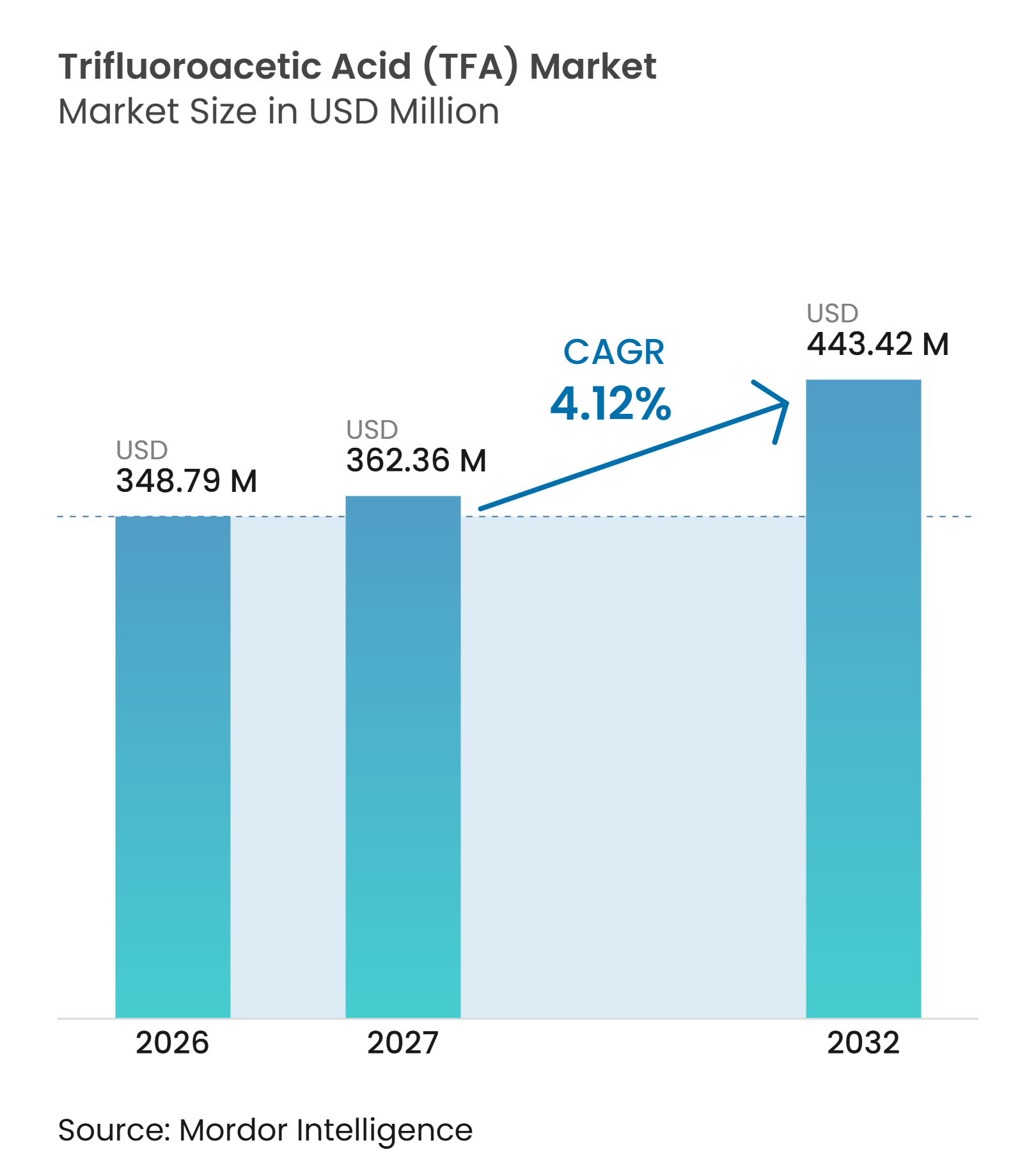
| Market Size (2027) | USD 362.36 Million |
| Market Size (2032) | USD 443.42 Million |
| Growth Rate (2027 - 2032) | 4.12 % |
| Fastest Growing Market | Asia-Pacific |
| Largest Market | Asia-Pacific |
| Market Concentration | Medium |
Major Players *Disclaimer: Major Players sorted in no particular order Image © Mordor Intelligence. Reuse requires attribution under CC BY 4.0. | |
Trifluoroacetic Acid (TFA) Market Analysis by Mordor Intelligence
The Trifluoroacetic Acid (TFA) market size was valued at USD 348.79 million in 2026 and is estimated to grow from USD 363.16 million in 2027 to USD 443.42 million by 2032, at a CAGR of 4.12% during the forecast period (2027-2032). The Trifluoroacetic Acid (TFA) market supports pharmaceutical peptide synthesis and fluorinated agrochemical production across two specialized chemical value chains. Demand conditions vary between pharmaceutical manufacturing and crop-protection production. Following Solvay’s withdrawal from TFA production at its Salindres and Bad Wimpfen sites, European buyers rely more on imports from Asian suppliers. Proposed European hazard classifications may affect handling, labeling, and discharge requirements. Suppliers offering specified purity, documentation, and regulatory support can serve qualified buyers in the Trifluoroacetic Acid (TFA) market.
Key Report Takeaways
- By purity, 99.5% Trifluoroacetic Acid held 55.78% market share in 2026, while 99.9% Trifluoroacetic Acid is forecast to grow at a CAGR of 4.89% through 2032.
- By application, Pesticide Intermediates held 53.21% of the Trifluoroacetic Acid (TFA) market share in 2026, while the same segment is forecast to grow at a CAGR of 5.25% through 2032.
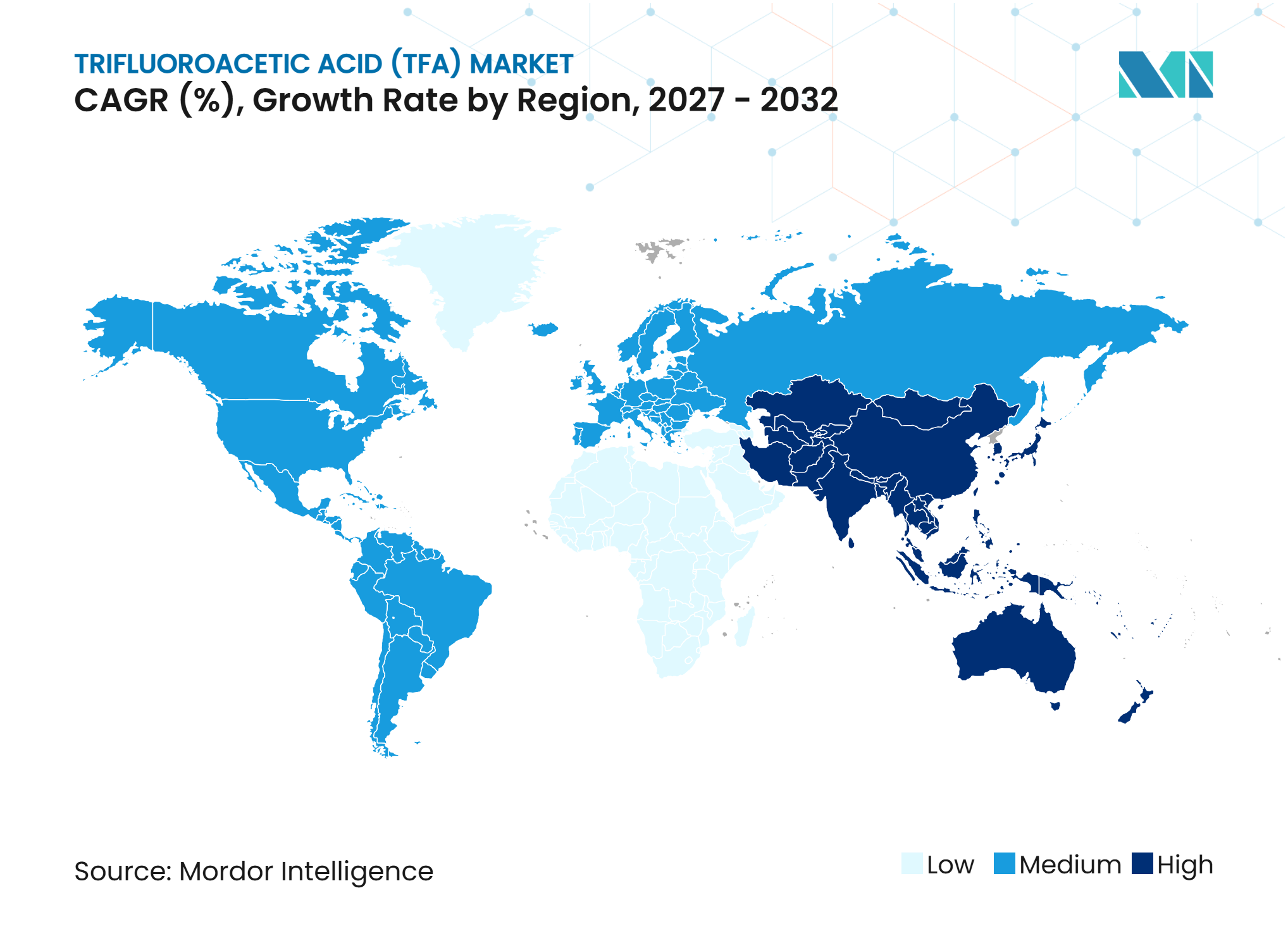
- By geography, Asia-Pacific held a 38.70% market share in 2026 and is forecast to grow at a CAGR of 5.03% through 2032.
Note: Market numbers in this report are based on Mordor Intelligence's proprietary estimation framework, which combines nine months of actuals with Q4 projections for base year 2026.
Market Trends and Insights
Drivers Impact Analysis of Trifluoroacetic Acid (TFA) Market*
| Drivers | (~) % Impact on CAGR Forecast | Geographic Relevance | Impact Timeline |
|---|---|---|---|
| Pharmaceutical and Peptide Synthesis Demand | +1.5% | Global, led by North America and Asia-Pacific | Medium term (2-4 years) |
| Fluorinated Agrochemical Intermediate Demand | +1.2% | Asia-Pacific core, spillover to North America and Europe | Medium term (2-4 years) |
| High-Purity Analytical and Chromatography Usage | +0.6% | Global | Short term (≤ 2 years) |
| Electronics and Advanced-Materials Applications | +0.4% | Asia-Pacific core, including Japan, South Korea, and China | Long term (≥ 4 years) |
| Supply Reshuffling After European TFA Production Exits | +0.5% | Europe, with global implications | Short term (≤ 2 years) |
| Source: Mordor Intelligence | |||
Pharmaceutical and Peptide Synthesis Demand
TFA is used in Fmoc solid-phase peptide synthesis for the cleavage and deprotection steps required to produce peptide active pharmaceutical ingredients (APIs). The Trifluoroacetic Acid (TFA) market is supported by demand for peptide therapeutics, including insulin and glucagon-like peptide-1 (GLP-1) receptor agonists. Peptide API production typically requires 20-30 L of TFA per kilogram of API, linking production growth to reagent consumption. Pharmaceutical manufacturers generally use qualified production processes; therefore, changing reagents may require product-equivalence studies and a regulatory revalidation cycle of 18-24 months. This requirement limits rapid reagent substitution during product launches and supports recurring demand for established TFA grades. It also increases the importance of suppliers that provide reliable assay results, lot records, and material-support documentation for regulated manufacturing environments.
Fluorinated Agrochemical Intermediate Demand
The Trifluoroacetic Acid (TFA) market supports the synthesis of fluorinated agrochemical intermediates and trifluoroacetate derivatives. Fluorinated crop-protection molecules are used in product development due to chemical properties that can support efficacy, selectivity, and metabolic stability. Fluorinated agrochemicals account for more than half of recent global pesticide approvals, linking intermediate demand to new product development pipelines. A 2026 life cycle study found that freshwater ecotoxicity and fossil resource depletion accounted for 65.00%- 86.00% of the environmental burden associated with the assessed production of key fluorinated pesticide intermediates, using Chinese parameters[1]. This finding indicates the need for producers to manage process inputs and waste streams while serving agrochemical customers. Higher-margin fluorinated molecules support agrochemical companies’ continued development programs that require specialized fluorinated inputs.
High-Purity Analytical and Chromatography Usage
TFA is used as an ion-pairing reagent in reversed-phase high-performance liquid chromatography (HPLC) methods for peptide and small-molecule separations. It can reduce peak tailing and support separation quality for compounds with multiple ionizable groups or chiral centers. The Trifluoroacetic Acid (TFA) market receives recurring demand from quality-control laboratories because analytical methods are commonly validated for specified mobile-phase compositions. Switching to an alternative reagent may require method revalidation, even when laboratory consumption is lower than manufacturing consumption. Annual laboratory supply arrangements can generate recurring demand based on the number of instruments and analysts. Indian generic drug manufacturers are expanding capacity for domestic and export markets, thereby supporting demand for high-purity TFA in Asia-Pacific through pharmaceutical testing and product release activities.
Electronics and Advanced Materials Applications
Other applications in the Trifluoroacetic Acid (TFA) market include specialty solvents, catalyst systems, fluorinated building blocks, and electronic cleaning applications. These applications represent a smaller share of demand than pharmaceutical and agrochemical uses but diversify the customer base. Japan, South Korea, and China are relevant markets because their advanced materials and electronics manufacturing ecosystems require high-specification chemicals. Fluorinated electrolyte solvents for lithium-ion batteries are an emerging area of demand. This application may expand the customer base requiring controlled impurity levels and documented chemical performance. The commercialization timeline reflects the time required for materials qualification and for commercial battery designs to move into broader-scale production.
Restraints Impact Analysis of Trifluoroacetic Acid (TFA) Market*
| Restraints | (~) % Impact on CAGR Forecast | Geographic Relevance | Impact Timeline |
|---|---|---|---|
| Per- and Polyfluoroalkyl Substances (PFAS), Persistence and Hazard-Classification Scrutiny | -0.4% | Europe and North America | Medium term (2-4 years) |
| Fluorinated Feedstock, Energy and Logistics Volatility | -0.3% | Global | Short term (≤ 2 years) |
| TFA-Induced Mass-Spectrometry Ion Suppression | -0.1% | Global, including research and analytical use | Long term (≥ 4 years) |
| Source: Mordor Intelligence | |||
PFAS, Persistence and Hazard-Classification Scrutiny
TFA falls within the Organization for Economic Co-operation and Development’s definition of PFAS, while the U.S. Environmental Protection Agency applies a narrower definition that excludes this ultrashort-chain compound. This difference results in varying regulatory conditions across regions. In June 2026, the European Chemicals Agency’s Committee for Risk Assessment adopted an opinion recommending the classification of TFA as toxic to reproduction, Category 1B; very persistent and very mobile; and persistent, mobile, and toxic under the EU Classification, Labeling and Packaging Regulation[2]. If the European Commission adopts this recommendation, it will affect labeling, handling, and discharge controls for users and importers. A broader PFAS restriction under the Registration, Evaluation, Authorization and Restriction of Chemicals (REACH) framework introduces regulatory considerations for companies that use TFA or fluorinated derivatives in European supply chains. Consequently, the Trifluoroacetic Acid (TFA) market may face longer qualification processes and higher compliance costs for applications subject to European environmental regulations.
Fluorinated Feedstock, Energy and Logistics Volatility
TFA production commonly relies on trifluoroacetyl chloride or electrochemical fluorination routes, both of which require fluorinated feedstocks and energy-intensive processing. Chinese prices for 99.5% grade TFA declined from CNY 37,800 per ton in mid-2025 to CNY 23,750 per ton in late 2025. These price changes affect procurement budgets for pharmaceutical and agrochemical buyers and create margin pressure for non-integrated producers. Fluorspar availability, export conditions, electricity prices, and transportation costs can affect costs across the value chain. Producers with captive fluorochemical inputs may manage cost fluctuations more effectively than companies that source all upstream materials externally. In the Trifluoroacetic Acid (TFA) market, these factors can delay capacity-expansion decisions even when customer demand remains stable.
*Our forecasts treat driver/restraint impacts as directional, not additive. The impact forecasts reflect baseline growth, mix effects, and variable interactions.
Trifluoroacetic Acid (TFA) Market Segment Analysis
By Purity:
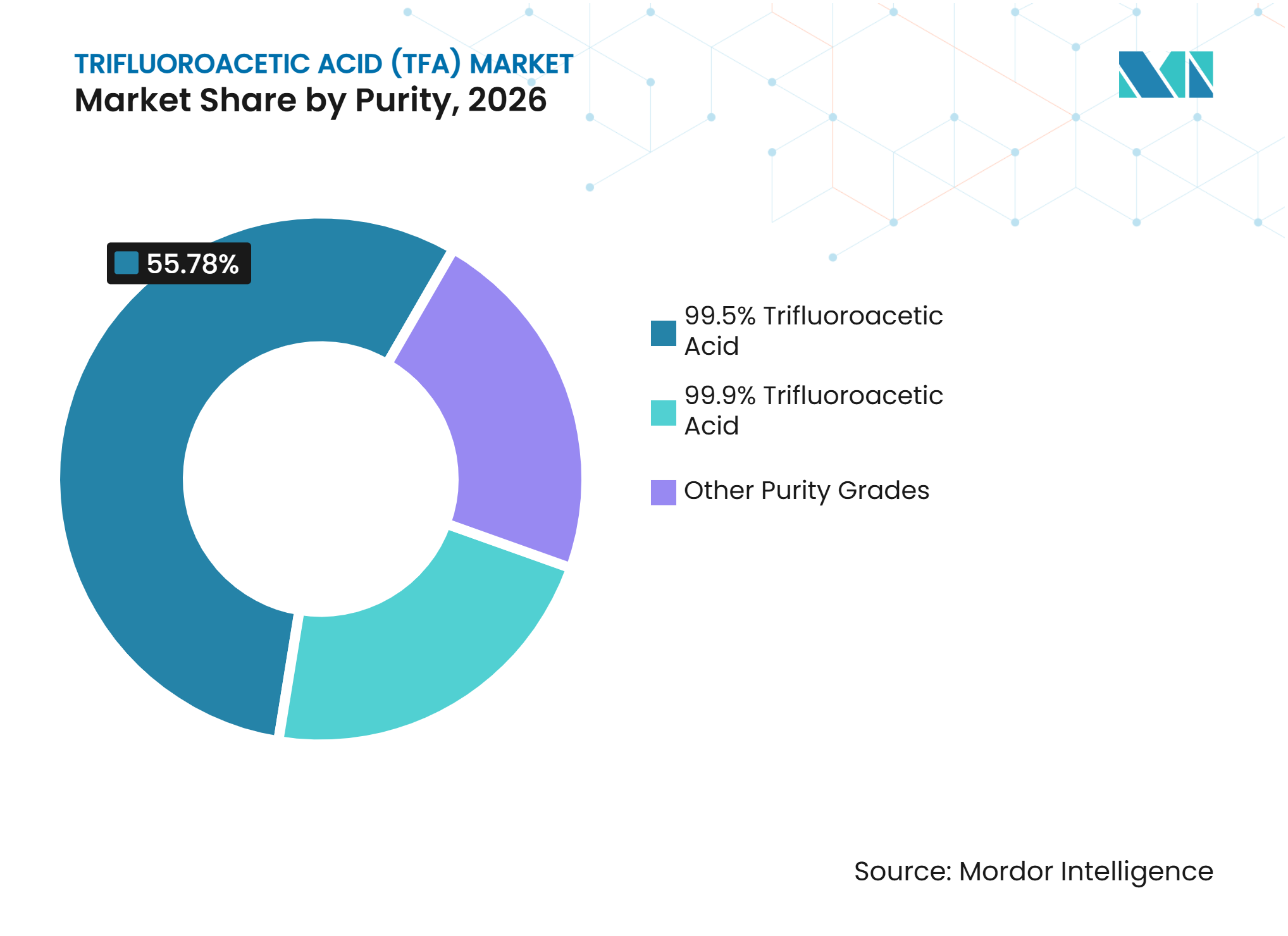
Pharmaceutical Demand Elevating Ultra-High Purity GradesThe 99.5% grade accounts for 55.78% of the trifluoroacetic acid (TFA) market in 2026, making it the largest purity category. It serves as a process-chemistry grade for agrochemical synthesis, industrial applications, and general pharmaceutical uses. Buyer qualifications and competitive pricing support demand for this grade. Chinese suppliers hold a significant position in this category, where buyers prioritize consistent availability and cost control.
The 99.9% grade is projected to grow at a CAGR of 4.89% from 2027 to 2032, exceeding the overall market forecast rate. Pharmaceutical manufacturers use this grade where residue limits, trace-metal content, and analytical consistency require closer control. Demand is driven by peptide manufacturing and tighter specifications for glucagon-like peptide-1 (GLP-1) agonists and insulin products. Halocarbon Products Corporation markets BioGrade TFA with a minimum assay of 99.9% for peptide cleavage, solid-phase synthesis, and GMP-grade analytical applications. This segment differentiates competition between a price-driven 99.5% tier and a documentation-driven high-purity tier. Other purity grades remain relevant for industrial and research applications where buyers can accept broader specifications at a lower cost.



By Application:
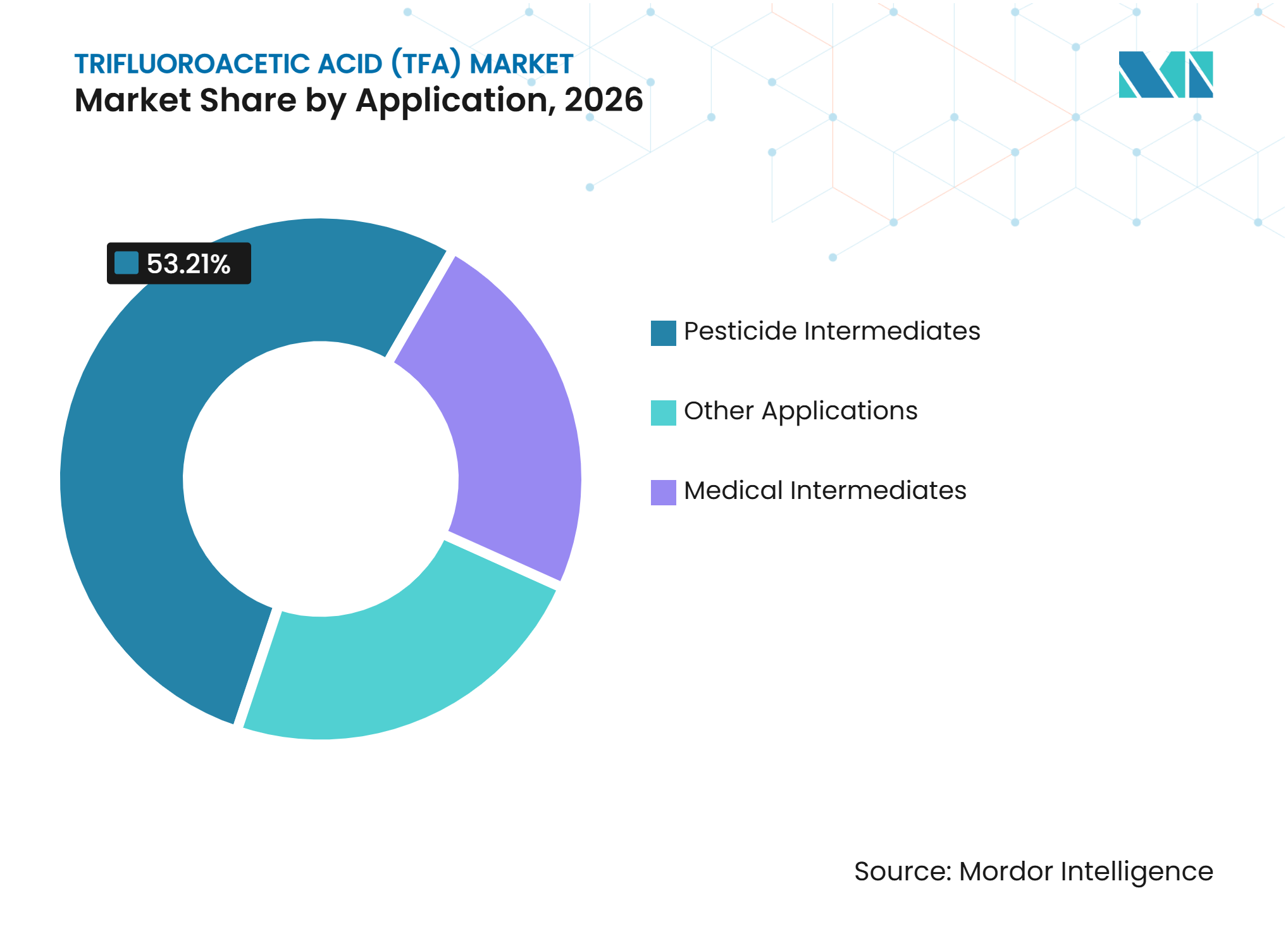
Agrochemicals Anchor the Market, Pharma AcceleratesPesticide intermediates account for 53.21% of the trifluoroacetic acid (TFA) market in 2026 and are projected to grow at a CAGR of 5.25% through 2032. The segment’s position reflects the use of fluorinated intermediates in crop-protection chemistry. TFA functions as both a reagent and a building block in these synthesis routes. Research published in the Journal of Agricultural and Food Chemistry identified 143 pesticides containing C-CF3 groups that were approved in the European Union, the United States, and China. The research also assessed the potential formation of TFA from pesticide degradation, making environmental regulations relevant to demand and downstream product stewardship. This dual exposure requires agrochemical customers to balance molecular performance with evolving environmental assessment requirements.
Medical intermediates represent the next application group, as TFA supports Fmoc-based peptide synthesis and active pharmaceutical ingredient (API) deprotection. The segment benefits from an expanding range of peptide therapeutics beyond insulin and glucagon-like peptide-1 (GLP-1) medicines, including treatments for oncology and rare diseases, as well as long-acting therapies. Manufacturers are increasingly installing TFA recovery and recycling systems to manage chemical costs and waste-treatment obligations. Although these systems can reduce net reagent demand per kilogram of peptide over time, they do not eliminate the need for qualified TFA in production processes. Other applications include specialty solvents, catalysts, fluorinated building blocks, and electronic cleaning agents. These applications provide the trifluoroacetic acid (TFA) market with exposure to specialized uses, although they remain at an earlier stage or are smaller than core pharmaceutical and agrochemical applications.

Geography Analysis
Asia-Pacific: Dominant Supply and Demand Hub
Asia-Pacific accounted for 38.70% of the trifluoroacetic acid (TFA) market in 2026 and is projected to grow at a CAGR of 5.03% through 2032. China remains a key regional supplier, with reported production capacity exceeding 88,000 tons in 2025. Chinese producers account for more than 40% of global capacity. Sinochem Bluestar’s TFA series products received a national manufacturing single-champion designation in 2025, reflecting the company’s fluorinated chemicals operations. Zhejiang Juhua reported growth in its output of fluorinated fine chemicals in the first half of 2025, indicating continued activity in the regional fluorochemicals industry.
India contributes to demand for generic pharmaceuticals and crop protection products, while customers in Japan and South Korea use high-purity TFA in analytical and pharmaceutical applications. ASEAN countries offer an additional avenue for demand growth as pharmaceutical contract manufacturing networks expand. The region’s manufacturing capabilities and customer base support supply availability and future consumption.
North America: Anchored by Complex Drug Development
North American demand is driven by pharmaceutical research, contract development, and manufacturing for complex drug candidates. The United States supports demand through biologics developers and contract manufacturers that use TFA in peptide synthesis and small-molecule deprotection. Oral peptides, targeted protein degraders, and oligonucleotide-conjugated peptides require specialized development and analytical workflows to support the demand for pharmaceutical-grade materials. According to its product communications, Halocarbon has supplied BioGrade TFA to pharmaceutical and biotechnology customers for more than three decades.
Canada contributes demand from research and clinical-stage laboratories, while Mexico adds a manufacturing base through its pharmaceutical and agrochemical industries. Regional buyers prioritize lot consistency, traceability, and technical support, as regulated applications often involve extensive qualification requirements.
Regional Dynamics Beyond the Leading Markets
Europe is increasingly dependent on Asian imports following Solvay’s production exits. The European TFA market is driven more by supplier qualification requirements than by growth in domestic production capacity. European pharmaceutical and agrochemical buyers require Registration, Evaluation, Authorization and Restriction of Chemicals (REACH) documentation, hazard communication, and evidence that imported materials comply with their quality systems. Regulatory requirements may increase, as a European Chemicals Agency recommendation could result in additional controls under the Classification, Labeling and Packaging (CLP) framework.
Brazil and Argentina account for much of South America's demand for agrochemicals. However, limited regional production exposes buyers to freight expenses and import costs. In the Middle East and Africa, demand remains comparatively small and is concentrated in South African research and pharmaceutical activities, as well as Gulf Cooperation Council investments in specialty chemicals and manufacturing. Suppliers in these regions must comply with local import procedures and customer specifications. These markets depend more on distribution reliability than on large-scale local TFA production.
Competitive Landscape
Market Concentration
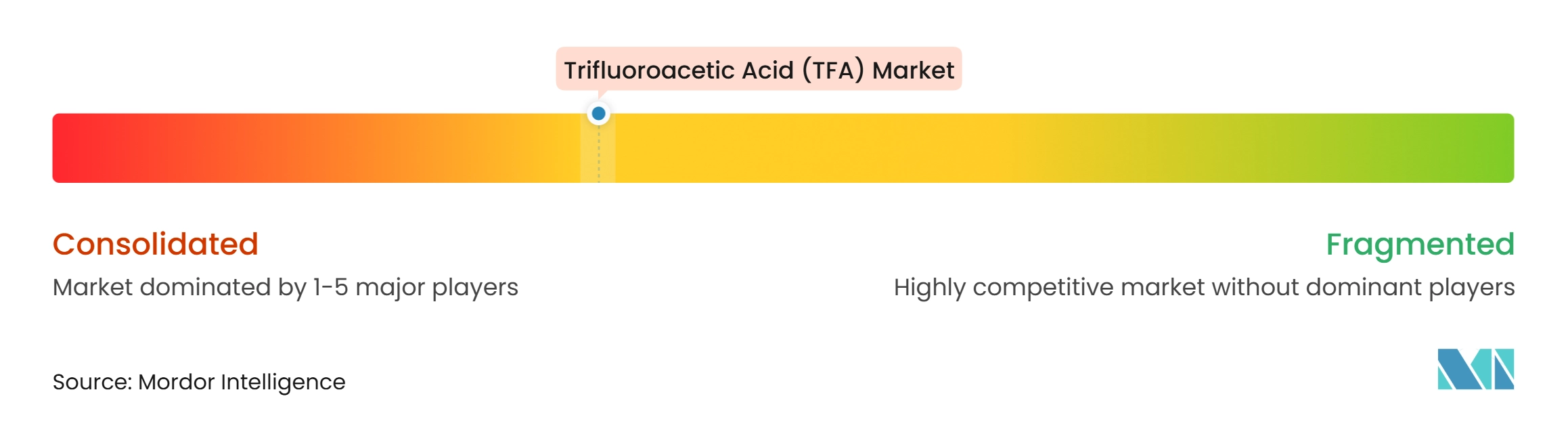
The Trifluoroacetic Acid (TFA) market is moderately concentrated, with producers that have integrated fluorochemical supply chains competing alongside regional Chinese suppliers serving commodity and industrial-grade applications. Key participants include Sinochem Bluestar, Zhejiang Juhua, Nantong Baokai Pharmaceutical, Jiangshan Xinlong Chemical, Halocarbon, and AGC. Competitive factors vary by customer requirements. Pharmaceutical customers prioritize purity, Good Manufacturing Practice (GMP) documentation, batch consistency, and regulatory support. Agrochemical and industrial customers also evaluate supply capacity, pricing, and logistics proximity. This differentiation supports supplier investments in quality systems where returns exceed those from standard grades.
Haohua Chemical Technology Group acquired Sinochem Bluestar in July 2024. In 2025, Sinochem Bluestar received a national manufacturing designation for TFA-series products. Jiangshan Xinlong Chemical announced a 2025 expansion to target 5,000 tons of TFA-series products, along with additional capacity for hexafluoropropylene derivatives. Zhejiang Juhua continued to expand its production of fluorinated fine chemicals, supporting its fluorochemicals portfolio. These developments indicate that Chinese suppliers are expanding capacity, process capabilities, and portfolio depth beyond commodity-grade sales. While the TFA market remains subject to price competition in standard grades, high-purity applications require technical expertise and regulatory capabilities.
Europe’s import dependence supports market access for Asian suppliers that provide REACH support, GMP certificates, and complete batch documentation. According to its 2025 securities filings, AGC has fluorine chemistry capabilities across performance chemicals and life-science contract development and manufacturing. SRF reported 21.00% revenue growth and a 60.00% increase in profit before tax in the fourth quarter of fiscal year 2025, supported by its integrated fluorochemicals business. TFA recovery and recycling systems at peptide manufacturing facilities address waste management requirements and procurement costs.
Trifluoroacetic Acid (TFA) Industry Leaders
-
Zhejiang Juhua Co., Ltd.
-
Halocarbon, LLC
-
Sinochem Holdings Corporation Ltd.
-
SRF
-
AGC Inc.
- *Disclaimer: Major Players sorted in no particular order
Trifluoroacetic Acid (TFA) Market Companies Covered in this Report
- AGC Inc.
- Anhui Jinao Chemical Co., Ltd.
- Changzhou Kangmei Chemical Industry Co., Limited.
- Halocarbon, LLC
- Honeywell International Inc.
- Jiangshan Xinlong Chemical Co., Ltd.
- Jiangsu Bluestar Technology Co., Ltd.
- Jinan Wanxingda Chemical Co., Ltd.
- Nantong Baokai Pharmaceutical Co., Ltd.
- Shandong Hua’an New Material Co., Ltd.
- Sinochem Holdings Corporation Ltd.
- SRF
- Xianju DOEASTCHEM Co., Ltd.
- Zhejiang Juhua Co., Ltd.
- Zhenfu New Materials Co., Ltd.
Recent Industry Developments in Trifluoroacetic Acid (TFA) Market
- June 2026: The European Chemicals Agency’s Committee for Risk Assessment adopted a scientific opinion recommending the classification of TFA as toxic to reproduction, Category 1B; very persistent and very mobile; and persistent, mobile, and toxic under the EU CLP Regulation. The opinion initiates the European Commission’s review process, which may make these hazard classifications legally binding across the EU. This may affect TFA handling, labeling, and discharge requirements for European users and importers.
- October 2025: Honeywell International completed the spin-off of its Advanced Materials division into Solstice Advanced Materials, an independent publicly traded company, effective October 30, 2025. Solstice produces hydrofluoroolefin (HFO) refrigerants, including HFO-1234yf, which degrades into TFA in the atmosphere. The company reported net sales of USD 3.80 billion in 2024 and employed 4,000 people globally.
Global Trifluoroacetic Acid (TFA) Market Report Scope
Trifluoroacetic acid (TFA), with the chemical formula CF₃CO₂H, is a colorless organofluorine acid classified within the ultrashort-chain subclass of per- and polyfluoroalkyl substances (PFAS). Its chemical properties support its use as an industrial and research chemical intermediate.
The trifluoroacetic acid (TFA) market is segmented by purity, application, and geography. By purity, the market is segmented into 99.5% trifluoroacetic acid, 99.9% trifluoroacetic acid, and other purity grades. By application, the market is segmented into medical intermediates, pesticide intermediates, and other applications. The report also covers market sizes and forecasts for trifluoroacetic acid (TFA) across 15 countries in major regions. The market sizes and forecasts are provided in terms of value (USD).
Segmentation Overview
| 99.5% Trifluoroacetic Acid |
| 99.9% Trifluoroacetic Acid |
| Other Purity Grades |
| Medical Intermediates |
| Pesticide Intermediates |
| Other Applications |
| Asia-Pacific | China |
| India | |
| Japan | |
| South Korea | |
| ASEAN Countries | |
| Rest of Asia-Pacific | |
| North America | United States |
| Canada | |
| Mexico | |
| Europe | Germany |
| United Kingdom | |
| France | |
| Italy | |
| NORDIC Countries | |
| Rest of Europe | |
| South America | Brazil |
| Argentina | |
| Rest of South America | |
| Middle East and Africa | Saudi Arabia |
| South Africa | |
| Rest of Middle East and Africa |
| By Purity | 99.5% Trifluoroacetic Acid | |
| 99.9% Trifluoroacetic Acid | ||
| Other Purity Grades | ||
| By Application | Medical Intermediates | |
| Pesticide Intermediates | ||
| Other Applications | ||
| By Geography | Asia-Pacific | China |
| India | ||
| Japan | ||
| South Korea | ||
| ASEAN Countries | ||
| Rest of Asia-Pacific | ||
| North America | United States | |
| Canada | ||
| Mexico | ||
| Europe | Germany | |
| United Kingdom | ||
| France | ||
| Italy | ||
| NORDIC Countries | ||
| Rest of Europe | ||
| South America | Brazil | |
| Argentina | ||
| Rest of South America | ||
| Middle East and Africa | Saudi Arabia | |
| South Africa | ||
| Rest of Middle East and Africa | ||
Key Questions Answered in the Report
What is current market size of Trifluoroacetic Acid (TFA) Market?
The Trifluoroacetic Acid (TFA) market size was valued at USD 348.79 million in 2026 and is estimated to grow from USD 363.16 million in 2027 to USD 443.42 million by 2032, at a CAGR of 4.12% during the forecast period (2027-2032).
Which purity grade leads TFA demand?
The 99.5% grade led demand with a 55.78% share in 2026, while the 99.9% grade is projected to grow at a 4.89% CAGR through 2032.
Which application is the largest for trifluoroacetic acid?
Pesticide Intermediates held a 53.21% share in 2026 and are forecast to grow at a 5.25% CAGR through 2032.
Which region leads TFA consumption and supply?
Asia-Pacific held a 38.70% share in 2026 and is projected to record a 5.03% CAGR through 2032. China remains central to regional supply.