
Thailand Social Commerce Market Size and Share
Market Overview
| Study Period | 2020 - 2031 |
|---|---|
| Forecast Data Period | 2026 - 2031 |
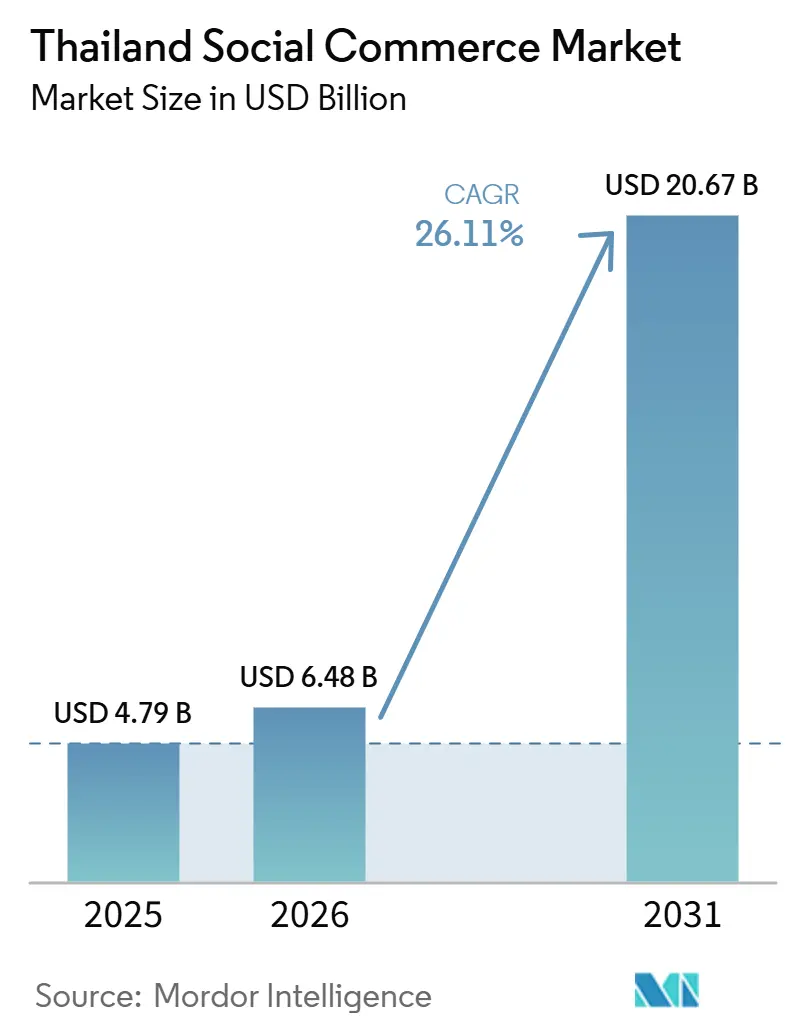
| Base Year Market Size (2025) | USD 4.79 Billion |
| Market Size (2026) | USD 6.48 Billion |
| Market Size (2031) | USD 20.67 Billion |
| Growth Rate (2026 - 2031) | 26.11 % |
| Market Concentration | Medium |
Major Players *Disclaimer: Major Players sorted in no particular order Image © Mordor Intelligence. Reuse requires attribution under CC BY 4.0. | |
Thailand Social Commerce Market Analysis by Mordor Intelligence
The Thailand social commerce market size was USD 4.79 billion in 2025 and estimated to grow from USD 6.48 billion in 2026 to reach USD 20.67 billion by 2031, at a CAGR of 26.11% during the forecast period (2026-2031). The Thailand social commerce market is supported by widespread mobile access, strong use of shopping apps, and payment methods that let consumers complete purchases within social platforms. Live video, short-form content, and affiliate selling are shifting product discovery away from search-led shopping toward creator-led recommendations. Platforms are competing through delivery coverage, payment integration, creator tools, and more personalized shopping experiences. The Thailand social commerce market is also expanding beyond Bangkok as logistics networks, seller training, and platform access reach provincial buyers and merchants. New product compliance rules may favor platforms that can verify sellers and regulated listings, especially in health, personal care, and food categories.
Key Report Takeaways
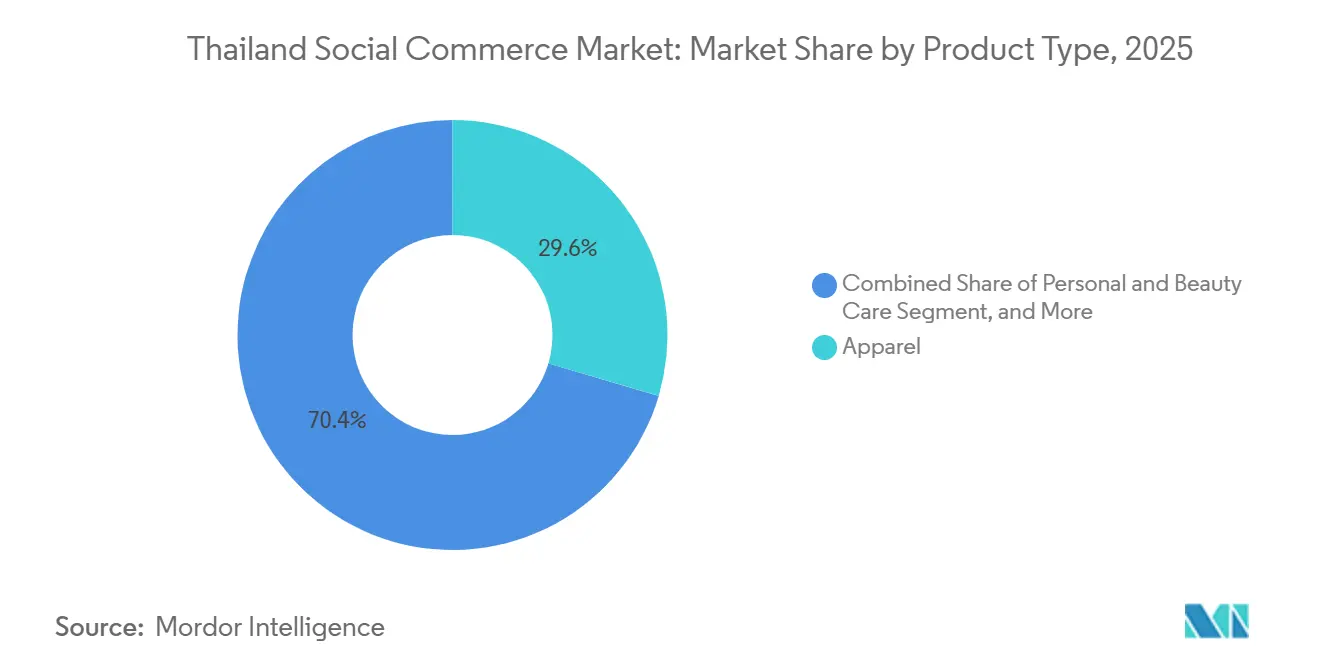
- By product type, apparel accounted for 29.58% of the Thailand social commerce market share in 2025, while personal and beauty care is projected to expand at a CAGR of 27.42% through 2031.
- By device, smartphones accounted for 78.45% share in 2025 and are projected to grow at a CAGR of 26.87% through 2031.
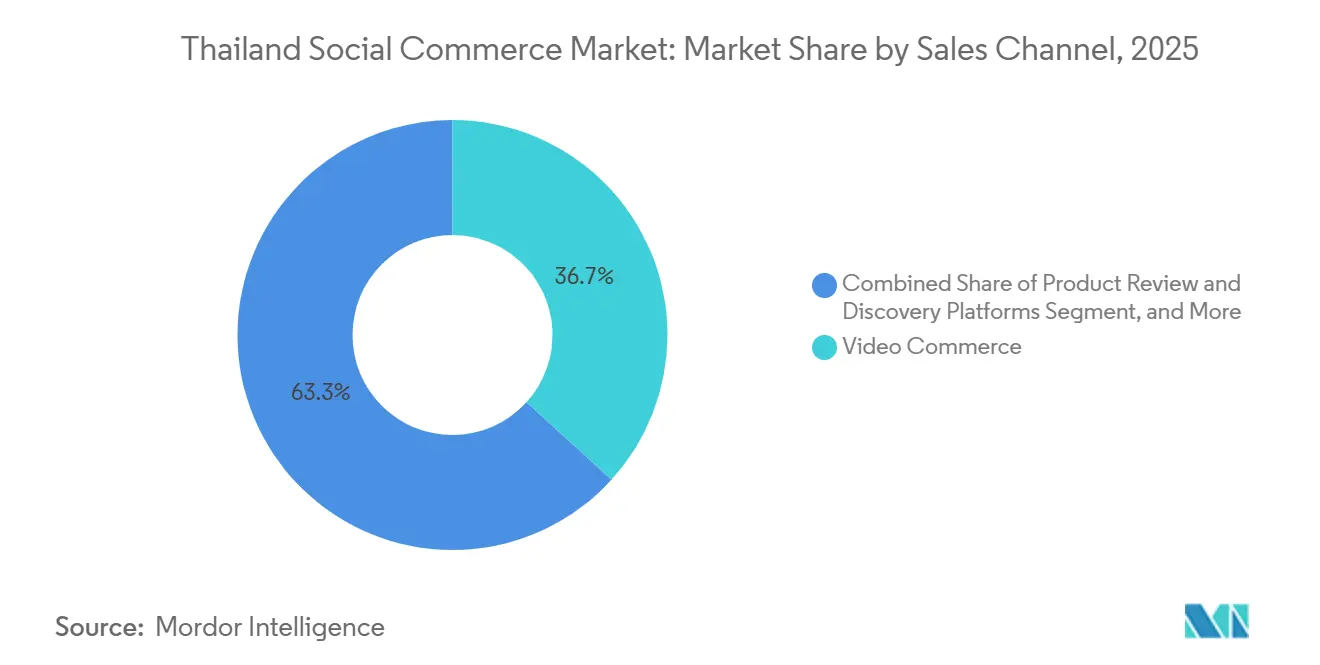
- By sales channel, video commerce held 36.74% share in 2025, while social reselling is projected to grow at a CAGR of 26.59% through 2031.
Note: Market size and forecast figures in this report are generated using Mordor Intelligence’s proprietary estimation framework, updated with the latest available data and insights as of January 2026.
Thailand Social Commerce Market Trends and Insights
Drivers Impact Analysis*
| Driver | (~) % Impact on CAGR Forecast | Geographic Relevance | Impact Timeline |
|---|---|---|---|
| Expansion of Live and Short-Video Commerce | +6.0% | Thailand, Vietnam, Indonesia, with spillover to Middle East and Africa | Short term (≤ 2 years) |
| Mobile-First Consumer Shopping Behavior | +5.5% | Global, with Thailand as the highest-penetration market | Short term (≤ 2 years) |
| Embedded Payments and In-App Checkout | +4.2% | Thailand, with early density gains in Bangkok, Chiang Mai, and Phuket | Medium term (2-4 years) |
| Influencer-Led Product Discovery and Affiliate Selling | +3.8% | Thailand, with spillover to Vietnam and Malaysia | Short term (≤ 2 years) |
| AI-Personalized Product Recommendations | +2.5% | Asia-Pacific, with early commercial gains in Bangkok and Chonburi | Medium term (2-4 years) |
| Formalization of Social Selling by Thai SMEs | +1.8% | Thailand, with early adoption in northeastern Thailand | Medium term (2-4 years) |
| Source: Mordor Intelligence | |||
Expansion of Live and Short-Video Commerce
Live and short-video selling is a central force in Thailand's social commerce market because it connects product discovery and checkout in a single session. Creator content, live sessions, and affiliate distribution can turn passive viewing into purchase activity. Live formats give small businesses access to product promotion and direct interaction with buyers. Sellers who demonstrate products in real time can build trust before purchase, which can be more effective than static listings for items that need explanation. They also allow buyers to ask practical questions on product use, availability, delivery timing, and return conditions before they pay. The Thailand social commerce market, therefore, gives greater weight to content quality, presentation skills, and reliable fulfillment than to discounting alone.
Mobile-First Consumer Shopping Behavior
Mobile use provides the basic access layer for the Thailand social commerce market. The U.S. International Trade Administration reported that mobile devices accounted for 74% of e-commerce transactions in Thailand, while apps accounted for 65%. The same source stated that 71% of Thai smartphone users shopped online at least twice each month. This pattern supports product discovery through social feeds, messaging services, and live streams instead of desktop browsing. It also makes checkout speed, product-page design, and payment reliability important parts of the customer experience. The Thailand social commerce market will remain strongly tied to smartphone behavior because sellers and platforms are designing content, advertising, and checkout flows for small screens.
Embedded Payments and In-App Checkout
Embedded payment tools reduce the gap between product interest and a completed order in the Thailand social commerce market. Kasikorn Global Payment partnered with Meta in 2025 to introduce Pay QR with Credit Card on Messenger, enabling customers to make QR payments with a credit card in the messaging app.[1]Kasikorn Global Payment, “KGP Partners With Meta to Launch Pay QR With Credit Card on Messenger,” Kasikorn Global Payment, kasikornglobalpayment.com Siam Commercial Bank also launched QR PromptPay transfers through SCB EASY on Messenger in November 2025. These tools make conversational commerce more practical for merchants who manage orders through direct messages. They can also support buyer confidence when payments are processed through familiar financial institutions. The Thailand social commerce market benefits when a viewer can move from a live session or a chat to payment without leaving the platform.
Influencer-Led Product Discovery and Affiliate Selling
Creator and affiliate activity has become an important distribution channel in the Thailand social commerce market. TikTok Shop has a large seller and creator ecosystem in Thailand, which gives brands access to many small, specialized audiences rather than reliance on a single campaign or storefront. Affiliate models align compensation with sales activity and can help newer brands test products with limited upfront advertising spending. They also increase the need for clear product claims, accurate disclosures, and sound relationships between brands and creators. Merchants must also provide reliable stock information and clear service responsibilities when several creators promote the same item. The market is likely to reward merchants who provide creators with useful product information, reliable inventory, and responsive customer service.
Restraints Impact Analysis*
| Restraint | (~) % Impact on CAGR Forecast | Geographic Relevance | Impact Timeline |
|---|---|---|---|
| Rising Customer-Acquisition and Creator-Commission Costs | -3.5% | Global, with acute margin pressure in Thailand, Indonesia, and Vietnam | Short term (≤ 2 years) |
| Consumer Trust, Counterfeit, and Product-Authenticity Concerns | -2.8% | Thailand, with early regulatory gains in Bangkok following ETDA notifications | Medium term (2-4 years) |
| Volatile Platform Algorithm and Policy Changes | -2.1% | Global, with specific exposure across Asia-Pacific social commerce markets | Short term (≤ 2 years) |
| Fragmented Seller Data and Conversational-Commerce Measurement | -1.4% | Thailand, with some spillover to Malaysia and Vietnam | Medium term (2-4 years) |
| Source: Mordor Intelligence | |||
Rising Customer-Acquisition and Creator-Commission Costs
Higher platform fees, advertising costs, and creator commissions can weaken seller margins in the Thailand social commerce market. Small and midsized merchants may respond by moving more transactions to direct chat channels, where they have greater control over customer relationships. That response can lower platform costs, but it can also create fragmented order handling and inconsistent service. Sellers with trusted content, repeat buyers, or established creator relationships are better placed to absorb rising acquisition costs. Merchants that rely on generic catalogs and paid visibility face greater pressure because their products are easier to compare on price. The Thailand social commerce market may consequently shift toward sellers that can combine differentiated content with disciplined unit economics.
Consumer Trust, Counterfeit, and Product-Authenticity Concerns
Consumer trust remains a restraint for the Thailand social commerce market, particularly for health supplements and personal care products. Thailand's marketplace requirements place greater emphasis on evidence and verification of product compliance for regulated listings. Sellers need to provide relevant registration or license details where those requirements apply. Influencer promotion of regulated products must also avoid unsupported claims and comply with applicable approval requirements. These requirements create added work for smaller sellers, but they can improve confidence in regulated categories. The Thailand social commerce market may favor platforms and merchants that treat product verification, accurate claims, and disclosure as part of the selling process.
*Our forecasts treat driver/restraint impacts as directional, not additive. The impact forecasts reflect baseline growth, mix effects, and variable interactions.
Segment Analysis
By Product Type: Apparel Remains the Largest Category While Personal and Beauty Care Gains Pace
Apparel accounted for 29.58% of social commerce sales in 2025. Fashion has long been well-suited to social selling because short videos, live demonstrations, styling content, and creator endorsements help consumers judge products before purchase. The U.S. International Trade Administration stated that clothing and footwear accounted for 60% of Thailand's total e-commerce activity, supporting a strong existing online shopping habit for fashion products.[2]U.S. International Trade Administration, “Thailand eCommerce,” Country Commercial Guide, trade.gov Apparel also fits social selling because product ranges can be refreshed often, and creators can show fit, color, and use in real time. These features explain why the category remains central to the Thailand social commerce market even as other product groups grow.
Personal and beauty care is projected to expand at a CAGR of 27.42% from 2026 to 2031. The category benefits from influencer recommendations, visual product demonstrations, and small products that are simple to ship and reorder. Health supplements are also becoming more visible through content-led product education, but sellers must comply with rules governing health claims and approvals. Electronics accessories and collectibles add volume through group buying and social reselling, where discovery often begins with creator content or communities. Across the Thailand social commerce industry, compliance requirements for personal care, health supplements, and food can create a barrier for informal sellers while giving verified merchants a clearer trust position.



By Device: Smartphones Set the Direction for Shopping Behavior
Smartphones held 78.45% of device sales in 2025 and are projected to grow at a CAGR of 26.87% through 2031. This combined lead in scale and growth shows that mobile shopping is becoming the norm for how consumers use social platforms to find and buy products. Shopping apps represented 65% of e-commerce transactions in Thailand, according to the U.S. International Trade Administration. Mobile screens support vertical video, live-stream comments, direct messages, and quick payment steps in a format that social platforms are built to use. The Thailand social commerce market size for smartphone-led transactions will continue to shape platform design and seller practices during the forecast period.
Laptops and desktops retained a 21.55% share in 2025. They remain relevant for higher-consideration purchases, including electronics, home furnishings, and cross-border orders, where consumers may want to compare products on a larger display. However, video-led platforms and one-thumb checkout flows are primarily designed for mobile use, which can make desktop interaction less convenient. This makes device strategy less about choosing between equal channels and more about improving a mobile-first experience without excluding desktop research. The Thailand social commerce market therefore gives desktop tools a supporting role for research and order management rather than the main role in buyer conversion.
By Sales Channel: Video Commerce Leads and Social Reselling Builds Reach
Video commerce held 36.74% of channel sales in 2025. It brings entertainment, product demonstration, and checkout together, which is useful for fashion, beauty, food, and home products. A live session can answer questions, show product use, and reduce uncertainty before a consumer makes a purchase. The approach depends on consistent hosts, reliable stock, clear product information, and fulfillment that matches buyer expectations. Video commerce is therefore a key operating format in the Thailand social commerce market, not only a media placement.
Social reselling is projected to expand at a CAGR of 26.59% from 2026 to 2031. Creator and affiliate networks allow merchants to reach buyers through many individual profiles, reducing reliance on a platform-owned storefront. Social network-led commerce includes Facebook Shops, Instagram storefronts, and LINE Shopping, while group buying supports price-sensitive and bulk purchases. Product review and discovery services connect awareness content with subsequent purchasing decisions. The Thailand social commerce industry is becoming more distributed as creators, resellers, messaging channels, and video formats take on a larger share of customer acquisition.
Geography Analysis
Bangkok and the Central region remain the highest-value areas for the Thailand social commerce market because they concentrate sellers, brand storefronts, logistics capacity, and platform testing activity. The capital has a dense delivery network that supports same-day and next-day fulfillment for many products. It also provides platforms with a practical environment to test live features, payment tools, and merchant programs before a wider rollout. Thailand had 56.6 million social media user identities by October 2025, which supports a broad social reach beyond traditional retail channels. Regional sales data is not provided, but Bangkok remains the primary center for transaction volume and operational capabilities.
Chiang Mai, Pattaya, and Phuket exhibit distinct demand conditions shaped by tourism, younger consumers, local creative activity, and small-business participation. A 2024 study of communities in northeastern Thailand found that 66% of small community enterprises already sold through both online and offline channels, with Facebook and LINE as the most widely used sales platforms.[3]Srinakharinwirot University, “Behavioral Economics of Consumer Buying Decisions Through Social Network Market Under Dynamic Situations in the Northeastern Region of Thailand,” Srinakharinwirot Research and Development Journal of Humanities and Social Sciences, so04.tci-thaijo.org This shows that social selling awareness extends well beyond the capital, although sellers may need support to build more organized online operations. Government-backed digital training programs have helped community businesses develop e-commerce skills and join platform ecosystems. Nationwide express delivery networks are improving access, though rural logistics costs remain more difficult for low-value or heavy products.
Rural and provincial areas offer the largest long-term opportunity for the Thailand social commerce market through 2031. The Live Commerce EXPO program showed that small businesses can create sales when they receive training, platform access, and visibility. At the same time, cross-border listings add price pressure in personal care and health supplements. The Thailand social commerce market will need dependable logistics and credible product verification to convert provincial reach into sustained purchasing activity.
Competitive Landscape
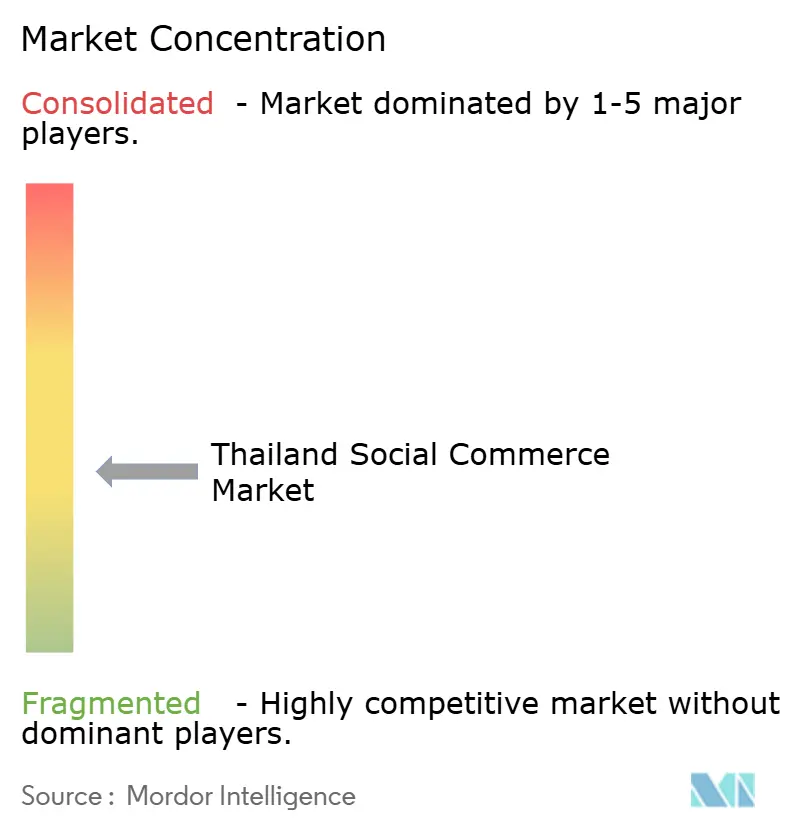
The Thailand social commerce market is concentrated at the platform level but fragmented among sellers and creators. Shopee generated THB 88.3 billion (USD 2.61 billion) in revenue in 2025, while TikTok Shop reached THB 54.4 billion (USD 1.61 billion). TikTok Shop moved from a THB 4 billion (USD 116 million) loss in 2024 to a THB 3 billion (USD 89 million) profit in 2025. The platform mix combines Shopee's delivery and loyalty capabilities with TikTok Shop's creator-led discovery model, creating different paths to buyer acquisition.
Sea Limited expanded its partnership with OpenAI in June 2026 to integrate Shopee into ChatGPT across Southeast Asia and South America. Thailand's Board of Investment approved TikTok System (Thailand) Co., Ltd.'s USD 25 billion data infrastructure expansion in May 2026. The investment includes server installation and data storage capacity across Bangkok, Samut Prakan, and Chachoengsao Province. These moves show that platform competition increasingly covers discovery tools, local infrastructure, and seller productivity as well as price and delivery.
LINE has a different position because its chat-based model supports consultation, customized orders, and continued brand relationships. Siam Commercial Bank's Messenger payment tool offers an example of how financial services can make conversational ordering easier. Service providers can support brands that need live-commerce production and multi-platform operations rather than a new marketplace.[4]Siam Commercial Bank, “Hassle-Free Transfers via SCB EASY on Messenger,” Siam Commercial Bank, scb.co.th Competition in the Thailand social commerce market will depend on whether platforms and their service partners can manage creator relationships, verified listings, data, payments, and delivery in one coherent customer experience.
Thailand Social Commerce Industry Leaders
Sea Limited
ByteDance Ltd.
Meta Platforms, Inc.
LY Corporation
Alibaba Group Holding Limited
- *Disclaimer: Major Players sorted in no particular order

Recent Industry Developments
- July 2026: AxtraMall, CP Axtra's digital commerce arm, launched an online-to-offline social commerce gateway connecting its platform to over 2,500 Lotus's and Makro branch locations across Thailand, initially deploying 100 SKUs across 25 Bangkok stores. The integration establishes a live-commerce-to-physical fulfillment channel for one of Thailand's largest retail networks, creating a hybrid model that connects social discovery to same-day in-store pickup.
- June 2026: Sea Limited and OpenAI announced a strategic partnership making Shopee the first e-commerce platform integrated into ChatGPT across Southeast Asia and South America. The agreement covers 8 markets including Thailand and introduces ChatGPT for Business to Shopee's seller ecosystem, enabling merchants to automate product listings, generate marketing content, and streamline customer service workflows.
- May 2026: Thailand's Board of Investment approved TikTok System (Thailand) Co., Ltd.'s USD 25 billion data infrastructure expansion encompassing server installation and data storage capacity across Bangkok, Samut Prakan, and Chachoengsao Province. This follows a THB 127 billion (USD 3.6 billion) data hosting project approved in January 2025.
- February 2026: Alphabet's Google and Sea Limited signed a strategic partnership to develop AI shopping tools for the Shopee platform, including building an AI agent capable of completing shopping tasks autonomously within the app. The agreement follows Sea Limited and YouTube's October 2024 Shopping Affiliate Program launch in Thailand, which established a creator-linked watch-and-shop commerce infrastructure.


Thailand Social Commerce Market Report Scope
The Thailand Social Commerce Market refers to the buying and selling of products and services through social media platforms, messaging applications, and community-driven digital channels in Thailand. It covers transactions influenced or completed on platforms such as Facebook, Instagram, TikTok, LINE, and emerging creator-led storefronts.
The Thailand Social Commerce Market Report is Segmented by Product Type (Apparel, Personal and Beauty Care, Accessories, Home Products, Health Supplements, Food and Beverages, and Other Product Types), Device (Laptops and Desktops, and Smartphones), and Sales Channel (Video Commerce, Social Network-Led Commerce, Social Reselling, Group Buying/Team Purchase, and Product Review and Discovery Platforms). The Market Forecasts are Provided in Terms of Value (USD).
| Apparel |
| Personal and Beauty Care |
| Accessories |
| Home Products |
| Health Supplements |
| Food and Beverages |
| Other Product Types |
| Laptops and Desktops |
| Smartphones |
| Video Commerce |
| Social Network-Led Commerce |
| Social Reselling |
| Group Buying/Team Purchase |
| Product Review and Discovery Platforms |
| By Product Type | Apparel |
| Personal and Beauty Care | |
| Accessories | |
| Home Products | |
| Health Supplements | |
| Food and Beverages | |
| Other Product Types | |
| By Device | Laptops and Desktops |
| Smartphones | |
| By Sales Channel | Video Commerce |
| Social Network-Led Commerce | |
| Social Reselling | |
| Group Buying/Team Purchase | |
| Product Review and Discovery Platforms |


Key Questions Answered in the Report
How large is social commerce in Thailand?
It is estimated at USD 6.48 billion in 2026 and is forecast to reach USD 20.67 billion by 2031, growing at a CAGR of 26.11%. Mobile shopping, creator-led discovery, live video, and embedded payments support this expansion.
What is driving social commerce growth in Thailand?
Mobile shopping, live video, affiliate selling, embedded payments, and creator-led product discovery are supporting growth. These functions shorten the path from content viewing to payment and order completion.
Which product category leads social commerce in Thailand?
Apparel led with 29.58% share in 2025, while personal and beauty care is projected to expand at a CAGR of 27.42% through 2031. Apparel benefits from video demonstrations, styling content, and frequent product refreshes.
Which device is most important for social shopping in Thailand?
Smartphones held 78.45% share in 2025 and are projected to grow at a CAGR of 26.87% through 2031. Apps, live content, direct messages, and in-app checkout make mobile the central shopping interface.
Which sales channel is growing fastest in Thailand?
Social reselling is projected to grow at a CAGR of 26.59% through 2031, supported by creator and affiliate networks. Video commerce led channel sales with 36.74% in 2025.
How are Thai platforms addressing product trust?
Platform rules require checks on regulated listings, while sellers must provide relevant compliance details for products subject to FDA or TISI requirements. This can help buyers assess product information before purchase.
Page last updated on:





