
Thailand Destination Wedding Market Size and Share
Market Overview
| Study Period | 2021 - 2031 |
|---|---|
| Forecast Data Period | 2026 - 2031 |
| Base Year Market Size (2025) | USD 1.02 Billion |
| Market Size (2026) | USD 1.32 Billion |
| Market Size (2031) | USD 2.01 Billion |
| Growth Rate (2026 - 2031) | 8.77 % |
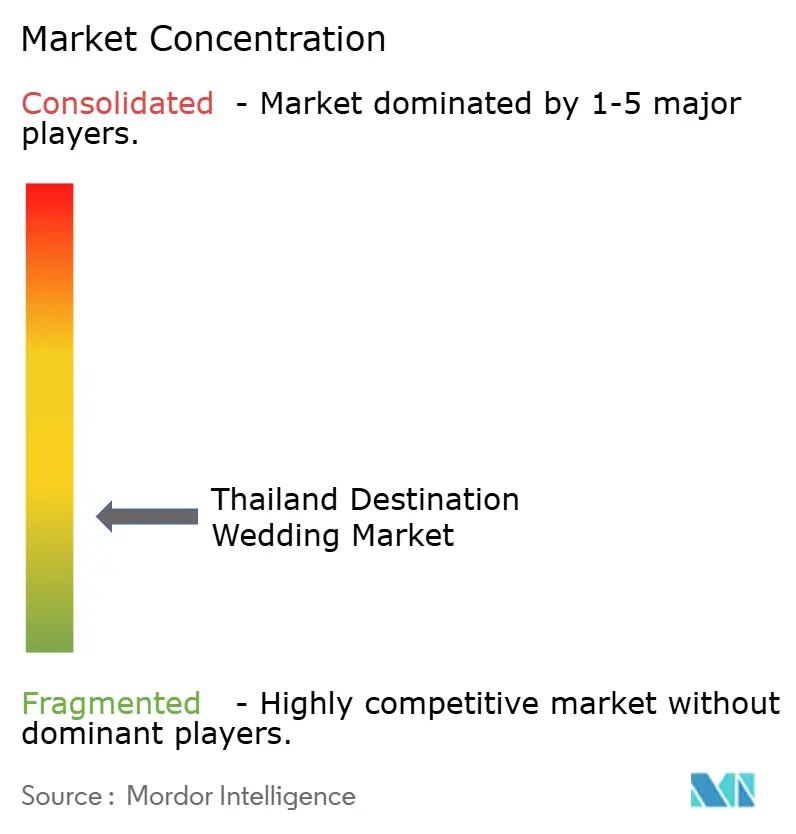
| Market Concentration | Low |
Major Players *Disclaimer: Major Players sorted in no particular order Image © Mordor Intelligence. Reuse requires attribution under CC BY 4.0. | |
Thailand Destination Wedding Market Analysis by Mordor Intelligence
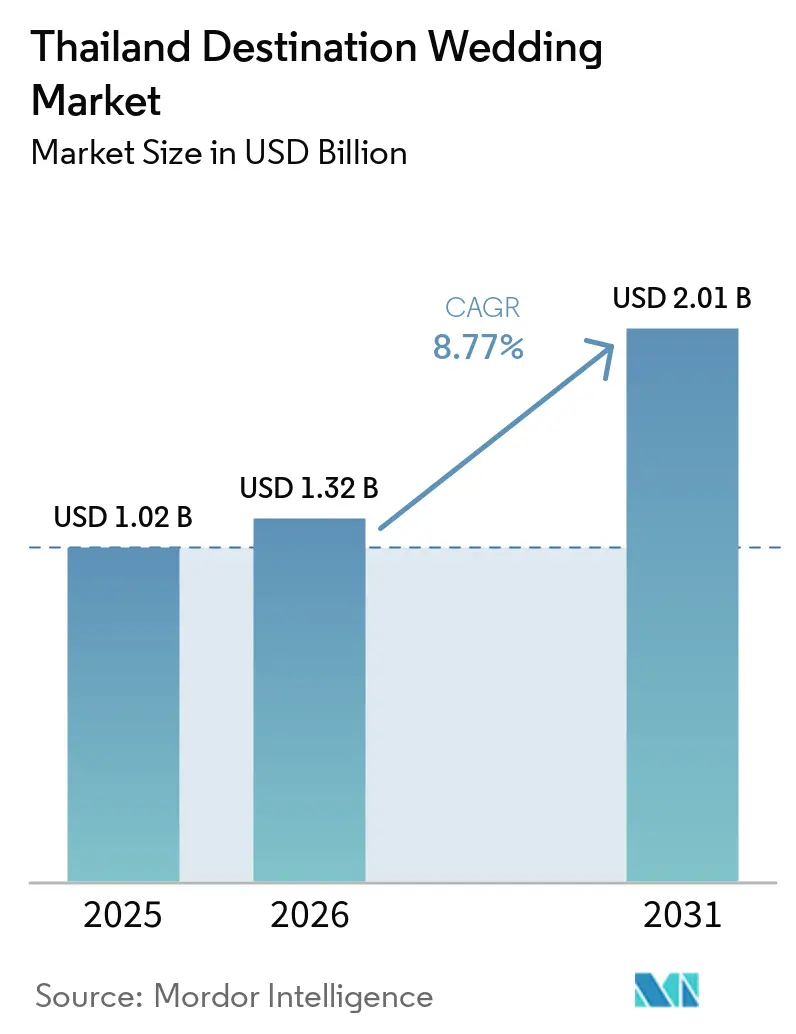
The Thailand Destination Wedding Market is expected to grow from USD 1.02 billion in 2025 to USD 1.32 billion in 2026 and is forecast to reach USD 2.01 billion by 2031 at an 8.77% CAGR over 2026–2031. Demand from India and China drives growth, keeping international buyer sentiment central to booking trends and spending. The Marriage Equality Act, effective from January 2025, expanded the potential couple base and enhanced Thailand’s appeal for long-haul romance travel. Public sector support has increased, with the Tourism Authority of Thailand and the Thailand Convention and Exhibition Bureau incorporating wedding and romance tourism into broader business event promotions[1]. Market fragmentation creates opportunities for operators offering integrated resort scale, cultural customization, and detailed planning. Risks include currency pressures against the INR and CNY and stricter visa-on-arrival rules introduced in May 2026, which impact group travel costs and booking reliability, both critical for international wedding parties.
Key Report Takeaways
- By type, international destination weddings held 61.2% share of the Thailand Destination Wedding Market in 2025, while domestic destination weddings are projected to record the fastest CAGR of 10.44% through 2031.
- By wedding size, intimate and micro weddings accounted for 45.12% share of the Thailand Destination Wedding Market in 2025, while medium weddings are forecast to expand at the fastest CAGR of 10.64% through 2031.
- By expenditure, mid-range weddings held 49.81% share of the Thailand Destination Wedding Market in 2025, while luxury weddings are projected to grow at a CAGR of 9.97% through 2031.
- By service, venue and accommodation represented 32.91% share of the Thailand Destination Wedding Market in 2025, while entertainment and photography is expected to record the fastest CAGR of 11.01% through 2031.
- By geography, Phuket and the Andaman Coast captured 27.93% share of the Thailand Destination Wedding Market in 2025, while the rest of Thailand is projected to expand at a CAGR of 10.39% through 2031.
Note: Market size and forecast figures in this report are generated using Mordor Intelligence’s proprietary estimation framework, updated with the latest available data and insights as of January 2026.
Thailand Destination Wedding Market Trends and Insights
Drivers Impact Analysis*
| Drivers | (~) % Impact on CAGR Forecast | Geographic Relevance | Impact Timeline |
|---|---|---|---|
| Strong inbound wedding tourism from China & India | +3.2% | Phuket, Krabi, Koh Samui | Short term (≤ 2 years) |
| Visa-on-arrival expansion to 60+ countries | +1.5% | Non- Association of Southeast Asian Nations (ASEAN) markets in Europe, the Middle East, and Oceania | Short term (≤ 2 years) |
| Rising popularity of micro-influencer wedding content | +1.0% | Strongest pull effect in India, China, and Asia-Pacific | Medium term (2-4 years) |
| Government promotion of “Wedding & Romance” as MICE pillar | +1.1% | National, with early gains in Phuket and Bangkok | Medium term (2-4 years) |
| Climate-resilient beachfront venue upgrades | +0.8% | Phuket and Andaman Coast, Krabi Province | Medium term (2-4 years) |
| Demand for carbon-neutral ceremonies by Gen-Z couples | +0.6% | Spillover to Phuket, Chiang Mai, and Khao Yai | Long term (≥ 4 years) |
| Source: Mordor Intelligence | |||
Strong inbound wedding tourism from China & India
India plays a crucial role in driving demand for Thailand’s destination weddings market, with a significant year-over-year increase in Indian visitors in 2025 reflecting a growing base for weddings, pre-wedding events, and family gatherings. Over 400 Indian weddings are hosted annually through 2024 and 2025, indicating a shift from occasional to more regular events. Indian wedding groups typically book multi-day programs, large room blocks, and multiple cultural functions, contributing significantly to the market. Meanwhile, China remains relevant despite softer arrival numbers, as Chinese weddings often focus on smaller, high-value events. The combination of India’s large-scale demand and China’s distinct preferences provides Thailand’s destination weddings market with a diverse and stable revenue base, reducing reliance on a single source market.
Visa-on-arrival expansion to 60+ countries
Thailand's 2024 visa reforms improved travel access for long-haul visitors, enhancing its appeal as a wedding destination. The Thai Embassy expanded visa exemption and visa-on-arrival programs in July 2024, reducing paperwork and lead times compared to other Asian destinations[2]. Simplified entry is critical for destination weddings, enabling smooth movement of families, entertainers, photographers, and suppliers for fixed event dates. Non-ASEAN markets in Europe, the Middle East, and Oceania benefited most, as wedding parties often combined ceremonies with extended leisure stays. Although Thailand narrowed visa-on-arrival eligibility in May 2026, the initial reforms significantly influenced market dynamics, creating a more complex mobility landscape for the wedding industry by the end of the forecast period.
Rising popularity of micro-influencer wedding content
The Thailand destination weddings market is becoming more visual, social, and venue focused. Couples now approach planners with shortlists shaped by short-form videos, real wedding clips, and creator-led venue storytelling, easily shared with family decision-makers across cities. This trend is especially significant in India and China, where wedding purchases are highly researched and influenced by execution proof over brochure claims. Thai venues and planners benefit as well-executed ceremonies continue generating inquiries long after the event, particularly when photography and entertainment are included. This explains why entertainment and photography are the fastest-growing service segments. The market increasingly relies on visual credibility, alongside travel trade relationships, to shorten awareness-to-inquiry timelines.
Government promotion of “Wedding & Romance” as MICE pillar
The Thai government has shifted focus from generic tourism branding to developing the destination weddings market while advancing initiatives for the broader business events sector. The Thailand Convention and Exhibition Bureau (TCEB) aim to achieve THB 371.3 billion (USD 11.79 billion) in business events expenditure by 2026 through the "Thailand Power Up" campaign, launched with the Tourism Authority of Thailand (TAT) to attract corporate meetings and incentive groups. TAT’s "Amazing Thailand Romance Trade Meet 2025" connected 52 global buyers with 55 Thai suppliers, emphasizing a structured trade calendar and supplier development. KTC and Weddinglist.co.th, supported by TAT, the Bangkok Metropolitan Administration, and the Thai Hotels Association, organized "Thailand Weddinglist 2026," featuring over 200 exhibitors and 5,000 couples[3]. Collaboration between public and private entities drives demand, payment support, and venue visibility within a unified ecosystem. These efforts enhance year-round promotion for Thailand's destination weddings and MICE markets, reducing reliance on individual resort-level sales activities.
Restraints Impact Analysis*
| Restraints | (~) % Impact on CAGR Forecast | Geographic Relevance | Impact Timeline |
|---|---|---|---|
| Baht appreciation versus INR & CNY | -1.8% | National, most acute for India- and China-origin bookings | Short term (≤ 2 years) |
| Capacity limits at tier-1 beach destinations (Phuket/Krabi) | -1.2% | Phuket and Andaman Coast, Krabi Province | Medium term (2-4 years) |
| Tight labour market for multilingual celebrants | -0.9% | Phuket, Koh Samui, Bangkok | Medium term (2-4 years) |
| Rising travel insurance premiums for guests | -0.6% | Most acute for large Indian wedding delegations | Short term (≤ 2 years) |
| Source: Mordor Intelligence | |||
Baht appreciation versus INR & CNY
Currency fluctuations significantly impact Thailand's destination wedding market. The Thai baht's exchange rate changes have reduced Indian purchasing power despite stable local pricing[4]. This affects mid-range weddings more than luxury ones, as they have less flexibility to absorb rising costs in venues, décor, and entertainment. Wedding budgets in rupees now cover less in Thailand, even with unchanged guest counts and plans. Similarly, a weaker Chinese Yuan against the baht reduces accessibility to destinations such as Phuket and Koh Samui for private luxury ceremonies. Resort operators have introduced fixed-rate package locks to mitigate this issue, but exchange rate sensitivity continues to influence demand in the market.
Capacity limits at tier-1 beach destinations (Phuket/Krabi)
Thailand's coastal wedding destinations are experiencing tighter peak-season supply. High occupancy rates during peak months highlight why beachfront venues in Phuket and Krabi are often booked well in advance. Krabi faces additional constraints due to its largest event space, the Sofitel Krabi Phokeethra Grand Ballroom, which has limited capacity. This poses challenges for Indian weddings, which typically host large guest delegations. As a result, demand is increasingly shifting to Khao Lak, Koh Samui, Bangkok, and inland venues. The Thailand destination weddings market is diversifying geographically, driven by both logistical constraints and evolving preferences.
*Our forecasts treat driver/restraint impacts as directional, not additive. The impact forecasts reflect baseline growth, mix effects, and variable interactions.
Segment Analysis
By Type of Destination Wedding: International Formats Define Market Character
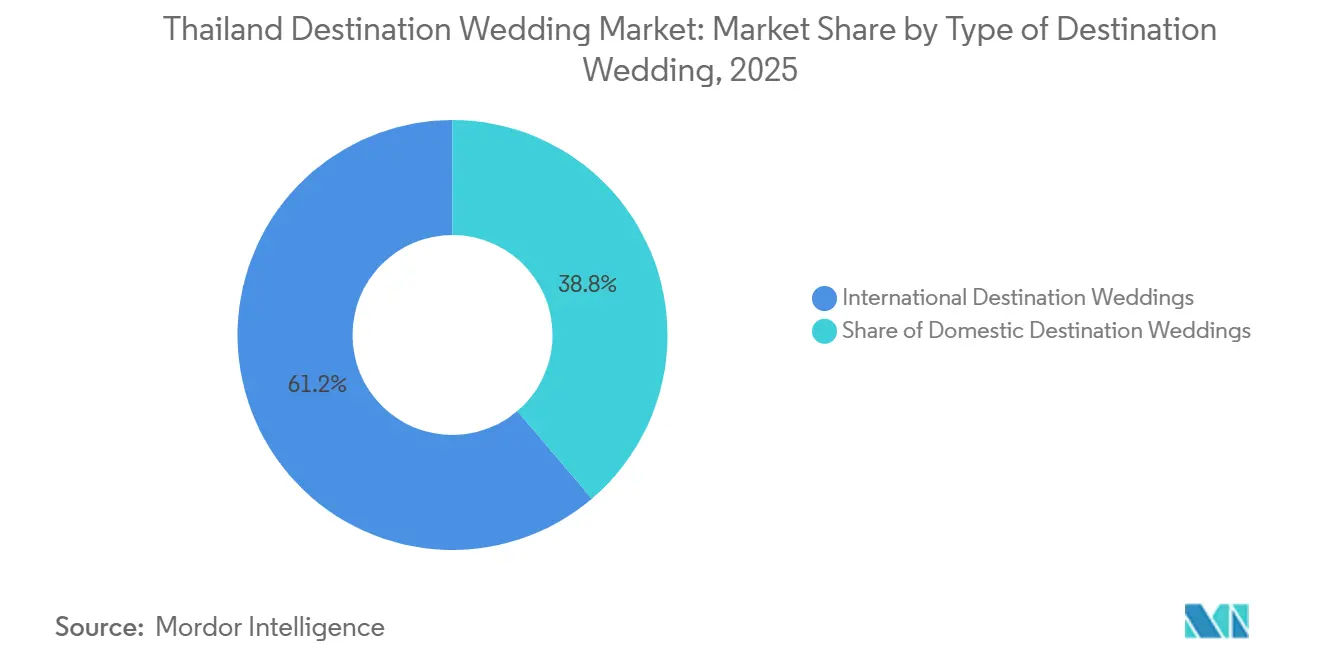
International weddings accounted for 61.2% of Thailand's destination wedding market in 2025, driven by cross-border demand. Thailand's proximity to India, China, Australia, and the Gulf states ensure accessibility for couples and guests. Factors like airline connectivity, visa regulations, and exchange rates significantly influence the market. The January 2025 Marriage Equality Act expanded the international client base, enhancing Thailand's appeal over other Asian destinations. It was recognized as the most popular international wedding destination in India in 2025, reinforcing its position in a key source market.
Domestic weddings represented 38.8% of the market in 2025 and are projected to grow at a 10.4% CAGR through 2031. This growth reflects increased bookings rather than replacing international demand. Thai millennials and urban couples are opting for weekend getaways, boutique resorts, and personalized ceremonies. The industry is diversifying to balance local and international demand, though international weddings generate higher revenue due to extended stays and multiple rituals.
The split between international and domestic weddings impacts venue pricing and planning. International events require longer lead times, supplier coordination, and language skills due to diverse participants. Domestic weddings are quicker to organize and fill off-peak dates, aiding market utilization and supporting emerging inland venues. Travel retail channels are formalizing support for international weddings. TUI added Thailand to its portfolio in April 2025, reporting a 34% rise in 2026 bookings. Tailored offerings, such as Western and Thai blessing packages in Phuket and Khao Lak, improve booking rates and maintain international weddings as a key revenue driver.
By Wedding Size: Intimate Formats Lead While Medium Weddings Build Momentum
Intimate and micro weddings with fewer than 50 guests accounted for 45.12% of the market share in 2025. Couples increasingly choose destination weddings for privacy, scenic locations, and control. Thailand’s venue offerings, including villas, boutique resorts, and smaller estates, align with this preference, emphasizing service quality over capacity. The Four Seasons Resort Chiang Mai’s "Private Vow Experience" for up to 20 guests highlights this trend. These weddings benefit from simpler logistics, reduced weather risks, and easier family coordination. Smaller weddings in Thailand often allow couples to allocate more spending per guest on accommodations, food, photography, décor, and wellness services. This trend supports resorts offering spa, dining, and pre-event services. It also appeals to same-sex couples and those entering second marriages, particularly after the 2025 Marriage Equality Act. For planners, micro weddings involve fewer vendors but require a strong design perspective and storytelling, maintaining their commercial appeal despite smaller guest counts.
Medium weddings with 50 to 200 guests are projected to grow at a 10.64% CAGR through 2031. These weddings balance social visibility with practical venue options, such as resort buyouts or large ballrooms. Venues like JW Marriott Khao Lak and Centara Grand Beach Resort Phuket cater to this demand, avoiding reliance on city-center hotels. Medium weddings combine event complexity with manageable risks, driving their growth over the forecast period. Large weddings of over 200 guests remain limited by beachfront capacity and staffing. Venues like Angsana Laguna Phuket can host up to 1,000 guests, but options are scarce. Growth in Thailand’s destination wedding market is expected to come from medium-format weddings rather than large beachfront events. Inland estates and urban luxury hotels may absorb some demand, but coastal venues will remain selective.
By Expenditure / Budget: Mid-Range Holds the Base While Luxury Deepens
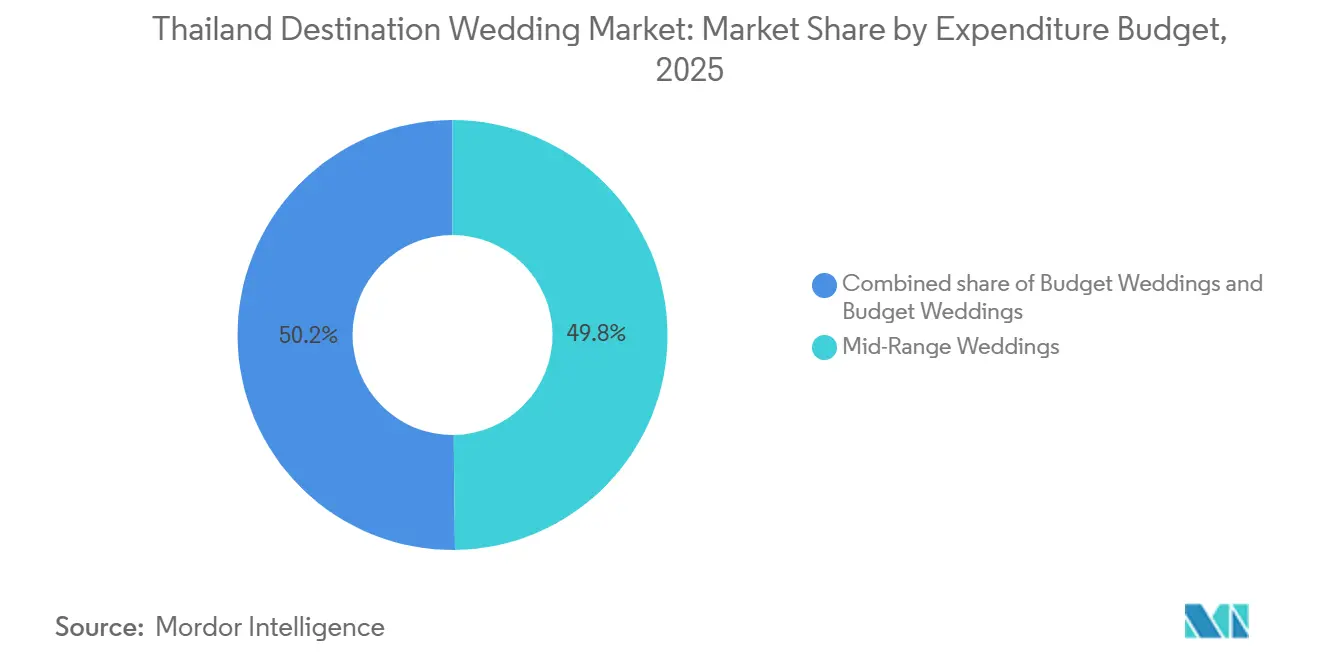
Mid-range weddings accounted for 49.81% of the Thailand destination weddings market value in 2025. These weddings typically cost THB 1.5 million to THB 5 million (USD 0.05 million to USD 0.16 million) and include beach resort packages and planner-led events with multiple vendors. Thailand remains competitive in this segment due to its venue quality, hospitality, and scenic appeal relative to costs, attracting families seeking a high-end look without entering the luxury tier. Currency fluctuations significantly impact the mid-range segment. Budget-conscious couples in this tier compare destinations closely but still seek multiple ceremonies, quality photography, and resort settings. A stronger baht affects this segment more than the luxury market, making package clarity, fixed-rate quotes, and bundled room offers critical for bookings. Independent planners play a key role by combining venue value with supplier selection, ensuring the market remains diverse rather than reliant on luxury.
Luxury weddings are projected to grow at a 10.0% CAGR through 2031, driven by demand from affluent Indian and Chinese couples and a preference for exclusivity and immersive experiences post-2020 disruptions. Hotels like Conrad Koh Samui and Rayavadee Krabi are enhancing accommodation, venues, and services to cater to this demand. Thailand offers coastal exclusivity and strong service standards at lower costs compared to European destinations, appealing to couples seeking value. Budget weddings remain a smaller, slower-growing segment. Thailand is less cost-effective than domestic Indian or regional alternatives. Budget-conscious couples often limit stays, guest counts, and spending, keeping this segment constrained. The market is expected to focus on mid-range and luxury growth rather than budget expansion.

By Service Type / Vendor: Venues Anchor Execution While Content-Led Services Gain Value
Venue and accommodation services represented 32.91% of the market value in 2025, highlighting the property's central role in Thailand's destination weddings market. Venue quotations often include room blocks, ceremony spaces, catering coordination, and guest logistics, increasing the importance of these services. This structure benefits branded hotels and integrated resorts by simplifying compliance, staffing, and supplier management. Venue access typically initiates planning discussions, keeping the market venue focused despite the influence of independent planners. Venue control impacts the sale of other services. Decor, catering, entertainment, and photography, though chosen independently, often depend on venue-approved vendors, technical rules, and event schedules. This gives resorts a competitive edge in the commercial chain. Hospitality brands with skilled romance teams effectively manage bundled services, reducing coordination stress for couples and protecting revenue for operators.
Entertainment and photography are the fastest-growing service segments, with an 11.01% CAGR projected through 2031. Couples increasingly prioritize cinematic documentation, drone videography, short-form content, and live performances as essential elements. Scenic venues in Thailand enhance the value of visual content, making weddings both private events and showcases of venue quality. This drives investment in creative production capabilities by planners and venues. The growth of this segment influences the supply chain. Event planning remains critical for multi-day programs requiring precise timelines and cultural sequencing. Catering and beverages remain stable due to their importance in family evaluations. Decor evolves gradually, with trends in artisan sourcing and custom installations. The market maintains operational fundamentals while allocating more budget to memory capture, entertainment, and content circulation.
Competitive Landscape
The Thailand destination weddings market is fragmented, with the top five operators - The Wedding Bliss Thailand, Anantara Weddings, Banyan Tree Phuket, Take Us To Thailand, and Luxury Events Phuket - holding an estimated 28.6% market share in 2025. No single operator dominates pricing, as competitive advantages rely on execution, specialization, and supplier relationships rather than scale. The market comprises globally branded hospitality players and boutique planners focusing on cultural customization, offering couples diverse options while requiring suppliers to maintain differentiation. Branded hospitality groups focus on vertical integration. Banyan Tree Phuket combines romance teams, décor coordination, wellness services, and accommodations, simplifying the process for clients. In 2025, Banyan Group expanded its offerings by investing in Laguna Phuket and adding Spa Pool Villa inventory. Anantara employs a multi-property model in Phuket, enabling it to handle various wedding formats while maintaining its positioning. Resort groups leverage nearby properties to cross-sell settings, room blocks, and service teams.
Independent planners emphasize cultural understanding, vendor selection, and personalization. Firms like The Wedding Bliss Thailand, Dream Asia Weddings, and Marry Me Thailand succeed by addressing religious rituals, family traditions, décor preferences, and entertainment needs. This approach is critical for Indian weddings, which require precise coordination of Mehendi artists, Mandap fabricators, Bollywood DJs, and halal-certified catering. The market rewards planners who deliver culturally specific and seamless execution, allowing boutique operators to outperform larger brands in certain assignments. Technology adoption is increasing but has not reshaped competition. Operators like Thailand Planner under Siam Planner Co., Ltd. use digital tools to streamline planning, helping younger couples move quickly from inquiry to shortlist. However, high-value weddings still depend on trust, cultural fit, and venue relationships rather than software. The market continues to value operators who combine the reliability of branded hospitality with the cultural expertise and customization of specialized planners.
Thailand Destination Wedding Industry Leaders
-
The Wedding Bliss Thailand
-
Anantara Weddings
-
Banyan Tree Phuket
-
The Bridal Planner Thailand
-
Luxury Events Phuket
- *Disclaimer: Major Players sorted in no particular order
Recent Industry Developments
- March 2026: Banyan Group announced a new phase of international residential development at Laguna Phuket, aiming to position the resort as a hub for long-term international residents and expand its high-net-worth clientele for on-site weddings and celebration events.
- January 2026: The Thailand Weddinglist 2026 took place on January 24–25 at QSNCC Hall 7, featuring over 200 brands and attracting more than 5,000 couples. Organized by Weddinglist.co.th and KTC, with support from TAT and the Thai Hotels Association, it offered discounts of up to 80% to promote Thailand as a wedding destination.
- November 2025: Tourism Authority of Thailand (TAT) won the “Most Popular International Wedding Destination 2025” award at the TTJ MICE Mart & Awards in New Delhi, highlighting strong India-Thailand wedding tourism ties. Thailand hosted over 400 Indian weddings annually during the past two years.
- August 2025: Marriott Vacation Club launched the Khao Lak Beach Resort in August 2025, expanding its presence into a region with limited global hotel chain representation and increasing wedding venue options along the Andaman Coast.
Thailand Destination Wedding Market Report Scope
| Domestic Destination Weddings |
| International Destination Weddings |
| Intimate / Micro (Less than 50 guests) |
| Medium (50 - 200 guests) |
| Large/Grand (More than 200 guests) |
| Budget Weddings |
| Mid-Range Weddings |
| Luxury Weddings |
| Venue & Accommodation |
| Travel & Transport |
| Event Planning & Coordination |
| Catering & Beverages |
| Entertainment & Photography |
| Decor & Theming |
| Bangkok & Central Plains |
| Phuket & Andaman Coast |
| Krabi Province |
| Pattaya & Eastern Seaboard |
| Rest of Thailand |
| By Type of Destination Wedding | Domestic Destination Weddings |
| International Destination Weddings | |
| By Wedding Size | Intimate / Micro (Less than 50 guests) |
| Medium (50 - 200 guests) | |
| Large/Grand (More than 200 guests) | |
| By Expenditure / Budget | Budget Weddings |
| Mid-Range Weddings | |
| Luxury Weddings | |
| By Service Type / Vendor | Venue & Accommodation |
| Travel & Transport | |
| Event Planning & Coordination | |
| Catering & Beverages | |
| Entertainment & Photography | |
| Decor & Theming | |
| By Geography | Bangkok & Central Plains |
| Phuket & Andaman Coast | |
| Krabi Province | |
| Pattaya & Eastern Seaboard | |
| Rest of Thailand |
Key Questions Answered in the Report
What is the current size of Thailand destination weddings in 2026?
The Thailand destination weddings market is valued at USD 1.32 billion in 2026 and is projected to reach USD 2.01 billion by 2031 at an 8.77% CAGR.
Which destination leads wedding demand in Thailand?
Phuket and the Andaman Coast lead with 27.93% of market value, supported by beach venues, flight links, and established planner networks.
Which wedding format is growing fastest in Thailand?
Domestic destination weddings are projected to grow fastest at a 10.39% CAGR through 2031, while international weddings still hold the larger 2025 share at 61.23%.
What budget tier is most important for suppliers?
Mid-range weddings are the largest budget segment with 49.81% of 2025 market value, making them the main revenue base for planners and resorts.
Which service category is seeing the fastest growth?
Entertainment and photography is the fastest-growing service line with an 11.01% CAGR, reflecting stronger demand for cinematic content and immersive guest experiences.
Why are Indian weddings so important to Thailand?
Indian wedding groups tend to book multi-day celebrations and large room blocks, and Thailand hosted more than 400 Indian weddings annually through 2024 and 2025.