
Telecom Service Fulfillment Software Market Size and Share
Market Overview
| Study Period | 2020 - 2031 |
|---|---|
| Market Size (2026) | USD 4.62 Billion |
| Market Size (2031) | USD 12.47 Billion |
| Growth Rate (2026 - 2031) | 21.97 % |
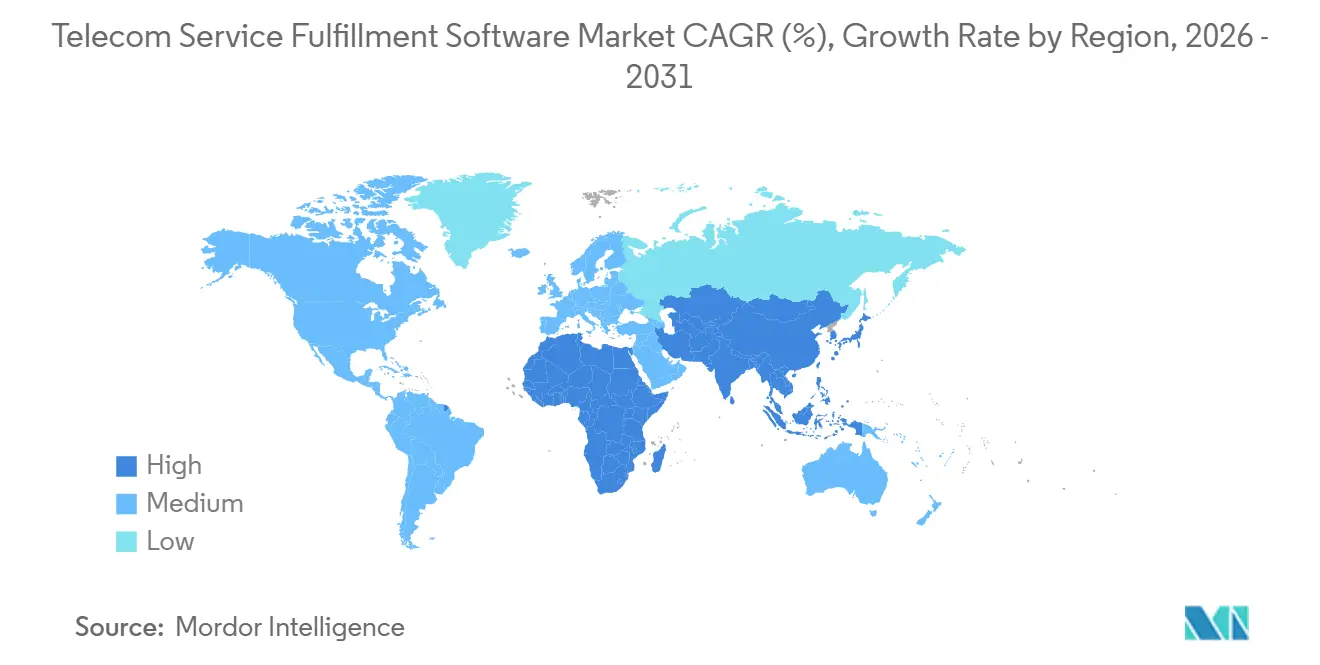
| Fastest Growing Market | Africa |
| Largest Market | North America |
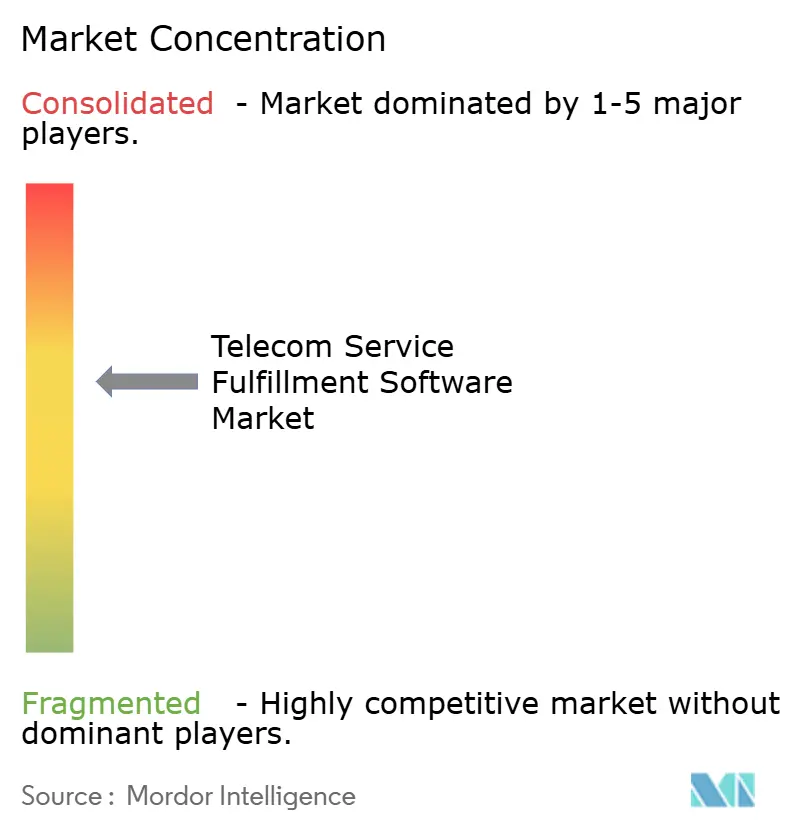
| Market Concentration | Medium |
Major Players *Disclaimer: Major Players sorted in no particular order Image © Mordor Intelligence. Reuse requires attribution under CC BY 4.0. | |
Telecom Service Fulfillment Software Market Analysis by Mordor Intelligence
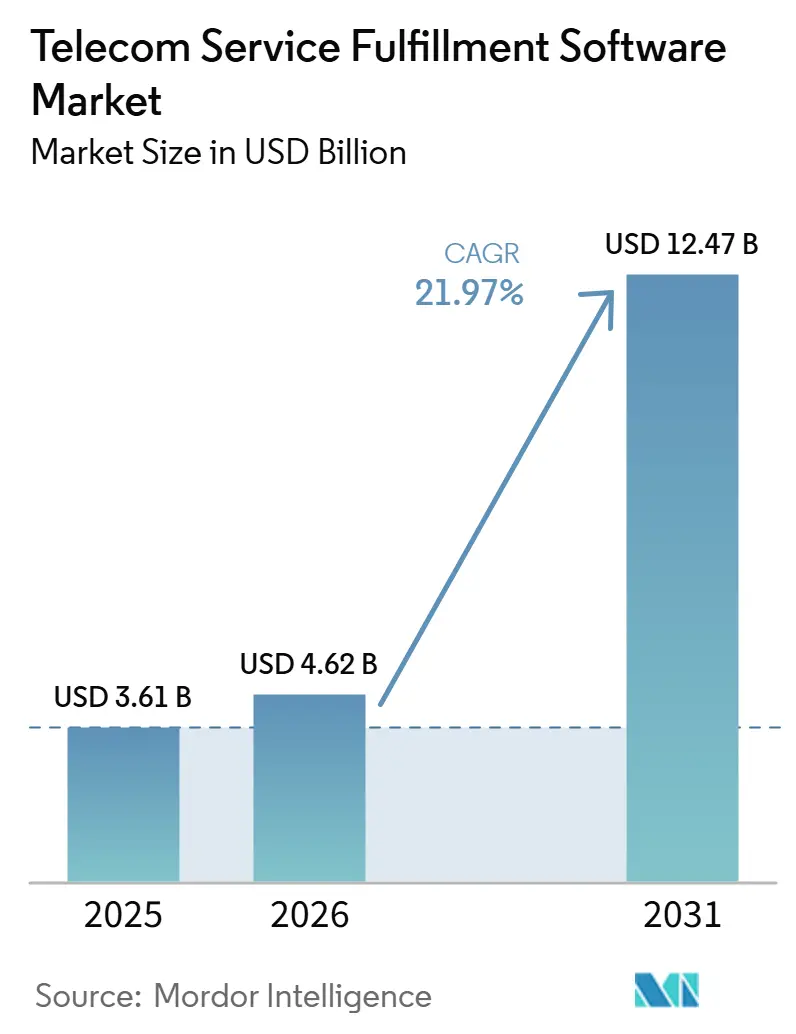
The Telecom Service Fulfillment Software Market size is projected to be USD 3.61 billion in 2025, USD 4.62 billion in 2026, and reach USD 12.47 billion by 2031, growing at a CAGR of 21.97% from 2026 to 2031.
The telecom service fulfillment software market is expanding as communications service providers modernize their systems to support 5G, fiber, and cloud services. Legacy operational support systems often require manual work to translate complex service orders into activated capacity. This can delay billing, constrain service launches, and weaken returns on network investment. Providers are moving from basic connectivity to managed services, making reliable orchestration increasingly important to commercial performance. Demand also reflects the need to support both public cloud delivery and sovereign or private cloud deployments, which gives capable platforms an advantage in the telecom service fulfillment software market.
Key Report Takeaways
- By product type, network management and orchestration software led with 23.51% of the telecom service fulfillment software market share in 2025.
- By deployment type, cloud accounted for 53.92% of revenue in 2025, while cloud deployment is projected to expand at a 29.64% CAGR through 2031.
- By network type, mobile networks held a 35.09% share in 2025, while cloud and data center networks are projected to expand at a 29.54% CAGR through 2031.
- By end user, mobile network operators held 37.96% market share in 2025, while wholesale and neutral-host providers are projected to expand at a 30.04% CAGR through 2031.
- By geography, North America led with a 29.96% share in 2025, while Africa is projected to expand at a 30.26% CAGR through 2031.
Note: Market size and forecast figures in this report are generated using Mordor Intelligence’s proprietary estimation framework, updated with the latest available data and insights as of January 2026.
Market Trends and Insights
Drivers Impact Analysis of Telecom Service Fulfillment Software Market*
| Driver | (~) % Impact on CAGR Forecast | Geographic Relevance | Impact Timeline |
|---|---|---|---|
| 5G, Fiber, and Cloud Service Complexity | +7.5% | Global, with highest concentration in North America, Europe, and Asia-Pacific core | Short term (≤ 2 years) |
| Demand for Faster Order-to-Activate Cycles | +5.5% | Global, accelerated in North America and Northeast Asia | Short term (≤ 2 years) |
| Growth of Enterprise Network-as-a-Service and Slicing | +4.2% | North America, Europe, and Asia-Pacific, with spillover to the Middle East | Medium term (2-4 years) |
| Cloud-Native OSS Modernization | +3.8% | Global, led by North America and Western Europe | Medium term (2-4 years) |
| AI Agents for Fallout Prevention and Closed-Loop Fulfillment | +3.1% | Global, with early commercial gains in Japan, South Korea, and Western Europe | Medium term (2-4 years) |
| Federated Inventory for Acquired and Multi-Vendor Networks | +2.4% | North America and Europe, with spillover to the Middle East and Africa | Long term (≥ 4 years) |
| Source: Mordor Intelligence | |||
5G, Fiber, and Cloud Service Complexity Driving Catalog-Led Automation
5G standalone changes how service design connects with network activation in the telecom service fulfillment software market. A customer order can require real-time work across core, radio access, and transport networks that use different vendor interfaces and activation methods. Operators are also managing consumer 5G, enterprise fiber, and multicloud connectivity products within the same service catalog. Legacy rules-based engines struggle with these combined requirements and can create more failed orders that need manual handling. Catalog-driven platforms model services as reusable components, which can simplify service creation and order decomposition. This approach supports faster introduction of new offers and more consistent activation of complex enterprise services.
Demand for Faster Order-to-Activate Cycles Creating Revenue Pressure
Order-to-activate speed is becoming a direct commercial issue for communications service providers. Enterprise buyers can compare connectivity offers with hyperscaler and managed-service alternatives, making activation time relevant to purchasing decisions. Delays can postpone the start of billing and create avoidable rework for operations teams. Failed orders often require manual investigation before a service can go live. Providers are therefore treating faster fulfillment as a revenue and service-quality priority. AI-assisted prevention of fulfillment fallout is being assessed as a way to improve operational results in the telecom service fulfillment software market.
Growth of Enterprise Network-as-a-Service and Slicing Demanding Intent-Based Fulfillment
Enterprise network-as-a-service and 5G slicing require fulfillment systems to respond to requested business outcomes rather than fixed configuration scripts. A request for a low-latency network slice for an event requires coordinated provisioning across several network domains. Nokia and AWS demonstrated an agentic AI-powered 5G slicing solution with du and Orange at MWC 2026. The system monitored radio access network performance indicators and adjusted slice policies without manual engineering action.[1] Wholesale and neutral-host providers face an added issue because orders can cross several network owners and service catalogs. Federated catalog models and automated intercarrier activation are becoming more relevant as these providers expand in the telecom service fulfillment software market.
Cloud-Native OSS Modernization Supporting Continuous Delivery
Cloud-native OSS modernization enables operators to update service components and provisioning adapters without taking production systems offline. Legacy fulfillment applications often depend on proprietary hardware and can require long upgrade cycles. Modular applications and automated delivery practices allow smaller updates to be introduced more frequently. This matters when operators need to revise catalogs and support changing enterprise services. TM Forum's Open Digital Architecture provides component-based blueprints and Open APIs for this transition.[2] The framework is shaping procurement because it gives operators a common basis for connecting fulfillment components from different vendors in the telecom service fulfillment software market.
Restraints Impact Analysis of Telecom Service Fulfillment Software Market*
| Restraint | (~) % Impact on CAGR Forecast | Geographic Relevance | Impact Timeline |
|---|---|---|---|
| Legacy Data Quality and Inventory Reconciliation | -3.4% | Global, most pronounced among operators with M&A history across North America and Europe | Long term (≥ 4 years) |
| High Integration and Migration Risk | -2.8% | Global, most acute in markets with large incumbent Tier-1 operators | Medium term (2-4 years) |
| Non-Standard Service Models Across Wholesale Ecosystems | -1.8% | Global, with highest impact in Europe and North America wholesale markets | Medium term (2-4 years) |
| Governance Risk From Autonomous Provisioning | -1.2% | Global, with early regulatory focus in the European Union and Japan | Long term (≥ 4 years) |
| Source: Mordor Intelligence | |||
Legacy Data Quality and Inventory Reconciliation Constraining Automation Payoffs
Accurate inventory data is necessary for automation to deliver consistent fulfillment results. An inventory record can be incomplete when it does not show available fiber capacity or the virtual and physical relationship needed for a 5G slice. Such gaps can create provisioning failures at the point when automation should reduce manual work. Amdocs has stated that a carrier inventory migration required the cleansing of 4 million erroneous attributes before AI-enabled automation could operate reliably. This makes discovery, reconciliation, and data-quality scoring important parts of a fulfillment deployment rather than optional additions. Vendors that include these capabilities can help providers achieve usable automation outcomes in the telecom service fulfillment software market.
High Integration and Migration Risk Extending Payback Periods
Migration risk can delay the benefits that support investment in new fulfillment platforms. Legacy systems often contain pricing rules, activation scripts, and compliance checks that are not fully documented. Recreating this business logic requires repeated testing and can extend costs and timelines. A complete replacement of separate inventories is often impractical, while phased data federation allows legacy repositories to remain active behind a common interface. This transition approach reduces disruption but can delay visible automation gains. Governance requirements for autonomous actions also mean that human checkpoints may remain necessary in live networks.
*Our forecasts treat driver/restraint impacts as directional, not additive. The impact forecasts reflect baseline growth, mix effects, and variable interactions.
Telecom Service Fulfillment Software Market Segment Analysis
By Product Type:
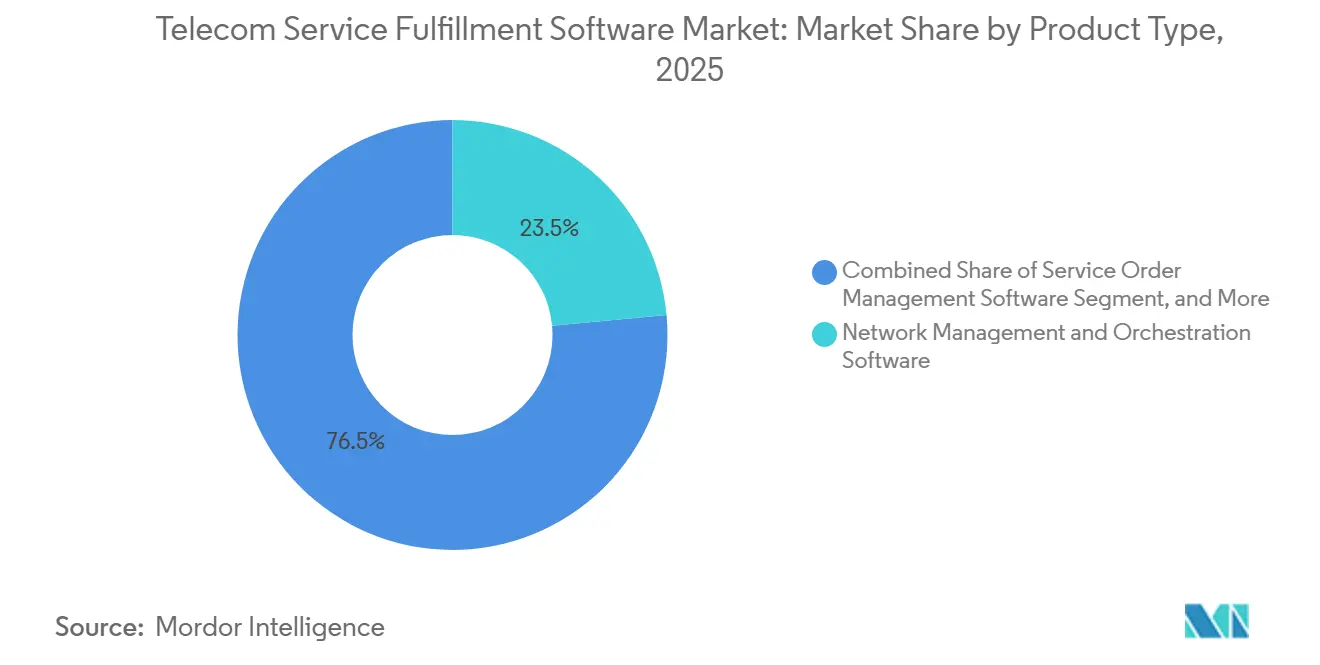
Network Orchestration Platforms Define Fulfillment OutcomesNetwork management and orchestration software held 23.51% of the telecom service fulfillment software market share in 2025, making it the largest product type segment. The segment coordinates service orders, inventory checks, activation steps, and assurance feedback across radio access, transport, and cloud-native core functions. A single customer order can require parallel activation actions across systems from different vendors. Orchestration platforms decompose that order into resource-level commands and coordinate the resulting work. This makes the platform a central part of fulfillment performance for complex services.
Amdocs introduced its Service and Network Orchestrator within its aOS offering in February 2026, supporting Kubernetes-native deployment across AWS, Azure, and GCP environments.[3] The platform also supports 5G slicing function decomposition across eMBB, URLLC, and mIoT subnets in a catalog-driven workflow. Service order management and inventory tools provide the order context and resource information that orchestration requires. Activation and provisioning tools are moving toward intent-driven interfaces that use Open APIs. These product categories are increasingly combined into microservices-based fulfillment suites with catalog-to-activation traceability.

By Deployment Type:
Cloud Delivery Accelerates Time-to-ActivateCloud deployment accounted for 53.92% of the telecom service fulfillment software market size in 2025 and is projected to advance at a 29.64% CAGR through 2031. Operators use cloud delivery to scale orchestration capacity as order volumes rise and to support continuous delivery practices. Security and compliance concerns have become less decisive as cloud services mature. Public cloud delivery can lower the infrastructure burden for operators that need more flexible fulfillment capacity. The deployment model is therefore central to current buying decisions in the telecom service fulfillment software market.
Nokia announced in June 2026 that it would host its full Autonomous Networks Fabric on AWS, covering orchestration, assurance, and unified inventory. On-premises deployment remains necessary where national rules require core operational data to remain in private or national infrastructure. This has particular relevance in Germany, where data sovereignty affects deployment choices. Vendors are responding with containerized designs that can run across public cloud, private cloud, and on-premises settings. The same codebase can support different commercial and compliance requirements without separate product development.
By Network Type:
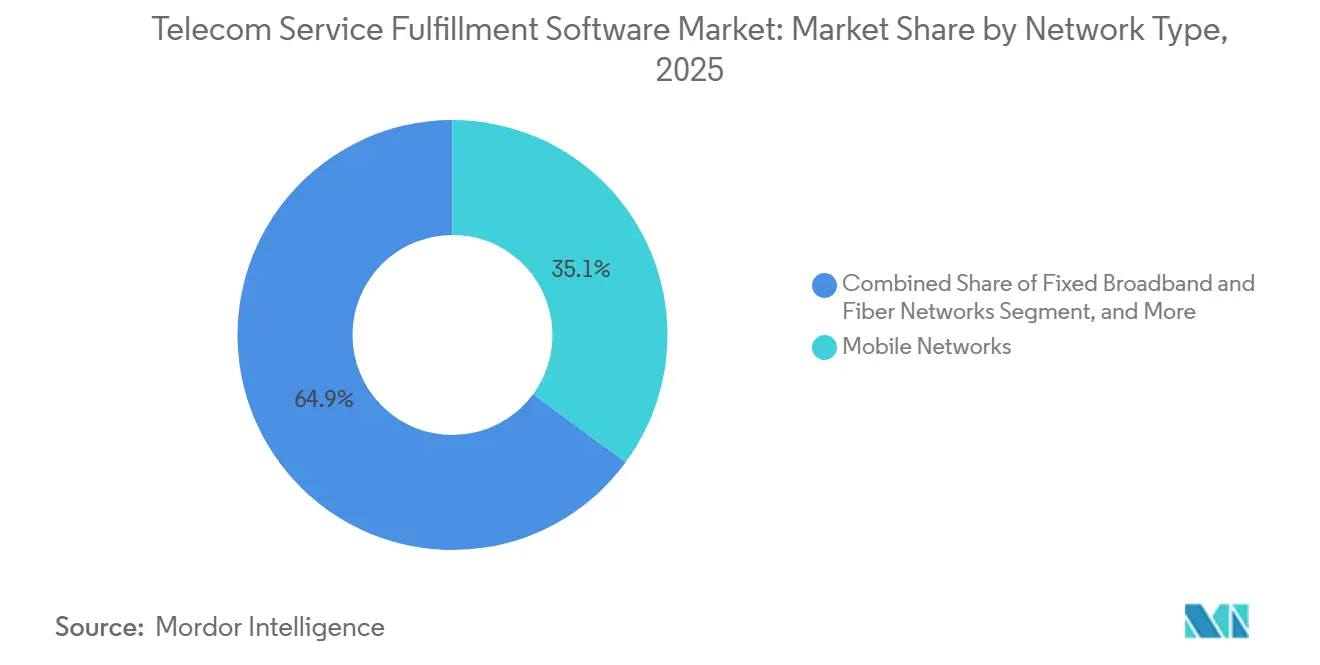
Mobile Networks Lead as Cloud and Data Center Connectivity AcceleratesMobile networks captured 35.09% market share in 2025, the largest share among network types in the telecom service fulfillment software market. 5G standalone rollouts require more advanced service fulfillment because an enterprise slice can require simultaneous allocation of radio resources, core functions, and service-level commitments. This work increases the need for coordinated, real-time activation. Mobile operators also need inventory views that connect physical and virtual network resources. These requirements keep mobile networks central to spending on fulfillment platforms.
Cloud and data center networks are projected to expand at a 29.54% CAGR through 2031, the fastest rate among network types. This reflects demand for automated cloud interconnect and colocation services as hyperscaler infrastructure expands. Customers increasingly view connectivity and compute as a single service, which requires unified catalog models. Fixed broadband, fiber, and cable providers also need address-specific or dual-stack provisioning as their networks evolve. Multi-domain environments add further complexity because Open RAN, software-defined wide area networks, and cloud-native cores often involve several vendors and interfaces.
By End User:
Mobile Operators Anchor Demand While Wholesale Providers Drive GrowthMobile network operators held 37.96% market share in 2025, confirming their position as the primary buyers at scale in the telecom service fulfillment software market. Standalone 5G needs native support for network slicing, closed-loop assurance, and real-time inventory federation that many 4G-era systems cannot provide. Operators are therefore replacing or reworking existing fulfillment stacks. Globe Telecom expanded its Netcracker partnership in April 2025 to cover order fulfillment, fallout management, and proactive monitoring. The program aimed to accelerate order processing in its enterprise business.[4]
Wholesale and neutral-host network providers are projected to grow at a 30.04% CAGR through 2031. They serve several retail operators through shared infrastructure and must manage different catalogs, service-level agreements, and activation timelines. Their systems need federated catalogs, role-based provisioning, and automated intercarrier ordering. Fixed operators, internet service providers, cable companies, and satellite providers also support demand through broadband investment and hybrid satellite-cellular delivery. This differs from the needs of vertically integrated providers that manage a single retail offer and network estate.
Geography Analysis
North America and Europe Telecom Service Fulfillment Software Market
North America held 29.96% of the telecom service fulfillment software market size in 2025, supported by Tier-1 operators with large OSS modernization budgets and a mature vendor base. U.S. carriers are replacing proprietary legacy OSS environments with cloud-native and API-driven systems that can produce multi-year software and services contracts. Canada and Mexico add demand through network expansion and enterprise broadband investment, although their spending is smaller than that of the United States. Europe is supported by the Germany-United Kingdom-France corridor, where fiber buildouts require address-level provisioning for high activation volumes. Germany's data sovereignty rules also support demand for on-premises and private-cloud OSS deployments.
APAC Telecom Service Fulfillment Software Market
Asia-Pacific includes advanced 5G standalone networks in Japan and South Korea and large markets at different stages of fulfillment modernization. NTT Docomo and NEC launched Japan's first commercial 5G core on AWS in February 2026 and reported AI-based automated core network construction using agentic workflows.[5] South Korean operators are active buyers of advanced orchestration systems because they run dense 5G networks. China maintains a domestic OSS environment with limited exposure to international vendors. India and other Asia-Pacific markets offer opportunities as operators modernize before enterprise 5G and fiber monetization programs.
MEA and South America Telecom Service Fulfillment Software Market
Africa is projected to expand at a 30.26% CAGR through 2031, the fastest geographic rate in the telecom service fulfillment software market. Operators in the region are investing in cloud-native platforms to meet mobile broadband and enterprise connectivity demand, including MTN South Africa's June 2026 Pi launch using LotusFlare's DNO Cloud BSS platform. The deployment covers catalog, order management, converged charging, and eSIM orchestration on public cloud infrastructure. The Middle East is investing in BSS transformation and 5G slicing, while South America is developing through Brazil's fiber expansion and enterprise connectivity programs.
Competitive Landscape
The telecom service fulfillment software market is moderately concentrated among specialized OSS platform vendors and network equipment providers with orchestration capabilities. These suppliers hold a large share of spending by major operators, while regional integrators and cloud-native specialists compete in the middle of the market. Open Digital Architecture conformance is increasingly relevant in procurement because it supports modular systems and standardized interfaces. Meeting this requirement calls for sustained engineering work and can limit smaller entrants. Vendors must also integrate existing systems while supporting cloud-native designs.
Leading suppliers are using agentic AI as a differentiator in their fulfillment offerings. Amdocs introduced aOS in February 2026 as an agentic operating system that can operate across BSS and OSS environments.[6] Nokia and AWS showcased an agentic AI-powered 5G slicing solution with du and Orange in February 2026. Nokia then expanded its AWS collaboration in June 2026 to host its Autonomous Networks Fabric, including orchestration, assurance, and unified inventory. These moves focus competition on cloud delivery, autonomous operations, and lifecycle integration.
Opportunities remain in wholesale automation, enterprise slicing, and low-code catalog tools for regional providers. Suppliers compete through AI-based fallout resolution, federated inventory management, and flexible public SaaS or sovereign-hosted delivery. Cerillion and Tecnotree seek mid-market and emerging-economy opportunities with configuration-led, pre-integrated suites. The telecom service fulfillment software market favors platforms that combine integration depth, quicker delivery, and multiple deployment options.
Telecom Service Fulfillment Software Industry Leaders
-
Amdocs Limited
-
Nokia Corporation
-
Telefonaktiebolaget LM Ericsson
-
Huawei Technologies Co., Ltd.
-
Oracle Corporation
- *Disclaimer: Major Players sorted in no particular order
Telecom Service Fulfillment Software Market Companies Covered in this Report
- Amdocs Limited
- Nokia Corporation
- Telefonaktiebolaget LM Ericsson (publ)
- Netcracker Technology Corporation
- Oracle Corporation
- CSG Systems, Inc.
- Huawei Technologies Co., Ltd.
- Cisco Systems, Inc.
- International Business Machines Corporation
- Accenture plc
- Capgemini SE
- Comarch S.A.
- Infosys Limited
- Tech Mahindra Limited
- Hewlett Packard Enterprise Company
- Cerillion plc
- Tecnotree Corporation
- Mavenir, Inc.
Recent Industry Developments in Telecom Service Fulfillment Software Market
- June 2026: Nokia and AWS expanded their collaboration to run Nokia’s Autonomous Network Fabric on AWS, combining service orchestration, assurance, and unified inventory to support Level 4 autonomous networks. The platform provides intent-based service orchestration across multi-domain and multi-vendor networks, with availability expected later in 2026.
- April 2026: Omantel selected Cerillion for a major BSS/OSS transformation, deploying Cerillion’s pre-integrated suite through Oman Data Park. The program includes Service Manager and Network Inventory alongside product catalog, CRM, charging, and revenue management, supporting unified service delivery across B2C, B2B, and IoT services.
- March 2026: Amdocs unveiled CES26, an agent-driven BSS-OSS-Network suite within its aOS platform. The solution incorporates telco-grade order management, end-to-end traceability, high-volume processing, and hybrid fulfillment across multiple provisioning systems and partners, strengthening automated service fulfillment capabilities.
- March 2026: Netcracker announced a major OSS modernization program with BICS, upgrading its Digital OSS platform across Resource Inventory, Discovery & Reconciliation, Service Inventory, Service Information Management, Service Problem Management, and Network Planning & Design. The platform supports BICS’s wholesale and carrier services, including 5G and IoT IP Exchange.
- February 2026: Nokia and AWS demonstrated an agentic AI-powered 5G-Advanced network slicing solution in a live 5G network. The intent-based solution combines Nokia network slicing with AWS AI technologies to dynamically adapt network resources to customer demand, supporting automated delivery of differentiated network services.
Global Telecom Service Fulfillment Software Market Report Scope
The Telecom Service Fulfillment Software Market Report is Segmented by Product Type (Service Order Management, Network Management and Orchestration, Inventory Management, Activation and Provisioning, and Other Product Types), Deployment (Cloud, and On-Premise), Network Type (Mobile, Fiber, Cable, Cloud and Data Center, and Multi-Domain), End User (MNOs, Fixed Operators, ISPs, Cable, Satellite, and Wholesale Providers), and Geography (North America, South America, Europe, Asia-Pacific, Middle East, and Africa). The Market Forecasts are Provided in Terms of Value (USD).
Segmentation Overview
| Service Order Management Software |
| Network Management and Orchestration Software |
| Inventory Management Software |
| Activation and Provisioning Software |
| Other Product Types |
| Cloud |
| On-Premise |
| Mobile Networks |
| Fixed Broadband and Fiber Networks |
| Cable Networks |
| Cloud and Data Center Networks |
| Multi-Domain and Multi-Vendor Networks |
| Mobile Network Operators |
| Fixed Network Operators |
| Internet Service Providers |
| Cable Network Operators |
| Satellite Communication Providers |
| Wholesale and Neutral-Host Network Providers |
| North America | United States |
| Canada | |
| Mexico | |
| South America | Brazil |
| Argentina | |
| Rest of South America | |
| Europe | Germany |
| United Kingdom | |
| France | |
| Italy | |
| Rest of Europe | |
| Asia-Pacific | China |
| Japan | |
| India | |
| South Korea | |
| Rest of Asia-Pacific | |
| Middle East | Saudi Arabia |
| United Arab Emirates | |
| Rest of Middle East | |
| Africa | South Africa |
| Nigeria | |
| Egypt | |
| Rest of Africa |
| By Product Type | Service Order Management Software | |
| Network Management and Orchestration Software | ||
| Inventory Management Software | ||
| Activation and Provisioning Software | ||
| Other Product Types | ||
| By Deployment Type | Cloud | |
| On-Premise | ||
| By Network Type | Mobile Networks | |
| Fixed Broadband and Fiber Networks | ||
| Cable Networks | ||
| Cloud and Data Center Networks | ||
| Multi-Domain and Multi-Vendor Networks | ||
| By End User | Mobile Network Operators | |
| Fixed Network Operators | ||
| Internet Service Providers | ||
| Cable Network Operators | ||
| Satellite Communication Providers | ||
| Wholesale and Neutral-Host Network Providers | ||
| By Geography | North America | United States |
| Canada | ||
| Mexico | ||
| South America | Brazil | |
| Argentina | ||
| Rest of South America | ||
| Europe | Germany | |
| United Kingdom | ||
| France | ||
| Italy | ||
| Rest of Europe | ||
| Asia-Pacific | China | |
| Japan | ||
| India | ||
| South Korea | ||
| Rest of Asia-Pacific | ||
| Middle East | Saudi Arabia | |
| United Arab Emirates | ||
| Rest of Middle East | ||
| Africa | South Africa | |
| Nigeria | ||
| Egypt | ||
| Rest of Africa | ||
Key Questions Answered in the Report
What is the size of the telecom service fulfillment software market?
The market was valued at USD 3.59 billion in 2025 and is estimated at USD 4.83 billion in 2026. It is projected to reach USD 16.93 billion by 2031 at a 28.53% CAGR, supported by modernization of fulfillment systems for 5G, fiber, and cloud services.
What is driving demand for the telecom service fulfillment software market?
Demand is supported by 5G standalone, fiber, cloud connectivity, and the need to reduce the time between order receipt and service activation. Providers also need tools that can coordinate services across radio access, transport, cloud, and core network domains.
Which product type led telecom service fulfillment software spending?
Within the telecom service fulfillment software market, network management and orchestration software led product types with a 23.51% share in 2025. Its role is to coordinate customer orders, inventory information, activation steps, and service assurance across different network systems. It is especially important when a single enterprise request requires parallel work across radio access, transport, and cloud-native core environments. Catalog-driven workflows help turn a requested service into the underlying activation commands, while preserving visibility across the full fulfillment sequence. This capability supports consistent activation across complex, multi-vendor network environments.
Why are cloud deployments important for the telecom service fulfillment software market?
Cloud deployment held 53.92% of revenue in 2025 and supports elastic capacity, continuous delivery, and faster changes to service catalogs. It can also support public cloud delivery while containerized designs preserve options for private or sovereign deployment.
Which end users are adopting fulfillment platforms most actively?
Mobile network operators held a 37.96% share in 2025, while wholesale and neutral-host providers are projected to grow at a 30.04% CAGR through 2031. Wholesale providers need federated catalogs and automated intercarrier ordering because they serve several retail operators on shared infrastructure.
Which region is expanding fastest for these platforms?
Africa is projected to expand at a 30.26% CAGR through 2031 as operators deploy cloud-native systems for mobile broadband and enterprise connectivity. North America remained the largest regional segment in 2025 with a 29.96% share, supported by large OSS modernization programs.