
Telecom IoT Roaming Management Market Size and Share
Market Overview
| Study Period | 2021 - 2032 |
|---|---|
| Market Size (2027) | USD 1.84 Billion |
| Market Size (2032) | USD 3.34 Billion |
| Growth Rate (2027 - 2032) | 12.66 % |
| Fastest Growing Market | Asia-Pacific |
| Largest Market | Europe |
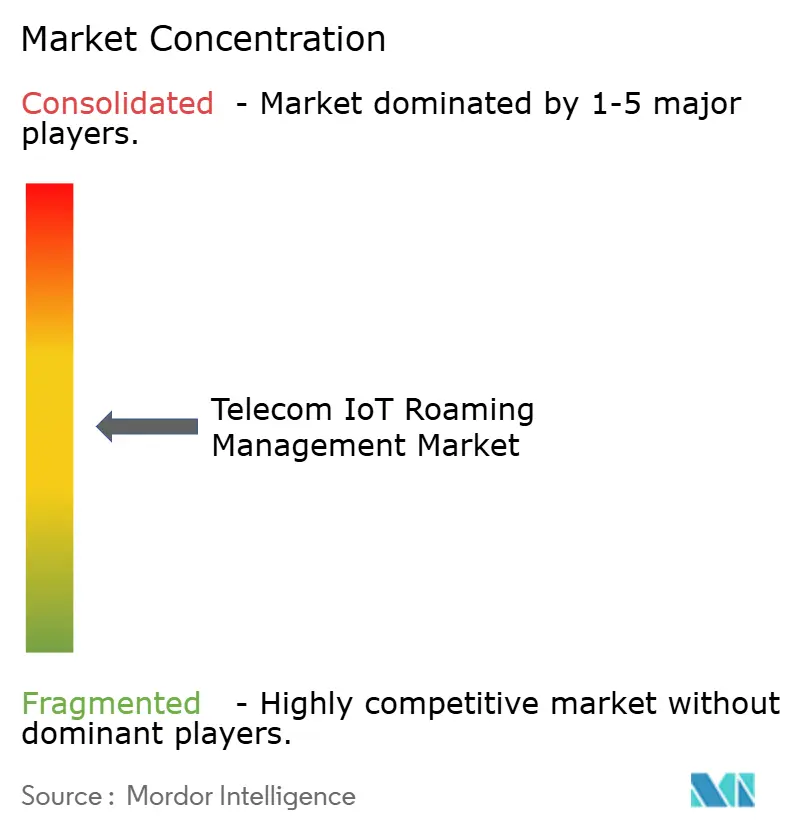
| Market Concentration | Medium |
Major Players *Disclaimer: Major Players sorted in no particular order Image © Mordor Intelligence. Reuse requires attribution under CC BY 4.0. | |
Telecom IoT Roaming Management Market Analysis by Mordor Intelligence
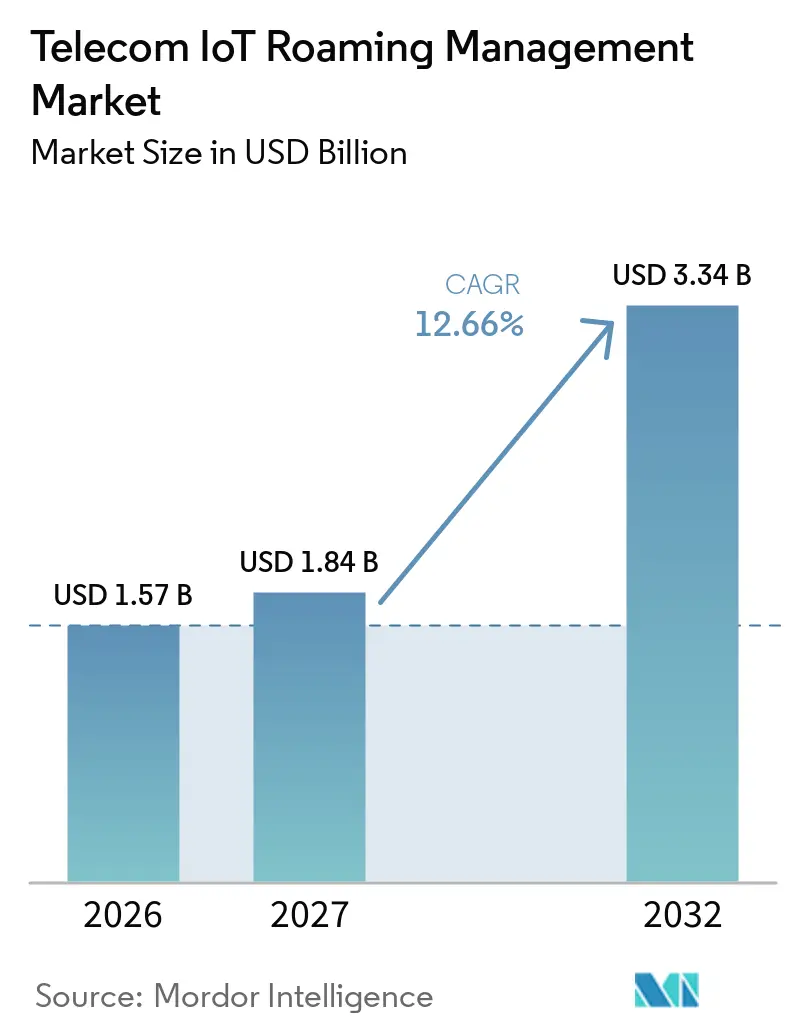
The Telecom IoT Roaming Management Market size is projected to be USD 1.57 billion in 2026, USD 1.84 billion in 2027, and reach USD 3.34 billion by 2032, growing at a CAGR of 12.66% from 2027 to 2032. The telecom IoT roaming management market is driven by the need to manage connected assets that cross borders, networks, and regulatory systems. Operators and enterprises are investing in settlement, policy control, and cross-border connectivity tools as fleets become more widely distributed. The shift from Transferred Account Procedures to Billing and Charging Evolution is making it easier to apply access-based charging to lower-value IoT traffic. SGP.32 eSIM provisioning is also shifting more control toward enterprises and original equipment manufacturers, while reducing dependence on a single operator profile. These changes create opportunities for platform providers, but they also place pressure on established wholesale roaming revenue models.
Key Report Takeaways
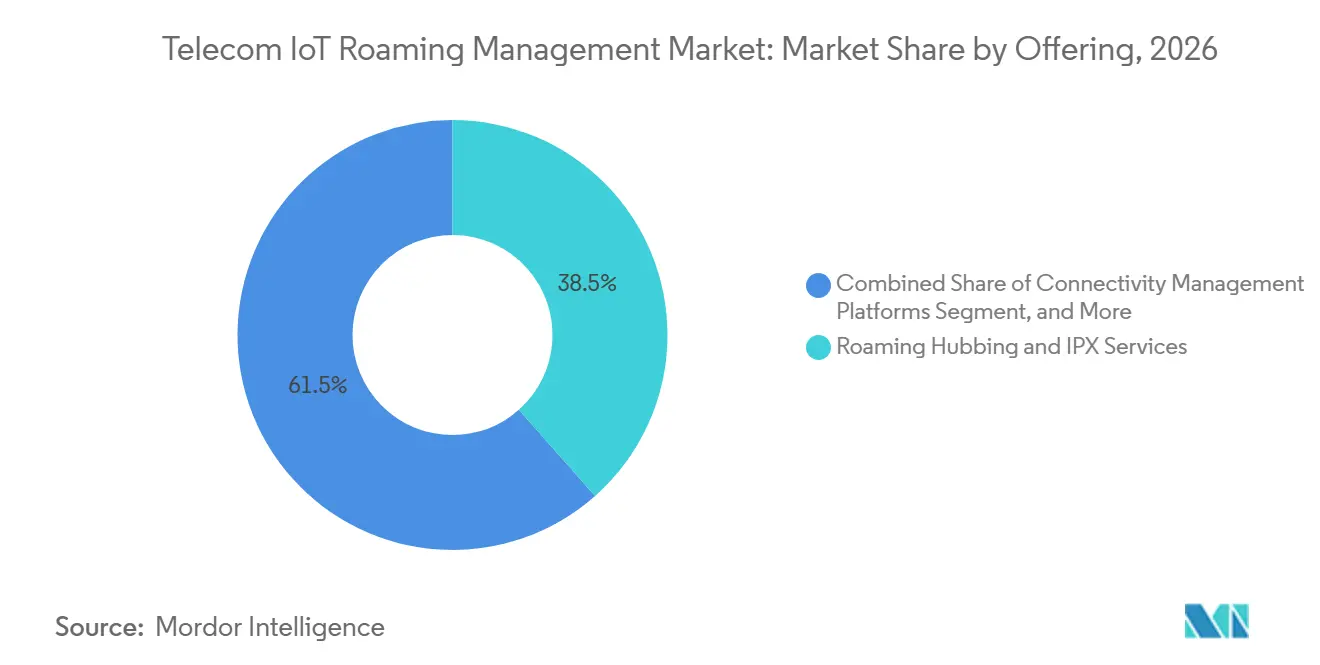
- By offering, roaming hubbing and IPX services held 38.46% of the telecom IoT roaming management market share in 2026, while the roaming analytics and quality management is projected to expand at a 14.37% CAGR through 2032.
- By deployment mode, cloud-based deployment accounted for 57.82% of the telecom IoT roaming management market share in 2026, while hybrid deployment is projected to expand at a 14.21% CAGR through 2032.
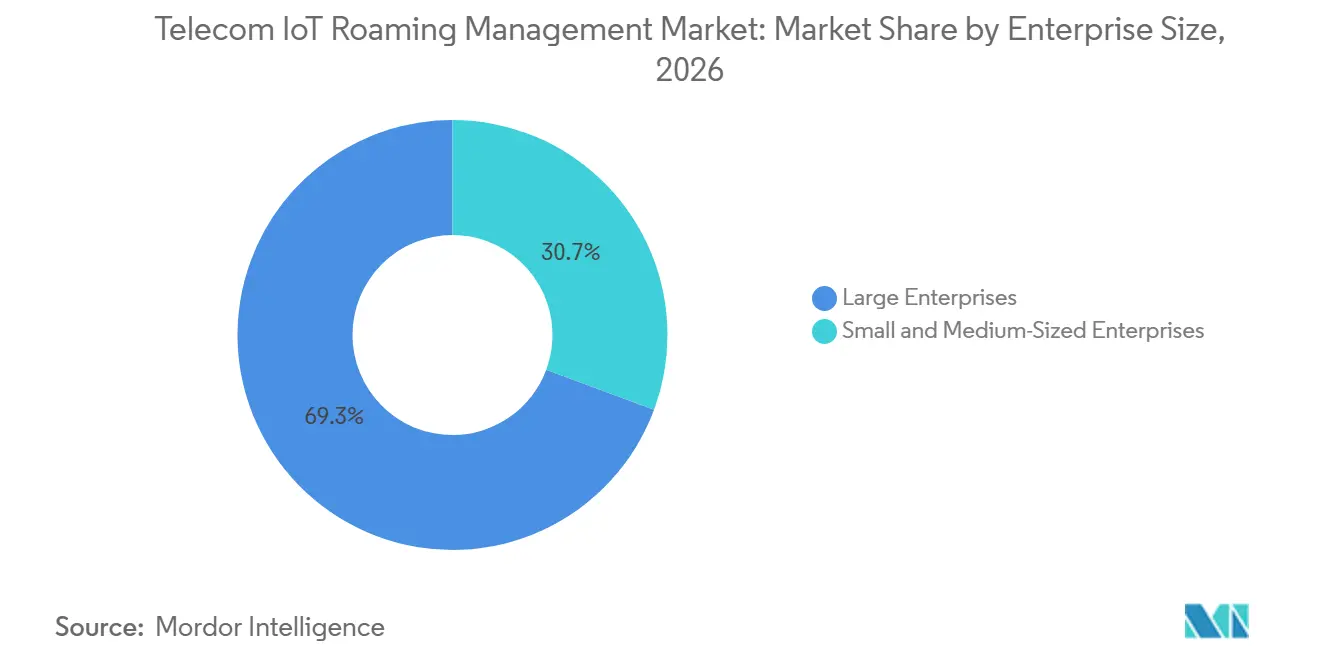
- By enterprise size, large enterprises held 69.34% of the telecom IoT roaming management market share in 2026, while small and medium-sized enterprises are projected to expand at a 14.18% CAGR through 2032.
- By application, connected vehicles and automotive telematics accounted for 30.72% of the telecom IoT roaming management market size in 2026, while the industrial automation and manufacturing is projected to expand at a 14.46% CAGR through 2032.
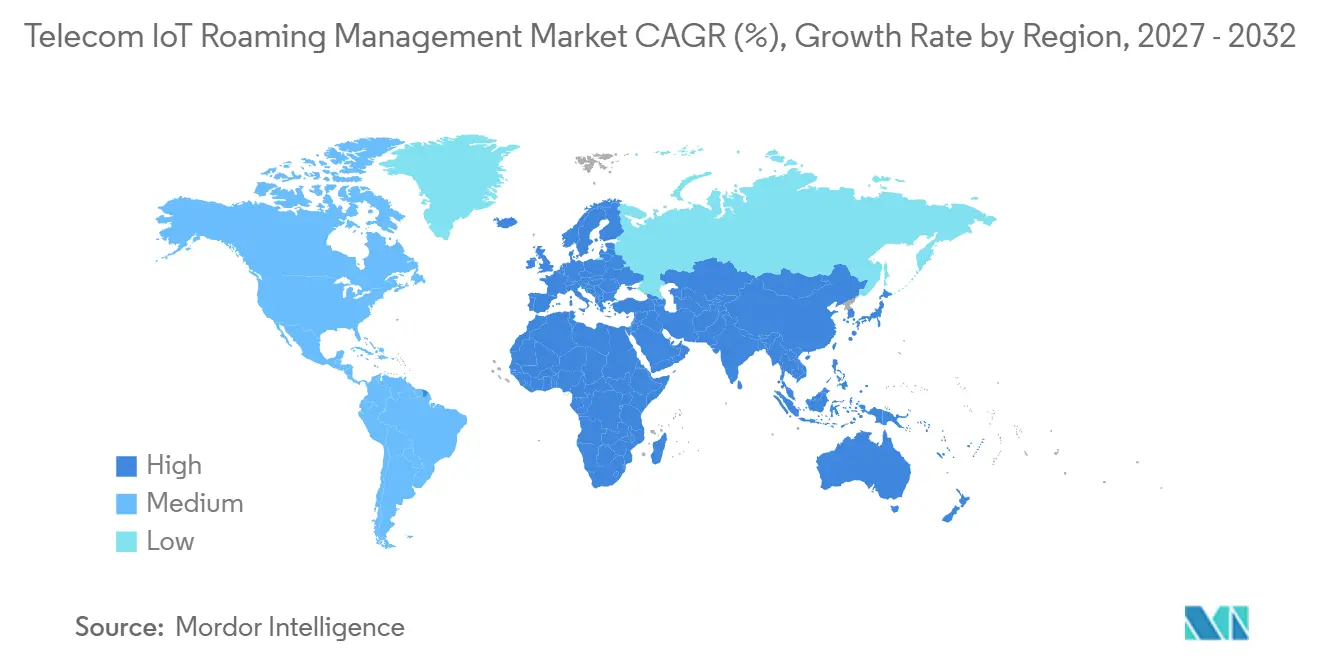
- By geography, Europe held 34.28% of the telecom IoT roaming management market share in 2026, while Asia-Pacific is projected to expand at a 14.49% CAGR through 2032.
Note: Market numbers in this report are based on Mordor Intelligence's proprietary estimation framework, which combines nine months of actuals with Q4 projections for base year 2026.
Market Trends and Insights
Drivers Impact Analysis of Telecom IoT Roaming Management Market*
| Driver | (~) % Impact on CAGR Forecast | Geographic Relevance | Impact Timeline |
|---|---|---|---|
| Global Expansion of Connected Fleets Across Borders | +2.5% | Global, with peaks in North America, Europe, and China | Medium term (2-4 years) |
| Adoption of eSIM and Remote SIM Provisioning for IoT | +2.2% | Global, with early gains in North America and Western Europe | Medium term (2-4 years) |
| Growth of 5G, LTE-M and NB-IoT Roaming | +2.0% | Asia-Pacific core, with spillover to North America and Europe | Long term (≥ 4 years) |
| Enterprise Demand for Unified Multi-Carrier Visibility and Automation | +1.8% | North America and Europe, with increasing Asia-Pacific adoption | Short term (≤ 2 years) |
| BCE-Enabled Monetization of Low-ARPU IoT Traffic | +1.5% | Global, with early gains in Europe and North America | Medium term (2-4 years) |
| Cellular-Satellite Roaming for Remote and Mobile Assets | +1.2% | Global, with strategic relevance in Middle East and Africa and Asia-Pacific remote areas | Long term (≥ 4 years) |
| Source: Mordor Intelligence | |||
Global Expansion of Connected Fleets Across Borders
Cross-border fleet connectivity remains a central driver for the telecom IoT roaming management market. Automotive manufacturers deploy the same vehicle platforms in many countries and need connectivity that works across network changes, local regulations, and operator agreements throughout a vehicle's life cycle, which can exceed a decade. The GSMA Open Gateway automotive report notes that manufacturers need remote provisioning, subscription management, and eSIM profile changes without modifying vehicle hardware.[1] Aeris supported more than 41 million connected vehicles across 190 countries on its IoT platform, showing the operational scale of fleet connectivity programs. Over-the-air vehicle software updates can create substantial roaming data costs when deployed across large fleets, especially when updates run to several gigabytes per cycle. Enterprises, therefore, need wholesale agreements, cost controls, and traffic analysis that provide more value than basic device monitoring.
Adoption of eSIM and Remote SIM Provisioning for IoT
Commercial use of the GSMA SGP.32 specification is changing how enterprises manage IoT roaming. It allows operator profiles to be changed over the air without replacing a physical SIM, giving enterprises more flexibility when they operate across countries and reducing dependence on a single operator relationship. Trusted Connectivity Alliance members estimated global eSIM shipments at 605 million units in 2025, up 18% from the previous year.[2] In September 2025, Tata Communications and Cisco combined Tata Communications MOVE with Cisco IoT Control Center to address fragmented SIM hardware and provisioning, as well as multi-network interoperability.[3] This arrangement covered 350+ million eSIM-enabled operating systems across 200+ countries, while Cisco IoT Control Center supported more than 270 million SIM-enabled IoT devices. The telecom IoT roaming management market benefits as enterprises seek tools that can manage profiles, local compliance, and operator changes through a single platform.
Growth of 5G, LTE-M, and NB-IoT Roaming
The expansion of 5G, LTE-M, and NB-IoT roaming supports the telecom IoT roaming management market by increasing the number of technologies that operators must manage across borders. LTE-M and NB-IoT remain important for metering and industrial uses, but national coverage and operator availability are uneven, requiring platforms that can switch between available connection options. The GSMA mobile IoT deployment guidelines identify predictable behavior across networks and roaming locations as a core requirement for interoperable IoT services. Research presented at IEEE IECON 2025 showed continuous low-latency streaming of up to 25 Mbit/s in industrial roaming scenarios. Billing and Charging Evolution extends settlement to NB-IoT and LTE-M traffic, enabling operators to use access-based charging for low-throughput connections rather than a billing approach primarily designed for larger data sessions. Syniverse became the first Billing and Charging Evolution agent to comply with GSMA BCE 2.0 in March 2026, signaling readiness for 5G standalone, low-power IoT, satellite, and non-terrestrial charging models.[4]
Enterprise Demand for Unified Multi-Carrier Visibility and Automation
Enterprises increasingly use multiple mobile network operators across regions, making separate carrier portals difficult to manage. They require centralized views of SIM inventory, data use, policies, and routing decisions, with the ability to apply these controls across different operator relationships. Mobileum presented its Roaming Exposure Function at MWC Barcelona in March 2026 as a policy-driven API for real-time roaming intelligence, fraud mitigation, IoT life-cycle management, and analytics. This capability helps enterprises monitor which networks their devices use, where those connections occur, and whether policies are being followed. It is particularly relevant to healthcare, energy, and financial services organizations that require auditable records to meet data residency and compliance obligations. As these requirements become more widespread, unified management tools can remain important even when device connection volumes vary.
Restraints Impact Analysis of Telecom IoT Roaming Management Market*
| Restraint | (~) % Impact on CAGR Forecast | Geographic Relevance | Impact Timeline |
|---|---|---|---|
| Permanent-Roaming Restrictions and Locality Requirements | -2.8% | Brazil, China, India, Türkiye, Nigeria, and Singapore, with increasing global concern | Medium term (2-4 years) |
| Legacy Network Sunsetting and Device Replacement Complexity | -2.0% | Global, with the highest near-term exposure in Europe and North America | Short term (≤ 2 years) |
| Fragmented Wholesale Charging, Settlement and Data Policies | -1.5% | Global, with the greatest effect on cross-regional deployments in Asia-Pacific and Middle East and Africa | Medium term (2-4 years) |
| Low-Usage IoT Traffic Compressing Roaming Economics | -1.2% | Global | Long term (≥ 4 years) |
| Source: Mordor Intelligence | |||
Permanent-Roaming Restrictions and Locality Requirements
Permanent-roaming restrictions are a major regulatory constraint on the telecom IoT roaming management market. Brazil reinforced its prohibition in 2025, while Türkiye required eSIM provisioning to flow through Turkish operators and blocked dozens of international eSIM providers. China, India, Singapore, Saudi Arabia, and the United Arab Emirates also apply licensing or operator-of-record requirements that can effectively restrict permanent roaming. These rules require enterprises to manage local SIMs or eUICC profiles in individual countries, adding operational work and procurement complexity. This burden is significant for global deployments that were designed around a single connectivity model and can weaken the economic case for international rollouts. The restrictions also increase demand for platforms that can deliver local profiles, coordinate licensed partners, and retain a complete record of compliance activity.
Legacy Network Sunsetting and Device Replacement Complexity
The shutdown of 2G and 3G networks is forcing many IoT users to replace devices that depend on legacy technologies. Transition plans differ between operators, which can leave multi-network deployments managing several migration schedules at once, even within a single country. The GSMA has identified smart metering, logistics, and security applications as especially exposed because continuous service may be legally or contractually required. Device replacement becomes more difficult in markets that restrict permanent roaming because a local licensed SIM may be required. In some cases, the change may require a physical site visit rather than remote reprovisioning, particularly when equipment is installed in remote or regulated locations. This situation supports demand for platforms that can manage legacy and newer technologies during a longer transition period.
*Our forecasts treat driver/restraint impacts as directional, not additive. The impact forecasts reflect baseline growth, mix effects, and variable interactions.
Telecom IoT Roaming Management Market Segment Analysis
By Offering:
IPX Infrastructure Leads While Analytics AdvancesRoaming Hubbing and IPX Services held 38.46% of the telecom IoT roaming management market share in 2026. IPX infrastructure enables operators to route IoT and consumer roaming traffic via multilateral interconnect agreements rather than maintaining numerous bilateral arrangements. The service layer remains important because operators need dependable signaling, clearing, and traffic-routing relationships as they add new roaming partners in the telecom IoT roaming management market. Connectivity Management Platforms serve enterprises by centralizing SIM life-cycle management, policy enforcement, and multi-carrier control. These platforms are important for fleets that operate across multiple operators and jurisdictions.
Roaming Analytics and Quality Management is projected to expand at a 14.37% CAGR from 2027 to 2032. Operators need timely, high-quality, and accurate traffic information to improve steering decisions, reduce revenue leakage, and protect the user experience. Cellusys and Arelion announced a hosted roaming services partnership in October 2025 that combined roaming value-added services with Arelion's global IPX and backbone. Roaming Steering and Policy Management are becoming more relevant because 5G standalone signaling requires methods that differ from those in earlier 4G approaches. The GSMA eSIM compliance framework is also becoming an important procurement consideration for operators selecting hubbing and analytics suppliers.

By Deployment Mode:
Cloud-Based Systems Lead While Hybrid Adoption AcceleratesCloud-Based deployment accounted for 57.82% of the telecom IoT roaming management market share in 2026. Software-as-a-service connectivity platforms have reduced entry barriers for new users and smaller enterprises. They support centralized billing, analytics, and orchestration without requiring every user to operate an extensive on-site platform. floLIVE deployed its global IoT services on Oracle Cloud Infrastructure in June 2025 alongside its existing AWS integration. The company positioned the multi-cloud model around connectivity assurance, security, and data residency needs.
Hybrid deployment is projected to expand at a 14.21% CAGR from 2027 to 2032. Enterprises and operators use hybrid designs to combine cloud scalability with control over sensitive routing and data processes. This model can keep real-time policy enforcement and signaling closer to the network edge while placing billing, analytics, and orchestration in cloud environments for the telecom IoT roaming management market. It is relevant to healthcare, utilities, and government-linked programs that face strong data sovereignty requirements. On-Premises systems continue to serve large operators and organizations for which latency, data residency, or internal control limits a complete move to the cloud.
By Enterprise Size:
Large Enterprises Lead While SMEs Gain AccessLarge Enterprises held 69.34% of the telecom IoT roaming management market share in 2026. Their multi-country IoT estates can include automotive production, international logistics, and utility infrastructure. The scale of these deployments can justify dedicated connectivity platforms, IPX agreements, and sophisticated roaming analytics. Large organizations also need governance tools that coordinate device policies across national markets. Their demand in the telecom IoT roaming management market, therefore, remains tied to the operational complexity of cross-border fleets rather than device volume alone.
Small and Medium-Sized Enterprises are projected to expand at a 14.18% CAGR from 2027 to 2032. Flat-rate and easier-to-use connectivity platforms are reducing commercial and technical barriers for smaller organizations. In January 2026, 1NCE reported more than 40 million managed endpoints across 30,000 customers in 17 industries after adding 10 million endpoints in 1 year. Mobileum and NOHOLD also allied in September 2025 to offer white-labeled AI assistants for telecom operators serving small and medium-sized enterprise customers. Managed service models can help operators reach smaller customers without requiring enterprise-scale procurement processes.
By Application:
Automotive Telematics Leads While Industrial Automation ExpandsConnected Vehicles and Automotive Telematics accounted for 30.72% of the telecom IoT roaming management market size in 2026. Global vehicle programs require persistent connectivity across country borders for navigation, safety services, diagnostics, and software updates. These requirements create a substantial need for profile control, roaming cost management, and network quality monitoring. Transportation, logistics, and fleet tracking are also significant applications because assets move across regional trade corridors and international shipping routes. Cellular connectivity serves as an important fallback for many logistics operations when assets reach the ground segment.
Industrial Automation and Manufacturing is projected to expand at a 14.46% CAGR from 2027 to 2032. Demand is linked to private 5G, mobile industrial equipment, and reliable movement between private and public networks. Private 5G and Industry 4.0 installations require reliable movement between private and public networks for mobile robots, automated guided vehicles, and sensors. IEEE research on industrial roaming demonstrated continuous low-latency streaming at up to 25 Mbit/s, supporting the technical feasibility of latency-sensitive industrial applications. Utilities, Smart Metering, and Energy depend on predictable NB-IoT and LTE-M behavior over long device replacement cycles. Healthcare and Remote Patient Monitoring also require auditable routing and storage controls for patient data, which makes network-path records important for governance.
Geography Analysis
Europe Telecom IoT Roaming Management Market
Europe held 34.28% of the telecom IoT roaming management market share in 2026. The region benefits from a favorable environment for machine-to-machine roaming, with 28 of 31 European markets permitting permanent M2M roaming. Germany, the United Kingdom, and France support demand through automotive production, cross-border logistics, and smart-energy infrastructure. The European Union Cyber Resilience Act and Data Act increase requirements around IoT security and data flows. Vodafone IoT expanded its in-car connectivity service to Slovakia in 2026, bringing coverage to 33 markets and seamless roaming across more than 40 European countries.
APAC Telecom IoT Roaming Management Market
Asia-Pacific is projected to expand at a 14.49% CAGR from 2027 to 2032. China has a large NB-IoT deployment base, while South Korea is an early 5G standalone industrial market, and India is expanding manufacturing and connected-vehicle activity. China prohibits permanent roaming, and India's requirements for licensed M2M providers increase the value of local profile delivery and locally licensed platform capabilities. Australia, Japan, New Zealand, and South Korea permit roaming-based models under certain conditions, in contrast to the restrictions in China and India. This fragmented regulatory environment increases the need for managed roaming tools in the telecom IoT roaming management market capable of applying country-specific policies.
The Americas and MEA Telecom IoT Roaming Management Market
North America is the second-largest geography in the telecom IoT roaming management market. It is supported by connected vehicle programs, logistics deployments, and platform vendors such as Syniverse, Aeris, and KORE. The United States and Canada do not impose legal permanent roaming bans, which allow roaming-based models to operate without SIM localization requirements. Brazil's restriction, reinforced in 2025, has created demand in South America for local SIM provisioning and eSIM local-profile solutions, while increased oversight in the Middle East and longer-term smart-utility opportunities in Africa broaden the need for localized management capabilities.
Competitive Landscape
The telecom IoT roaming management market is moderately concentrated in wholesale roaming, where Syniverse Technologies, BICS SA, and Comfone AG hold significant positions due to their operator networks, IPX infrastructure, and financial clearing capabilities. Syniverse reported that its Universal Commerce platform was used by 90% of Billing and Charging Evolution-compliant operators globally. In March 2026, Syniverse and BICS partnered to integrate their 5G Signaling Hub platforms and establish Security Edge Protection Proxy peering. The partnership was designed to make 5G standalone roaming relationships easier for connected operators to establish.
The connectivity management layer of the telecom IoT roaming management market is more fragmented. floLIVE, 1NCE, Aeris Communications, KORE, Telit Cinterion, and Transatel compete through platform scale, multi-carrier support, SGP.32 readiness, and specialized features. Mobileum and Cellusys compete in roaming intelligence and fraud detection. Mobileum's Roaming Exposure Function provides a policy-driven API for real-time roaming intelligence, offering a distinct approach compared to conventional steering tools. The API model supports fraud, analytics, and IoT life-cycle applications that operators may not be able to build internally.
Cellular-satellite connectivity is becoming a relevant area of competition in the telecom IoT roaming management market. Deutsche Telekom launched a multi-orbit IoT roaming service in February 2026 that linked its NB-IoT and LTE-M networks with GEO satellites from Skylo and low Earth orbit services from Sateliot and OQ Technology. GSMA BCE TD.202 V5.0 supports the settlement framework for satellite-terrestrial roaming architectures. Suppliers that can support satellite charging models may be better prepared for emerging use cases in non-terrestrial networks. Providers that remain dependent on TAP clearing and lack mature 5G standalone or SGP.32 capabilities could be less competitive as procurement priorities shift.
Telecom IoT Roaming Management Industry Leaders
-
BICS SA
-
Comfone AG
-
Mobileum, Inc.
-
Syniverse Technologies, LLC
-
Tata Communications Limited
- *Disclaimer: Major Players sorted in no particular order
Telecom IoT Roaming Management Market Companies Covered in this Report
- BICS SA
- Comfone AG
- Mobileum, Inc.
- Syniverse Technologies, LLC
- Tata Communications Limited
- Telefonica Global Solutions, S.L.U.
- Telna Mobile, Inc.
- Cellusys Limited
- A1 Telekom Austria Group
- Vodafone Group Plc
- Deutsche Telekom AG
- Orange S.A.
- Tele2 AB
- Telenor ASA
- KORE Group Holdings, Inc.
- floLIVE Ltd.
- 1NCE GmbH
- Telit Communications Limited (Telit Cinterion)
- Transatel SA
- Aeris Communications, Inc.
Recent Industry Developments in Telecom IoT Roaming Management Market
- March 2026: Syniverse Technologies and BICS SA announced a strategic partnership to integrate their respective 5G Signaling Hub platforms and establish Security Edge Protection Proxy peering arrangements. The arrangement enables MNOs connected to either hub to form 5G SA roaming relationships more quickly. BICS's connectivity infrastructure reaches over 5 billion subscribers across more than 1,000 mobile destinations worldwide. The collaboration directly addresses the operator-by-operator friction that had slowed the formation of the 5G SA roaming ecosystem. It also gives operators a clearer route to establish secure signaling relationships without duplicating hub integration work for every new roaming partner.
- March 2026: Mobileum showcased its "Signal to Value" strategy at MWC Barcelona 2026. The company demonstrated the Roaming Exposure Function, a standardized API framework that provides real-time roaming intelligence for fraud mitigation, IoT life-cycle management, and analytics use cases. It also presented Roaming DNA and AI-driven analytics for proactive network performance optimization across complex roaming environments. The demonstrations reflected the need to turn signaling and traffic data into practical decisions for operations, quality management, and security teams.
- February 2026: Mobileum enabled the launch of GSMA Industry Services' VOLTIS 5G Extension Verification Program. The program extends the existing VoLTE and IMS interoperability framework to include 5G readiness verification for international roaming. The standardized path reduces reliance on bilateral testing, accelerates the formation of 5G SA roaming partnerships, and provides operators with formal industry recognition for next-generation roaming readiness. It can reduce time spent on individual interoperability processes when operators prepare new international service relationships.
- January 2026: 1NCE reported more than 40 million managed endpoints across 30,000 customers in 17 industries after adding 10 million endpoints in 1 year. The company also launched 1NCE Insights, an AI-powered data intelligence program for IoT applications in supply chain, smart cities, and utilities. The announcement reflects increased access to global IoT connectivity management for small and medium-sized enterprise customers across several verticals. It also points to a service model that combines device management with data intelligence for customers that do not operate large internal telecom teams.
Global Telecom IoT Roaming Management Market Report Scope
The Telecom IoT Roaming Management Market Report is Segmented by Offering (Roaming Hubbing and IPX Services, Connectivity Management Platforms, Roaming Analytics and Quality Management, Roaming Steering and Policy Management, and Other Offerings), Deployment (Cloud-Based, On-Premises, and Hybrid), Enterprise Size (Large Enterprises, and Small and Medium-Sized Enterprises), Application (Connected Vehicles and Automotive Telematics, Transportation, Logistics and Fleet Tracking, Industrial Automation and Manufacturing, Utilities, Smart Metering and Energy, Healthcare and Remote Patient Monitoring, and Other Applications), and Geography (North America, South America, Europe, Asia-Pacific, Middle East, and Africa). The Market Forecasts are Provided in Terms of Value (USD).
Segmentation Overview
| Roaming Hubbing and IPX Services |
| Connectivity Management Platforms |
| Roaming Analytics and Quality Management |
| Roaming Steering and Policy Management |
| Other Offerings |
| Cloud-Based |
| On-Premises |
| Hybrid |
| Large Enterprises |
| Small and Medium-Sized Enterprises |
| Connected Vehicles and Automotive Telematics |
| Transportation, Logistics and Fleet Tracking |
| Industrial Automation and Manufacturing |
| Utilities, Smart Metering and Energy |
| Healthcare and Remote Patient Monitoring |
| Other Applications |
| North America | United States |
| Canada | |
| Mexico | |
| South America | Brazil |
| Argentina | |
| Rest of South America | |
| Europe | Germany |
| United Kingdom | |
| France | |
| Italy | |
| Spain | |
| Russia | |
| Rest of Europe | |
| Asia-Pacific | China |
| Japan | |
| South Korea | |
| India | |
| Australia | |
| Rest of Asia-Pacific | |
| Middle East | United Arab Emirates |
| Saudi Arabia | |
| Rest of Middle East | |
| Africa | South Africa |
| Nigeria | |
| Rest of Africa |
| By Offering | Roaming Hubbing and IPX Services | |
| Connectivity Management Platforms | ||
| Roaming Analytics and Quality Management | ||
| Roaming Steering and Policy Management | ||
| Other Offerings | ||
| By Deployment Mode | Cloud-Based | |
| On-Premises | ||
| Hybrid | ||
| By Enterprise Size | Large Enterprises | |
| Small and Medium-Sized Enterprises | ||
| By Application | Connected Vehicles and Automotive Telematics | |
| Transportation, Logistics and Fleet Tracking | ||
| Industrial Automation and Manufacturing | ||
| Utilities, Smart Metering and Energy | ||
| Healthcare and Remote Patient Monitoring | ||
| Other Applications | ||
| By Geography | North America | United States |
| Canada | ||
| Mexico | ||
| South America | Brazil | |
| Argentina | ||
| Rest of South America | ||
| Europe | Germany | |
| United Kingdom | ||
| France | ||
| Italy | ||
| Spain | ||
| Russia | ||
| Rest of Europe | ||
| Asia-Pacific | China | |
| Japan | ||
| South Korea | ||
| India | ||
| Australia | ||
| Rest of Asia-Pacific | ||
| Middle East | United Arab Emirates | |
| Saudi Arabia | ||
| Rest of Middle East | ||
| Africa | South Africa | |
| Nigeria | ||
| Rest of Africa | ||
Key Questions Answered in the Report
What is the size of the Telecom IoT Roaming Management Market?
The Telecom IoT Roaming Management Market is projected to increase from USD 1.57 billion in 2026 to USD 3.34 billion by 2032, at a 12.66% CAGR from 2027 to 2032. Cross-border connected devices and stronger demand for policy, settlement, and profile management support this outlook.
What is driving demand for telecom IoT roaming management?
Demand is supported by cross-border connected fleets, eSIM provisioning, multi-carrier visibility, and the expansion of 5G, LTE-M, and NB-IoT roaming. These needs become more important when enterprises operate devices across different operators and national regulations.
Which offering has the largest share in telecom IoT roaming management?
Roaming Hubbing and IPX Services held the largest offering share at 38.46% in 2026. The segment supports multilateral operator relationships for signaling and traffic routing.
Which application is expanding fastest through 2032?
Industrial Automation and Manufacturing is projected to expand at a 14.46% CAGR from 2027 to 2032. Demand is linked to private 5G, mobile industrial equipment, and reliable movement between private and public networks.
Which region leads telecom IoT roaming management?
Europe held 34.28% share in 2026, while Asia-Pacific is projected to expand at a 14.49% CAGR through 2032. Europe's permissive machine-to-machine roaming setting contrasts with more complex rules across several Asia-Pacific countries.
How do permanent-roaming restrictions affect global IoT deployments?
Restrictions can require local SIMs or eUICC profiles, increasing operating complexity and creating demand for local profile management and licensed partner capabilities. They can also make remote technology upgrades harder when deployments depend on local licensing arrangements.