
Telecom Identity-as-a-Service Market Size and Share
Market Overview
| Study Period | 2020 - 2031 |
|---|---|
| Market Size (2026) | USD 2.84 Billion |
| Market Size (2031) | USD 6.89 Billion |
| Growth Rate (2026 - 2031) | 19.39 % |
| Fastest Growing Market | Asia-Pacific |
| Largest Market | North America |
| Market Concentration | Medium |
Major Players *Disclaimer: Major Players sorted in no particular order Image © Mordor Intelligence. Reuse requires attribution under CC BY 4.0. | |
Telecom Identity-as-a-Service Market Analysis by Mordor Intelligence
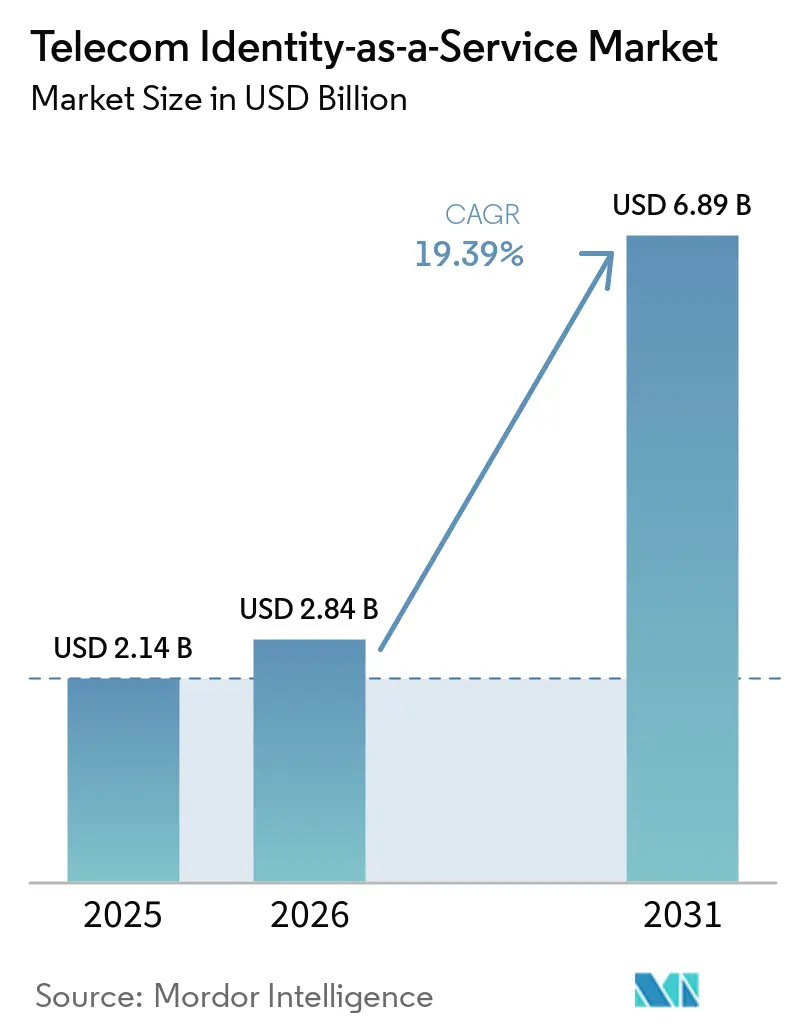
The Telecom Identity-as-a-Service Market size is projected to expand from USD 2.14 billion in 2025 and USD 2.84 billion in 2026 to USD 6.89 billion by 2031, registering a CAGR of 19.39% between 2026 to 2031. The Telecom Identity-as-a-Service Market is being shaped by higher exposure to SIM-swap fraud, account takeover, and identity misuse across digital services. Regulatory measures are also moving organizations away from shared-secret authentication and toward verified digital identity methods. Carrier-grade application programming interfaces are making number verification, SIM-swap detection, and identity checks available through a simpler integration model. The Telecom Identity-as-a-Service Market, therefore, provides operators and service providers with a way to leverage network signals in enterprise authentication workflows. Competition centers on API coverage, interoperability, consent management, and support for cross-country identity checks.
Key Report Takeaways
- By component, solutions accounted for 71.23% of the Telecom Identity-as-a-Service Market share in 2025, while services are projected to expand at a 21.61% CAGR through 2031.
- By deployment, cloud accounted for 82.36% of revenue share in the Telecom Identity-as-a-Service Market 2025 and is projected to expand at a 21.73% CAGR through 2031.
- By authentication type, number verification API held 29.18% revenue share in 2025, while silent network authentication is projected to expand at a 21.87% CAGR through 2031.
- By end user, enterprises held 61.34% Telecom Identity-as-a-Service Market revenue share in 2025, while over-the-top service providers are projected to expand at a 21.81% CAGR through 2031.
- By industry vertical, financial services held 41.16% revenue share in 2025, while healthcare is projected to expand at a 21.69% CAGR through 2031.
- By geography, North America held 33.12% revenue share in 2025, while Asia-Pacific is projected to expand at a 21.71% CAGR through 2031.
Note: Market size and forecast figures in this report are generated using Mordor Intelligence’s proprietary estimation framework, updated with the latest available data and insights as of January 2026.
Market Trends and Insights
Drivers Impact Analysis of Telecom Identity-as-a-Service Market*
| Driver | (~) % Impact on CAGR Forecast | Geographic Relevance | Impact Timeline |
|---|---|---|---|
| Rising SIM-Swap and Account-Takeover Fraud | +4.8% | Global, with highest incidence in North America, the United Kingdom, and South Africa | Short term (≤ 2 years) |
| Strong Customer Authentication and Digital-Identity Regulation | +4.1% | Europe, Asia-Pacific, and North America | Short term (≤ 2 years) |
| Expansion of MNO Identity and Network APIs | +3.5% | North America and Europe, with scaling in Asia-Pacific and the Middle East | Medium term (2-4 years) |
| Cloud Migration Across Telecom Operations | +2.8% | Global, with Asia-Pacific and North America leading adoption | Medium term (2-4 years) |
| Consent-Based Network Signals for Passwordless Authentication | +2.2% | Asia-Pacific and Europe | Medium term (2-4 years) |
| AI Agent and IoT Identity Provisioning Requirements | +1.6% | Global, with North America and East Asia leading deployment | Long term (≥ 4 years) |
| Source: Mordor Intelligence | |||
Rising SIM-Swap and Account-Takeover Fraud
Unauthorized SIM-swap cases rose 402% in the first half of 2026 compared with the same period in 2025, according to Cifas.[1] The increase points to the wider use of organized, automated SIM-porting methods rather than isolated phishing attempts. SMS one-time passwords depend on the assumption that a mobile number remains tied to the intended user. That assumption weakens when a fraudster can obtain control of a reassigned or ported SIM. This exposure is making carrier-verified possession checks more relevant to banks, retailers, and digital platforms in the Telecom Identity-as-a-Service Market. It also makes verification at account recovery and high-value transactions more important for organizations that still use SMS as their primary authentication step.
Strong Customer Authentication and Digital-Identity Regulation
Regulation is increasing the need for authentication that does not rely solely on knowledge-based credentials. Regulation (EU) 2024/1183 required every EU member state to provide at least 1 European Digital Identity Wallet by December 6, 2026.[2] The framework also establishes obligations for regulated relying parties to accept the wallet within its implementation timetable. These rules give financial institutions, telecommunications providers, and digital services a clearer reason to modernize identity flows. The Telecom Identity-as-a-Service Market can support this transition when carrier signals complement wallet-based or other strong authentication methods. NHS England’s DAPB3051 standard also required full conformance with digital health identity standards by December 31, 2026, reinforcing the importance of verified patient access controls.[3]
Expansion of MNO Identity and Network APIs
Mobile network operators are turning subscriber-related signals into enterprise-facing network APIs. GSMA Open Gateway covered more than 79 operator groups, 291 networks, and nearly 80% of global mobile connections in 2025. CAMARA standards allow enterprises to access functions such as number verification, SIM-swap detection, and KYC match without negotiating separately with every operator.[4] In the United Kingdom, BT and EE, CK Hutchison Group Telecom, Virgin Media O2, and Vodafone launched KYC age-verification and KYC tenure APIs in September 2025. The Telecom Identity-as-a-Service Market benefits when common specifications reduce integration work and improve cross-network availability. Aggregators can still differentiate through orchestration, risk scoring, consent controls, developer tools, and support for enterprise workflows.
Cloud Migration Across Telecom Operations
Cloud migration is changing how telecom operators organize identity and access management across networks and applications. ITU-T Recommendation M.3411, approved in March 2025, sets requirements for user identity and access management in telecommunication management networks. This framework is relevant as operators place network functions and operational systems in cloud environments. Cloud-native identity services can replace separate identity controls at individual sites and make policy management more consistent. The Telecom Identity-as-a-Service Market also gains when enterprises opt for software-delivered verification rather than direct on-premises connections to carrier systems. This change enables faster deployment, although regulated users may still retain hybrid designs to maintain data residency and operational continuity.
Restraints Impact Analysis of Telecom Identity-as-a-Service Market*
| Restraint | (~) % Impact on CAGR Forecast | Geographic Relevance | Impact Timeline |
|---|---|---|---|
| Privacy Restrictions on Centralized Subscriber Data | -2.3% | Europe and markets with expanding privacy law | Short term (≤ 2 years) |
| Fragmented Cross-Border KYC and Identity Standards | -1.8% | Global, with high friction in EU-Asia-Pacific and Americas-Africa corridors | Medium term (2-4 years) |
| MNO and Aggregator Revenue-Sharing Complexity | -1.2% | Global, with high complexity in multi-MNO markets across Europe and Asia-Pacific | Medium term (2-4 years) |
| SIM Recycling and Incomplete Subscriber-Data Accuracy | -0.8% | Africa, South Asia, and South America | Long term (≥ 4 years) |
| Source: Mordor Intelligence | |||
Privacy Restrictions on Centralized Subscriber Data
Telecom operators hold valuable subscriber data, but privacy law limits how that data can be reused. Connect Europe stated in its 2025 response to European Data Protection Board guidance that operators could not rely on the GDPR’s compatibility provisions for traffic and location data under the current ePrivacy framework. This restricts the use of behavioral and location information in centralized identity models. Providers must therefore rely more heavily on defined signals such as a number match or a SIM-swap flag. Such signals can be useful, but they offer less context than a broader behavioral risk model. The Telecom Identity-as-a-Service Market must expand its use of consent-based and privacy-preserving approaches if it is to use network information more broadly.
Fragmented Cross-Border KYC and Identity Standards
Cross-border identity verification remains difficult because KYC requirements, accepted documents, and assurance levels differ between jurisdictions. The Bank for International Settlements identified fragmented KYC data systems as a core challenge in addressing fraud across payment corridors. The i3Forum issued KYC and Know Your Traffic guidelines in September 2025 to address the absence of common telecom standards. For providers, each country-specific connection can increase integration, legal, and operational work. These differences can reduce the cost advantage normally associated with an API-delivered service. They also slow multinational deployments, even when the underlying authentication method is technically similar.
*Our forecasts treat driver/restraint impacts as directional, not additive. The impact forecasts reflect baseline growth, mix effects, and variable interactions.
Telecom Identity-as-a-Service Market Segment Analysis
By Component:
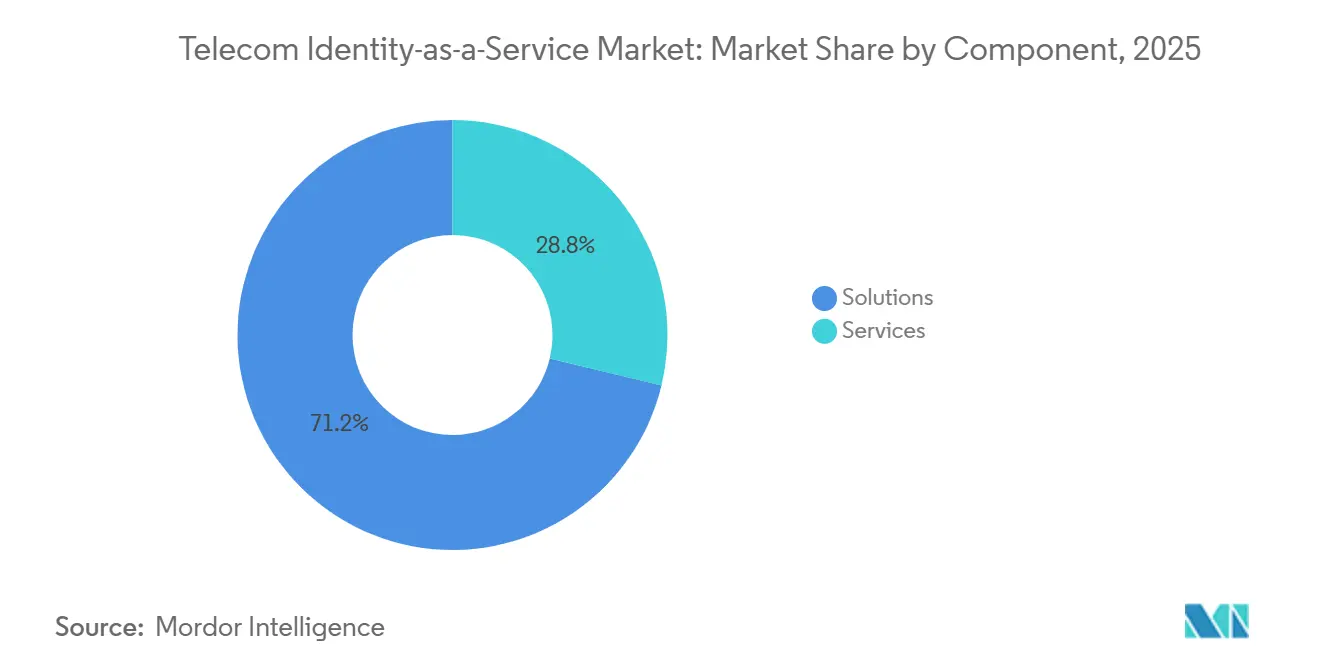
Solutions Lead Revenue While Services Gain ImportanceSolutions held 71.23% of revenue in 2025, making them the largest component of the Telecom Identity-as-a-Service Market. This category includes number-verification APIs, SIM-swap detection, digital-identity APIs, and silent network authentication products. Enterprises often choose these pre-integrated products because they can introduce carrier-based checks without building individual relationships with operators. A packaged solution also combines API access with workflow controls that can be deployed within existing fraud and customer-access systems. GSMA Open Gateway standardization is narrowing differences in basic API access. As a result, providers are placing greater value on orchestration, risk scoring, consent management, and reporting capabilities related to the network signal.
Services are projected to expand at a 21.61% CAGR from 2026 to 2031. This reflects growing demand for implementation support, carrier relationship management, regulatory advice, and continuous fraud monitoring. Enterprise identity environments often combine several authentication methods, which raises the importance of design and configuration work. Services can help organizations align carrier signals with internal fraud controls, customer-experience requirements, and country-specific compliance obligations. The rise of AI agents also creates a need to design trust controls for nonhuman actors. Prove launched its identity platform in April 2026 to support verification of people, businesses, and AI agents within a unified environment. This requirement can support professional services as buyers test how agent permissions should be verified and monitored.
By Deployment:
Cloud Retains a Clear LeadCloud deployment accounted for 82.36% of revenue in 2025 and is projected to expand at a 21.73% CAGR through 2031. The segment’s scale indicates that many buyers prefer software-delivered identity services over dedicated infrastructure. Cloud systems allow enterprises to invoke verification and authentication functions via APIs without managing local carrier connections. They can also support high transaction volumes across several countries and customer channels. The wider adoption of cloud-native network functions and digital customer journeys drives the Telecom Identity-as-a-Service Market size for cloud delivery. ITU-T Recommendation M.3411 provides a standards-based reference for identity and access management in telecom management networks. This strengthens the case for centralized governance across distributed environments.
On-premise and hybrid deployments continue to serve users with strict data residency, security, or infrastructure requirements. Government agencies, certain financial institutions, and healthcare organizations may retain local controls for regulated data. Hybrid designs are also relevant to operators that manage older virtual network functions alongside 5G cloud-native functions. A common identity policy can cover both environments without requiring immediate replacement of legacy systems. These designs can reduce disruption during modernization, but they may require more integration work than a cloud-first approach. The Telecom Identity-as-a-Service Market continues to include these options because security and regulatory needs are not uniform across verticals. Hybrid deployment is therefore a transition path for many users rather than a universal end state.
By Authentication Type:
Number Verification Leads as Silent Authentication ExpandsNumber verification API held 29.18% of revenue in 2025, the largest share among authentication types. The technology benefits from broad carrier coverage and a relatively direct integration model. It can confirm that a mobile number is associated with a device or network connection without depending only on user-entered information. Orange reported that partner deployments that combined number verification with KYC matching reduced document fraud by 50% and improved conversion by 30% for targeted users. These outcomes show why number verification is relevant to onboarding and high-risk transaction flows. The Telecom Identity-as-a-Service Market uses this signal as a practical starting point for organizations seeking carrier-based assurance.
Silent network authentication is projected to expand at a 21.87% CAGR from 2026 to 2031, the fastest rate among authentication types. It verifies a user through network and device signals while reducing the need for SMS codes. Meta’s 2026 paper supported silent authentication APIs based on CAMARA APIs and GSMA TS.43 as a global direction for passwordless phone-number authentication. SMS-based OTPs remain in use, but they are vulnerable when a number is ported or a SIM is reassigned. Mobile biometrics and multifactor authentication tokens are often used as complementary factors, rather than complete substitutes for network signals. Digital identity verification APIs are also being used in onboarding and KYC workflows, where carrier records can reduce dependence on document checks.
By End User:
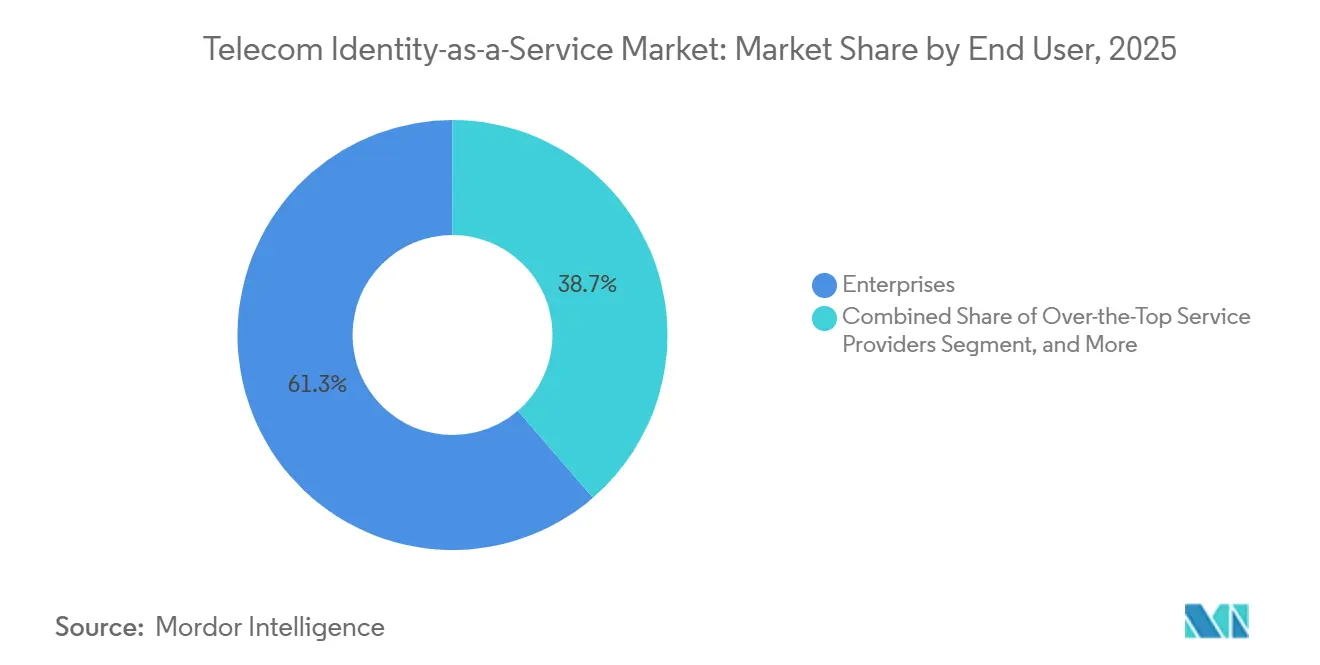
Enterprises Provide Scale While OTT Providers Grow FasterEnterprises accounted for 61.34% of revenue in 2025, reflecting their large transaction volumes and exposure to fraud and compliance risks. Financial institutions, e-commerce companies, healthcare systems, and digital brands use more than 1 authentication method within the same customer journey. Number verification can support account access, SIM-swap detection can flag elevated transaction risk, and silent authentication can reduce friction during a session. This use of several signals makes identity APIs part of broader fraud management systems. Enterprise revenue leadership also reflects the ability of larger buyers to fund integrations, internal controls, and ongoing performance monitoring. Prove stated that 19 of the 20 largest US banks used its platform, showing the relevance of carrier-signal identity in enterprise financial services.
Over-the-top service providers are projected to expand at a 21.81% CAGR from 2026 to 2031. Streaming services, super apps, social networks, and gaming platforms operate at large user volumes and face account sharing, fake accounts, and login abuse. Their earlier reliance on email and SMS code flows can create both exposure to fraud and customer drop-off. Carrier-based authentication can reduce these issues when it is available across relevant mobile networks. MNOs and mobile virtual network operators also use telecom identity tools for subscriber management and porting verification. Government agencies are becoming additional buyers as digital identity wallets and online public services require stronger identity checks. These patterns drive demand for the Telecom Identity-as-a-Service Market from both consumer-facing platforms and public service delivery.

By Industry Vertical:
Financial Services Remain Largest While Healthcare Grows FastestFinancial services held 41.16% of revenue in 2025, making it the largest vertical within the Telecom Identity-as-a-Service Market. Banks and payment providers are highly exposed to account takeover, synthetic identity fraud, and unauthorized payments. They also face strong customer authentication obligations, which makes authentication modernization a continuing priority. These organizations increasingly combine carrier signals with device intelligence and behavioral biometrics in layered fraud decisions. This approach is more resilient than depending on 1 authentication factor. The large share of financial services reflects both regulatory pressure and the high costs of fraud for customers and institutions.
Healthcare is projected to expand at a 21.69% CAGR from 2026 to 2031. Telemedicine, patient portals, and data-sharing networks require controls to verify a person's identity before sensitive information is accessed. NHS England’s identity verification and authentication standard sets a clear expectation for digital health and care services. E-commerce and retail remain major sources of demand, as post-purchase account takeover increased in the United Kingdom during the first half of 2026. Government and public-sector users are also adopting verified onboarding through national digital identity programs. Media and entertainment, travel, and hospitality are smaller users, but all are adding identity controls for subscription fraud and check-in impersonation.
Geography Analysis
North America Telecom Identity-as-a-Service Market
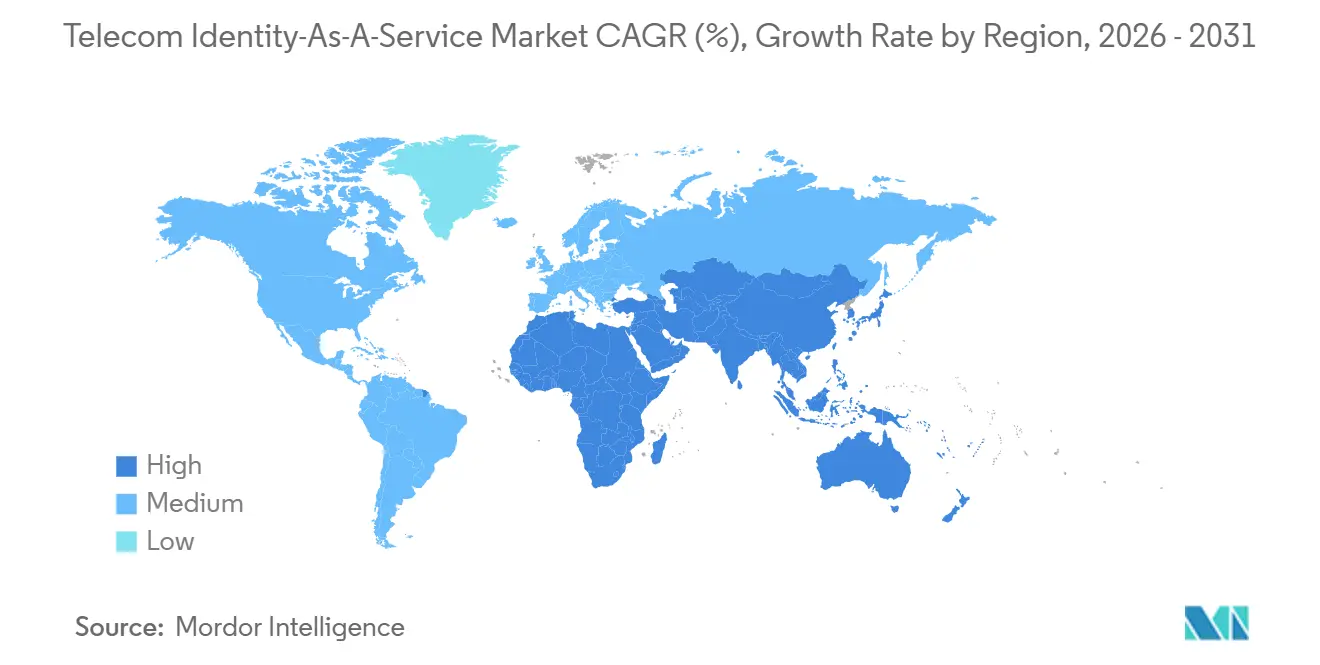
North America held 33.12% of revenue in 2025, supported by large enterprise buyers, mature mobile networks, and high fraud exposure. The United States recorded USD 15.9 billion in consumer fraud losses in 2025, which reinforced the need for stronger customer authentication. The region’s operators and aggregators are establishing network API services that can be integrated through a single enterprise connection. This makes number verification and SIM-swap detection more accessible to banks, e-commerce firms, and digital platforms. North American revenue leadership also reflects a broad base of cloud software and communications providers. Canada and Mexico are developing related use cases through financial services and government digital identity initiatives.
Europe Telecom Identity-as-a-Service Market
The implementation of digital identity and privacy rules strongly influences Europe. The European Digital Identity framework requires member states to offer at least 1 wallet by December 2026. This encourages financial institutions, operators, and online services to align authentication infrastructure with common identity requirements. United Kingdom operators launched KYC age-verification and KYC tenure APIs under GSMA Open Gateway in September 2025. Infobip received GSMA Open Gateway certifications for SIM Swap and Number Verification APIs in 2025, supporting interoperability across operator networks. The region’s privacy restrictions can limit the use of centralized subscriber data, so consent and compliance design remain central to provider strategy.
APAC, South America and MEA Telecom Identity-as-a-Service Market
Asia-Pacific is projected to expand at a 21.71% CAGR from 2026 to 2031, the fastest rate across geographic segments. The region combines large mobile-first populations, rising use of digital services, and active regulatory development. India and the United Arab Emirates introduced requirements that increase the need for stronger forms of authentication in financial services. The Telecom Identity-as-a-Service Market size in Asia-Pacific is also supported by network API deployments that can serve high-volume digital platforms. South America is an emerging demand area, particularly where network APIs are already processing high transaction volumes. Africa and the Middle East have strong long-term potential because of high mobile usage and national digital identity programs. These regions can benefit when providers adapt identity services to local operator coverage, consent rules, and enterprise technology budgets.
Competitive Landscape
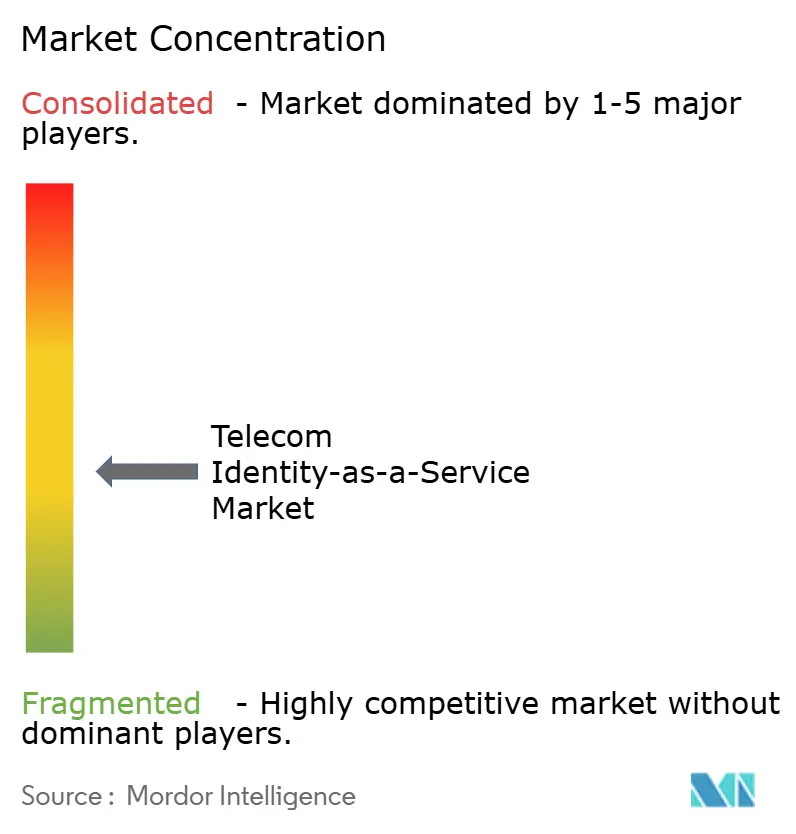
The Telecom Identity-as-a-Service Market is moderately fragmented across communications-platform aggregators, specialist carrier-signal identity providers, and secure-element vendors. Twilio, Infobip, and Sinch offer communications and developer platform capabilities. Boku, Prove Identity, and Tru.ID focuses more directly on identity and carrier-derived verification. IDEMIA, Giesecke+Devrient, and Thales bring secure-element and identity infrastructure capabilities. No company has a dominant position across authentication coverage, carrier reach, industry depth, and geography. This makes interoperability, enterprise integration, and local network access important competitive factors. The available information does not provide combined market shares for the leading providers, so the market concentration score is assessed based on the fragmented competitive structure rather than a quantified total for the top player.
Platform convergence is a defining feature of competition in the Telecom Identity-as-a-Service Market. Twilio completed its acquisition of Stytch in November 2025 to extend its authentication capabilities to AI-agent identity workflows. Infobip partnered with T-Mobile in March 2026 to integrate CAMARA Open Gateway APIs for SIM-swap detection and number verification into its omnichannel platform. GSMA certifications are becoming an important requirement for vendors seeking enterprise deployments across several operators. Standardized access can reduce the importance of proprietary connections while increasing the value of software layers that manage risk, consent, and customer experience.
Providers are also targeting areas where carrier-based identity remains less established. Healthcare identity has scope for further adoption as patient access controls tighten and digital health networks grow. SME-grade identity APIs may address buyers who cannot support large enterprise integrations. AI-agent identity is another emerging area, as organizations need to verify the authority of automated actors. Sinch launched Agent Tools in August 2026 to support AI-assisted integration of its authentication, verification, and messaging APIs. Competition is likely to depend on which providers can combine carrier signals, device data, behavioral analysis, and privacy controls in usable enterprise services.
Telecom Identity-as-a-Service Industry Leaders
-
Boku, Inc.
-
Infobip Limited
-
Telesign Corporation
-
Sinch AB
-
Twilio Inc.
- *Disclaimer: Major Players sorted in no particular order
Telecom Identity-as-a-Service Market Companies Covered in this Report
- Boku, Inc.
- Infobip Limited
- Telesign Corporation
- Sinch AB
- Twilio Inc.
- Mobileum Inc.
- Prove Identity, Inc.
- Callsign, Inc.
- 1Kosmos Inc.
- Trulioo Information Services Inc.
- Authlete, Inc.
- Tru.ID Limited
- IDEMIA France SAS
- Giesecke+Devrient Mobile Security GmbH
- Thales Digital Identity and Security France SAS
- Tyntec Group Limited
- Mitek Systems, Inc.
- Route Mobile Limited
- CM.com N.V.
- Syniverse Technologies, LLC
- GMS Global Mobile Solutions Inc.
- XConnect Global Networks Ltd
- Cloudcom Communications Corp.
- Vonage Holdings Corp.
Recent Industry Developments in Telecom Identity-as-a-Service Market
- August 2026: Sinch launched Agent Tools, a developer suite enabling AI-assisted integration of Sinch's authentication, verification, and messaging APIs through major development environments and AI coding tools, extending its carrier-grade identity capabilities to AI-driven application development pipelines.
- July 2026: Route Mobile, a Proximus Global company, partnered with Truecaller to expand its Business Messaging platform, combining Route Mobile's CPaaS infrastructure with Truecaller's verified caller identity capabilities to enable trusted, fraud-resistant enterprise-to-consumer communications at scale.
- April 2026: Prove Identity launched the Prove Identity Platform, a unified foundation for verifying people, businesses, and AI agents in real time, integrating human assurance, account opening, pre-fill, unified authentication, and an agentic suite under a single identity infrastructure trusted by 19 of the top 20 US banks.
- March 2026: Infobip partnered with T-Mobile to integrate T-Mobile's CAMARA Open Gateway network APIs into Infobip's omnichannel communications platform, enabling enterprise customers to deploy carrier-level SIM-swap detection and number verification for fraud prevention across T-Mobile's subscriber base.
Global Telecom Identity-as-a-Service Market Report Scope
The Telecom Identity-as-a-Service market refers to the ecosystem of solutions and services that leverage unique telecom network assets such as subscriber data, SIM card information, and real-time network signaling to provide secure, seamless, and scalable identity verification and authentication. This market encompasses various authentication methods, including traditional SMS-based one-time passwords, mobile biometrics, multifactor authentication tokens, and advanced network-based capabilities like silent network authentication and number verification APIs. These services are utilized by mobile network operators, over-the-top service providers, enterprises, and government agencies across industries such as financial services, e-commerce, and healthcare. By utilizing direct network intelligence, Telecom IDaaS enables organizations to enhance security, prevent identity fraud (such as SIM swap and account takeover attacks), reduce user friction during digital onboarding, and ensure regulatory compliance in an increasingly connected digital ecosystem.
The Telecom Identity-as-a-Service Market Report is Segmented by Component (Solutions and Services), Deployment (Cloud, On-Premise, and Hybrid), Authentication Type (SMS-Based One-Time Password, Mobile Biometrics, Multifactor Authentication Token, Digital Identity Verification API, Number Verification API, Silent Network Authentication, and Others), End User (Mobile Network Operators, Mobile Virtual Network Operators, Over-the-Top Service Providers, Enterprises, and Government Agencies), Industry Vertical (Financial Services, E-Commerce and Retail, Government and Public Sector, Healthcare, Media and Entertainment, Travel and Hospitality, and Others), and Geography (North America, South America, Europe, Asia-Pacific, Middle East, and Africa). The Market Forecasts are Provided in Terms of Value (USD).
Segmentation Overview
| Solutions |
| Services |
| Cloud |
| On-Premise |
| Hybrid |
| SMS-Based One-Time Password |
| Mobile Biometrics |
| Multifactor Authentication Token |
| Digital Identity Verification API |
| Number Verification API |
| Silent Network Authentication |
| Other Authentication Types |
| Mobile Network Operators |
| Mobile Virtual Network Operators |
| Over-the-Top Service Providers |
| Enterprises |
| Government Agencies |
| Financial Services |
| E-Commerce and Retail |
| Government and Public Sector |
| Healthcare |
| Media and Entertainment |
| Travel and Hospitality |
| Other Industry Verticals |
| North America | United States |
| Canada | |
| Mexico | |
| South America | Brazil |
| Argentina | |
| Chile | |
| Rest of South America | |
| Europe | Germany |
| United Kingdom | |
| France | |
| Italy | |
| Spain | |
| Rest of Europe | |
| Asia-Pacific | China |
| Japan | |
| India | |
| South Korea | |
| Australia | |
| Rest of Asia-Pacific | |
| Middle East | United Arab Emirates |
| Saudi Arabia | |
| Qatar | |
| Rest of Middle East | |
| Africa | South Africa |
| Egypt | |
| Nigeria | |
| Rest of Africa |
| By Component | Solutions | |
| Services | ||
| By Deployment | Cloud | |
| On-Premise | ||
| Hybrid | ||
| By Authentication Type | SMS-Based One-Time Password | |
| Mobile Biometrics | ||
| Multifactor Authentication Token | ||
| Digital Identity Verification API | ||
| Number Verification API | ||
| Silent Network Authentication | ||
| Other Authentication Types | ||
| By End User | Mobile Network Operators | |
| Mobile Virtual Network Operators | ||
| Over-the-Top Service Providers | ||
| Enterprises | ||
| Government Agencies | ||
| By Industry Vertical | Financial Services | |
| E-Commerce and Retail | ||
| Government and Public Sector | ||
| Healthcare | ||
| Media and Entertainment | ||
| Travel and Hospitality | ||
| Other Industry Verticals | ||
| By Geography | North America | United States |
| Canada | ||
| Mexico | ||
| South America | Brazil | |
| Argentina | ||
| Chile | ||
| Rest of South America | ||
| Europe | Germany | |
| United Kingdom | ||
| France | ||
| Italy | ||
| Spain | ||
| Rest of Europe | ||
| Asia-Pacific | China | |
| Japan | ||
| India | ||
| South Korea | ||
| Australia | ||
| Rest of Asia-Pacific | ||
| Middle East | United Arab Emirates | |
| Saudi Arabia | ||
| Qatar | ||
| Rest of Middle East | ||
| Africa | South Africa | |
| Egypt | ||
| Nigeria | ||
| Rest of Africa | ||
Key Questions Answered in the Report
What is the size of the Telecom Identity-as-a-Service Market?
The Telecom Identity-as-a-Service Market was USD 2.84 billion in 2026 and is projected to reach USD 6.89 billion by 2031, at a 19.39% CAGR. Its expansion reflects the growing need for carrier-verified authentication in digital services.
What is driving demand for telecom identity services?
SIM-swap fraud, account takeover, digital identity rules, and carrier network APIs are increasing demand for stronger authentication. The Telecom Identity-as-a-Service Market serves this need through verification signals that can be applied across account access, onboarding, and higher-risk transactions.
Which deployment model leads telecom identity adoption?
Cloud led with 82.36% revenue share in 2025 and is projected to expand at a 21.73% CAGR through 2031. Cloud delivery gives Telecom Identity-as-a-Service Market users API access without requiring separate on-premise connections to mobile network operators.
Which authentication method is growing fastest?
Silent network authentication is projected to expand at a 21.87% CAGR from 2026 to 2031 because it can reduce reliance on SMS codes. It uses network and device signals to support a lower-friction customer journey.
Which end users are adopting telecom identity services?
Enterprises led with 61.34% revenue share in 2025, while over-the-top service providers are projected to expand at a 21.81% CAGR through 2031. The Telecom Identity-as-a-Service Market supports both groups as they manage user scale, fraud exposure, and customer-access controls.
Which region is expanding fastest?
Asia-Pacific is projected to expand at a 21.71% CAGR from 2026 to 2031, supported by digital service growth and stronger authentication requirements. Regulatory development and mobile-first service use are also strengthening regional demand.