
Telecom Fraud Intelligence Platforms Market Size and Share
Market Overview
| Study Period | 2020 - 2031 |
|---|---|
| Market Size (2026) | USD 1.44 Billion |
| Market Size (2031) | USD 2.87 Billion |
| Growth Rate (2026 - 2031) | 14.79 % |
| Fastest Growing Market | Asia-Pacific |
| Largest Market | North America |
| Market Concentration | Low |
Major Players *Disclaimer: Major Players sorted in no particular order Image © Mordor Intelligence. Reuse requires attribution under CC BY 4.0. | |
Telecom Fraud Intelligence Platforms Market Analysis by Mordor Intelligence
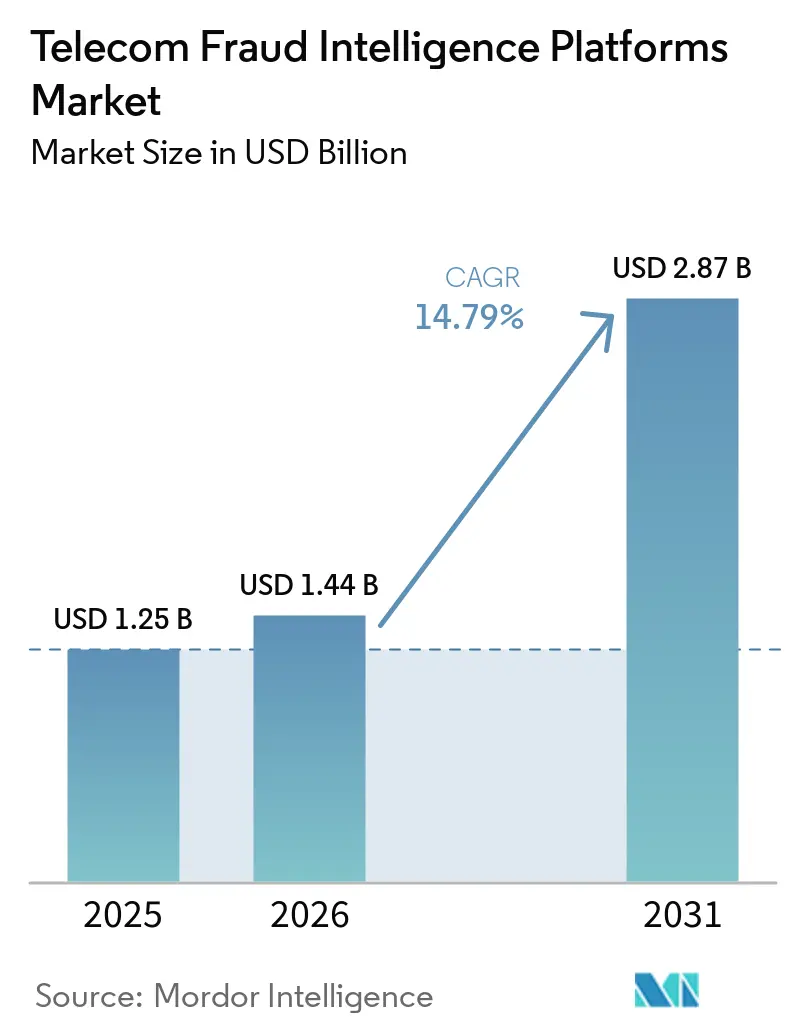
The Telecom Fraud Intelligence Platforms Market size is projected to expand from USD 1.25 billion in 2025 to USD 1.44 billion in 2026, and to USD 2.87 billion by 2031, registering a CAGR of 14.79% between 2026 and 2031. Global telecom fraud losses reached USD 41.82 billion in 2025, up from USD 38.95 billion in 2023, strengthening the case for fraud platforms as revenue-protection infrastructure. Subscription fraud resulted in USD 5.31 billion in losses during 2025, and account takeover resulted in USD 4.73 billion in losses. 5G standalone networks, IoT connections, and cloud-native functions expanded the signaling attack surface beyond the reach of legacy rule-based firewalls. Operators are therefore prioritizing platforms that combine network, billing, and subscriber data in real time. The Telecom Fraud Intelligence Platforms Market is also shaped by privacy requirements, legacy data silos, and fraud groups that are adopting AI tools.
Key Report Takeaways
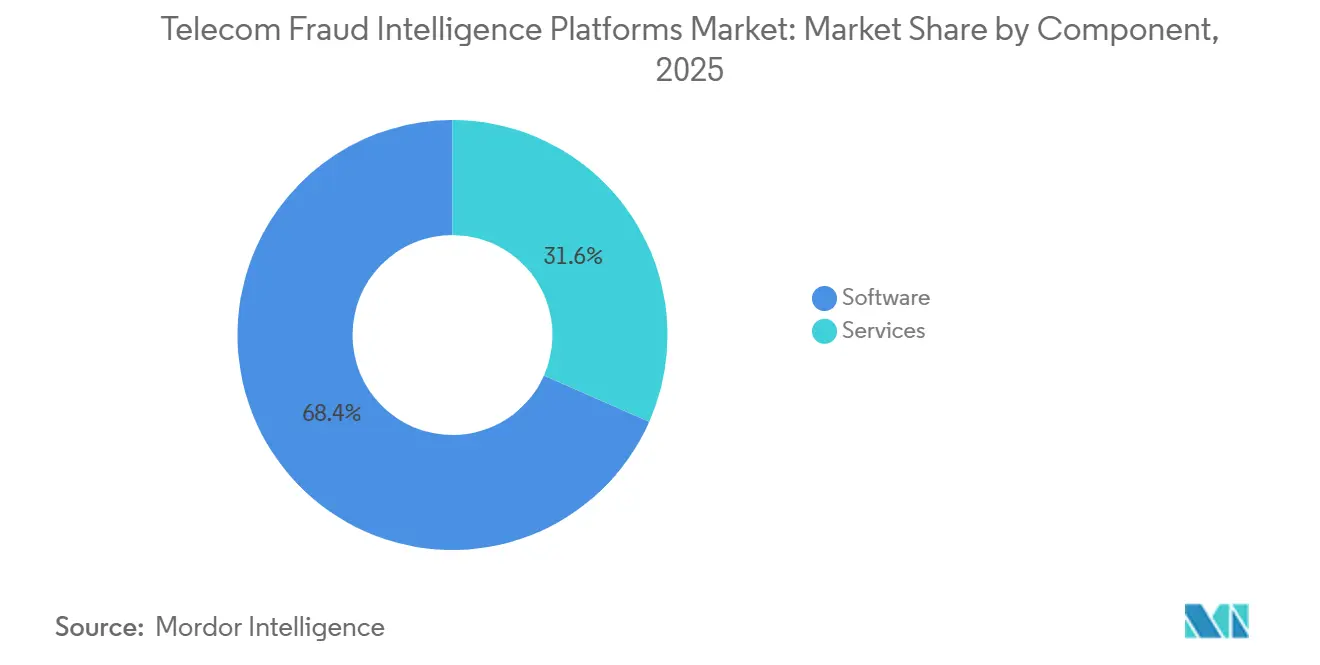
- By component, software held 68.38% of the Telecom Fraud Intelligence Platforms Market share in 2025, while services are projected to expand at a 15.68% CAGR through 2031.
- By deployment mode, cloud held 58.14% of the Telecom Fraud Intelligence Platforms Market share in 2025, while hybrid is projected to expand at a 16.32% CAGR through 2031.
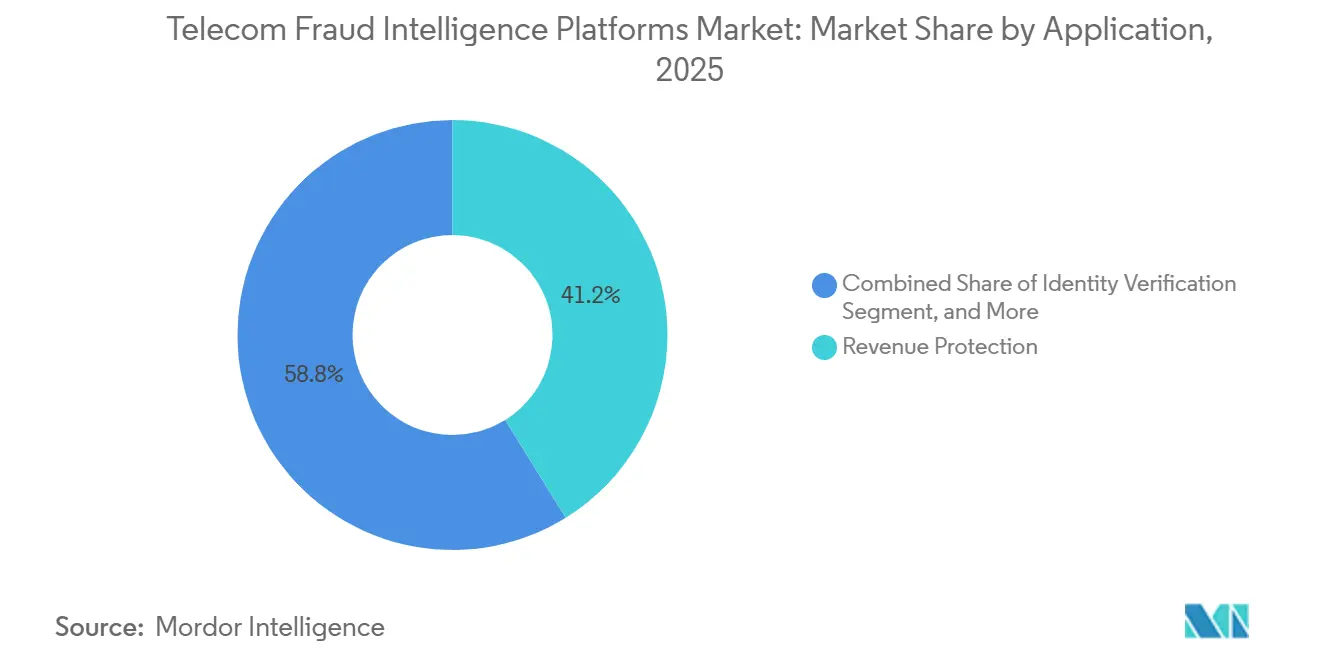
- By application, revenue protection held 41.17% of the market share in 2025, while identity verification is projected to expand at an 18.92% CAGR through 2031.
- By end user, mobile network operators held 58.11% of the Telecom Fraud Intelligence Platforms Market share in 2025, while mobile virtual network operators are projected to expand at a 16.84% CAGR through 2031.
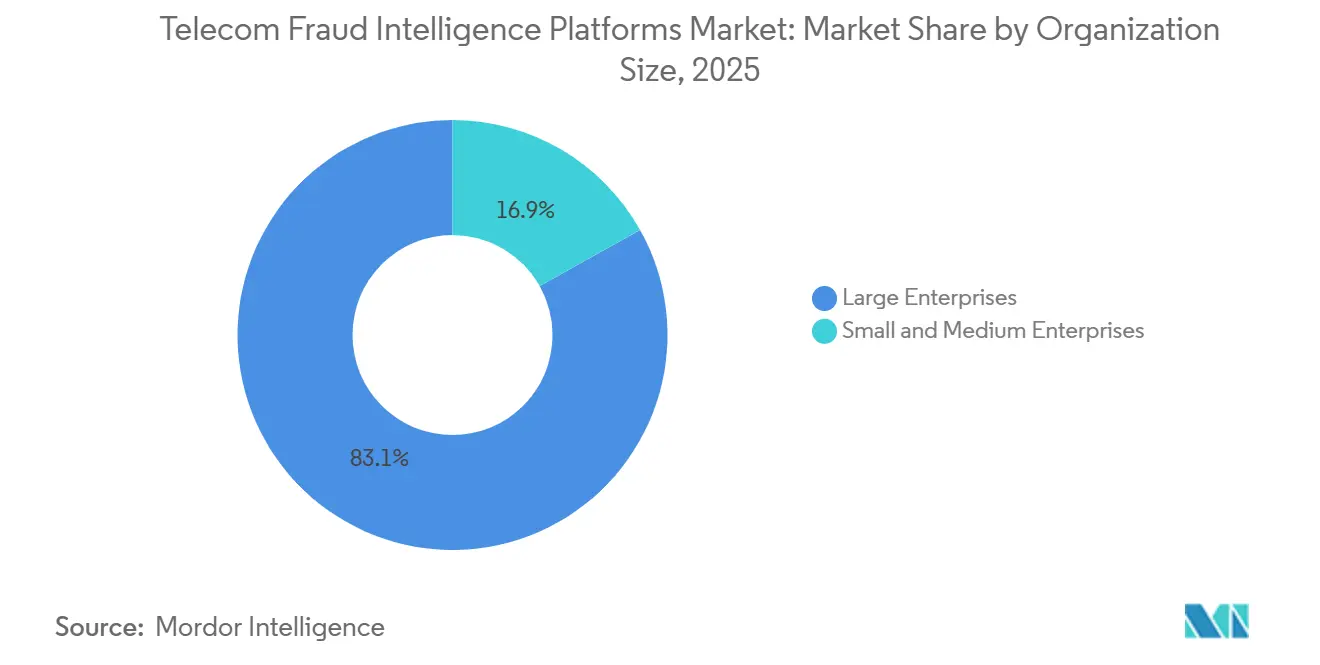
- By organization size, large enterprises held 83.13% of the Telecom Fraud Intelligence Platforms Market share in 2025, while small and medium enterprises are projected to expand at a 16.87% CAGR through 2031.
- By technology, machine learning and deep learning held 48.14% of the market share in 2025, while big data analytics is projected to expand at a 16.24% CAGR through 2031.
- By geography, North America held 34.12% of the market share in 2025, while Asia-Pacific is projected to expand at a 16.92% CAGR through 2031.
Note: Market size and forecast figures in this report are generated using Mordor Intelligence’s proprietary estimation framework, updated with the latest available data and insights as of January 2026.
Market Trends and Insights
Drivers Impact Analysis of Telecom Fraud Intelligence Platforms Market*
| Driver | (~) % Impact on CAGR Forecast | Geographic Relevance | Impact Timeline |
|---|---|---|---|
| Expansion of 5G, IoT, and cloud-native signaling surfaces | +3.2% | Global, concentrated in China, South Korea, the United States, and India | Long term (≥ 4 years) |
| Rising subscription, identity, and account takeover fraud | +2.8% | Global, highest in North America, Europe, and South Asia | Short term (≤ 2 years) |
| Increasing real-time revenue protection requirements | +2.1% | Global, led by North America and Europe, with spillover to Asia-Pacific | Medium term (2-4 years) |
| Interconnect bypass and messaging fraud intelligence gaps | +1.6% | Asia-Pacific core, with spillover to Middle East and Africa and South America | Medium term (2-4 years) |
| Fraud intelligence for programmable networks and API exposure | +1.1% | North America and Europe, with early gains in Southeast Asia | Long term (≥ 4 years) |
| Operator demand for autonomous, explainable fraud investigation | +0.9% | Global, led by large mobile network operators in Europe and North America | Long term (≥ 4 years) |
| Source: Mordor Intelligence | |||
Expansion of 5G, IoT, and Cloud-Native Signaling Surfaces
The move from monolithic cores to a 5G standalone, service-based architecture has changed how operators assess fraud exposure. HTTP/2 and REST APIs connect core functions and create abuse patterns that differ from traditional SS7 attacks and legacy signaling firewall controls. These interfaces require platforms that can assess REST semantics, JSON payloads, OAuth flows, call detail records, signaling events, and changing relationships between core network functions. Operators are incorporating packet-core, service-based architecture, and RAN telemetry as they build fraud-detection baselines for 5G networks and compare normal activity with new forms of abuse. The Telecom Fraud Intelligence Platforms Market benefits as operators place detection closer to network functions, rather than relying solely on billing records that may identify issues only after traffic has occurred. This supports demand for systems that normalize diverse telemetry, correlate related events, and identify anomalies without the multi-day delays associated with batch-processing tools.
Rising Subscription, Identity, and Account Takeover Fraud
The CFCA recorded USD 5.31 billion in subscription fraud losses and USD 4.73 billion in account takeover losses in 2025.[1] Cifas recorded nearly 3,000 unauthorized SIM swaps in 2024, an increase of 1,055%, with mobile accounts accounting for 48% of account takeover cases. A compromised mobile identity can also affect bank accounts, two-factor authentication systems, healthcare portals, and other services that rely on a phone number for account recovery. This broadens the liability associated with a SIM swap beyond an operator's direct service revenue, making prompt verification more important for downstream organizations. The GSMA is promoting standardized fraud-prevention APIs for SIM swap detection, call-forwarding monitoring, and scam intelligence through the Open Gateway and CAMARA frameworks. The Telecom Fraud Intelligence Platforms Market can benefit when operators offer subscriber identity intelligence as an enterprise API product with clear controls over data access and use.[2]
Increasing Real-Time Revenue Protection Requirements
Revenue protection is shifting from periodic billing reviews to continuous assurance across the order-to-cash cycle. SIM box and interconnect bypass caused USD 1.92 billion in annual losses, according to the CFCA's 2025 survey. Operators need to assess usage, billing, and partner settlement records together because a gap across any one of these systems can conceal leakage or allow disputed traffic to remain unresolved. Real-time processing reduces the period in which fraudulent traffic can remain active before action is taken, which is particularly important for high-volume voice and messaging routes. Integrated platforms can consolidate partner settlement, network usage, fraud controls, and investigation records into a single operating process. The Telecom Fraud Intelligence Platforms Market favors this approach as operators manage an increasing number of digital services, wholesale relationships, financial partnerships, and IoT-based offerings.[3]
Interconnect Bypass and Messaging Fraud Intelligence Gaps
Interconnect bypass remains difficult to identify because SIM box operators rotate SIM pools, distribute activity across towers, and vary calling behavior to resemble ordinary subscriber use. The GSMA's June 2026 update to FS.01.1 described bypass methods that are designed to evade static behavioral profiles.[4] This increases the value of models that are continuously refreshed, incorporate multiple data signals, and do not depend only on manually maintained rules. Artificial traffic inflation can appear legitimate in normal billing systems until detailed reconciliation exposes the issue and identifies the parties involved. New RCS and over-the-top messaging channels also create fraud patterns that need updated monitoring methods as communications traffic shifts across different formats. The Telecom Fraud Intelligence Platforms Market gains from platforms that combine messaging, voice, and interconnect data rather than treating them as separate control areas.
Restraints Impact Analysis of Telecom Fraud Intelligence Platforms Market*
| Restraint | (~) % Impact on CAGR Forecast | Geographic Relevance | Impact Timeline |
|---|---|---|---|
| Legacy data silos and inconsistent CDR and signaling data quality | -2.2% | Global, most acute in Africa, South Asia, and South America | Long term (≥ 4 years) |
| Privacy, data residency, and cross-border intelligence constraints | -1.5% | European Union, India, China, and Middle East and Africa national operators | Long term (≥ 4 years) |
| Long telecom procurement and integration cycles | -1.1% | Global, especially state-owned operators in Asia-Pacific and Middle East and Africa | Medium term (2-4 years) |
| Adversarial adaptation and false-positive fatigue | -0.7% | Global | Short term (≤ 2 years) |
| Source: Mordor Intelligence | |||
Legacy Data Silos and Inconsistent CDR and Signaling Data Quality
The main obstacle for many operators is fragmented data, rather than a lack of fraud algorithms. Call detail records, signaling events, provisioning data, billing transactions, and customer account updates often remain in separate OSS and BSS environments, each built for different operational purposes. That structure makes it harder to build the cross-domain behavioral profiles that machine learning models require, and it can delay the confirmation of a suspected fraud event. The 2025 GLF report described widespread international revenue-share fraud exposure and a limited ability to automate route blocks using near-real-time data. Unifying records from separate mediation systems in a streaming layer can reduce the time needed to identify, assess, and escalate suspicious activity across operational teams. The Telecom Fraud Intelligence Platforms Market faces longer adoption cycles, particularly when multi-vendor modernization programs have not yet started or when data ownership remains divided across departments.
Privacy, Data Residency, and Cross-Border Intelligence Constraints
Fraud intelligence depends on connecting signaling events, subscriber identifiers, behavioral profiles, and network activity across relevant systems. Data sovereignty rules in Europe, India, China, and several Asia-Pacific markets can limit those connections or require strict controls over where data is processed. GDPR restricts international transfers of subscriber data and can reduce the reach of collaborative intelligence networks. Indian and Chinese requirements can require separate local processing environments for international platform vendors, which can affect the pace of implementation. This adds integration work, governance review, and ownership costs in important growth markets. Fraud groups can coordinate international revenue-share fraud, wangiri, and account-takeover campaigns across borders, while the platforms countering them may be limited to national data environments.
*Our forecasts treat driver/restraint impacts as directional, not additive. The impact forecasts reflect baseline growth, mix effects, and variable interactions.
Telecom Fraud Intelligence Platforms Market Segment Analysis
By Component:
Software Supports Platform-Led Intelligence DeploymentSoftware held 68.38% of the Telecom Fraud Intelligence Platforms Market share in 2025. This position reflects procurement models that integrate detection logic, behavioral scoring, case workflows, and reporting controls into a single operating platform. Vendors are adding autonomous investigation tools, real-time scoring, explainable AI functions, and rule governance features to their software. These features can reduce dependence on external services for model tuning, threshold setting, case management, and routine analyst review. They also make it easier for operators to apply new detection logic across multiple fraud use cases. The Telecom Fraud Intelligence Platforms Market is therefore moving toward products that support continuous operational use rather than isolated projects, because operators need systems that can be updated as fraud patterns, network services, regulatory expectations, and internal investigation practices evolve.
Services are projected to expand at a 15.68% CAGR through 2031. Managed fraud operations, threat intelligence feeds, model adaptation services, implementation support, and specialist analyst support remain important for operators with limited AI and security expertise. The CFCA found that 84% of respondents described their AI knowledge and experience as beginner or intermediate in 2025. This skills gap creates a role for providers that can help operators interpret alerts and refine controls after deployment. Modular platforms for handset fraud, subscription abuse, and international revenue-share fraud are gaining traction among digital-native mobile virtual network operators. Subex introduced FraudZap in 2025 to enable handset fraud deployment in days rather than months, illustrating interest in offerings that reduce the delivery burden for operators who cannot wait for extensive platform configuration.
By Deployment Mode:
Hybrid Architectures Balance Sovereignty and ScaleCloud deployment held 58.14% of the market share in 2025. Elastic processing, continuous model updates, lower infrastructure investment, and cross-operator intelligence aggregation support cloud adoption. Cloud platforms also allow operators to scale analysis as traffic volumes, event types, and network functions increase. This model can give fraud teams access to current detection capabilities without requiring them to maintain the same level of local computing capacity. The Telecom Fraud Intelligence Platforms Market benefits from this flexibility as 5G and IoT services generate more network data. However, local privacy rules can limit the movement of subscriber data within regional cloud environments, so cloud implementation decisions often require detailed review by network, security, privacy, and legal teams before data flows are established.
Hybrid deployment is projected to expand at a 16.32% CAGR through 2031. The model addresses the tension between cloud-scale analytics and data sovereignty requirements in Europe, India, China, and Gulf Cooperation Council markets. Operators assess data sovereignty, latency, data gravity, and operational readiness when deciding where to place telecom AI workloads. On-premises installations remain relevant for regulated tier-1 operators and signaling functions that cannot tolerate wide-area network latency. Hybrid systems can score events at the edge while sending anonymized intelligence to the cloud for broader threat correlation. This approach gives operators greater control over sensitive subscriber records while retaining access to scalable processing resources, and it lets them separate functions that require immediate local action from analytical workloads that can run in a cloud environment.
By Application:
Identity Verification Extends Fraud ControlRevenue protection accounted for 41.17% of the Telecom Fraud Intelligence Platforms Market size in 2025. SIM box and interconnect bypass losses supported continued investment in settlement, traffic, and usage controls. Operators use these systems to protect interconnect revenue from bypass, gray-route leakage, and invalid usage records. This established application also supports earlier intervention against international revenue share fraud and other high-cost traffic events. It remains a core part of operator assurance programs because billing and network usage must be reconciled continuously. The Telecom Fraud Intelligence Platforms Market continues to treat revenue assurance and fraud management as closely related requirements, since both depend on accurate usage data, timely investigation, clear case ownership, and coordinated action across commercial and network teams.
Identity verification is projected to expand at an 18.92% CAGR through 2031. The increase in unauthorized SIM swaps and the demand for mobile identity in financial services, healthcare, and government authentication. Payment security and regulatory compliance also benefit as telecom and financial fraud risks converge around the subscriber account. Network and signaling monitoring is gaining importance as the 5G service-based architecture exposes network function APIs to various threats. Operators are also assessing identity intelligence as a service that can be made available to enterprise customers. The GSMA's API initiative could enable identity verification capabilities to become operator revenue products for banks, digital service providers, and other enterprise users, rather than remaining only a cost of control.

By End User:
MVNO Compliance Requirements Support AdoptionMobile network operators held 58.11% of the Telecom Fraud Intelligence Platforms Market share in 2025. Their share reflects greater exposure to fraud and the resources needed for enterprise platform integration. Mobile network operators also manage broad subscriber bases, interconnect relationships, wholesale traffic, and extensive regulatory obligations. These factors support investment in dedicated fraud operations, integrated assurance systems, and network-level detection capabilities. Fixed-line and broadband providers, internet service providers, and wholesale carriers face distinct risks related to customer equipment bypass, gray-route messaging, and settlement disputes. Their inclusion broadens the potential user base beyond mobile operators alone and recognizes that fraud controls must address different traffic types, service models, customer relationships, and financial settlement arrangements across the broader communications ecosystem.
Mobile virtual network operators are projected to expand at a 16.84% CAGR through 2031. The FCC's February 2026 Enforcement Advisory confirmed that MVNOs are subject to Robocall Mitigation Database registration, STIR/SHAKEN certification, and know-your-customer obligations. These requirements make the management of caller authentication and subscriber controls a direct responsibility for virtual operators. Cloud-first architectures can make platform integration faster for digital-native MVNOs. Investment in voice and SMS anti-fraud controls is increasing across carriers as compliance requirements become more detailed. This expands procurement across end-user categories rather than only among major mobile operators.
By Organization Size:
Smaller Operators Gain Access to PlatformsLarge enterprises held 83.13% of the market share in 2025. Tier-1 operators can fund multi-vendor data integration, regulatory reporting, dedicated fraud operations centers, and ongoing model maintenance. Their scale also makes the financial impact of fraud more immediate because a single event can affect large traffic volumes or subscriber groups. Enterprise-grade implementations often require extensive coordination across network, billing, customer, security, and compliance systems. These requirements have historically concentrated spending among the largest operators. Their established operational teams can also support more complex platform configurations, including integrations that connect multiple mediation systems, customer databases, traffic sources, case-management processes, compliance reporting tools, and security operations functions.
Small and medium enterprises are projected to expand at a 16.87% CAGR through 2031. Modular cloud-native platforms lower ownership costs and reduce the specialized expertise needed for deployment. Vendors are offering plug-and-play modules for handset fraud, subscription abuse, and international revenue-share fraud without hardware buildouts or prolonged implementation programs. Smaller operators can also use managed service bundles when they lack in-house capacity for AI, cybersecurity, or fraud analysis. These bundles can combine software, analyst support, and threat intelligence for operators with smaller teams. Cross-operator intelligence can also help smaller operators without sufficient internal traffic data identify robust fraud patterns on their own.
By Technology:
Big Data Analytics Supports Carrier-Scale DetectionMachine learning and deep learning held 48.14% of the technology segment in 2025. Behavioral anomaly detection is central to the assessment of call detail records, signaling, subscriber data, and changes in usage behavior. A 2025 peer-reviewed study reported receiver operating characteristic area under the curve results above 0.99 on balanced call detail record datasets for Wangiri and international revenue share fraud detection. These models use temporal, geographic, and behavioral features to distinguish unusual traffic from legitimate customer activity. The CFCA reported that 75% of operators used machine learning or AI for fraud detection in 2025, compared with 38% in 2023. This points to wider operational use of AI across fraud teams.
Big data analytics is projected to expand at a 16.24% CAGR through 2031. 5G and IoT deployments generate event volumes that require distributed, real-time processing across billing, signaling, and network data. Natural language processing is also being applied to smishing and voice phishing across SMS, RCS, and over-the-top channels. It can help identify suspicious text and AI-generated voice-cloning scripts that keyword filters may miss. Cloud-native streaming databases are also reducing the latency advantage that on-premises systems once held. The Telecom Fraud Intelligence Platforms Market is consequently placing greater weight on data ingestion, correlation, and decision speed.
Geography Analysis
North America Telecom Fraud Intelligence Platforms Market
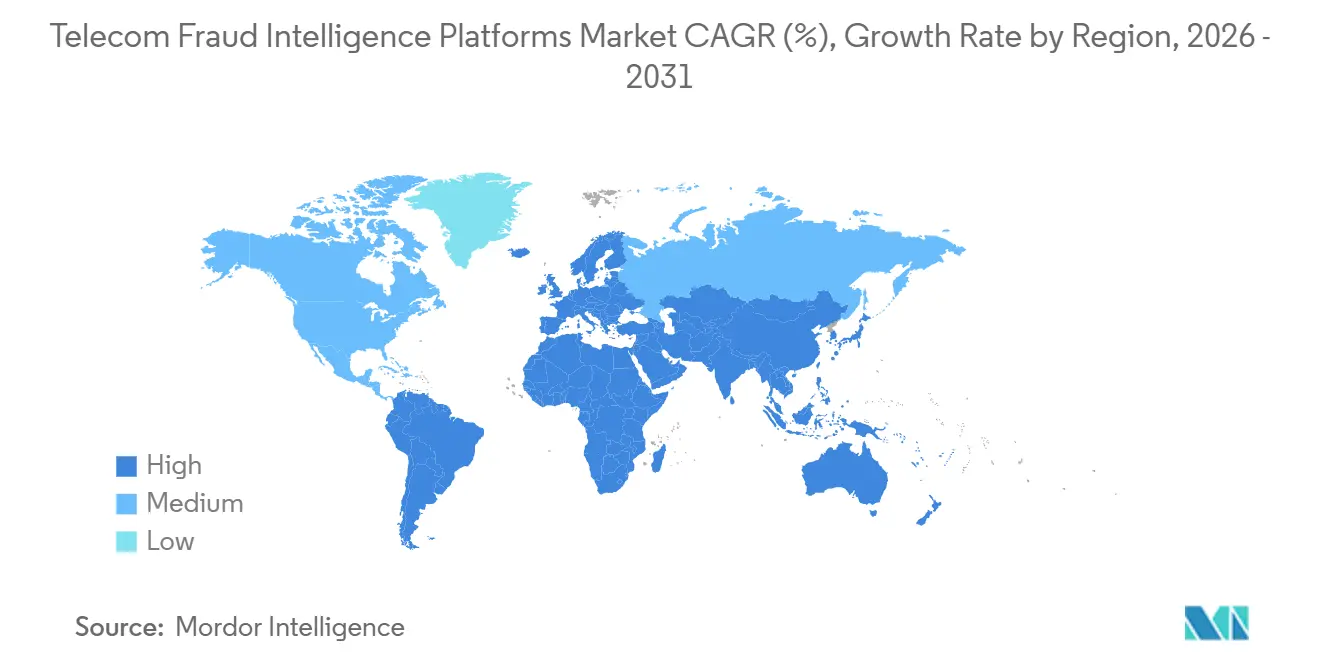
North America held 34.12% of the Telecom Fraud Intelligence Platforms Market share in 2025. The region has a high concentration of cloud-native fraud intelligence vendors, substantial telecom spending, and strong regulatory enforcement. The FCC adopted enhanced Know Your Upstream Provider rules and STIR/SHAKEN attestation standards in May 2026. The Robocall Mitigation Database annual recertification deadline of March 1, 2026, also extended compliance requirements to smaller voice service providers. Canada and Mexico add regional demand through interconnect security and consumer-protection frameworks.
Europe Telecom Fraud Intelligence Platforms Market
Europe was the second-largest regional position, led by Germany, the United Kingdom, France, Italy, and Spain. Cifas reported that identity fraud and facility takeover accounted for 72% of cases filed by members in 2025, and identified telecoms as the main target for account takeover involving mobile products. Scandinavian markets are investing in AI-driven signaling firewall upgrades as 5G standalone networks introduce SEPP and API exposure. NIS2 raises network-security obligations for essential service providers, including telecom operators, while GDPR supports deployment models that meet European data residency needs.
APAC, South America and MEA Telecom Fraud Intelligence Platforms Market
Asia-Pacific is projected to expand at a 16.92% CAGR from 2026 to 2031, making it the fastest-growing region. Its mobile subscriber base exceeded 3.7 billion, and large 5G programs in China, India, South Korea, and Japan increase the scale of fraud exposure. China's Cybersecurity Law requires subscriber identity verification and data protection, while India has applied zero-tolerance SMS spam policies. South America, the Middle East, and Africa remain high-potential regions where fraud losses are rising faster than platform adoption. South Africa lost more than ZAR 5.3 billion, USD 290 million, to cybercrime in 2025, and Gulf operators are investing as part of 5G transformation programs.
Competitive Landscape
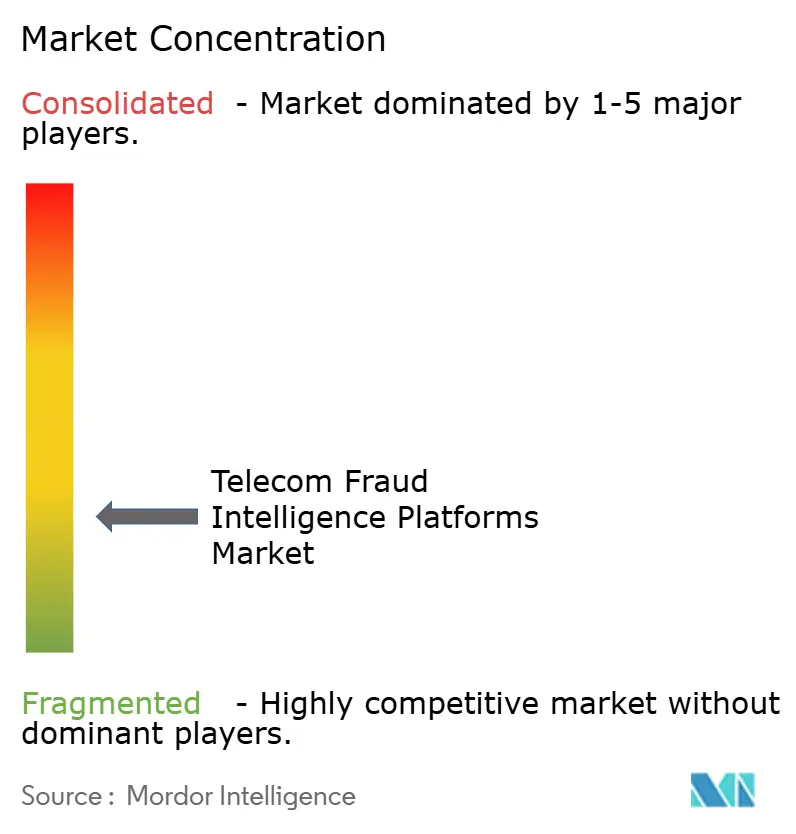
The Telecom Fraud Intelligence Platforms Market is fragmented. Established telecom-security vendors retain installed-base advantages with tier-1 and tier-2 mobile operators. AI-native challengers compete on detection speed, modular deployment, and operating cost. Competition centers on signaling coverage across SS7, Diameter, SIP, and 5G service-based architecture APIs, as well as autonomous investigation depth and collaborative threat intelligence.
Mobileum launched RAID 9 in February 2025 with more than 5,000 telecom-specific risk catalogs and enhanced AI-driven fraud detection. The company demonstrated agentic AI developments for RAID 9 during Mobile World Congress Barcelona 2026. Subex added embedded generative AI to HyperSense in June 2025 to support continuous learning and real-time contextual analysis. HyperSense has more than 300 installations across more than 100 countries, providing a substantial behavioral database. These moves show how established vendors are unifying fraud, revenue assurance, and compliance functions.
White-space opportunities are developing around network APIs that allow operators to commercialize subscriber identity signals for financial services and enterprise authentication. Specialized vendors focus on interconnect bypass, handset fraud, Wangiri, or AI voice-clone detection, where specialized models may enable faster deployment. Enea integrated FoxIO's JA4+ network fingerprinting standards into Qosmos ixEngine in 2026 to identify bots, malware, proxies, and suspicious encrypted traffic behavior without decryption. FCC and European compliance requirements favor platforms that include reporting workflows.
Telecom Fraud Intelligence Platforms Industry Leaders
-
Subex Limited
-
Mobileum Inc.
-
TEOCO Corporation
-
Amdocs Limited.
-
Nokia Corporation
- *Disclaimer: Major Players sorted in no particular order
Telecom Fraud Intelligence Platforms Market Companies Covered in this Report
- Subex Limited
- Mobileum, Inc.
- Araxxe SAS
- TEOCO Corporation
- Telarix, Inc.
- Heksagon Technologies Ltd.
- Cellusys Limited
- upCOM Labs LLC
- Amdocs Limited.
- TransNexus, Inc.
- Tollring Limited
- Nokia Corporation
- Calltic NV
- Mobik d.o.o.
- SecurityGen Cyber Security Solutions PTE. LTD.
- Enea AB
- Belgacom International Carrier Services SA
- Zumigo, Inc.
- Syntelligence AI Inc.
- Tango Telecom Limited
- Latro Services, Inc.
- Comviva Technologies Limited
- Vonage Holdings Corp.
- Socure Inc.
Recent Industry Developments in Telecom Fraud Intelligence Platforms Market
- July 2026: Enea published its "Plugging the Leaks: Fraud Handbook for MNOs," a comprehensive operational guide covering charging bypass, gray-route messaging fraud, and international revenue share fraud detection across data, messaging, and voice domains, reinforcing its strategy of combining threat intelligence publishing with its Adaptive Messaging Firewall and Adaptive Signaling Firewall product portfolio for operators in more than 100 countries.
- May 2026: The FCC formally adopted enhanced Know-Your-Upstream-Provider rules and codified STIR/SHAKEN attestation standards, defining A-, B-, and C-level attestation criteria, prohibiting improper attestations, and extending upstream accountability obligations to carriers that authenticate or transmit voice traffic.
- March 2026: Mobileum announced that its AI-driven risk management platform went live at Grameenphone, one of Bangladesh's largest telecom operators, to analyze, verify, and block scam and spam calls in real time.
- February 2026: The FCC's Enforcement Bureau released Enforcement Advisory No. 2026-02, confirming that MVNOs are subject to Robocall Mitigation Database registration, STIR/SHAKEN implementation certification, and know-your-customer obligations.
Global Telecom Fraud Intelligence Platforms Market Report Scope
The telecom fraud intelligence platforms market refers to the ecosystem of software solutions and services designed to detect, analyze, and mitigate fraud across telecommunications networks. These platforms leverage advanced technologies such as machine learning, deep learning, natural language processing, and big data analytics to monitor network signaling, verify identities, and secure payment processes in real-time. Deployed across cloud, on-premises, or hybrid environments, these solutions cater to mobile network operators, internet service providers, MVNOs, and wholesale carriers. By providing critical applications such as revenue protection, regulatory compliance, and payment security, telecom fraud intelligence platforms help communication service providers minimize financial losses from sophisticated fraud vectors such as SIM swaps, toll fraud, and robocalling, while maintaining overall network integrity, optimizing operational costs, and safeguarding subscriber trust.
The Telecom Fraud Intelligence Platforms Market Report is Segmented by Component (Software, and Services), Deployment Mode (Cloud, On-Premises, and Hybrid), Application (Revenue Protection, Identity Verification, Payment Security, Network and Signaling Monitoring, Regulatory Compliance, and Others), End User (Mobile Network Operators, Fixed-Line and Broadband Providers, Internet Service Providers, Mobile Virtual Network Operators, Wholesale Carriers and Interconnect Hubs, and Others), Organization Size (Large Enterprises, and Small and Medium Enterprises), Technology (Machine Learning and Deep Learning, Natural Language Processing, Big Data Analytics, and Others), and Geography (North America, South America, Europe, Asia-Pacific, Middle East, and Africa). The Market Forecasts are Provided in Terms of Value (USD).
Segmentation Overview
| Software |
| Services |
| Cloud |
| On-Premises |
| Hybrid |
| Revenue Protection |
| Identity Verification |
| Payment Security |
| Network and Signaling Monitoring |
| Regulatory Compliance |
| Other Applications |
| Mobile Network Operators |
| Fixed-Line and Broadband Providers |
| Internet Service Providers |
| Mobile Virtual Network Operators |
| Wholesale Carriers and Interconnect Hubs |
| Other End Users |
| Large Enterprises |
| Small and Medium Enterprises |
| Machine Learning and Deep Learning |
| Natural Language Processing |
| Big Data Analytics |
| Other Technologies |
| North America | United States |
| Canada | |
| Mexico | |
| South America | Brazil |
| Argentina | |
| Chile | |
| Rest of South America | |
| Europe | Germany |
| United Kingdom | |
| France | |
| Italy | |
| Spain | |
| Rest of Europe | |
| Asia-Pacific | China |
| Japan | |
| India | |
| South Korea | |
| Australia | |
| Rest of Asia-Pacific | |
| Middle East | United Arab Emirates |
| Saudi Arabia | |
| Qatar | |
| Rest of Middle East | |
| Africa | South Africa |
| Egypt | |
| Nigeria | |
| Rest of Africa |
| By Component | Software | |
| Services | ||
| By Deployment Mode | Cloud | |
| On-Premises | ||
| Hybrid | ||
| By Application | Revenue Protection | |
| Identity Verification | ||
| Payment Security | ||
| Network and Signaling Monitoring | ||
| Regulatory Compliance | ||
| Other Applications | ||
| By End User | Mobile Network Operators | |
| Fixed-Line and Broadband Providers | ||
| Internet Service Providers | ||
| Mobile Virtual Network Operators | ||
| Wholesale Carriers and Interconnect Hubs | ||
| Other End Users | ||
| By Organization Size | Large Enterprises | |
| Small and Medium Enterprises | ||
| By Technology | Machine Learning and Deep Learning | |
| Natural Language Processing | ||
| Big Data Analytics | ||
| Other Technologies | ||
| By Geography | North America | United States |
| Canada | ||
| Mexico | ||
| South America | Brazil | |
| Argentina | ||
| Chile | ||
| Rest of South America | ||
| Europe | Germany | |
| United Kingdom | ||
| France | ||
| Italy | ||
| Spain | ||
| Rest of Europe | ||
| Asia-Pacific | China | |
| Japan | ||
| India | ||
| South Korea | ||
| Australia | ||
| Rest of Asia-Pacific | ||
| Middle East | United Arab Emirates | |
| Saudi Arabia | ||
| Qatar | ||
| Rest of Middle East | ||
| Africa | South Africa | |
| Egypt | ||
| Nigeria | ||
| Rest of Africa | ||
Key Questions Answered in the Report
What is the Telecom Fraud Intelligence Platforms Market size?
The Telecom Fraud Intelligence Platforms Market was USD 1.44 billion in 2026 and is forecast to reach USD 2.87 billion by 2031 at a 14.79% CAGR. The outlook reflects demand for platforms that address subscription fraud, account takeover, signaling exposure, revenue leakage, and the growing volume of data created by 5G and IoT services. It also reflects operator need for faster detection, coordinated investigation, and controls that can operate across network and commercial systems, including billing, settlement, subscriber, signaling, and fraud operations environments.
What is driving demand for telecom fraud intelligence platforms?
Rising subscription fraud, account takeover, 5G API exposure, and real-time revenue protection needs are increasing platform demand. The Telecom Fraud Intelligence Platforms Market also responds to the need to connect network, billing, subscriber, and partner data in time to stop active fraud. This is especially important where traditional reviews identify problems only after usage, billing, or settlement records have already been processed.
Which deployment model is growing fastest?
Hybrid deployment is projected to grow at a 16.32% CAGR through 2031 because it combines local processing with cloud-scale analytics. In the Telecom Fraud Intelligence Platforms Market, this model also helps operators manage sensitive subscriber data under national data-residency requirements.
Which application is expected to grow fastest?
Identity verification is projected to grow at an 18.92% CAGR through 2031 as SIM swap and account takeover risks increase. The application can help operators assess subscriber changes before compromised identities affect services that rely on mobile numbers for authentication. It can also support better coordination with organizations that use a mobile number as part of their customer verification process.
Which end user is projected to grow fastest?
Mobile virtual network operators are projected to grow at a 16.84% CAGR through 2031, supported by expanded U.S. compliance requirements. Cloud-first operating models can also make it easier for these providers to add fraud controls without extensive local infrastructure. Regulatory accountability gives virtual operators a clearer reason to invest in monitoring, caller authentication, subscriber verification, and documented mitigation processes.
Which region is expected to grow fastest?
Asia-Pacific is projected to grow at a 16.92% CAGR from 2026 to 2031, supported by large 5G programs and a broad mobile subscriber base. The region also combines varied national data rules, rapidly evolving mobile services, and demand for more effective messaging and identity controls. China, India, South Korea, and Japan are central to this regional opportunity because of their extensive network deployment and large subscriber populations.