
Telecom Fault Management Software Market Size and Share
Market Overview
| Study Period | 2020 - 2031 |
|---|---|
| Market Size (2026) | USD 5.96 Billion |
| Market Size (2031) | USD 9.82 Billion |
| Growth Rate (2026 - 2031) | 10.50 % |
| Fastest Growing Market | Asia-Pacific |
| Largest Market | North America |
| Market Concentration | Medium |
Major Players *Disclaimer: Major Players sorted in no particular order Image © Mordor Intelligence. Reuse requires attribution under CC BY 4.0. | |
Telecom Fault Management Software Market Analysis by Mordor Intelligence
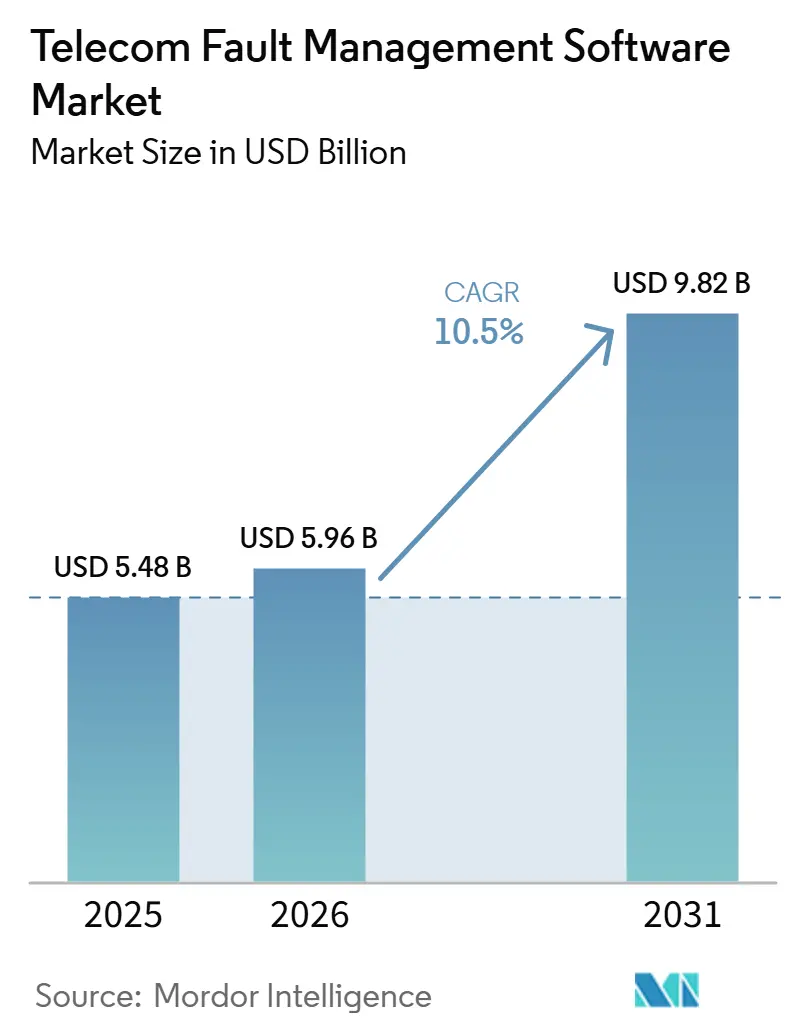
The Telecom fault management software market size was valued at USD 5.48 billion in 2025 and estimated to grow from USD 5.96 billion in 2026 to reach USD 9.82 billion by 2031, at a CAGR of 10.5% during the forecast period (2026-2031). 5G standalone networks, Open RAN, cloud-native network functions, and multi-vendor architectures are increasing the volume and variety of alarms that operators must interpret. These conditions are shifting procurement toward platforms that correlate events across radio, core, transport, and edge environments. Operators are also replacing older OSS and BSS systems to support real-time data flows and automated responses. The Telecom fault management software market is therefore being shaped by the need to protect service quality while making network operations more efficient. Vendors are responding with AI-enabled assurance tools, cloud delivery options, and integrations that support a gradual move toward autonomous operations.
Key Report Takeaways
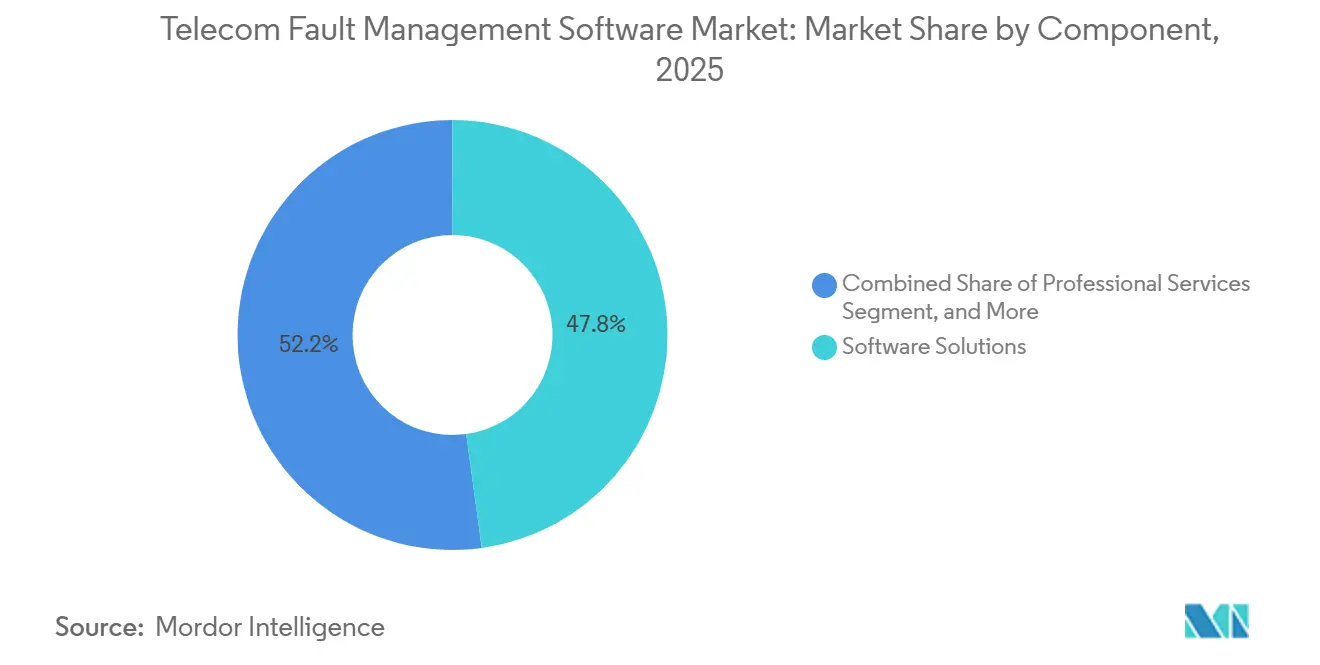
- By component, Software Solutions held 47.82% of the Telecom fault management software market share in 2025, while Managed Services is projected to expand at a 12% CAGR through 2031.
- By fault management function, Alarm and Event Management accounted for 25.68% of the Telecom fault management software market size in 2025, while Automated Remediation and Closed-Loop Control is expected to grow at a 12.4% CAGR through 2031.
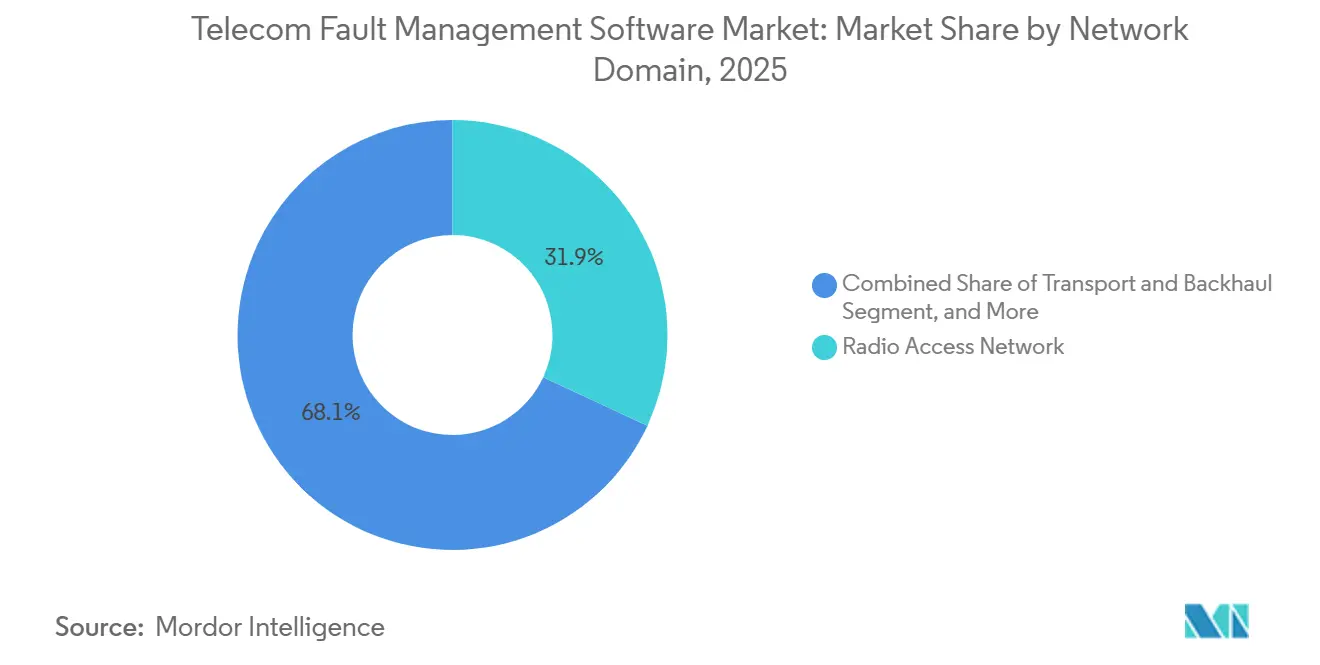
- By network domain, Radio Access Network held 31.94% revenue share in 2025, while Cloud-Native Network Functions is projected to advance at a 12.6% CAGR through 2031.
- By deployment, On-Premises retained 56.28% revenue share in 2025, while Cloud-Based deployment is expected to grow at an 11.9% CAGR through 2031.
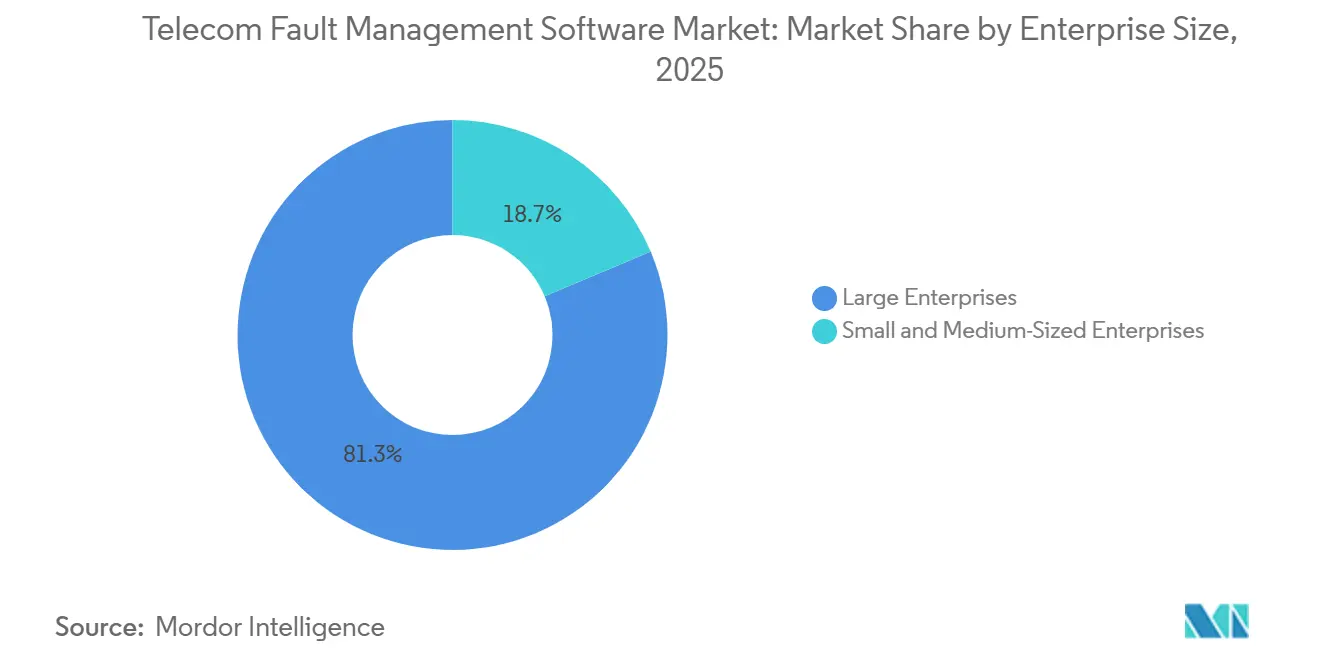
- By enterprise size, Large Enterprises held 81.34% revenue share in 2025, while Small and Medium-Sized Enterprises is projected to expand at an 11.5% CAGR through 2031.
- By application, Service Assurance and Customer Experience accounted for 29.74% revenue share in 2025, while Enterprise and Private-Network Assurance is expected to grow at a 12.2% CAGR through 2031.
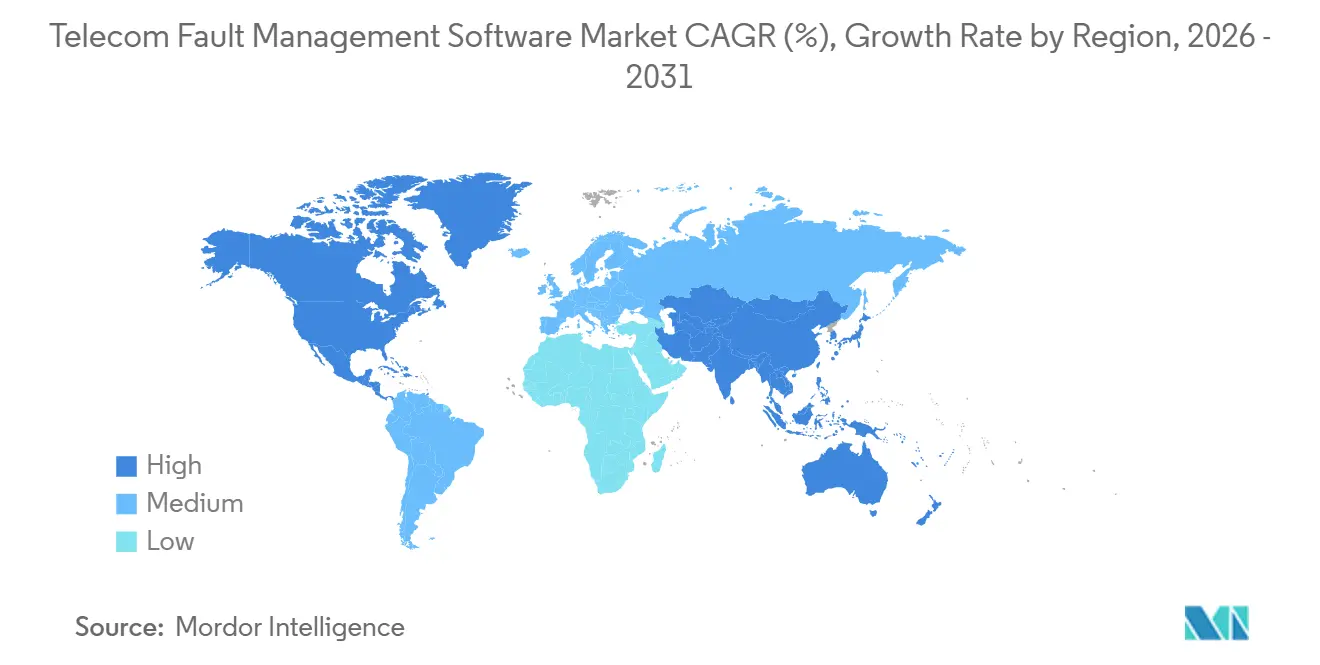
- By geography, North America held 34.86% revenue share in 2025, while Asia-Pacific is projected to advance at an 11.8% CAGR through 2031.
Note: Market size and forecast figures in this report are generated using Mordor Intelligence’s proprietary estimation framework, updated with the latest available data and insights as of January 2026.
Global Telecom Fault Management Software Market Trends and Insights
Drivers Impact Analysis*
| Driver | (~) % Impact on CAGR Forecast | Geographic Relevance | Impact Timeline |
|---|---|---|---|
| 5G and Open RAN Multi-Domain Complexity | +2.8% | Global, led by North America, Asia-Pacific, and Europe | Long term (≥ 4 years) |
| AI-Enabled Autonomous Network Operations | +1.9% | Global | Long term (≥ 4 years) |
| Real-Time Quality of Experience and SLA Assurance | +1.8% | Global, with acute demand in North America and Europe | Medium term (2-4 years) |
| Cloud-Native OSS/BSS Modernization | +1.5% | Global, with faster adoption in Europe and North America | Medium term (2-4 years) |
| Network-Slice Revenue Protection and Assurance | +0.7% | North America, Europe, South Korea, and Japan | Long term (≥ 4 years) |
| Network Energy Optimization Through Fault Intelligence | +0.6% | Europe and Asia-Pacific, with wider global adoption | Long term (≥ 4 years) |
| Source: Mordor Intelligence | |||
5G and Open RAN Multi-Domain Complexity
Open RAN separates radio units, distributed units, and centralized units that one supplier previously delivered as a single base station system. Each layer can create different alarm formats, making it harder for traditional OSS tools to form a common view of a service failure. This complexity is a major reason operators are evaluating multi-domain platforms in the Telecom fault management software market. Interoperability among supplier platforms is becoming more important as operators seek to run automation applications across multi-vendor RAN environments. Capgemini and Deutsche Telekom also developed a vendor-independent service management and orchestration platform for O-RAN and legacy RAN environments across Deutsche Telekom's European operations. Platforms that can ingest O1, E2, and A1 interface data across equipment suppliers are better positioned to support large operator deployments.
AI-Enabled Autonomous Network Operations
AI is moving from pilot programs into operational workflows for event correlation, diagnosis, and recovery. Deutsche Telekom launched its RAN Guardian Agent in Germany in November 2025 and reported that it reduced major event management time from hours to less than 1 minute and autonomously initiated more than 100 remediation actions in its first month. Nokia and Google Cloud expanded their partnership in June 2026 to integrate 6 Gemini-powered agents into Nokia Assurance Center, with a SaaS release planned for September 2026.[1]Google Cloud, “Nokia and Google Cloud Partner to Embed AI Agents, Built With Google’s Gemini Models, Into Nokia’s Autonomous Network Product Suite,” Google Cloud Press Corner This direction makes AI-assisted root-cause analysis and automated response central to vendor selection in the Telecom fault management software market. Managed service providers can also learn from a broader operating base, while operators that retain all activity on-site have more limited opportunities to reuse operational data. The resulting difference in data access may affect how quickly automation quality improves across competing platforms.
Real-Time Quality of Experience and SLA Assurance
5G service commitments are making service-level assurance more specific than aggregate network availability measures. Operators must identify issues at the level of an individual slice or enterprise service when contracts define performance obligations. SLA-backed services create a direct commercial need for slice-level monitoring and fault detection. A 2026 study reported an R² value of 0.91 for packet-loss prediction and 81.1% accuracy for delay classification in proactive 5G slicing quality prediction.[2]Zhe Chen et al., “A Multi-Model Deep Learning Approach for Proactive QoS Prediction in 5G Network Slicing,” Journal of Engineering and Applied Science Operators are using agentic AI systems to shorten the interval between detection, diagnosis, and recovery. These deployments raise expectations for faster detection and resolution across premium consumer and enterprise services.
Cloud-Native OSS/BSS Modernization
Legacy OSS and BSS platforms often lack the event-streaming capacity needed for real-time AI correlation. Modernization is therefore closely linked to the adoption of cloud-native fault management software. Many operators need BSS modernization to support 5G services, while integration complexity remains a significant challenge. New platform designs are connecting prediction, diagnosis, recommendation, and resolution across assurance, inventory, and orchestration. Lumen adopted Blue Planet AI Studio and Ciena agents in February 2026 to leverage network digital-twin insights and streamline resource reconciliation.[3]Ciena, “Lumen Boosts AI Network Transformation With Blue Planet's AI Studio and Agents,” Ciena Investor News These programs show why the Telecom fault management software market increasingly depends on open interfaces and data architectures rather than stand-alone monitoring tools.
Restraints Impact Analysis*
| Restraint | (~) % Impact on CAGR Forecast | Geographic Relevance | Impact Timeline |
|---|---|---|---|
| Legacy-System Integration and Migration Cost | -1.5% | Global, most acute in Europe and North America | Short term (≤ 2 years) |
| Multi-Cloud Security and Data-Residency Complexity | -1% | Europe and North America, expanding to Asia-Pacific and the Middle East | Medium term (2-4 years) |
| Scarcity of Telco-Grade AI and Automation Talent | -0.7% | Global, most acute in emerging markets | Medium term (2-4 years) |
| Inconsistent Alarm Semantics Across Disaggregated Network Domains | -0.4% | Global, worsening with Open RAN adoption | Long term (≥ 4 years) |
| Source: Mordor Intelligence | |||
Legacy-System Integration and Migration Cost
Large operators often rely on customized OSS integrations for decades, which makes replacement programs costly and technically difficult. Parallel-run migration requirements can add substantial cost before any legacy module is retired. Full transformation programs can require extended implementation periods and careful operational continuity. These costs increase when southbound interfaces must support SNMP, NETCONF, and CLI across multiple equipment suppliers. Consequently, the Telecom fault management software market has a clearer entry point in greenfield private 5G networks, where legacy integration debt is lower. This also supports demand for managed deployments that reduce the amount of internal integration work required.
Multi-Cloud Security and Data-Residency Complexity
Centralized AI engines benefit from access to large volumes of fault telemetry, but location, behavior, and device information can raise privacy and telecom regulatory concerns. Operators must balance this analytical value against data localization rules and governance requirements for automated recovery actions. Governance concerns continue to sit alongside technical performance requirements for automated remediation. This environment helps explain why On-Premises delivery remained important for large regulated operators in 2025. Hybrid designs can keep raw telemetry in private infrastructure while using cloud resources for selected analytical workloads. Such designs may expand participation in the Telecom fault management software market among operators constrained by compliance requirements rather than by demand for automation.
*Our forecasts treat driver/restraint impacts as directional, not additive. The impact forecasts reflect baseline growth, mix effects, and variable interactions.
Segment Analysis
By Component, Managed Services Accelerate as Software Maintains the Structural Lead
Software Solutions held 47.82% share in 2025, reflecting operator demand for analytics-driven platforms that work across network domains. The Telecom fault management software market industry is moving away from hardware-dependent tools that assess faults on a per-network-element basis. Software layers can correlate signals from RAN, core, transport, and edge operations in a single workflow. Hardware and Probe Infrastructure remain relevant in 5G standalone core environments where encrypted traffic restricts purely software-based visibility.
Managed Services is projected to grow at a 12% CAGR through 2031 as smaller operators seek external operational support. Professional Services also remains necessary when operators need integration, configuration, and migration support during modernization projects. Managed service delivery can lower capital requirements and reduce the need for in-house AI operations specialists. It also gives providers exposure to operating patterns across several customer networks. Vendors are connecting software products with ongoing automation services to support recurring operational needs.



By Fault Management Function, Closed-Loop Automation Changes Operational Priorities
Alarm and Event Management held 25.68% share in 2025 because alarm normalization remains the starting point for multi-vendor operations. Automated Remediation and Closed-Loop Control are projected to expand at a 12.4% CAGR through 2031 as operators seek machine-executed responses. The Telecom fault management software market still requires Fault Detection and Localization to identify the affected service or infrastructure layer. Fault Correlation and Root-Cause Analysis then helps operators distinguish a primary issue from the many related alarms it generates.
Predictive Fault Management is gaining relevance as models trained on historical key performance indicators become more reliable. Incident, Ticket, and Workflow Management links technical detection with field teams and operational accountability. Knowledge graph approaches are being applied to root cause analysis in large network environments. This supports the use of closed-loop functions at a large operating scale. However, operators still need reliable alarm semantics before they can broadly extend automated recovery.
By Network Domain, Cloud-Native Functions Lead Growth While RAN Holds the Base
Radio Access Network held a 31.94% share in 2025, supported by the large number of deployed 5G base stations and the increasing complexity of Open RAN. Cloud-Native Network Functions is projected to grow at a 12.6% CAGR through 2031. Containerized network functions are prone to errors such as instance crashes, resource contention, and Kubernetes scheduling failures. These events differ from the fault patterns handled by traditional element managers.
An IEEE conference study in 2025 reported more than 90% accuracy for fault aggregation and localization using an integrated diagnosis model for telecom network clouds.[4]Y. Liu et al., “Research on Cloud-Native Intelligent Diagnosis Model for Telecom Network Cloud Based on Multimodality,” IEEE AIHCIR Conference Proceedings Transport and Backhaul, Fixed Access and Fiber, and IP and Core Network remain established areas for assurance investment. Suppliers are extending automation platforms across both RAN and core network environments. Edge and Private Networks remain a developing domain with requirements centered on latency and availability. The Telecom fault management software market must therefore support both established network domains and cloud-driven operational patterns.
By Deployment, Cloud Expands While On-Premises Supports Regulated Operators
On-Premises deployment held 56.28% share in 2025, as major operators kept fault data inside their own infrastructure boundaries. Cloud-Based delivery is expected to advance at an 11.9% CAGR through 2031. Data sovereignty, security, and contractual obligations continue to influence deployment decisions. These requirements are particularly relevant for operators with regulated consumer and enterprise services.
Cloud delivery can reduce infrastructure overhead for smaller operators and enterprise 5G users. Cloud-hosted assurance frameworks are supporting predictive and intent-based operating models. ETSI ENI specifications and 3GPP NWDAF standards are influencing how cloud deployment architectures support network intelligence. Feature parity across cloud and on-premises options is important because both models will remain relevant. The Telecom fault management software industry, therefore, has to address hybrid operating environments rather than treat cloud delivery as a complete replacement.
By Enterprise Size, Small and Medium-Sized Enterprises Drive Growth
Large Enterprises held 81.34% share in 2025 because major communications service providers remain the main customers for specialized fault management platforms. Their alarm volumes can justify significant investment in licensing and integration. Small and Medium-Sized Enterprises is projected to grow at an 11.5% CAGR through 2031. Private 5G deployments in manufacturing, logistics, healthcare, and retail are creating a new group of network owners.
These organizations often need carrier-grade assurance without maintaining a large network operations center. Managed services can provide a practical route to automation when internal technical resources are limited. AI-based reasoning tools are being designed for closed-loop operations and greater network autonomy. This type of offer can make automation more accessible to customers below the largest operator tier. The Telecom fault management software market is consequently broadening beyond its traditional Tier 1 operator base.
By Application, Private-Network Assurance Grows as Service Assurance Remains Central
Service Assurance and Customer Experience held 29.74% share in 2025 because SLA compliance has direct commercial importance in 5G services. Enterprise and Private-Network Assurance is projected to grow at a 12.2% CAGR through 2031. Manufacturers with time-sensitive 5G production networks require availability controls similar to those used by carriers. Their budgets and staffing models, however, differ from those of national operators.
Network Operations Center, Automation, and Network Maintenance and Field Operations continue to support daily operator activities. Network Security and Anomaly Response are gaining attention because cloud-native infrastructure anomalies can also indicate security issues. Containerized assurance tools can offer automated assurance and closed-loop capabilities through NWDAF. This approach shows how carrier-grade tools can be adapted to enterprise 5G environments. The Telecom fault management software market is increasingly serving both service quality requirements and operational risk management needs.
Geography Analysis
North America held 34.86% share in 2025, supported by advanced 5G deployments and active OSS modernization programs. The Telecom fault management software market size in the region reflects major carriers' investment in AI-driven network operations. In 2026, NVIDIA reported that network automation had overtaken customer experience as the leading AI investment use case for telecom operators. Canada follows 5G buildout cycles, while Mexican operators are using managed fault services to compensate for more limited internal automation resources.
Asia-Pacific is projected to grow at an 11.8% CAGR through 2031, making it the fastest-growing regional area. China had deployed more than 2.8 million 5G base stations by mid-2026, creating a significant need for large-scale alarm management. Large-scale 5G deployment is increasing the need for fault correlation and root-cause analysis across complex network estates. Japanese operators are also deploying AI-based maintenance and fault-cause identification systems. KDDI began operating a real-time fault-cause identification AI agent in February 2026, while SoftBank started multi-agent validation for base-station operations in March 2026. India's TRAI quality-of-service requirements add a regulatory reason for operators to adopt real-time assurance and dashboarding.
Europe maintained a substantial share in 2025 through mature operations in Germany, the United Kingdom, and France. Deutsche Telekom reported up to 65% energy savings in a 5G core network through energy-aware automation in 2025. European operators are consolidating fixed and mobile fault operations into unified management environments. The Middle East is adding intelligent operations platforms as 5G and 5.5G services expand. Africa and South America remain earlier-stage areas, with activity concentrated among major carriers in South Africa, Egypt, Brazil, and Argentina.

Competitive Landscape
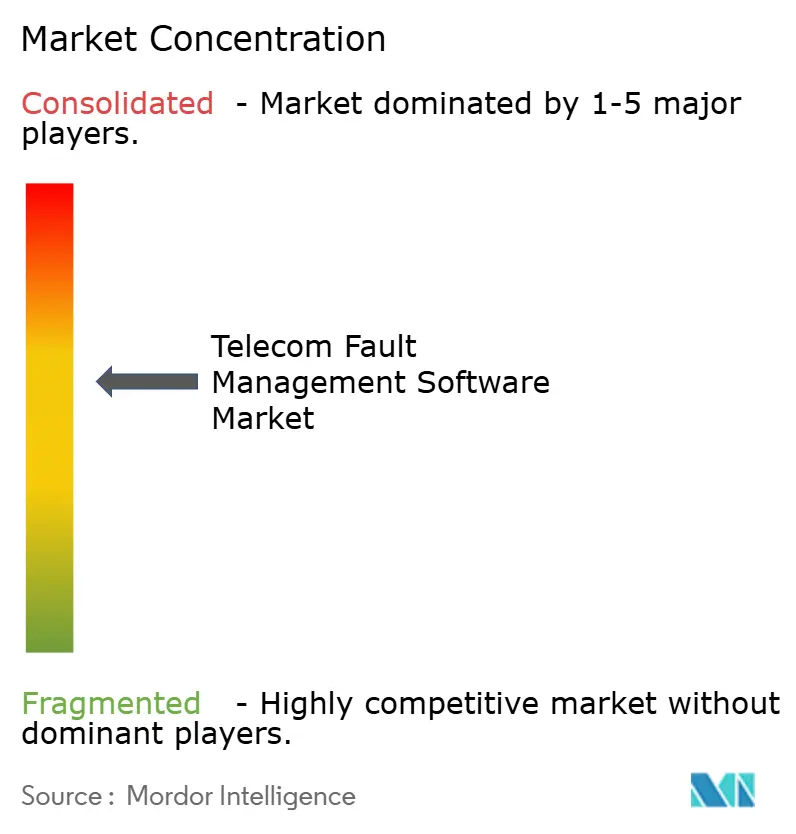
The Telecom fault management software market has a moderately consolidated upper tier that includes Nokia, Ericsson, IBM, Huawei, and Cisco. Large operator contracts favor suppliers that can integrate fault management with broader network management portfolios. Comarch, RADCOM, Infovista, NETSCOUT, and TEOCO compete through focused assurance, observability, and automation capabilities. Nokia launched Autonomous Network Fabric in June 2025, featuring telco-trained AI models, security functions, and applications designed to integrate observability, analytics, security, and automation. In June 2026, Nokia also expanded its work with Google Cloud on AI agents for Assurance Center.
Leading suppliers in the Telecom fault management software market are expanding automation functions from radio networks into core network operations. Nokia and Ericsson are both using marketplace models that make it easier for operators to access third-party automation applications. This can lower switching barriers and create a larger route to market for specialized suppliers. White-space opportunities remain in alarm-semantic standardization, edge and private 5G assurance for smaller enterprises, and energy-aware closed-loop remediation. Google Cloud's autonomous operations framework is used by Deutsche Telekom and One NZ, showing that cloud platforms are becoming more relevant competitors in the Telecom fault management software market.
Specialized suppliers are emphasizing governance and auditability in agentic AI platforms. This responds to operator concerns over the traceability of automated remediation decisions. The Telecom fault management software market also requires vendors to show how human oversight can be retained when automated actions affect customer services. TM Forum Open Digital Architecture compliance is also becoming more relevant in sourcing decisions, which favors vendors that can demonstrate open and certified components. Smaller vendors may face pressure to accelerate standards compliance while preserving specialized functionality. The Telecom fault management software market remains competitive because buyers need both broad integration capacity and proven domain expertise. This creates room within the Telecom fault management software market for specialists that demonstrate clear operational value in a defined network domain.
Telecom Fault Management Software Industry Leaders
International Business Machines Corporation
Telefonaktiebolaget LM Ericsson
Nokia Corporation
Huawei Technologies Co., Ltd.
Cisco Systems, Inc.
- *Disclaimer: Major Players sorted in no particular order

Recent Industry Developments
- July 2026: Comarch Communications delivered its Fault Management and Integration Platform to VodafoneZiggo, consolidating separate fixed and mobile fault operations into a unified platform that automates daily operations across the Netherlands telecom provider and enables advanced automation toward Level 3 and Level 4 network autonomy. The win followed a competitive evaluation and built on a prior Comarch deployment for Vodafone Germany.
- June 2026: Nokia and Google Cloud announced an expanded partnership to embed 6 Gemini-powered AI agents into Nokia Assurance Center at DTW Ignite Copenhagen. The platform is planned to launch as a SaaS offering on Google Cloud Marketplace in September 2026. Nokia cited a potential 50% to 80% reduction in network problem-solving times and plans to extend agentic automation across Unified Inventory, Data Suite, and Orchestration applications through late 2026 and 2027.
- June 2026: Ericsson expanded its Intelligent Automation Platform to cover core networks, introducing core-specific automation applications alongside a new ESPE data streaming capability for low-latency network event data. AT&T and Swisscom endorsed the expansion's potential for autonomous network transformation across their operations.
- June 2026: Nokia launched its Autonomous Networks Agent Library and released updated agentic AI capabilities across RAN, IP, fixed, and optical domains at DTW Ignite Copenhagen. The company is working with NTT DOCOMO on SMO-driven autonomy through MantaRay SON, AutoPilot trials, and Non-RT RIC and rApp development.


Global Telecom Fault Management Software Market Report Scope
The Telecom Fault Management Software Market Report is Segmented by Component (Software Solutions, Hardware and Probe Infrastructure, Professional Services, and Managed Services), Fault Management Function (Alarm and Event Management, Fault Detection and Localization, Fault Correlation and Root-Cause Analysis, Predictive Fault Management, Incident, Ticket, and Workflow Management, and Automated Remediation and Closed-Loop Control), Network Domain (Radio Access Network, Transport and Backhaul, Fixed Access and Fiber, IP and Core Network, Cloud-Native Network Functions, and Edge and Private Networks), Deployment (On-Premises and Cloud-Based), Enterprise Size (Large Enterprises and Small and Medium-Sized Enterprises), Application (Network Operations Center Automation, Service Assurance and Customer Experience, Network Maintenance and Field Operations, Network Security and Anomaly Response, Enterprise and Private-Network Assurance), and Geography. The Market Forecasts are Provided in Terms of Value (USD).
| Software Solutions |
| Hardware and Probe Infrastructure |
| Professional Services |
| Managed Services |
| Alarm and Event Management |
| Fault Detection and Localization |
| Fault Correlation and Root-Cause Analysis |
| Predictive Fault Management |
| Incident, Ticket, and Workflow Management |
| Automated Remediation and Closed-Loop Control |
| Radio Access Network |
| Transport and Backhaul |
| Fixed Access and Fiber |
| IP and Core Network |
| Cloud-Native Network Functions |
| Edge and Private Networks |
| On-Premises |
| Cloud-based |
| Large Enterprises |
| Small and Medium-Sized Enterprises |
| Network Operations Center Automation |
| Service Assurance and Customer Experience |
| Network Maintenance and Field Operations |
| Network Security and Anomaly Response |
| Enterprise and Private-Network Assurance |
| North America | United States |
| Canada | |
| Mexico | |
| South America | Brazil |
| Argentina | |
| Rest of South America | |
| Europe | Germany |
| United Kingdom | |
| France | |
| Italy | |
| Spain | |
| Russia | |
| Rest of Europe | |
| Asia-Pacific | China |
| Japan | |
| India | |
| South Korea | |
| Australia | |
| Rest of Asia-Pacific | |
| Middle East | Saudi Arabia |
| United Arab Emirates | |
| Turkey | |
| Rest of Middle East | |
| Africa | South Africa |
| Egypt | |
| Rest of Africa |
| By Component | Software Solutions | |
| Hardware and Probe Infrastructure | ||
| Professional Services | ||
| Managed Services | ||
| By Fault Management Function | Alarm and Event Management | |
| Fault Detection and Localization | ||
| Fault Correlation and Root-Cause Analysis | ||
| Predictive Fault Management | ||
| Incident, Ticket, and Workflow Management | ||
| Automated Remediation and Closed-Loop Control | ||
| By Network Domain | Radio Access Network | |
| Transport and Backhaul | ||
| Fixed Access and Fiber | ||
| IP and Core Network | ||
| Cloud-Native Network Functions | ||
| Edge and Private Networks | ||
| By Deployment | On-Premises | |
| Cloud-based | ||
| By Enterprise Size | Large Enterprises | |
| Small and Medium-Sized Enterprises | ||
| By Application | Network Operations Center Automation | |
| Service Assurance and Customer Experience | ||
| Network Maintenance and Field Operations | ||
| Network Security and Anomaly Response | ||
| Enterprise and Private-Network Assurance | ||
| By Geography | North America | United States |
| Canada | ||
| Mexico | ||
| South America | Brazil | |
| Argentina | ||
| Rest of South America | ||
| Europe | Germany | |
| United Kingdom | ||
| France | ||
| Italy | ||
| Spain | ||
| Russia | ||
| Rest of Europe | ||
| Asia-Pacific | China | |
| Japan | ||
| India | ||
| South Korea | ||
| Australia | ||
| Rest of Asia-Pacific | ||
| Middle East | Saudi Arabia | |
| United Arab Emirates | ||
| Turkey | ||
| Rest of Middle East | ||
| Africa | South Africa | |
| Egypt | ||
| Rest of Africa | ||


Key Questions Answered in the Report
What is the size of the telecom fault management software market?
The telecom fault management software market size is USD 5.96 billion in 2026 and is forecast to reach USD 9.82 billion by 2031 at a 10.5% CAGR.
What is driving demand for telecom fault management software?
5G standalone networks, Open RAN, cloud-native functions, and multi-vendor networks are increasing the need for event correlation and automated remediation.
Which component leads telecom fault management software adoption?
Software Solutions led with 47.82% share in 2025, while Managed Services is the fastest-growing component at a projected 12% CAGR through 2031.
Why do telecom operators still use on-premises deployments?
On-Premises deployment held 56.28% share in 2025 because operators must address data sovereignty, security, and contractual requirements.
Which region is expected to grow fastest through 2031?
Asia-Pacific is projected to grow at an 11.8% CAGR through 2031, supported by large 5G deployments and operator-led AI automation programs.
How is AI changing network fault operations?
AI supports alarm correlation, root-cause analysis, predictive detection, and closed-loop recovery, reducing manual troubleshooting and response times.
Page last updated on:


 Your data is secure and never sold or shared.


