
Telecom Battery Analytics Market Size and Share
Market Overview
| Study Period | 2021 - 2032 |
|---|---|
| Market Size (2027) | USD 0.53 Billion |
| Market Size (2032) | USD 0.9 Billion |
| Growth Rate (2027 - 2032) | 11.17 % |
| Fastest Growing Market | Africa |
| Largest Market | Asia-Pacific |
| Market Concentration | Medium |
Major Players *Disclaimer: Major Players sorted in no particular order Image © Mordor Intelligence. Reuse requires attribution under CC BY 4.0. | |
Telecom Battery Analytics Market Analysis by Mordor Intelligence
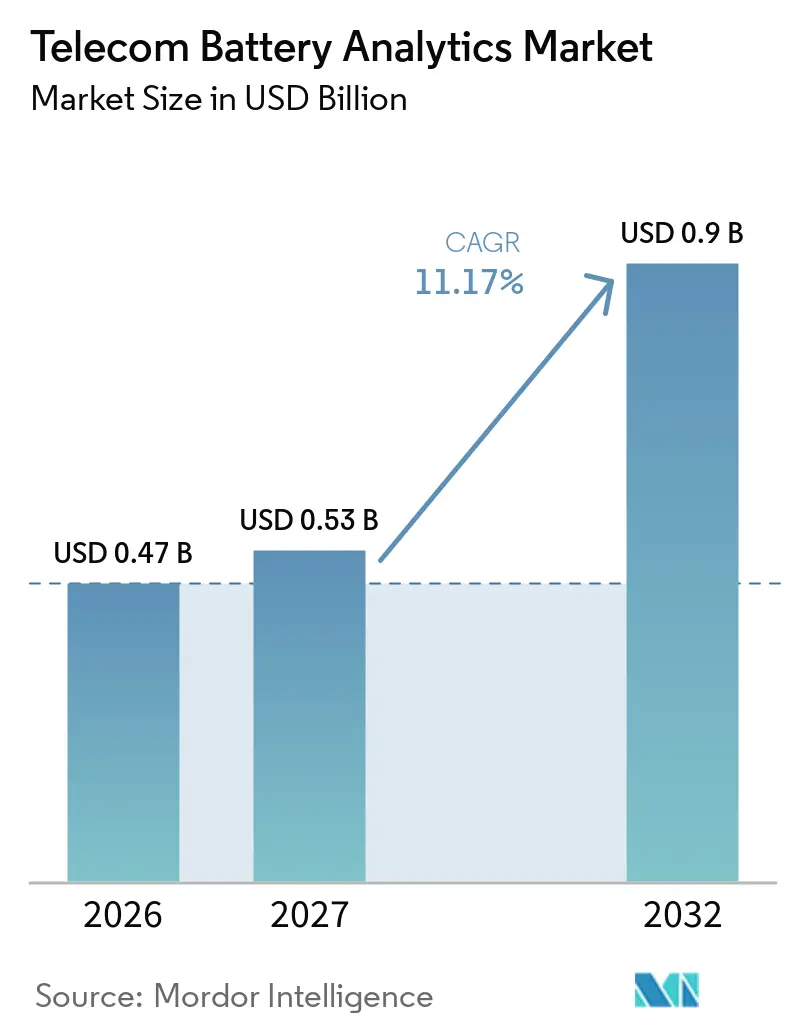
The Telecom Battery Analytics Market size is expected to increase from USD 0.47 billion in 2026 to USD 0.53 billion in 2027 and reach USD 0.9 billion by 2032, growing at a CAGR of 11.17% over 2027-2032. The telecom battery analytics market is becoming central to site availability as 5G networks increase power demand and add more distributed equipment. A 5G base station can use 3 to 6 times as much electricity as a 4G site, while multi-band sites can exceed 10 kW, and multi-carrier configurations can exceed 20 kW, underscoring the importance of continuous battery monitoring. Operators are moving from periodic inspection toward predictive maintenance because battery condition affects outage exposure, replacement planning, and operating costs. The telecom battery analytics market also benefits from greater use of lithium-ion batteries, hybrid power systems, and centralized network operations centers. Suppliers are responding by combining monitoring equipment, analytics software, and energy management services, while remote-site operators are seeking platforms that work with mixed battery fleets.
Key Report Takeaways
- By component, hardware held 44.36% of the telecom battery analytics market share in 2026, while software is projected to expand at a 12.78% CAGR through 2032.
- By analytics function, voltage and temperature monitoring accounted for 30.42% of the telecom battery analytics market size in 2026, while remaining-useful-life prediction is expected to record a 12.94% CAGR through 2032.
- By deployment mode, cloud held 43.58% of the telecom battery analytics market share in 2026, while edge and hybrid deployment is projected to advance at a 12.62% CAGR through 2032.
- By battery chemistry, VRLA accounted for 40.76% of the telecom battery analytics market share in 2026, while lithium-ion is expected to expand at a 12.86% CAGR through 2032.
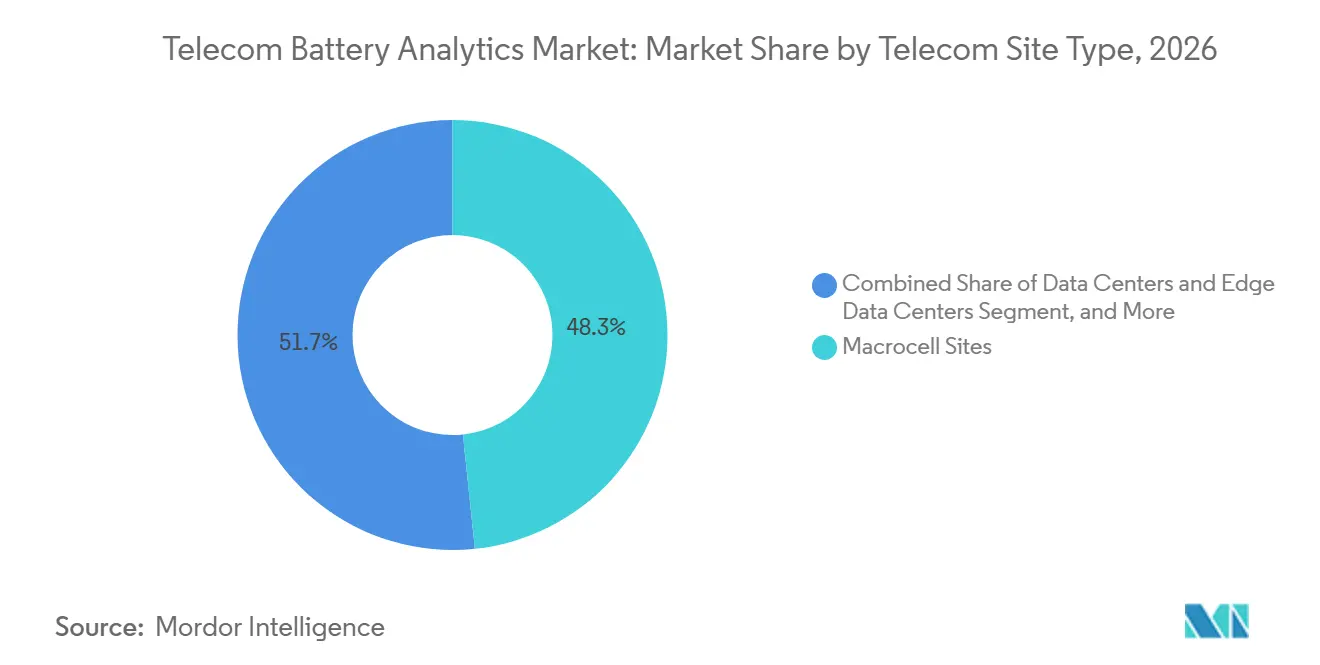
- By telecom site type, macrocell sites held 48.34% of the telecom battery analytics market share in 2026, while data centers and edge data centers are projected to register a 12.73% CAGR through 2032.
- By customer type, mobile network operators accounted for 46.52% share in 2026, while Telecom Energy-as-a-Service Providers are expected to record a 12.98% CAGR through 2032.
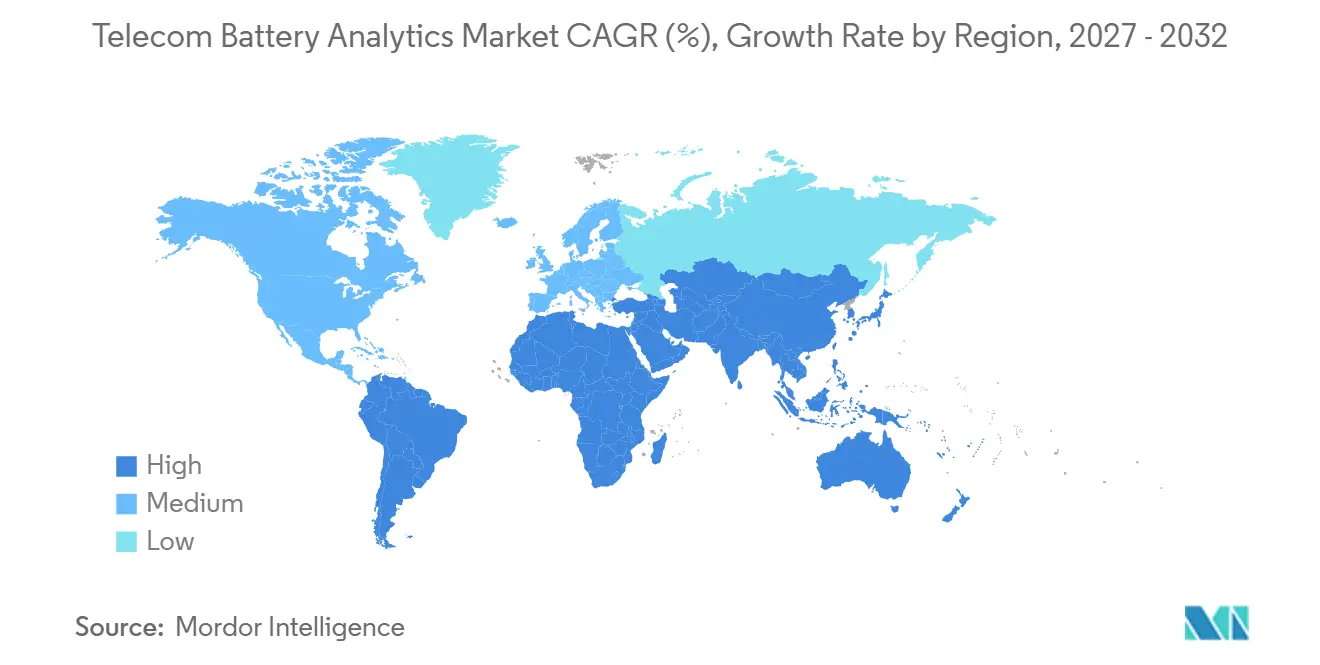
- By geography, Asia-Pacific held 36.24% share in 2026, while Africa is projected to expand at a 12.68% CAGR through 2032.
Note: Market numbers in this report are based on Mordor Intelligence's proprietary estimation framework, which combines nine months of actuals with Q4 projections for base year 2026.
Global Telecom Battery Analytics Market Trends and Insights
Drivers Impact Analysis*
| Driver | (~) % Impact on CAGR Forecast | Geographic Relevance | Impact Timeline |
|---|---|---|---|
| 5G Network Densification and Site Power Complexity | +3.0% | Global, concentrated in China, South Korea, and India | Short term (≤ 2 years) |
| Predictive Battery Lifecycle Management | +2.5% | Global | Medium term (2-4 years) |
| Remote and Poor-Grid Telecom Site Expansion | +2.0% | Africa, South and Southeast Asia, South America | Medium term (2-4 years) |
| Lithium-Ion and Hybrid Battery Deployment | +1.5% | Global, led by Asia-Pacific | Medium term (2-4 years) |
| Centralized Multi-Site Network Operations Center Visibility | +1.1% | North America and Europe | Short term (≤ 2 years) |
| Telecom Energy Optimization and Carbon-Reduction Commitments | +0.8% | Europe, Asia-Pacific, and North America | Long term (≥ 4 years) |
| Source: Mordor Intelligence | |||
5G Network Densification and Rising Telecom Site Power Complexity
5G architecture raises site power requirements beyond the limits of older battery sizing practices and manual inspection schedules. More than 30% of global sites need grid modernization to support 5G access, and this work can take 1 year per site, leaving batteries to carry unplanned backup loads during the transition. The wider use of small cells also increases the number of endpoints that operators need to supervise. This makes manual inspection costly and difficult to manage across large networks. A 2025 Applied Energy study found that backup storage used as a dispatchable grid resource needs real-time state-of-charge monitoring with deviation below 5%. These requirements are placing analytics hardware and software within the initial power design for new 5G sites.
Shift From Preventive Maintenance to Predictive Battery Lifecycle Management
Fixed replacement intervals can retire usable VRLA batteries too early and still fail to identify problems that occur between inspections. Predictive platforms combine voltage, temperature, impedance, and operating history to identify deteriorating strings before they affect site availability. Servato states that its system processes more than 100 million hours of battery data each year and can identify failures up to 3 months in advance. Predictive maintenance also lets operators schedule replacement activities around supply availability rather than relying on emergency purchases. Emergency single-unit procurement can carry a 30% to 50% cost premium, which brings battery condition data into capital planning. This shift supports the telecom battery analytics market because operators need a consistent view of battery life across sites and equipment types.
Expansion of Remote and Poor-Grid Telecom Sites
Remote and poor-grid sites are creating sustained demand for battery monitoring because batteries often act as the primary power source. GSMA reports that 32% of mobile base stations in Africa, close to 96,000 sites, operate off-grid or on weak grids. IFC committed USD 45 million in March 2026 to IPT PowerTech to modernize 2,235 telecom sites in Ethiopia, Liberia, and Sierra Leone, with more than 90% of the sites classified as off-grid or on weak grid.[1] The project targets power cost reductions of up to 52% in Ethiopia through improved solar-battery hybrid management. Remote locations often produce less complete telemetry than urban macrocell sites, even though they require more battery oversight. Local data processing can reduce this gap by assessing sensor inputs on-site before sending changes and alerts to a central system.
Growth of Lithium-Ion and Hybrid Battery Deployments
Lithium-ion batteries, particularly lithium iron phosphate systems, are replacing VRLA batteries at new telecom sites because they provide higher energy density, longer cycle life, and native digital communications. The ITU states that high-quality lithium-ion batteries for telecom use should support remote monitoring of voltage, current, temperature, state of charge, and state of health.[2] It also specifies detection deviation below 5% for voltage-related measures and below 10% for state-of-health monitoring. Amara Raja Energy and Mobility exceeded 1 GWh of cumulative lithium battery deployment in India’s telecom sector in April 2026 and is targeting 2 GWh by year-end.[3] Digital battery management systems collect data more frequently than analog VRLA monitoring. That richer data supports faster development of remaining-useful-life models and fleet-wide operational comparisons.
Restraints Impact Analysis*
| Restraint | (~) % Impact on CAGR Forecast | Geographic Relevance | Impact Timeline |
|---|---|---|---|
| Legacy Telemetry and Multi-Vendor Integration Gaps | -1.70% | Global, most acute in emerging markets | Medium term (2-4 years) |
| Limited Return-on-Investment Visibility for Brownfield Monitoring Retrofits | -1.30% | Global | Medium term (2-4 years) |
| Cybersecurity and Data-Sovereignty Concerns Across Distributed Sites | -0.90% | Europe, North America, and Asia-Pacific | Long term (≥ 4 years) |
| Inconsistent Site Data Quality and Weak Sensor Calibration Discipline | -0.50% | Africa, South America, and the Middle East | Long term (≥ 4 years) |
| Source: Mordor Intelligence | |||
Legacy Telemetry and Multi-Vendor Integration Gaps
Telecom networks usually contain battery systems acquired across several procurement cycles and from different suppliers. These systems can use incompatible protocols, data formats, and monitoring interfaces. Integrating them into a single platform may require custom protocol adapters and data normalization layers, which can cost as much as the analytics software license. Older VRLA strings may use proprietary serial interfaces or lack a digital interface. Idaho National Laboratory identified incomplete asset inventories, unencrypted communication protocols, and unmanaged switches as continuing weaknesses in distributed operational technology environments.[4] The sites with the oldest fleets can therefore have the greatest need for analytics, but provide the least complete data for analytics models.
Limited Return-on-Investment Visibility for Brownfield Monitoring Retrofits
Battery analytics retrofits can avoid costs across field maintenance, battery replacement, outage penalties, and diesel use. These savings often sit in separate budgets, making it difficult to present the full payback within a single approval process. Even a deployment with a total cost of ownership payback period below 24 months may be delayed when each cost center sees only a small benefit. Tower-sharing arrangements add another obstacle because the party funding the platform may not receive the maintenance savings. Some operators are positioning monitoring as an energy-management and carbon-reduction investment rather than as a stand-alone maintenance tool. This approach can place decisions under sustainability budgets that can accommodate longer investment horizons.
*Our forecasts treat driver/restraint impacts as directional, not additive. The impact forecasts reflect baseline growth, mix effects, and variable interactions.
Segment Analysis
By Component: Hardware Anchors the Installed Base, While Software Commands the Growth Premium
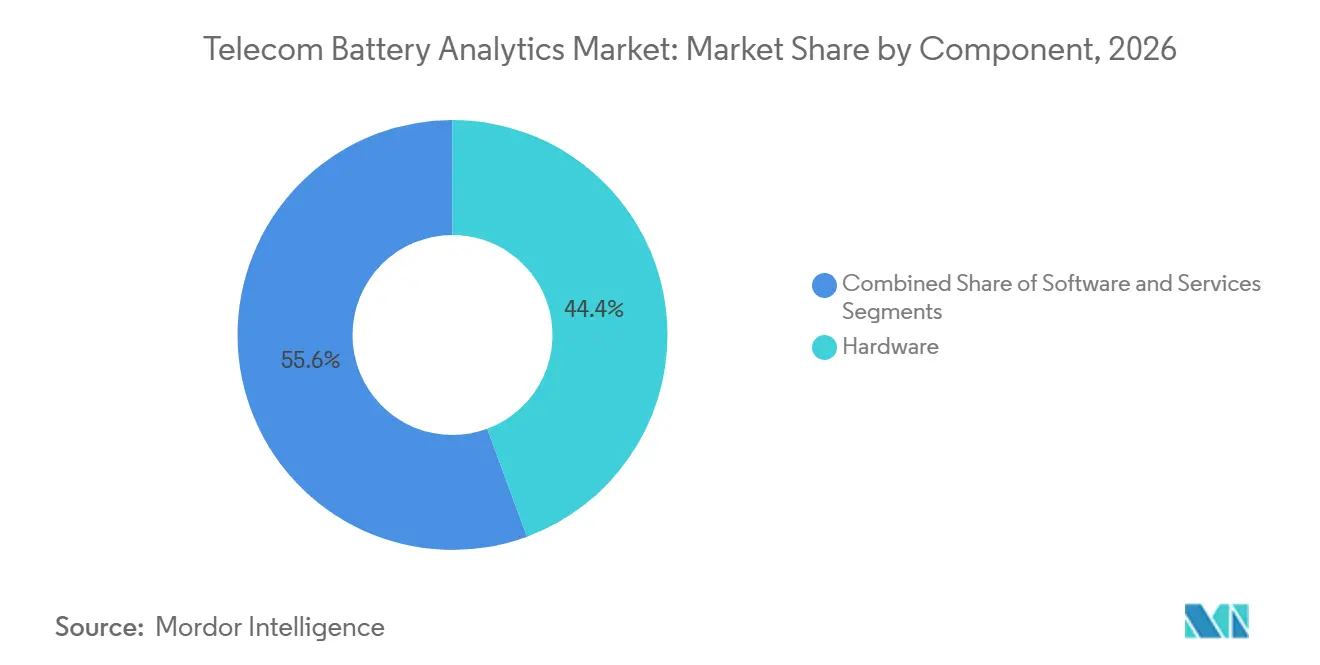
Hardware held 44.36% share in 2026 because every monitored site requires sensors, controllers, and data-acquisition equipment. These devices establish the site-level data needed for subsequent analytical functions. New 5G sites create demand for hardware as part of their initial power installation. Brownfield sites also require new sensors when operators need more frequent or more reliable data. The telecom battery analytics market size for hardware, therefore, remains linked to both new site construction and upgrades to existing equipment.
Software is projected to expand at a 12.78% CAGR through 2032 as operators seek state-of-health estimates, fleet dashboards, and links to network operations center systems. Services such as installation, calibration, and managed analytics subscriptions also increase as operators adopt outcome-based contracts. Software can identify patterns across thousands of battery strings that site-level equipment alone cannot show. ITU-T Recommendation L.1397, published in October 2025, defines monitoring and control interfaces for battery systems in ICT networks, including objects representing state of charge, state of health, voltage, current, and temperature. The standard can reduce uncertainty in procurement specifications and support upgrades at sites with limited digital communication capabilities.

By Analytics Function: Foundational Monitoring Holds Share, While Prognostic Capabilities Lead Growth
Voltage and temperature monitoring accounted for 30.42% of the telecom battery analytics market size in 2026. It supplies continuous measurements of cell-level voltage variation, thermal gradients, and float-voltage drift. These measurements serve as the basis for more advanced battery analytics. State-of-charge analysis estimates available backup time at a site. State-of-health analysis tracks cumulative degradation and supports replacement planning.
Remaining-useful-life prediction is projected to expand at a 12.94% CAGR through 2032. It uses historical charge-discharge patterns and impedance movement to estimate when a battery will no longer meet service requirements. Energy consumption and battery autonomy analytics examine site loads, discharge behavior, and renewable generation inputs. A 2025 IEEE Industrial Electronics Society paper described a battery digital twin that estimated state of charge and detected stealthy cyberattacks by comparing model output with sensor data. This type of design reflects the security and condition-monitoring capabilities that are moving into commercial remaining-useful-life tools.
By Deployment Mode: Cloud Leads in Scale, While Edge and Hybrid Platforms Support Distributed Management
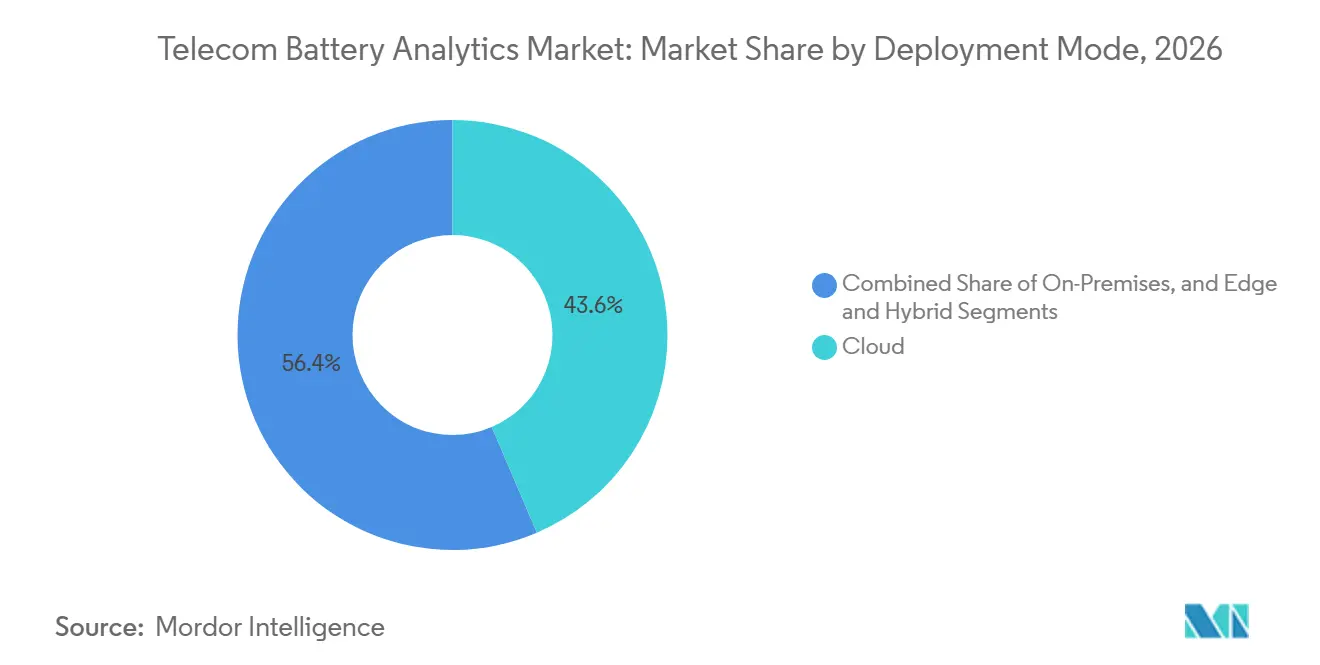
Cloud deployment held 43.58% share in 2026 because it enables multi-site monitoring without local computing infrastructure at every site. It gives operators a centralized view of alerts, trends, and battery condition across dispersed assets. The model can be useful where sites have dependable backhaul connectivity. It also supports fleet-level reporting and remote specialist oversight. Cloud platforms can reduce the operating burden of maintaining analytical infrastructure at individual locations.
Edge and hybrid platforms are projected to record a 12.62% CAGR through 2032. They address the intermittent and low-bandwidth connections common at remote sites, including a large share of African base stations that operate off-grid or on weak grids. Edge systems pre-analyze information locally and transmit state changes or anomaly flags rather than continuous raw data. On-premises systems remain relevant where data-sovereignty requirements restrict the movement of critical-infrastructure telemetry. The telecom battery analytics industry uses these deployment approaches to meet varying connectivity, latency, and data governance requirements.
By Battery Chemistry: Lead-Acid Heritage Sustains Dominance, While Lithium-Ion Changes Replacement Economics
VRLA batteries held 40.76% share in 2026 because they remain prevalent across the installed telecom base. Their capacity can decline without clear warning until a discharge event exposes the loss of backup capability. This failure profile created much of the early demand for battery monitoring. Vented lead-acid batteries remain in some large central-office applications. Nickel-cadmium batteries also continue to be used in selected legacy railroad-adjacent telecom sites.
Lithium-ion is projected to advance at a 12.86% CAGR through 2032 and requires different analytical capabilities. Operators need cell-level voltage balancing, thermal-runaway monitoring, and state-of-health analysis capable of detecting lithium plating and electrolyte dry-out. Lead-carbon has a smaller role in solar-hybrid sites where standard VRLA batteries can degrade under deep daily cycling. The ITU identifies end-to-end safety systems and mandatory cell-level monitoring as requirements for the use of lithium-ion batteries in critical infrastructure. Mixed fleets increase the value of platforms that can assess multiple battery chemistries through a single operational interface.
By Telecom Site Type: Macrocell Volume Underpins Demand, While Data Centers Lead Growth
Macrocell sites accounted for 48.34% share in 2026. Their large presence in the global network footprint and rising 5G power loads make reliable battery backup a site-availability requirement. Small-cell deployments add monitoring volume as operators extend mid-band and millimeter-wave coverage. In dense urban areas, small-cell counts can exceed macrocell numbers by 5 to 10 times. Central offices and switching facilities use larger battery strings in controlled indoor environments and often connect their analytics systems to building-management tools.
Data centers and edge data centers are projected to expand at a 12.73% CAGR through 2032. Fiber and broadband cabinets also create monitoring opportunities, as fiber-to-the-premises deployment broadens the distributed infrastructure base. Delta Electronics presented its Grid-to-Chip approach at Data Center World Frankfurt in May 2026, combining battery backup and monitoring for data-center applications. This move shows how suppliers are extending their power analytics offerings into adjacent computing infrastructure. The telecom battery analytics market can therefore benefit from the increasing overlap between connectivity assets and distributed computing sites.
By Customer Type: Operators Command the Largest Share, While Energy-as-a-Service Models Lead Growth
Mobile network operators held 46.52% share in 2026 because they operate the largest number of sites and often own the battery assets directly. They also have the strongest need to limit outage risk through data-based maintenance. Tower companies are the next major customer group because they have uptime commitments to tenant operators. Fleet-level battery analytics can support their position in tower-leasing discussions. Internet service providers and wholesale network operators increase demand, as fiber and broadband cabinet networks require more systematic monitoring.
Telecom Energy-as-a-Service Providers are projected to expand at a 12.98% CAGR through 2032. These providers include analytics within contracts that guarantee uptime and power-cost targets. The monitoring platform becomes an operational control layer rather than a discretionary purchase by the operator. IFC’s March 2026 investment in IPT PowerTech demonstrates how financing can embed battery analytics within the broader power service agreement. This model can align analytics costs with the party responsible for energy performance.
Geography Analysis
Asia-Pacific held 36.24% of the telecom battery analytics market share in 2026, supported by the world’s largest concentration of 5G infrastructure. China had deployed more than 4 million 5G base stations by early 2025, creating a large installed base that requires careful power management. China’s 5G power use is projected to account for 2.1% of national energy consumption in 2026, which increases the need for real-time site energy and battery visibility. India has more than 700,000 tower sites, and intermittent grid supply creates a need for durable monitoring at many locations. In April 2026, KDDI, in partnership with Kyushu Electric Power Company, activated Open Power Station equipment at 300 base stations in Japan’s Kyushu region, enabling remote battery monitoring and renewable-linked charge-discharge control.
Europe and North America form the second major group of mature demand for the telecom battery analytics market. European operators balance emissions targets with data-sovereignty requirements, which can support regional-cloud and on-premises deployment models. Elisa Estonia deployed Elisa Industriq’s Gridle battery optimization platform in May 2026 to participate in Estonia’s electricity balancing system. North America is supported by 5G build-out and aging VRLA fleets, while South America adds demand through Brazil’s 5G rollout and rural coverage obligations.
Africa is projected to record a 12.68% CAGR through 2032, the highest regional rate in the telecom battery analytics market. As of September 2025, 53 operators in 29 African markets had launched commercial 5G services, while unreliable grids and diesel dependence remained key commercial constraints. IFC’s USD 45 million financing for IPT PowerTech covers 2,235 sites in Ethiopia, Liberia, and Sierra Leone, embedding solar and battery hybrid management into telecom power modernization. The Middle East is supported by high-capital 5G investment and centralized network operations center platforms that include battery monitoring. These regional patterns connect the telecom battery analytics market to both advanced grid services and basic site-resilience requirements.
Competitive Landscape
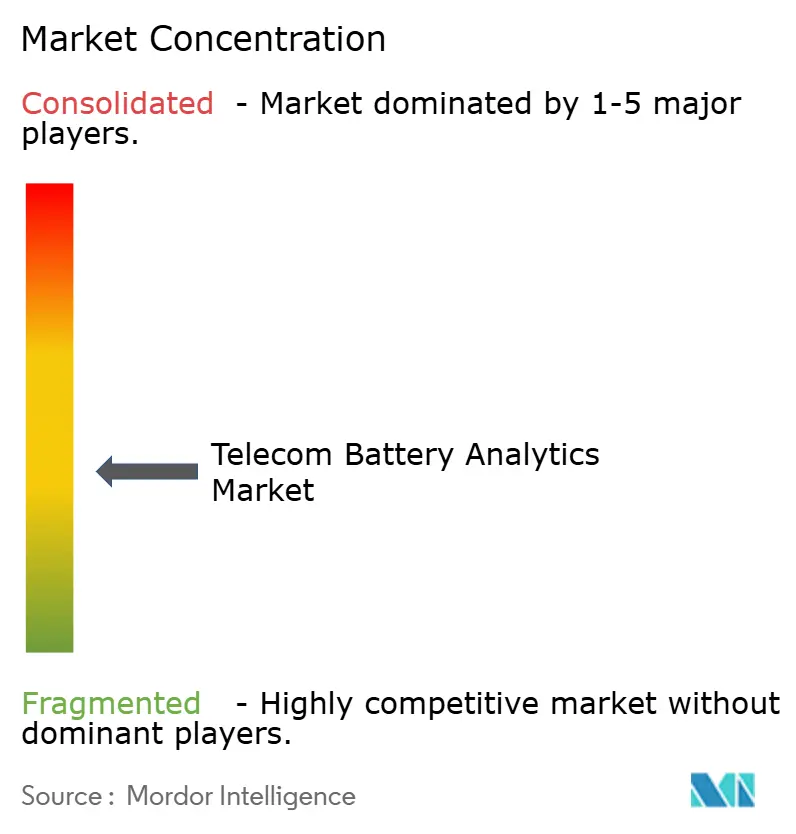
The telecom battery analytics market is moderately fragmented because no supplier holds a dominant position across all equipment types, chemistries, and deployment model. Vertiv Holdings Co., Schneider Electric SE, Eaton Corporation plc, and Huawei Technologies Co., Ltd. integrate battery monitoring into DC power and uninterruptible power supply platforms. Their established operator relationships enable them to combine hardware, software subscriptions, and managed services into a single offering. Huawei uses a vertically integrated model that includes equipment, battery supply, and Site Power virtual power plant capabilities. Its platform can aggregate up to 10,000 telecom sites in a cluster, with response time below 7.5 seconds and control accuracy above 95%.
Analytics-focused suppliers such as BTECH, Inc., Servato Corp., PowerShield Pty Ltd, Eagle Eye Power Solutions, LLC, and Franklin Grid Solutions compete through detailed string-level data and multi-vendor compatibility. This capability matters where operator fleets contain both lead-acid and lithium-ion assets. A unified interface with chemistry-specific state-of-health models can reduce the need for parallel monitoring tools. Battery digital twins that compare predicted and observed data also support condition monitoring and cyber-risk detection.
Energy-market integration is creating a further area of differentiation in the telecom battery analytics market. Elisa Industriq’s Gridle platform enables mobile-network batteries to support grid balancing in Estonia while optimizing charging and discharging. Vertiv integrated its EnergyCore Grid battery storage system with CPower’s virtual power plant platform in April 2026, enabling participating data centers in the United States to use stored energy in demand-response and ancillary-service programs. These moves extend battery analytics beyond maintenance and outage prevention.
Telecom Battery Analytics Industry Leaders
-
Vertiv Holdings Co.
-
Schneider Electric SE
-
Eaton Corporation plc
-
Delta Electronics, Inc.
-
Huawei Technologies Co., Ltd.
- *Disclaimer: Major Players sorted in no particular order
Recent Industry Developments
- April 2026: Vertiv integrated its EnergyCore Grid battery energy storage system with CPower’s virtual power plant platform, enabling data centers in the United States to monetize on-site storage through demand response and ancillary grid services, validated by a 1 MW microgrid demonstration at Vertiv’s Ohio Customer Experience Center that generated demand response revenue across PJM programs.
- December 2025: Vertiv launched the EnergyCore Grid, a modular utility-grade battery energy storage system that uses lithium iron phosphate cells with integrated power conversion and energy management controls, now available in North America and scalable from 1 MW to over 200 MW.
- November 2025: Vertiv unveiled the PowerDirect 7100 Energy hybrid DC power system across EMEA, delivering up to 52 kW of 48V DC power at up to 98% efficiency with remote monitoring and energy scheduling via the NetSure Control Unit for on-grid, off-grid, and hybrid telecom environments.
- October 2025: Schneider Electric launched the Schneider Boost Pro battery energy storage solution across Europe, scalable from 200 kWh to 2 MWh, with AI-driven analytics via the EcoStruxure Microgrid Advisor cloud platform and cybersecurity protection that meets IEC 62443-applicable security levels.
Global Telecom Battery Analytics Market Report Scope
The Telecom Battery Analytics Market Report is Segmented by Component (Hardware, Software and Services), Analytics Function (Voltage and Temperature Monitoring, State-of-Charge Analytics, State-of-Health Analytics, Remaining-Useful-Life Prediction, Energy Consumption and Battery Autonomy Analytics, and Other Analytics Functions), Deployment Mode (Cloud, On-Premises, and Edge and Hybrid), Battery Chemistry (Valve-Regulated Lead-Acid, Vented Lead-Acid, Lithium-Ion, Nickel-Cadmium, Lead-Carbon, and Other Battery Chemistries), Telecom Site Type (Macrocell Sites, Small Cell Sites, Central Offices and Switching Facilities, Data Centers and Edge Data Centers, and Fiber and Broadband Cabinets), Customer Type (Mobile Network Operators, Tower Companies, Internet Service Providers, Wholesale Network Operators, and Telecom Energy-as-a-Service Providers), and Geography (North America, South America, Europe, Asia-Pacific, Middle East, and Africa). The Market Forecasts are Provided in Terms of Value (USD).
| Hardware |
| Software |
| Services |
| Voltage and Temperature Monitoring |
| State-of-Charge Analytics |
| State-of-Health Analytics |
| Remaining-Useful-Life Prediction |
| Energy Consumption and Battery Autonomy Analytics |
| Other Analytics Functions |
| Cloud |
| On-Premises |
| Edge and Hybrid |
| Valve-Regulated Lead-Acid |
| Vented Lead-Acid |
| Lithium-Ion |
| Nickel-Cadmium |
| Lead-Carbon |
| Other Battery Chemistries |
| Macrocell Sites |
| Small Cell Sites |
| Central Offices and Switching Facilities |
| Data Centers and Edge Data Centers |
| Fiber and Broadband Cabinets |
| Mobile Network Operators |
| Tower Companies |
| Internet Service Providers |
| Wholesale Network Operators |
| Telecom Energy-as-a-Service Providers |
| North America | United States |
| Canada | |
| Mexico | |
| South America | Brazil |
| Argentina | |
| Rest of South America | |
| Europe | Germany |
| United Kingdom | |
| France | |
| Italy | |
| Spain | |
| Russia | |
| Rest of Europe | |
| Asia-Pacific | China |
| India | |
| Japan | |
| South Korea | |
| Australia | |
| Rest of Asia-Pacific | |
| Middle East | Saudi Arabia |
| United Arab Emirates | |
| Rest of Middle East | |
| Africa | South Africa |
| Nigeria | |
| Rest of Africa |
| By Component | Hardware | |
| Software | ||
| Services | ||
| By Analytics Function | Voltage and Temperature Monitoring | |
| State-of-Charge Analytics | ||
| State-of-Health Analytics | ||
| Remaining-Useful-Life Prediction | ||
| Energy Consumption and Battery Autonomy Analytics | ||
| Other Analytics Functions | ||
| By Deployment Mode | Cloud | |
| On-Premises | ||
| Edge and Hybrid | ||
| By Battery Chemistry | Valve-Regulated Lead-Acid | |
| Vented Lead-Acid | ||
| Lithium-Ion | ||
| Nickel-Cadmium | ||
| Lead-Carbon | ||
| Other Battery Chemistries | ||
| By Telecom Site Type | Macrocell Sites | |
| Small Cell Sites | ||
| Central Offices and Switching Facilities | ||
| Data Centers and Edge Data Centers | ||
| Fiber and Broadband Cabinets | ||
| By Customer Type | Mobile Network Operators | |
| Tower Companies | ||
| Internet Service Providers | ||
| Wholesale Network Operators | ||
| Telecom Energy-as-a-Service Providers | ||
| By Geography | North America | United States |
| Canada | ||
| Mexico | ||
| South America | Brazil | |
| Argentina | ||
| Rest of South America | ||
| Europe | Germany | |
| United Kingdom | ||
| France | ||
| Italy | ||
| Spain | ||
| Russia | ||
| Rest of Europe | ||
| Asia-Pacific | China | |
| India | ||
| Japan | ||
| South Korea | ||
| Australia | ||
| Rest of Asia-Pacific | ||
| Middle East | Saudi Arabia | |
| United Arab Emirates | ||
| Rest of Middle East | ||
| Africa | South Africa | |
| Nigeria | ||
| Rest of Africa | ||
Key Questions Answered in the Report
What is the telecom battery analytics market size?
The telecom battery analytics market is valued at USD 0.47 billion in 2026 and is forecast to reach USD 0.90 billion by 2032 at an 11.17% CAGR.
What is driving adoption of telecom battery analytics?
The telecom battery analytics market is supported by 5G power requirements, remote-site expansion, predictive maintenance needs, and lithium-ion deployment.
Which component holds the largest share?
Within the telecom battery analytics market, hardware holds 44.36% share in 2026 because each monitored site needs sensors, controllers, and data-acquisition units.
Which analytics function is expanding fastest?
In the telecom battery analytics market, remaining-useful-life prediction is projected to record a 12.94% CAGR through 2032 as operators seek better replacement planning and early fault detection.
Which region is expected to expand fastest?
Africa is projected to record a 12.68% CAGR through 2032 in the telecom battery analytics market, supported by off-grid and weak-grid telecom sites.
Who are the main suppliers in telecom battery analytics?
Companies active in the telecom battery analytics market include Vertiv, Schneider Electric, Eaton, Huawei, BTECH, Servato, PowerShield, Eagle Eye Power Solutions, and Franklin Grid Solutions.