
Telco Kubernetes Operations Market Size and Share
Market Overview
| Study Period | 2020 - 2031 |
|---|---|
| Market Size (2026) | USD 2.36 Billion |
| Market Size (2031) | USD 6.18 Billion |
| Growth Rate (2026 - 2031) | 21.23 % |
| Fastest Growing Market | Asia-Pacific |
| Largest Market | North America |
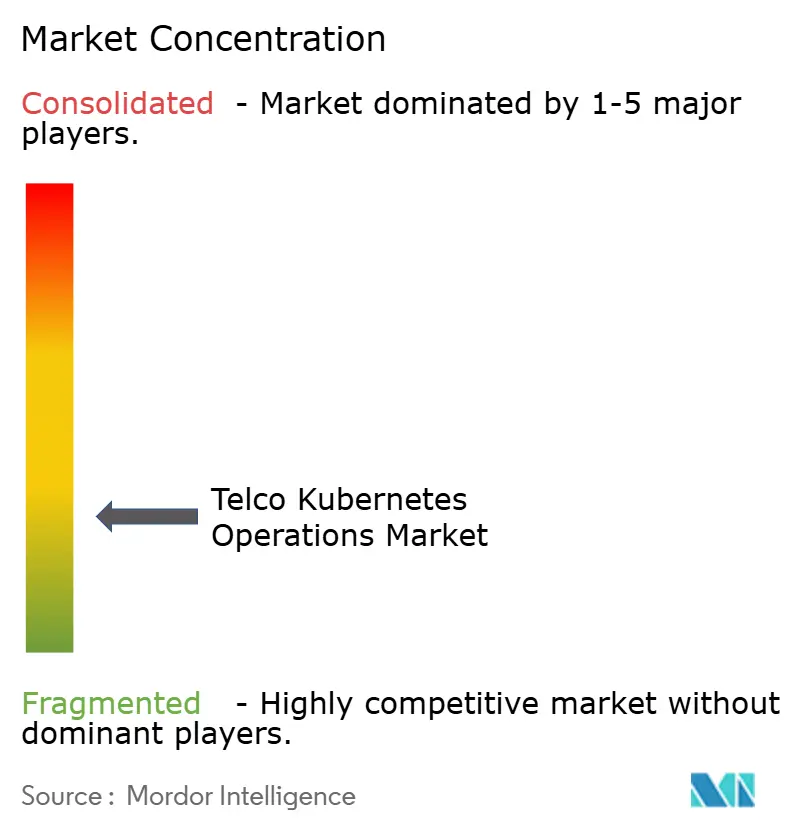
| Market Concentration | Low |
Major Players *Disclaimer: Major Players sorted in no particular order Image © Mordor Intelligence. Reuse requires attribution under CC BY 4.0. | |
Telco Kubernetes Operations Market Analysis by Mordor Intelligence
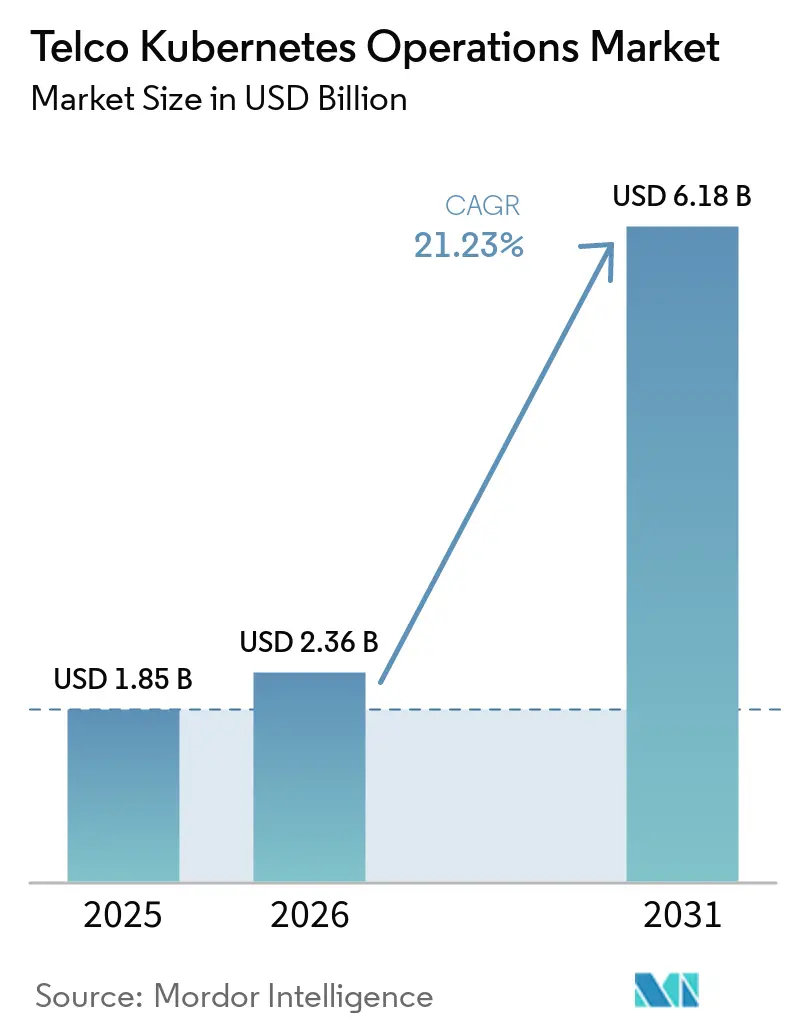
The telco Kubernetes operations market size was valued at USD 1.85 billion in 2025 and estimated to grow from USD 2.36 billion in 2026 to reach USD 6.18 billion by 2031, at a CAGR of 21.23% during the forecast period (2026-2031). The shift from dedicated network appliances toward software-defined platforms is expanding demand for Kubernetes-based operations. Standalone 5G core networks need consistent orchestration across core, radio, and edge environments. Operators are also moving adjacent functions, including IMS, policy control, and charging, onto the same platform. This approach raises the value of lifecycle management, automation, governance, and managed operations. Open reference architectures are making basic platform features more common, while increasing the value of automation and service delivery.
Key Report Takeaways
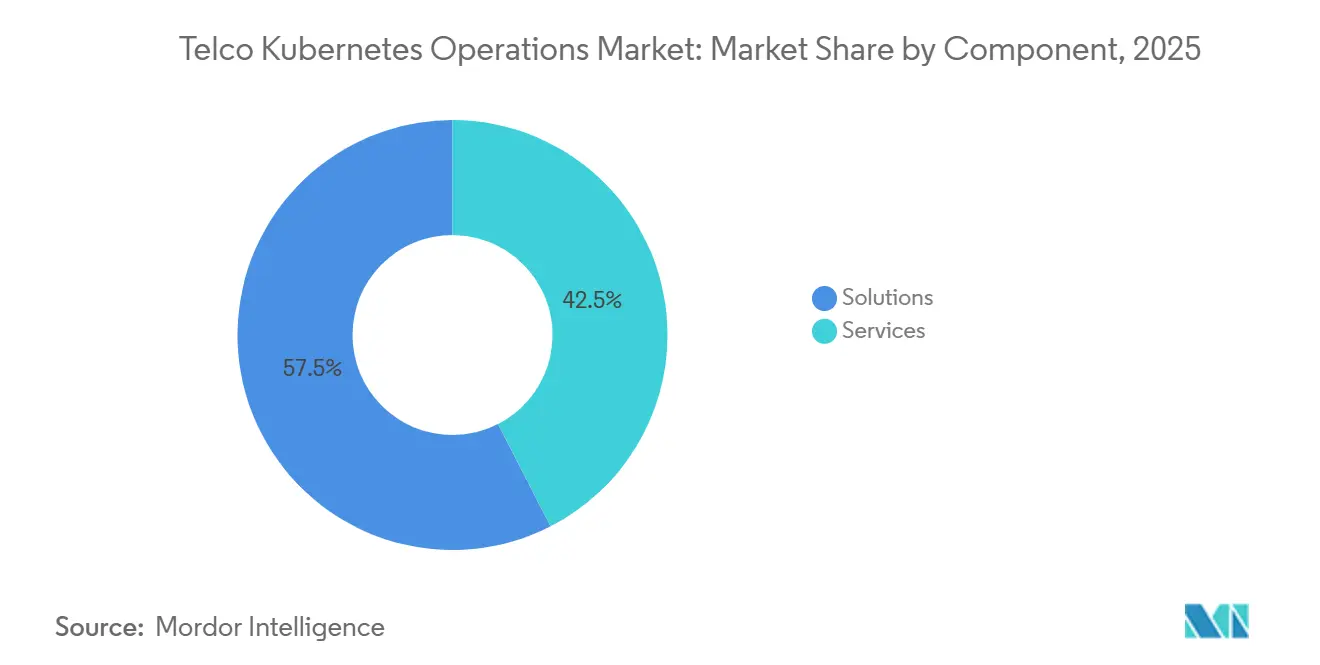
- By component, solutions held 57.54% of the telco Kubernetes operations market share in 2025, while services are projected to expand at a 23.46% CAGR through 2031.
- By deployment model, on-premise deployments held 52.44% share in 2025, while cloud deployments are expected to expand at a 22.08% CAGR through 2031.
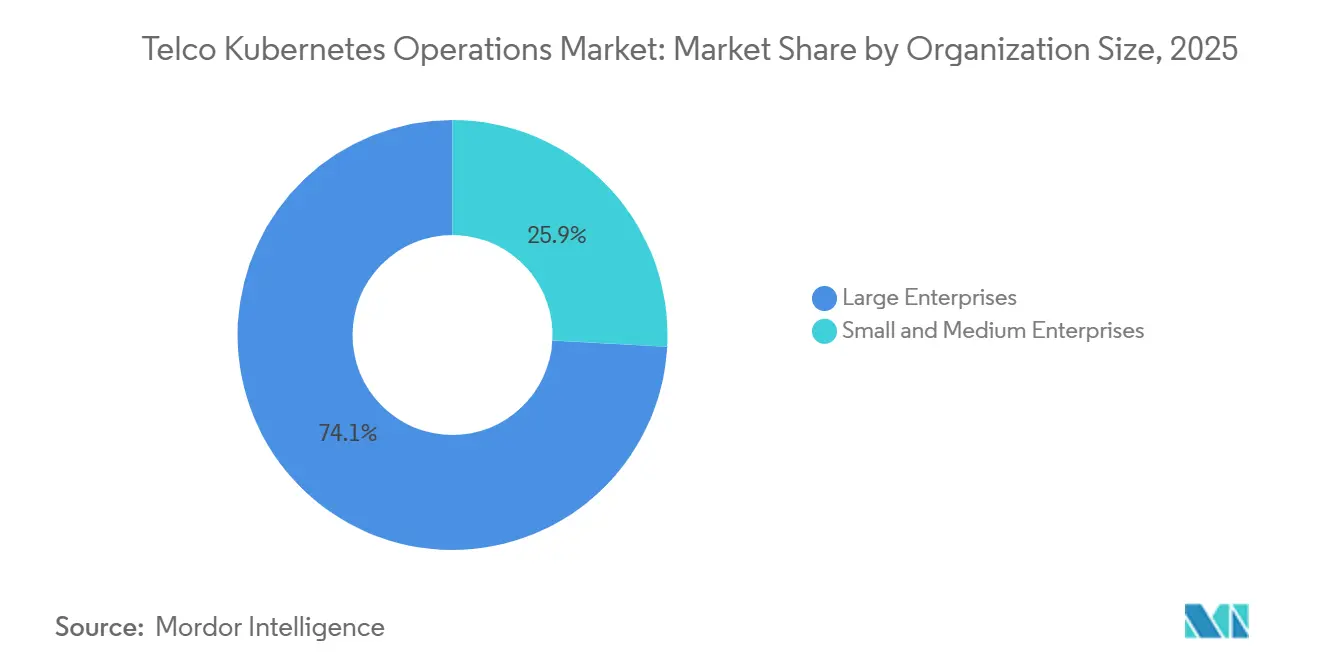
- By organization size, large enterprises held 74.13% share in 2025, while small and medium enterprises are projected to expand at a 22.43% CAGR through 2031.
- By application, Cloud-Native 5G Core held 39.49% share in 2025, while edge computing and multi-access edge computing are expected to expand at a 21.89% CAGR through 2031.
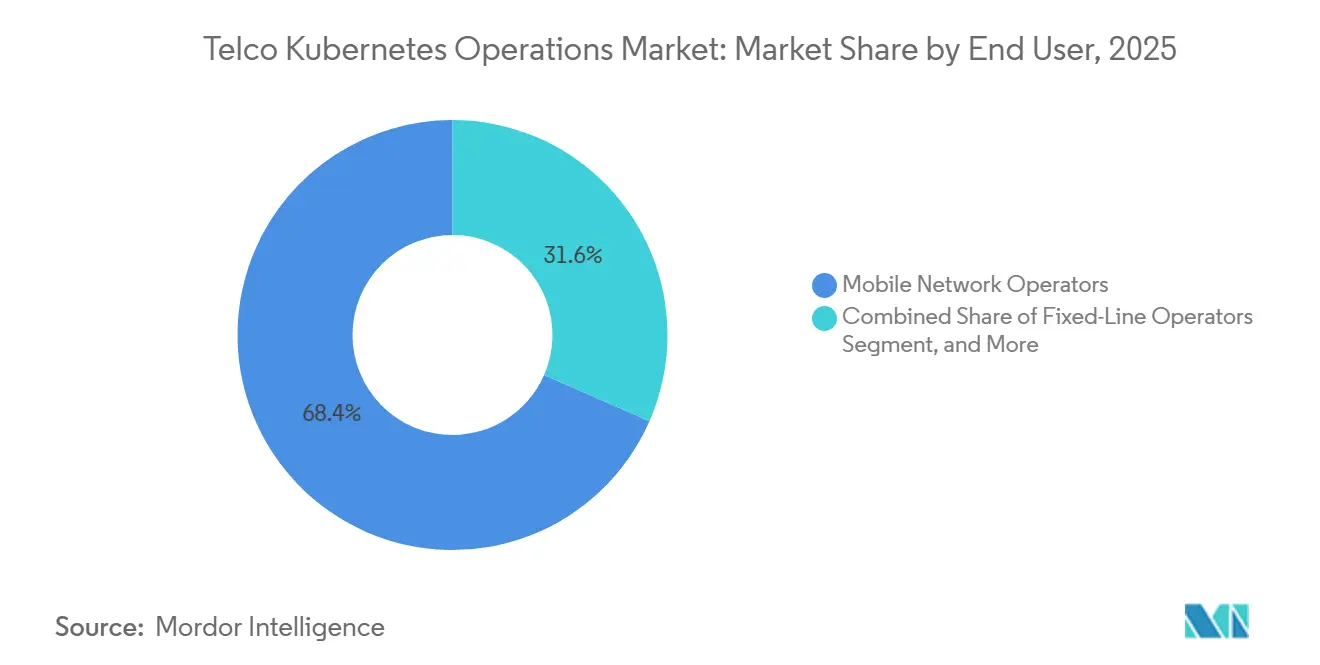
- By end user, mobile network operators held 68.43% share in 2025, while cloud service providers and managed service providers are projected to expand at a 22.32% CAGR through 2031.
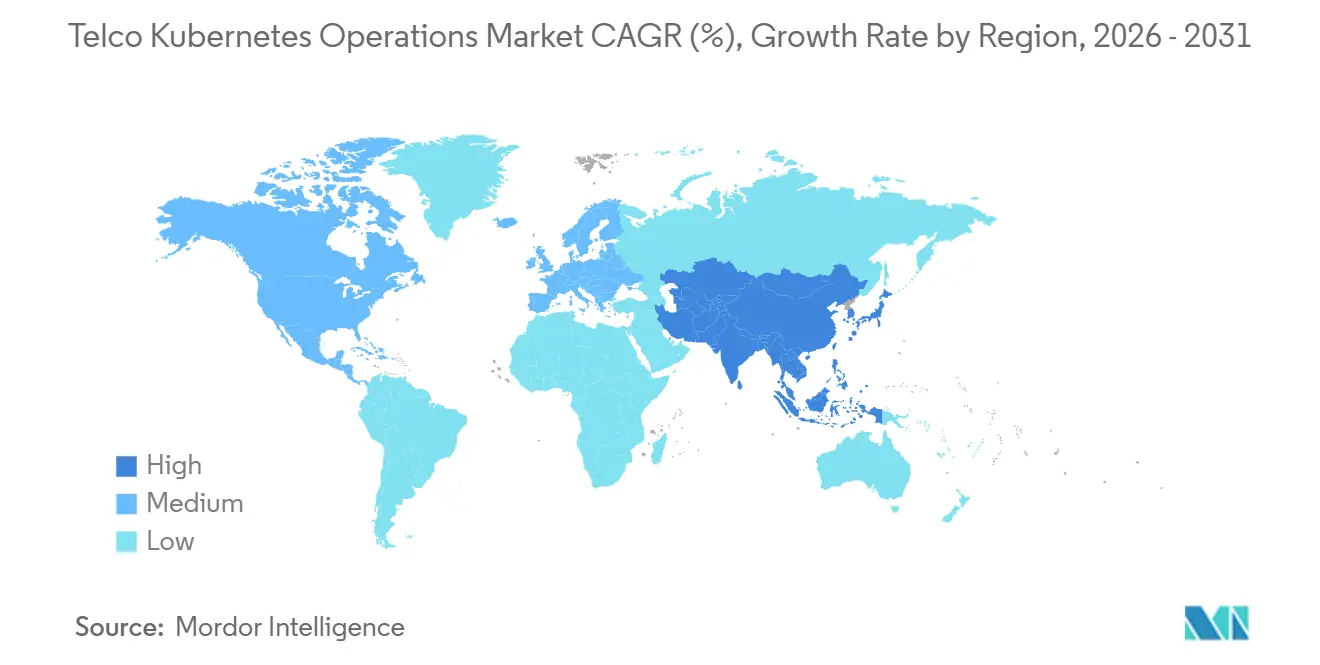
- By geography, North America held 73.44% share in 2025, while Asia-Pacific is expected to expand at a 22.76% CAGR through 2031.
Note: Market size and forecast figures in this report are generated using Mordor Intelligence’s proprietary estimation framework, updated with the latest available data and insights as of January 2026.
Market Trends and Insights
Drivers Impact Analysis of Telco Kubernetes Operations Market*
| Driver | (~) % Impact on CAGR Forecast | Geographic Relevance | Impact Timeline |
|---|---|---|---|
| 5G Standalone and Cloud-Native Core Rollouts | +5.2% | Global, concentrated gains in North America, Asia-Pacific core markets, and Europe | Short term (≤ 2 years) |
| Edge Site Proliferation and Distributed Workloads | +4.0% | North America, Asia-Pacific, with spillover to the Middle East and Africa | Medium term (2-4 years) |
| Network Function Virtualization and Containerization Economics | +3.6% | Global | Short term (≤ 2 years) |
| Multi-Vendor Network Automation and Zero-Touch Operations | +3.0% | North America and Europe, emerging in South America and the Middle East and Africa | Medium term (2-4 years) |
| Kubernetes-Based AI and Closed-Loop Assurance | +2.3% | North America, Europe, and Asia-Pacific | Medium term (2-4 years) |
| Telco Cloud Interoperability Initiatives and Open Reference Architectures | +1.6% | Europe and North America, with early gains in Asia-Pacific | Long term (≥ 4 years) |
| Source: Mordor Intelligence | |||
5G Standalone and Cloud-Native Core Rollouts
Standalone 5G core rollouts are a direct source of demand for the telco Kubernetes operations market. These core functions use cloud-native designs that need container orchestration at production scale. Once operators use Kubernetes for the 5G core, they have incentives to migrate IMS, policy, and charging functions onto the same environment. NTT DOCOMO launched commercial hybrid 5G Core services on AWS with NEC in March 2026. The deployment used Amazon Bedrock AgentCore and GitOps to automate core design and deployment.[1] The O-RAN Software Community released its L version in July 2025, combining AI and machine learning tools, service management, and non-real-time RAN controller components in a unified Kubernetes environment.
Edge Site Proliferation and Distributed Workloads
Distributed edge deployments are broadening the telco Kubernetes operations market beyond centralized data centers. Each new site needs consistent configuration, software updates, observability, and policy controls. Orange managed several hundred live Kubernetes clusters across more than 12 affiliates using SUSE RKE2.[2] Its Telco Cloud was planned to grow from 8 network functions across 3 affiliates to 200 functions across 25 affiliates by 2027. SUSE Telco Cloud 3.6 added IEEE 1588 precision timing support for downstream edge and RAN clusters in May 2026. This support addresses a production requirement for time-division duplex radio synchronization at distributed sites.
Network Function Virtualization and Containerization Economics
Containerized network functions can reduce idle capacity and shorten maintenance windows across operator infrastructure. They also allow multiple functions to share common hardware instead of relying on dedicated appliances. Deutsche Telekom reported up to 65% energy savings in live 5G Core validation with Mavenir through its Horizontal TelCo Cloud program. The telco Kubernetes operations market benefits when operators replace siloed platforms with a shared cloud layer. ETSI presented a platform-oriented Telco Cloud framework in April 2025. It emphasized software portability, modular scale, and AI-driven orchestration for future networks. These principles support long-term demand for common lifecycle and governance tools.
Multi-Vendor Network Automation and Zero-Touch Operations
Multi-vendor networks create integration work that can delay cloud-native deployments. Declarative automation and zero-touch provisioning help operators manage this work at scale. This need is broadening spending in the telco Kubernetes operations market. Nokia and Ericsson announced mutual ecosystem membership in March 2026. Ericsson joined Nokia's SMO Marketplace, while Nokia joined Ericsson's rApp Ecosystem. The arrangement expands software choices for operators using either platform. NGMN published a Cloud-Native Maturity Model in 2025 that outlines the path from controlled AI use to Level 4 autonomous operations. This framework helps operators assess technology and operating readiness before widening automation programs.
Restraints Impact Analysis of Telco Kubernetes Operations Market*
| Restraint | (~) % Impact on CAGR Forecast | Geographic Relevance | Impact Timeline |
|---|---|---|---|
| Carrier-Grade Reliability Validation Burden | -2.1% | Global, most acute in North America and Europe | Short term (≤ 2 years) |
| Legacy VNF and CNF Coexistence Complexity | -1.7% | Global, particularly regions with large 4G installed bases | Medium term (2-4 years) |
| Shortage of Kubernetes-Telco Engineering Skills | -1.3% | Acute in the Middle East, Africa, and South America | Medium term (2-4 years) |
| Energy, Hardware Acceleration, and Edge-Site Cost Constraints | -0.9% | Edge-dense markets in North America, Europe, and Asia-Pacific | Long term (≥ 4 years) |
| Source: Mordor Intelligence | |||
Carrier-Grade Reliability Validation Burden
Carrier-grade validation slows adoption in the telco Kubernetes operations market because network functions have strict availability requirements. Emergency communications can pass through the same software platform as routine traffic. Nokia noted that carrier-grade network software must tolerate zero downtime, including during upgrades. Operators must validate hardware and software combinations against ITU-T and ETSI requirements. This creates a site-by-site and version-by-version backlog. Smaller carriers often lack dedicated validation teams and rely more heavily on supplier support. Broadcom announced upgrade features for VMware Telco Cloud Platform 9 in March 2026, including 24 months of support per minor Kubernetes release.
Legacy VNF and CNF Coexistence Complexity
Most operators run virtualized network functions and containerized network functions at the same time. Separate tools for orchestration, monitoring, and lifecycle management add operational complexity. This model can persist for years because network functions are migrated in stages. The telco Kubernetes operations market must therefore support both existing virtual machines and newer containers. SUSE Telco Cloud 3.6 includes KubeVirt, which allows virtual machines and containers to share a Kubernetes cluster under Rancher Prime management. This reduces platform fragmentation but does not remove integration work across different network function suppliers. The ability to manage VNF-to-CNF migration remains an important platform selection criterion.
*Our forecasts treat driver/restraint impacts as directional, not additive. The impact forecasts reflect baseline growth, mix effects, and variable interactions.
Telco Kubernetes Operations Market Segment Analysis
By Component:
Solutions Platforms Form The Revenue BaseSolutions commanded 57.54% of the telco Kubernetes operations market share in 2025. Operators invested in carrier-grade distributions, cluster management, policy governance, and orchestration tools. Red Hat OpenShift, Wind River Cloud Platform, and SUSE Telco Cloud address the validation requirements that are difficult for operators to manage internally. They provide tested release paths, support, security updates, and lifecycle tools. This makes the software layer central to initial deployments. The telco Kubernetes operations industry also benefits when each additional cluster needs supported platform software.
Services are projected to expand at a 23.46% CAGR through 2031, making them the fastest-growing component. Operators with limited Kubernetes expertise are outsourcing lifecycle management, patching, and observability work. Ericsson launched Ericsson On-Demand in June 2025 as a managed 5G core service built on Google Kubernetes Engine. The offer allows communications service providers to provision core services without operating the underlying infrastructure. Private 5G, neutral-host, and satellite-connected edge sites also need tailored operating models. These differences favor managed outcomes over standalone platform licenses.

By Deployment Model:
Cloud Deployments Gain GroundOn-premise deployments held 52.44% of the telco Kubernetes operations market size in 2025. Operators retain local infrastructure for sensitive core functions and workloads that need low latency. Cloud deployments are projected to expand at a 22.08% CAGR through 2031. Many deployments use a hybrid design rather than moving every workload off premises. Control-plane workloads can run in the cloud while data-plane services remain near the network edge. This approach gives operators a common operating model without abandoning local processing.
Existing 4G and non-standalone 5G systems still carry much of current network traffic. Those systems remain connected to established on-premise infrastructure. New standalone 5G functions are more likely to be cloud-native from the start. This creates a layered technology transition instead of an immediate replacement cycle. Platform suppliers need to support both configurations through the forecast period. The deployment model remains a competitive choice based on regulation, latency, and internal engineering capacity.
By Organization Size:
Large Enterprises Dominate While SMEs Grow FasterLarge enterprises held 74.13% share in 2025. Tier 1 mobile operators need multi-site cluster management, zero-touch provisioning, assurance, and multi-vendor governance. These capabilities require large technical teams and multi-year infrastructure plans. Certification costs further favor well-capitalized operators. Large providers also have established relationships with cloud, platform, and network equipment suppliers. Their needs make them the current revenue base for the telco Kubernetes operations market.
Small and medium enterprises are projected to expand at a 22.43% CAGR through 2031. Managed services and pre-integrated reference architectures reduce the technical barrier for smaller providers. Mobile virtual network operators, fixed wireless providers, and private 5G operators can use carrier-grade functions without building platforms from scratch. Mavenir stated that it supports more than 300 operators in over 120 countries.[3] Shared and managed infrastructure gives these organizations access to more advanced operating capabilities. This expands the reachable customer base for vendors.
By Application:
5G Core Anchors Demand While Edge Computing Leads GrowthCloud-Native 5G Core held 39.49% share in 2025. It provides the anchor workload that establishes the Kubernetes operating model for other functions. Edge computing and multi-access edge computing are projected to expand at a 21.89% CAGR through 2031. Each additional edge location can create demand for cluster management, observability, policy control, and managed operations. This site-by-site requirement favors scalable automation. It also increases operational needs compared with a single centralized deployment.
Edge sites support latency-sensitive workloads such as augmented reality, industrial IoT, and AI inference. Distributed environments need consistent software versions and configuration controls. They also require timing support for certain radio workloads. SUSE added Precision Time Protocol support for edge and RAN clusters in May 2026. The update supports production Open RAN use cases that depend on precise timing. These needs expand the operational scope of the telco Kubernetes operations market.
By End User:
MNOs Lead While Service Providers Grow FastestMobile network operators held a 68.43% share in 2025. They own much of the standalone 5G core infrastructure that requires carrier-grade Kubernetes operations. Their needs include multi-cluster management, policy governance, security, and closed-loop assurance. Their network footprints support sustained multi-year platform agreements. This makes mobile network operators the leading end-user group in the telco Kubernetes operations market. Fixed-line operators are a smaller but growing group for virtualized broadband access and software-defined wide-area network services.
Cloud service providers and managed service providers are projected to expand at a 22.32% CAGR through 2031. They provide the infrastructure layer for private 5G, mobile virtual network operator, and enterprise edge deployments. Their offerings remove the need for every customer to own a dedicated platform team. Managed core services show how suppliers are moving toward consumption-based delivery. This model can make advanced network capabilities accessible to smaller users. It also creates a scalable route to recurring service revenue.
Geography Analysis
North America Telco Kubernetes Operations Market
North America held a regional share of 73.44% in 2025. Large operator infrastructure programs and extensive cloud partnerships supported the region's position. Tier 1 operators entered standalone 5G deployments with experience in 4G virtualization. They also had established engineering teams and carrier-grade procurement processes. These conditions made Kubernetes a common orchestration choice for new 5G core functions. The telco Kubernetes operations market continues to benefit from this established operating base.
APAC Telco Kubernetes Operations Market
Asia-Pacific is projected to expand at a 22.76% CAGR through 2031. China, Japan, South Korea, and India are advancing cloud-native network programs at different scales. NTT DOCOMO launched commercial hybrid 5G Core services on AWS in March 2026. The deployment used automated design and deployment tools across a network serving more than 91 million subscribers. NEC commercialized 5G-compatible virtualized base station software in March 2025 and targeted more than 50,000 vRAN base stations by fiscal 2026.[4]
EMEA and South America Telco Kubernetes Operations Market
Europe is advancing Kubernetes adoption through shared technical references. Project Sylva brings together Deutsche Telekom, Orange, Vodafone, Telefónica, and Telecom Italia under Linux Foundation Europe. It aims to improve portability across telco cloud environments. Canonical became part of Sylva 1.5 in 2025. This work can provide the telco Kubernetes operations market with more consistent European operating references. South America, the Middle East, and Africa are at varied stages of adoption. Managed services are especially relevant where in-house Kubernetes and telecom engineering skills remain limited.
Competitive Landscape
The telco Kubernetes operations market has several leading platform providers but no single dominant global supplier. Red Hat, Wind River, and SUSE provide carrier-grade Kubernetes platforms used in operator environments. Their position rests on validation, lifecycle support, and integration with network functions. Managed services and specialized orchestration remain more dispersed across vendors. This structure gives operators a range of technology and sourcing options.
Network equipment providers bundle Kubernetes platforms with their network functions to reduce integration effort. Hyperscalers focus on managed offerings, AI tools, and flexible consumption models. AWS launched validated Outposts configurations for 5G Core and cloud RAN deployments in March 2025. Nokia and Ericsson expanded mutual ecosystem access for multi-vendor service management in March 2026. These moves show suppliers reducing integration barriers while building their partner ecosystems.
Open-source projects are moving common Kubernetes functions toward shared references. Project Sylva and the O-RAN Software Community are examples of this direction. Vendors can differentiate through automation, AI inference, observability, and lifecycle services instead of basic platform capabilities. Mavenir and Red Hat launched an Integrated AI Platform in June 2026 using Red Hat OpenShift. The platform targets operator AI service delivery and policy-governed access to models. This is widening competition in the telco Kubernetes operations market around AI-enabled network operations.
Telco Kubernetes Operations Industry Leaders
-
Red Hat, Inc.
-
SUSE S.A.
-
Wind River Systems, Inc.
-
Nokia Corporation
-
Amazon Web Services, Inc.
- *Disclaimer: Major Players sorted in no particular order
Telco Kubernetes Operations Market Companies Covered in this Report
- Red Hat, Inc.
- Wind River Systems, Inc.
- Rakuten Symphony, Inc.
- Broadcom Inc.
- Nokia Corporation
- Telefonaktiebolaget LM Ericsson
- Huawei Technologies Co., Ltd.
- Cisco Systems, Inc.
- Hewlett Packard Enterprise Company
- Amazon Web Services, Inc.
- Microsoft Corporation
- Google LLC
- SUSE S.A.
- Canonical Group Limited
- Juniper Networks, Inc.
- Dell Technologies Inc.
- Samsung Electronics Co., Ltd.
- NEC Corporation
- Mavenir Systems, Inc.
- Ciena Corporation
- IBM Corporation
Recent Industry Developments in Telco Kubernetes Operations Market
- July 2026: The OCUDU Ecosystem Foundation, hosted by the Linux Foundation with US Department of Defense FutureG office backing, launched an open-source CU/DU project targeting a production-ready RAN software stack for 5G and future 6G deployments; founding contributors include AMD, NVIDIA, Qualcomm, Ericsson, Nokia, Samsung, AT&T, Verizon, and T-Mobile US. The initiative positions Kubernetes as the foundational orchestration layer for RAN software and represents the largest coordinated open-source commitment to cloud-native RAN infrastructure to date.
- June 2026: Nokia and Google Cloud expanded their partnership to embed Google's Gemini AI models into Nokia's Assurance Center via a six-agent framework (router, event triage, KPI selector, anomaly reasoner, action reasoner, and dashboard agents) deployed on standard Google Cloud compute using Kubernetes. Nokia's initial certified agent starter pack is planned for launch on Google Cloud Marketplace in September 2026, targeting a 50%–80% reduction in network troubleshooting time for CSPs.
- May 2026: IBM announced Red Hat AI Inference on IBM Cloud and Red Hat OpenShift Virtualization Service on IBM Cloud, extending carrier-grade Kubernetes and AI inference to enterprise and telco customers via managed hybrid cloud services, with OpenShift Virtualization Service general availability targeted for June 2026.
- March 2026: NTT DOCOMO, in collaboration with NEC and AWS, launched commercial hybrid 5G Core services on AWS, the first in Asia-Pacific, using Amazon Bedrock AgentCore and GitOps to automate 5G Core design and deployment, reducing deployment time by approximately 80% and complex network incident response time by approximately 50% across a network serving more than 91 million subscribers.
- February 2026: Samsung and Orange Group expanded their European vRAN and Open RAN partnership, advancing to broader commercial deployment sites in 2026 following successful pilots since 2023, using Samsung's AI-powered vRAN on Intel Xeon 6 SoC processors on Dell COTS servers with Wind River Cloud Platform.
Global Telco Kubernetes Operations Market Report Scope
The Telco Kubernetes Operations Market Report is Segmented by Component (Solutions, and Services), Deployment Model (Cloud, and On Premise), Organization Size (Large Enterprises, Small and Medium Enterprises), Application (Cloud-Native 5G Core, Cloud RAN and Open RAN, Edge Computing and Multi-Access Edge Computing, Network Functions Virtualization, and Other Applications), End User (Mobile Network Operators, Fixed-Line Operators, Mobile Virtual Network Operators and Mobile Virtual Network Enablers, Cloud Service Providers and Managed Service Providers, Other End Users), and Geography (North America, South America, Europe, Asia-Pacific, Middle East, and Africa). The Market Forecasts are Provided in Terms of Value (USD).
Segmentation Overview
| Solutions | Carrier-Grade Kubernetes Distributions |
| Cluster Management and Policy Governance | |
| Network Automation and Orchestration | |
| Services | Professional Services |
| Managed Kubernetes Operations |
| Cloud |
| On Premise |
| Large Enterprises |
| Small and Medium Enterprises |
| Cloud-Native 5G Core |
| Cloud RAN and Open RAN |
| Edge Computing and Multi-Access Edge Computing |
| Network Functions Virtualization |
| Other Applications |
| Mobile Network Operators |
| Fixed-Line Operators |
| Mobile Virtual Network Operators and Mobile Virtual Network Enablers |
| Cloud Service Providers and Managed Service Providers |
| Other End Users |
| North America | United States |
| Canada | |
| Mexico | |
| South America | Brazil |
| Argentina | |
| Rest of South America | |
| Europe | Germany |
| United Kingdom | |
| France | |
| Russia | |
| Rest of Europe | |
| Asia-Pacific | China |
| Japan | |
| South Korea | |
| India | |
| Australia | |
| Rest of Asia-Pacific | |
| Middle East | Saudi Arabia |
| United Arab Emirates | |
| Turkey | |
| Rest of Middle East | |
| Africa | South Africa |
| Nigeria | |
| Rest of Africa |
| By Component | Solutions | Carrier-Grade Kubernetes Distributions |
| Cluster Management and Policy Governance | ||
| Network Automation and Orchestration | ||
| Services | Professional Services | |
| Managed Kubernetes Operations | ||
| By Deployment Model | Cloud | |
| On Premise | ||
| By Organization Size | Large Enterprises | |
| Small and Medium Enterprises | ||
| By Application | Cloud-Native 5G Core | |
| Cloud RAN and Open RAN | ||
| Edge Computing and Multi-Access Edge Computing | ||
| Network Functions Virtualization | ||
| Other Applications | ||
| By End User | Mobile Network Operators | |
| Fixed-Line Operators | ||
| Mobile Virtual Network Operators and Mobile Virtual Network Enablers | ||
| Cloud Service Providers and Managed Service Providers | ||
| Other End Users | ||
| By Geography | North America | United States |
| Canada | ||
| Mexico | ||
| South America | Brazil | |
| Argentina | ||
| Rest of South America | ||
| Europe | Germany | |
| United Kingdom | ||
| France | ||
| Russia | ||
| Rest of Europe | ||
| Asia-Pacific | China | |
| Japan | ||
| South Korea | ||
| India | ||
| Australia | ||
| Rest of Asia-Pacific | ||
| Middle East | Saudi Arabia | |
| United Arab Emirates | ||
| Turkey | ||
| Rest of Middle East | ||
| Africa | South Africa | |
| Nigeria | ||
| Rest of Africa | ||
Key Questions Answered in the Report
What is the size of the telco Kubernetes operations market?
The telco Kubernetes operations market was valued at USD 1.85 billion in 2025, is estimated at USD 2.36 billion in 2026, and is forecast to reach USD 6.18 billion by 2031.
What is driving Kubernetes adoption among telecommunications operators?
Standalone 5G core rollouts, edge deployment growth, and the need for common automation across network functions are the principal drivers.
Which component is growing fastest in telco Kubernetes operations?
Services are projected to grow at a 23.46% CAGR through 2031 as operators use managed lifecycle, security, and observability services.
Why do operators continue to use on-premise Kubernetes deployments?
Data sovereignty requirements and the latency needs of user-plane functions continue to support local infrastructure use.
Which region is growing fastest for telco Kubernetes operations?
Asia-Pacific is projected to grow at a 22.76% CAGR through 2031, supported by activity in China, Japan, South Korea, and India.
Who are the main users of carrier-grade Kubernetes platforms?
Mobile network operators were the largest end-user group with 68.43% share in 2025, while service providers are expanding through managed offerings.